Pink Trombone
https://github.com/imaginary/pink-trombone
Evy Kassirer - !!Con 2019 - Reverse engineering your mouth! by Evy Kassirer
https://www.youtube.com/watch?v=hTwjirrCuDE&t=34s
Zack Quattan - Pink Trombone Playlist - Gamepad / MIDI / Machine Learning / Phoneme Classifier / etc
https://www.youtube.com/watch?v=LflxVULOtLs&list=PLzgiV7-SLJ...
https://deepwiki.com/zakaton/Pink-Trombone
pink trombone controlled by max msp via OSC
https://www.youtube.com/watch?v=i7eJ209ayFw
Circuit Bending - Pink Trombone "Speech Synthesis"
https://www.youtube.com/watch?v=l_qd116njyk
How to break Pink Trombone
It's a good game for every aspiring trobonist (or people just remotely interested in music-related video games)
New Horizons Band: https://newhorizonsmusic.org/Find_a_Group
Pedal B flat is the fundamental, low B flat is the 2x, F 3x, mid B flat the 4x, D the 5X, high F is 6X, G half sharp is 7X and high B flat is 8X.
The position your music teacher most likely will have told you to adjust is 2nd position - you play it slightly sharper for an A vs the E or C sharp it's also used for.
Why is that? It's the major 3rd that has the largest variation between just and equal temperament. The A is often a 3rd against the F, is that why?
But it seems to me that it's all the notes on the D embouchure that will be off -- 1st position D on the trombone is 5X the fundamental, so it's justly tuned, not equally tuned, so shouldn't it be the one that needs the most adjustment? I guess all wind instruments have this problem, so maybe I don't notice because usually I'm playing in a wind band with very few equally tempered instruments like piano, guitar and glockenspiel?
A group of trombonists all playing in a giant underground water tank with incredibly long reverb.
[0] https://usa.yamaha.com/products/musical_instruments/winds/tr...
Thanks, but I'll stick to my keyboard's pitch bend control.
The trombone's great expressiveness comes at a steep learning cost.
I tuned my piano to EBVTIII and I like it. (well I tuned 3 notes and then got my son interested and he tuned the rest). It isn't as hard to tune a piano as professionals make it out. However it takes me about 5x as long so if you can find a good tuner I'd call it worth it.
Source: I’m a sponsor of the trombone arts. My kid played trombone in high school.
I don't think intervals are unique to trombones. If you understand that X+1 is a half step above X, and you know note X is 1st valve and note X+1 is 1+2, then you know adding 2-to-1 adds a half step even if you've never seen a trombone.
The D in 1st position - it varies from horn to horn but more often than not yes it'll be a little flat. If you're playing the D as the third of a Bb major chord, then you're already adjusted, easy. If you need a really in-tune D, either 1) tune the whole horn such that 1st position is not quite "all the way in" so you have some room to sharpen the D, 2) use the D in 4th position instead.
Lowering the thirds of chords when you're playing them is generally not something people worry about until they're serious players. And it's really more of an ear training thing than a neuroticism thing. The exercise is to play a static drone over some speakers (say a D), and then play each note of a D major chord up the range, sliding in an out until you can sort of feel the overtones locking in. On the F# you'll feel the lock-in at a flatter position that F# normally is. And the idea is that this proprioceptive sense of intonation will then carry over to your playing.
Manufacturers have different philosophies around this as well. I have a vintage mid-1960s King 3b whose partials line up differently and require different adjustment from my modern XO 1634... and both of those horns are extremely similar .508 bore tenor trombones.
The just/equal temperament thing lead me to suspect that it was the 5th partial (a major 3rd partial, the D) that would be the one most likely to be off, but a trombone is neither a perfect cylinder nor a perfect cone so simplified models might be off. The perfect 5th (aka both the F partials) is pretty exact on an ideal model, but a real trombone isn't ideal.
Bach wrote two books of the Well-Tempered Clavier over 300 years ago that explain musically why that sacrifice is worth it:
* Book I: pick a prelude/fugue in any key and it will sound ok on a keyboard that you tuned ahead of time
* Book II: modulate anywhere you want[1] in the middle of a piece and it will sound ok
That same system works all the way through high-Romantic Wagnerian operas and atonal pieces of the 20th century. Use equal temperament and let the singer/violinist/horn player "sweeten" a third by ear where applicable.
Edit: well, anywhere Bach wanted. Hee hee.
The same as true with violin and viola. The older and more primitive and instrument is, the more work you have to do.
Contrast this with the trombone’s cousins, the baritone and euphonium, which have infinitely better tone quality with little to no effort at all.
I will get downvoted for this, but modern players like Trombone Shorty have nowhere near the tone of players like Tommy Dorsey. this is clearly a matter of preference because he could nail that smooth smooth sound if you wanted to. I just don’t like the blatty sound.
> The trombone is the only brass instrument in a classical orchestra […] where the main mode of pitch control is by moving the tuning slide.
Which is correct.
Trombone is great for people who learned to play by ear.
For those who can easily hear the 13 cent difference between a justly tuned major third and an equally tuned major third, justly tuned instruments can be really hard to play.
But I am, like most, like you. I first learned on the piano and my ear is pretty bad for an experienced trombonist. I have a pretty good ear compared to the average person, but compared to a typical trombonist, it's really bad.
I play with others who have incredible ears. It makes me jealous.
> But any instrument that’s not the piano or guitar can actually make micro-adjustments while playing a song
You can make micro adjustments on a guitar, but only to be sharper[1]
> But for now, one obvious advantage is that this allows us to do “real” glissandos, where the pitch smoothly transitions from one note to another
For a famous example of a "fake" glissando, the opening clarinet solo of Rhapsody in Blue, which, as typically performed, is rather smooth from D5 to C6[2]
Imagine hundreds of low brass players activating this enclosed volume of air - I've never experienced anything like it before or since!
Because so much of music was written around the organ (e.g. vocal music sung in tune with a church organ) tuning was what it was.
The well tempered clavier is exceptional because it is an exception to the vast majority of JS Bach’s work.
> Pedal B flat is the fundamental, low B flat is the 2x, F 3x, mid B flat the 4x, D the 5X, high F is 6X, G half sharp is 7X and high B flat is 8X.
I've always been amused at how many sources state the "tube with one end open" model, derive the "odd harmonics only" behavior from the model, and then never engage with the observable behavior of the instrument or reconcile it with the model.
I did find this when trying to understand that disparity, but I don't know enough to confirm/refute/amend the explanation:
(Didn't mean to imply you didn't know that, I just was humored by you using the same term for both).
Dave has been building on the work Donald Reinhardt started in methodically categorizing embouchure types and figuring out how each type best functions. They seem to be part of a minority in the brass community who actually care to approach things scientifically - I could go on about my own experiences of brass teachers who aren't interested in furthering their understanding of embouchure mechanics, but Dave covers that topic pretty well already [2]. Reinhardt's stuff can also be worth reading, but Dave simplified some of the categories that seemed unnecessarily complicated.
[0] https://wilktone.com/?page_id=5619
I interpreted "acoustically-accurate" to mean physically modeled in some way. Filtered sawtooth makes a simple brass-like timbre, but 80% still sounds synthetic.
Really neat anyways, thanks for sharing.
See also https://en.wikipedia.org/wiki/Brass_instrument#Trigger_or_th...
But brass being out of tune is not as hard on the ears as the squeaks from a beginner clarinet or saxophone...
Probably the most parent friendly is the flute. It's really hard to get good volume out of a flute so beginners are really quiet and inoffensive. :)
(I played trombone throughout middle and high school.)
(Some relatively rare instruments like the Shires Alto do "tuning in slide" with a mechanism for fine adjustment in the hand slide).
If you're also moving the tuning slide in the middle of a piece you're probably a bass trombonist doing the now-impossible glissando (see https://www.youtube.com/watch?v=fWJPeA_1g48) in the Bartok concerto for orchestra.
His well tempered clavier was a plea to give him organs that could play in any key. We don't know what temperament he used (there is plenty of debate), but it is clear he was trying to show how the key in his system changes the sound/mood of the piece - something lost in equal temperament.
- 1+3 (6)
- 2+3 (5)
- 1+2 (4)
- 1 (3)
- 2 (2)
- open (1)
All I mean to say, sliding a little bit at a time up the slide is easy to map to "short slide higher pitch" in a way that valves don't
Harpsichords went out of tune easily and quickly, so they had to be tuned at least as often as every performance.
The way I look at it, a musical scale is a technology. Often, a particular technology is chosen because it solves multiple problems with acceptable compromises. A problem for the harpsichord is that the musician has to tune it themselves, often quickly, to make it sound good enough for a performance.
We don't attempt equal temperament on the thing.
And to be clear, Well Tempered Clavier is generally believed to have been written for harpsichord not organ. There is not more evidence that it was a plea than that it was simply JS Bach writing experimental music for the latest technology.
You use it as needed. If you're playing a really fast passage, you'll likely skip it, but shorter notes are harder to place the precise pitch anyway.
If you really want to see tuning slides in action, find a video of a good tuba soloist.
harpsichord - I knew that, but couldn't think of the right instrument...
I’ve been playing the trombone since fourth grade. Today, I’m going to share what I’ve learned about, especially the technical aspects of playing such an instrument.
To understand why playing the trombone is so different, let’s first look at the instrument itself.
Pictured here is a Yamaha tenor trombone. It’s very simple to assemble as it’s just 2 parts: the horn and the large tuning slide.
The trombone is the only brass instrument in a classical orchestra (I specify classical because variations such as the superbone also exist) where the main mode of pitch control is by moving the tuning slide. This means that, like string instruments (violin, viola, cello, etc), the pitch is continuous: I will get into why this is important later. But for now, one obvious advantage is that this allows us to do “real” glissandos, where the pitch smoothly transitions from one note to another.
As a brass instrument, you also “buzz” into the metal mouthpiece in order to play the trombone. “Buzzing” is the act of vibrating the lips against the mouthpiece to produce sound. If you just relax your lips and blow air (without vocalizing any pitch), that’s pretty close to what we call a “buzz”.
On a piano, you just press a key to play a note. For a trombone, you change the “slide position” where extending it makes a lower note.
Of course, since there’s only 7 slide positions (where 1st position is where the slide is fully retracted and the 7th is where the slide is fully extended), you would also need to adjust your embouchure (the way you shape your lips and tongue) to get to different “partials” to hit higher or lower notes.
To understand how that works (one of the hardest parts of playing a brass instrument), we need to look at the standing waves inside the trombone.
Side note: while the mechanics of this is technically the same for all wind instruments, the trombone is also unique in that it’s the most visually simple example of this system.
When you buzz into the mouthpiece, you create a standing wave (vibrating air column) inside the trombone, which produces a specific pitch. The trombone can be modeled as a tube with one end open (the bell) and the other end closed (the mouthpiece which you are playing into).
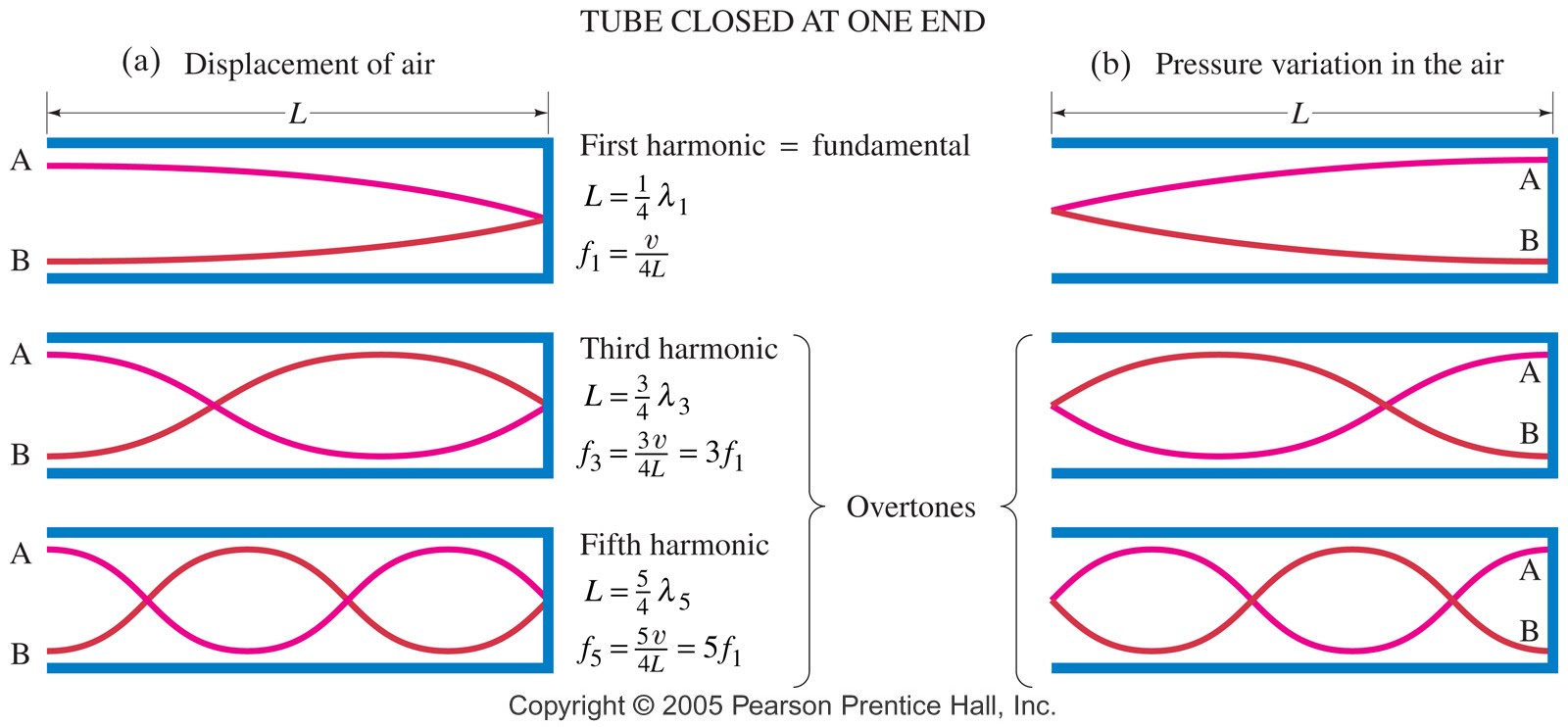
Image courtesy of Dan Russell, licensed under a Creative Commons Attribution-NonCommercial-NoDerivatives 4.0 International License.
For now, the equation that’s useful here is
f=v4Lf = \frac{v}{4L}
Where ff is the frequency, vv is the speed of sound, and LL is the length of the air column (the length of the slide).
Since pitch is frequency, and frequency is inversely proportional to the length of slide, extending the slide decreases the frequency, and thus lowers the pitch. Simple, right?
Those notes need to be accessed with different “partials” achieved by changing your embouchure (lip and mouth technique).
Look at what the other diagrams are showing. When you play a note on a trombone (or any instrument actually), you’re not just playing the fundamental frequency (which is the main pitch you hear), but also a series of higher frequencies called overtones or harmonics. These overtones contribute to the unique timbre of the instrument and are why every instrument sounds different, even if they’re playing the exact same note.
Since the vibration of our lips is what creates the standing wave inside the trombone, changing the speed of our lips (e.g. by making it tighter) will “change the fundamental frequency” of the standing wave: if the frequency of our lips resonates (i.e. matches frequency) with one of the overtones, it amplifies it, making it sound like the “new fundamental frequency.” Yes: that means the higher we go, there will be “less” (or at least audible) overtones in the sound, making the tone sound more pure and closer to a pure sine wave.
By the way, when I say changing the speed of our lips is what selects the partial, while it’s technically true, it’s not a good way to teach technique.
Just like how playing the piano isn’t just moving a finger up and down (even technically that’s all what’s happening) but instead involving the whole arm, to effectively control your trombone playing, you need to involve your tongue as well.
In fact, even if your lips are the main source of sound, your tongue actually does a lot of work in helping your lips with managing the air speed. Overstressing the lips is one of the most common mistakes beginners make when trying to reach the high partials. We call the overall technique of how you control your face to play into a wind instrument embouchure, and good embouchure is important for good sound.
Speaking of good sound, let’s talk about
Being a “continous pitch” instrument is both a blessing and a curse: while you technically have the capability to always be in tune, it also means there’s more responsibility on you with regards to tuning.
Whereas you can just press a key on a piano to make a sound, you have to physically adjust the pitch of the trombone to match the desired frequency. This includes adjusting the length of the slide, the tension of the lips, and even where your lips are positioned on the mouthpiece! Everything changes the sound slightly.
But, how can a trombone ever be better than the piano when there’s so many variables? Well, unlike a piano, where each key produces a fixed pitch, a trombone lets me subtly adjust every note as I play.
Here’s a little detour into musical instrument tuning systems. Let’s say I play a note at 440 Hz (this would be the standard A above middle C). Let’s say I were to play another note at 450 Hz. What would happen?

The two notes would sound slightly out of tune, creating a beat frequency of 10 Hz. This is because the frequencies are not exact multiples of each other. Since the human ear can detect small differences in pitch, these slight discrepancies can be perceived as dissonance or even unpleasantness. Nice-looking frequency ratios like 1:1 (octave), 3:2 (perfect fifth), 4:3 (perfect fourth), etc, sound “good” to our ears, because they’re the most resonant. This is called just intonation. In just intonation, we base the tuning of notes on each other using these nice ratios. Of course, that definition varies wildly depending on what note you are referencing and what intervals you use, and it could lead to really, really ugly intervals known as wolf intervals.
So, the modern piano isn’t tuned this way. That’s because we want be able to use the piano to play in all 12 keys. Everything should sound relatively good. Thus, the piano is tuned to a system that equally divides an octave into 12 equal parts, known as equal temperament. This system ensures that every key and every note sounds equally good, but it sacrifices the purity of just intonation.
But any instrument that’s not the piano or guitar can actually make micro-adjustments while playing a song. This means that we can actually have the nice-sounding just intonation without the hassle. For most wind instruments, this involves embouchure adjustments. For string instruments, this involves slight adjustments to the finger placement.
For trombonists, while you can also make embouchure micro adjustments, you can also just simply move the slide up or down.
In practice, I never actually think about “oh I have to tune this note around 13 cents flat than how I would normally play it because it functions as the third of this chord.” Instead, I am instead always listening to the rest of the band and I try to fit in my note before I play it. It’s not that deep: use your ears to determine if it sounds good or not.
While there’s a lot more aspects of the trombone (and brass instruments in general) I could talk about (such as the triggers or how to achieve good tone), this is the core of what I’ve learned about playing the trombone.
This blog post is hosted on GitHub. If you want a part 2 covering the other aspects, let me know!