Now some will bill Taiwan and Korea the same way they bill consumers when they need RAM, should they need us.
Chinese companies were at least producing more and more to brace for restrictions from western manufacturers
A 2x32GB DDR5 kit I paid $150 for 11 months ago costs $910 today from the same retailer. A 2x16GB DRR4 kit that was $105 last year is now $230.
The RAM alone in my newest machine would sell for over double what I paid for the entire machine one year ago.
Been solid so far for 6-ish months.
https://www.amazon.com/Crucial-6000MHz-Overclocking-Desktop-...
Is supply actively constrained, or is this mostly in anticipation of future shortages? How much of this is a mix of panic buying and price gouging on bad news?
I care more about the secondhand market. Prices are nuts for old used gear, but that also tracks with patterns I've been seeing since roughly the pandemic where more and more secondhand sellers on the usual platforms setting pricing patterns are small businesses, not hobbyists.
- Altman, a.k.a. Dory from Finding Nemo and/or Dario, a.k.a. Carl from Jimmy Neutron.
Spec-ing and buying servers has become quite the pain in the past year, at least at the relatively-small scale we operate at. It's "dynamic pricing" with most quotes being valid for 24 hours :(
Right now the biggest threat to their IPO's is that people realize that local models are good enough for whatever they're peddling, what's the most important factor to even running good enough models? RAM since you want the models in memory to not be total slogs.
Steam Deck had a huge price increase (~40-50%) but it still sold out in 24 hours.
All it would take is for everyone not to pull the trigger on buying things for a little bit and prices would fall but instead enough people are buying things at a crazy markup. If anything that's a signal to sell things at higher prices. Of course AI is amplifying this problem but realistically people are still buying consumer hardware at these prices which lets businesses know people will pay this price.
I'm on a machine built from parts in 2014 and it's all very good for me to do every day development so I'm not posting this from a machine I won't have to touch for another 10 years.
I am annoyed that the new handhelds are all crazy so sticking with my Legion Go for now.
The one I am annoyed with is storage. I desperately need to get a couple new drives for my NAS (one to replace one that its bad sectors are growing and one to add more storage) and I am not looking forward to spending $600-$700 each for 20TB drives.
If you're building your own PC, your best bet is to buy a bundle. If you happen to be lucky enough to live near a Micro Center (they don't deliver), then you have good options [2]. Newegg does too.
Prebuilts get a bad rep and it's not really justified. That Walmart PC is ABS. That's Newegg, basically. I'm sorry but you just can't buy that parts list for $!900. The idea that there is a $1000 premium for a prebuilt is just not true. Alos, I hear people say "it only takes an hour to build a PC". No, it doesn't. Maybe if you've built 20 PCs it does but if you don't do it regularly, it's a massive pain. Years ago I used to do this. I'm too old and the novelty has worn off. I don't want to diagnose if I've gotten my motherboard headers right or why my fans aren't spinning up or why my PC isn't POSTing or even just getting the cabling right, etc etc etc.
But yes, if you're just buying RAM by itself the situation is horrific. If you can live with a 32GB gaming PC, there are options that are relatively comparable to what you could get a year ago. If you want 64GB+ of RAM, that's going to bite.
[1]: https://www.walmart.com/ip/ABS-Eurus-Ruby-Gaming-PC-Windows-...
[2]: https://www.microcenter.com/site/content/bundle-and-save.asp...
There certainly is lots and lots of potential.
Well... I guess William Gibson laughs last, after all!
I bought it for 82 EUR, before the whole ongoing situation.
Now the same spec costs upwards of 290 EUR, about 3.5x the original price and even on Amazon the best prices I can find are upwards of like 210 EUR (2.5x).
That said, getting hold of them was hard and needed a special order.
https://www.amazon.com/dp/B0BJ7X9P1W
Consumers need to start playing legal warfare against the companies for openly distorting the market. The ramifications will only hurt us and there needs to be a true comeuppance.
Both. AI datacenters create immense demand on DRAM, NAND storage, even HDD storage.
Then Sam Altman went ahead and "bought" 40% of the world's DRAM production, by way of secretly approaching both Samsung and SK Hynix (each unaware of the other getting a similar deal), which sent the entire market into a panic and everyone rushed to buy ahead of the anticipated supply shortage.
The kicker is that it wasn't even a proper purchase agreement. Just a non-binding promise of "By 2030 I will have infinite dollars and buy your DRAM".
I wanted to upgrade my SSD but prices are more than at the end of 2025. I refuse to pay 500 euro for a 4TB SSD. I rather go outside and play with my bike like when I was 5.
And if you're wondering, who's throwing out DDR5 systems? A local healthcare company. The boxes for some units are crushed and have water stains on them, and I imagine others don't meet their exacting requirements in some minor way (though they look and work OK to me, regardless of scratches and dings on the case).
Looking at it from that frame, it seems reasonable.
Same thing with GPUs, is kind of insane having so much processing power and yet requiring more and more. What purpose for? What's the limit? Does it really really pay off such investments?
For me as a non-AI developer (I don't use any models of any kind, nor I train LLMs at all), a system with 16Gb seems to be more than enough for a vast number of applications.
I have no idea why a weather forecast site needs tens of megabytes of resources, and gig+ of ram for my browser, since i get no more info from it, than i did back then. Same for chat programs (how is discord different than irc? and why does it need so much ram to do so? same for slack), mail clients, etc.
Maybe it's time to kick developers to start optimizing stuff a bit, since neither they nor the users can't afford "unlimited" ram anymore.
edit: i'm not saying we need to get back to literally 32 megs of ram, just to make developers performance test their stuff on a laptop that was on sale 3 years ago in their local supermarket, i.e. stuff their users use at home.
[1] https://tweakers.net/pricewatch/1419292/corsair-vengeance-lp...
It is hard to overstate the damage that the infinite money being poured into AI is doing to the wider economy. Anything involved in datacenters is going to experience shortages/price rises. A pre-existing problem is power transformers: https://www.reuters.com/business/energy/us-power-transformer...
The impact on domestic electricity prices in a year just after high oil prices is not going to be popular either.
Anyway, I just can't find a reason to build an AM4 PC even though the RAM is "free". It's just not worth it. If you need 64GB+ of RAM and the DDR4 vs DDR5 difference isn't significant to you then maybe it's worth it. Otherwise, you can still buy a 32GB DDR5 PC for similar prices to last year sometimes. It's not worth buying any AM4 CPU then the 7500X3D/7600X3D/7800X3D are so much better for the same price.
The 5800X3D re-release is kinda funny. AMD claims they had to do significant re-engineering but it is my understanding they stopped selling it in the US but were still selling it overseas. So did production really stop? Anyway, the price seems to be $349. If so, that's completely not worth it. It's the same price as the 7800X#D, which is significantly better.
As an example, here's a 7800X3D + motherboard + 32GB DDR5 bundle you can buy today for $629 if you happen to live near a Micro Center [1]. No AM4 option is going to compete with that, particularly not with a $349 CPU.
[1]: https://www.microcenter.com/product/5007391/amd-ryzen-7-7800...
I thought 128MB of SDRAM was a good deal at $100.
I also thought $479 for 32GB of DDR4 was nuts back in 2016/2017.
When I bought the same ECC DDR4 16gb ram stick in 2016 (when DDR4 was rather new) it cost $85 (cant remember if it was new or used)
That's about 50% higher than you'd pay for retail, small quantity, off the shelf alternatives in the US.
Many vendors have limited allocation so they're sending out extremely high quotes to see who will take it. They know everyone is seeing news about high RAM prices and getting new vendors approved can be hard, so they raise prices and see who takes it.
I would recommend getting quotes from multiple vendors. Don't be afraid to push back. They might come back immediately with a lower price in this market. Also check the retail suppliers you can access in your country.
> Quotes came back to about €200k for 48 x 96GB DDR5-5600 RDIMMs.
That's around EUR 40 per GB? That seems quite high compared to what consumer DDR5 RAM is selling for, though it being RDIMM may account for some of the difference.
I sell used RAM in trays of 50 sticks (I physically know how much that is, I've held that many). I've had some trays sell for a few thousand dollars. Six figures for just one tray is absurd, but I've never collected enough DDR5 to make a full tray.
The only hope here is China floods the market which would be a good or bad thing however you look at it.
Right now the biggest threat to their IPO's is that people realize that local models are good enough for whatever they're peddling...
...plus the recent price increases by AI companies, made me actually think the opposite: that there might be another additional "run" for memory and/or GPUs.
Therefore, yesterday I decided to order an additional RTX 5060 with 16 GiB VRAM for the ~500$ that I saved during the last months (to be added to the RTX 5070 12 GiB that I bought last year to play games in 4k + my old RTX 3060 12 GiB which I recycled a few months ago after noticing how nice it is to run llama.cpp locally without having to worry about subscription costs).
The original 24 GiB VRAM were actually quite enough for some of the stuff that I do (e.g. transcribe text of image scans of old magazines, coding with Aider, etc - I usually use Q5_K_M quantizations of Qwen & Gemma by Bartowski as lower ones delivered sometimes weird results and/or looped forever in "thinking"-mode), but I guess that with 40 GiB I should be bullet-proof for my pessimistic view of our future :o)
I pulled the trigger on an early Ayn Thor because it was obvious this was going to happen. Something I didn't really want to fit into my budget but knew that if I didn't I would regret it later.
I had it all priced out, but a bunch of birthdays in my family were coming up and I felt like I shouldn't buy something for myself if it's really their time.
My old laptop will have to cut it for a while. :-)
Some people need to buy at these inflated prices anyway, and are ultimately willing to spend. Maybe it differs in your area but there's no risk in listing these on Facebook Marketplace or similar platforms and see the interest.
Would be nice to be able to own property.
The 5700X3D has been the smarter pick back then, it fits to the current latent user hostility of AMD to focus on the more expensive processor.
I get what you're saying but medium term this is an extremely funny sentiment. This money being poured is likely to end up being a huge boon for a lot of economic sectors, including in the US. Most commodity shortages like this end in a glut, with a medium term win for consumers, even if we have 1-2 (more) years of pricing pain. Meanwhile expensive RAM has so far left stock for people that really need it. Calling this kind of demand economic damage is odd.
I know it's an unpopular opinion on Hacker News but I think most people are overstating the damage to the economy. Increased demand starts to pull more advancements forward and increase spending on production, which benefits everyone.
Transformer demand is real, but what percentage of your electricity bill do you think goes to spending on those transformers? The number is so small that it's a rounding error. Many examples like this where we see headlines about some part going up in price and forget that it's such a negligible piece of our bill that it barely matters.
The cost of fuel inputs for base generation and peak supply are a bigger factor.
Quotes are 7 days max, lead times fluctuating out months, and often now have language they can choose to not honor the quote for any reason due to price fluctuations.
Surely it is a more efficient use of DRAM to run inference on shared hardware with large batch sizes and more utilization.
they are not. Unless you are satisfied with plausible, but mostly garbage output.
Implicitly, but that's blaming the consumer who has no or few equivalent choices. Purchasing RAM is not like choosing between Coke and Pepsi. A better analogy is that when a hurricane is coming or a natural disaster has already hit, it doesn't help that people will purchase food and fuel at any price.
I think people who need more than 16GB of RAM are power users with higher memory requirements, such as those using local LLMs, those who frequently use virtualization, and people doing tasks such as video editing.
I have a 48GB development machine which is nice if you are running IDEs, backend stuff via docker, etc. And even just having a bunch of RAM there for file caching helps keep things fast.
This is similar situation to housing market. Prices are going up and supply is being restricted by whatever means.
It will be a bit of Catch 22.
It will happen, but yeah it takes time and money
Sentiment is the right word here. None of us really know, and go by feeling. If you perceive the AI boom as approaching tulip craze levels of irrationality, it feels pretty dire.
The RAM is a commodity and may be repurposed afterward. This kind of thing is a bit like a debt jubilee when the dust clears and survivors scavenge the dead. But a lot of other build-out may essentially be waste. To me, apologists for this boom seem to be harboring a variant of the broken windows fallacy. Not all economic activity is productive.
The other kind of damage is opportunity cost. How many players in other industries are being strategically harmed by this situation? We can't all just live on AI token output if these other industries retract too far.
Smaller businesses in particular - not so long past the COVID disruption and already facing significant challenges in areas like logistics and energy supply costs - will not necessarily have the reserves that older and larger businesses often do to withstand another multi-year price shock.
No such thing as a free lunch. Whilst a lot of industries are doing extremely well right now (i.e. everything involved in datacenter construction), everyone else has to actually pay for it.
Therein also lies the damage; The economy wasn't doing so great to begin with, and now this massive multi-trillion-dollar expense has been added.
The direct expenses come out of the pockets of Big Tech, but all the indirect stuff like the DRAM crisis affect the wider economy directly.
There's smaller businesses that I know _need_ data capacity (hard drives) that can't afford them and are facing serious CAPEX challenges.
I work for a start up that helps folks move off of existing on-prem virtualization solutions and every small to medium company across every sector you can think of aren't just able to not afford additional storage and memory, they can't find them either.
There isn't as much stock as you think. I can't wait for this AI bubble to pop. It's been absolutely terrible for 90% of the industry.
There are two issues... one being that an economy needs people to buy things to work, and people only can buy things if they have money, and people only have money when they have work - but everyone is laying off people left and right due to "AI".
The other issue is that there's trillions of dollars floating around between all the companies. It is likely that a significant chunk of these will fail and give us another 2007.
The evidence coming out is saying otherwise.
When it comes to server RAM, I got quoted double a previous quote within the span of a week.
Buying servers is basically quote roulette now.
Let's say you're an alchemist living in ancient China. You discover some kind of strange material made out of melted sand and want to sell some of it as a drinking vessel. One problem: everyone already uses porcelain for that purpose, which holds hot drinks without cracking like your strange sand ones do. So you toss that in the trash and move onto the next attempt at making an elixir of life.
Problem is, what you invented was a kind of glass; which has no economic niche in the society you live in. Some funny other places in the far west might invent it, though - hell, they might even figure out that you can grind this material down into lenses and discover an entire field of magic - optics - that you discarded because nobody needed tea cups that crack when you put tea in them.
Now, let's say you live in a society that has access to some kind of artificial intelligence. You are going to chuck the AI at absolutely everything, because on average, it tends to be better at all the problems you throw at it. Even simple things like spell-checkers get turned into AI invocations because, well, the Bitter Lesson dictates that having enough compute and learning to throw at the problem will always yield a better result than hard-coded nonsense logic that demos well. And even if you want to, well, you couldn't afford the RAM to run modern vibe-coded slop software anyway. Porcelain crowds out investment in glass, and as a result, we are limited to only having technologies that can be made by or from a pile of stolen books tied together with a bunch of matrix multiplies.
i5-13500E, 32GB DDR5, 512 GB NVMe, scratched and dinged a bit for $500 is practically a steal! Hardly anyone's biting or clicking, I don't get it...
New open box models (not scratched and dinged), if anyone's interested: https://www.ebay.com/itm/188355326179
Edit: they're intended to be retail POS PCs, like cash registers. (The motherboard literally has a header for a cash drawer!) So unless you're a particular kind of retailer, you're not asking your distributor for them. If distributors aren't looking for them, our B2B buyers aren't buying them. If they were Elite/Prodesks, Optiplexes, or Thinkcenters, they'd probably be gone by now.
For non-coding work, they are more than good enough. A lot of the ways my non-technical family members have interacted with AI would be perfectly served by using a local model.
After all, people were more than satisfied with the results from GPT 3. That has long since been surpassed by open weight models.
The 3 RAM manufactures know this too, from painful experience. There won't be a glut this cycle because there are no capacity build-outs. Instead of increasing capacity, some OEMs left the consumer segment to focus on enterprise AI.
> Calling this kind of demand economic damage is odd.
It's not odd at all because the complementary industries are being damaged - possibly permanently: manufacturers of motherboard, cases, fans, and the entire consumer PC supply chain are being negatively impacted. Expect bankruptcies and consolidation if this lasts for 2 more years.
Because what to do with power-consuming outdated hardware ? let's say 5 years from now ?
They will need new RAM.
I wonder.
It's gotten to the point where nvidia doesn't even bother to report their gaming revenue anymore. It's a clear sign that we're back to the bad old days of pc gaming being a 'prosumer' hobby, but don't worry I'm sure nvidia and their ilk are salivating at the idea of making pc gaming into a streaming stadia like solution that you pay for monthly

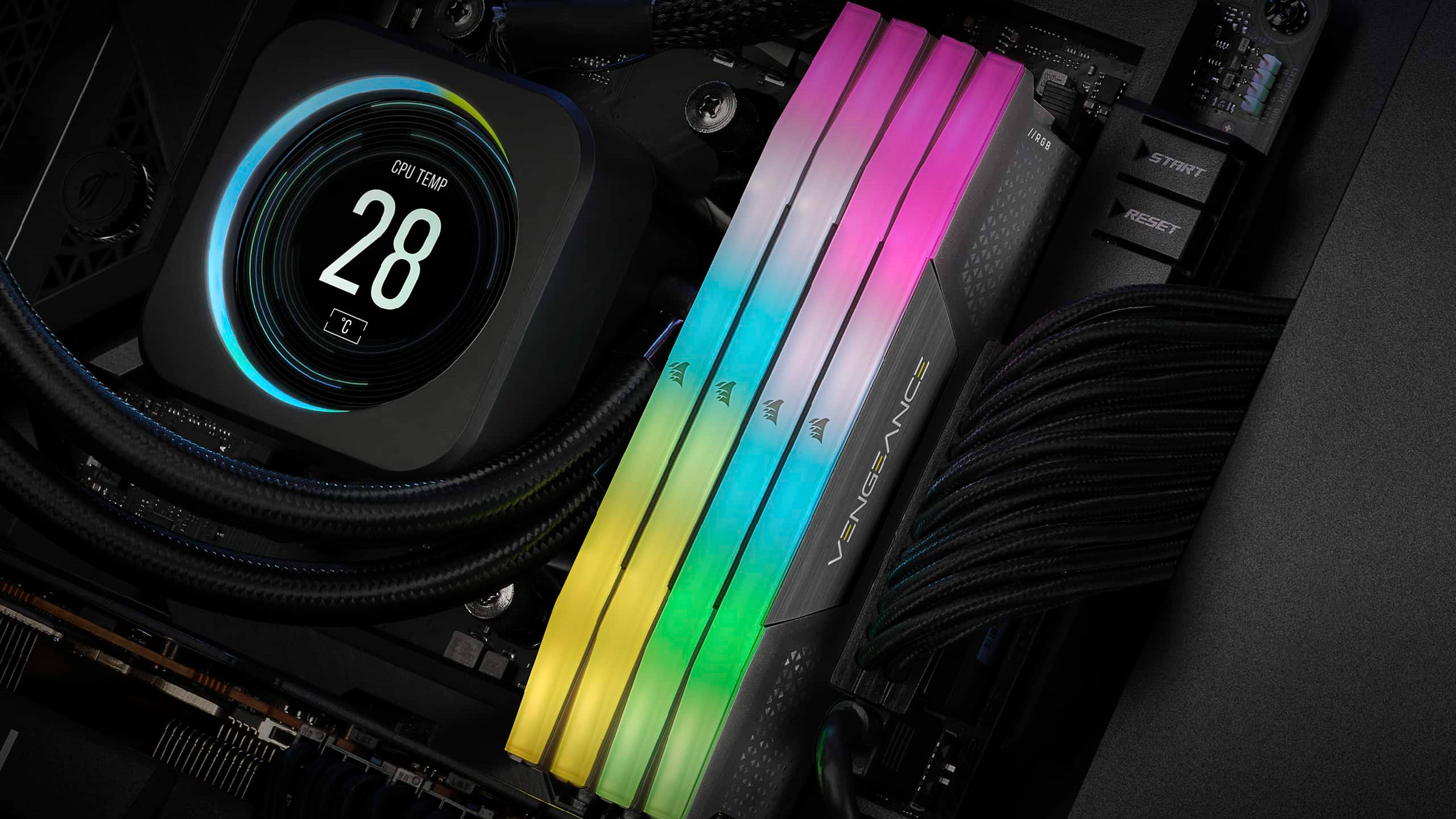
(Image credit: Corsair)
As the demands of AI continue to consume manufacturing capacity at every level of the PC hardware supply chain, 32GB of DDR5 RAM — broadly understood to be the sweet spot for gaming PCs and enthusiast builds — can no longer be found for less than $375. Well, $374.97 to be precise.
RAM price tracking through 2026 will show you that kits that routinely cost less than $100 just a year ago are now fetching upwards of $240 (16GB). As the AI frenzy has taken hold, retailers far and wide have been pumping up their RAM prices to exorbitant levels. However, there's so much fluctuation and noise that average pricing is now something of a ludicrous fugazi. The going rate for 32GB of DDR5 RAM — the cheapest you can expect to pay — has hovered around $320 for some time, climbing past $350 in recent weeks. Price tracking courtesy of PCPartPicker now reveals the cheapest 32GB DDR5 RAM you can buy is $375. Specifically, four XPOWER kits from Silicon Power will set you back $374.97 thanks to a promo code. You can see the listings yourself below.
As you can imagine, this is enormous pricing pressure for enthusiasts trying to build gaming PCs or upgrade their rigs in 2026. A component that once cost less than $100 and was something of an afterthought now costs almost four times as much, and that's before you've even fired a neuron in consideration of aesthetics, timings, or brand. More popular kits from the likes of Corsair and Crucial, or RGB offerings to match the rest of your build, will easily set you back more than $400.
Of course, 32GB is really the minimum sweet spot you should be aiming for when building a PC in 2026. If you did want more capacity, 64GB will set you back an astonishing $679.99. 16GB of RAM as a compromise can be found for $200 at B&H Photo, but with SK hynix warning that manufacturing constraints will persist through 2030, there's no sign of prices letting up so that you can upgrade capacity any time soon.
The humble RAM combo deals we've been highlighting in recent months are a small source of solace for builders, letting you score RAM for less than the $375 going rate if you pair it with a decent motherboard, a processor, or even an entire set of PC components. A theme of ongoing Computex 2026 announcements remains a lack of pricing clarity on lots of PC hardware, including Nvidia's RTX Spark laptops and PCs, as well as new-build systems and, of course, RAM components themselves. Vendors are likely wary of scaring off potential buyers with higher-than-expected prices ahead of release. Perhaps more likely, the prices haven't been set because they're still going up. Storage isn't much better, with SSD price tracking revealing that drives which once cost as little as $38 are now fetching $200.
AMD is making a noticeable effort to keep PC gaming prices down, this week announcing the return of its Ryzen 7 5800X3D, and the advent of a new Ryzen 7 7700X3D. Intel, which warned this week that "something has to give" when it comes to memory prices, also teased dragging out some of its legacy products to give users more options on older memory technologies, namely Raptor Lake and DDR4.
Get Tom's Hardware's best news and in-depth reviews, straight to your inbox.
Stephen is Tom's Hardware's News Editor with almost a decade of industry experience covering technology, having worked at TechRadar, iMore, and even Apple over the years. He has covered the world of consumer tech from nearly every angle, including supply chain rumors, patents, and litigation, and more. When he's not at work, he loves reading about history and playing video games.
I'd say local models are fairly capable of even somewhat complex coding execution. For complex non-coding work (research, in-depth analysis, assembly of complex info-dense documents) I'd rather do it by hand than switch from Opus 4.7 to anything I could even theoretically run locally.
Very lucky me!
I’d even get a house with a garage or something just for that.
Demand will only go down if people reduce their use of these AI tools. Given how much folks here complain about quotas, I'm very skeptical that will happen willingly.
Ten years from now I'll get to watch inception in 4K.
I think I paid a total of around $5,500 for the current components of my PC. Hard to say for sure since my PC has been a Ship of Theseus for over 30 years and started as a 486. The link merely reflects its current state.
At one point, PCPartPicker was showing my PC as worth $11,000. It's now at $7,200 without including the RAM or PSU. That would put it at $9,000.
> It's a clear sign that we're back to the bad old days of pc gaming being a 'prosumer' hobby
Yup.
I think it's especially bad since the gap between budget-grade and mid-grade feels like it's gotten wide. If you wanna play the latest AAA games and not feel like you need to upgrade in 3 years, you can't settle for the budget grade unless you're still gaming at 1080p.
I wouldn't recommend spending under $3,000 for a gaming PC these days, and that's just an absurd price.
When I was trying to upgrade to Windows 11 from Windows 10 I got the same warning. It is the reason why I'm now happily running Xubuntu on the same machine.
I did end up installing a Windows 11 VM (VirtualBox) which works perfectly fine running as a guest under Xubuntu on a 4790k (screw you Microsoft). But I otherwise never want go back to Windows as a daily driver. The enshittification just got too much for me.
You can get a $200 to $300 microcenter cpu+motherboard+16GB DDR5 bundle [1], then $300-$400 GPU, and you'll be able to play nearly every game on the market just fine at 1080p.
I'm sure there are pre-builts using stockpiled RAM that are similar $1000 price range.
And if you buy used you can do even better. $300-400 might get you a 5060 or a 9060XT right now [2][3] but if you go used you can get something like a 3080 instead.
I play games at 1080p with a 1660 Ti and, outside of some newer UE5 games that heavily rely on frame gen for performance (Monster Hunter Wilds performance was too poor to play), everything I've thrown at it has been playable or 100+ FPS.
[1] https://www.microcenter.com/site/content/bundle-and-save.asp...
[2] https://pcpartpicker.com/products/video-card/#c=594,593&sort...
[3] https://pcpartpicker.com/products/video-card/#c=596&sort=pri...
Using red tape as some kind of prophylactic is ridiculous. If the state doesn't have the monitoring in place, you have to just trust the company, which is naive if not negligent. If you do have the monitoring, why require the extremely expensive song & dance? To protect corporations from negligently wasting money?
Answer: because the song & dance is primarily about extracting concessions, like union labor or even cash (e.g. promises to pay to fix someone else's pollution, or contributions to various interest groups). The friction and expense involved in today's development review processes are many times more costly to all involved than the social benefit.
In a constrained market, supply and demand favors folks who can most efficiently extract rent. Local models only make sense in a world with abundant compute and energy.
That's hopelessly naïve.
If you let them build the facility that can pollute, they're going to pollute.
And if you point to the pollution coming out and tell them "you have to stop," they're going to say "make us."
And if you point to the pollution already in the environment and tell them "you have to clean that up, because you put it there," they're going to say "prove it."
And they're going to tie the government up in court for years or decades, and then oh, whoops, somehow the entity that actually did all the polluting has no more money and can't do anything about it :-( Good thing they were only a subsidiary that all the profit and assets can be moved out of!
And the people who actually live there are suffering from preventable diseases and dying of cancer at rates 5x the national average.
How do I know all this? Because this has been industry's playbook for over a century.
Punishing instead of supporting.
But even so, how does the song & dance prevent any of that? It's not like, e.g., a battery manufacturer submits a plan admitting that they're gonna dump stuff.
It raises the stakes, Obviously they can still cheat but now it's a matter of criminal negligence not civil law.
The maxim, "a nation of laws, not of men", is applicable here. If you don't have fixed goal posts or rules, governance becomes chaotic, not to mention unjust, inefficient, and ultimately corrupt (so many people like Trump because he promises to substitute his own judgement in place of democratic processes).
It would be nice if we could comprehensively hypothesis and address every possible manner in which things could wrong, but we can't. Most of the time you need to rely on broad rules, at least as a catchall, like don't harm someone or don't pollute, and ensure fast, consistent, and efficient accountability when injuries occur. The current state of development approval has become grossly degenerate in many places. In others it could definitely use some firming up. But let's not pretend that a project in California would get away with most of the stuff they can in Louisiana just because we reformed the review process. For one thing, California is much better about enforcing existing hazard codes at both the planning approval and operational stages.