> Post-quantum authentication is no longer a problem the Web PKI ecosystem should defer. Long-lived keys (root certificate authorities, code-signing keys, identity systems) are particularly valuable targets, and new technology takes years to gain broad adoption, so the work has to start early.
This is a problem that I have met so many times talking with people: they parrot the "Harvest-Now-Decrypt-Later is the only urgent problem, signatures can wait" mantra, and this piece of misinformation has spread so much that even AI repeats it (because it has been trained on open data, where the overwhelming sentiment has been following this trend), thereby reinforcing the problem. Ask Claude/ChatGPT/Gemini about the problem, and they will invariably tell you that signatures are less urgent because theyr are not subjective to retroactive compromise.
There are two problems here.
The first one is included by the Letsencrypt announcement: the migration path for signatures/certificates is typically longer and more complex than encryption: long-lived certificates, firmware update keys, secure boot certificates, these are all objects that are painful to migrate.
The second one, even more serious in my opinion, is: "retroactive" in respect to what? "Retroactive" presupposes you can observe the trigger (the arrival of a cryptanalytically-relevant quantum computer), but this is precisely the kind of capability an adversary keeps secret, and a quantum forgery is operationally indistinguishable from, e.g., key exfiltration, a library bug, or a classical break. You may see a forged signature, a drained wallet, a failing certificate, and have no way to attribute it to quantum cryptanalysis. The threat is dark: reactive migration against an unobservable trigger is structurally impossible.
This is not to say that Harvest-Now-Decrypt-Later is a less urgent threat, but it's not so asymmetric as people have been believing so far. Glad to see things are changing!
I am obviously not in the field, but as far as I know, no QC is close of working for a practical purpose(aside quantum research), but to make it practical, it needs a groundbraking brakethrough of some sort. But if a brakethrough happens, can we really estimate the consequences?
These upsides seem extremely promising, but I'm curious to know if there are any notable downsides as well.
Still better than the alternatives that would saddle us with worse performance for ~ever.
In Vernor Vinge's novel "A Fire Upon the Deep" one of the most valuable commodities were one time pads that are physically transported to communication nodes to enable unbreakable communication. The pads are split into three pieces that are XORed to create the actual pad to reduce risk of compromise.
> This is a problem that I have met so many times talking with people: they parrot the "Harvest-Now-Decrypt-Later is the only urgent problem, signatures can wait" mantra, and this piece of misinformation has spread so much that even AI repeats it (because it has been trained on open data, where the overwhelming sentiment has been following this trend), thereby reinforcing the problem. Ask Claude/ChatGPT/Gemini about the problem, and they will invariably tell you that signatures are less urgent because theyr are not subjective to retroactive compromise.
I can't speak to public sentiment, but the stance I've held for years was roughly:
HNDL is more urgent because people are already encrypting messages today that could be decrypted in the future if a quantum computer is ever built in the foreseeable future, and that harms their privacy for the entirety of human history until PQC is rolled out.
That's not the same as "authentication doesn't matter at all". It was, if you must pick a problem to solve today, this one will stop the bleeding sooner.
But they were always both important to solve. The question was whether we could delay PQ auth until better signature algorithms were deployed. The Google/Cloudflare 2029 decision signaled to the rest of us: "No, we need to start the migration now."
(Of course, basically all encryption, especially asymmetric encryption, is predicated on there not being some as-yet-undiscovered exploitable structure to the mathematics on which it is built. Modern cryptography, AFAIK, tends to have some decent arguments for why this is not expected to be the case, but it's never completely proven top-to-bottom outside of fairly niche/trivial cases. It's always in principle possible that someone discovers an attack on these new algorithms, classical or quantum)
However, just like for RSA we know that the problem of efficient integer factoring has been worked on for a long time with no progress, the same is true for quantum computing. We have been trying to figure out quantum algorithms for a great number of problems that are hard for classical computers for a long time now, and we haven't been able to, except for the ones that we have. Mathematicians have also developed certain intuitions for which problems have characteristics that make them potentially easier to solve on a QC and which don't.
In general, just like with P=NP?, we haven't proven yet if BQP, roughly the class of problems which have efficient QC versions, is equal or not to P, the class of problems that can be efficiently solved on a classical computer; and we also don't know if BQP=NP.
So yes, there is at least a theoretical possibility that the problems used for creating post-quantum encryption will turn out to be in BQP, will turn out to have an efficient quantum algorithm that solves them. But that would come from mathematical research, it is entirely unrelated to creating and tinkering with actual quantum computers. The math of quantum algorithms is currently far ahead of the engineering and physics on building the actual computers.
I think there is a sense in which we have a historical accident that has make quantum computers sound bigger than they are, in that we ended up with "factoring prime numbers" being the first thing we had to make practical encryption out of, and by what is from a human perspective mostly a coincidence, it so happens that quantum computers may be really good at that. But the problem is that quantum computers happen to be good at factorizing that is the problem, not that quantum computers are somehow "good at breaking encryption". It seams to me that in some sense "post-quantum computing" is actually "all practical encryption schemes except those based on factoring large numbers". Breaking large prime number-based schemes is the exception that QC happens to be good at, not the rule.
I did read the books 20 years ago and forgot this aspect of the story
And even if there was only a 10% chance of QC breaking crypto, the community is not comfortable with a 10% chance of such a catastrophic scenario.
This is part of my day job, so here's another interesting fact: for migrating encryption use cases, you have to consider that attackers can capture your encrypted data today to break in the future. So, as a rule of thumb, your migration timeline is much shorter for encryption than for signatures.
OTP is in theory the correct choice if you don't have working symmetric cryptography but in fact the "Quantum computer" approach barely dents our symmetric cryptography.
I've written about this before, DES was standardized in 1977, almost 50 years ago and you might think "Well but DES is broken". Yes, DES broke exactly the way it was designed to. Literally nothing went wrong, when it was standardized we knew the keys are too small (yup, you can break it by trying all the keys) and the blocks are too small (yup, you can "just" make duplicate blocks) and it was broken by leaning on these weaknesses with huge fast modern computers.
AES is an entirely different cryptosystem, but the two most important choices were that the keys are big enough (128-bit or 256-bit commonly) and the blocks are too (128 bits). And those may seem like a small upgrade, only 2-4x as big, who cares? Well those are bit lengths so that's an exponential increase, and your quantum computer barely helps (assuming it magically is the same price rather than incredibly expensive). It is not physically practical for the necessary computation to be done, AES is broken only if there's some mathematical backdoor we didn't know about.
"We'll crack AES with a quantum computer" is a Hollywood movie plot, it's not a thing that makes any actual sense.
[Edited: I wrote "Bruce Sterling" but I meant "William Gibson", I apologise to both people for muddling them, though not for my opinion]
The way a quantum mechanics PhD explained it to me years ago in layman's terms is similar to nuclear science. We "knew" that a nuclear explosion was possible before a bomb was created and what conditions it would work. The Nagasaki bomb was a completely different type of bomb than the trinity test and Hirosima, plutonium instead of uranium, and it was never even tested before it's first use!
The issue instead is for signatures. We don’t have a fine hybrid signature. Concretely, our current hybrid signatures achieve security in a weaker model (they do not achieve BUFF security) than what our PQ signatures achieve.
So the question is if we want explicitly weaker security to provide assurance against possible security issues in the PQ hardness assumption. Or we could delay standardization longer while people search for better ways of making hybrid signatures. Both seem stupid, especially as obtaining cryptographically relevant quantum computers recently seems less like “if” than “when”. Note that when cryptographically relevant quantum computers appear, we will NEED to have a PQ secure component. The main “pro hybrid” cryptographer (Bernstein) has himself predicted classical (public key) cryptography will likely be broken by 2032. Things must transition now.
No. Don't do that.
If you encrypt your data twice, and one of them is broken by a quantum computer, the adversary gets the plaintext anyway.
You want a Hybrid KEM, not encrypting twice. The nuance matters.
There were 5 levels being considered for each submission.
Level 1 - at least as difficult to attack as AES-128 (block cipher)
Level 2 - at least as difficult to attack as SHA-256 (hash function)
Level 3 - at least as difficult to attack as AES-192 (block cipher)
Level 4 - at least as difficult to attack as SHA-384 (hash function)
Level 5 - at least as difficult to attack as AES-256 (block cipher)
The security of attacking an N-bit block cipher is morally congruent to a birthday collision against a {2N}-bit hash function. With some caveats: https://soatok.blog/2024/07/01/blowing-out-the-candles-on-th...
ML-DSA-44 (smallest parameter set) targets Level 2 for signatures.
ML-KEM-768 targets Level 3 for KEMs.
Some well-known other problems are also HSP instances over non-abelian groups, for example
1. the learning with errors assumption (the main PQ thing people like) is a HSP instance over the dihedral group, and
2. graph-isomorphism is a HSP instance over the symmetric group.
LWE appears to be quite hard classically (SOTA attacks are 2^{~0.3n} time and exponential memory). Graph isomorphism is a famously easy problem outside of P, namely it is in quasi-polynomial time. So the fact that both are not in BQP doesn't say much about their relative classical difficulty.
I think it's very funny to consider that if you were a time traveler tasked with making sure that humanity had the economic incentive to develop quantum computers, the most efficient way to ensure that in a single stroke would be by suggesting the use of prime factorization as a trapdoor function to Rivest, Shamir, or Adleman.
The relevant property here is known as "information-theoretic security", and I'm not sure if one-time pads are the only way to achieve it, e.g. Shamir's secret sharing also has this property (although the use case is slightly different): https://en.wikipedia.org/wiki/Information-theoretic_security
People bring up SIKE/SIDH in these discussions because Daniel Bernstein has used it as innuendo in his arguments against the MLKEM standard (always left out of those discussions: Bernstein himself backed a lattice KEM in the same competition). It's aggravating because its very clear that he's succeeded in getting people to believe that SIDH somehow reflects on lattice cryptography. That's not a problem because it's persuasive (no cryptographer would take that argument seriously) but rather because he's succeeded in making people say dumb things.
Is the idea here that "you broke quantum and quantum breaks classical, therefor layering is pointless"?
https://www.quantamagazine.org/thirty-years-later-a-speed-bo...
And the post-quantum algorithms are not by design less efficient either. For example, RLWE-based schemes are more cycle-efficient than elliptic curve schemes. They're not uniformly more efficient (key/ciphertext sizes are generally longer), but this has nothing to do with intentional design choices to make them post-quantum secure. Just different things are different.
For your overall question, the current record-holders for integer factorization wrote a paper on this a few years ago that is probably a good reference
https://hal.science/hal-03691141/file/cryptography.pdf
The (rough) outline of the paper is that
1. theoretically there's been no progress on factoring in ~30 years
2. practically, there have been both improved hardware + efficient implementations driving the progress. They estimate that current nation-states can (classically) break RSA-1024. The cost would be approximately 500,000 core-years of computation. At current cloud prices this is doable on aws for < $1B.
3. attacks against factoring use a technique ("index calculus") that can also be used to attack finite-field discrete logarithm. There were significant advances on that problem in the 2010s (at least for certain parameters, namely the "small characteristic" setting). An easy way to communicate this is that the RSA factoring record is ~830 bits, while the binary-field discrete logarithm record is > 30,000 bits. These significant advances have not been able to be ported over to factoring, nor have they been ported over to medium/large-characteristic discrete logarithm. It is a (very upsettingly) large open question of whether similar-magnitude improvements are possible more generally for index calculus algorithms.
He has also repeatedly pointed to (seemingly random) pieces of lattice cryptography and claimed that it is the cause for concern/plausibly where attacks may come from. Here, I mean the galois group structure, the whole “quotient vs product” stuff he was doing trying to pretend LWE is a variant of ntru (and less secure, which was explicitly wrong), and his “spherical models” claims. These last ones included an explicit claim of subexponential attacks to be presented later, which have been delayed for a number of years now.
In short, his fearmongering over lattices, while persistent, has never been right. He’s pointed fingers at things we have not found issues with, and either backed sides in debates which ended up being less secure (NTRU vs LWE), or completely missed other things (say the sPIP attacks a decade ago). He may plausibly be the least credible person to make predictions about lattices in the world.
This is ignoring all of his other explicitly embarrassing behavior, for example
1. Insinuating all lattice cryptographers are on the payroll of the NSA. The winning schemes were European teams predominantly.
2. Adding a license to all emails he sends in the IETF wg that is incompatible with the wg. This ends up with him getting censure, which he then argues is unjust.
3. Recently, finding a bug in a 2017 piece of software, and then fabricating 3 other bugs. He then wrote a 60 page paper on it, using it as justification to argue against lattices. All of the bugs would be caught by standard high quality testing procedures, eg mutation testing, which he appears unfamiliar with. I believe the “actual” bug (from the v1 reference impl a decade ago) is caught by current test vectors as well.
c1 = E1(p, k1)
c2 = E2(p, k2)
If we assume E1() is broken by a quantum computer, E2 doesn't matter to protect p.What you do instead is to use multiple KEMs and combine them securely (see the blog post I linked) in such a way that the confidentiality of your shared secret (i.e., the key you actually use for encryption) is preserved if any of the underlying KEMs is unbroken.
ss1, ct1 = KEM1(pk1)
ss2, ct2 = KEM2(pk2)
secret = Combiner(ss1, ss2, [ct1, [ct2]])
This in practice looks like a KDF based on a hash function where the component shared secrets (and, depending on the underlying KEM's binding properties, underlying ciphertexts too) are concatenated.This is very different than merely "encrypt your data twice". You only encrypt your data once. The KEY YOU ENCRYPT WITH is, instead, the result of multiple asymmetric operations.
I cannot stress enough how different these proposition are. It's like suggesting someone swim downstream in electric current. The words might make logical sense to a non-expert, but it's utterly unsafe taken literally.
Alternatively, shamir's secret sharing can be extended to threshold settings pretty easily. So you can write a generalized scheme where you only recover things when "enough people" (but perhaps not everyone) tries to reconstruct. This generalized scheme doesn't look particularly like the one-time pad.
So they end up coinciding in the 2-party case over F2 but it seems to be mostly a coincidence.
key = get_key()
classic_key = derive_key(key, "domain-classic")
qc_key = derive_key(key, "domain-qc")
ciphertext_a = classic_encrypt(plaintext, classic_key)
ciphertext_b = qc_encrypt(ciphertext_a, qc_key)
I think this is different from what you wrote but I can't really tell.FWIW I am not advocating for "encrypt twice" at all, I'm just trying to understand.
The thing a cryptography-relevant quantum computer does is break RSA and elliptic curve cryptography, so that the underlying key (k1 or k2) is recoverable from its corresponding public component.
Hybrid KEMs, such as mlkem768x25519 (a.k.a. X-Wing) is a simple abstraction with security proofs that does both classical (X25519 is elliptic curve) and post-quantum (ML-KEM-768 is lattice-based) cryptography and combines them securely into a single key agreement.
"Encrypt twice" is bad advice. Even if you get the same approximate security, you're giving up a lot of performance.
Encrypt once, but encrypt with a key you can be confident in the secrecy of.
Whether or not people understand the nuance of encrypting the block cipher keys or encrypting the blocks themselves, I think we all mean to stack the two encryption methods for defense-in-depth protection. They intuit having to open two locks in series to get to the valuable stuff, not adding two different access paths that each suffice for access.
Let’s Encrypt is committed to a post-quantum-safe Web PKI. The path we’re planning to take is Merkle Tree Certificates (“MTCs”), a new approach that adds post-quantum authentication to the web without sacrificing the speed and reliability that have made TLS universal.
This post is about these plans and why we believe MTCs are worth pursuing as a key to a post-quantum future.
For much of the last several years, the conversation about post-quantum cryptography has been a conversation about encryption. The reasoning was straightforward: an attacker who records encrypted traffic today might be able to decrypt it years from now once quantum computers can break the underlying math. Authentication, the part of TLS that indicates a server is who it says it is, has been a less urgent problem. A quantum computer needs to forge a signature in real time, not retroactively, so threats to authentication hinge on the existence of a cryptographically relevant quantum computer (CRQC).
That comfort has been eroding for a while. In the United States, the NSA’s CNSA 2.0 suite has directed national security systems toward post-quantum algorithms on a 2030-to-2035 schedule since 2022, and NIST’s draft transition guidance would deprecate RSA-2048 and P-256 after 2030 and disallow them after 2035. The European Union’s roadmap targets high-risk systems by the end of 2030 and broad migration by 2035. These mandates don’t bind the public Web PKI directly, but they set the end-of-decade timeline that the vendors, libraries, and standards bodies it relies on are already working toward.
This year, the timeline shortened further. Google announced that it would migrate its services by 2029, citing tightening estimates for the potential arrival of a CRQC. Cloudflare followed with a parallel commitment. In addition, Go 1.27 adds ML-DSA, a NIST-standardized post-quantum signature scheme, to the standard library, a sign that post-quantum signatures are becoming practical infrastructure.
Post-quantum authentication is no longer a problem the Web PKI ecosystem should defer. Long-lived keys (root certificate authorities, code-signing keys, identity systems) are particularly valuable targets, and new technology takes years to gain broad adoption, so the work has to start early.
The Web PKI is one of the trickiest places to deploy post-quantum signatures. The reason is size.
ML-DSA-44, one of the smaller NIST standardized post-quantum signature schemes, has a signature roughly 2,420 bytes long. The algorithms used in the Web PKI today are much smaller. RSA-2048 signatures are 256 bytes and ECDSA-P256 signatures are 64 bytes. Public keys are bigger as well: 1,312 bytes for ML-DSA-44, 256 bytes for RSA-2048, and 64 bytes for ECDSA-P256. A typical Web PKI handshake today carries five signatures and two public keys. Replacing those with ML-DSA equivalents would push a single TLS handshake well past 10 kilobytes. Cloudflare’s research has shown that, at that scale, a meaningful share of TLS connections fail on real-world networks, and the rest get slower.
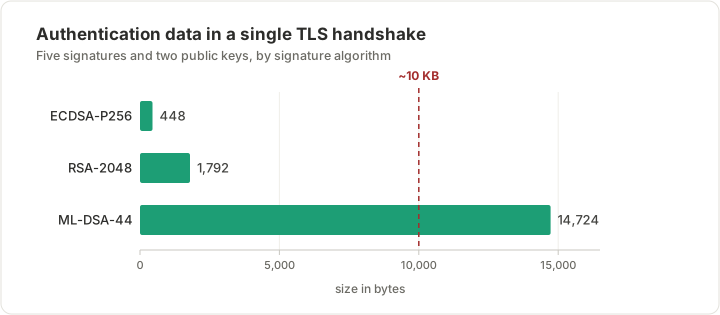
Larger handshakes would affect every TLS connection, not just those that would fail. They would mean constrained bandwidth, slower connections, and a worse experience for users, all in exchange for security against a threat that hasn’t materialized yet. That’s a steep cost to enable by default, and defaults are what actually move security at web scale.
A different design called Merkle Tree Certificates (“MTCs”) has been emerging over the past year, and we believe it is a strong path forward for the post-quantum Web PKI.
Instead of issuing certificates one at a time and signing each one individually, an MTC certificate authority issues certificates in batches, with a single signature covering the entire batch. Browsers stay up to date on those batch signatures (called “landmarks”) separately from the TLS handshake.
In the common case, the entire authentication path in an MTC handshake is one signature, one public key, and one inclusion proof. That’s smaller than today’s Web PKI handshake, even though MTCs use post-quantum algorithms. The other case is the “standalone” form. It uses slightly larger handshakes as a fallback when a client’s landmark is out of date.
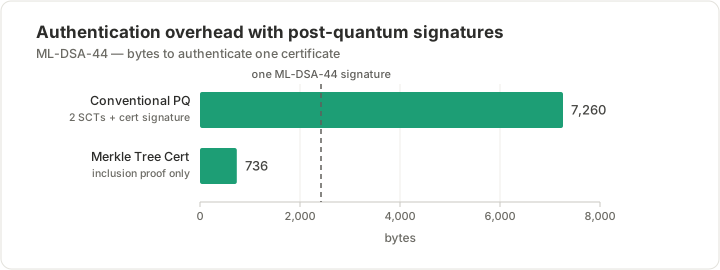
There is more to MTCs than size optimization. Because every certificate is part of a published Merkle tree, transparency becomes a property of issuance itself. Today’s Certificate Transparency ecosystem is bolted on after the fact: certificates are issued by CAs, then logged separately, with extra signatures riding along in the TLS handshake to attest to that logging. With MTCs, a certificate cannot exist outside the Merkle tree. Certificate Transparency is built in.
This is not entirely new ground for us. Let’s Encrypt has operated Certificate Transparency logs since 2019. Those logs are append-only Merkle trees, the same core data structure MTCs are built on, and ones we have run in production, at scale, for years.
Cloudflare and Chrome are already running a feasibility experiment with MTCs against real internet traffic. The IETF’s PLANTS working group is working on standardizing the design. Chrome has announced that MTCs are its preferred path for adding post-quantum certificates to the public web.
We are planning to support Merkle Tree Certificates as the path forward for the post-quantum Web PKI. We are targeting late 2026 for a staging environment that issues MTCs, and 2027 for a production-ready environment.
This is not a small endeavor. Issuing MTCs at the scale of Let’s Encrypt requires meaningful changes throughout our stack: in our issuance infrastructure, in the ACME protocol our subscribers use to obtain certificates, in revocation and operational tooling, and in the transparency-log infrastructure that MTCs subsume. We have been participating in the IETF PLANTS and ACME working groups as the standards take shape.
Alongside the MTC work, we are tracking the standards for ML-DSA signatures in X.509 (RFC 9881) and TLS (draft-ietf-tls-mldsa), and the ecosystem work this depends on, like the addition of ML-DSA to the Go standard library. The Web PKI’s transition to post-quantum security needs all of this to land in browsers, libraries, and ACME clients, whether the certificates ultimately delivered are MTCs or ML-DSA signed X.509.
Nothing changes today. Your current Let’s Encrypt certificates will continue to be issued and renewed exactly as they always have been. When post-quantum certificates become available from Let’s Encrypt, they will arrive the way our service always has: free, automated, and available to anyone with an ACME client.
The transition will take time. There are standards still being finalized, root programs still defining their requirements, and engineering work that has to land in the broader ecosystem (browsers, libraries, ACME clients) before any of this matters at scale. We will keep the community informed as the work progresses and as the timelines firm up.
If you maintain an ACME client or run an ACME-driven certificate pipeline, this is a good moment to start tracking the work in the PLANTS working group and the discussions on the mtcs@chromium.org mailing list. Some of the changes coming will require client-side support, and the ecosystem will benefit from clients that are ready when the issuance side is.
For the broader internet community: post-quantum encryption is the more urgent problem, because any TLS connection without post-quantum key exchange is potentially harvestable for later decryption. If you operate servers, please ensure they support hybrid post-quantum key exchange (X25519MLKEM768). Major browsers and operating systems already do, and turning it on at the server is one of the highest-leverage things you can do this year.
We have been building infrastructure for the public web since 2013 on the principle that security should be available to everyone, automatically, at no cost. The quantum transition is a generational change in how that security works under the hood.