"I resolved to enable every household to own its own home. If we were going to get the people to take National Service seriously, I could not ask their sons to fight and die for the properties of the wealthy. We worked out a personal savings scheme that allowed them to own an apartment painlessly through instalments over 20 years. We sold the apartments to them at below cost to enhance their assets. Today, 95 per cent of Singaporean households are homeowners. It has immeasurably increased their wealth and our social stability. Without home ownership, we would have become like Tokyo, Seoul or Hong Kong, where the voters in the cities are disaffected because they pay a large proportion of their salaries in rents.”
https://sgmatters.sg/i-could-not-ask-their-sons-to-fight-and...
It is a kind of workers paradise. If you're well behaved and don't shout you get a good education, health system and housing. 95% owner occupied is pretty damn good.
Huge dependence on south Malaysia migrant workers shuttling over the bridge every day, so it's "homes for us but not for thee" however he did cry when the greater Malaysian dream fell apart.
The arguments over his house and garden post death sum up the legacy well: he did not seek ulogising or mythologised shrine status, the apparatchiks can't resist the temptation.
I see parallels to Britain's Enoch Powell. Super smart, highly educated, disinterested in what others think, Not afraid to be contrarian and not particularly interested in performative democracy but also a bit one eyed on his hobby horse. If Powell hadn't been a racist shit, he could have been as effective as Lee Kwan Yew was.
Trivialising Singapore-for-foreigners as "no long hair, gays, gum or spitting" misses the point. Singapore welcomes all kinds of people if they have money, contribute to society and are useful or rich. Modern Singapore has gays and lesbians and tattoos and long hair a-plenty. They're just in a "don't ask don't tell" demi-monde netherworld.
Many people would feel safer in Lee Kwan Yew's Singapore than in the USA. Better housing and health policy, less graffiti and street violence.
As he described it, people crammed into shophouses, kampongs (villages) and squatter settlements with no proper toilets (human faeces and urine were carted away by "night soil" men carrying them in open containers in the streets), no clean water, no drainage, no fire safety.
In 1959 barely 9% had public housing. The streets boiled over with riots, strikes and communist agitation, one bloody flashpoint after another.
Work was casual and wages were thin. The British still ruled but had lost all moral authority after the Japanese rolled over across the northern causeway with not much of a resistance from the brits (the idiots were stationed in the southern island of sentosa with their guns pointing south thinking the japanese will invade from the sea) and buggered them in the war.
Singapore was a poor, overcrowded, combustible place with no business surviving, let alone becoming a nation. The hard truth the world forgets: Singapore is an improbable nation. By all logic, it had no right to exist. No natural resources. No hinterland. No oil, no land, no army, no water of its own. Thrown out of Malaysia in 1965, a tiny island of immigrants with three races, four languages and nothing in the bank. By every textbook measure, it should have failed.
It didn't, because of one man's sheer will.
My father now is 90 years old, worked his way up as a menial laborer, put himself through night school, became a successful businessman, and built a family. To my father and his generation, LKY will always be their hero.
From a shit-hole to the first world. In one generation.
This is one of the greatest lies ever told, that Singapore was an obscure fishing village when the colonial powers came to "modernise" Singapore.
Read the history books, Singapore is bang in the middle of ancient super powers of India and China. It's has been and always has been for most of its history a successful entreport for several thousand years before the colonials first visited, and the later Chinese immigrants settled in Singapore.
The founder of Malacca, where the Strait of Malacca name originated from, was himself a prince from Singapore and at the time better known as Temasek.
The people who originally settled in the Malay Archipelago several thousands years ago were successful maritime explorers. Their descendents discovered and migrated to wider Austronesia including Madagascar to the west, and New Zealand and Hawaii to the east several thousand years before the colonial powers "re-discover" these places. They also who speak their ancestors derivatives languages until now, that at one time US government tried to ban.
https://en.wikipedia.org/wiki/Lim_Chin_Siong?wprov=sfla1
Operation Spectrum untracing the conspiracy' https://share.google/2mRpZk3RGaYUKCRXS
When Singapore was squirted out from Malaysia in 1965, it had no natural resources, surrounded by hostile Muslim nations ( though not as bad as Israel, but still), and no one to depend on, except themselves.
The Malaysian Ringgit vs Singapore dollars was 1 to 1 back then in 1970s. And now it's 3.1 to 1. This alone is a testament how far Singapore has come.
One important factors separating Singapore and Malaysia is Malaysia's affirmative action (or quota system) that favors the majority, the Malay Muslims, which gives preference to Malay and Islam in all things including tertiary education, GLC opportunities. If you want to get listed in Malaysia stock market you need to have certain quota reserved for the Malays. It was supposed to ensure social justice and diversity, equality and inclusivity for everyone; why should Chinese monopolize all the opportunity to make money and leave Malays poor? This was so unfair.
This affirmative action was started in 1970, after the famous May 1969 racial riot incident. The argument was the riot happened because that the Malays were badly left behind by circumstances; they suffered so much injustice that they had to release it out on others, and the government must do everything to improve their socioeconomic status, lest the same thing happened again. It originally lasted only 30 years but in 2000, the government deemed that the Malays need more help still, and so it's still in effect today.
The affirmative action initiative by Malaysia government would have made any DEI adherents proud for it's thoroughness. Yet when you look at the results you must have wondered whether we did anything wrong. For if it was done right then why, by the affirmative action supporters own admission, the gap didn't close? And why Malaysia lagged so much behind Singapore? And how much minorities were driven away-- and many of them went to Singapore, to contribute to the economy there-- precisely because of affirmative action?
There is a lot to learn from his philosophy and there used to be countries that were on a similar track that also saw similar transformation from a backwater agrarian society deciding from marxism to market economy.
His legacy speaks for itself and I love how he can make Western journalists completely shut up, a true Cambridge law student, he could speak English effectively out of all non-Western leaders.
The only problem is that he lost the war on the hot scorching weather, something that really takes a way from enjoying the country. If Singapore had cooler weather, it would've been completely flooded with all the disillusioned Westerners from democratic countries.
Despite Singapore's geographical advantages, Lee's achievement in transforming it into a great financial hub is certainly a testament to his capability. However, when you consider his track record 'Operation Clodstore;, the suppression of freedom through defamation laws, and Singapore's early streaming education system — it ultimately seems like he only nurtured people from his own faction, believing that parental background matters.
While criticizing Singapore like this, I suddenly looked up Singapore's statistics. To my surprise, its intergenerational social mobility ranks 20th in the world — higher than I thought. Moreover, I found data showing that South Korea's social mobility is even lower than Singapore's. That made me feel depressed. Of course, with a population of just 5 million, Singapore is easier to manage than larger countries. but stil it functions properly as a nation.
And since Singaporeans reportedly have high life satisfaction, it even makes me question whether authoritarianism is really that bad. But I still dislike authoritarianism based on my personal values.
Still, maybe this is just blind hatred — because I've never been at the center of any industry in my entire life; I've always been an outsider
Ah, yet another uncritical narration of the People Action Party's literal party line.
Singapore was the second richest city in Asia (behind Shanghai) before WW2. While the PAP obviously deserves credit for their economic management from the 1960s onward, their starting point was far from the opium-riddled fishing village backwater they like to paint it as.
Ownership is closer to 90% now or something and the 30% of non resident foreigners will have much lower ownership obviously.
None of the things that LKY did that made Singapore great are unique to a dictatorship but him being the spiritual head and huge focus on education is critical. Interesting the USA has a good appetite for spending lots of money on students, but the education outcomes are really bad compared to places with half the spending
How do you compare Powell's "racism" and LKY's views on race and intelligence? By nearly all definitions of racism, Yew was a racist as well
LKY chalked it up to good, pragmatic policies implemented in a culturally sensitive way: https://paulbacon.wordpress.com/wp-content/uploads/2010/04/z.... (Read the whole thing. The first part is about culture, while the second part starting on p. 114 is about how he implemented western economic policies without trying to import western style social policies.) Singapore focused on neoliberalism within a social and cultural framework that accommodates the Chinese, Malay, and Indian communities that compose the country. It focused on anti-corruption and government efficiency, a major weak spot of nearly all developing countries. But it didn’t try to go straight from fishing village to liberal democracy. Like other countries that developed rapidly in Asia (Taiwan, Japan, South Korea, and now China) development of state capacity and civil institutions happened under soft-authoritarian, one-party rule.
To put it in one sentence: LKY was a bog standard neoliberal who didn’t suffer from the neoconservative delusion that American-style individual rights and populist democracy can be transplanted into any country hand-in-hand with neoliberal economic policies.
Of all the things wrong with the USA, when picking just two, it seems strange for one of them to be graffiti. I have lived in the USA all my life, in some more and some less urban areas, and even from the people most afraid of cities I have never heard graffiti mentioned as a serious worry or complaint.
Governance is more important than one’s history when it come to success of a country.
Be mindful of using terms that are widely recognized as racial slurs.
> However, by the time the Portuguese arrived in the early 16th century, Singapura had already become "great ruins" according to Alfonso de Albuquerque.
https://en.wikipedia.org/wiki/History_of_Singapore
How far back and how much context is required for a simple narrative to not constitute lying? And for a narrative about national origin, is it not also misleading to insinuate that successive settlements and polities constitute a singular, shared history?
And Europeans were not the first colonial powers to land on and assert control over the peninsula. In fact, the incumbent Muslim powers the Europeans encountered had colonized the peninsula only a couple of centuries beforehand. Aboriginal peoples (pre-history "colonizers") still live in Malaysia, and they're still as isolated and impoverished by the state as they were before Europeans arrived. Malaysia even has its own Plymouth Rock-like monument (on the coast somewhere near Malacca, IIRC), and it's not where Europeans first stepped ashore. And it seems a little odd to presume Singaporeans would identify with the political and social history of their Malay and aboriginal predecessors when Singapore, a majority Chinese community, was kicked out of Malaysia precisely because of racist and xenophobic sentiments of many Malays.
The racial politics of Malaysia and Singapore are at least as complicated as in the US if not more so. I count South Africa and Malaysia as the two countries where racial politics are not only as complicated, but open and explicit as in the US, and like the US the relationship between European colonizers and the "native" groups constitutes only a portion of that complexity. Many other countries have similarly diverse groups, but usually one group is unchallenged in its power and there's very little open discourse about the subject. But contemporary anti-colonial rhetoric whitewashes (figuratively and literally) all of this.
That comment upset me as a Melanesian. I'm sorry, but I need to challenge the above statement as it is factually incorrect. What you are claiming is widely spread in a politicized way in Malaysia and Indonesia, and in a similar but different context in Thailand and Phillipines. Firstly, I'm sure you know that the actual original first peoples (called as "orang asli negrito" or "sakai" (derogatory) by "Malay" settlers) are Melanesian/Negrito/Aboriginal tribes. Again, Malay settlers are not the the 'people who originally settled' as you claimed, they took the land from Melanesians. To be precise, the original people are MT Haplogroup P, MT Haplogroup M/sub-R, Y Haplogroup K/F. They have predominantly jet black skin and curly hair or straight hair in the case of some Aboriginal tribes in Australia. These are the genuine first peoples. They were in South and South East Asia, Papua and Australia first prior to the Toba eruption 70ka ago. Today, they have been mostly genocided by 'Malay' (sometimes used to cloud the term Austronesian term) settler populations. You can see this process happening even today in West Papua where 'Malay' soldiers and settlers brought over from Java, Indonesia are genociding Melanesian men in West Papua and taking over their land. The indigenous Melanesians are now a minority in their own land. There's brutal horific videos you can find online of Javanese settlers attacking and skinning a Melanesian man alive inside an oil drum. Truly barbaric stuff. It is a slow genocide but you don't hear much about it, probably because the mines of Freeport McMoran and Grassburg supply a huge chunk of the copper/gold that's key for EV and other modern technologies. That's as much time as I can spend on communicating this right now. I hope this information will help you and others correct your misunderstanding and stop spreading such disingenous claims intended to enable land grab by settlers. Thank you.
But I do think many of those policies are no longer needed - many of the Malays are more educated and smarter compared to 50 years ago. Right now those policies likely doing more harm than good - driving brain-drain and limiting economy growth, but any government try to remove those policies is just suicidal.
Very democratic country.
This part of the history, only mentioned in this one sentence, is the most interesting and relevant for other countries, and is really what sets Singapore apart from other countries in the region.
There are severe restrictions on speech, assembly, press and important legal and political barriers for the opposition parties. It is very easy to land in front of a tribunal for defamation or similar for expressing dissent or accusing the government of corruption.
The truth is that Singapore has been lucky that Lee Kuan Yew and most of his successors have been good bureaucrats and politicians. That makes the ruling party also somewhat popular.
Lee Kuan Yew has been an astonishing nation builder and an extremely brilliant man with a huge sensibility for politics and understanding the world.
But it's still a system that's waiting for the wrong people to be put in charge and test the limits of their "democracy".
His legacy as a statesman is unparalleled, but his legacy as a parent falls short, given how poorly his son did at maintaining the country his father built. His father surrounded himself with smart people and welcomed criticism, while his son surrounded himself with yes-men and prosecuted critics. And now Singapore is becoming increasingly unappealing to MNCs due to recent discriminatory visa policies, and the rising cost of living is making life harder and harder for young people, with the fertility rate now under 0.9 as people can't afford to start a family.
I am not a fan of "authoritarianism" but I do recognize that Singapore had a lot of the same issues and Lee Kuan Yew effectively used authoritarianism to drive it out. But one thing to keep in mind is that Singapore got very lucky in getting Lee Kuan Yew as their leader, someone who was very idealistic in his goals and had the pragmatism to execute it. Such a person is very rare and even rarer is for someone like that to rise to a position of power.
They do not; in fact, they're the least happy country in SE Asia.
https://www.hcamag.com/asia/specialisation/employee-engageme...
What a bizarre non-sequitur.
Regardless many of the strategies these countries used are increasingly difficult for low income countries to do as these countries (China is the biggest example) themselves are protective of these industries, there's no push for globalizing and as factories got increasingly automated.
That's not to say that I believe governance isn't important but the one's history is important for governance itself.
Even more dangerously, I think they're even rarer than people who can convincingly pretend to be one. So even if you go looking for such a person you're heading into the danger zone.
How do you think Philiippines compare now to Singapore as a result of its "democracy" ?
tbf that applies to all democracies, including genuinely competitive multiparty democracies. Would PAP accept defeat and cede power if they handled a crisis so badly an effective opposition party emerged? That's unclear, as is how many of their appointees would support them in that goal, though it is considerably more likely than nations which do not attempt to hold representative elections. But we've also seen the answer to questions of how much success will someone have in explicitly overriding democratic norms and revelling in open corruption be plenty in the United States with all its storied separation of powers and tradition of political freedoms, and perhaps more surprisingly he gave up quietly to wait for the next election was the answer to what would happen when a narrow majority rejected a guy who'd spent years turning Hungary into his personal fiefdom....
The other quirk about the PAP's paternalism is how many of their authoritarian type policies have been primarily driven by a culture of trying to avoid upsetting people, hence years of doublethink on homosexuality and newspapers being told that publishing aerial before and after photographs of Singapore's coastline might be a touch too provocative towards their neighbours.
I don’t think this is only by luck. Singapore made the decision to ‘pay the bureaucrats well’ so that they can build a career on it. This attracts more people to be a bureaucrat. The alternative is that only already rich people become politicians and bureaucrats or bureaucrats only getting their bag by joining lobbying firm after their time in government.
IMO, the hard part about implementing this ‘pay the bureaucrats well’ system is that it is often hard to determine the market rate as there are often no equivalent roles in the private market.
None of the problems you listed are unique to Singapore. Chinese buyers who often serve as effective money mules for capital out of China have inflated real estate prices globally and the enablers at home profited from the transaction, fully aware of the demographic impact it can have.
Singapore acted the best for its citizens in protecting them from outsider speculation compared to Canada for example.
[1]https://ourworldindata.org/happiness-and-life-satisfaction
One of the big questions of Singaporean politics is what would happen if there ever was a "freak result" (in LKY's words) and the opposition won a majority, since thanks to the first past the post voting system further exacerbated by mandatory "group representative constituencies" the winner always wins big and coalitions or minority governments are not an option.
If Singapore isn't a democracy then the U.S is a dictature.
I can assure you Ptolemy never been to India let alone Singapore.
But hey you just deleted your Ptolemy narrative, are you misleading a narrative?
Ironically although Ptolemy never been to Singapore it's apparently recorded in his book as Sabana [1]. Perhaps that the reason you deleted your Ptolemy entry.
It's also recorded in ancient Chinese record in the 3rd CE Chinese traveller's record describing an island at the same location called Pú Luó Zhōng a transcription of Singapore's early Malay name Pulau Ujong, literally meaning Tip End Island because it's located at the southern most tip of Malaysian Peninsular.
The famous Indian Emperor Chola also said to briefly conquer Singapore/Temasek in the 11th CE [1].
Singapore by any definition for the past two thousands years was not an obscure fishing village. It's always has been a bustling metropolitan with international entreport status. Anyone who said otherwise is lying through their teeth and pushing their own wicked narrative.
[1] Early history of Singapore:
That being said, I would assume that a one party state isn't very democratic. It'd be an unstable democracy.
Cost of housing in HK is going to be an embuggerance if they don't fix that, it may bifurcate into a more strong over/underclass imbalance. Taiwan is amazing but has thinner underpinnings now the US has demanded chip manufacturing moves to continental USA and the water supply issue is huge.
But your central point I agree with strongly: fix education, health, housing and provide at least some representation and you can do so much better than being a colonial outpost of somewhere else sucking value out.
When I learned English writing, I was taught to use an em dash after words like 'by the way' or 'to add to that' — as a kind of aside. For hyphens, I was taught to use them in compound words. And for semicolons, I learned to use them when moving on to the next sentence within the same clause.
Actually, this is formal writing — techniques I learned in graduate school. Is this 'AI writing'?
It's hard because I'm not a native speaker.
What nonsense, colonizers do not live and settle there for thousand of years. Would you called majority Japanese now a colonizers since the originally come from Korea/China and before them they were people there?
>Singapura had already become "great ruins" according to Alfonso de Albuquerque.
Albuquerque was the first European colonial who conquered Malacca in the early 16th CE, later Dutch and then British. They all came because they wanted to bypass what they considered "trading bottleneck" created by Ottoman, the most powerful maritime empire in the Mediterranean and Europe for many centuries.
The local authorities most probably very well deployed a typical scorched-earth strategy to prevent the Albuquerque to fully utilize Singapore infrastructure. The British did exactly this to most part of Singapore including totally damaging the very important causeway when the were defeated by Japanese in the mid 20th CE. Fun facts, the world busiest causeway still not return to the its original sophisticated design with elegant pass-thru water design until today, thus pollution side effect are still happening and not being solved [2].
[1] Scorched earth:
https://en.wikipedia.org/wiki/Scorched_earth
[2] Why Singaporeans Are Fleeing to Malaysia Every Weekend | AB Explained [video]:
I may be displaying my age. Feeling safe equates to being on the street, and unafraid. The tagging isn't the problem the social conditions which ignore it, maybe are.
https://www.bbc.com/news/articles/c62m7xrd2z0o
https://www.theguardian.com/world/2024/oct/10/spanish-couple...
democracy failed America
The word one to ten in most Austronesian countries from Madagascar to Hawaii, spanning more than 17,000 km or 10,000 miles (about half of earth's perimeter of 40,000 km). These countries main languages including Malagasy, Malay, Indonesian, Javanese, Tagalog, Sulu, Palau (Micronesia), NZ Maori, Hawaii (Polynesia), etc are very similar. In particular, "Lima" meaning five/hand is the common and signature Malay/Austronesian world, even in Hawaii.
Based on your throw away name, most probably you're from Papua Island, you probably know that one of its original main languages, apart from the recent colonial based Tok Pisin, is the Malay Austronesian based Hiri Motu [2].
>Today, they have been mostly genocided by 'Malay' (sometimes used to cloud the term Austronesian term) settler populations.
What nonsense, as they said the proof is in the pudding. If genocide happened as you claimed most of these people are gone but they're everywhere. Please check Borneo Island for example, ruled by the Malay Brunei Kingdom for several centuries until the colonial Brooke the White Rajah came. This third largest Island in the world probably has the most diverse demographic population of indigenous peoples in the world [3].
Fun facts, as comparison the Champa Malay people were genocided by the Vietnamese warlords mainly by the Nguyen lords. They controlled majority of Vietnam for about two thousands years but now you hardly find this Champa Malay people, similar to what happened in muslim in Spain. The highly contested South Chinese Sea original name was Champa Sea [4].
>I hope this information will help you and others correct your misunderstanding and stop spreading such disingenous claims intended to enable land grab by settlers.
Since we are in the Singapore topic, by your own definition of land grab by settlers, the Chinese immigrants where the first PM LKY are from, that constitute majority of Singaporean were performing land grab by settlers because just 200 years ago majority were Malay?
[1] Asia’s secret World Heritage site:
https://www.bbc.com/travel/article/20160518-malaysias-11000-...
[2] Hiri Motu:
https://en.wikipedia.org/wiki/Hiri_Motu
[3] Borneo:Demographics:
https://en.wikipedia.org/wiki/Borneo#Demographics
[4] The Cham: Descendants of Ancient Rulers of South China Sea Watch Maritime Dispute From Sidelines:
https://www.nationalgeographic.com/science/article/140616-so...
with separate schooling systems, many Malaysians grow up in ethnic silos, which fundamentally hinders national unity even beyond any legal framework
All these lands were Dharmic originally, all the way to Japan, before the various cults arrived.
edit: wikipedia says 25% of the world's trade flows through the Straight of Malacca - it's a big deal!
People throw out the word democracy like they know what it is.
A better comparison might be Alexander Hamilton or Abraham Lincoln’s view of free markets combined with an interventionist government. But we don’t really have a neat label for that. In the U.S., free markets get conceptually lashed together with individual rights and limited government.
Earlier you claimed 'originally settled by Malays' now you're saying Malays inter-married with the actual indigenous population. That's like saying European Americans inter-married with actual native population and therefore European Americans are now the first peoples in America. I'm unsure if it is worth discussing further with someone that would manipulate facts in this way.
I'll also ask you to google about Y-haplogroup and MT-haplogroup statistics to see how it shows the disappearance of male Melanesian contribution to the population in Phillipines, Indonesia, Malaysia, Thailand. Countries like Malaysia and Indonesia had official policies even going on today where indigenous Melanesian women were targeted to be impregnated by settler 'Malay Muslim' men. For example:
https://www.thestar.com.my/news/nation/2006/06/27/incentives... 'Kelantan will offer RM10,000 to each Muslim preacher who marries an orang asli woman and naturally converts her'
I noticed you refused to address what is happening in West Papua.
Sadly, I think our conversation can't really continue effectively since you're starting to bring in unrelated topics like Spain and then you started talking about 'land grab by Chinese immigrants in Singapore' which is unrelated to the claims you originally made. Again, I sought to correct your statement claiming 'originally settled by Malays' which I notice you've now softened to 'Malays intermarried with the actual indigenous people'. I think that's the extent of the possible communication with you.
Japan did not view Korea as a place to enrich for anyone's benefit but Japan. The same with their occupation of Taiwan.
Depending on context, yes, especially considering that (AFAIU) there still exist identifiable (socially, not just genetically) ethnic groups on the Japanese archipelago who predate that colonization event, and who still experience forms of ostracization typical of such colonization. There'd be no cognitive dissonance for me because I refuse to internalize a definition of colonialism that tacitly presumes European exceptionalism and supremacy through a sort of reverse White Man's Burden logic of moral accountability and historical criticism.
For the same reason, I recognize that groups we (i.e. westernized, globalist, cosmopolitan, what-have-you types) typically call aboriginal in a homogenizing, undifferentiating manner were often colonizers themselves thousands of years ago, displacing other aboriginal groups that may or may not still exist today. There are multiple such groups in Southeast Asia. And the first such modern human aboriginal group may have colonized an area occupied by pre-modern, archaic humans. (Or possibly vice versa!)
Buying into the logic of modern anti-colonialism critical theory is not required to appreciate and criticize the harms European colonization inflicted and continues to inflict. But rejecting that logic might be a prerequisite to recognizing and appreciating the exact same dynamics and harms that played out and still play out today among non-European ethnic groups.
> they wanted to bypass what they considered "trading bottleneck" created by Ottoman
The Ottomans didn't exactly close the Silk Road, but they made it harder and more expensive to use it.
But the major reason for the maritime routes taking over the cargo traffic was that it's much more efficient to sail to Asia with your cargo than to walk it on camels.
So when the Portugese found the way around Africa and landed in Calcutta on May 20 1498, the trade patterns changed forever.
As to your other point, again, you’re overlooking that places change over time. The Arabs built a huge civilization a thousand years ago. But by the 19th century, there wasn’t much left.
What was the population of what is now Singapore when Raffles landed there? Wikipedia says that under the Sultanate the population was under 1,000. https://en.wikipedia.org/wiki/History_of_Singapore
China and Singapore showed democracy is not necessarily the most productive way to run a country
Regardless of whether you're using AI (please don't btw) or coming by your em-dashes honestly, people who fixate on trivial obvious cues will notice your em-dashes and assume you're using it.
> a: dishonest or illegal behavior especially by powerful people (such as government officials or police officers) : depravity
> b: inducement to wrong by improper or unlawful means (such as bribery); the corruption of government officials
> c: a departure from the original or from what is pure or correct the corruption of a text; the corruption of computer files
> d: decay, decomposition; the corruption of a carcass
As far as I can tell the law was passed by the legislature, the police enforced the law, they weren't bribed to not enforce it or to enforce it.
Seems like the whole system worked correctly, legally and without corruption of any kind.
What does detaining someone over an unlawful (per the written law) protest have anything to do with corruption?
Corruption involves bribes, selective enforcement of the law, unethical favoritism when it comes to legal decisions, "favors", etc.
Your links just describe people participating in a protest that was against the law on the books, and then that law being enforced upon them. You can call that specific law unfair, undemocratic, authoritarian, etc., but what's the corruption angle here?
There's a reason why every single democracy to turn authoritarian in the last 60 years has been presidential or semi-presidential.
The only parliamentary democracy to turn authoritarian since the 60s has been Sri Lanka, there's not a single other example.
But where I am from, there are two kinds of graffity:
- Cool elaborate pictures, usually in "legal zones" walls city dedicated to it. They take time to create, hence preference for legal place and are made by artists.
- Less cool stuff created by skinny "edgy" teenagers, who are jerks to the owners, but also completely harmless.
Not much change for Singapore, I know this because I learnt my history and geography properly, I hope you too.
Strait of Malacca has always been the busiest maritime trade route in the world continously since recorded history even until now, and at the heart of it is Singapore Strait where Singapore or Temasek is located.
Even until now most of the world's trade are performed via maritime route even with advent of aircraft, and guess what most of these trades when through Malacca and Singapore Straits. Maritime industry called these Straits the world's busiest trading choke-point. I'm not even exxagerating to say that Strait of Hormuz is nothing compared to this chokepoint, especially in the ancient time.
On top of that, more than quarter of the world's population since recorded history are living in China and India, and in between these two most populous nations are connected via maritime sea route through Straits of Malacca and Singapore.
In the old days, or most of our maritime trading history for thousand of years, we do not have engine for ships neither steam nor fuel, only for very short period recently starting from late 19th CE [1].
During most of our maritime history we use sails. People or sailors travelling between India and China, and returning back rely entirely on wind power that are based on alternate monsoon seasons. This where we got the famous saying of "time and tide wait for no man".
For one season (half a year) they used for travelling westward and another half season they travelling eastward. Either way, ancient sailors from Europe/India/China/Arab/Japan they need to stop over somewhere (read Malay Peninsular or Singapore/Temasek) while waiting for monsoon to change before returning back home. Since Singapore/Temasek at the end of this Peninsular, it's the most natural transit point for these ancient/modern sailors. Whenever you fly over Singapore take a look down to see these multitude of these ships. Although now in theory they don't need to stop for monsoon due to fuel, but realistically the ships still need for refuel/rest/transit/etc.
[1] From Sails to Steam Power:
https://www.marinmuseum.se/en/visit/exhibitions/from-sails-t...
Opposition can literally just converge to the PAP positions over time. Or internal factionalism causes a schism and leads to 2 parties forming from one overwhelming ruling party. In political settings there are enormous incentives to set up roughly 50-50 coalitions.
Nothing more irritating that having your apartment building get a fresh coat of paint, look great, and then someone writing scribble tags all over it.
In Korea, it's not that difficult to input an em dash because you can type it using 'ㄱ + chinese characterbutton' (both based on the Korean keyboard). But I guess it's hard for people outside Korea.
Actually, since Korean doesn't have em dashes or hyphens, you could simply not use them at all. However, in 'formal' writing, I was taught that you should use them. just like you should use 'could' instead of informal alternatives.
This is really tough. When I use Hacker News, I keep a machine translator and DeepL open next to it. When I translate that way, em dashes sometimes appear, and that's what I'm worried about.
I thought this was obvious, but it seems like writing in Korean and then using an AI translator would be much better. The problem is that on this site, I'm not really allowed to use an AI translator either, so I'm almost being forced to write everything manually. The goal is to get overseas freelance work.
I had no idea that typing an em dash is difficult overseas. For me, it's just two buttons I never imagined that would be an issue. Thank you.
If you're down Proudhon's "all property is theft" then graffiti is a kind of tragedy of the commons. Go ahead. Graffiti the Uffitzi, Nelson's column, the Plaka. Stick it to the man!
I think that this sounds good and is a sensible hypothesis, but it's far from clear to me that the corollary of prosperity for those without property is true in practice.
It seems that Singapore/PAP figured out that policy control could effectively keep power without the violence traditionally associated with authoritarianism. I wonder what other dark arts they employ.
One man more than any other is associated with Singapore’s remarkable 20th-century success. Who was Lee Kuan Yew, and how did he do it?
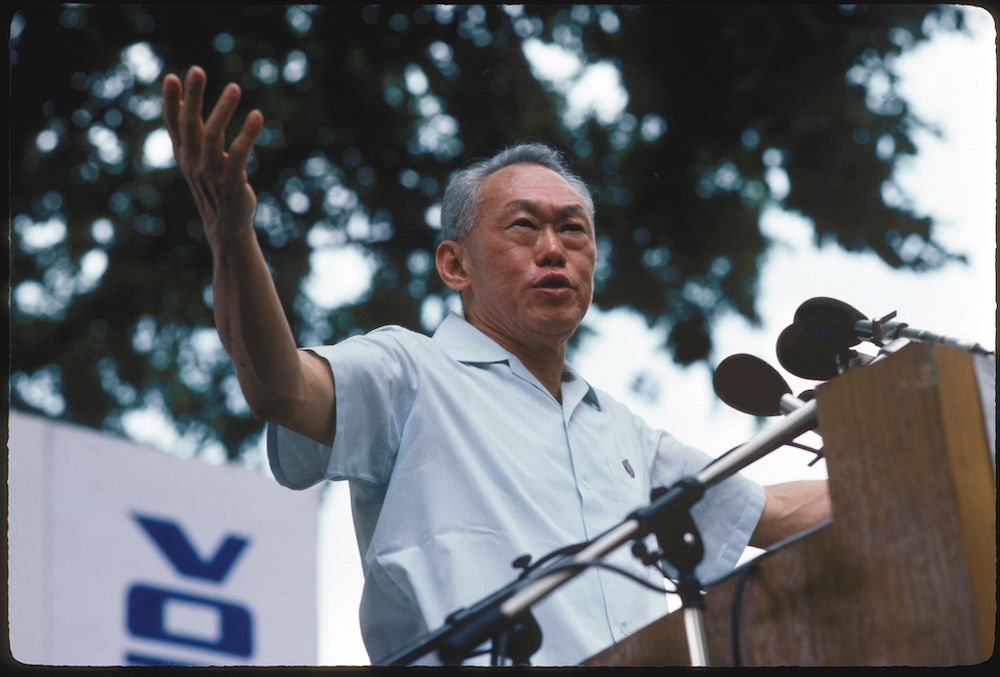
Prime Minister of Singapore Lee Kuan Yew speaks in Fullerton Square, Singapore, 18 December 1984. Alex Bowie via Getty Images.
On the north bank of the Singapore River is an eight-foot-tall statue of a man striking a stately pose, arms folded, gazing into the horizon. Stamford Raffles stands – according to the plaque attached to the plinth – on the ‘historic site’ where he first landed as an agent of the British East India Company on 28 January 1819 and, thereafter, ‘with genius and perception changed the destiny of Singapore from an obscure fishing village to a great seaport and modern metropolis’. Raffles – who is officially recognised as the ‘founder’ of modern Singapore – had a strong conviction that the tiny trading outpost he founded at the southern tip of the Malay Peninsula would fulfil a destiny larger than its physical size. He was right. But he was not a nation-builder. He visited Singapore just three times, spending slightly more than nine months on the island across a period of three years. After founding the outpost, he spent most of his time elsewhere, in neighbouring Indonesia (then the Dutch East Indies). If Raffles boasted of Singapore as his ‘child’, it is fair to say he was an absent father.
The story of Singapore’s ascent from ‘Third World’ to ‘First’, following its forced separation from Malaysia in August 1965, happened under the watch of another visionary, Lee Kuan Yew. In September 2023, Singapore celebrates the centenary of his birth. Reflecting on his life and achievements a few years before his death in 2015, Lee told a group of assembled journalists: ‘I have spent my life, so much of it, building up this country. There’s nothing more that I need to do. At the end of the day, what have I got? A successful Singapore. What have I given up? My life.’ Lee believed this: his 1998 autobiography was titled, simply, The Singapore Story. Since his passing, Lee has been honoured as the nation’s ‘founding father’.
Lee grew up in a comfortable, but not rich, English-speaking Chinese family. His parents, brought together in an arranged marriage, belonged to the colony’s majority Chinese community. Like any Singaporean child, Lee mingled with children of other ethnicities and played with Malay friends. The eldest of four children, the young Harry Lee – his anglicised first name was added by his grandfather who admired the British, but later dropped by Lee – was a gifted student. Coming first at the Senior Cambridge examinations in Singapore and Malaya in 1940, Lee decided to study law in London. The Second World War precluded this and, with Britain at war, Lee accepted a scholarship to study at Raffles College, the colony’s leading tertiary institution in the arts and sciences. There, he became the college’s best student in mathematics, but not in English or economics, which were topped by another student, Kwa Geok Choo, Lee’s future wife.
War had torn Europe apart and was creeping towards Singapore. On 8 December 1941, the sleepy city was awakened before dawn by the blare of air-raid sirens to the stark realisation that Britain was now at war with Japan. With classes cancelled, Lee volunteered as a medical auxiliary. Less than three months later, he watched with bewilderment the rapid collapse of British Malaya, as demoralised British and Commonwealth troops beat a desperate retreat to their island citadel of Singapore, only to see their much vaunted ‘impregnable fortress’ fall on 15 February 1942.
The brutal Japanese occupation lasted for three-and-a-half years and profoundly affected the trajectory of Lee’s life, and that of the city. The occupation was very hard on the city’s inhabitants, especially its Chinese population which was suspected of being anti-Japanese. Before the invasion, many overseas Chinese had openly supported China in its prolonged war with Japan. The victorious Japanese army, which had fought in China, now sought revenge. Like many other Chinese men, Lee was ordered to report to a ‘screening centre’. Many of those who complied were loaded onto lorries and executed. Lee asked to leave the line in order to return to a friend’s dormitory to collect his belongings. He hid there and never returned. Had the Japanese guard refused his request, Lee could have been among the estimated 5,000 to 50,000 Chinese men who were unfavourably ‘screened’ by the Japanese and who perished in the Sook Ching (‘purge through cleansing’) massacre. ‘I will never understand how decisions affecting life and death could be taken so capriciously and casually’, he later reflected.
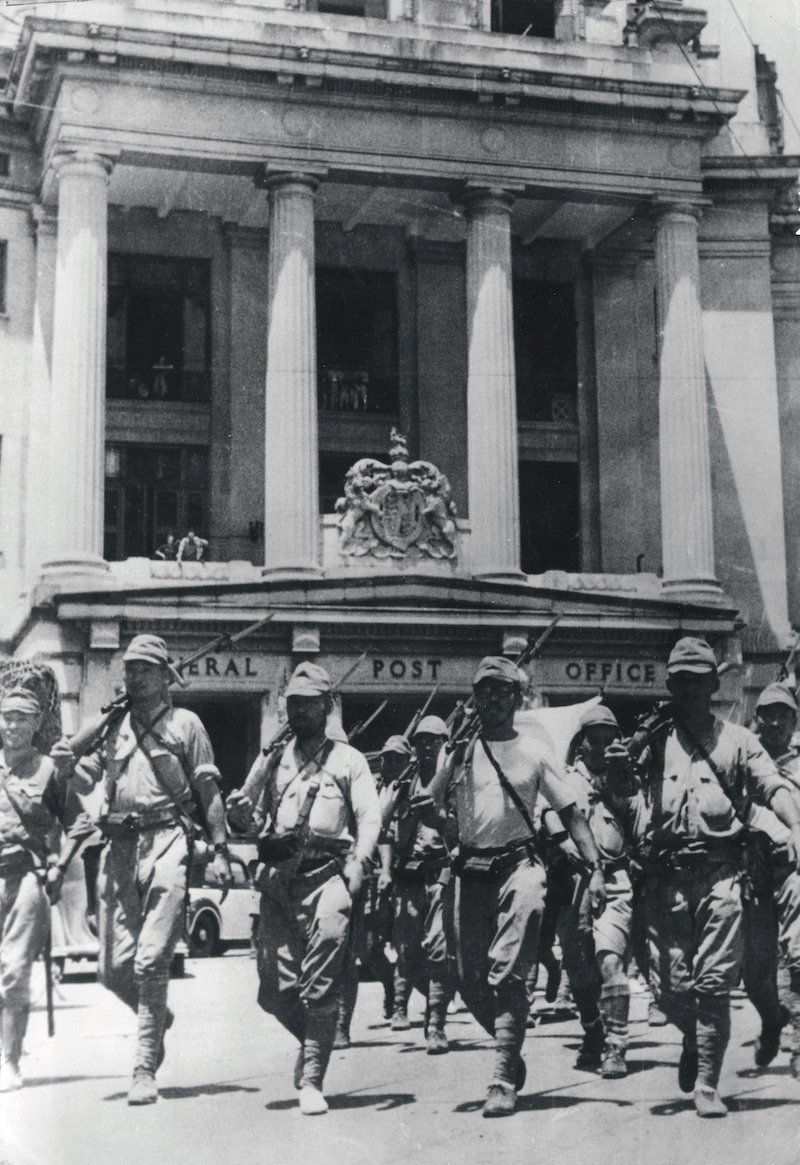
Japanese troops in Singapore following the fall of the city in 1942. Lee Kuan Yew narrowly escaped death during the Second World War occupation and the experience profoundly shaped his view of Britain. Chronicle/Alamy Stock Photo.
Before the war, Lee had considered himself apolitical. But the war – and the Japanese occupation – destroyed the myth that the British were a superior and invincible people with an inherent right to rule Asians: ‘In 70 days of surprises, upsets and stupidities, British colonial society was shattered, and with it all the assumptions of the Englishman’s superiority.’ In his memoirs, Lee described being slapped and forced to kneel for failing to bow to a Japanese soldier. Lee’s experience of British failures destroyed his reverence for them; his experience of Japanese brutality led him to abhor them. As he later wrote, he emerged from the war ‘determined that no one – neither the Japanese nor the British – had the right to push and kick us around’.
After the war, Lee left Singapore for England to read law at the London School of Economics. Disliking London, he moved to Cambridge University. By the time he graduated in 1949 with a double first with starred distinction, he was a changed man. While his stellar achievements at Cambridge gave him confidence in subsequent dealings with British officials, his experiences in England also forged a deeply anti-colonial sentiment. He never forgot Britain’s blunders during Singapore’s fall, nor the class and colour prejudices he encountered in Britain. Inspired by socialist ideals, he befriended political leaders in the British Labour Party and even campaigned on behalf of one of his Cambridge friends, David Widdicombe, a Labour candidate. His growing political involvement in England caught the eye of Singapore’s Special Branch, which added Lee to its watch list.
In 1950, Lee delivered a parting speech to the Malayan Forum, a London-based discussion club founded to deliberate the future of Malaya. Lee spoke of how returning Malayan students, schooled in British institutions, could lead the fight for independence and oversee a smooth transfer of power. Upon returning home to begin his legal practice, the 27-year-old law graduate found a city still reeling from the aftermath of war, battling a rising communist insurgency, and shuffling uneasily toward an uncertain post-colonial future.
Since 1948, a mainly Chinese-led communist insurgency, cloaked as an anti-imperialist revolt, had established itself across Malaya and Singapore. In Malaya, British troops battled communists in a jungle war that would last another 12 years. In Singapore, the city’s mostly Chinese population made it a major target for communist subversion.
Lee considered joining a political party but none suited his left-wing, anti-colonial convictions. Because of the communist insurgency, only pro-British, right-wing parties such as the Progressive Party had survived. In response, Lee assembled a group of like-minded English-educated activists who met in the basement dining room of his bungalow at 38 Oxley Road to ponder the merits of forming a party. Lee’s roles as barrister and would-be politician soon became inseparable as he took on cases, often pro bono, of unionists, civil servants and student groups who had got into legal skirmishes with the colonial government. High-profile cases brought him public attention and he became a sought-after legal adviser. Contact with the leftist Chinese students he represented opened his eyes to the dynamism and anti-colonial potential among Singapore’s Chinese-educated population, which the communists had been working on for decades. Ever pragmatic, Lee formed an alliance of necessity with the communists to gain access to their mass base.
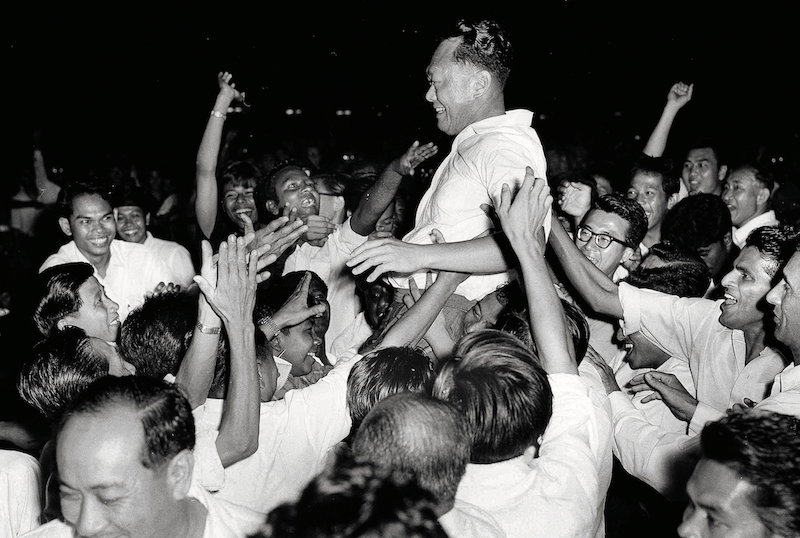
Lee Kuan Yew surrounded by supporters of the People’s Action Party following their victory in the September 1963 Singapore elections, held five days after the formation of Malaysia. Associated Press/Alamy Stock Photo.
On 21 November 1954, ahead of a legislative assembly election the following year, Lee and his group launched the People’s Action Party (PAP), committed to using ‘every constitutional means’ to hasten the end of colonial rule in Malaya. Lee’s ‘men-in-white’ – identified by their all-white party uniform to symbolise incorruptibility – duly elected him as their Secretary General. At the PAP’s first election in 1955, Lee’s token team did well, winning three of the four seats it contested, and Lee became de facto opposition leader in a shaky coalition government helmed by the Labour Front. In the legislative assembly, Lee attacked colonialism and called for its swift demise.
But the PAP was not united. Split within, a pro-communist faction, sceptical of the effectiveness of constitutional methods, advocated the use of united front tactics, and even violence, in toppling the colonial government. The internal power struggle ended after Lee expelled the pro-communists in 1961. The splintered group formed the Barisan Sosialis (Socialist Front) and remained a troublesome thorn in the PAP’s side into the late 1960s.
In 1959, the PAP, campaigning on a pro-independence agenda and a detailed plan to solve bread-and-butter issues, won a spectacular landslide victory to form the government of self-governing (but not yet independent) Singapore. Lee became its founding prime minister, an office he retained until 1990. Since 1959, the PAP has won every general election on the island.
Under Lee, Singapore became independent twice, once by choice, once not. Lee’s goal had never been an independent Singapore; he wanted a free Malaya that included Singapore, which had been constitutionally detached from the peninsula as part of controversial British postwar plans to reconstitute its Malayan dependency. Britain feared that Singapore’s inclusion would unbalance Malaya’s population in favour of the Chinese. The island’s separation was to have serious repercussions for its future. Lee did not believe that tiny Singapore could survive on its own, or that the British would grant the colony freedom when communists were waiting to take power. After Malaya achieved independence ahead of Singapore in 1957, Lee championed ‘independence through merger’ with Malaya as the only realistic strategy for Singapore’s future. He convinced the Malayan premier, Tunku Abdul Rahman, of the security and political merits of including Singapore in a wider federation under Malayan leadership that also comprised the British Borneo territories. Lee defended this merger abroad and at home against a ferocious campaign by the Barisan Sosialis, and conducted a keenly fought, if controversial, referendum, which he won decisively, on merger terms agreed between the two leaders. Incorporating Singapore, the new state of Malaysia came into being on 16 September 1963, Lee’s 40th birthday.
But hopes of Singapore playing a role in the new Malaysian nation were dashed almost as soon as they had begun. No Singaporean minister was invited to join the right-wing Malaysian cabinet. Tunku Abdul Rahman did not want another prime minister in his cabinet. Heightened political competition and tensions flared up over competing visions of what Malaysia represented – whether it was to be a Malay Malaysia, where political power was jealously vested in a Malay-led and privileged central government; or a Malaysian Malaysia, where multiracial ideals were upheld.
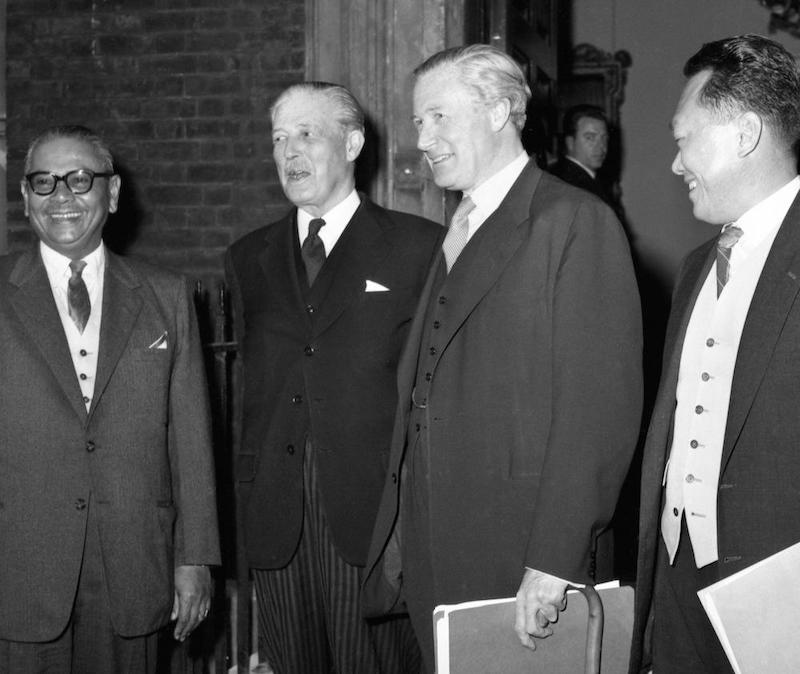
Singapore Prime Minister Lee Kuan Yew with (left to right) Malaysian Prime Minister Tunku Abdul Rahman, Harold Macmillan and Duncan Sandys, British Secretary of State for Commonwealth Relations and the Colonies, at Admiralty House, 31 July 1962. Chronicle/Alamy Stock Photo.
In 1964, deadly Sino-Malay race riots broke out in Singapore. Lee blamed the riots on incitement by radical Malay activists hoping to undercut the appeal of the PAP’s socialist agenda to young Malays within Singapore and Malaya. ‘They wanted us to confine ourselves to Chinese voters and stop appealing to the Malays’, he later said: ‘The Malay electorate was out of bounds to non-Malay parties like the PAP.’ As relations slumped and a war of words became more and more heated, Tunku Abdul Rahman decided that removing Singapore from Malaysia was the only way to contain a potentially explosive situation. For their part, PAP leaders appeared set on leading a newly formed Malaysia-wide multiracial coalition to challenge Tunku’s government and its weaponising of race. Amid calls for his arrest to nip the PAP’s ‘Malaysian Malaysia’ movement in the bud, Lee secretly set his finance minister, Goh Keng Swee, to work on a deal with his Malayan counterparts for Singapore’s disengagement from federal affairs. But Goh exceeded his brief. He pressed instead for separation, convinced that the political cost of merger was dreadful and the economic benefits non-existent. Lee supported the move, which Tunku backed. With no better offer on the table, the Singapore premier, with great difficulty, persuaded his senior Malaya-born PAP ministers to accept separation and avert a bloody headlong collision. On 9 August 1965, Lee delivered a press conference announcing the separation, weeping at the shattering of his Malaysian dream. After less than two years, Singapore was out of Malaysia and independent for a second time.
Independence was as sobering as it was cathartic. In Singapore’s Chinatown, relief at the end of the altercation was celebrated with firecrackers. But this light-hearted response belied the grave situation Singapore faced. ‘I have a responsibility for the survival of the two million people in Singapore’, Lee told foreign correspondents five days after separation. Lee was faced with the task of building a nation that would prove his earlier thesis wrong: that a small, vulnerable, independent Singapore, bereft of its Malayan hinterland, could survive. ‘Ten years from now’, he declared weeks later, ‘this will be a metropolis. Never fear!’
Within ten years it was. The PAP government, led by Lee, embarked on a novel strategy, using multinational corporations as agents of economic development at a time when many developing postcolonial nations shunned them for being exploitative. Interventionist and pro-business policies transformed the city-state into a leading financial, aviation and shipping hub, a ‘global city’ with the world as its hinterland. No effort was spared to promote Singapore overseas as an efficient and hassle-free investment destination, offering favourable industrial infrastructure and generous tax breaks and subsidies. Additionally, Lee galvanised domestic support for his social programmes, underpinned by the values of multiracialism, meritocracy, equality and rule of law. Over the following decades, Lee built a strong government that was backed by a competent and virtually corruption-free civil service, provided affordable world-class public housing making Singaporeans a nation of homeowners and created a well-equipped, modern defence force from scratch (with Israeli help) based on mandatory conscription for men. Drawing on his wide network of friends and world leaders, who valued his astute assessments of Asia and the world, Lee enlarged the nation’s strategic space to give big powers a stake in its continued survival and security. He fussed over every detail and imperfection, however minor, and imbued Singapore with his personal attributes: an openness to ideas and an emphasis on discipline, order and cleanliness. Singapore was to be his lush ‘garden city’, a First World ‘oasis’ in a Third World region.
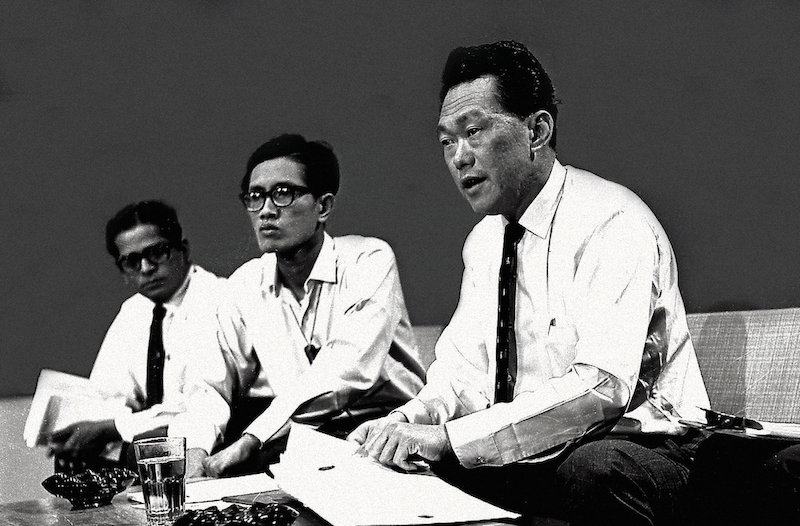
Lee Kuan Yew announces Singapore’s separation from Malaysia in a televised press conference, 9 August 1965. Associated Press/Alamy Stock Photo
Lee succeeded because he was backed by an exceptionally able team of ‘lieutenants’, but also because he built a deep reservoir of trust with Singaporeans over his long tenure. A charismatic speaker in English, Mandarin and Malay, Lee persuaded and cajoled Singaporeans to work with him on his national project. He lived frugally – his home was spartan, his office unadorned. Singapore survived its early years and became one of the most stable, safe, cosmopolitan and wealthy countries in Asia, enjoying a role and influence well out of proportion to its size. By the time Lee stepped aside as prime minister in 1990, Singapore’s GDP per capita had risen to around US$13,000, up from US$500 in 1965, surpassing South Korea, Israel and Portugal. Lee continued as senior minister and then minister mentor, before resigning from the cabinet in 2011. His death in March 2015, aged 91, was met with a nationwide outpouring of grief and gratitude. An estimated 1.5 million Singaporeans attended his lying in state to bid farewell to the nation’s strict father who once said he would rather be feared than loved.
Lee’s legacy, however, is not without its critics. Among the charges are that the PAP’s record of undefeated electoral successes since 1959 has turned Singapore into a one-party dominant state – perhaps even a dictatorship – with no tolerance for political dissent or parliamentary opposition. The heavy hand used against challenges to Lee’s authority and his conception of social order – curbing free speech and assembly, muzzling a free press, bankrupting opposition politicians by lawsuits (often for libel, which Lee won) and sanctioning detention without trial – is evidence of the dark side of Lee’s legacy.
For Lee, such ideological subtleties did not matter. ‘Do I need to be a dictator when I can win, hands down?’ he asked one American interviewer. Lee sensed a more sinister reason for the criticisms he faced, especially those from the West: an unspoken fear that Singapore’s success was proof of what enlightened authoritarianism can achieve where liberal democracy cannot. Does Singapore’s success justify the darker parts of Lee’s record in the ‘trade-off’ between prosperity and freedom? Lee never believed Western liberal democracy to be a universal good; its only virtue, he argued, was to change governments without violence. The essence of politics to him was not elections, but good governance and ensuring Singapore’s survival. ‘What political party helps an opposition to come into power?’ he probed. ‘Why should we not demolish them before they get started?’ Lee could be notoriously Machiavellian.
As Singapore commemorates the 100th anniversary of Lee’s birth on 16 September 2023, no full-sized statue has been built to honour him (busts, however, are a different story; two have been publicly displayed with his permission). This is in accordance with his wishes. Lee was adamant that his Oxley Road home – the birthplace of the PAP – be demolished after his death to prevent it from becoming a museum. He worried that a personality cult around him would be detrimental to Singapore’s future. He may – or may not – have his wish. Since his death, Oxley Road has been the focus of an ongoing family feud involving Lee Hsien Loong, Lee’s eldest son and Singapore’s current prime minister, and his two younger siblings over the demolition of the house. The younger Lees accuse their brother (who has recused himself from cabinet deliberations on the property) of wanting to benefit politically by avoiding the demolition of their family home.
Lee did not believe the PAP would rule forever, even if he was scrupulous in bringing in new blood to perpetuate its political longevity. But the PAP and independence are not his only legacies. In his eulogy to his father, Prime Minister Lee Hsien Loong referenced the Latin epitaph on the grave of Sir Christopher Wren in St Paul’s Cathedral: ‘si monumentum requiris, circumspice’ (‘if you seek his monument, look around you’). ‘To those who seek Mr Lee Kuan Yew’s monument’, he added, ‘Singaporeans can reply proudly: “Look around you.”’
Albert Lau is Associate Professor of History at the National University of Singapore.
It’s not. On Apple platforms, you can type two hyphens in a row and let the default text replacement convert it; or you can hold down the hyphen and pick from hyphen, en dash, or em dash; or you can press Option-Shift-Hyphen. I think it’s about as easy on other platforms as well.
Don’t listen to them. The em dash is not some obscure punctuation nobody but AI uses.
> If you're down Proudhon's "all property is theft" then graffiti is a kind of tragedy of the commons. Go ahead. Graffiti the Uffitzi, Nelson's column, the Plaka. Stick it to the man!
I honestly don't get what are you on about here. I never seen anyone interpret graffiti as some kind of political statement, unless it is swastika or some such. I genuinely doubt any teenager doing graffiti has any kind of idea about any of those names.
I don't know. Do you? If the latter answer is correct and it's backed up by quantitative evidence, then I guess that I have to accept at least some form of the corollary, although there are still games that one can play with measurement (for example, it's possible that being numerically richer in those richer settings can still result in poorer overall quality of life).