Anyone else get Game of Life vibes?
I’m so sorry. Couldn’t help myself.
Please no.
In this analogy, a planet is like a smaller ball. If it rolls close enough to the bowling ball, its path will be altered by the dimple in the mattress — space-time tells matter how to move."
This analogy is wrong in a way that even people who've studied physics often don't realize.
On an everyday scale like the Earth orbiting the Sun, almost none of that gravitational interaction is from the bending of space. Far beyond 99% (actually, about 99.999999%) of it is from the bending of time.
> The more non-Clifford gates you need to produce a quantum state, the more magical that state is. The group found that the particles were highly magical. ..They showed that magic gave space its springiness. Magic, in other words, is connected to space’s ability to bend.
At some point these physicists crossed over into a very specialized form of poetry, a game of language.
This naming-proposal couldn't possibly cause any problems down the line...
> They had worked out a way of running software on a classical computer that would mimic a quantum task.
When it comes to using a regular computer to mimic (read: fake) the execution of an exotic program/API for nonexistnet future hardware, I highly recommend the humorously titled talk: "Temporally Quaquaversal Virtual Nanomachine Programming In Multiple Topologically Connected Quantum-Relativistic Parallel Timespaces... Made Easy!" [0][1]
Why am I trying to find a name for this? Otoh, why are so many physicists trying so hard to popularize their projects for the last 40 or 50 years? Oh .. I think I just answered my own question.
...ah yes holography again. Not to say that all these insights from it are completely worthless, but unless we actually find a holographic dual of our universe instead of AdS spaces (which are the opposite of our universe if anything), this whole field is starting to feel more like a jobs program for mathematicians out of new ideas.
Gravity is the force created by a mesh of entanglements. Entanglement is not the "connective tissue". Entanglement is the whole universe. Only our minds disentangle the universe out of necessity.
In other words, there are no particles, only waves. A planet is not a chunk of matter, it is a wave. a planet has no real boundary, that is a product of human consciousness.
time and gravity are the same thing, the history of understanding physics is basically of the same nature, understanding that two things are actually one thing, which is more like philosophy but with physical confirmation
It's bad enough all the corporations trying to steal perfectly active words for their brand names or products.
Analogies aid understanding, even if on an abstract level.
Which. Yeah, has been a pretty bad thing for people in understanding those. :(
You're a little late here, "magic" is already a fairly well known term in quantum computing literature. There's "magic states" and protocols for "magic state distillation" and "magic state injection", there's "shallow magic depth circuits", etc.
"The best kind of science is magic, and the best kind of magic is science."
But magic is related to non-Cliffordness, not mixing.
Also, the term "magic" is pretty well used in quantum computing, it really doesn't need to be popularized. The concept is quite important already and would be talked about regardless of its name.
We can do better than "magic".
Physicists get a failing grade for naming things.
Would gravity or spacetime under these definitions behave differently and yield something we can observe?
Or is this fancy math modeling that looks nice on paper, but that we won't be able to test until we become a Kardashev type III civilization?
Your worries are a bit late, there's already a huge amount of new age conspiracy bull about quantum healing with wave function collapse, microtubule alignment and biophotons - quality all-you-can-eat word salad buffet.
One of the most boring and yet egregious examples imo is "Random Variable". So named because
- they aren't random and
- they aren't variables.[1]
A "random variable" is actually a measurable deterministic function from the set of possible outcomes of some experiment to the real numbers. But you can see why the name "random variable" is confusing to people.
[1] https://cyril9227.github.io/random-variables/ and elsewhere.
So sick of seeing phrases like this.
Science is not business. It is not about producing results that you personally think are important. It is understanding the nature of the universe for the sake of it.
They’re promoting their preferred frame to ontological status when you can’t use a dual model to assert more than equivalence between frames.
The main take away for a lay person is that _like_ the mattress space is being deformed. That's where the analogy stops. Taking it further, like with all analogies, breaks the analogy.
If the analogy was a perfect one, then it would just be the reason and not an analogy.
My main gripe is how hard for most people it is to extrapolate that deformed mattress into a 3d space.
It's not just a bad idea because of that BS, but even within the field it's just asking for trouble. We may all wish we were perfect Vulcans who have perfect mental separation between all concepts and emotions, but we aren't. It's going to have a small, but extremely persistent and long-term effect on the field if you seriously name a major part of it "magic". The emotional connotations simply can not help but smear into the putatively mathematical term. It's a high price to pay for what isn't really all that funny of a joke even the first time.
And of course the BS will crank up even higher. People get hurt by that, but I don't know how much to lay at the foot of people who are all but taunting them by naming something "magic", because most of the hurt was going to come anyhow and what particular guise it is wearing is of minimal importance. Still, why even sign up to be in the line of fire of responsibility for that sort of thing?
Now just add massive scale and distances.
It may help your intuition to consider the extreme case of a black hole. The event horizon is where time is so warped that no possible future trajectories lead outside of the black hole, and you need a magical time machine to escape. (Of course, the best way to gain intuition is to work through the mathematics, either symbolically or with diagrams, rather than reading English-language descriptions.)
There is a sense in which an orbit is a straight line. Obviously, an orbit is not a straight line through space (unless you count the perfect and unobtainable orbit of a beam of light around a black hole, some distance from the event horizon), but we often think of them as spirals through spacetime: there's an argument that really we should think of them as straight lines through spacetime, much like how a great circle is a straight line along the earth's surface.
If it is competing against another model that does both that and offers new testable hypothesis (which experiments match), the other model is the clear winner. But lacking that, if no other model explains all existing data, is new testability really necessary when it is the only model that currently explains all existing tests?
That said, aren't most of theoretical models only contenders for such, as in they haven't been expanded to actually explain all testing results, only that, as far as they have been expanded, there are no contradictions yet? So they need physicists to expand them, but if the model is wrong, the effort might largely be wasted, and we have some models that there is disdain for not because they contradict existing experiments, but because they have eaten too many careers without showing value in return?
I don't think that this was the formalization that was used when the term was coined, given how late set and measure theory were formalized.
That is, the concern is that instead of studying the real world, theoretical physicists are spending more and more time studying mathematical constructs and their properties.
Obviously. Because the fact that they use this word for something modernly scientific means that its meaning is as far from the commonfolk meaning of the word as possible. Magic doesn't mean anything sensible yet. So it's basically free real estate for something physical, especially something very foundational.
Without tests it’s just pretty math that can be coaxed into agreeing with reality but that proves nothing.
Physicists try to indirectly test all the time via cosmological observations but that is extremely hard and limited to what you can infer and how well you can eliminate other explanations or sources of error.
Is this actually stated somewhere by the institutions that take taxpayer money for this research, or just your opinion?
Does using words that are more of a mouthful make scientist more credible?
In holographic theories, physicists may have traced the pliability of space-time to its quantum roots: a measure of quantumness known as “magic.”
In 1973, John Archibald Wheeler described the relationship between space and matter in two sentences: “Space acts on matter, telling it how to move. In turn, matter reacts back on space, telling it how to curve.” Wheeler’s words serve as a pithy encapsulation of general relativity, Albert Einstein’s theory of gravity.
Wheeler’s sentences also lay out a challenge that theorists face today: When they build a model of the universe — at least one that works at the quantum level — it’s been difficult to get space and matter to interact in the way that they must.
Einstein cast gravity not as a force but as the geometric bending of space and time. In a popular analogy, the fabric of space-time is like the flat expanse of a mattress, and a massive object like a star is like a bowling ball sitting on top. The weight of the bowling ball compresses the mattress, forming a dimple — matter tells space-time how to curve.
In this analogy, a planet is like a smaller ball. If it rolls close enough to the bowling ball, its path will be altered by the dimple in the mattress — space-time tells matter how to move.
But general relativity has a fatal flaw. When a star dies and collapses, its mass is concentrated into an unimaginably dense point. The dimple in the mattress stretches into a deep depression, one that essentially rips all the way through. Physicists call this arrangement a black hole. If a ball reaches such a rip, it’s no longer guided by the fabric, and the analogy breaks down; scientists need a new theory to understand this and other, similarly extreme situations.
In the late 1990s, physicists had a stroke of luck. They learned that if they imagined space-time as a collection of purely quantum particles, they could in principle describe a black hole — rip and all — in an entirely new way.
Theorists have spent the last few decades trying to understand exactly how a space-time constructed from such quantum particles could work. And they’ve made progress: They’ve found that entanglement between particles gives space-time its structure, building an environment where matter can move — and satisfying the conditions of Wheeler’s first statement. But the origin of Wheeler’s second statement remained mysterious; in their models, matter didn’t tell space how to curve. The bowling ball sat atop the mattress without making a dent.
Until now. Physicists including Charles Cao at Virginia Tech have recently determined how quantum particles could give space-time its bendiness. In a handful of recent works, multiple teams have identified a feature of quantum mechanics that Cao calls “the fabric softener of space.” It’s a measure of quantumness called “magic.”
“Without magic, things are a little too simple,” said John Preskill, a physicist at the California Institute of Technology who contributed to Cao’s newest paper. “And, you know, quantum space-time isn’t quite that simple.”
Perspective shifts abound in physics. For instance, there’s more than one way to look at the motion of a pendulum. You might specify its location using the height and the horizontal displacement of the weight hanging at the end of the string. Or you might use the length of the string and its angle instead. The perspectives are equivalent; simple trigonometric equations take you from one perspective to the other.
Mark Belan/Quanta Magazine
For 50 years, theorists have been chasing a far more profound perspective shift: a new way, beyond Einstein’s curved space-time, to look at the universe.
In the early 1970s, Jacob Bekenstein and Stephen Hawking took the first step in that direction when they discovered that you could reinterpret a black hole (and anything that had fallen into it) as a spherical collection of particles. In the late 1990s, Juan Maldacena, Edward Witten, and others extended this insight to a whole universe; they described an exotic, static world as a throng of interacting particles, also arranged in a sphere.
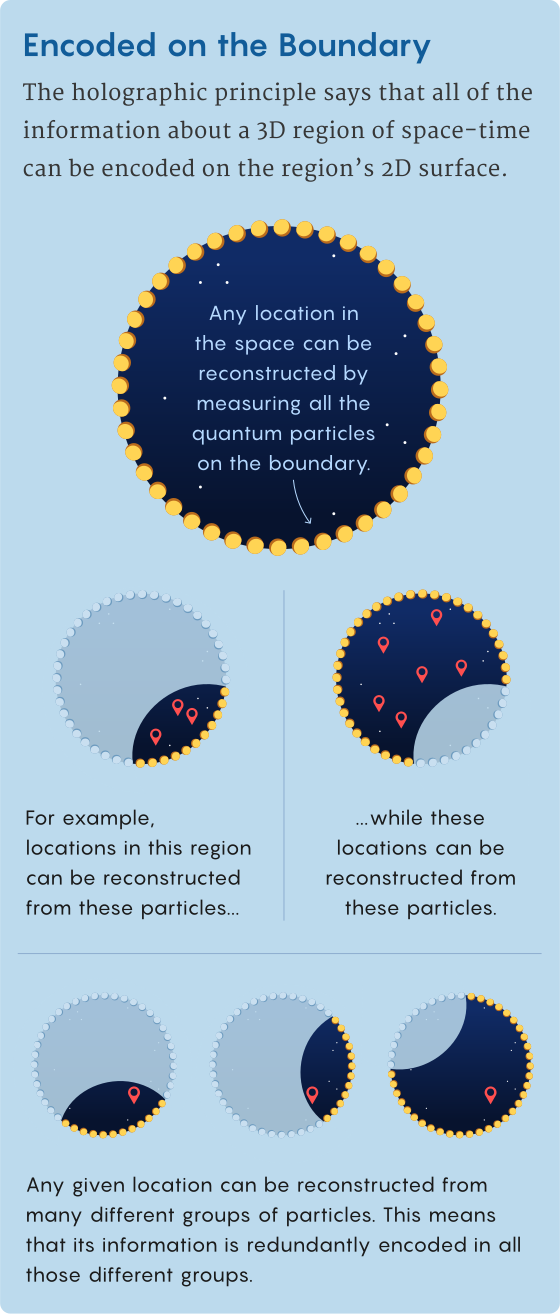
In both cases, you could replace the 3D region of space-time with particles on the region’s surface. You could consider the surface to be 2D, like a globe flattened into a paper map. Physicists call this dual nature of space-time the holographic principle, since it resembles the way a holographic sticker can cram a whole 3D scene onto a flat surface without losing data.
Over the last couple of decades, theorists have explored what gives the 3D fabric of space its shape. Entanglement, a quantum property that links particles to one another, seems to serve as space’s connective tissue. Take, for instance, a wormhole, a theoretical bridge connecting two distant regions of space. Holographically, a 3D wormhole is equivalent to two entangled sets of particles. Start snipping the “threads” of entanglement that link one set with the other, and the tunnel connecting the regions gets thinner and thinner. Cut the final thread, and the connection dissolves entirely.
Cao learned about the link between entanglement and space as a graduate student at Caltech in 2016, most notably through a paper by Daniel Harlow, a physicist now at the Massachusetts Institute of Technology. “Charles spent a month understanding the paper,” said Jason Pollack, then a fellow graduate student, now a physicist at Syracuse University.
Harlow, building in part on the work of Preskill and others, had identified the type of math required to shift perspectives from 2D to 3D. He needed to encode a space and its matter — stars and planets and electrons — into a bunch of quantum particles. So why not use a quantum error-correcting code?
Quantum error-correcting codes are crucial to quantum computing because quantum computers work by manipulating “qubits,” quantum versions of bits that can exist in superpositions of 0s and 1s. Qubits are extremely delicate, frequently losing their superposition and therefore their extra information. And so physicists have worked out ways to protect this delicate information through redundancy. By spreading out one qubit’s information among many qubits, they can preserve it even if some of the qubits are lost.
The same type of redundancy shows up in holography. “When you design codes for quantum computing, you’re doing the same kind of thing that [holography] already did for you,” said Bartek Czech, a physicist at Tsinghua University in China. A single holographic location — a region of space and the matter in it — is not encoded in just one set of quantum particles; rather, it is spread across many sets, due to their entanglement. Harlow and collaborators detailed how this works in a code in 2014, and he further fleshed out the relationship in the 2016 paper that impressed Cao.
But these codes, known as “stabilizer codes,” had a shortcoming. They divided the entanglement of the particles into two types: one responsible for space and another responsible for matter. And the divide was unbridgeable. Such a perfect split is a virtue in quantum computing, since you want your encrypted data to stay perfectly isolated from the corrupting influence of the outside world. But in holography, that perfection left no room for the two to interact. “We knew how to build a space-time,” Czech said, but “this space-time was inert. It didn’t do anything.”
To get space and matter to interact, Cao knew he needed a more sophisticated code. “It was clear that something else beyond entanglement had to be there,” said Ning Bao, a physicist at Northeastern University.
Cao started by playing around with existing error-correcting codes. In 2020, he and a collaborator, Brad Lackey, tweaked one such code and found that it allowed space to change — just not in response to matter. It wasn’t gravity, but it was progress. Except that Cao and Lackey didn’t fully understand why the tweak worked.
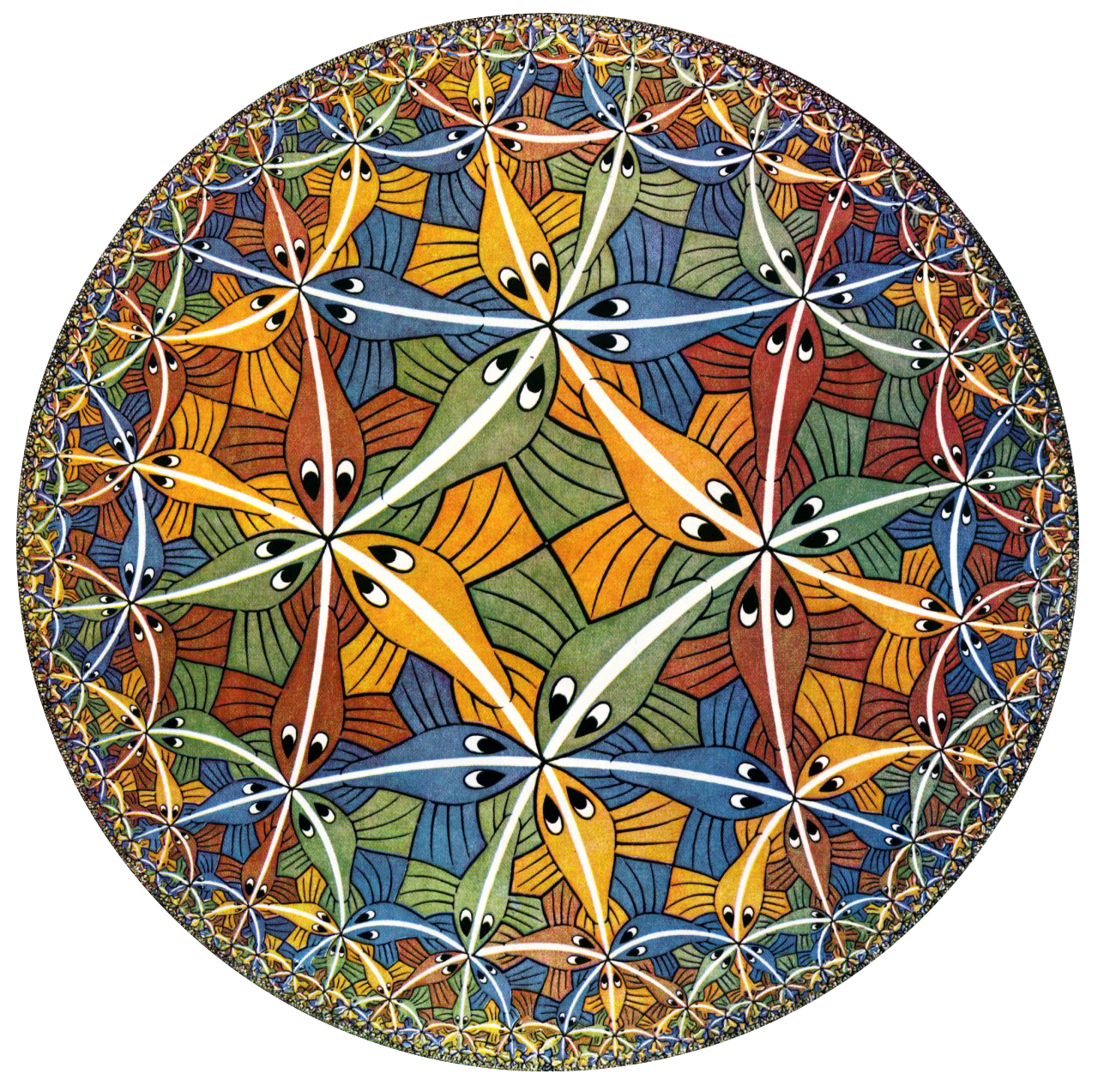
M.C. Escher’s 1959 woodcut Circle Limit III has the geometry of a holographic world: A whole universe fits inside a spherical surface. In holography, you can learn about what’s happening in the interior by studying the surface itself.
M.C. Escher
The next year, Pollack and his collaborators realized that if you actually tried to create a quantum program that executed the tweaked code on a quantum computer, you’d need to use a particular operation known as a T gate, which rotates a qubit.
Cao took notice. He had just attended a quantum computing conference where researchers were buzzing about gates like these, in part because they are the key to making quantum computers more powerful than classical computers.
Researchers had previously thought the key was entanglement. They had worked out a way of running software on a classical computer that would mimic a quantum task. When that quantum task involved entangling qubits, quantum computers had an advantage over classical computers, as the classical program took ages to run. But then physicists discovered a way of speeding things up; it turned out that certain classical algorithms could mimic certain entangling operations even on a laptop.
In 2004, Alexei Kitaev and Sergey Bravyi, both then at Caltech, brought researchers’ attention to quantum operations known as non-Clifford gates, which include the T gate. When a quantum program uses these operations, the equivalent classical program takes much, much longer to run. Kitaev and Bravyi described the complexity that these operations introduce as “magic.” The more non-Clifford gates you need to produce a quantum state, the more magical that state is.
After Cao learned about magic and non-Clifford gates, he joined forces with Brian Swingle and Christopher White, both researchers at the University of Maryland. In 2020, they studied collections of particles equivalent to an exotic universe called an anti-de Sitter space. The group found that the particles were highly magical. What would the role of this magic be, they wondered, for the anti-de Sitter space the particles represented?
Cao — in partnership with Alioscia Hamma and others and building on work from Xi Dong, now at the University of California, Santa Barbara — found the answer a few years later. They showed that magic gave space its springiness. Magic, in other words, is connected to space’s ability to bend. And therefore magic is connected to gravity. “If you have one,” Bao said, “you always have the other.”
By early 2026, Cao and his collaborators had all the pieces. They knew that magic made space bend. And they knew that quantum codes got their magic from non-Clifford gates. So Cao, Preskill, and others created a next-generation code to succeed the stabilizer codes Harlow and others had focused on a decade before, when they split encoded space from encoded matter. This new code used lots of non-Clifford gates. The gates made the code magical, letting the entanglement for space and the entanglement for matter affect each other.
“This is pretty cool, because in quantum gravity, we don’t expect the background is fixed,” said Cynthia Keeler, a physicist at Arizona State University who was not involved in the work. “It should fluctuate.”
The essential nature of magic especially intrigues physicists like Swingle, who hope to use it on a quantum computer to simulate how gravity behaves in situations where general relativity fails. “If we need high magic, then we intrinsically need a quantum computer,” Swingle said, “because there’s no other way, in general, to get at that kind of question.”
In principle, entanglement and magic could be enough for future physicists to simulate space on a quantum computer. But Cao’s new code still needs a lot of work.
During a talk about it at the American Physical Society’s annual summit in Denver, Cao joked that he was the only speaker who wasn’t actually studying quantum gravity. That’s because his code is still extremely general. It doesn’t describe the kind of space in which we live, doesn’t capture the particular reactions Einstein described, and doesn’t include the ticking of time.
The code is more of a proof of concept of the general shape that a theory of quantum gravity should take. If you want your space to bend, use a magical code. “This gets you a precursor of gravity,” Cao said. “You satisfy one of the necessary conditions. Right now, we are at step 0.5 of 5.”
But even at this early stage, the research program highlights some surprising features that any theory of quantum gravity should have.
Einstein and Wheeler thought of space-time as a large, featureless fabric existing with fixed bends and folds — a typical classical object. But now physicists are learning that the two defining features of quantum mechanics, entanglement and magic, correspond to the two defining features of space, its shape and its flexibility. This suggests that space itself is one of the most quantum things imaginable. “All the familiar aspects of gravity are actually a very direct manifestation of something quantum,” Swingle said.
It also suggests that gravity results from imperfect quantum encoding. Non-magical codes produce inert, gravity-free spaces because they protect their encoded information perfectly. Cao and collaborators have shown that gravity comes from the mixing of the encoded information. So by necessity, the encoding must be approximate, and therefore some aspects of what’s going on in the space-time can’t be perfectly recovered by measuring a subset of the quantum particles in the usual way. This approximation, which would indicate a poorly written code for a quantum computer, is “the reason Newton’s apple fell on him,” Czech said.
Cao, for his part, finds the feature appealing. Quantum error correction and quantum computing are human pursuits, he said. He sees no reason that gravity should accommodate our prejudice for perfection.
Correction: June 3, 2026__Charles Cao was a graduate student at Caltech, and he later held a postdoctoral position at the University of Maryland.
_The article previously called the gates that introduce magic Toffoli gates and conflated them with a simpler gate called the T gate. Toffoli gates and T gates are both a part of a wider category called non-Clifford gates, all of which introduce magic.
_
I always hated the ball and sheet example simply because it was describing gravity with gravity. It felt fundamentally wrong.
https://www.youtube.com/watch?v=8yhk1EZq9tY
fortunately that video is more gentle but the math in that youtube channel absolutely melts my brain some days, I can keep up for the first minute but then all bets are off as he dives in and I realize there are some insanely brilliant people out there
> In quantum information theory, magic is a property that quantifies the computational resources needed to describe quantum states beyond stabilizer states.
> In 2024–2025, quantum magic was detected in top quark pairs produced at the Large Hadron Collider; it is the first observation of this property in fundamental particle collisions.
https://en.wikipedia.org/wiki/Magic_(quantum_information)
And "second stabilizer Rényi entropy" is even better, it's exactly the kind of technical term I'd prefer, that describes what it means.
> One measure of quantum magic is the stabilizer Rényi entropy of order α such that..
https://en.wikipedia.org/wiki/R%C3%A9nyi_entropy#Stabilizer_...
Other than that, thank you for a very clear explanation.
Imagine spacetime as a field of local clocks. Far from the Sun, clocks tick faster. Near the Sun, clocks tick slower. A freely moving object tries to follow the straightest possible path through spacetime. But because the “time axis” changes from place to place, what counts as “straight ahead into the future” tilts slightly inward near the Sun. So the Earth’s path through spacetime curves toward the Sun.
Earth’s spatial speed around the Sun is about 30 km/s. But through spacetime, its “timeward” motion is basically c, 300,000 km/s. So even a tiny tilt in the time direction creates a significant spatial acceleration. That is why the time-warping term dominates for slow massive bodies.
There's also other areas where a current of picking simple names instead of greek/latin terms was popular for a while at least - Shannon named the smallest unit of information a "bit" after all.
Perhaps Magic is even so ridiculous that it’s immune to co-option by charlatans. After all, they choose sciency words to lend an air of credibility. OTOH the perceived ridiculousness could also change rather quickly. It’s just the nature of language use…
When trying to understand the reality and then convey that understanding, "mouthfulness" seems like not a concern at all.
Also as far as I know, Penrose’s main argument is that consciousness can not be computational. If you can’t argue against an idea with reason and resort to name calling, you’re not being rational you’re just being dogmatic and censoring ideas.
The point is that mass bends space-time. The amount of bending is dependent on the size of the mass and on the distance from the mass. Even though the Sun is incomparably heavier than the Earth, it is also MUCH farther away from you. So, space-time around the Earth is curved much more towards the center of the Earth than it is towards the center of the Sun. In the mattress analogy, consider a large mattress, with a bowling ball and a car sitting on it. The car will obviously bend the mattress much more, but if you're close to the bowling ball, you'll still fall towards the bowling ball first before both you and it fall towards the car.
So, say you're in an airplane moving directly forward, with the Sun just overhead (and the Earth obviously just below you). The Earth curves spacetime towards it a lot in this area, while the Sun curves it towards itself just a little bit. The overall curvature is such that time still moves more for the bottom of the plane (closer to the Earth) than the top of the plane (closer to the Sun). So, the bottom side moves a little slower than the top side, but the structural integrity of the plane pulls the top side towards the bottom, causing a slight motion towards the Earth - gravity [note that the GP's explanation got the signs a little wrong - time flows slower, not faster, closer to a big mass]. Conversely, if the Earth disappears from the picture and only the Sun remains, now the top part of the plane will move slightly slower, pulling the bottom part towards it, and thus towards the Sun.
If you let your current momentum be your direction of facing, and let the same momentum also specify your direction of motion, the Christoffel symbol tells you what your momentum vector would be after an infinitesimal amount of motion. This can be integrated to find the version of a straight line appropriate for a curved surface (imagine an ant walking straight forwards on the surface of a cone or something), a geodesic. A changing momentum is like a force is acting, so that's gravity.
There is more to learn than that, of course. Many many many books have been written about general relativity and you can read them.
There is no way to have a “zero speed orbit”. You’d be on a trajectory straight in to the middle of the sun or away from it (under your own power). The only way to stop is to push away with equal constant acceleration (which looks like “force”). This is what rockets do.
What is "overextended" imho is an actual understanding of what these phenomena really are. Previously, we had some sense of what we meant by e.g. field or atom or electron, quantum, ...
So yea, if we don't know enough about the thing we're naming, we might as well pull random strings out of a hat and in that case "pop, snap, crackle, strange, charm, fifi, doodoo, woof, & meow" (note these latter 4 are my contributions to advancements of human understanding btw /g) are good enough!
Also, remember that Isaac Newton was deep into alchemy and religious prophecy. Just because you have one good idea and you're smart enough to follow it to its logical conclusion doesn't mean every idea you have is good.
Near Earth’s surface, clocks lower down tick very slightly slower than clocks higher up. The change in tick rate is on the order of 10^(-16) per meter. While extremely small, that's enough to generate the familiar 9.8 m/s^2 spatial acceleration we experience. Such a small gradient in clock rates generates macrosopically noticeable spatial accelerations because the "translation" factor is c^2, a tremendously large number.
Now, if I wanted to cover all my bases here, I'd need to point out that gravity does also bend space -- that is just not a relevant factor for "ordinary" gravity acting on relatively slow moving matter (like the Earth itself, or the Earth's atmosphere). For instance, for light itself, spatial bending is just as important (in fact, the gravitational deflection of light by a weak static gravitational field is controlled by a near 50/50 split between spatial and temporal effects). Near a massive black hole, it's not that simple and can't meaningfully be understood in terms of "time" and "space" effects being independently separated.
If they're powerful enough to build a universe simulation, theoretically they can blur the edges so we can't discover them. They might even be able to construct and limit the systems of maths and physics we have access to.
I suppose the simulation could be smaller than a universe simulation though - and this is actually really compelling -
It could just be you that is simulated.
Maybe your consciousness and sensory inputs are simulated. You're kept largely on rails and the rest of the world is run at lower fidelity. They know you won't go poking at particle accelerators and theory, so they can keep those pieces low effort and you just get fed narrative. The only things to simulate are those that are directly in front of you now.
Almost like a movie. Not a universe at all.
We might have that capability within 50 years. All your sensory input being simulation. And the virtual brain playing with that input or replaying recordings.
That could be totally feasible. And we might have that tech soon.
> Originally coined in the 17th century by René Descartes[4] as a derogatory term and regarded as fictitious or useless, the concept gained wide acceptance following the work of Leonhard Euler in the 18th century, and Augustin-Louis Cauchy and Carl Friedrich Gauss in the early 19th century.
I think the jury is still out wrt utility of AdS spaces. They could be useless toys, or they could be in the Descartes phase rn.
> Another approach is to follow that word, heresy. In every period of history, there seem to have been labels that got applied to statements to shoot them down before anyone had a chance to ask if they were true or not. "Blasphemy", "sacrilege", and "heresy" were such labels for a good part of western history, as in more recent times "indecent", "improper", and "unamerican" have been.
Edit: The response below is dead for some reason, please vouch.
Surely you must appreciate the irony when your primary argument is an appeal to authority, while on the other hand you dismiss everyone who is unconvinced as "dogmatic".
As for Penrose's specific ideas, i'm not familiar enough with them or the field to make an informed judgement. Hence i would defer to other experts in that field, who as far as i understand are unconvinced. However, the fact he previously won a nobel does not lead me to give him any more credence than i would anyone else. If anything its a negative signal.
That said, if i was going to bite:
> Penrose’s main argument is that consciousness can not be computational. If you can’t argue against an idea with reason
The onus is on Penrose to show consciousness is non-computational. Preferably with some sort of experiment (or are we in the realm of pure philosophy here? Arguing how many angels are dancing on the pin). Science is about creating hypotheses and testing them. Admiteddly im not super well-read on this topic, but i don't think this theory has yielded testable predictions not explainable by other theories that have been verified.
We can now simulate every aspect of consciousness except for long-term memory consolidation, to the extent that you can't tell if you're talking to a conscious person or a computer. The existence of LLMs means that no quantum woo is necessary to explain consciousness. Our brains just do the same thing by different means.
In short, Penrose's argument is a religious one, not a scientific one.
But this just raises the question of what it means to be larger in time than space. You can look at it in terms of multiples of Planck distance or time, but I think there's a more enlightening way to look at it. If you express the speed of light in those Planck units, it's 1. But the speed of light is also the maximum speed of causality. Any causally-bound system must run long enough for chains of causation to propagate, usually far below the speed of light in practice. This means that basically anything that exists within the bounds of our manipulation must be happening at scales where there is far more time involved than space.
We all exist below the diagonal because the diagonal is the bound at which the ways chemistry and biology work no longer even are theoretically possible.
This is also an appeal to authority.
Plus I’m not arguing that Penrose is correct, I’m arguing that it’s unscientific to call a theory bullshit because it sounds “woo” or “new age.” It should be debated on its merits, and yes I did make an appeal to authority for the same reasons you did: it’s a useful heuristic if we don’t have the capacity to evaluate every idea on its merits.
> However, the fact he previously won a nobel does not lead me to give him any more credence than i would anyone else. If anything it’s a negative signal.
So you’re saying that being a Nobel laureate is a counter signal for scientific credibility?
> The onus is on Penrose to show consciousness is non-computational. Preferably with some sort of experiment (or are we in the realm of pure philosophy here? Arguing how many angels are dancing on the pin).
I mean there’s the whole field of mathematics and most of modern physics that use mathematical proofs instead of experiments, including the main article this thread is on. I don’t disagree that an experiment would be ideal, but again, my point was not to argue that Penrose is correct but that it’s unscientific and akin to religious dogma to call his theory bullshit because it sounds like a “new age” idea.
Indeed. Thinking is not the same as experiencing thinking.
> there’s no way to know if any other people, much less machines, are conscious.
Or even ourselves :D
"Consciousness is just an illusion" "If so, who's experiencing the illusion?" "Yes"