"NASA’s Robotic External Leak Locator (RELL) is a robotic, remote-controlled tool that helps mission operators detect the location of an external leak and rapidly confirm a successful repair.
… Two instruments working in sync give RELL its ammonia-detecting superpowers. … Mass spectrometer & Ion vacuum pressure gauge"
[1] (PDF fact sheet from NASA) https://www.nasa.gov/wp-content/uploads/2023/10/rell-factshe...Naively, I would assume that there are airlocks between the different sections of the ISS. I would also assume that they would close these airlocks while doing the kind of work they are doing to repair the leaks.
So, assuming I'm right (and my assumptions might be wrong,) why do the astronauts need to shelter?
I'm clearly not understanding what they're trying to say here. If _one_ leak was sealed, but the air was "escaping elsewhere", it would still be a leak, causing pressure readings to drop.
Obviously they can't, it looks like an obvious solution they couldn't have missed. But I wonder why it is impossible to do.
I expected better from the BBC.
>> "SOMEDAY, THE international Space Station will descend, but if you're frightened at the prospect of a million-pound hunk of metal falling out of the sky, take heart. NASA does have a plan to decommission the space station eventually without creating havoc. The European Space Agency is planning to build three expendable space vehicles by 2003: two of them will ferry propellant, the other will force the station to land in a designated area. Called an automated transfer vehicle (ATV), the craft will be unmanned, similar to the Russian Progress resupply vehicle but larger, with enough thrust to nudge the entire station down in a single piece-a cheaper and safer alternative to hauling pieces of the station down in multiple trips. Roughly 90 percent of the station will be cinder by the time it reaches Earth's atmosphere; a Pacific splashdown is the plan.-Gunfan Sinha"
For example: "The space station is made up of Russian and US segments, and there are modules from the European and Japanese space agencies too." It feels like this sentence is inserting some points, but is lacking in authorial intent. Is the intent to say the station is largely Russian and US, or to say the station has more than two partners? Probably an okay sentence, but still feels like a stone in the shoe.
Rumors are that Elon gets spaceX to buy tesla so tele-operated Optimus robots do the hard space work from now on. Not a bad idea per se but I’m not educated on the topic. Curiosity has me asking if we really want humans to go to mars or in space at all.
> Astronauts told to return to International Space Station after sheltering over air leak repairs.
One of the innovations of ISS is larger docking adapter with bulkhead that is removed after docking. Russian section still uses hatches. All of the cables go through the docking adapter or hatch which makes impossible to close door or quickly disconnect.
I don't think any crewed interplanetary mission is going to last that long for the foreseeable future.
These are usually the same vessels they used to get up to the station.
This has the consequence that if they need to re-dock one of the vessels (for whatever reason) all the astronauts that would normally use that vessel must board it for that menuvre. Just in case it fails to dock again.
And they don't normally have spares.
IIRC, this is a good video on the topic: https://m.youtube.com/watch?v=82YHM12n2JI
There are not. The airlocks on the ISS are either docking modules for spacecraft, for spacewalks, or for deploying satellites.
The crew shelters in the vehicles so that in case of an emergency they can evacuate immediately.
Not exactly something you want to be doing under time pressure.
Paint obviously is not the right tool for making seals air tight.
I've never shipped anything to real customers in the wild before, so let me tell you how insanely stressed I was to open the firmware and find a 10k lines of C contained entirely within a single switch statement. I think they used some no-code tool to graphically design a state machine then plopped the generated code straight into the device.
Surely this was considered when building the first modules.
Love the use of the word supposed there.
Dragon is built by Space X that has a track record of blowing things up.
Corrosion is a hard problem in living quarters (ie moisture and salt) in space (sealed with no gravity)
I.e. leaving the actual ISS structure entirely.
Except you forgot to mention an epic leak in Destiny just three years after it was attached to the ISS: "At its highest rate, the station was leaking about 5 pounds of air per day overboard." [0] Imagine that happening on the 4th year of American Mars mission.
Also, if you on American mission to Mars, it would be reasonable to worry about cooling system dying mid-flight requiring three spacewalks to fix it: "We'd lose cooling capability to half of the electronics on the U.S., European and Japanese part of the space station." [1]
We had two astronauts stranded in space for the better part of a year just last year!
https://en.wikipedia.org/wiki/US_Orbital_Segment
Several of the US modules were built in Europe by Thales Alenia Space and were transferred to the US in exchange for the US launching the European modules on the Space Shuttle.
Paper?
No Paper. No string. No sellotape.
They were also the cause of a fire on Mir. https://en.wikipedia.org/wiki/Mir_EO-23
I don't think you'll find that type of language in the more traditionally published/edited articles.
It looks like NASA helped redesign it to be safer, creating the modern Solid Fuel Oxygen Generator (SFOG) system still in use on the ISS as the backup.
Several other countries contributed, in an attempt to include other nations, but for all practical purposes it is an American/Soviet(Russian) project from a more civiled age of international competition. I think its appropriate the article remind us of this. A lot of people wasn't born them, and have no idea that once science had less borders.
(Submitted title was "Astronauts on ISS told to shelter as repairs under way to fix air leaks", no doubt because that's what the article said at the time.)
Because, space. It's hard. Unbelievably hard.
Generally firmware can't be updated by the end user because there is physically no way to do so without returning the hardware. (Unless an update mechanism is specifically implemented in hardware, obv)
Pucker factor goes way up because if you ship a bug, there's no way back. If you aren't careful, you can break physical devices which can have consequences anywhere from thousands of RMAs to burning down a user's house depending on the hardware and how bad you fucked up.
The deployment process itself is about the same. Tests and more tests, including testing on prototype and/or pre-production units. Hardware testing can get wild depending on application, but I don't think any SWE would find it too surprising. Then you email a binary to your manufacturer and pray
Just convincing them that their problem boiled down to a single incorrect bit was difficult enough but then having to, in a day, build and successfully operate a test harness to prove the fix worked was the real stress.
I do not miss embedded engineering.
So in a cylindrical ship you'd want to have one end pointing at the Sun most of the trip. This is, of course, very different in effect on the hull compared to the repeated expansion and contraction of heating cycles.
Doing the whole module sounds like a lot of mass though.
https://www.reuters.com/world/nasa-live-international-space-...
Conservation of mass: if a cubic meter of air escapes, that's 1.25 kg, and you need at least that much in candles. (You actually need 2 kg because the candle isn't solid oxygen)
There's ultimately 1.2 t of atmosphere on the ISS. This will also result in a pure oxygen atmosphere, which is dangerous. You need nitrogen.
It might be hard to access the actual pressure hull from the inside (there's probably insulation and padding on top)
If you use paint, you somehow have to get rid of the solvent in it when it dries, which might be a problem when painting a whole module
If you mean on the inside, it'd be a lot of time and disruption to devote to maintenance on a station that's already having to spend an increasing amount of time on maintenance instead of science.
The modules have a lot of stuff that has been wired between them over the years, all that would need to be sorted out, consequences understood and more before ever starting the work, and by then it'll be time for the ISS to retire anyway.
(All this was pretty lucid of the US, but obviously the Russians did no such thing on their side. The Japanese even managed to get an ISS resupply mission launched on their own vehicle, which is no small achievement, and the ESA did a bunch of good science. And what would space be without the Canadarm :-)
Thats why the ISS can have small leaks like this that are a problem but not catastrophic like they would be in a deep sea submarine.
You don't get the AtOx going to mars but you have everything else which will utterly take its toll on a traveling craft.
Anything larger, say a lost screw driver, would punch thru the ISS like it wasn't even there leading to some ugly consequences.
The ISS can dodge debris by adjusting the height of its orbit.
Russian cosmonauts Sergey Kud-Sverchkov and Sergei Mikayev were using a saw to break into an area where they believed they could access the crack leaking air, the NASA official said.
NASA officials disagreed with this method, the NASA official added, prompting mission control in Houston to order safe-haven procedures."
A few years ago a Soyuz was improperly drilled during manufacture. This was patched with a super epoxy... and then began leaking air on orbit. Paint won't seal what a super aerospace epoxy failed to seal.
I don't know what solvents would do, but I remember that astronauts' bone density loss in space means there are challenges around managing the significant amount of calcium captured by the air scrubbers in the ISS.
Wouldn't all paint works well in microgravity? If it didn't, I would think you wouldn't be able to apply it to your floor, walls, and ceiling, with the same paint.
Why obviously?
The USSR invited cosmonauts from all over the world to fly and work at the Salut-6, Salit-7 and Mir stations.[0]
That's France, Britain, Austria, Japan, India, Soviet block countries, Mongolia, Vietnam, Syria and Afghanistan.
Maybe parent feels like rocket science is a field that should have few launch failures?
I can't give you a quantitative answer since I'm usually focused on new research rather than what company/nation did said research... but their stuff does seem to blow up on the launchpad more often than NASA's :-)
In college, we'd use toothpaste for the holes left from nails in the walls we hung up our posters with.
A fun fact about SpaceX:
Remember our esteemed national American hero, and spiritual father of SpaceX, Wernher von Braun.
Wernher wrote a book about Mars referring to "The Elon", an imaginary Mars governor, and the father of Elon Musk claimed that Elon's name came from there.
Well at least, that's what he claims. Reality doesn't matter if you have billions and power. History can be rewritten.
Because it's more extreme.
Do you think a soft vacuum of 0.002 atmospheres of pressure would be notably easier to prevent leaks into?
> A few years ago a Soyuz was improperly drilled during manufacture. This was patched with a super epoxy... and then began leaking air on orbit. Paint won't seal what a super aerospace epoxy failed to seal.
Wasn't the fix on the ground a secret patch by the person that drilled the hole? I don't trust that to have been done properly.
And then when they noticed it was leaking... they used the super aerospace epoxy. Which was labeled as temporary but as far as I know it's still the fix.
Also that was a serious hole, 2mm wide, not a microhole like you'd try to fix with paint.
Publications have had live-updating articles for things ongoing for years. This seems both entirely reasonable and normal, and I'm not sure what the concern or issue is.
Two astronauts stranded for nine months taking the ISIS supplies intended for others. This is after they safely docked, which was considered risky at the time.
The Soyuz, the MIR, the human space records, the Venera program, closed cycle rockets, all have no equivalent in the West. Even their version of the shuttle was superior (it flew 100% autonomously).
I don't like Musk, but he single handedly saved the Western space programs.
Paint that would fall to the ground if it didn't stick to anything on Earth, would just be floating around in microgravity. Any dissolved gasses or moisture can usually passively sort themselves out due to their differing masses, but again, not in microgravity.
Unless you count test artifacts, an actual catastrophic failure of a rocket on a launchpad (or even in flight) has been rare in the last 10 years.
https://en.wikipedia.org/wiki/Salyut_3
had a machine gun!
> Otherwise please use the original title, unless it is misleading or linkbait; don't editorialize.
So, even if you use original title, once "Live Update" article changes, it might seem that submission did not use original title.
Pallab Ghosh
Science correspondent
Image source, Anadolu via Getty Images
Image caption,
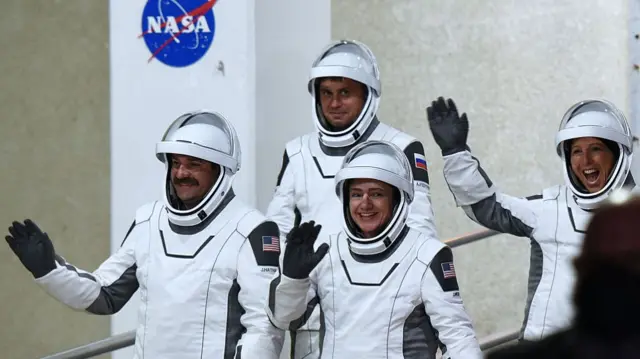
Crew-12 mission astronauts Jack Hathaway, Andrey Fedyaev, Jessica Meir and Sophie Adenot preparing to launch to the ISS from Florida
The seven crew members currently aboard the International Space Station represent five countries and a remarkable range of backgrounds.
Jessica Meir, 48, commands the Crew-12 mission. Born in Caribou, Maine, to Israeli and Swedish immigrant parents, she holds a doctorate in marine biology and once studied how emperor penguins hold their breath in Antarctica. She made history in 2019 as part of the first all-female spacewalk. She is a mother and a private pilot, and is conversational in both Swedish and Russian.
Jack Hathaway, 44, is Crew-12's pilot and a US Navy Commander from South Windsor, Connecticut. He trained as a test pilot at the Empire Test Pilots' School in the UK before being selected by NASA in 2021.
Sophie Adenot, 43, is a French colonel, helicopter test pilot and the second French woman ever to reach space, inspired as a teenager by watching Claudie Haigneré launch to the Mir space station. She speaks four languages, is a certified yoga teacher and a trained skydiver.
Chris Williams, 42, is a Nasa physicist and former cancer researcher at Harvard Medical School and Brigham and Women's Hospital who pivoted from studying the early universe for his MIT doctorate to treating tumours before becoming an astronaut. He also volunteered as a firefighter and EMT.
Sergey Kud-Sverchkov, 42, the station commander, is a rocket engineer born in Baikonur — the very city from which so many space missions have launched. He graduated with honours from Moscow State Technical University and worked as an engineer at RSC Energia before being selected as a cosmonaut in 2010. He was awarded the Hero of the Russian Federation after his first ISS mission in 2020. He has also trained in underground cave systems in Sardinia and studied planetary geology in the Dolomites as part of ESA's astronaut preparation programmes.
Sergei Mikaev, 39, is on his first spaceflight. Born in Irkutsk in Siberia, he rose to Major and commander of a military aviation unit in Primorsky Territory — Russia's remote far east, bordering China — before being selected as a cosmonaut in 2018. He is married with two children.
Andrey Fedyaev, 45, is a Russian cosmonaut and former Air Force major from Serov in the Ural mountains, on his second spaceflight. When he flew on Crew-6 in 2023, he became only the second Russian cosmonaut ever to launch aboard an American commercial spacecraft. He is now on his second mission, again flying alongside Nasa colleagues aboard Dragon.
Fry: How many atmospheres can the ship withstand?
Professor Hubert Farnsworth: Well, it's a space ship, so I'd say anywhere between zero and one.
Now, will it immediately off-gas and embrittle on exposure to vacuum? Different question.
> Any dissolved gasses or moisture can usually passively sort themselves out due to their differing masses, but again, not in microgravity.
This is a solved problem with the ECLSS system [1], required from humans releasing ~3.3 lbs of water per day, and exhaling gases that must not accumulate or form dead zones, and normal VOCs scrubbers [2] due to most modern materials releasing them.
I suspect it would be more of a "how many extra filters do we send" type problem and cycling the collected water a couple more times.
[1] https://www.sciencedirect.com/science/article/abs/pii/S13640...
[2] https://www.researchgate.net/figure/Typical-concentrations-o...
Don't blame Russian space failures on the war.
Roskosmos was robbed blind by the likes of Dmitry Rogozin long before 2022. The Angara heavy launcher project has been started in the 1990s and still reminds me of Duke Nukem Forever. The Vostochnyi cosmodrome has been a black hole in red numbers for some 15 years etc. Things were "meh" even during the times when oil was 140 USD per barrel and Russia had no sanctions going against it.
https://www.space.com/space-exploration/launches-spacecraft/...
They've also got some new passenger jets certified and about to enter production (MC-21 and SU-100).
But "Nasa" still looks weirder to me than "NASA" does.
Like writing "The Scsi bus went Awol" instead of "The SCSI bus went AWOL" also looks weird.
Or coat the outside with a soapy water solution.