Some day I might try it again using modern css
The reason is that full bandwidth 6 Mhz analog composite or component video could look wonderful. If you ever have the chance to see a 2-inch quad VTR playing a master tape on a broadcast quality monitor pleased do. I suspect you'll be shocked at how good it looks, even to modern eyes. Yes, the absolute resolution is lower, but the magic of those analog broadcast standards was how gracefully they fit so much image into 6 Mhz of bandwidth. Conversely, VHS tape recording was the absolute worst, most compromised form of that. At the time, it was the best that could be done at consumer prices. But no one ever thought it was remotely good quality in any sense other than perhaps "better than nothing", and even that was hardly unanimous.
There's something about full bandwidth broadcast quality analog composite video that can be genuinely aesthetically pleasing, even compared to digital HDTV. Sadly, very few consumers ever got to see it in its pure, unadulterated form. Even live broadcasts, after being sent up a transmitter tower and down an aerial antenna, were a decimated form of the original signal at the head end (although leagues better than VHS). Yes, modern digital IS better in almost all ways, but in a few ways there was, and still is, something uniquely 'good' about that analog head-end video signal. I won't say 'better' because that's an aesthetic and stylistic judgement but definitely 'good'. Whereas, there's literally nothing good about VHS. At no point ever did a 1980s video creator look on their equipment shelf, see a VHS camcorder next to... literally any other camera or recording system, and say "I'll take the VHS today because it's the better tool for this job."
There's one context where I'm a huge proponent of recreating our analog past and that's when viewing 1980s and early 90s computer or game console graphics created to be displayed on 15khz analog composite video displays. That's when analog CRT emulation via GPU pixel shaders should always be used. The square razor sharp, hard-edged pixels of such content as seen on modern digital flat screens is an inaccurate distortion of the past because no one in that past, like the people involved in the creation or consumption of that media, ever saw square pixels like that. The only displays we had then were CRTs and images made for 15 Khz analog CRTs look not only different but much better on the displays they were designed on and for (or a good simulation of those displays).
"Whatever you now find weird, ugly, uncomfortable and nasty about a new medium will surely become its signature. CD distortion, the jitteriness of digital video, the crap sound of 8-bit - all of these will be cherished and emulated as soon as they can be avoided. It’s the sound of failure: so much modern art is the sound of things going out of control, of a medium pushing to its limits and breaking apart. The distorted guitar sound is the sound of something too loud for the medium supposed to carry it. The blues singer with the cracked voice is the sound of an emotional cry too powerful for the throat that releases it. The excitement of grainy film, of bleached-out black and white, is the excitement of witnessing events too momentous for the medium assigned to record them." - Brian Eno
And of course PAL and Hanover bars.
You mind reader you
I also ported it to JavaScript (linked from above page)
Though in my case the purpose was to digitize my video tapes and teach myself about DSP.
Then even we could have filter like: VHS Panasonic, VHS Sony...
This would be very interesting project.
I'd donate heavily to one that would actually let you send decodable teletext pages in the output ;-)
I was also looking into https://codeberg.org/fsphil/hacktv which generates a variety of different analog tv signals (meant to be broadcast using HackRF) - but yes, I want the opposite - an analog-receiver-emulator...? And one that would be "ok" with incorrect signals // fail like an analog TV would... :-)
Hmm. Now that we have 1 terabyte 1000MB/s NVme drives, we can really be nostalgic about the 1.44Mb 3.5” floppy drives that have about 30KB/s throughput…
Might even be practical with the latest trends in storage pricing…
It can't be that hard for someone with skill and determination!
- Every new medium obsolesces the previous one - which then becomes the content, or the art form, of the new medium.
- Once the old ground becomes content of a new situation, it appears to ordinary attention as aesthetic figure. At the same time, a new retrieval or nostalgia is born
But there are also certain qualities in analog audio or video that were lost or severely degraded in the technologies that came after. For example, you need an extremely high bitrate mp3 to get to the fidelity of a vinyl (CDs can achieve it without issues, though) and in crts image clarity in movement is still unmatched in modern displays, and will probably always be due to the sample and hold nature of modern displays.
For ham radio-like sounds, maybe use SDR software like SDR++ and just pipe in a regular audio input, then mess with the decoding settings like LSB/USB.
I bet the first viewers of VHS were busier with marveling at color, compactness and convenience instead of thinking of the new medium as something ugly and nasty. New technology that gets very popular usually starts as state of the art and impressive, and it's only in retrospect that people think of it in condescending way.
Instead it’s about chasing the era. For example, the 80s/90s seemed like a happier time, for both those who grew up in it and those who don’t, and imperfections like VHS artifacts put the viewer in that mindset.
I was watching a live worship session on Youtube and it was beautiful, kept my mind at peace.
Now mind you at the same time I was also a perfectionist, which means you tend to see imperfections in others.
Now at a certain point the singer's voice broke as she was hitting a high note. But before I could mentally register the imperfection I heard or felt such a clear gentle voice that said: "that was the most beautiful part".
In an instant it reframed the imperfect into perfect for that moment and thus forever.
And that's what your quote encompasses. Good read, thanks for sharing.
I'll email you. sorry everyone, just two pal's pall'ing around xx
I wish my VCR was that good in LP mode back then!
For teletext it would display 40x25 text with eight colours (the colour control codes took up a character space) and simple block graphics, which was stored in the first 25 lines or so above the top of the screen.
In the UK, the BBC ran Ceefax and ITV ran Teletext, which you could access with a button on your TV remote. These days it's actually possible to recover them from VHS recordings with really careful analysis (the bandwidth wasn't really there for it to work with a naive data slicer). During the day BBC2 ran "Pages from Ceefax" with some library music behind, when it didn't have Test Card F up (making Carole Hersee the most broadcast face on British TV, probably even to this day).
But the quality/color was always a noticeable downgrade from broadcast quality video (and that was a noticeable downgrade from film). But the sacrifice was absolutely worth it.
It is notable that LaserDisc only came out two years after VHS (and before it reached mass adoption), and it could produce (and often exceed) prefect broadcast quality video. Anyone could see the improvement.
Yet LaserDisc never had much success outside of enthusiasts, simply because it couldn’t match the convenience of VHS. Well… it was mostly the lack of recording, but that’s an aspect of convenience too.
now, i am not so optimistic we will get there, however.
Yes, yes we will. And we'll throw random ad breaks in there in the middle of the dialog just for shits and giggles, unskippable of course, at a +10db volume too.
Yes, just like we make remakes of Windows 95 in typescript, we will make retro video streaming platforms with spinners and buffering effects.
For those born after an era it can be easy to romanticize an era. And for those who lived through it, it can be easy to remember the good, and forget the bad.
Growing up in the 80s with no cell phones meant it was much harder to co-ordinate schedules, events, social events etc. No "I'm outside, where are you?"
Ultimately each era is different. Some good, some bad. But in 20 years expect your kids to be idolizing the "20s". "Such a simpler time than now..."
"You got to stay home for a year? What fun...."
DVD resolution seemed fine to me at the time - it does not seem fine anymore.
Cassettes were not great, not terrible compared to CDs. That is still the case because stereo audio doesn't get much better than CDs.
Conclusion: Whether something seems good at the time depends on availability of something similar but better.
Related is that a lot of cultures embrace intentional imperfections in art for spiritual reasons, as it conveys authenticity and humility in the face of perfection. E.g. Persian flaw [2].
[1] https://en.wikipedia.org/wiki/Gimme_Shelter
[2] https://en.wikipedia.org/wiki/Persian_carpet#cite_note-68
In Islamic art, the artist often leaves a mistake in a pattern, or a little blob, or some error somewhere in it, because only God is perfect.
In Japan, craftsmen will leave a tiny scratch on an immaculately polished piece of wood, to show how perfect the rest is.
https://en.wikipedia.org/wiki/Quantization_(signal_processin...
Many TVs people already had in the 80s didn't have RCA connections so VCRs were connected via twin lead to F connector adapters. They had the same noise as the antenna or cable input. So your commercial tapes usually looked about as good as broadcast. If you actually read the instructions with your VCR to set the timing correctly recorded broadcasts in SP mode also tended to look pretty good.
In absolute terms the VHS video was worse than the original broadcast but on the TVs we had it was hard to notice.
This definitely changed through the 90s. Larger and brighter tubes made the deficiencies of VHS more noticeable. Moving to cable TV from antenna was also very noticeable and made VHS quality more apparent.
If you happened to see a LaserDisc video as a comparison to VHS then the quality difference was stark. As much as VHS and DVD by the late 90s and early 00s. However I think that direct comparison was out of reach for most people.
The lack of recording was also a killer, if you went with VHS you could record and watch home movies if you had a camera, read videos at the video store, record from broadcast TV, it was much more versatile.
Except PAL/SECAM don't have any of the color issues of NTSC.
That said, I would not be surprised to see camcorders, DV or VHS or whatever, rise up as a Polaroid-like alternative to smartphone cameras! Old digital point and shoots are already popular that way.
The imaging device used in electronic camcorders before the transition to CCD had visibly gray whites. They weren't so great by any standards. Hence very few chases it, with nostalgia being the sole reason to do it.
See also: Picture At Last!
See also: System Essentially Contrary to the American Method
I disagree with this, the lack of cellphones meant that once people agreed to a plan, they stuck to the plan. "Meet next Saturday at 17:00 at the main square", and everybody would be there.
Nowadays people keep arguing and changing plans until the very last minute, it's exhausting.
The model (HDRCX405) is wonderful, 30x optical zoom a real value-add over smartphones, but also I just love the ergonomics in general, very easy to pick it up, and start a video within a second.
That said, Sony discontinued the low-end handicam line last year (this model went from $200 new to $800 used), which is really unfortunately, right as I hope this niche might gain momentum.
At about 1:30, just after the "I was very nervous" line, Haley pushes her voice until it breaks. I found it a lovely little grace note, emphasizing the lyric.
I ended up reaching CFTO (CTV Toronto), and took the footage over to Channel 9 Court. What happened next took me by complete surprise.
The flagship station of a national network had no deck in the building that would play HDV mini DV tapes. I hadn’t brought my camcorder or my MBP either, so I couldn't quickly convert it into a format that they could use.
I ended up going home, and exporting via FCP and burning onto a DVD. It worked, I got to see the inside of a news station and I got $135 for it. The news broadcast later that day showed about 10 seconds of my footage, which by extrapolation, was the highest-ever hourly rate I’ve ever earned: ~$48,600/hour.
The lesson here was that DV and DV-adjacent workflows were difficult in a pro context even when they were mainstream in the consumer market.
NTSC = ''never twice same colour''
SECAM = ''système électronique pour confondre les americaines.''
As for your second point. A friend of mine's little sister asked him for help setting up the vintage camera she bought. And it was an early 00s digital point & shoot.
Give the idea that this is something from another reality.

Your analog dreams, come true
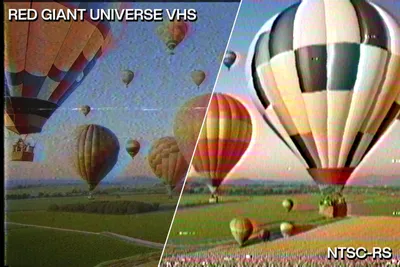
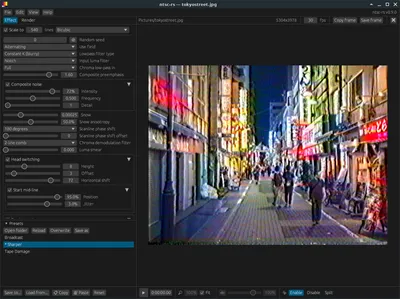
ntsc-rs is a free, open-source video effect which accurately emulates analog TV and VHS artifacts.

Amazingly accurate
Other popular effects eyeball the look of VHS tapes using simple color lookup tables and overlays. ntsc-rs uses algorithms that model how NTSC transmission and VHS encoding actually work, based on algorithms developed in composite-video-simulator, zhuker/ntsc, and ntscQT.

Blazingly fast
ntsc-rs is written in Rust, and is multithreaded and SIMD-accelerated. Unlike similar effects such as ntscQT, it can run in real time at much higher resolutions than actual NTSC footage.

Fits into your video editing workflow
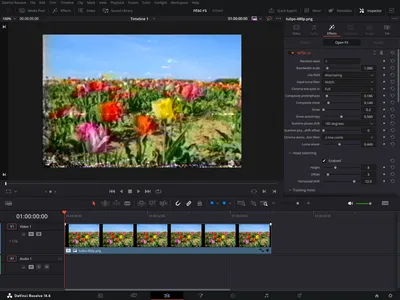
ntsc-rs is available not just as a standalone and web application, but also as a plugin for After Effects, Premiere, and all OpenFX-compatible software. This includes DaVinci Resolve, Hitfilm, and Vegas.