The result is an antenna that operates at very low frequencies, around 35–36 kHz, while remaining far more compact than the conventional electrical antennas that work at those same frequencies.
They are using a super low frequency.
However, this required huge antennas and very high power transmitters, so this was used mainly to transmit short messages from a terrestrial station to submarines, for instance instructing them to send an antenna to the surface, for bidirectional communication at high speed.
The innovation here is the use of a new kind of antenna, which can work well under water despite small dimensions, and with which a low-power transmitter is sufficient for communication with other submarines or with a surface boat, up to a few hundred meters.
According to the late, and somewhat controversial, T.E.Bearden the Rogers system has been rediscovered and then "lost" at least five times since WW1.
"James H. ROGERS Underground & Underwater Radio ( Static-free Reception & Transmission Underwater & Underground )"
https://www.rexresearch.com/rogers/1rogers.htm
There is also
Wallace MINTO Hydronic Radiation Transmitter
Radio-Electronics (May, 1967), p. 37-38.
“Build a Hydronic-Radiation Transmitter”
by Jack Althouse
“Scientists in Florida have discovered a new form of electromagnetic radiation which propagates under water as well as radio does in air”.
https://www.rexresearch.com/hydronics/hydronics.htm
While not indented for water use the Sutton & Spaniol et.al.'s "Black Hole" Antenna is always of interest when it comes to VLF/ELF. This work was done for NASA. Dr Sutton described it to me this way:
"Re: ACTIVE ANTENNA From: John and Helen Date: 10/02/05 10:54 pm
Hi Bob,
The synchronous detectors were used in temperature monitors and temperature controllers designed to control temperatures on spacecraft at 60 milliKelvin +/- a few ucroKelvin. The preamplifier had to have a gain of 10E5 after which the demodulated signal had to be converted by a 16 bit ADC, with +/- 1LSB allowable error.... so of course, you can see that we were working with extremely small signals buried in the noise, and we had to go all out in an effort to beat down the noise. That's why we had to use a new improved synchronous demodulator. This project was as close to being impossible as you can get! I still have trouble believing that we actually made it work.
The active ("Black Hole") antenna was developed in another project, where we didn't want to transport a two meter long antenna that weighed 200 pounds.....so we miniaturized the hardware while simultaneously expanding the antenna field cross section. We wanted to receive the entire ELF-VLF bands all at once, so we had to have an extremely broadband antenna....like four decades of bandwidth or more. You wouldn't believe the arguments I had with the reviewer at Physics Essays. He just couldn't believe that one could do what we did....and if it was indeed true, then why hadn't someone done it years ago?.., "and what makes you so smart", .so, of course, "this must be nonsense, etc....." Progress in physics is so bloody difficult because most physicists think that everything worthwhile has already been discovered....so they expect nothing new. This is negative feedback which, of course, makes the system stable, I suppose.
The one text book that includes diagrams of the antenna-external field interaction is listed as one of the references in the Physics Essays paper. Sorry, I can't remember the name of the author or the title.
John Sutton, Ph.D."
https://web.archive.org/web/20120722112702/http://www.unusua...
does this result in some acoustic side channel emissions? can an adversary track subs by correlating acoustic with EM noise if this were employed on second strike submarines?
conceptually its like a 3 port device: a magnetic port, an electric port and an acoustic port.
One would be especially interested in the scattering parameters S_mag-acou , S_acou-mag , S_elec-acou, S_acou-elec at the used frequencies, for passive detection, and for wider frequency range for active detection...
Yes, waves apparently compress or expand depending on the medium they are in...
I'm curious as to what the extremes of potential medium might be... on one end, we might have the densest of heavy metals and on the other, we might have the vacuum of outer space...
Also, what role does/would temperature play?
If a heavy metal was frozen and its temperature brought as close to absolute zero as possible, then would that shrink or expand any propagated waves through it, if even by the smallest amount?
Also, if so, might there be a definable relationship between that phenomena, if it exists, and superconductivity?
Anyway, great article, and it's interesting to learn about Magnetoelectric Antennas!
(I had never heard about them before!)
Acoustics is the entire game under water. You can only detect nearby objects with visible light or sound. A great deal of submarine design goes into minimizing the amount of sound emitted into the environment because water is astonishingly good at transmitting sound waves very long distances with little loss.
The wavelength is the ratio between velocity and frequency, so it changes proportionally.
If you multiply 36 kHz by 8326 m, you get a value only slightly less than the speed of light in vacuum, which is true for the propagation of electromagnetic waves in most gases.
On the other hand, with 170 m, you will get a speed of VLF radio waves in sea water that is much lower than in vacuum.
The speed of electromagnetic waves in most media depends strongly on frequency.
At frequencies corresponding with visible light, only in few materials the speed is lower than half of the speed in vacuum (i.e. the refractive index is greater than 2).
On the other hand, for low frequency radio waves, speeds that are 10 times slower or even 100 times slower than in vacuum are not unusual.
Page 13 shows the diagram of an undersea fiber network separating into durable heavy and lightweight wires.
Sea surface
~~~~~~~~~~~~~~~~~~~~~~~~~~~~~~~~~~~~~~~~
|
| near-surface armored cable
|
[Depressor]
\
\ fiber cable
\ 0.010 inch diameter
\ up to 40 km long
\
[Float pack]
\
\ 50 m secondary cable
\
[Vehicle]
https://sundowner.colorado.edu/seefeldt/ptc-2005_2016/2013_p...Such antennas and transmitters cannot be installed in a small submarine.
Here a new kind of antenna is used, which is efficient under water even at small dimensions, so it can be installed in small submarines, for communication at distances of up to a few hundred meter.
And then there's "slow glass", in which the passage of light through half an inch of glass takes years; the subject of the short story "Light of Other Days" :).
Arthur C. Clarke and Stephen Baxter wrote a novel of with the same title, but the two stories have nothing in common. It's worth a read in these surveillance heavy times.
The exact application for this is autonomous underwater vehicles where what you would like to do is communicate quickly and without a tether in arbitrary scenarios - i.e. think a bunch of autonomous vehicles which might need to relay a message or communicate with dropped assets. Using radio in those scenarios solves the problem of a consumable (the wire), and also the problems associated with sonar like fouling of the array.
Most underwater robots lose contact with the surface the moment they descend. But a new antenna technology, borrowed from the physics of medical implants, is rethinking how submarine machines talk to each other – and to us.
Radio waves are nearly useless beneath the surface. In saltwater, conventional signals attenuate between 1 and 10 dB per meter, limiting range to just a few feet. Acoustic communication works at longer ranges but introduces Doppler distortion (frequency shift from movement), multipath interference (echoes bouncing off the seafloor and surface), and noise that can harm marine life. Optical systems are blazing fast but require a direct line of sight and fail in murky water or when the buildup of microorganisms degrades the lenses. The net result is that most underwater robots today either exchange short status pings or must surface to transmit mission data, severely limiting real-time autonomy.
A new antenna called BlueME has been designed to change this. This new communication system was developed by a team at the University of Florida, and lets autonomous underwater vehicles (AUVs) exchange data reliably at distances of up to 730 m (2,395 ft) while drawing around 10 watts of power, less than a household LED light bulb.
The work, accepted in the IEEE Journal of Oceanic Engineering, grew out of an unlikely research background. Project co-lead Adam Khalifa spent years designing miniature wireless implants before he noticed something obvious in hindsight. "At one point it clicked that many of the same physical challenges inside the human body also exist underwater," he explains. "Our body is effectively made of lightly salted water. That realization opened the door to thinking about ocean communication in a completely different way."
BlueME's key innovation is a magnetoelectric (ME) antenna, a device that couples two physical effects in sequence. A magnetic field deforms a magnetostrictive layer made from a material called Metglas, and that mechanical deformation then induces a voltage in an adjacent piezoelectric layer (PZT, a common ceramic used in sensors and actuators). Run the process in reverse, and you have a transmitter. The result is an antenna that operates at very low frequencies, around 35–36 kHz, while remaining far more compact than the conventional electrical antennas that work at those same frequencies.
The full system packs 15 such antennas into a 3x5 array, housed in oil-compensated waterproof enclosures that equalize the crushing hydrostatic pressure at depth. What makes the design counterintuitive is that ME antennas actually improve when submerged. At 36 kHz, the wavelength shrinks from roughly 8,327 m (27,320 ft) in air to just 170 m (558 ft) in freshwater – a compression that dramatically boosts radiation efficiency for small antennas. Running 15 antennas together multiplies radiated power by a factor of 225 compared to a single element; combine that with a matched receiver array, and the theoretical total link improvement reaches approximately 119 dB.
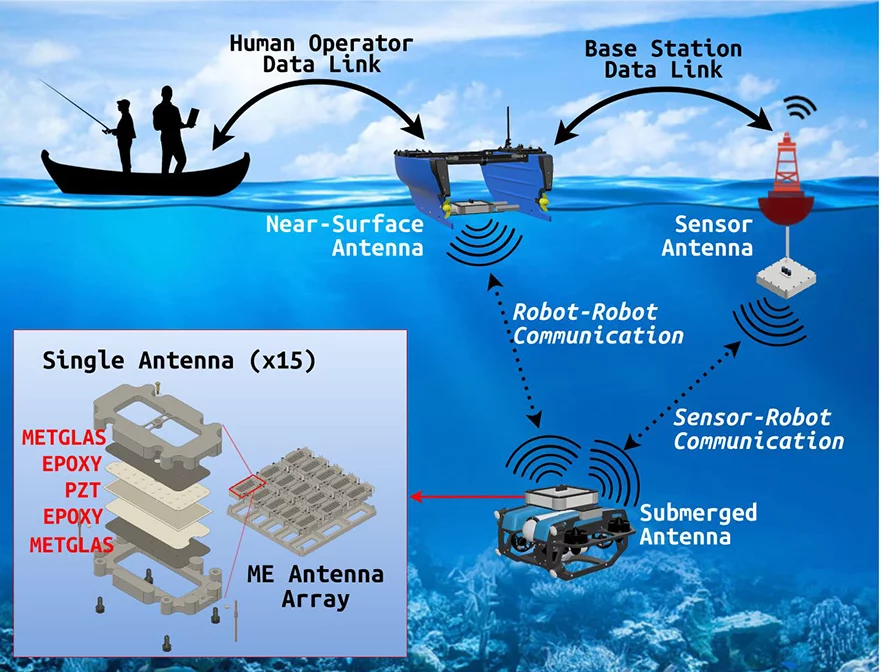
A diagram of the BlueME system, showing how magnetoelectric antennas relay data between a surface operator and a submerged robot
Md Jahidul Islam, Ph.D., and Adam Khalifa, Ph.D./UF
The team ran open-water trials at two sites: Lake Wauburg in Gainesville, Florida (freshwater), and the Florida Gulf Coast (saltwater). In freshwater, BlueME maintained reliable communication at 200 m (656 ft) on just 1 watt. In saltwater, the system detected signals at 730 m (2,395 ft) on under 10 watts – and performance held steady regardless of turbidity, obstacles, or multipath interference.
Data rates sit between 1 Kb/s and 100 Kb/s, far below the gigabit speeds optical systems can achieve in ideal conditions. But speed was never the point. "Imagine the robot pings you back every 10 minutes on how the mission is going, and the operator can make real-time decisions and maybe adapt the mission," says co-lead Md Jahidul Islam.
The paper represents, according to its authors, both the first practical outdoor deployment of ME antennas and the largest Very Low Frequency/Low Frequency array of this type ever built. The team has filed a provisional patent and is seeking funding to refine the hardware and conduct trials aboard full-scale AUVs, with potential applications in cooperative fleet navigation, seafloor mapping, and real-time localization.
"We demonstrated these results with very limited initial resources," Khalifa notes. "With dedicated development and larger-scale deployment, the possibilities become much broader."
"We are talking about the very early days of a very powerful product," adds Islam.
Source: University of Florida