1948 was an interesting time for computing. For decades, businesses had used punch card equipment that added and sorted electromechanically. Now these electromechanical relays and counting wheels were being used to build room-filling general-purpose computers such as Harvard Mark I (1944) and IBM's SSEC (1948). But slow electromechanical mechanisms were already becoming obsolete. World War II had fostered the development of electronics and vacuum tubes for radio, radar, and navigation. Electronic technology was being used in massive electronic computers, such as Colossus (1943) and ENIAC (1946). The first stored-program computer, the Manchester Baby, was built in 1948.
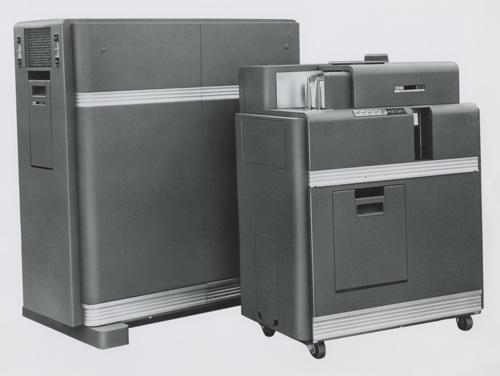
The IBM 604 Electronic Calculating Punch behind a Type 521 Card Reader/Punch. Photo from IBM. Note the panels in the side of the 604 and in the front of the 521 to hold plugboards.
In the midst of these technological advances, IBM introduced the Electronic Calculating Punch, type 604.1 This system may seem like a step backward: it wasn't a computer, but a programmable calculator that performed a fixed set of operations.2 However, it was much smaller3 than a computer—about the size of a double refrigerator—and much cheaper: renting for $550 a month, it was affordable by businesses and universities. Since it used vacuum tubes, it was much more powerful than electromechanical equipment; it could do 60 operations in under a second, including multiplication and division. As a result, the IBM 604 became very popular, with over 5600 units produced. Moreover, IBM's experience with electronics in the 604 led to the success of its vacuum-tube computers in the 1950s.
One of the innovations of the 604 was the pluggable module, which combined a tube and its associated circuitry as shown below. The insulated handle was used to remove and install modules in the calculator. The nine pins at the bottom of the module plugged into a socket in the 604, with the sockets connected with backplane wiring. The tube was also socketed, so a bad tube could be quickly replaced. At the right, the resistors and capacitors are mounted on insulating wafers in the module.4
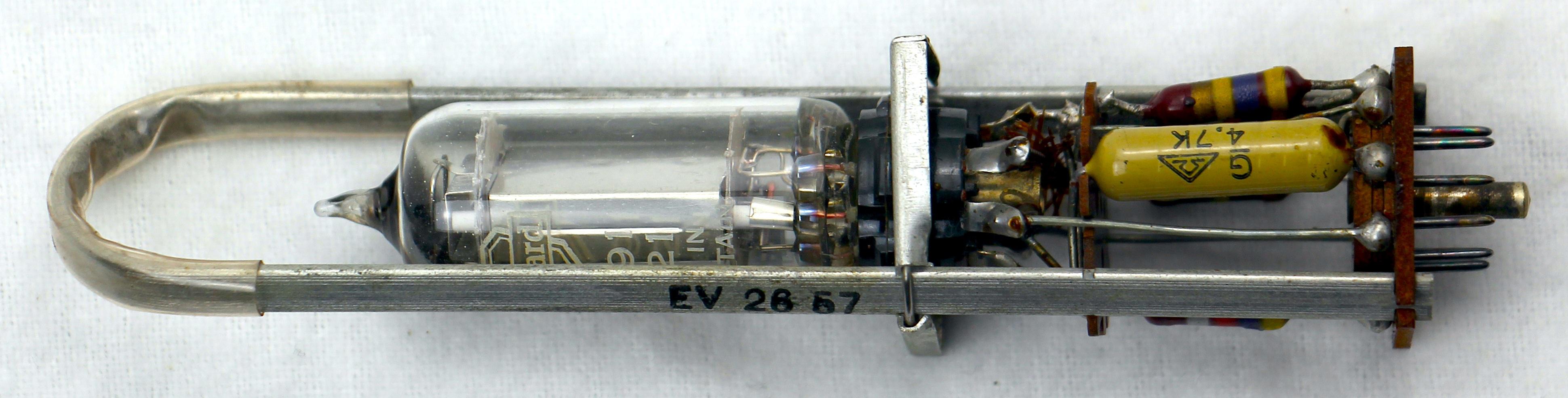
A thyratron tube module from the IBM 604 Electronic Calculating Punch.
The 604 used several different types of modules. This module has a thyratron tube, a special type of tube that acts as a high-current switch. I put this module in a circuit and powered it up. The video below shows the module controlling a light bulb. The first button sends a small signal to the module (center), turning it on and illuminating the bulb. As I'll explain below, a thyratron tube stays on until its power is cut off, which I did with the second button.
Pluggable modules may seem trivial, but they were an important innovation. Previously, vacuum tube equipment was typically built from a metal chassis with tubes mounted on the top and the other components, such as resistors and capacitors, mounted underneath. IBM developed a different approach: pluggable modules, where each module held a vacuum tube along with its associated components. These patented modules were dense, since they packed components in three dimensions. Moreover, by using a small set of standardized modules, the modules could be mass-produced and the computers assembled on a production line. Maintenance and repair were simplified; modules could be swapped to find the bad module, which was replaced with a spare. These modules were so important that IBM featured them in ads for the 604. IBM used tube modules in later vacuum tube computers, using larger eight-tube modules in the high-end 700-series computers.
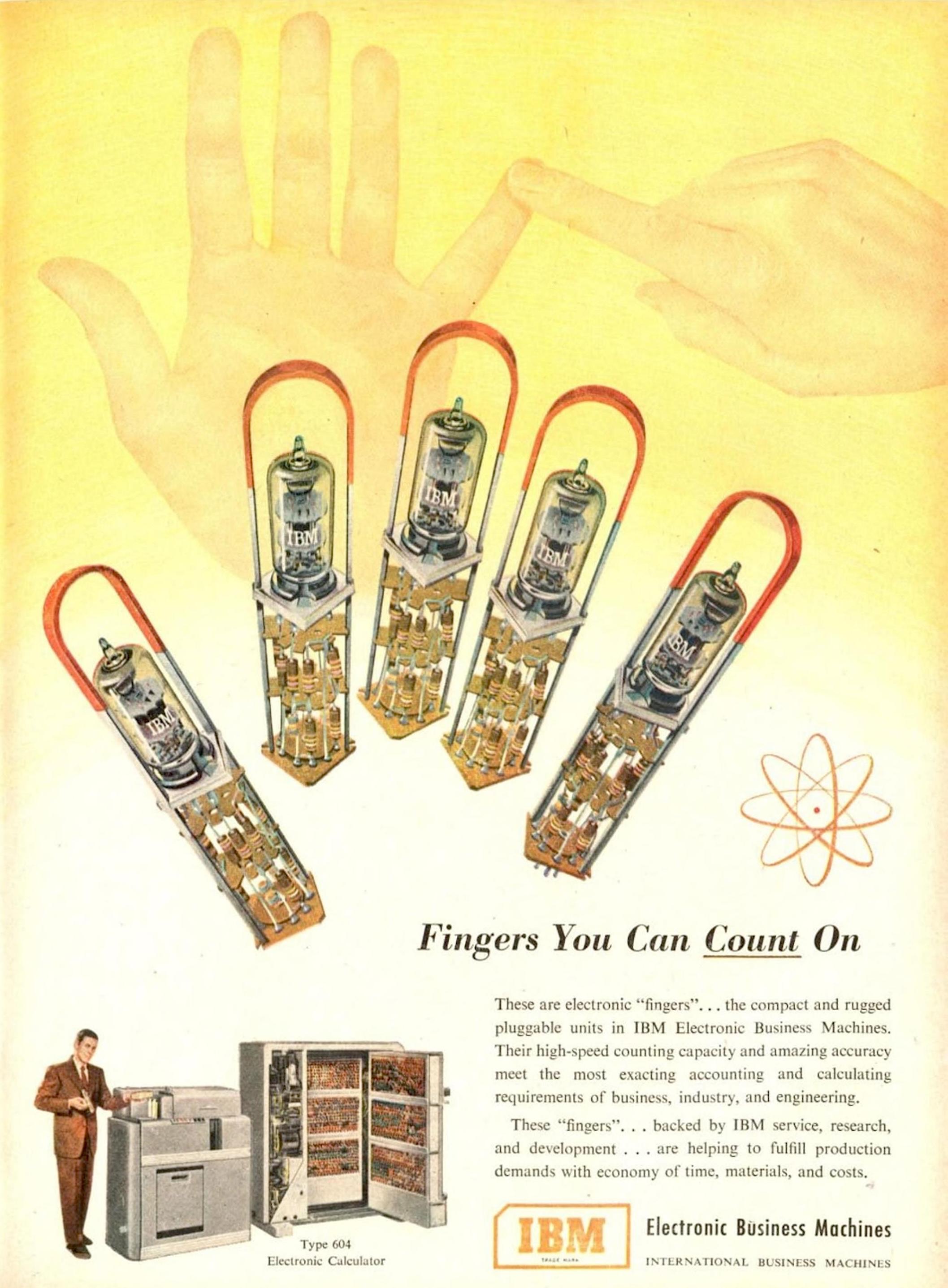
An ad for the IBM 604, highlighting the pluggable modules. From Time magazine, March 31, 1952, page 65. Click this image (or any other) for a larger version.
Vacuum tubes and the thyratron
The IBM 604 used about 1250 vacuum tubes. While vacuum tubes come in many different types, a typical type is the triode. A triode is analogous to a transistor: a small input signal is amplified to control a much larger current. In a transistor, the control signal is applied to the gate, controlling the current between the source and drain. In a triode tube, the control signal is applied to the grid, controlling the current between the cathode and the plate.
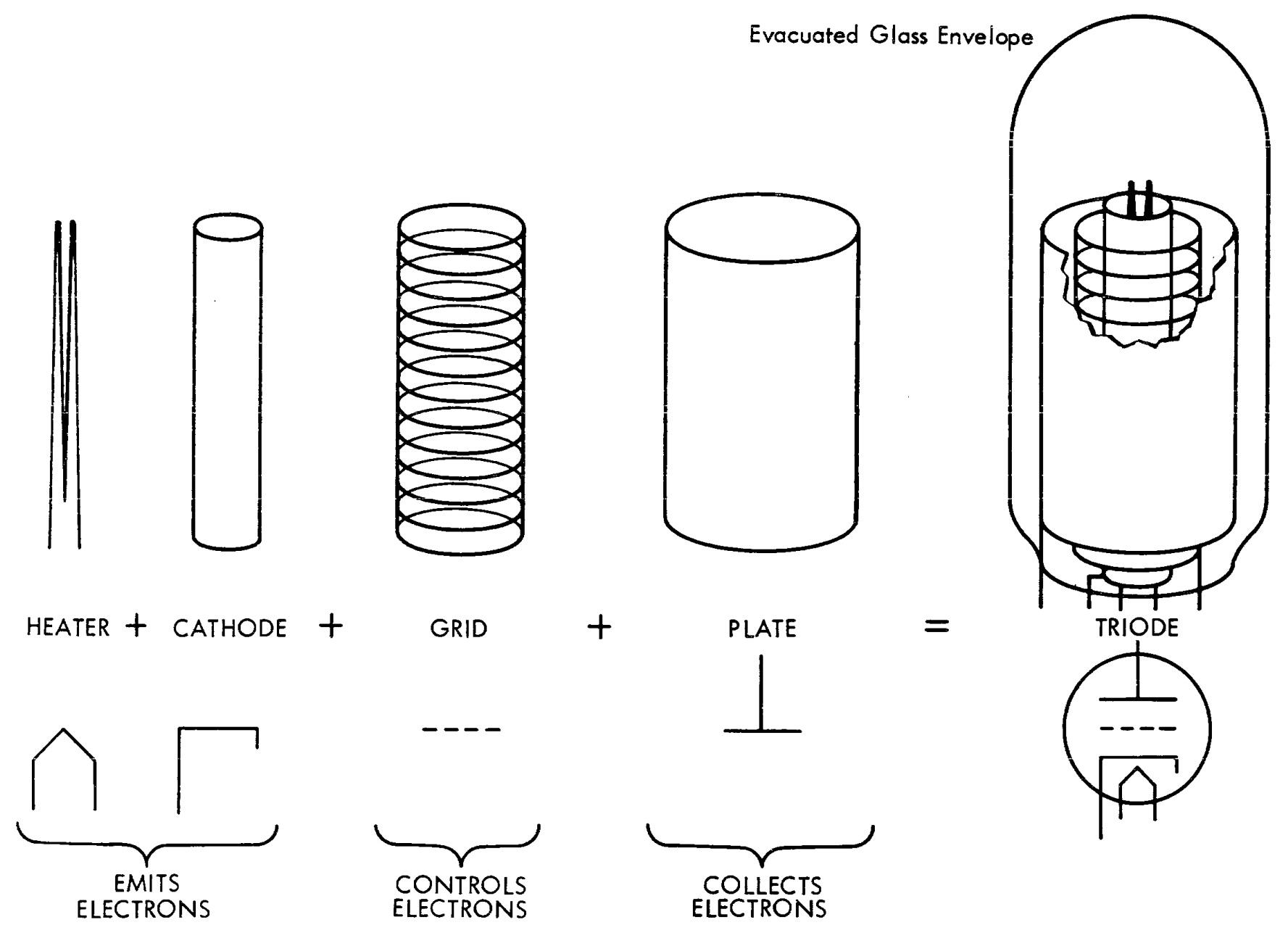
The diagram above shows the construction of a vacuum tube. The heater is a filament, very similar to an incandescent light bulb, that heats up the cathode to roughly 750 ºC. At this high temperature, the cathode emits electrons. When a large positive voltage (say, 100 volts) is put on the plate, the negatively-charged electrons are attracted. The stream of electrons from the cathode to the plate causes a current to flow through the tube. The current is controlled by the grid: if a small negative voltage is placed on the grid, it repels the negative electrons, preventing them from reaching the plate and blocking the current through the tube.
A thyratron tube is similar to a vacuum tube, except it has a tiny bit of xenon gas inside, allowing it to handle higher current.7 Like a triode, the thyratron is controlled by the grid. However, when current starts to flow through the thyratron, the xenon ionizes and the xenon plasma carries current. Unlike a vacuum tube, the grid cannot stop the flow of current. Once the gas is ionized, a thyratron tube stays on until you remove its power5 and the gas deionizes in microseconds.6
You can see this behavior in the video. When I pushed the first button, a small control signal ionized the gas, turning the tube on. The large current through the ionized gas illuminated the light bulb. The light stayed on until I briefly cut the power with the second button; the gas deionized, turning off the tube.
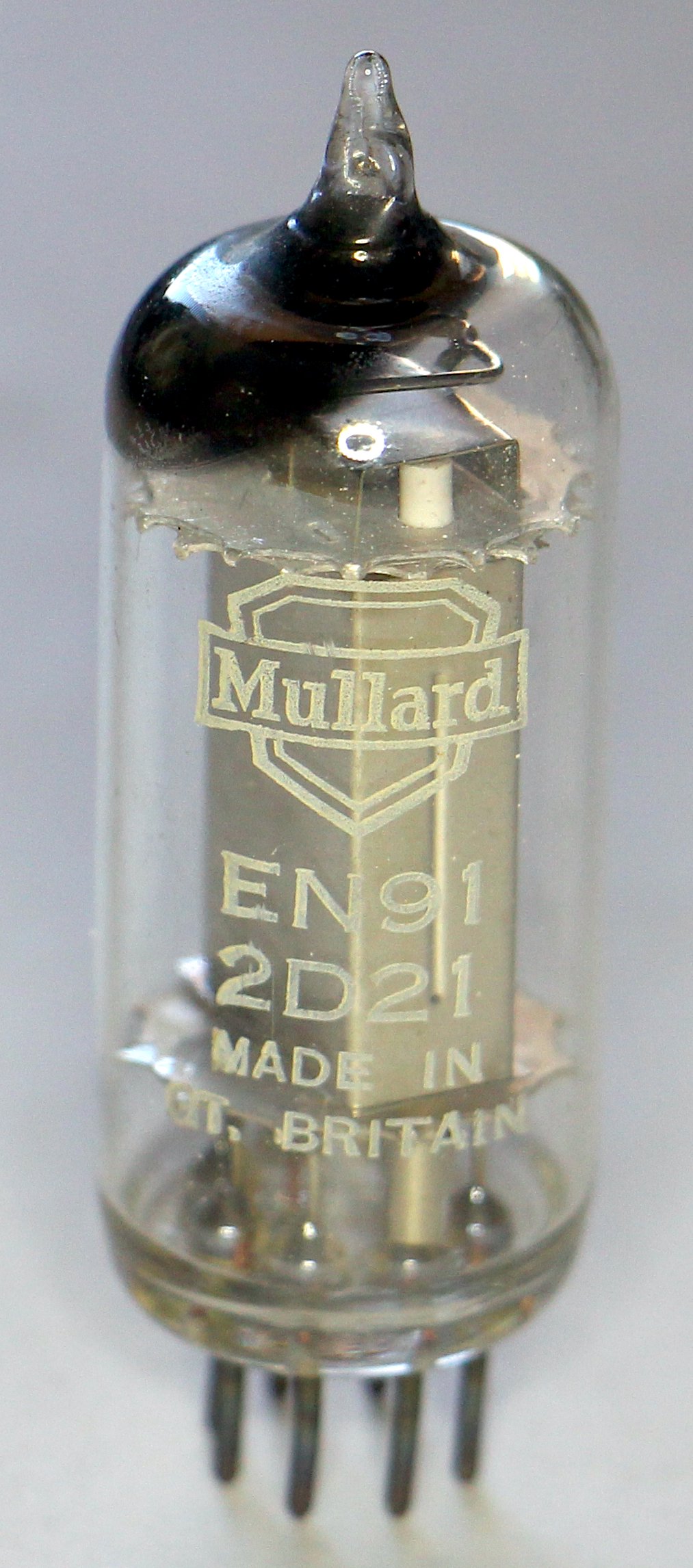
The thyratron tube, type 2D21.
The photo above shows the thyratron tube, type 2D21, a miniature 7-pin tube.8 The plate is visible inside the tube, with the other components hidden by the plate. The dark stain at the top of the tube is the "getter", a reactive substance such as barium that absorbs impurities inside the tube.
In the 604, thyratron tubes drove relay coils and powered the electromagnets that punched holes in cards. Other IBM systems also used these thyratron tubes. For instance, the IBM 83 Card Sorter used thyratron tubes as short-term storage to keep track of which holes had been detected in a card.
Conclusion
The IBM 604 occupies an interesting position between electromechanical accounting machines and electronic computers. Although it has the speed of an electronic computer, it was still a calculator, lacking computer features such as loops, memory, and stored programs. Despite these limitations, the 604 was highly successful and led to other important IBM products.
IBM extended the 604 in 1949 so it could be programmed by punch cards in combination with plugboards; this was called the Card-Programmed Electronic Calculator. This system was still not quite a computer, but was very useful for scientific calculation at places such as Los Alamos National Labs (link). In 1953, IBM announced the successor to the 604, the IBM 650. Unlike the 604, the 650 was a programmable, general-purpose computer; it became the most popular computer of the 1950s.
Eric Schlaepfer (TubeTime) has a box of IBM 650 modules, which we hope to power up soon. For updates, follow me on Bluesky (@righto.com), Mastodon (@[email protected]), or RSS. Thanks to CuriousMarc for extensive milling work to build the socket and colorful breakout box to hold the module.
AI statement: Despite the presence of the em dash, no AI was used in the writing of this article (details).
Notes and references
For information on the IBM 604, see the Operating Manual. The Customer Engineering Manual of Instruction explains the circuitry. See IBM's Early Computers for information on the development of the 604. For a detailed description of an application, see this petroleum engineering article, using the 604 to predict the profitability of an oil property. ↩
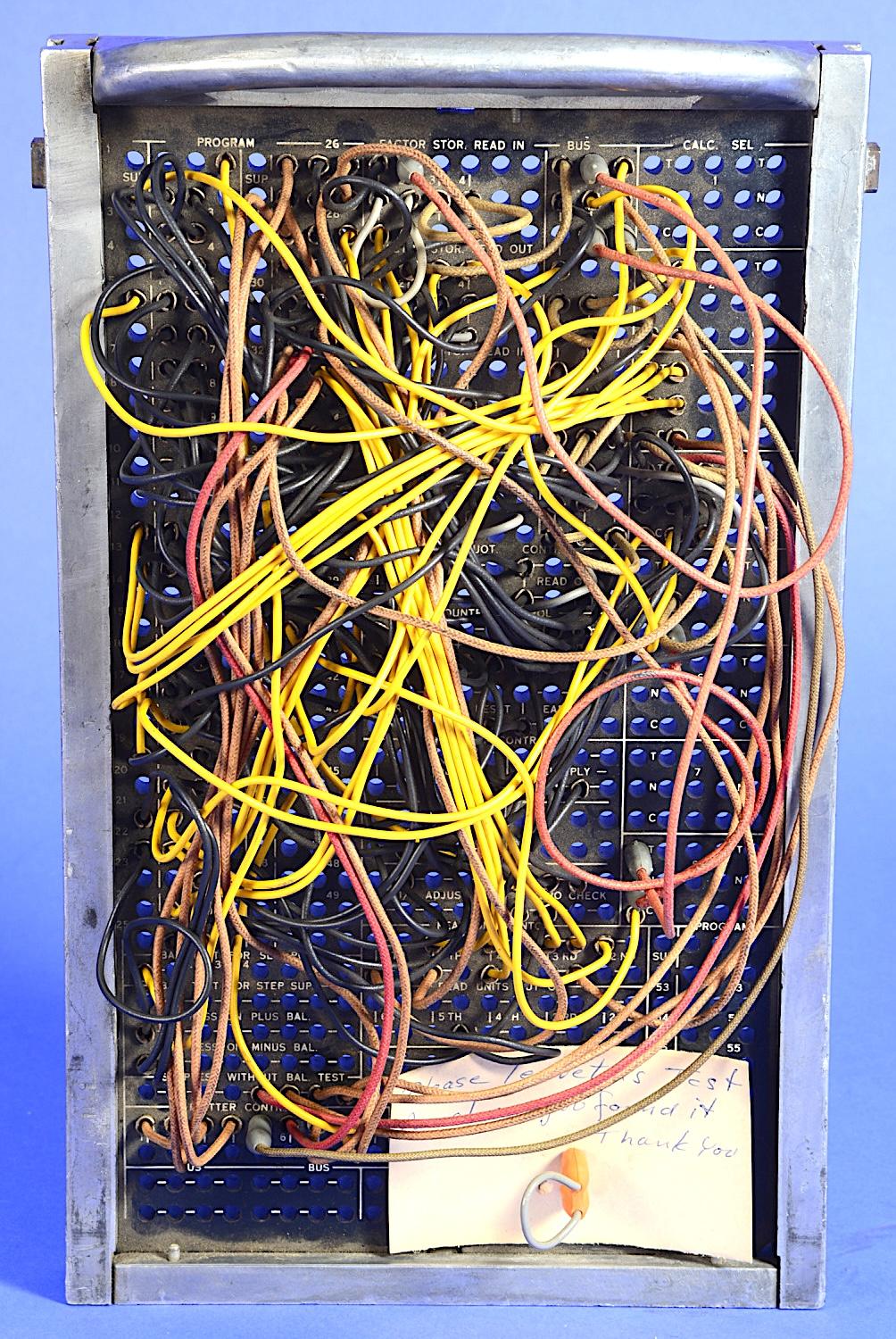
The IBM 604 operated by reading numbers from a punch card, performing up to 60 operations, and punching the result onto the punch card. This was repeated for each card, processing 100 cards per minute. The IBM 604 was not a stored-program computer, so it didn't have code. Instead, the IBM 604 was programmed by plugging wires into plugboards. The plugboard below was inserted into the 604, while a second plugboard, twice as large, went in the card punch unit to control which columns of the 80-column punch card were read and punched.
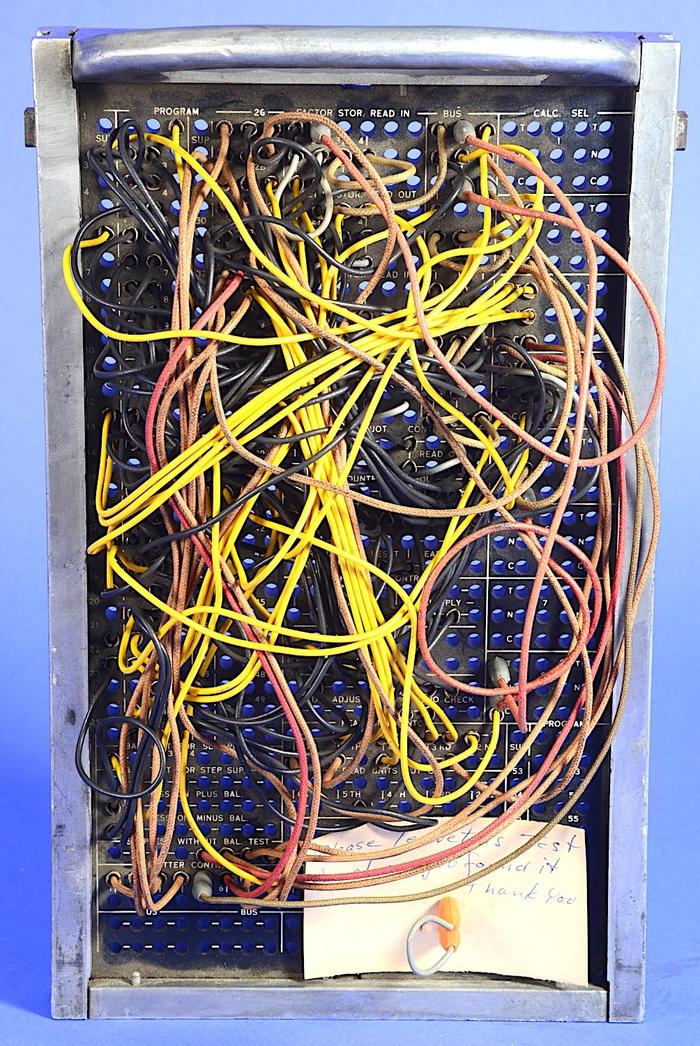
Looking at the plugboard above, the column on the left with the heading "PROGRAM" had a row for each programming step. A wire from that row was connected to the function to be performed on that step. The system supported conditionals: the operation that was performed on a step could be changed or skipped with the calculator selectors ("CALC. SEL.") on the right. (A selector was a relay that could send a signal along one of two paths (Normal or Transfer) based on a Control input.) For more information on the plugboards, see the Operator's Manual. ↩
The IBM 604 weighed 1310 pounds, while the attached 521 Card Reader/Punch weighed 670 pounds. The system used 5.5 KW of power. (Vacuum tubes are power-hungry; the module that I used required 3.75 watts for the heater alone.) ↩
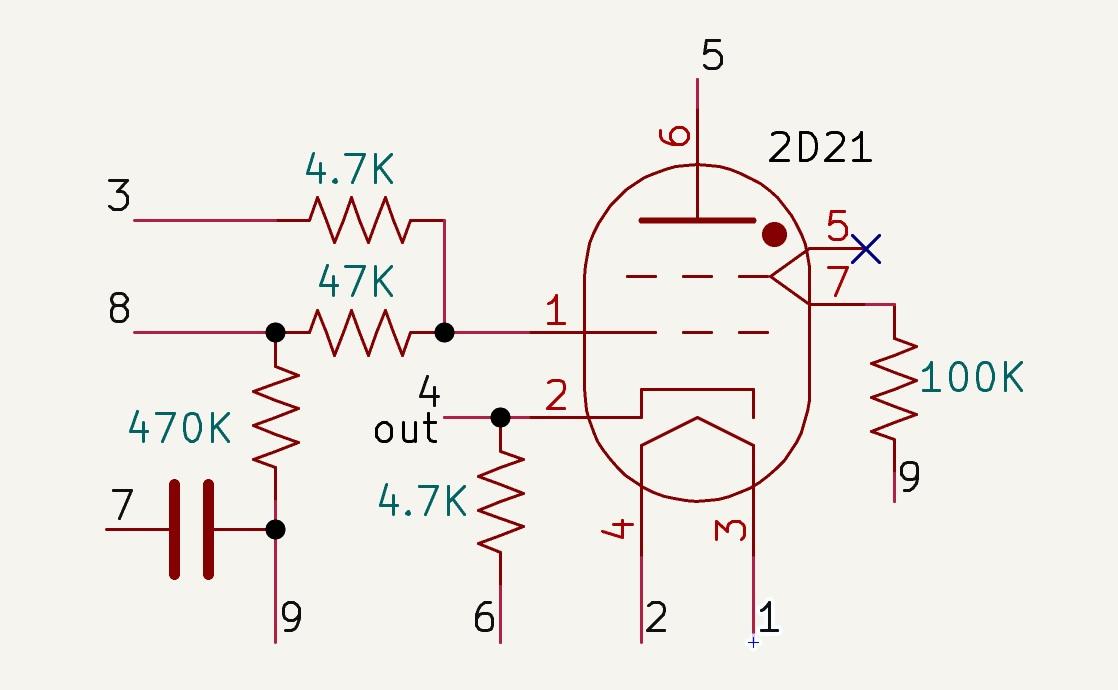
I reverse-engineered the MD7A thyratron module to create the schematic below. Black pin numbers are module pins (1-9), while red pin numbers are tube pins (1-7).
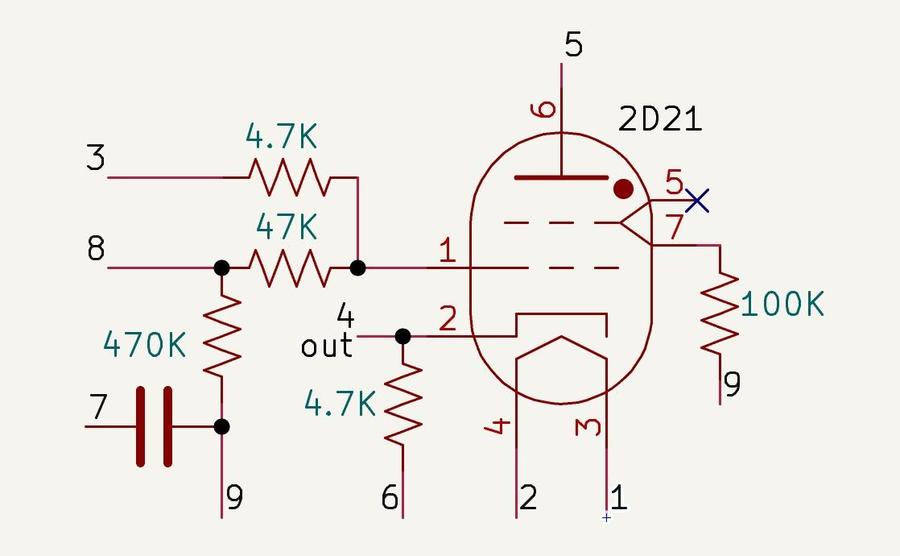
Schematic of the IBM MD7A module, reverse-engineered.
For my experiment, I powered the module with about 100 volts on the plate (pin 5). I used pin 3 of the module for the input, using about 8 volts to trigger the thyratron. Pin 4 is the output, pulled high when the thyratron fires. I connected the light bulb between pin 4 and ground (pin 6). I ignored pins 7, 8, and 9. ↩
One disadvantage of a thyratron is that you need to remove its power to turn it off. In the 604, a mechanical cam in the card reader/punch activated a microswitch to turn off the power (details. Since the card reader/punch used cams on a rotating shaft for its timings, one more cam wasn't an inconvenience. ↩
The behavior of a thyratron is very similar to the silicon-controlled rectifier (SCR). This semiconductor device is also called a thyristor, short for thyratron transistor. ↩
The xenon pressure in the thyratron tube is very small, just .05 Torr, less than 1/10,000 of atmospheric pressure (source). Vacuum tubes, in comparison, have a vacuum that is orders of magnitude higher, around 10-6 Torr.
Some high-power thyratron tubes use mercury vapor, such as the ones inside a 1940s power supply that we examined. These tubes give off a blue glow when active. The xenon tube, in comparison, didn't emit any light that I could see, apart from the orange glow from the filament. ↩
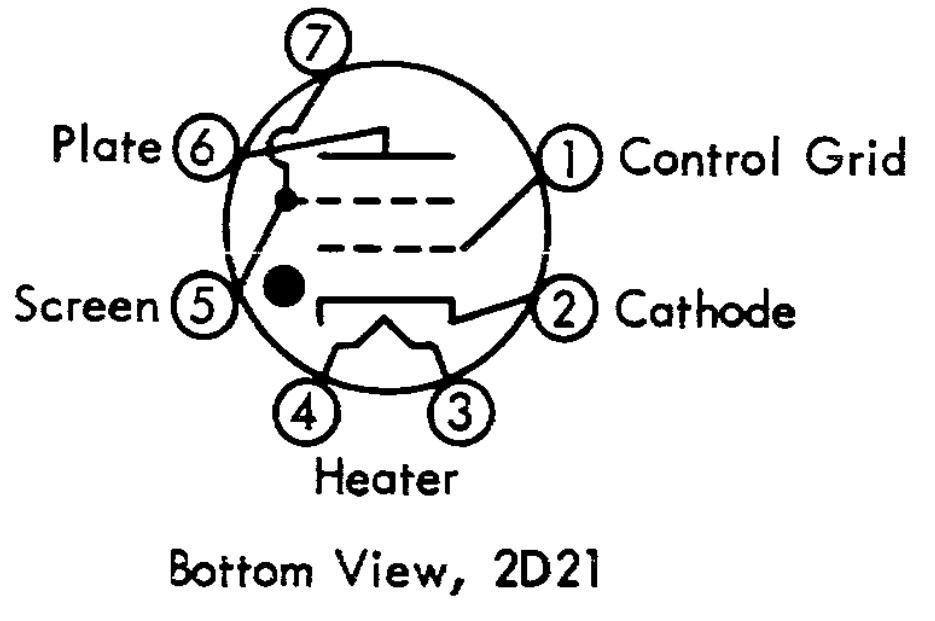
The pinout for the 2D21 thyratron tube is shown below, and the datasheet is here. Thyratrons use the same symbols as vacuum tubes, except the large black dot indicates the presence of gas in the tube.
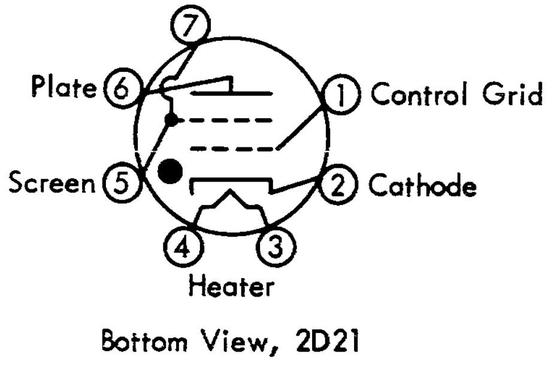
As the symbol shows, the 2D21 tube has two grids, so it is technically a tetrode (four active elements). The second grid improves performance by screening the control grid from the cathode and the plate, reducing capacitance. (See Thyratrons for modern industry.) For my experiment, I ignored the screen grid. (The 604 also used some pentagrid tubes with a whopping five grids: two control grids, two screen grids, and a suppressor grid.) ↩