https://www.dkriesel.com/en/blog/2013/0802_xerox-workcentres...
"On the scale of things too horrible to contemplate, "document-altering scanner" is right up there with "flesh-eating bacteria". Since 2006, Xerox scancopiers literally are making stuff up. They, for example, replace digits with others in scans. The replacement digits are layouted perfectly into the page, so the errors are hard to see. Sounds unbelievably insidious, but it's true. Drug prescriptions, construction plans, just anything can be affected. "
Is this with JBIG2? I remember reading about JBIG2 also used in the FORCEDENTRY zero click exploit that which was (?) used in the Pegasus spyware. Unrelated tidbit, I guess.
> “Similar image” searches using Google Lens, Bing Images or DuckDuckGo betray hundreds more that we have yet to document
In my experience these would return any image of an antibody (edit) Western blot, not just the exactly matching background. Would be curious to hear others thoughts.
Watch him cycle from Wales -> China in 90 days: https://www.youtube.com/watch?v=MdgHZPfivVA
This isn't his first fraud rodeo either. For his discovery of serious fraud by the Dana-Farber Cancer Institute in 2024, he received $2.6 million.
Be more like Sholto, exercise your free will!
Anything that large companies published in/as magazines, etc, back in the 80/90s first went to a design company. Then to a repro company for the "finishing touches" to make it look nice. Faces were touched up, photo artifacts was removed, everything was to look neat and tidy.
This looks so much like that. I wouldn't be surprised if Thermo Fisher still ran everything that is to be published through a marketing/repro cycle, who has tampered with this without realizing what it looks like.
It'll be interesting to see if any actual data has been changed, or just the presentation of the data.
> Moving forward, where an original image is not present or available, the Company will ensure that website users are informed that antibody images may have been optimized for presentation and clarity on the website.
wut. Bro if you don't have an original valiation image then the answer is not to say "oh we'll make sure we communicate that we're making up a random image" - it's to say you don't have the damn image. It's validation data wtf. It's not a pretty background image it's validation data if you don't have the data wtf are you "optimizing for presentation?" This faq is unreal - pure CYA except by someone who doesn't seem to know what they're trying to cover. If you've got cut and pasted/rotated bands that's just fake data. Not "optimized for presentation."
Yes labs should and usually do always validate new antibodies as well. It's a waste of time and taxpayer money for them to spend their time on bad antibodies they purchased based on fake validation data. And just fundamentally - don't make up validation data. If it's not there it's not there. What are you optimizing for presentation if there's no original!? What does that say about the rest of your process?
Also, how many other scientists just bought into that and used this for their own "analysis"?
I dealt with this where our fax number had a 6 in it and it would sometimes get changed into an 8, which happened to be a valid fax number for another company, ugh. And this was confidential info too…
Always a funny phone call when they insist they sent it to the number on the cover page we sent and then they send us a copy and xerox made it wrong.
"Feedback from unverified e-mail addresses? Fifth-hand analyses by vendors? All data is good! The more the better! Just put it all into the AI and it'll fix it!"
It's more than just false advertising, it's criminal negligence wasting research attention, research time (repeating experiments to understand whats not working), naive nameplate quotations in the scientific literature also corrupts the scientific record (the author knows they are simply restating the nameplate specifications, but the reader may confuse it as a claim by the author).
Wondering if its sort of OK because it might just be marketing material, think of how the tobacco and other lobbies manipulate the scientific record. I mean technically it is marketing material... if one cynically views the scientific record as a poster wall where the highest bidder is allowed to plaster their spam all over the place.
Typically these catalogues have some numbers with regards to the antibodies binding affinity / impurities so you can have a general idea of what to expect, but having a clean image might mislead you into thinking that you did something wrong in your own setup. Seeing how wide spread it is, it's easy to imagine that their own lab is not run very "cleanly" and they have antibody contaminations in their gels, or issues with their own protocol that they're trying to edit out. Doubt that's the case, but it's really not a good look.
So what this fraud does is convince you to give these antibodies a chance when you otherwise wouldn’t have. You should validate them yourself and show they only bind your target before doing an experiment, but now you’re just wasting time and money evaluating something that’s guaranteed to fail.
Antibodies are notoriously unreliable, so you might have to give two or three vendors a try before you get one that works. Now I’m starting to wonder how much of that reputation is due to fraud and not just nature.
Its hard to argue that that isn't fraud as a result. It isn't touching up existing data, its fully fabricating data
> No.
Listen to these guys. What assholes.
More like 10%, but my search has not been systematic. I am mostly looking where I know I will find image issues based on image filenames and “Find Similar Images” searches.
They are clearly saying they think this is likely above average.(links to https://www.thermofisher.com/uk/en/home/life-science/antibod...)
I think it is technically marketing material, but if you have to fabricate your marketing material, that's not a good sign that the material is accurate. If I buy a car based on an advert where it shows the car going at 300 mph, and in real life it maxes out at 30mph, that's misleading advertising and something should be done about it.
Given that "at Thermo Fisher, a single vial containing a 0.1 mL aliquot of antibody solution typically costs 400 to 500 USD", you'd want to have accurate marketing material before buying it
2. It should be determined whether the fraud was just the display image (imagine a sales manager making a bad call when images are not available) or involved the underlying research (more systemic and worrying).
3. It would be interesting to examine occurrence of faked images along with apparent unreliability/irreproducibility of research that has used those products.
When I buy an electronic component as a regular consumer I expect the datasheet "typical" values to be accurate 90% of the time. I can imagine larger industrial customers would really raise a stink if it's worse than that. However, any critical components in my circuit must be verified and "binned", and that's on me.
> The civil settlement includes the resolution of claims brought under the qui tam or whistleblower provisions of the False Claims Act by Sholto David. Under those provisions, a private party can file an action on behalf of the United States and receive a portion of any recovery. David will receive $2,625,000 under today’s settlement.
https://www.justice.gov/opa/pr/dana-farber-cancer-institute-...
https://www.theverge.com/2023/3/13/23637401/samsung-fake-moo...
Manipulating images for presentation is an automated process unless you're ripping someone off. The changes would be uniform across whole sets.
The problem with trying to pass off a fake image is that you need to be more knowledgeable in each dimension of the effort than the recipients are in just one. If anyone remembers the folks identifying East German video from background hum it's kind of like that.
It seems nearly impossible to imagine that to be the case. I'd have to disregard the kinds of manipulation entirely. What sales manager would create a whole western block sequence by copying, rotating, and flipping a single element?
That is to say, this looks bad for Thermo Fisher. But, that’s as far as the damage should go.
https://www.institutionalinvestor.com/article/2d7d14lmtfwc1e...
$40m for this person in the US
> This image is supposed to demonstrate that the antibody being sold works as intended. (…) Antibodies are near-ubiquitous but notoriously fickle laboratory reagents in biomedical research. For many applications, it is absolutely crucial that the antibodies that you use are selective (i.e., the antibody binds strongly to the target protein) and specific (i.e., the antibody binds to the protein of interest and little else).
Antibodies showing a different picture (Western blot) than what is expected can drastically change the interpretation of the results as well as the conclusion of a study, for example. It may also encourage scientific fraud by authors by forcing them to unknowingly/coincidentally make to a blot image the same (or similar) fraudulent modifications performed by the vendor.
Now I’m curious about how much of the blot photoshopping present in retracted papers can be attributed to these misleading verification data.
The evidence of painting out the background is likely someone cleaning up other bands, where the antibody has bound to something other than the intended target. So, they are making out the antibody is better than it actually is.
Copy-pasted bands could be evidence of attempting to make a weak band look stronger, or even adding a band where one didn't exist - potentially the entire blot is fabricated.
Either way, like someone else said, this is like fabricating parts of a data sheet.
It doesn't excuse it, but like someone else said, scientists would never just trust an antibody they bought. They'd do their own tests. Labs will also share notes amongst each other, along the lines of "that antibody is bad, and also strongly binds XYZ. You should try this other one instead".
Now, if while preparing the images they needed to do some editorial choices (or it is well possible a person in the editorial group was told to 'enhance the images' but wasn't aware of the details) because of limitations in doing the experiment then this is probably not a big deal
But unless you’re in the field, you won’t realize exactly how big ThermoFisher actually is. They are the major supplier of everything for molecular biology work. From freezers (the Thermo part) to plates and pipettes (Fisher) to enzymes and antibodies. In many ways they are like Amazon. They sell everything. Some of it from outside companies, but a good deal of sales are from in-house brands. They could use their position as a reseller to know which products sell the best and with the highest margins.
In a company of this size, it’s easy to have one group feel pressure and cheat on running the gels to confirm results. Particularly when the real results are ambiguous or dodgy. It’s not a good look, but I doubt it will put a dent in people from buying things (non-antibodies) from them.
> would be more worried if the blotted area was different (the dark blob) - or if data in a datasheet (something like test specificity, level of detection, etc) was wrong
These images are provided on the datasheet and form the basis for the level of detection / specificity claims
Or if more than one blob is present (i.e. blobs at different molecular weights) for a supposedly selective and specific antibody that should show exactly one blob on the blot.
> Now, if while preparing the images they needed to do some editorial choices
Editorial choices on raw scientific data are a big no-no.
I don't think you can find a picture in an article that hasn't been photoshopped in one way or another (which is mostly ok as long as it is not misleading)
Edit: TF's reply is interesting https://www.thermofisher.com/es/es/home/life-science/antibod...
Basically they say they are reviewing the images
[ TL;DR: As of 3 June 2026, we have identified more than 450 images bearing signs of manipulation in verification data advertised by Thermo Fisher Scientific in its online primary antibodies catalog (+1 by Abcam). See the full repository of problematic images, curated by myself and Sholto David, here:
Zenodo – Problematic images in vendor antibody verification data
You are welcome to contribute new findings at this Google form.
This blog post was original posted on 28 May 2026 and has not been edited to update counts since that date. There is an update covering Thermo Fisher’s response at the bottom of this post. ]
A week and a half ago, while looking for trustworthy data demonstrating a cell line’s deficiency in the protein p53, Sholto David came across the following image of a Western blot in Thermo Fisher Scientific’s online antibodies catalog:
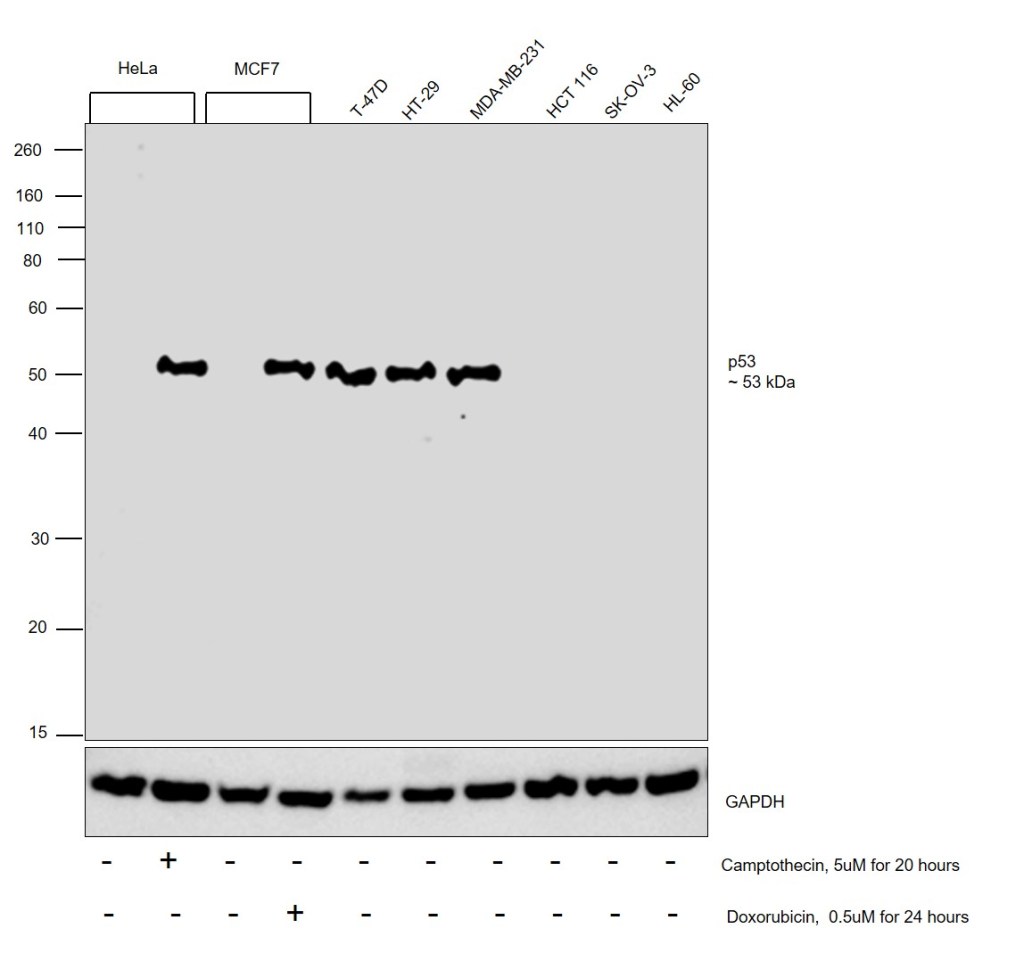
A Western blot presented as “Advanced Verification” data for an anti-p53 monoclonal antibody.
This image is supposed to demonstrate that the antibody being sold works as intended. It is labeled as “Advanced Verification” data on Thermo Fisher’s site and its caption implies that the data was produced internally (other images in the catalog that have not been produced internally are labeled under “Published Figures”).
This Western blot appears to be fabricated. As annotated by Sholto, several of the bands in the image are identical after flipping and rotation:
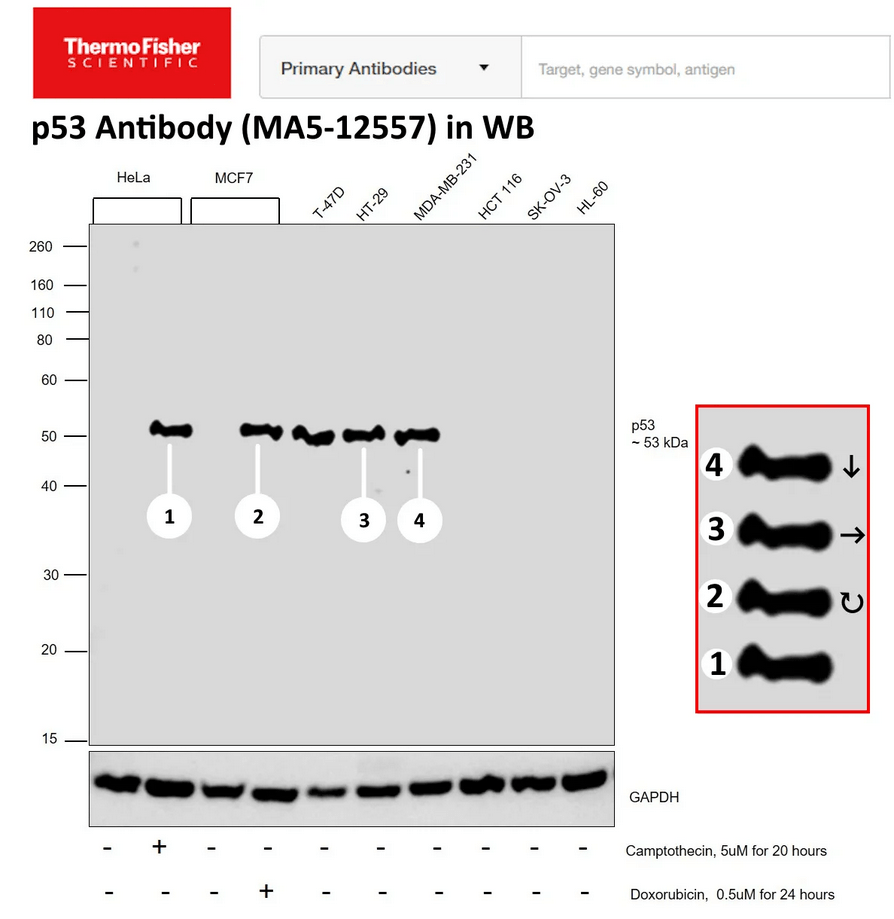
![]()
The bands labeled 1 through 4 are all identical to one another after a vertical flip, a horizontal flip or a 180 degree rotation.
Shortly after, Johan Duchêne noticed a similarly suspicious image of another anti-p53 antibody in Thermo Fisher’s catalog. I decided to go looking myself and quickly turned up ten more suspicious images on eight other antibody products offered by Thermo Fisher.
Sholto and I have now documented more than 100 images provided as verification data in Thermo Fisher’s antibody catalog that have apparently been manipulated. You can see all of them at this Zenodo repository, which we’ll try to update regularly. This repository also contains a handful of instances that are less suggestive of manipulation, but the data is still problematic (e.g., the same image being presented as verification data for two different antibodies).
Here are some highlights:
Some images are similar to the example that started this excursion and also feature bands that are unusually similar to one another.
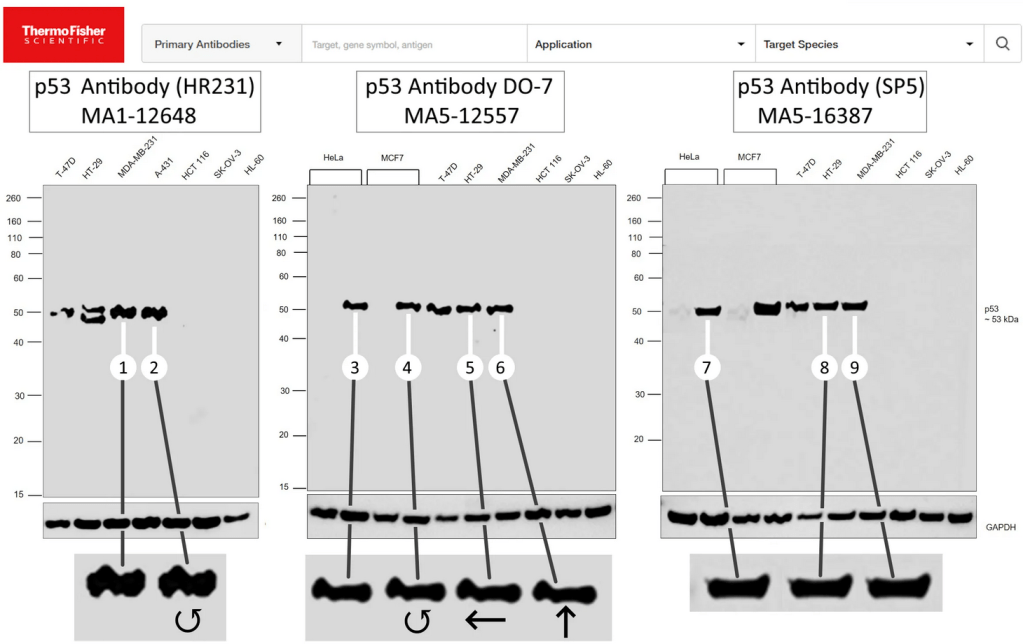
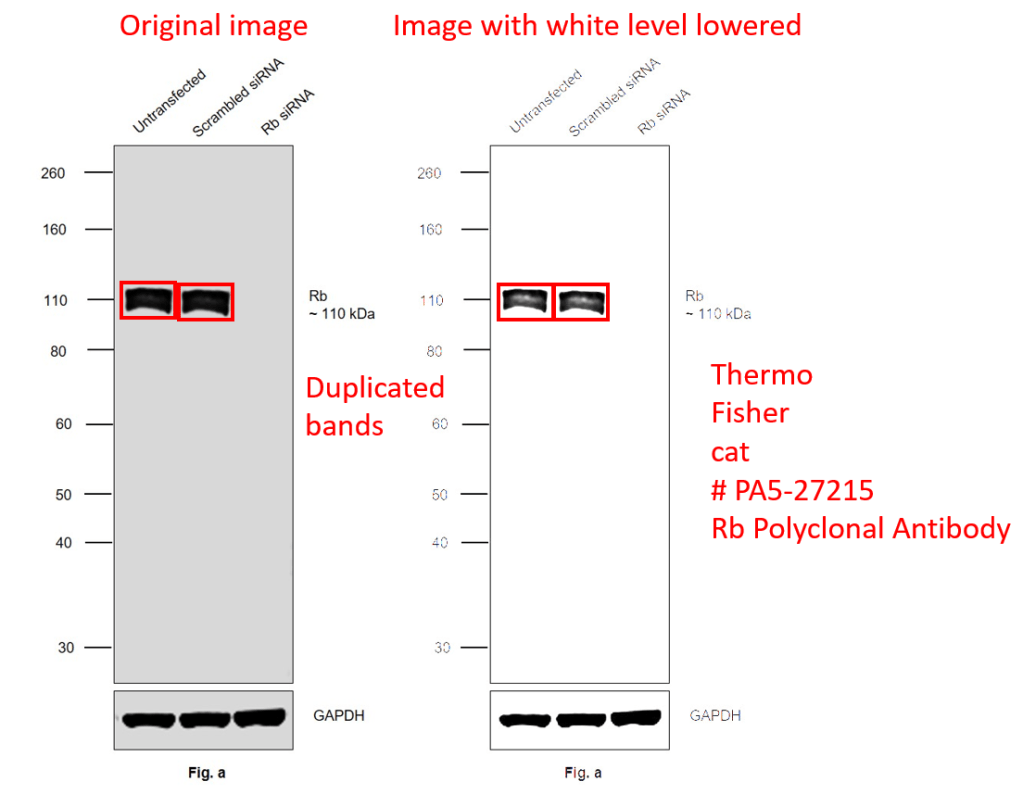
Many images, if you adjust the contrast, feature conspicuous “brushstrokes”, suggesting that part of the image has been painted over in a program like Photoshop.
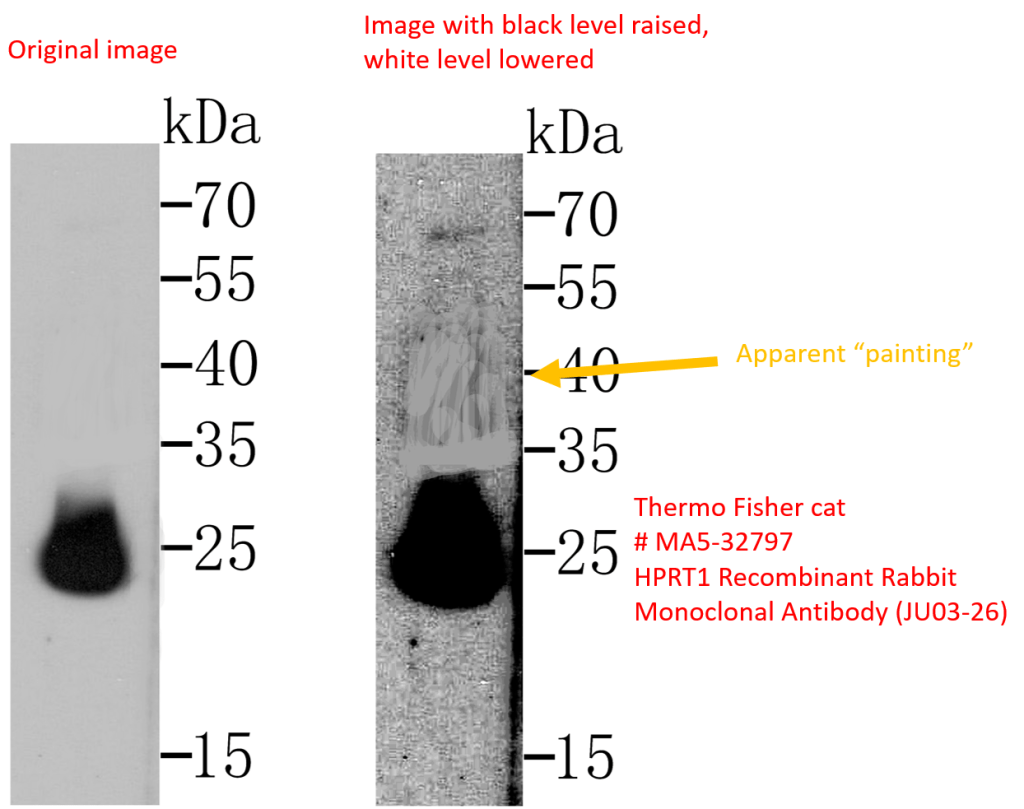
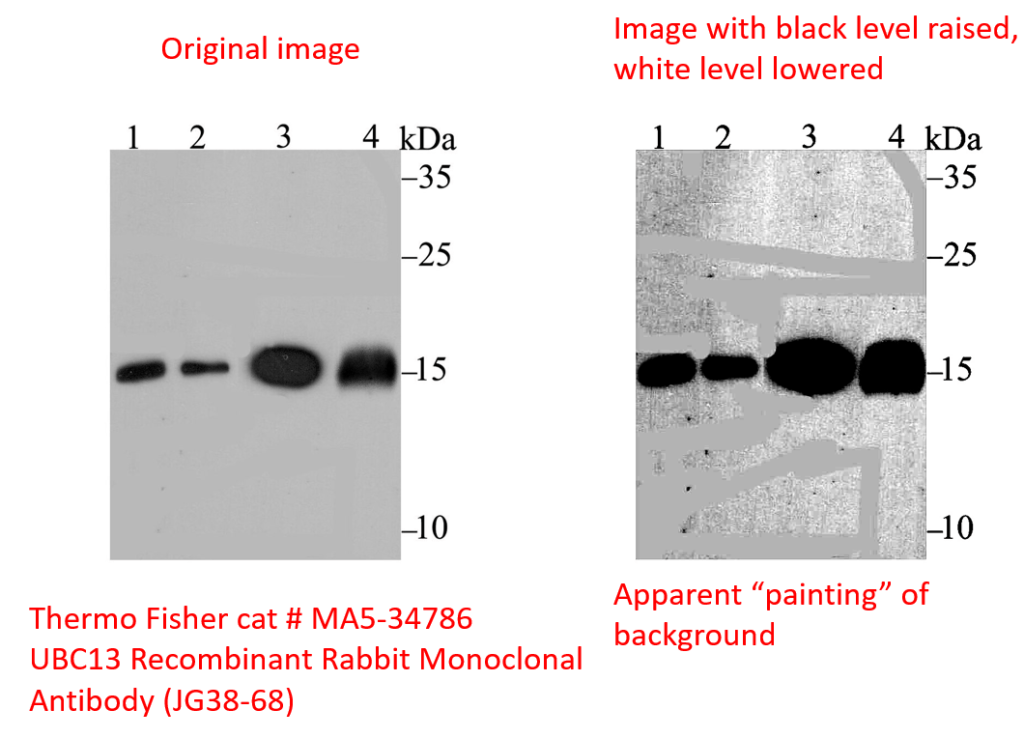
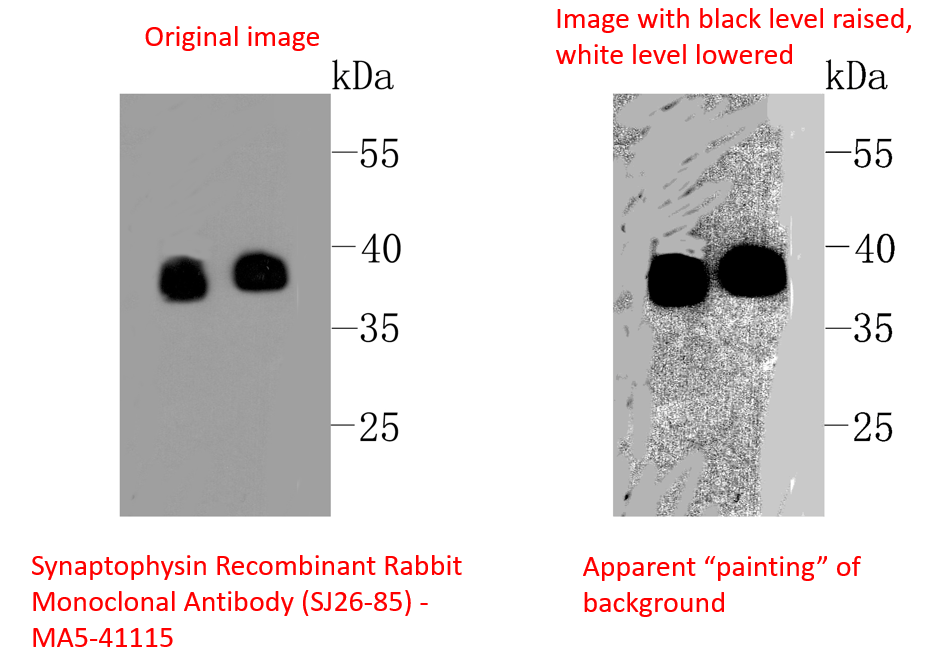
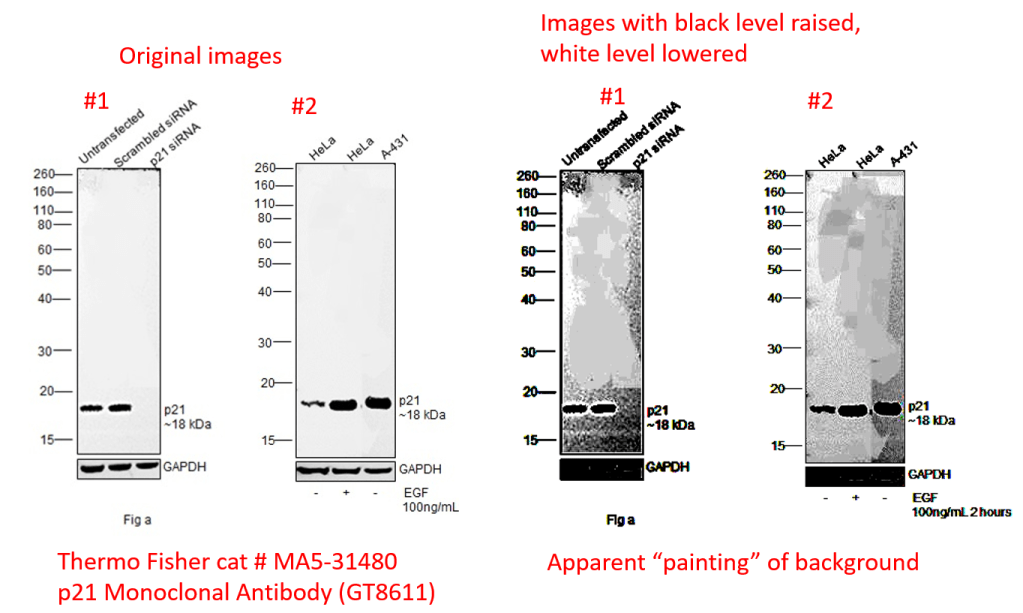
Other images feature repetitive blocks of background noise, suggesting that parts of the image were copy-pasted over each other. They might also feature sudden unexpected discontinuities in the pattern of background noise.
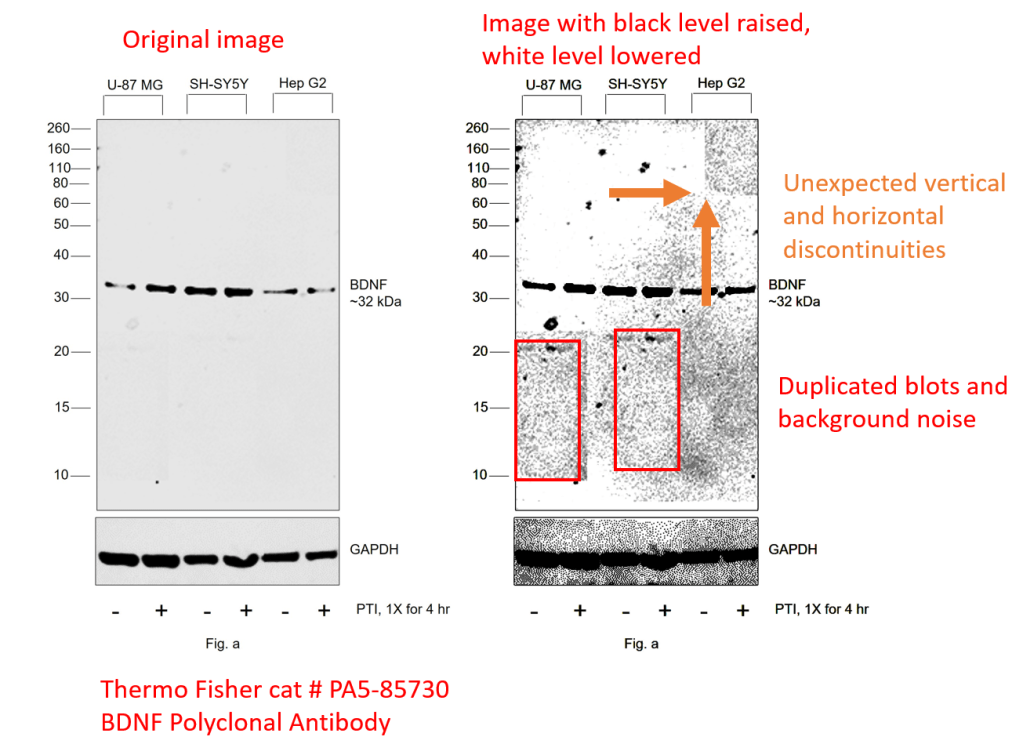
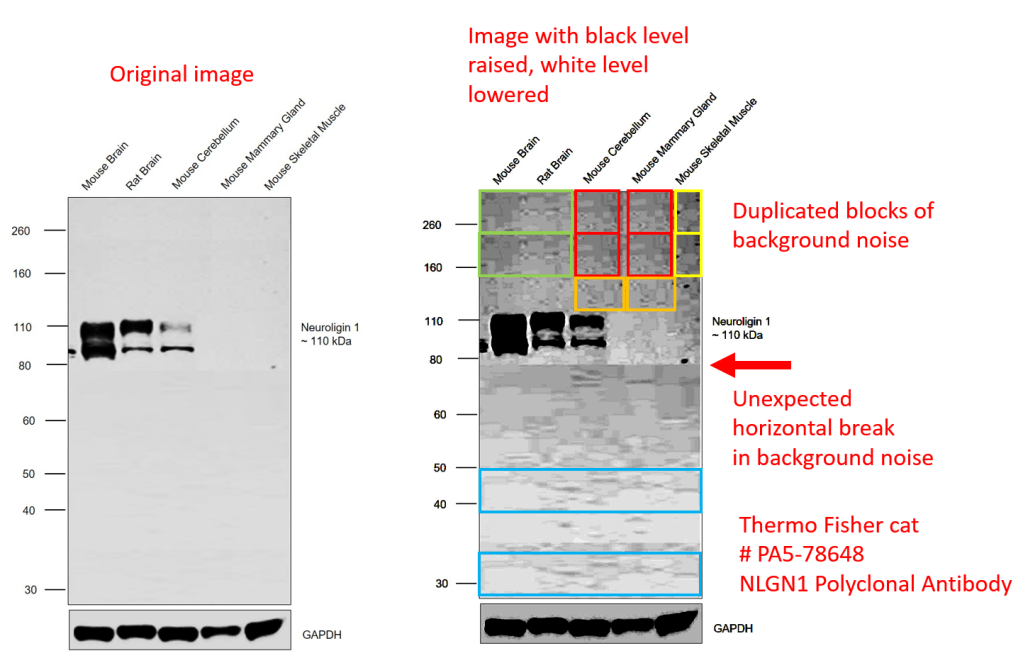
In one instance, I thought I had stumbled across another one of these instances of duplicated blocks of background noise…
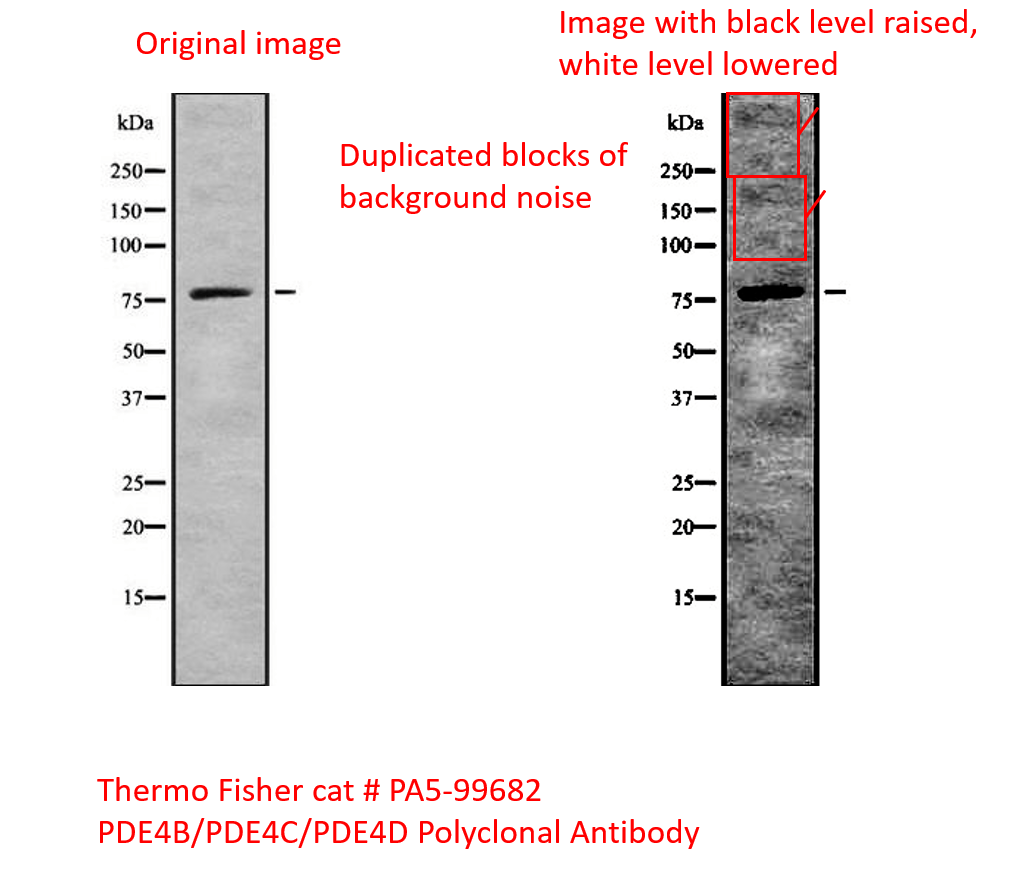
…only to discover that dozens of antibodies for sale from Thermo Fisher present a verification Western blot that features this exact background pattern, just with minimal edits such that the single band is positioned where one would expect to see the protein of interest.
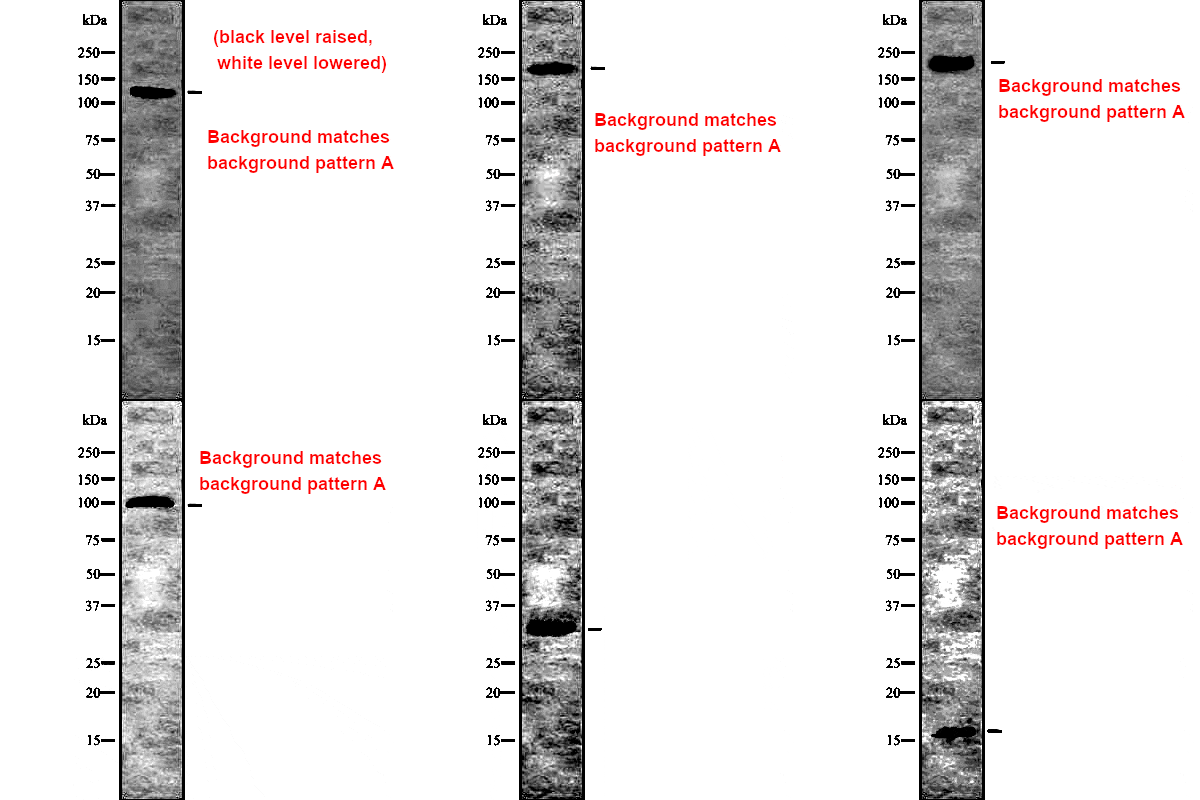
A slideshow of contrast-adjusted Western blots all featuring “background pattern A”.
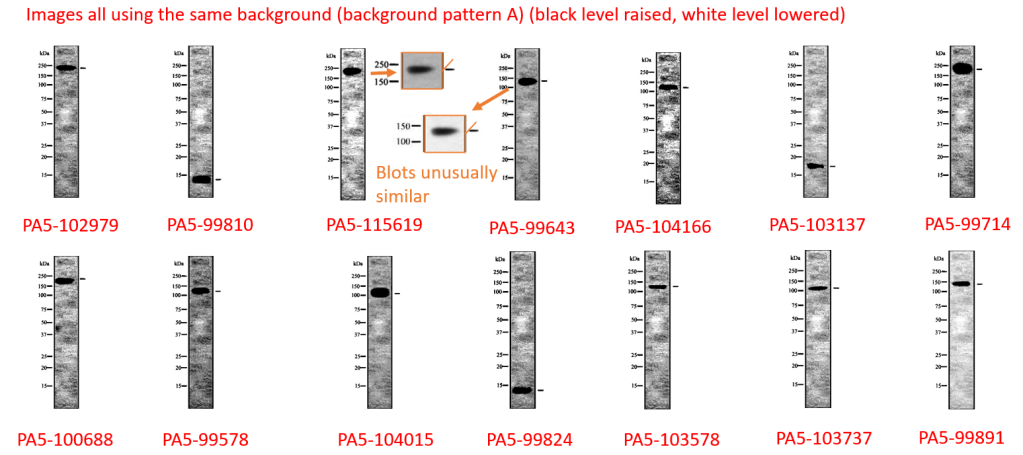
At the time of writing, we’ve documented 50 instances of this background pattern appearing in verification data on Thermo Fisher’s site, but this is far from an exhaustive list. “Similar image” searches using Google Lens, Bing Images or DuckDuckGo betray hundreds more that we have yet to document.
Antibodies are near-ubiquitous but notoriously fickle laboratory reagents in biomedical research. For many applications, it is absolutely crucial that the antibodies that you use are selective (i.e., the antibody binds strongly to the target protein) and specific (i.e., the antibody binds to the protein of interest and little else). Commercially-available antibodies often fail to meet these criteria. Members of YCharOS, an independent antibody validation initiative, estimated in 2024 that “more than 50% of all antibodies failed in one or more applications”. Antibodies that don’t work as intended can delay experiments by weeks and non-specific antibodies are a massive source of irreproducibility in the biomedical literature. To learn more, check out Johan’s September 2025 talk in which he details his experience with a study published using a non-specific antibody.
Antibody vendors like Thermo Fisher (probably the largest laboratory reagent supplier in the world) put verification data in their catalogs to demonstrate to scientists that the product works as intended. While signs of manipulation in this verification data don’t necessarily imply that the antibodies in question don’t work as advertised, without reliable verification data available, scientists will have no way of knowing until they have actually purchased the antibody. And antibodies are not cheap; at Thermo Fisher, a single vial containing a 0.1 mL aliquot of antibody solution typically costs 400 to 500 USD.
We created our repository of problematic images in vendor antibody catalogs A) to raise awareness among working biomedical scientists that the antibody verification data they see in a vendor’s catalog may be unreliable and B) to encourage others to look for and report problematic vendor-provided antibody verification data (not limited to just Thermo Fisher). If you spot anything, feel free to fill out this Google form so that it might be added to the spreadsheet and repository.
A parting message: always validate your antibodies!
UPDATE 8 June 2026: Thermo Fisher has released a galling 15-point response to our observations. The most important part (in my assessment) is quoted below (emphasis mine):
6. Did Thermo Fisher manipulate or fabricate antibody data?
No. The Company fully stands by the data and underlying science. At Thermo Fisher Scientific, as the world leader in serving science, scientific integrity is a core value. The Company takes antibody validation, specificity and accurate product documentation seriously, and is committed to the transparent and ethical generation, analysis and presentation of scientific data. In the process of preparing antibody images for publication on its website, some images may have been adjusted to clarify for presentation purposes – not to alter or misrepresent the underlying experimental results. Thermo Fisher recognizes, however, that image adjustments of any kind can raise questions about data integrity, which is why moving forward, where an original image is not present or available, the Company will ensure that website users are informed that antibody images may have been optimized for presentation and clarity on the website.
The phrase “antibody images may have been optimized for presentation and clarity on the website” is repeated on this FAQ page six times. I encourage readers to peruse the images collected in our Zenodo repository and decide what could and could not charitably be described as “optimization for presentation and clarity”.
(Also journals are usually more rigorous than marketing material)
Still part of the article.