A frontier model team having to fight their board on whether to monetize the datacenters directly or continue to invest in AI work is going to have a hard time.
If that ends up being viable and profitable, there is no realistic competition for decades. In this view, xAI earning a reputation as a reliable AI hyperscaler is just another tactic in that strategy.
Polluting power generation, straining local power and broken promise after broken promise to fix the situation. And regulators caring more about helping xAI than mitigating the problems.
Google own 5-6% of the shares of SpaceX. SpaceX is seeking a valuation of $1.77T which means Google's shares would be worth $88.5B-$106.2B. I'm not a skeptic of AI/LLMs but this makes me deeply suspicious of these circular deals. What happens when the music stops?
> In comparison, SpaceX/xAI are incredible at building datacentres on time. The original Colossus 1 datacentre was built in 122 days. Musk's empire does have a huge advantage in really understanding how to plan, build and execute enormous infrastructure projects quickly
Without even mentioning that it was done illegally and the air pollution they are creating with gas turbines is wildly irresponsible
I get the point the author is trying to make (in that SpaceX's most valuable asset is its compute capacity), but it's not quite the right analogy.
SpaceX is basically Elon's holding company for everything-but-Tesla at this point. If you're betting on SpaceX, you're betting on a conglomerate.
Edit: from the footnotes: > Colossus actually runs largely on its own on-site gas turbines, which comes out even cheaper: at a simple-cycle heat rate of ~10,000 Btu/kWh and Henry Hub gas at ~$3.50/MMBtu, the fuel bill is only around $90mn a year.
OK, that's crazy. How can I get into renting GPUs to hyperscalers?
- roughly 1B revenue per month is a good look for SpaceX - provides some credibility to otherwise non-existent xAi business.
- pos. News for Google due to their share in SpaceX.
- can be interpreted as leasing versus building for Google, a nice Hedge on compute capacity.
- saves Capex for Google at time of horrendous GPU, memory costs.
It is only a bridge until 2029. What will be the value of the SpaceX data centers by then? Fine print matters on deal with Google. MS made billions up front payments to Coreweave. SpaceX has no upfront payments, has to stem Capex alone. Very favourable for Anthropic and Google.
Provider Compute Sold Valuation
-------- ------------ ---------
Nebius ~$46.4B ~$55.3B
CoreWeave $99.4B ~$55.8B
SpaceX ~$70+B ?Pretty smart if that's what happens.
If they can't build enough capacity where their best option (and they're signing multi-BILLION dollar contracts) is an unproven 'datacenter in space' technology, we are toast.
- near term costs will go up (demand is greater than supply) - tokens shift from all you can eat (TOKENMAXXX) to ROI-driven - engineers with real orchestration skills rule and shift to lower cost optimization (deep seek) - Frontier AI unit economics collapse
if the bubble doesn't burst until then...
The compute rental is driven by SpaceX AI likely driven by SpaceX side of the business.
It is not xAI.
Not a good look.
But the short term numbers may oddly provide the emotive juice necessary to fuel the gig "hey, look at their massive revenues!"
Except there is no gold. Or arguably that "gold" is prohibitively expensive to use (not just store, it deprecates fast) so the entire rush is being subsidized. Let's go! /s
Moreover they're leasing compute - the actual infra around it is much less important - and how long does anyone expect heavily utilized GPUs to run? How likely is SpaceX to be able to re-lease this compute capacity? It will be broken down or out of date in 2-3 years.
This should be essentially ignored in the long term for SpaceX business prospects, and is low margin business that barely justifies a 10x earnings multiple let along a 100 revenue multiple for the xAI unit.
Say it goes down 50%, then it suddenly appears cheap, when in reality that would still be way overpriced.
https://www.cnbc.com/2026/03/11/musk-unveils-joint-tesla-xai...
Fairly simple. You put 16 turbines that don't require permit for a year. After a year has passed you put another 16 pulled from another site and move the initial 16 to the former empty one.
Then you lobby hard to make sure that the authorities read temporary per turbine serial number and not total installed capacity.
I guess it’s very possible multiple people are coming up with the same idea at the same time but given this was submitted by the author it seems kinda rude not to mention it.
- Raw materials: Silicon, electricity
- Data centers: turn raw materials into compute
- Model vendors: turn compute into tokens
The frontier labs are competing in the idea that their tokens are worth more $/mtok than the others. If you look at the cost/quality Pareto curves, yes OpenAI and Anthropic are in the corner of expensive & good. But you need a log scale on price to look at these charts because the Chinese models are almost as good for a small fraction of the price. For this business model to be sustainable they need to keep innovating faster than everybody else AND for the quality difference to stay meaningful. Neither of those seem like sure things or frankly even likely to happen.
In contrast, further down the supply chain, folks supplying compute and raw materials both seem to be providing solid services that will be useful in the long term.
Yet when we learn of this new $26B in yearly revenue (2.2B/month from Google and Anthropic)the conversation does not return to that discussion. It transforms into:
"xAI's tech sucks"
"Google/SpaceX is Structurally Bad for the Economy"
etc
This is called motivated reasoning. We get new information and instead of the obvious thing, updating prior conclusions, we just find a different way to react negatively. The negative reaction will be achieved. The narrative here is completely polluted by people who dislike Elon/SpaceX.
I feel like there is some use case planned here that isn't to be known about until it's way too late to do something about it. Or this is a very serious bubble. One of the two or some really horrible blend.
Total Cost = F(261) - F(0)
≈ 5,220.00 - (-2,338.19)
≈ 7,558.19
So $7.5B for the required tonnage to space. 3 million to $3.5 for each rack is 7407 * 3.5m = 25,924.5b. + 7,558.19 is 33b. if we can rent 1gw for $2-3b a month we get buyback in 13ish months? Literally best business model ever. if they last 5 years, each gw is worth $160-180B for the cost of $33B.Holy F*ck.... SpaceX is going to be the most valuable company of all time by a long shot.
Because the GPUs go out of date.
The datacenter deals came after. But now, the man who promised the world an AI system that defends free speech and is “pro-human”, is instead selling to his competitors and lowering the daily app usage limits of his own Grok by an order of magnitude (really).
If you’re dealing with the world’s richest man, you can predict that money will come before other concerns despite other rhetoric. Interesting strategy though!
Edit: To be fair, they did decide that hardware was "the bottleneck" according to an interview I saw last year. But I firmly believe they underestimated the software problem (and their app was/is riddled with them).
Out of curiosity (since I basically never saw $/lb mentioned in any replies anywhere on this, which is hilarious; like talking about having your grain mill at 10,000ft/in the mountains since sunlight is better there): Have you ever tried a forSpace Program?
(And not only 100mi or more above, they're 17,500 mph faster--Mach 22 Datacenters in an oxygen-free, higher-radiation, insulated environment with absolutely no resources)
There are no dark GPUs. Compute translates directly to money for these frontier labs.
I think everyone is reading way too much into this. Sure there is some circular transactions that are sus, but this ain't it.
Colossus is the world's largest single, unified GPU cluster, all GPUs acting as one coherent supercomputer rather than fragmented pools or multi-site setups. They spun it up in a fraction of the time by all estimates. It's not something you can just throw money at and reproduce the results.
Per Jensen Huang:
"As far as I know, there's only one person in the world who could do that; Elon is singular in his understanding of engineering and construction and large systems and marshaling resources; it's just unbelievable. A supercomputer that you would build would take normally three years to plan and then they deliver the equipment and it takes one year to get it all working."
..."it took 19 days to get Colossus from hardware installation to beginning training, the fastest by far anyone's been able to do that."
https://www.businessinsider.com/jensen-huang-elon-musk-super...
Regarding on site generators. Meta, OpenAI (Microsoft/Oracle) and others are also using on-site gas turbines, generators, and "behind-the-meter" power plants to keep up with the power demand. This has become an industry-wide strategy driven by grid constraints, with natural gas as a fast-deploy option.
It would be great if the grids could keep up with demand, if other options would be considered capable of producing the ongoing demands (ie. more renewable, nuclear, etc) but they're not, and companies are not going to just wait because then they're as good as done.
It's very hard to know how much the deal actually increases SpaceX market cap, but unless Google exits their SpaceX position soon it doesn't even make much sense as a circular deal.
That said details matter. Can the DCs be reused for other in-demand things?
It's clever business perhaps, but it's terrible governance.
But then Musk will always control the majority of voting rights in SpaceX, so not like the shareholders are able to vote to remove him from the board. Being fair, it's the same share structure Zuckerberg uses to retain control over Meta, in case I give the impression that I think only Musk is doing this.
Which is why I'd never buy shares in either of them, the directors are supposed to act in the best interests of all shareholders, and well, if you can't vote on director appointments, you can't do anything when they decide to act in the best interests of a few shareholders.
Hard disagree. It's polluted by Elon in general (pro and con), just like Tesla's idiotic valuation.
But in this case, a pivoted business model fundamentally changes the value proposition, and I'm not clear why "this space company making money on space things is now pretending to be a compute reseller and that's a good thing" is the narrative you think is preferable.
It's also beyond lame to essentially subtweet a "narrative" instead of responding to it directly. Who is "we", aside from a transparently dishonest way to pretend consensus exists?
Clearly, xAI thinks this is the best way for them to extract value out of their assets.
Also, it is clear that Google and Anthropic both think they can extract more value out of those assets than they will pay in rent to SpaceX.
Regardless, if Google is spending just shy of 1 billion USD per month, that suggests that there is a pretty high ceiling on capex available.
Consider the PR of massive datacenters here on Earth. People complain about noise, water usage. It doesn't even matter if those concerns are valid, the PR is bad enough. That might attract other massive corps that want to outsource instead of deal with the headache of building local.
You realize that not long ago companies were exploring building nuclear power sites next to their data centers to handle the expected power needs?
I'm not saying it will work. I'm saying if it does, SpaceX will own the market for a good while.
Sundar Pichai at Q4 2025 earnings call: “We’ve been supply-constrained".
Satya Nadella, 2026: Microsoft would increase total AI capacity by over 80% in the year and roughly double total datacenter footprint over two years.
Microsoft CFO, 2026 earnings call: “We’ve been short now for many quarters. I thought we were going to catch up. We are not. Demand is increasing.”
So yeah, either top management of hyperscalers are doing a 'bit' for the last few years, or Aschenbrenner 'Situational Awareness' is going roughly as predicted and hyperscalers are desperate to acquire compute even at higher cost.
"you have compute, i need compute, i'll pay you for some compute.".
There are actually lots of GPUs in storage somewhere waiting for data center megawatts to put them in.
To reap massive profits before depreciation is just plain smart. LLM space, model generation is just plain crowded now too. And everyone thinks a crash is coming.
They could also build out their own end-user infra, but letting someone else which already sells direct to the public do so, is sensible.
I know of the desire to show profit for the IPO, but my point is, this is a good move on its own.
Why would I believe a rich guy hyping his company's temporarily magical product when he hypes another guy who is a proven liar and flagrant fraudster? The cool thing is how the Twitter purchase was "on hold" due to bots and now it's mostly bots. But if you own the company making the software that powers the bots, I guess that's ok.
Jensen is smart enough to know he's glossing over the many shortcomings of an ultra-rich loser because it benefits him in the markets. I have no respect for that.
The demand is finite. There is clear evidence that it has limits. When costs become great, the consumers set limits, create budgets and seek alternatives. Consumers are still figuring out where the cost/benefit lines are, and we can all see that the lines at least exist.
They're not and it's not clear why you seem to believe that. The immense capex for buildouts, training costs, etc. are not rolled into inference costs. Moreover, companies are already rapidly starting to re-evaluate token spend.
Consider the alternative. SpaceX figures out how to build the datacenter in space thing but fails at the rest. That would be an expensive mistake.
So they’re cutting edge in that way.
this agreement between spacex and google can be cancelled with 90 days notice from either party without the other's agreement.
It's purely there to make the IPO look good, on google's part.
I want to make a comparison with a car rental business and say that it would be like valuing Hertz entirely on the basis of the number of cars they own, as opposed to how many they rent out, but cars have a much longer depreciation period, if there are no customers they’re not costing you more money, unlike your computer which you are using for training and sucking up massive amounts of energy, and those cars do maintain decent value even after they’re of little use to the car rental company, unlike the compute here.
This might not be true. Someone was comparing Nvidia's production rate with known data center capacity, and they do not match. Their conclusion was that people (possibly even Nvidia) were hoarding GPUs- in the very short term this might be a good strategy, but GPUs go EOL fast. There are other stories about paused datacenter builds that match with this.
TSMC is definitely fully allocated, based on current 40 wk lead times for FPGAs..
Let us pin this comment and see how it ages
Ahahaha. Just like when he marshaled resources to buy Twitter?
More like he just cracked the whip, and the actual smart people worked day and night to figure it out, or else they’re fired.
The fiat economic system is irreparably broken, and we are circling the drain. Another bailout is _probably_ inevitable. But the cycle sure as hell isnt resetting and we are speeding towards something... what it is is unclear though, and when is also unclear.
The part people cant wrap around is the scale of it and the time it takes to go through the super cycle. Theoretically, it all started with the Dot com bubble, which indirectly cause the housing bubble, which caused the GFC. Which caused whatever happened in 2019, which caused QE in 2022 under the guise of COVID, which is causing whatever the hell is happening now.
Capitalism has become uncorked, and money is irreversibly flowing to the top at an increasing rate. The logical next stage is that like 75% of the world's population is literally not even part of any economy. And that doesnt really make any sense
Except they're not. Anthropic's claims of temporary profitability line up exactly with when SpaceX is giving them discounted compute, OpenAI's such a shitfest they threw the CFO off the glass cliff for daring to push back against the IPO. "Profitable on inference" is an unsubstantiated rumour.
Just look at the copilot changes. Demand switching to other providers immediately when prices rise, and there's not even certainty that the new copilot prices cover costs.
> They might not make back the money from training
This is an understatement. With all the datacenter buildout, they need trillions. For the investors get their money back and the bubble to not implode, they functionally need to unemploy everyone in the US.
If the AI dream is real, society just breaks.
* LLMs are useful
* Company valuations around LLMs are not realistic
Both can be true, much like they were during the Dotcom bubble. The internet turned out to be a pretty real thing. A couple examples below might feel familiar in the next couple months/years.
> Blucora (then InfoSpace): Founded by Naveen Jain, at its peak its market cap was $31 billion and was the largest Internet business in the American Northwest. In March 2000, its stock price reached $1,305 per share, but by 2002 the price had declined to $2.
> Broadcast.com: A streaming media website that was acquired by Yahoo! for $5.9 billion in stock, making Mark Cuban and Todd Wagner multi-billionaires. The site is now defunct.
> eToys.com: An online toy retailer whose stock price hit a high of $84.35 per share in October 1999. In February 2001, it filed for bankruptcy with $247 million in debt. It was acquired by KB Toys, which later also filed for bankruptcy.
> GeoCities: Founded by David Bohnett, it was acquired by Yahoo! for $3.57 billion in January 1999[20] and was shut down in 2009.
> MicroStrategy: After rising from $7 to as high as $333 in a year, its shares lost $140, or 62%, on March 20, 2000, following the announcement of a financial restatement for the previous two years by founder Michael J. Saylor.
** Some scams transcend time **
Great link: https://en.wikipedia.org/wiki/List_of_companies_affected_by_...
Makes sense. Very difficult to catch OpenAI and Anthropic now since their flywheel of generate revenue, use revenue to buy more compute, train a smarter model with more compute, made it hard to compete.
Being able to supply compute makes more sense for SpaceXAI if you can't compete in SOTA LLMs anymore.
They all have various strengths and weaknesses. My favorite is still ChatGPT, then Gemini/Claude, then Grok.
Grok often feels 1-2 generations behind the competition in general use, but it has three things that I love:
1. It seems to be the best at understanding current events. Maybe due to X integration, or some other tool call optimization in the backend? I don't know, but I often ask about things going on, and the other models have outdated info, give unhelpful answers, etc.
2. It is generally the least sycophantic for personal things. Anthropic is getting here too. ChatGPT and Gemini are working on this, but previous models in those families would almost never say anything negative about what I am doing. Sometimes I need career advice, personal advice, etc and I like the tone of how it responds. I think Claude will be caught up soon.
3. For professional work, there are certain topics that other models would refuse to engage with. At my last company we had an enormous amount of legal users. When a deposition would need a summary on certain topics, most models would refuse. Grok would not. I understand the need for safety and I don't blame the other model providers, but for some professional use cases you NEED a model that is capable of handling sensitive subjects.
I guess the benchmarks disagree, but whenever I need to find specific information that does not easily show up with a web search, I try chatgpt, gemini and grok. Grok surfaces what I was looking for more often than the others.
Things like "find the github repo from 2017 that does $vague_thing".
I do feel like there are some use cases which are cost constrained right now, but that area is getting smaller as local models get better.
There's a huge GPU shortage right now, so prices are inflated. In the long term what matters is that
cost of launch + space hardware < cost of electricity
Electricity is only about 10-15% of the cost of running a terrestrial AI datacenter, so that doesn't give them a lot of room to undercut their terrestrial competitors
Same with GPUs. There is also a huge market for used GPUs from 1-2 generations ago. The A100 is a six year old chip at this point and is still running strong, especially for inference. Like cars, chips can be refurbished and repaired. A hyperscaler or even mid level player here isn't going to hold onto chips for their entire usable lifespan.
I don’t know but this dude at my son’s school has a 32GB RTX 5090 and it’s worth more than what he paid for; and he did the same trick with the RTX 4090 before that.
Until shortages are the rule, these assets are appreciating
There is depreciation, which is taking the purchase price and dividing it across N number of years (typically 5). That's the D in EBITDA and is mostly used as a profitability calculation.
The depreciation of a GPU also gets mucked up in the current GPU financed market as well. DDTL loans. The people running the GPUs often don't even own the GPU, they lease it, so there is nothing for them to depreciate (D).
The analogy that a GPU is like a used car makes zero sense. There is no oil or tires to change on a GPU. They don't wear out in the same way that a rental car would. They are housed in climate controlled locations with clean power. They just don't fail the way that is portrayed in the press.
Useful life of a GPU is based on profitability. When does opex cost more than profitability?
Some companies, like mine, also have support contracts. Anything goes wrong with the GPU (or any part of the system), Dell comes and fixes it at no extra charge. We just migrate customers and workloads to hot spares while the parts are replaced.
As for compute going down in value... the 122TB of enterprise nvme and 2GB of ram in each server that I bought 2 years ago is now worth vastly more than I paid for it. I'm also renting my GPUs out for more money now due to supply being so tight and demand being so high.
So are you using the computers or not? I'd argue that if you're using them for training, then it's not wasted capacity. And if you're not using them, then you can turn them off, so you're not sucking up energy.
the comment you replied to is word-by-word what people hyping canadian telecoms were saying before the dotcom crash!
It's sheer brute force, tons of waste, seems like very little thought going in to fitting the implementation to the problem.
The value of compute can drop significantly in the event of users figuring out how to optimise for their particular need. And yep, there are wasteful applications that can burn whatever compute is available, but how much demand for that is there when it's properly priced?
Extreme example. Generating novel 4K VR video on demand. I'm certain there's a market for it, at $10/hour probably quite a healthy one, at $100/hour not so much.
When COVID was ongoing there was a term floating around I liked, "Psychosis" was it. The spell is like that of, denial? Terror & shock?
Trauma might be better?
Looking at trauma responses and how to detect it in humans is an interesting perspective to look at all this with. Personally, if I look at it from "people are afraid, traumatized, defending themselves" and use that to extrapolate how most people (the masses, the non-rich) would act and also the rich - that points me to why theres such a sudden hastening of action and pace of wealth up towards the top in the name of AI & war.
The submarine option in the caves? Expensive, not there on time, didn't work. His push for the screens
Hyperloop was apparently his baby. Fails on all 3 counts.
Tesla self driving. Ineffective, overdue and I can imagine the lawsuits aren't cheap.
It looks like we have an idiot in charge where his only advantage is in pressuring his underlings into reckless behaviour and offloading the responsibility and the negative externalities
(note: Allied Irish Banks and Anglo Irish Bank are different organizations with the same initials; the latter is the massively fraudulent one run by Sean Quinn who did eventually see a small amount of jail time)
Google itself has a good reputation as a facilities operator. SpaceXAI is operating gas turbines emitting exhaust at ground level.
What shall that even mean?
Even A100s are still barely available on the major clouds despite being 6 years old.
If you want to understand how companies behave you really need to look at things from the perspective of people making the decisions.
The real suffering comes from whatever effect there is on the rest of the economy due to a recession, more layoffs, etc.
That's the default assumption but in the new GPU+Memory constrained age isn't true.
Time on 4 year old H100 servers costs more now than when they were new (!!)
There's a reason old 3090's went from $600 in 2022 o to over $1K in 2026.
This is a reference to the 1990's dot com bubble where internet infrastructure companies overbuilt network capacity, leading to the term "dark fiber". That was an indicator of a bubble because it showed that capacity was larger than demand. OP is saying that this is specifically NOT happening in the case of GPUs yet, indicating that demand still outstrips supply of compute.
>GPUs go EOL fast
We are seeing the opposite of what was expected, GPUs are actually getting more valuable because demand is so great, something that basically never happens. Even older chips have become more valuable.
>paused datacenter builds
It doesn't seem that datacenters have been paused because of lack of demand for AI, it seems mostly that there is a lot of pushback by cities to build these things and also there is a shortage of power to run them.
IMO none of these things point to a AI being a bubble (over-hyped, demand does not match the stated value). It mostly points to the opposite, there is massive demand for AI and every layer of the supply chain is struggling to keep up with that demand.
The frontier labs are shifting from pricing grounded in the price of compute, to pricing grounded in the intelligence provided, or more specifically the economic value of that intelligence downstream.
The margins on that allow them to pay a hefty premium on compute and still come out ahead.
As they buy more compute at high prices, they're also pricing out competition from cheaper models. It's already become materially more difficult to get compute to run open weight models at competitive prices as a result of frontier labs in the last year.
The NVIDIA GPUs, HBM, land-use permits and power-supply agreements xAI nailed down are absolutely not commodities.
I think xAI is a mess. But let’s call a spade a spade, they speculated on AI compute and they are currently right.
See "M2SL" or "TOTBKCR" on tradingview if you want to see inflation live.
Should the government bail them out or somehow stop the collapse? Arguable. Will they anyway? Almost certainly. These companies have engineered themselves into a position where being allowed to fail would wreak catastrophic damage to the national (and global) economy precisely so that the taxpayer will be left holding the bag if and when it all comes crashing down.
Capitalism is rotten to the core and there's no fix for it.
An unexpected development over the past few weeks is xAI's new partnerships with Anthropic and Google, providing them with a huge amount of capacity. It's worth remembering that xAI is now part of SpaceX, after the two merged back in February - so the revenue from these deals flows straight into the entity about to go public. While much has been made of the potential financial engineering given SpaceX's upcoming IPO, I think there's a bit more to this than just pure accounting tricks.
If you use Claude products much, you'll be (very, probably) aware that Anthropic has had serious capacity problems, especially early afternoon onwards in Europe and in the mornings in the US (this is when demand seems to be highest as both European users and the Americas are both at work, fighting for capacity). I've written about this compute crunch before a few times - the coming crunch, whether it's here yet, and what comes next.
This resulted in Anthropic having to introduce new peak hour restrictions on their subscriptions, with usage between 5am–11am PT / 1pm–7pm GMT using more of your usage limit - with the aim of smoothing demand between peak hours and off peak hours where they had more capacity available.
However, there is only so much demand shifting you can do when demand is growing as fast as Anthropic's. At some point you end up having to ration users further, which definitely is far from ideal when you have both Google and OpenAI breathing down your neck for customers.
At the start of May, xAI announced a partnership with Anthropic to provide access to their (older) Colossus 1 datacentre in Memphis. This allowed Anthropic to reverse the usage limit restrictions on their subscriptions, and in general while stability of Anthropic services still leaves a lot to be desired, the peak time crunch has abated (for now, at least).
The fees involved are enormous, ramping to $1.25bn/month for 300MW of capacity - approximately 220k GPUs.
Last week, Google announced a similar partnership - $920mn/month for 110k GPUs[1]. It's important to note that both agreements have cancellation clauses - allowing either party to cancel with 90 days' notice after an initial lock-in period.
If you take this on face value, this is a ludicrously profitable deal for xAI:
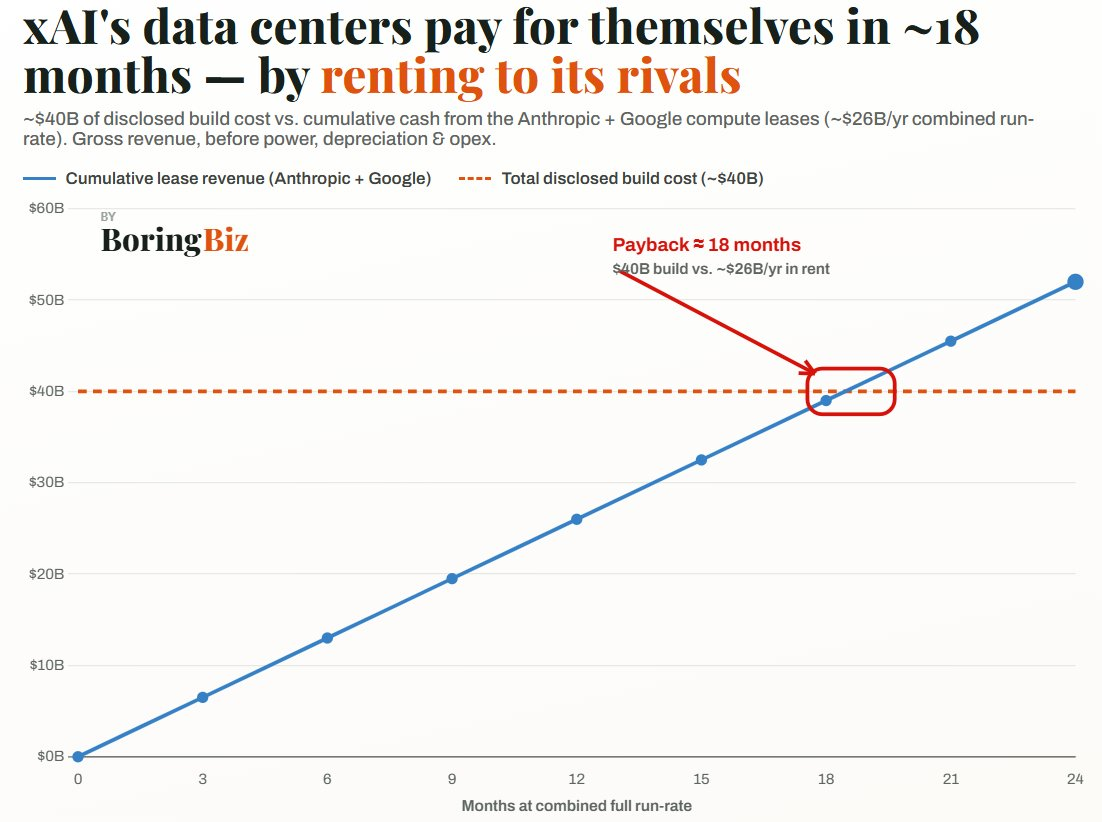
While this doesn't include opex[2] and depreciation, if the deals continue for 18 months, xAI recoups all the capex they spent and still has many hundreds of MW of GPUs available. With the giant compute shortages likely to persist into the medium term, even older H100s are likely to be extremely useful even 18 months out.
It's important to note there are certainly some red flags with the deal. Firstly, Elon Musk and OpenAI were/are locked in a bitter legal battle, and the Anthropic deal could be motivated to add pressure to OpenAI more than commercial reality.
And Google is a major shareholder in SpaceX, so they certainly have incentive to juice the valuation of the IPO.
While I'm sure there is some degree (potentially a lot!) of truth in these viewpoints, it's important to note that huge volumes of GPUs are in enormously short supply.
One of the untold stories of this capex boom in datacentres is just how behind all of them are. Even OpenAI's flagship Stargate UAE datacentre - being built in a jurisdiction that is renowned for a laissez-faire attitude to building regulations - is now under direct threat from the current Iran conflict, with Iranian drones having already hit other UAE datacentres.
In comparison, SpaceX/xAI are incredible at building datacentres on time. The original Colossus 1 datacentre was built in 122 days. Musk's empire does have a huge advantage in really understanding how to plan, build and execute enormous infrastructure projects quickly. While the hyperscalers no doubt have the experience to do this, they were built with far less urgency - with typical project execution taking many years. Given the capex only really started to ramp up in the last couple of years, many of these projects are still years away.
This gives xAI a serious competitive advantage that shouldn't in my opinion just be hand waved away.
There is no doubt this leaves Grok in an odd spot, with a lot of the datacentre capacity that was destined for Grok training and inference now being leased to a direct competitor.
While it's foolish to write off any model provider, it certainly looks like a serious retreat from Grok vying to be a frontier class lab. But, perhaps, they over-specified their datacentre capacity - there is no doubt that inference demand for Grok models is likely to be seriously behind projections, leaving a bunch of spare capacity which might as well be monetised while the training lottery continues? It's hard to say and the xAI & Cursor deal muddies the water even further.
As such, I think all three things are true to some degree. There's no doubt some level of financial engineering going on. There's also an enormous compute shortage. And it seems to me SpaceX/xAI does have a real competitive advantage in datacentre buildout.
It's just the magnitude of how true each of these are is going to define the success or failure of the biggest IPO in North American history.
Either way, the more I look at it, the more xAI is starting to resemble a datacentre REIT with a frontier lab attached, rather than the other way around.
I suspect that these are likely to be GB200s given the pricing, vs the mostly H100/H200 for Anthropic, but this is speculation on my part. ↩︎
Power is the obvious big opex line, but at this scale it's almost a rounding error. 300MW running flat out is roughly 300,000 kW × 8,760 hours, or about 2.6 billion kWh a year. Tennessee has some of the cheapest industrial electricity in the US at around 6 cents/kWh, so buying it off the grid would cost somewhere around $160mn a year. Colossus actually runs largely on its own on-site gas turbines, which comes out even cheaper: at a simple-cycle heat rate of ~10,000 Btu/kWh and Henry Hub gas at ~$3.50/MMBtu, the fuel bill is only around $90mn a year. Either way, set against the ~$15bn a year Anthropic is paying for that 300MW, power is no more than about 1% of revenue. The deal value utterly dwarfs the running costs. ↩︎
These companies are going all in and growing rapidly, because they want to dominate the market and since it is difficult to differentiate between competitors, even being third place is a terrible place to be in the consumer facing AI space.
It's a fairly sweet deal for everyone involved. Anthropic/Google get to sell more tokens and xAI gets a war chest for another bite at the apple. I don't have much confidence that they'll do anything with it but that doesn't mean these deals don't make sense for them.
What caused the crash was Yahoo! being unable to do anything with their acquisitions and Google coming out with a better search engine, undermining Yahoo!'s core product. Google basically pulled the rug from under the dot com bubble.
The situation we're in now with LLMs is different, if I'm right we're actually pre-bubble, the bubble hasn't even started yet.
Grok used to be really really bad ~8 months ago or so, but it's gotten better.
ChatGPT team needs to turn down the 'disagree just because' factor by a lot.
- https://cloud.sustainability.watch/explore-issues/example-go...
- https://www.sfgate.com/national-parks/article/mount-hood-wat...
They also seemingly dropped their net-zero climate goal:
https://www.tomshardware.com/tech-industry/google-quietly-re...
Might as well be the Mars colonization the way both are going.
So is "unprofitable on inference".
Thankfully we should find out for real as soon as those S-1 documents arrive.
More like $75/mo per user for the next 5-10 years if they can get 5% of the global population to pay that.
It will likely take a few years for supply to fully catch up, which means xAI will eat well for a while.
I can see a world where a few data centers come on line this year and reduce margins a bit, but it's crazy to think the margins will go to "cost of electricity plus a few percent" anytime soon.
Cisco was over 400 at one point and Nvidia is around 30. Not quite the same.
Other players today: - Digital Realty 48x - Equinix 75x - CoreWeave (still losing money)
There is likely a bubble of some type here, but I don't think this is the same as the Dotcom bubble.
I'll do a write-up at some point. But the core drivers are launch cost, permitting delays for terrestrial datacentres and interest rates.
The balance is between, on one hand, the financing cost of the permiting delays against, on the other hand, the cost of launching radiators. (Chips are light. Solar panels without glass cladding are surprisingly light, too. The weight of an orbital datacenter is almost entirely in its radiator.)
The math high-level works with Starship (6 flights/year), 3+ year financing delays and a 10 kg/kW radeiator (assuming 6% financing cost). Of course, there are devils upon devils in the details. But directionally, we're seeing pushback against terrestrial datacenters. And from what I can tell, advanced heat pipes may be the unlock to get radiators down to 5 to 6 kg/kW, at which point I think even New Glenn's $300/kg projected prices become competitive.
It all goes out the window if launch costs don't come down, interest rates go above 10%, terrestrial datacenters start getting built quicker, or demand for this category of compute collapses.
This is where we lack data. I’m skeptical of the claim. If anything will force retirement of old chips, it will be power efficiency, not customers being picky amidst a chip shortage.
But the S&P 500 is currently trading at over 2x its average long-term CAPE: https://www.multpl.com/shiller-pe
So it can reasonably be expected to drop more than 50% to return to average long-term valuation levels.
And the "nonfinancial market cap to gross-value-added" ratio is even more insane, I have a site tracking this number: https://sharperatios.com/market-cap-gva.html
Whatever financial games they play in the background, doesn't matter when you make that much per 2 quarters alone.
Let's not mix up depreciation of real value vs USD price (which is arbitrary, plus government controlled)
Yes, the demand is there for the currently unsustainable price. Lets see what happens when the dumping of money into AI stops and the companies are forced to increase prices a lot.
I agree the demand is there, but hyperscaler capex is what now? 3% GDP? This is an absurd amount of money and people who question whether the ROI is there have a point just because of the order of magnitude of this spend number.
In the medium term, everyone ramps up production. Huawei and other Chinese companies work really hard to develop in-house alternatives. At some point, the hype cycle will peak and less money will flow into datacentres (yes, this will happen. It always does. Even for technologies that change society. The bubble always bursts).
The question is not if this will happen. It will happen. It's just a question of when it happens and how big the magnitude of the cycle is.
Nothing about this deal is about better technology or talent. It's about an opportunity that's too juicy for Google to pass up on.
If they were speculating on compute, it seems highly unlikely they'd have spent the operating costs for the last 3 years of model development and deployment instead of just getting even more compute.
I almost exclusively use claude for all my professional and private needs. In my experience it's really good at adhering to my wishes in regards to sycophancy and pushing back. If you really want to you can tell it to systematically push back on anything where pushback makes sense until it continues with the flow of conversation.
In my first therapy session, the answers were too long and contained multiple questions, spawning multiple threads of conversation. I told it to tone it down and only ever ask one question back, maybe two, if they are related. The answers got too short. I told it to make them "slightly longer" again and reached a sweet spot.
The conversation is yours to form! You need to find the "system prompts" and guidelines to give it that work for you.
Come on, the most logical thing is that Musk overestimated the compute he needs and got lucky with the secondary usage of it.
As soon as the IPO is done and if it didn't fail, he will buy curser and try to push again if he hasn't given up on it.
He also needs some compute for the robotics stuff and for Tesla in-car entertainment and for training FSD.
It was definitely a smart business move. It should be troubling to any shareholder than xAI is unable to utilize this infrastructure as renting it out to competitors.
And some others might need to pull out when its down.
Money doesn't appear out of thin air.
Why would it lead to recession if a handful of big companies lose money they have?
It will show that the USA is in a recession for sure, but otherwise
We are not going to come up with a market-based solution to fix income inequality. The solution, as much as people in the dwindling middle class resist it, is a strong social safety net coupled with a hard reset on taxation and housing policies. Nobody should be homeless, nobody should be allowed to starve, but you might have to accept that your 401K goes down in exchange for a government guarantee of housing and food.
This is hard for people to accept because they currently have equity in their home or a 401K to save them from starving. But those are transient, individualistic solutions. You can lose your house. You can lose your 401K. Society should be taking care of each other in a broader way than letting everyone accumulate a little, private pile of money.
Note that a pension plan that invests for you blindly is no better - either the returns are so bad that they are a scam, or they are investing in stocks anyway and so you get the same results but less control. Similar for things like social security, they are either worse options or you need to pump stocks.
Also, selling shares puts them in a better position to survive a downturn (more cash, less debt).
Is it an age or a temporary situation?
There are several confounding factors.
We’ve seen massive inflation since then. So some growth in cost was expected.
More importantly, the current Tech industry almost always starts by selling things at a loss. The increased cost could simply be the industry choosing to not subsidize that particular service anymore.
But also, I don’t think that’s a realistic comparison. Rented out GPUs are likely not a similar use profile as compute used for training LLMs. The latter is likely closer to the cryptocurrency GPUs that are running at full tilt 24/7.
And those things physically burn out.
What I am wondering though is how long can you run such a system at basically full load without interruption before it starts to just physically degrade.
If I have a H100 and I let it run for 4 years at full throttle does it still have the same theoretical value as it had at the start or are the chips just burning out.
I think I remember that back when the cards used for crypto mining were sold en masse on ebay the advice was to stay away from them because they are more likely to fail?
How someone can look at an asset class thats appreciated an order of magnitude in the last two years and say it will depreciate in value when the tailwinds are even stronger now is beyond me.
Huh, anybody want to buy a GTX 680? Or even a formerly-SLI'd pair?
Don't you mean gas turbine purchases and questionably legal operation? But yeah I feel exactly the same way. The AI part of xAI looks like a mess but it seems that they still managed to score a massive win.
That makes sense, but occasionally you ask about an issue where it's clearly received political instruction from the commissar and it acts totally lobotomized. But it's true that Gemini will often blithely state that something could never happen and you'll say "what do you mean, that just happened" and then it comes back apologizing after running a Web search.
Hence why all the bitcoin miners are cashing in (or trying to) by converting their facilities to datacenters.
> permitting delays for terrestrial datacentres
going down any time soon, or even being possible.
I don't understand why people don't call that out more, when Musk rambles endlessly about how he's going to reinvent data centers and semiconductor fabs.
All this investment is completely driven by the companies leading the pack. OpenAI and Anthropic have been telling everyone they need to spend hundreds of billions in a few years. Of course they don't, they could do this over 10-15 years and still be profitable. But they're terrified they won't be able to dominate the market. So to dominate the market, they've estimated they need this growth to beat China (and each other). And the US technically has the capital to make this happen, but there's only so much money available to spend. By growing too fast, they spend money faster than they can make it, and the bills are so big that the investors go bankrupt.
That's what happened in the panic of 1873 (railroads instead of AI). That's what's going to happen here in the next 2-4 years.
I'm not saying that's what's happening, just making it clear that company valuation not being permanent is not a valid argument against money flowing to the top.
Where is this assumption of malicious intent coming from? This has all been fueled by a global AI hype that might or might not prove to be justified in the end. The overall economic situation looks (IMO) quite similar to that of the railroads in the US and those did ultimately fail and were nationalized(ish).
The current situation is hardly limited to the US and capitalism. China also appears to be actively reorganizing their economy around AI.
But better to make some money with it while trying to catch up than none money hoping you _can_ catch up.
"Well, you didn't want a data centre in the field near your town, so instead we'll rain astrocentere debris across the western hemisphere and set off a Kessler syndrome cascade. Thank god we didn't have to wait for a permit."
I am certain Anthropic spent less on building the next model this quarter if they make it to profitability due to the shear fact that they don't have enough compute.
Which solves the profitability problem with relative ease momentarily.
Also just to confirm, AI subscriptions are definitely being sold at a loss how big I don't know but these models are much harder to run.
API is definitely being sold at a decent profit.
So if you rate limit users and do usage billing + lower research costs which is a money pit temporarily.
(Proof is the fact that we don't have a new pre training run since 4.5 yet, they used to do one every 2 releases)
4.9 will probably be the same.
Next model Mythos doesn't seem to have a successor yet and was trained previous quarter most likely, they don't seem to have pre trained another one just improved Mythos if at all.
As much as I am into AI these attempts to show that there can be a profitable quarter seem like cooking the books, even if we assume no shady dealings otherwise.
Unless one of the Labs can say for certain training is going to stop they can't be profitable and I don't think training can stop because marginal gains is all they have.
8-12 months behind narrative for Chinese labs literally is going to kill the company that stops training first.
If we assume only a 3-6 month gap once China has more compute, then well then even if they keep training the lack of ability to arbitarily scale data centers in US, will kill them first.
DeepSeek V5 might actually just end the AI race for good.
Also given Mythos is atleast a 10x model compared to Opus, then it's pricing is likely going to be 10x as well so well token prices are likely never coming down, especially if these companies want to IPO.
In the case of Enron, people were obviously speculating in its stock, and that remains true regardless of why it collapsed later, or even whether it collapsed at all.
I say "first" because if you still can't agree that speculation in AI stocks even exists, then it's pointless to discuss what people might be doing to exploit or encourage it.
https://fred.stlouisfed.org/series/M2SL
https://fred.stlouisfed.org/series/TOTBKCR
And you would have been massively wrong. People have been complaining about quantitative easing since post GFC, and if you took the figures at face value, those would imply inflation was nearly 100% between the end of GFC and before the pandemic. Whatever you thought about the post-pandemic inflation, the period between GFC and pre-pandemic definitely did not see the level of inflation implied by those figures.
In fact [fiat] money does appear out of thin air (well, created by banks when they originate loans) - and has to to support a growing economy. Unfortunately, for various reasons, rather too much has been appearing, and has been funneled to the already wealthy.
Stock buybacks are also a tax trick.
They're just holistically evil and should have never been made legal.
This is untrue.
H100's are used for training (well were, but are now outdated because B100/B200s are much faster).
Most of the reason people rent H100s is for smaller training runs.
If you are doing inference you usually buy managed capacity at Baseten or something, and that is often priced differently (although it comes down to an extra margin on longer term H100 prices basically).
Inference utilization is often actually higher than training now because so much effort has been spent on optimizing that stack.
Temperature is a big factor, as well as current density.
But there's also the # and magnitude of thermal cycles (which translate into mechanical stress, leading to metal-fatigue like effects on contact points etc), attack from chemicals in the air, cosmic radiation, ESD damage & more. Some may matter, some not.
That's why "new" > "used" in case of electronics. Especially since you don't know the (ab)use history of used parts.
That's because the rate of improvement in silicon manufacturing has been continually declining for a few decades, which has a compounding effect. Just compare the technological improvements in successive decades. 1976->1986->1996->2006->2016->2026.
That's why "in real terms" performance has only been very slowly improving if you compare apples to apples (and not e.g. apples to oranges by reducing precision, like nvidia tends to do, or by comparing chips with x W to an MCM with x*2 W and saying the latter is much faster). The "just halve the number of bits in each generation" strategy has also run out now, there's no more bits to halve.
The physical world can’t be patched overnight, and cutting edge manufacturing takes a long time. Fortunately we are in a very peaceful low tension world right now and no one would try burning down or blowing up one of those extremely important, irreplaceable fabs.
The same argument you’ve made would work for tulip bulbs, dotcom prices, or whatever. Prices go up until they don’t. Exponentials don’t last forever and the intrinsics of technology assets depreciate: things wear out and are also replaced with better things.
At some point the market will be saturated with supply and prices will come down for older gen hardware. It can take years though, but it happened to fiber cable and fiber doesn't even depreciate like chips.
Opus 4.7 has all the signs of a smaller model distilled from a newer pretraining run... except a smaller price.
Flash 3.5 raised in price pretty meaningfully over Flash 3
GPT 5.4 got a small price bump over gpt-5.3-Codex/gpt-5.2, then gpt-5.5 doubled pricing over gpt-5.4
Even open weights isn't immune: Kimi K2.6 was originally priced higher despite openly being 2.5 + more post-training, same with GLM 5.1 vs 5
-
All while rental prices are spiking month over month, and NVIDIA Inception discounted prices for buying are higher than undiscounted prices for buying 6 months ago...
Half of Alphabet's revenue increase last quarter came from marking up unrealized gains in their Anthropic investments.
I'm not saying Alphabet is doing this to juice the share price, but I want to point out that they don't have to sell shares to post banner earnings results and see a 10% jump in share price overnight.
When stocks get bid up, market valuation goes up far more than the amount of money that changed hands. Most of the market cap appears "out of thin air." It's just what people think it's worth.
And when the stock goes down again, it goes back where it came from.
The investors who bought stock at too high a price lose some of the money they put in, but there are others who never paid that price.
You mean hedge funds and private equity/private credit that all under perform S&P500?
A welfare state maybe?
The GPU shortage looks to be even longer lived.
I assumed the latter and therefore that the memory is depreciating along with the GPU cores it's soldered onto PCBs with.
... or is it a different argument being made, perhaps that depreciation for GPUs has slowed because rising demand will keep them in service longer?
The key question is on direction of LLMs. Right now, LLMs are taking over human jobs. If the cost of silicon+power < cost of human being doing the same work, what rational reason is there to employ a human being?
If this applies to SWEs, lawyers, business analysts, many research scientists, .... this situation could persist for a long, long time. While capital costs less than the inputs of labor (nominal food, housing, etc.), there is no need for labor.
The key question is about continued progress in models, and of the tooling around them:
- Plateau: Old silicon obsoletes in due course
- Rise quickly: Old silicon maintains value for a long time
The supply is currently constrained because 50+% of data center plans were cancelled as a result of the impossibility of the buildouts happening in a timely fashion, and subscriptions are charging a small fraction of the actual cost of inference, leading them to all bleed money, hence the rush to IPO to get one last infusion, since many of the past investors have publicly stated they aren’t putting any more money in until they see an ROI.
Home grow a bunch discount them federally, let them wipe the foreign markets.
If AI is threatened by china why would US NOT do the same? If they did they're in a much stronger position to do so than china. Cheaper energy, more cash, stronger industries.
Infrastrucure is thr kind of thing that only a foolish US admin would let fall apart to their advesary.
What's your evidence for this? Because from the S-1, SpaceX is largely an internet service provider that happens to launch rockets and own xAI.
If they were, they'd never shut up about it. Yet they keep quiet about the financials.
The point is it’s running. They built fast before the backlash got organized. Now everyone has to deal with delays and thoughtful permitting processes.
There are also legitimate companies from the dotcom bubble era like amazon, microsoft, and intel. They all were vastly overpriced during the dotcom era. Probably also now lol.
Today’s market cap is 45.35B.
It isn’t down, but it isn’t up much since 2000.
Rates drive permitting costs. If rates are 1%, a 3-year delay is tolerable. If they’re 5%, that might crash your economics on its own.
* except ram
Investors proping up stuff by 20%, 401k and etf etc. regularly invest, investor drop out.
Who loses? 401k and etf.
Money was transfered.
Same shit happen to my company share: Price jumps 40%, company has to buy them because of employer benefits, I auto buy them, price falls back by 40%, what happened?
Investors extracted money out of the company and me.
Google is still running 10 year old Tesla T4s at full capacity.
This is way beyond the expected lifetime.
https://www.tomshardware.com/pc-components/gpus/datacenter-g...
Others say that moderate load means a lifespan of ~5 years
Not sure what that means but I would assume that a datacenter will start replacing a node once the error rate hits a certain threshold without really investigating why it failed, so the practical lifespan may be shorter than 5 years even if it would technically still be usable enough
I have to say, I find this really puzzling. We know for a fact that Anthropic are making bank on metered inference. That's their biggest source of profitability, we are seeing software companies start to majorly adopt coding agents over just the last few months.
Right as the biggest driver of enterprise adoption is accelerating, and it's tied to their biggest profit vector, you find it suspect that their profits are increasing significantly?
Also, can you clarify what you mean by "slowing down research" exactly? Do you mean they're not doing big pretraining runs? Less compute available for researchers? Scaled back RL?
>Also just to confirm, AI subscriptions are definitely being sold at a loss how big I don't know but these models are much harder to run.
Maximum usage of AI subscriptions is a loss, but do we actually know how that nets out? Has anyone done any research to try to figure that out?
I think there are accelerating returns: i.e. a models are still not good enough to be “drop in” remote workers, but once that threshold is passed, the value of each token of inference has a far higher multiplier.
This justifies the buildup. However not everyone agrees that model intelligence will continue scaling thus they assert that eventually the economics will hit a wall.
>Also given Mythos is atleast a 10x model compared to Opus, then it's pricing is likely going to be 10x as well so well token prices are likely never coming down, especially if these companies want to IPO.
I don't know why people say this when cost per unit of intelligence has been going down continuously over the past few years. When Opus 3 was first released, its API cost was $15.00 per million input tokens and $75.00 per million output tokens. Opus 4.8. which is significantly better, is $5.00 per 1 million input tokens and $25.00 per 1 million output tokens
Where do you get this from?
Enterprise plans are being cancelled or limited all over the place (Uber, Microsoft). I doubt Anthropic would be leveraging a loss leader with their consumer plans, while catastrophically hemorrhaging customers on the enterprise.
They are either operating at a loss (possibly a minor one), or a minor profit (which is chasing customers away).
If they were comfortably profitable they wouldn't need to participate in the circular deal circus.
Also to be more specific about our point of disagreement, I think we are referring to speculation in different domains. When I brought it up, I am referring to the fact that any companies whose revenue is driven by a speculative bubble (like what precipitated the 2008 crisis) would be at risk of massive losses "if the music stops". Anthropic/OpenAI aren't flipping assets. It is true that VC funding is based on speculation, but their core business model is producing massive revenue growth on selling tokens.
Target funds are diversely managed. This isn’t a real concern.
The shortage I referred to is in GPUs, that's what really being rented here.
Even if GPUs lasted forever, they're are a depreciating asset because they become obsolete with improvements over generations.
GPUs do not last forever, either. I've read here, and heard from others, that they aren't even living up to their 5 year depreciation schedules under production load, closer to 2-3 years.
I use AI all the time. I hope AI isn't short lived. It might be if they can't figure this shit out, or if IPOs like spacex poison public opinion against them first.
To maintain a functioning society and social contract?
Is wanting low unemployment in our society not rational?
So okay cool you don't need people to design and build cars. Who's going to buy the cars and where exactly are they finding money?
But see also the "radiologists driving to work" meme for why I think tech in general is currently getting high off their own farts.
So what's all the project Stargate stuff? Subsidies only work when China is doing it?
Deepseek is actively sacrificing performance for cost, which is very clear in their latest model releases. They are not attempting to get to number 1 in benchmarks, and they say it clearly in their own publications.
Furthermore, being open weight, anyone can sell qwen and deepseek compute, not just Ali and deepseek themselves.
US is doing the same and was doing that for decades now. American companies operate on loss for astonishing amounts of money and consider it completely normal. One gotta love complains about Chinese companies selling under price coming from American tech industry.
I think OpenClaw created a mania that was completely unfounded (Apple Silicon is worth dirt compared to literally anything from NVIDIA including consumer GPUs), but the prediction of compute becoming scarce was correct
Turns out there was another company with a much better reputation for which the compute is a better fit. Now that the data centers are being put to use, they actually make them a little bit of money instead of losing money.
[1] https://www.businessinsider.com/spacex-ipo-anthropic-paying-...
[2] https://www.nytimes.com/2025/03/11/technology/google-investm...
The "backlash" is the poorest residents one of the poorest large cities in America trying to fight for their right to clean air.
Your point might end at "it's running", but holistic thinkers have no problem considering the how they arrived there, given what it's doing to these folks for marginal benefit.
It's not like xAI would go under if they had chosen a less populated location and waited to get permanent power.
Its not that there isn't value in that business, but it's not the AI business either. Its the one where Oracle is laying off staff to try and avoid a revenue crash on future commitments.
Both Google and Anthropic would be trying to can this sort of rental arrangement as fast as possible since it's a mind bogglingly expensive way to get something you already do in house.
Further the human costs in the loop for AI training are insanely low or atleast substantially lower outside of US, so sure without the Nvidia upcharge I think everyone else who can use Compute from China is at an advantage.
If the assumption is AI is scaling issue then China will win because they can do infrastructure. Maybe if US wasn't in a trade war with rest of the planet there was some hope but I don't think so.
Once Deepseek figures out the new compute and can get it on par with Nvidia's clusters even if by using 4x the energy(cause they can). I don't think OpenAI or Anthropic can maintain a lead, if they don't have a lead the pricing difference will kill the AI race.
The best case scenario is OpenAI and Anthropic are dead in 2-5 years once China is caught up.
The worst case scenario where AI is not a productive boost is that well the thing pops.
Either way I don't see how this works out. Sure US govt could bomb China that's always an option.
He is claiming that they have been investing less in R&D and that this is juicing their numbers in an unsustainable way given how close the competition is to catching up. His evidence is the content and cadence of model releases recently. (I'm not taking a position one way or the other, just clarifying for you.)
> Maximum usage of AI subscriptions is a loss, but do we actually know how that nets out?
They almost certainly don't have to care. All the enterprise accounts use the API pricing AFAIK and that appears to be profitable and is expected to be the vast majority of the usage in the medium to long term (if it isn't already).
1T parameter models like Kimi K2.6 can be served for 1/10 to 1/5 of the price of opus 4.8 for perspective.
Sure opus is 2x the size and hosting might be non linearly scaling so still it should be around 50% margin at regular gpu prices.
If it isn't I would be very surprised.
Also for enterprises we joke but Google is not paying same rates as us there are big massive enterprise discounts. I have heard upto 20-30%... OpenAI is supposedly even more generous.
I don't think API is being sold at a loss at the end of the day even if the API profits are marginal 10-20% because of insane GPU prices now.
People said this about GPUs during the crypto mining craze and were wrong back then too. While I can’t speak for the entire industry I can say my personal experience follows any normal intuition over solid state electronics.
Some early failures in the bathtub curve, and then you start seeing fans, heat paste, and board capacitors fail far before you start seeing any chip failures at scale.
Sure you can abuse anything you want to burn it out, but I doubt that’s what’s happening inside these facilities.
However.
It's not rational relative to the short-term incentives of a typical corporation or investment vehicle. PE, VC, fund managers aren't paid to give a fuck about the social contract. Literally not in their job description.
Only conditionally on there being bad consequences for high unemployment.
I don't particularly trust politicians, but there's a whole host of hypothetical scenarios about futures where work is essentially optional. Unfortunately, they're all either in the sci-fi or religion sections of the book store:
Despite people occasionally investigating UBI, the efforts to research UBI seriously have the same problems that Marx had with literal Communism, in that there's an obvious difference between any partial transition as compared to a global transition, and we don't have a completely disconnected parallel world to be a petri dish for us to test the economic outcomes on.
Just look at these charts: they were declining when inflation was raging on in 2022-23 …
Sure their actual immediate revenue is driven by concrete numbers but when the rest of the economy is reorganizing itself based on their projected future revenue is the former observation still relevant?
If you're good with that, I'll send you my PayPal so you can get me my 5 bucks. It's a tiny fraction of your overall cash flow, whats the big deal?
Everyone is so fixated on the winners, that they completely forget (or aren't even aware) that there a many many times more losers.
Short term, money physically exists and gets spent, so if you wave a magic want of oversimplification and transition all labour to AI instantly, all the money currently in bank accounts and wallets gets spend on the same businesses it was already getting spent on, a lot of which gets spent on stuff from other businesses who have in this scenario also replaced all their labour with AI.
Eventually, perhaps quickly, all this money ends up in the hands of shareholders and landlords. There's a lot of both in the economy; famously retirement funds, but smaller-scale shareholders and landlords also exist. I wouldn't want to guess what the distribution looks like, probably highly variable between countries not just social classes (the definitions of which themselves can vary between countries).
Long term, money exists as a convenient fiction to help us organise transactions of goods and services: while it may be physically possible to eat gold and banknotes, you're not getting any real nutrients out of it when you do. So in a world where goods and services come from machines, the options are too broad to forecast: humanity could be relegated to the same role and economic stature as other primates (both in and out of zoos), or we could get universal UBI denominated in machine labour credits which lets each of us live better lives than the most extravagant billionaires live today.
Like imagine there was something you could buy where you insert some lumber, give it some passable description of furniture, and it outputs it. And you paid $20/month for access to this. And this was all being bankrolled by the furniture industry? I mean, sure guys - it's much appreciated, but I don't think I've ever seen anybody so enthusiastic about digging their own grave. I think it's already obvious that the gazillion dollars of API calls isn't going to materialize - it seems the handful of companies that trialed that are already reversing course hard. And in the future where LLMs are successful, that'd be even more true.
In the meantime subscriptions still exist in the form of chatbots and it’s easy to exceed the inference cost of the provider by simply using your daily, weekly, and monthly limits.
The reality is that we just don’t seem to be at a point now where people are willing to pay full price for the perceived value. Perhaps we’ll get there within another generation or two of hardware and software improvements.
Sorry, I'm referring to the national pushback against datacenters being built in peoples' backyards. xAI didn't face backlash. At least not organised enough to stop them. Their competitors, today, are facing backlash sufficiently powerful to stop new datacenters from being put down.
Also, well before then, most of the bigger petrostates got together to create OPEC, raised prices enough to cause an economic crisis and stagflation. I don't doubt that big oil companies have bribed and/or SuperPACed and/or lobbied, but fact was, until the mid 2010s (exact year depending on where you live), renewables were more expensive than oil. Now PV and wind are both cheaper. But before renewables were cheaper they were a very hard sell, while "support oil and coal because power is critical" was a very easy sell.
Right now, space data centres are a hard sell even economically, but given most of the land area of the world isn't the USA, I can easily imagine the US not caring (because even what survives re-entry mostly won't end up in the US), while everyone else can care as much as they like but can't do anything about it (unless I'm right about a completely unrelated topic, which is that we're pretty close to ground-to-orbit laser weapons being viable).
"folk economics" implies it is by untrained people.
Milton Friedman's famous quote of "inflation is always and everywhere a monetary phenomenon" shows that he deeply believed the relationship between inflation and money supply, and one certainly cannot call Friedman a "folk economist" considering he won the Nobel prize in economics and was a professor at the University of Chicago.
Note: I am not saying he is right or supporting his belief. I am merely stating that such a belief is not a "folk economics" belief. This belief is still very prevalent in the freshwater schools of economics. [1]
As a personal anecdote, at Ronald Coase's 100th birthday party, I personally got Gary Becker and Richard Posner debating a very related topic (whether and by what degree the velocity of money of fluctuates and whether helicopter drops of cash would have been better during the early days of the money supply collapse in 2008/2009 than just giving money to the banks). In a room full of Nobel Prize winning economists in 2010, there was a very rigorous debate on the topic.
[1] https://en.wikipedia.org/wiki/Saltwater_and_freshwater_econo...
What do you find controversial, and would cause a material difference in the headline inflation rate?
Both of those are devastating for their valuation. Stopping growth means open modes catch up in a year or so. Continuing means end of the current economy.
But there are many funds that have different strategies, both passive and active. Such as by investing based on value, quality, dividends, etc.
I get that the average person doesn’t know this, but the 401k doesn’t inherently force somebody into broad market funds.
If you want to complain about selfishness then do it on selfish individuals, which by the way, are present in all types of economic systems.
I'm just trying to understand if suppose you have fully robotic farms and fully automated slaughterhouses and fully automated McDonald's, who is McDonald's selling anything to and how do these people supposedly buying fully-mechanized burgers have jobs? Something just doesn't add up about this in my head about how this equation balances.
UBI ultimately seems like socialism with extra steps. Mostly is comes across as billionaires desperately begging for an alternative to being nationalized.
The problem is mostly its appropriation by untrained people though.
> Milton Friedman's famous quote of "inflation is always and everywhere a monetary phenomenon" shows that he deeply believed the relationship between inflation and money supply
Creationists theoreticians believe in creationism too. The problem arise when their theory reach the mainstream… (Influential people inside the Swedish Central bank making a fake Nobel prize to promote these ideas didn't help of course…)
Recall that the exchange earlier called into question the similarity or difference to enron. Sure, the current revenue numbers don't appear to be cooked but if the future revenue numbers are unrealistic and everyone is using those future numbers to make their decisions then isn't the end result roughly analogous? Blatant fraud not withstanding of course.
Note that I'm not claiming the above to be the case. Merely illustrating the commonality and acknowledging the possibility.
CPI works by asking how much people pay for rent. If home prices raise 20% in one year (not at all unreasonable in various times in the last ten years), it takes a long time for that to be reflected as many people have their rents fixed, some people have rent control, some landlords will only raise rents on new tenants, etc.
Capitalism provides a set of incentives that shape how people make decisions. Anyone can be selfish, but selfishness in capitalist society has a particular shape. To ignore the external incentives when looking at human behavior is horribly naive and shortsighted, but is frequently done by capitalism-apologists who seek to disregard any criticism of their favorite incentive system.
Well, people need to eat, so either the customers are on government support, or it comes from passive income, or from savings.
The people without those options, do it the old fashioned way: pick berries, throw rocks at animals, rub sticks for fire to cook them, or starve. Mostly starve, as the maximum number of humans who can survive as hunter-gatherers is 100-1000x smaller than the current global population.
> UBI ultimately seems like socialism with extra steps.
I agree. It's very much "from each according to their ability, oh wait we're all strictly worse than machines I guess that's from each nothing, to each according to their needs".
> Mostly is comes across as billionaires desperately begging for an alternative to being nationalized.
Perhaps, but that feels like claiming they're playing 5D chess, when Zuckerberg only plays Settlers of Catan with sycophants who let him win.
> how do these people supposedly buying fully-mechanized burgers
stand in line and watch some ads; the more you watch, the more you can order!…but the real question whether you want to undervolt your asset if you’re renting it out is why bother? You probably expect to replace it anyway after it’s spec lifetime, for sure want to replace it when a more efficient solution is available since datacenters are power and volume constrained and customers care about performance much more than hardware longevity (otherwise they’d buy instead of rent).
What point are you making?
>[...] many people have their rents fixed, some people have rent control, some landlords will only raise rents on new tenants, etc.
In other words, rent is lagged when it comes to the CPI... because the rent people actually pay is also lagged?
I think the main problem with the 401k is that not enough people actually contribute to one. Or they don’t put in enough.
But I very much doubt the average person who’d invested enough over several decades in a 401k feels like they got fleeced.
(Only answer I can think of is political ads).
Since this entire sub-thread is in the context of used 3090s or consumer GPUs in general, you've failed to bring up anything relevant yet again.
Here is your strategy:
1. Increase power consumption by 50%: This costs you more energy to run the GPU, it also costs you more energy to cool the GPU, it ruins the GPU and since you hit power limits of your infrastructure earlier, you will have fewer GPUs in total.
2. Increase maximum performance by 10%: This is hardly noticeable, since the standard inference use case primarily involves taking advantage of the high memory bandwidth of a GPU. This means prompt processing will be 10% faster, or maybe your segmentation model that ingests video runs at 33 fps instead of 30 fps. You're optimizing for winning a benchmark with what will be used hardware in the future, that's asinine.
3. Throw away old GPUs or sell them for peanuts when they still sell for $1000 on the used market if they are in good condition and for $400 if they are damaged. I think the mistake here is obvious. If your GPUs are sold for peanuts, it's because you didn't take care of them.
Your business strategy is obsolete and based around the idea of pre COVID excess hardware capacity before there was massive AI demand where throwing out hardware made sense, because Moores' law was in full swing. Even Google is still offering their v2 TPUs from 2017 even though they've been long since obsoleted. Now in 2026, there isn't enough memory for consumers and people are snatching up all the hardware they can get their hands on. There were some big initial energy efficiency wins from implementing smaller data types that are no longer possible now that fp4 is the smallest possible floating point type that still makes sense and even if you go smaller, you can go down to two bits at best. The parameters are starting to become so small that 2:4 sparsity is becoming unattractive, because it adds one bit to the parameters.
2:4 sparsity for fp4 means 4+4 bits are compressed to 4+1 bits, but 2 bit parameters mean 2+2 bits are compressed down to 2+1 bits.
If you understand even a little bit about hardware, you notice that the tensor core hardware has already been optimized to the extremes and that there isn't much more you can pull out of it. Unlike CPUs there is hardly any control flow in matrix multiplication. The tensor cores implemented in Nvidia GPUs might be a little bit less efficient than an NPU/TPU based implementation (think Google), but there are no more obvious micro architectural improvements here. With CPUs the micro architecture has become so complex, that there may be ways to increase performance further, but for GPUs and NPUs, there is not much left other than process scaling. Further gains require better manufacturing processes from TSMC. TSMC introduced 3nm in 2022 and only started producing 2nm in 2025. That's a three year gap where barely anything happened and all the gains came from going from bf16 or half precision floating point, to fp8 and fp4.
Burning through hardware at high power consumption and mediocre performance increases is clearly not the way to go.