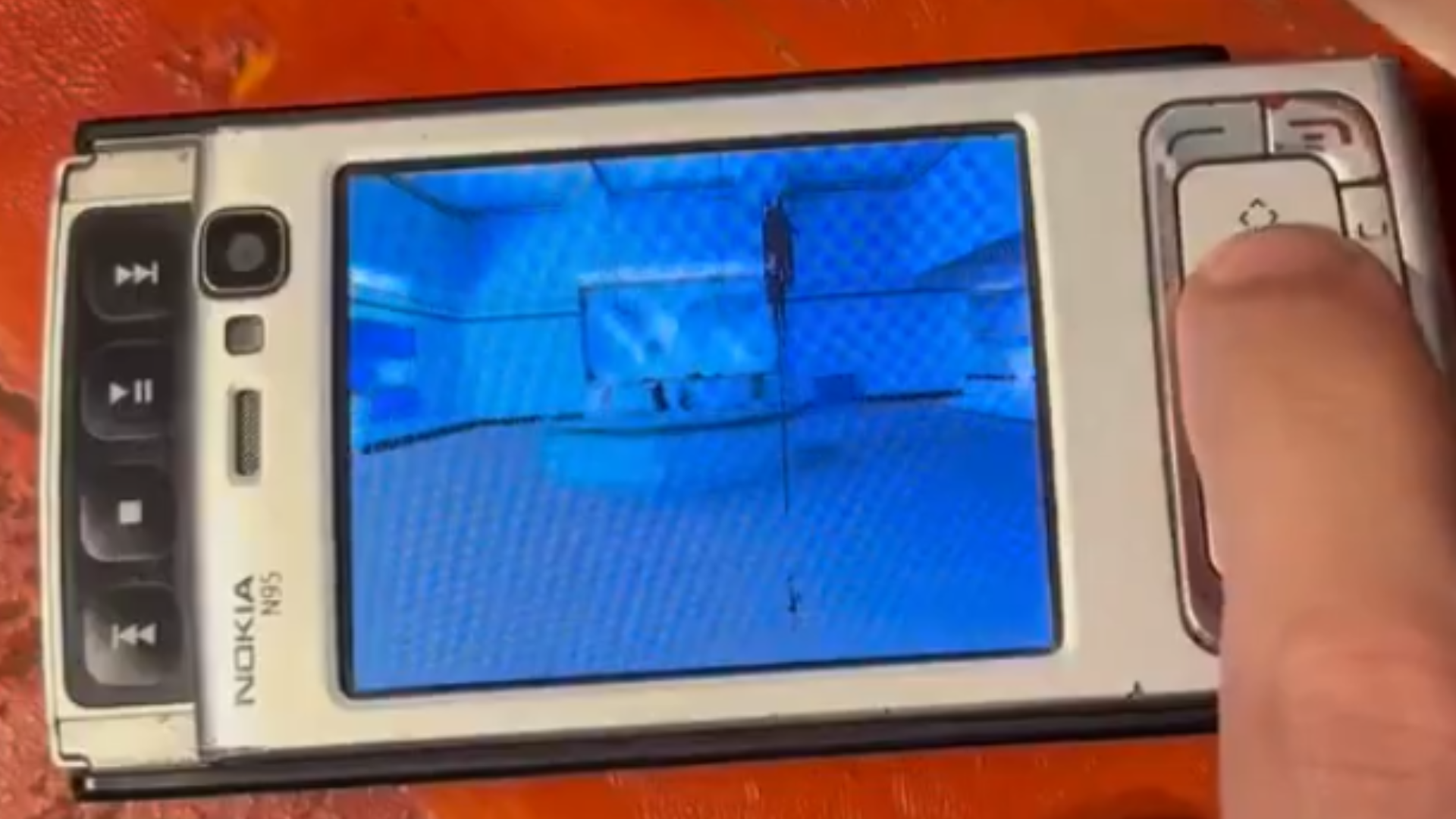
(Image credit: X.com @dante_leoncini)
Argentine developer Dante Leoncini has gotten the original Half-Life running at 30 FPS on a Nokia N95, the Symbian slider phone that launched in 2007, and has added mouse and keyboard support, he said in a post on X this week. Leoncini says that while some slowdowns remain, he has pinned down the cause and is working on a fix, the latest step in a series of efforts to run heavyweight software on the dual-core, 332 MHz handset. Half-Life shipped in 1998, needing a 133 MHz Pentium and 24MB of RAM at minimum, specs the N95 clears on paper. To date, Leoncini has managed to run Quake 3, Crash Bandicoot, and emulate Sega, ScummVM, and NES on the handset.
Half-Life 1 on the Nokia N95 finally reached 30 FPS! Some slowdowns remain, but I've already identified the cause and am working on a fix. Mouse and keyboard support has also been added. Still a few bugs to fix, but it's getting there.#HalfLife #nokia #symbian #valve #steam pic.twitter.com/PDlq2CRxAyJune 5, 2026
The N95 pairs a 332 MHz Texas Instruments OMAP 2420, a dual-core part built around the ARM11 design, with a PowerVR MBX 3D accelerator, 64MB of RAM, and a 240x320 display, all under Symbian OS 9.2 and S60 3rd Edition. An 8GB storage variant, released later in 2007, doubled the memory to 128MB.
Because the phone runs an Arm processor and a non-Windows operating system, getting Half-Life onto it requires a native Symbian build rather than emulation of the PC version. Leoncini has said before that the limiting factor on his earlier Quake 3 work was the CPU, which aligns with the slowdowns he’s now chasing.
Ports of Half-Life to unusual platforms generally lean on Xash3D, an open-source engine compatible with Valve's GoldSrc that’s been built for Android, the Raspberry Pi, and the Meta Quest. Whether Leoncini's N95 version uses it isn’t confirmed, however.
The OMAP 2420 architecture has managed to carry a game running at 30 FPS before. Way, way back in 2008, GMSArena reported that developer Olli Hinkka had ported Quake III Arena to S60 3rd Edition phones running the same chipset, with Bluetooth keyboard and mouse support and the option to host a multiplayer server on the phone itself. That port ran on the N95 8GB, N82, and E90, but not the original N95, which carried half the RAM of the 8GB model; Leoncini hasn’t said which N95 variant he’s using.
Half-Life is one of several things Leoncini has built or ported for the N95, alongside a from-scratch Blender clone called Blendersito and his own game engine, both on his GitHub. Running. In terms of the N95 as his choice of hardware medium, it’s far from the weirdest one we’ve seen.

Follow Tom's Hardware on Google News, or add us as a preferred source, to get our latest news, analysis, & reviews in your feeds.
Get Tom's Hardware's best news and in-depth reviews, straight to your inbox.
Luke James is a freelance writer and journalist. Although his background is in legal, he has a personal interest in all things tech, especially hardware and microelectronics, and anything regulatory.