
Ukrainian immigrants living in Spain take part in a procession through the streets of Madrid. Credit: Aaron Heredia/NurPhoto via Getty
Global migration has increased from 13 million people per year in 2000 to around 35 million in 2023. The data, published in Nature on 10 June1, come from the most detailed maps of global migration produced in the 33 years.
Researchers analysed the number of people moving to and from 230 countries and territories each year between 1990 and 2023, training an artificial-intelligence model on several sources of migration data (see ‘A global picture of human migration’). The study reveals the patterns of migration affected by drivers such as economic change, climate, conflict and policy reforms — for example, the largest single instance of people migrating occurred in 1994, with nearly 950,000 people moving from Rwanda to the Democratic Republic of the Congo following the Rwandan civil war.
The data, which can be explored on the researchers’ website, will be a useful resource for “planning purposes where migration is relevant”, such as schooling, social benefits and labour markets, says Wolfgang Lutz, a demographer at the Wittgenstein Centre for Demography and Global Human Capital in Vienna, who was not involved in the study.
“This is a much more complete picture of global migration streams than we had any time before,” adds Lutz.
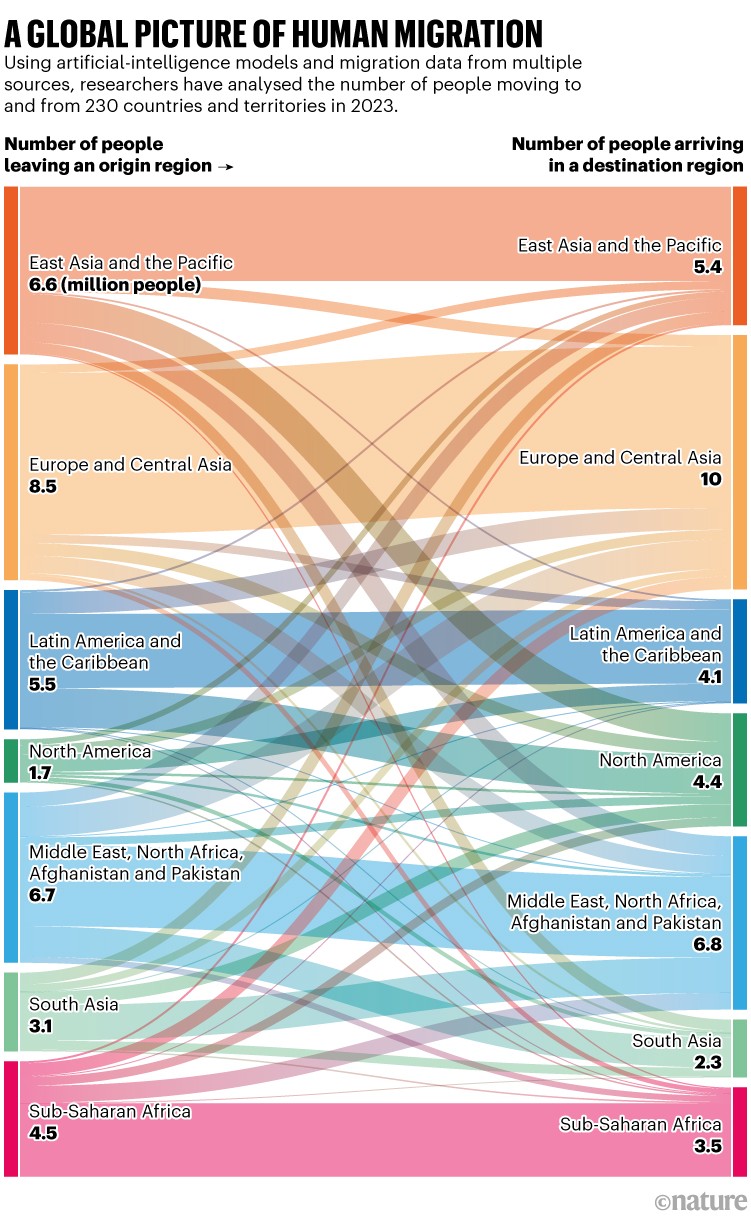
Source: Ref 1.
Gaps in the data
For demographers who study how populations change over time, data on migration have “been notoriously the least reliable”, says Lutz. Migration trends are sometimes estimated indirectly from changes in population size that cannot be attributed to births or deaths.
There are also gaps in the data on migration — some nations do not consistently collect information about people emigrating or immigrating . Even the United Nations and World Bank data sets on the number of migrants in each country are only published at five- and ten-year intervals, respectively. “A lot of people might migrate for a couple of years and then move back or move on,” and that’s not picked up at all, says study co-author Guy Abel, a statistical demographer at the University of Hong Kong.
To create a more detailed data set of migration dynamics, Abel and his colleague Thomas Gaskin, an applied mathematician at the London School of Economics and Political Science, turned to several data resources, including the United Nations, national statistics and the social-media platform Facebook.

The researchers then designed a hybrid approach to estimate migration flow, combining classical mathematical models with deep-learning networks that incorporated dozens of geographical, economic, cultural and political factors that influence people’s decisions to migrate. These factors included economic status, trade between countries, religious similarities, wars and conflicts, colonial ties and even the number of speakers of various languages in each nation, explains Gaskin.
The approach allowed the team to estimate how many people moved to or left each country or territory each year. “With the annual resolution that we are estimating, we gain a lot of additional insight that you wouldn’t get over the five- or ten-year intervals that are done currently because [they] will mask a lot of what happens,” notes Abel.