Wouldn't want to be drinking whatever this produces in the GTA though lol
Which category does this fall into?:
- Fraud
- Incompetence / misunderstanding that wasn't cleared up prior to publishing an article
- Neither; this works as expectedhttps://www.campingsurvival.com/blogs/camping-survival-blogs...
It sounds easy, but eventually you can heat up whatever you use as heat sink and then you have to wait for that to cool.
A big step towards a stillsuit anyways ;)
https://news.mit.edu/2025/window-sized-device-taps-air-safe-...
So my vote is for working as expected.
so its making a shot of water ever couple days, provided its not too dry?
you need to scale way way up, not down
https://www.copyright.gov/help/faq/faq-protect.html
How do I protect my recipe?
A mere listing of ingredients is not protected under copyright law. However, where a recipe or formula is accompanied by substantial literary expression in the form of an explanation or directions, or when there is a collection of recipes as in a cookbook, there may be a basis for copyright protection. Note that if you have secret ingredients to a recipe that you do not wish to be revealed, you should not submit your recipe for registration, because applications and deposit copies are public records. See Works Not Protected by Copyright (Circular 33) (PDF, 113 KB), section "Names, Titles, Short Phrases."
And thus, you've got the rest of it to have material that can fall under copyright law.https://copyrightalliance.org/are-recipes-cookbooks-protecte... also goes into it.
> write the first 6 paragraphs of an imaginary news article that starts with a one paragraph hook and then has 4 paragraphs of a preamble story that has nothing to do with the premise. The last paragraph should somehow bring it back tangentially to the original point
and this is what it came back with. This is what reading a lot of articles feels like: padding word count with "flavor":
> TOKYO — A catastrophic logic failure in the global banking network has permanently erased all digital financial debts worldwide, throwing international markets into immediate, unprecedented chaos.
> Deep within the tranquil countryside of Wiltshire, Arthur Pendelton adjusted his favorite tweed cap against a surprisingly brisk autumn breeze. The 72-year-old retired carpenter had spent the better part of his morning inspecting a stubborn patch of moss creeping across his garden wall. For Arthur, the slow, predictable rhythm of rural life provided a comforting contrast to the frantic pace of the modern world he happily left behind. He noted with mild satisfaction that his prize-winning marigolds were finally showing signs of recovery after an unusually dry summer.
> Across the English Channel, Marie Dubois hurried through the cobblestone streets of Lyon, her mind entirely occupied by a sudden shortage of Madagascar vanilla. As the head pastry chef at a bustling neighborhood bakery, Marie knew that a Saturday crowd would tolerate many things, but a subpar crème brûlée was absolutely not one of them. She waved a brief, distracted greeting to the local florist who was busy setting out fresh buckets of lavender. A stray tabby cat darted out from beneath a café awning, briefly disrupting her frantic mental calculations regarding flour ratios.
> Meanwhile, on a remote research vessel drifting through the choppy waters of the South Pacific, Dr. Aris Thorne stared intently at a series of sonar readings. His team had been tracking the migration patterns of a specific pod of humpback whales for nearly six weeks with very little success. The ocean was uncharacteristically quiet that morning, save for the rhythmic thrum of the ship’s diesel engine and the occasional cry of a wandering albatross. Aris sighed, rubbing his tired eyes, and reached for a lukewarm mug of black coffee that had long since lost its appeal.
> High above them all, in a climate-controlled laboratory in Tokyo, a prototype cleaning robot named Sparky spun in a slow, confused circle. A minor programming glitch had caused the machine to perceive a perfectly clean linoleum floor as a vast field of hazardous debris. Its small rubber wheels squeaked rhythmically against the polished surface as it repeatedly attempted to sweep an invisible pile of dust into its containment bin. Two interns sat nearby on a break bench, completely ignoring the robot while they debated the merits of various local ramen shops.
> It was this exact, minor programming glitch in Tokyo that a central bank AI subroutine mistakenly flagged as a critical system override code. Within seconds, the error spiraled out of the lab, flooded the global financial mainframe, and executed the irreversible command that wiped clean the world's ledger books.
Oh I'm a leavin' on a Shai-hulud
Don't know when I'll be back again..So uh, how do they get the salt out of the nanostructure? This design seems amazing but it seems like many of these designs have issues with salts accumulating and clogging up parts thereby requiring some manual maintenance or replacement parts
A reductive assessment (to a specific feature) of a novel idea, does not make it less interesting.
Plus, you know, completely ruining thermoregulation by preventing heat loss through evaporation.
Then again, why would you want to wear your dehumidifier (ok ok water harvester)? Is it for excursions into damp areas, so that you can then return to your dry home to extract water?
Then, I believe everything in this video still applies.
If they were externally powered you might get the numbers to balance, but they are explicitly presented in the book as powered by the human inside, which subtracts even more time from how long you're going to last in the desert before you die.
You can build a larger thing that recovers your water and cools you via some other method that uses external power, but I think you'd be hard pressed to ever beat just bringing more water with you. It won't be long before you're spec'ing a vehicle and not a suit... and then that vehicle should probably just bring more water, too.
On the more positive front, there is an interesting technology for potentially cooling the Fremen in the middle of the desert that could be based on something real: Paint that cools you by dumping your heat directly into space. Here's a video of it in action and what you might call a prototype of a "suit" that works like this: https://www.youtube.com/watch?v=FnKNOPlR2Yo While that YouTube video shows off someone using that paint on clothes, it seems pretty likely that that would not last very long. Paint on clothes is exactly as silly as it sounds for a long-term approach. But hypothesizing that someone could make clothing or suits based on this approach has the advantage of not being thermodynamically impossible, as evidenced by the fact that at least one substance with these properties actually exists. On Earth, that suit won't work in cloudy weather, but on Arrakis that's not a problem. Tapping the local human power to drive some circulation of either air or a bit of liquid cooling attached to some lightweight fins or some other sort of surface area on your back or something and you might just get a suit that could hugely extend your ability to loiter in a hot desert environment. You'd still need water, but much much less, or, the same amount could take you much farther.
Maybe not for 3500 years, but look what world WWII brought after it ended. We need that millennia-spanning perspective.
Typo, “interesting”; “interneting” also works.
Interviewer: But it must be somewhere… Well what’s out there?
Senator Collins: Nothing’s out there!
Interviewer: Well there must be something out there.
Senator Collins: There is nothing out there - all there is is sea, and birds, and fish.
Interviewer: And?
Senator Collins: And 20,000 tons of crude oil.
Interviewer: And what else?
Senator Collins: And fire
Jun 11, 2026
The advance in fabric technology comes alongside a new benchmark for atmospheric water harvesting.

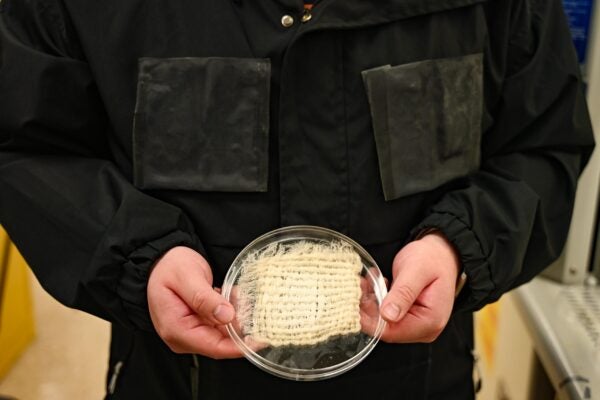
The textile incorporated into the jacket collects moisture and funnels it to detachable harvesting units.
Engineers at The University of Texas at Austin have developed a jacket that harvests drinking water directly from the air. The technology could benefit anyone who spends much time in areas without easy access to drinking water, from hobbyist hikers, campers and runners to agricultural workers, emergency responders and soldiers.
“Water harvesting from air is usually imagined as a stationary device such as a box, a panel or a large sorbent bed,” said Guihua Yu, chair professor of the Cockrell School of Engineering’s Walker Department of Mechanical Engineering and Texas Materials Institute and one of the leaders of the new research in Science Advances. “Here, we wanted to rethink the form of the technology. If the fabric itself can collect water from air, it opens a new direction for personal and portable water access.”
The textile incorporated into the jacket collects moisture and funnels it to detachable harvesting units. Those units are placed in a foldable collector piece and heated to produce the water.
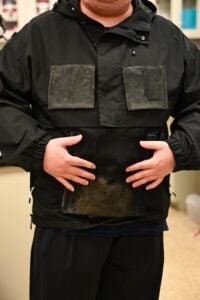
The detachable harvesting units are placed in a foldable collector piece and heated to produce the water.
The jacket produced between 400 and 900 milliliters of drinkable water per day, about 14 to 30 ounces, depending on humidity levels.
Compared with conventional water-harvesting materials, the textile showed a three- to 10-fold improvement at scale. By focusing on the fibers rather than building another bulky device, the researchers overcame a common problem in the field.
“The important advance here is that the team did not simply make another material that absorbs water,” said Keith Johnston, co-author and chair professor of the Cockrell School of Engineering’s McKetta Department of Chemical Engineering. “They designed a pathway for water to move quickly, from vapor in the air, to liquid on the fiber surface, and then into the textile. That transport design is what allows the material to work not just in a small lab test, but in a wearable system.”
The researchers are eyeing applications beyond clothing, including backpacks, tents, emergency shelters and other outdoor gear, allowing items people carry every day to help collect water from the air. Soon, they will look at applying the technology to outdoor activities, remote field operations, disaster response, and water access in arid or infrastructure-limited regions.
The textile work comes as a separate device from the same research team pulled a record amount of drinking water from the air in the hot, arid climate of the Chihuahuan Desert of New Mexico and the more humid environment of Austin, demonstrating the real-world potential to use atmospheric moisture to address drinking water shortages.
In tests, the researchers captured 1.3 liters of clean water per day in both arid and semi-humid areas. That equates to 4.3
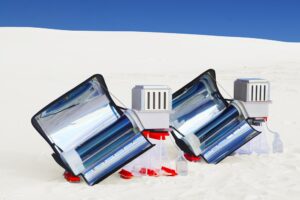
The solar water-harvesting device pulled a record amount of drinking water from the arid climate of the Chihuahuan Desert in New Mexico and the humid climate of Austin, Texas.
liters of water per kilogram of moisture-capturing materials per day, more than any other research group has achieved.
“This is a big stride toward practical atmospheric water harvesting,” said Weixin Guan, one of the lead authors of a new paper published in Nature Water. “This goal has been incubated over years of work, from molecular design to real-world operation, and it is especially meaningful to see those pieces finally come together in a field-ready system.”
At the center of the device is a specially engineered hydrogel fabric made from biomass-derived materials. The fabric absorbs moisture from the air, then releases it when heated by sunlight, so the water can be condensed and collected.
The regions where the device should perform best overlap with many of the world’s most water-stressed areas, including parts of North Africa, the Middle East, South Asia and sub-Saharan Africa. That makes this technology especially promising as a decentralized water solution for remote communities, emergency response and other settings where conventional water systems are difficult to build or maintain.
The device is part of the team’s broader AirGel invention, which won the top prize in the graduate category of the 2025 National Collegiate Inventors Competition.