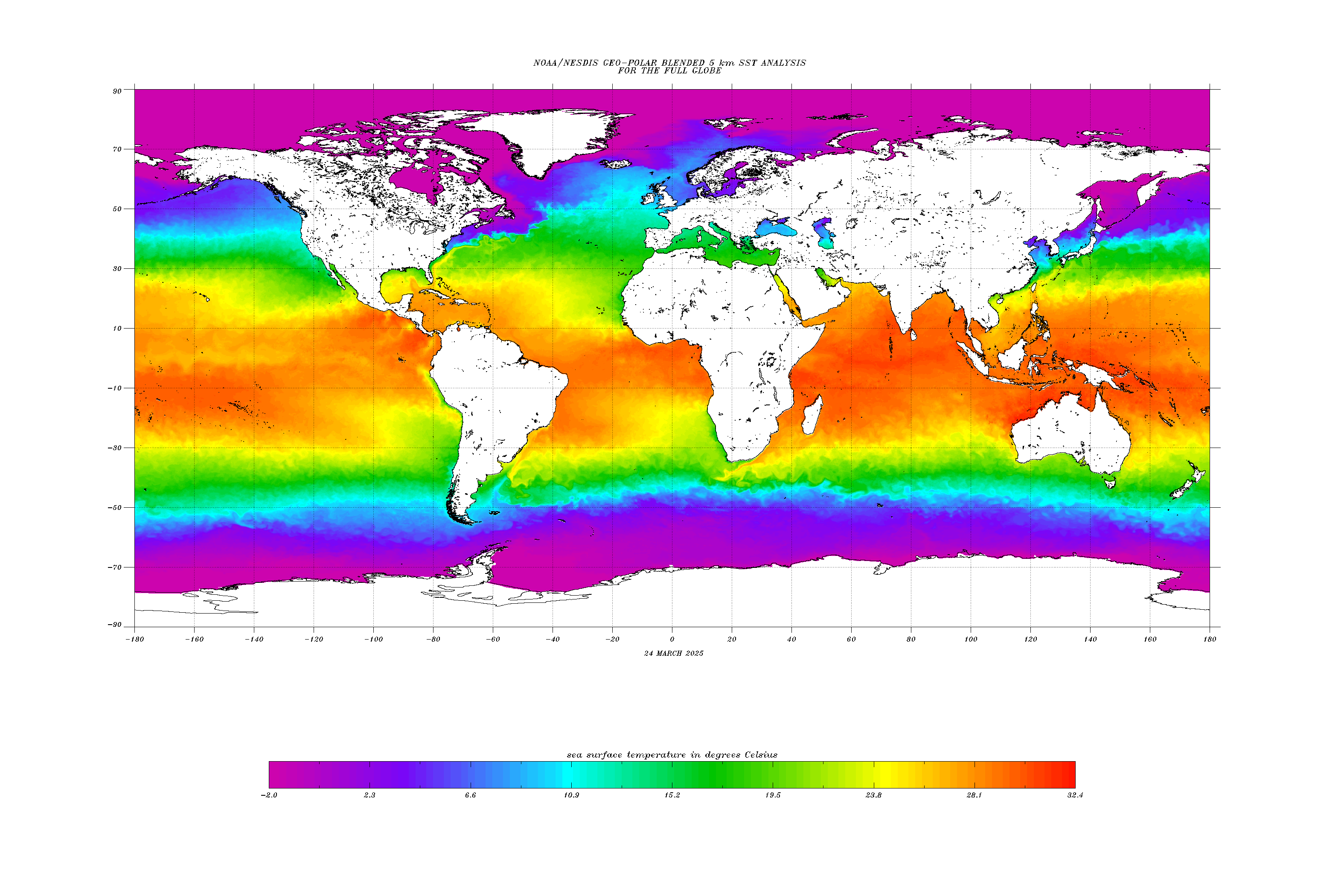
Now, looking at the image in the article, there is a massive cold blob right there where the Labrador Current joins the Atlantic, but no mention of the theories that I've read about years ago, just that it is mysterious
And for some perspective, this is only one of many other huge changes that huge populations will react violently to in the next 20-50 years. Good luck to us all.
It was 48 C this week in some cities. The power grid was not ready for the amount of AC power needed, and it turned into blackouts. You're sitting in a dark cube that has been cooking for 12 hours, hoping something might happen. A healthy 25 year old would die in 6 hours.
Even if you do not want to accept climate change is a thing, you can accept the current state of the world is affecting people.
https://www.cnn.com/2026/06/13/politics/judge-ruling-nationa...
> At South Carolina’s Fort Sumter National Monument, a sign that included details on the looming impacts of climate change, including information on how “rising seas could inundate most of the fort’s walls and flood the historic parade ground” was removed in its entirety.
However, I do think we have time to prepare for the worst case scenarios, and individual countries and states can do that efficiently on their own.
Improve evacuation routines in floodable areas, build greenhouses to deal with cold snaps, ensure there are air conditioned buildings to deal with heatwaves, have distributed local production of electricity, keep strategic food reserves stocked, and so on.
Edit: Not saying that such efforts are the solution by any means, but they will help.
https://www.ospo.noaa.gov/data/sst/contour/global_small.cf.g...
https://www.nytimes.com/2026/05/26/climate/emissions-worst-c...
Still work to be done, and also plenty of reasons for optimism. Batteries, motors, and carbon free generation only get better.
Don't mistake "I don't understand the science" for "the science behind climate change is weak". Go out, learn some coupled atmospheric modeling PDEs, and build a climate model yourself (Claude can help). It'll only take a few days. You'll learn a lot about what's known and the sources of uncertainty.
...so the answer is to accelerate the burning, but not for the sake of burning more, but to focus on getting to true clean energy sources which will allow us to economically unwind the mess before the whole house of cards collapses, i.e. fusion + global scale solar (maybe even space solar and microwave beam down) + boatloads of batteries.
But. The level of international coordination with vaccine rollouts and agreements between countries was way more than I had initially expected. Of course this feeling depends on what your own baseline expectations are.
My takeaway was that if the conditions arise that we all decide to do something about climate change (because of political conditions or because of actual effects) we (humanity) are willing to make big sudden changes
we're jumping to a catastrophe when it might just ring, and whatever the environmentalists who prioritize it qant to do about it might change something that doesnt need changing, and result in actual catastrophe when the ringing stops
If the true costs were accounted for, Capitalism would work great. The problem is a lot of the costs are left for someone else to eat.
Unlikely. The government will be the only one who can bail them out.
Or you could choose option three: do neither and go on Twitter to do some political point scoring: "The Democrat Party is going to use this three day Indian heatwave (they have one every summer) and their climate hoax to open our borders back up to illegal immigration! We must stop them! Vote against the Demonrats this November! MAGA!"
No point in letting a good crisis go to waste.
https://www.indiatoday.in/science/story/north-india-heatwave... for anyone curious, and that was almost a month ago. Pakistan is also very vulnerable.
There will always be outliers who don't believe something. But even for the people who do believe climate change is real, there is a huge variance of how we should address it. Most people have more immediate problems. Many take the same type of argument as the infinite population growth is good crowd - future tech will save us.
The areas to be rendered “uninhabitable” in our lifetimes are all poor. Hence the disconnect.
It's the difference between Chinese planning philosophy versus the West's.
Global warming is much trickier though. Covid had hundreds dying daily, it was very direct and undeniable, and the cure was cheap and efficient once it was developed.
Global warming has no clear signal (oh look, another heatwave) and no clear cure at all, let alone a cheap and efficient one.
The comparison with Covid is also striking because the only reason a global "don't travel too much" solution couldn't work is due to the nature of capitalism. It's not like we couldn't feed everyone. It's just that some people with too much wouldn't gain as much for a little bit. Which is the same root cause of why solving climate change is impossible without radical change.
Unfortunately, I don't know the answer. I'm quite certain it's not to maintain the status quo, though.
Nuclear should not be off the table. It’s safe, it’s well understood, it’s reliable and is a very cheap way to create base load capacity that renewables like solos and wind can build out on top of
But just because it’s also their fault doesn’t hinder them to blame the government.
Who do you think will MAGA blame for the consequences of climate change?
Nobody should ever adopt sustainable practices from which you only benefit when everybody else does, in which case a minority of people who didn't adopt sustainable practices also benefit. That's just bad economics.
And then there's all the wealthy hypocrites who criticize the middle class while they make weekly flights with private jets. And dont forget the coal powered data centers, I wouldn't be surprised if there's some hypocrisy there from the epstein class too.
Government mandates for e.g. large nuclear construction, geo-engineering, BEV adoption, or other similar proposals would have had an impact. These all exposed the real tradeoffs which would need to be accepted of cost, hardship, or whatever the opposition to nuclear was.
The environmental movements of the last 60 years focused on impossible goals which were easy to rally behind.
The only way forward is developing as much solar, wind and nuclear as possible, driving down energy prices. Obviously stuff like carbon tax can help accelerate the process, but mostly it's happening because renewables have become the cheapest way of generating energy in most parts of the world.
https://edition.cnn.com/2026/06/03/climate/ocean-monitoring-...
What are you talking about? The united states is currently ~-30% off peak carbon emissions.
PSA: the is (as well as pp) parameter is for tracking. If possible try to trim it.
I've seen people on social media seriously claiming that coal plants are cleaner than wind energy or solar energy. It's aggravating. Never mind that it's easy to show that for the same amount of energy output, you get a similar amount of tons of coal ash yearly to the amount of materials it went into building a wind or solar plant...
I go back and forth if they are bots, or somehow people who are just really susceptible to this kind of garbage shill clickbait.
We should define climate skepticism, to avoid indicting a strawman. I'd start with my definition, as someone with unorthodox views on climate that often place me at odds with progressives.
It may be easier to start with the elements we agree on. Is the climate changing? Yes, obviously, visibly, measurably. Do human activities, including burning of coal and hydrocarbons, likely have a causal, contributory impact? Absolutely. Is the adoption of cleaner sources of energy: solar, hydro, geothermal, wind, nuclear, as well as investment in transmission and storage upgrades, a good thing? Unquestionably. Is climate change causing a growth in a class of threat to human life and prosperity (e.g. heat deaths, coastal flooding, extreme weather events, etc.)? Of course.
As for the areas where I diverge from progressives: Do I expect any amount of reduction in human activity, including reduction of coal and hydrocarbon combustion, reduction of overall energy usage, reduction of living standards and growth targets, to make any difference in the magnitude of the coming climate change at all in the long run? No.
The earth has both heated and cooled by orders of magnitude more than worst-case projections before humans started burning hydrocarbons.
Earth's climate is changing, yes, but historically, over the last 500 million years, the global average temperature has been as low as ~11° C at times; as high as ~34°C at others. You're reading that correctly: strictly natural processes that predate humanity itself have repeatedly changed the global averge temperature by as much as ~23°C. Ice ages occurred with zero human impact, just as the Cretaceous Thermal Maximum and global atmospheric CO2 levels exceeding 1000ppm occurred with zero human impact.
If you were to measure the full range of earth's climate variation over the history of the earth, and attempt to assign and attribute causality to all sources of that climate variation, you'd find that both the presence of all of humanity and the sum impact of all of human activity is an insignificant footnote. If this duration were a football field, humanity itself would be the last centimeter of grass in the distance of that football field; the period in which we've been measuring the climate is a thin slice of a single blade of grass.
The potential and capacity of natural processes to raise global average temperatures by 23° C has always been present, and nothing we can do will eliminate that potential and capacity.
The focus of human climate concern, accordingly, should be preservation of human life and wealth through adaptation to a changing climate, not futile efforts to prevent change itself, or an irrational alarmism that seeks to instill a widespread sense of anxiety over a process that cannot (and never could be) stopped, and for which the sum of humanity is not responsible for.
Build AC in Seattle. Set up better floodgates in New York City. Winterize the grid in Texas. Fix building codes to make houses more safe from hurricanes in Florida, and develop better solutions to stop the destruction of homes from wildfires in Colorado.
And yeah, do invest in alternative sources and production of energy. Energy is good. Energy is prosperity - it's causally linked to GDP, it's a direct requirement for quality of life / comfort / happiness. We need renewable energy. We need dispatchable energy. We need zero-emissions energy. We need energy that works at night, when it's cloudy, when we run out of oil, and when the wind's not blowing. We need better storage, better transmission. More energy, more sources, and lower costs for all of humanity.
We can't stop the world from changing, and trying to is foolish; we should accept that it is changing whether we try to prevent that or not, and focus on protecting and improving quality of life for all of humanity in the face of this always-changing environment on this little blue dot instead.
You can live in a well-insulated fully electric home powered by renewable energy and have most things you need within a walk, bike, or public transport ride away, _OR_ use an electric car for the things that aren't. If you combine that with a mostly-plant based diet (or at _least_ swapping chicken for most of your beef and lamb) and have 2 kids or fewer you're... basically there.
The main reason most people can't do this is because of political choices, not technological limitations.
Granted this doesn't include luxuries like jetting halfway around the world for a 1 week holiday or living in a 4000 square foot house in the desert and driving a studio apartment an hour to work every day, but really, is that a better life?
superficial and incorrect
Disclaimer: For myself, I do believe in personal changes, e.g. consuming less (red meat, flights, gas etc). Not because it makes a big impact but because that's just my personal morality and it makes me feel better to do it. On a societal level it's tougher because most/many people's brains don't work like that (I think).
Climate scientists could help convince skeptics by correctly predicting future events. Skeptics could vet the predictions immediately to avoid late refutations. They’d look foolish if they tried to downplay the events if they didn’t raise concerns at the time they were predicted.
Looking fairly at things, predictions along the lines of ‘An inconvenient truth’ did not help. ( A UK high court ruling found at least 9 errors or exaggerations in the film. )
Demonstrating predictability should increase acceptance.
This is true about the instantaneous state of the governments of the US and China rather than some intrinsic permanent cultural quality.
I wouldn’t mind shortening e.g. the Iran war by a couple of days and redirecting the funding from that to fusion research and battery buildout.
The challenge still remains decarbonizing the rest/electrification
Of course, given the seeming inability of the US to do any kind of large projects any more, small and decentralized is probably the only thing that will work.
The AMOC shutdown isn't merely "possible" and due "this century". The math of the dynamics of complex systems shows the current behavior to be signs of a phase transition in the process of happening. The speed of that shutdown isn't "decades" either, it's more likely just years.
The voices of "experts" telling you it was all some incomprehensible conundrum should deeply worry you. They're either not being honest or they're no experts.
Have you travelled? This doesn't describe most of the world. Most of the world would need to increase carbon emissions to live the way you're describing.
You aren't describing a zero carbon lifestyle, you're describing a lower carbon lifestyle. And we still use carbon in building the things in your scenario: the building, the car, etc.
Lower carbon lifestyles can slow the speed of the increase in global warming, but as long as we're emitting any carbon we're increasing global energy forcing.
By all means choose lower carbon lifestyles, but fundamentally we need nuclear or renewables + battery or all of the above such that we don't face a tradeoff between energy use and getting stuff people want.
Energy is extremely useful.
This is at odds with lots of other relevant topics that go beyond just "consumption".
2 or fewer is below the replacement rate of 2.1 This _has_ already happened, but there are a lot of voices voicing a lot of reasons why they believe that that might actually be not the best situation.
For this to be the most effective it really needs to be deployed somewhere like India. How are they coming along with that?
Household electricity self-sufficiency obscures the vast requirements to support it and extend this self-sufficiency to billions of other people.
I mean you have two separate points here, one is "adapt" and the other is "nothing can be done", which itself can be picked apart into different specific things that can't be done, such as on the one hand getting everybody to behave themselves conscientiously with one mind, and on the other hand unilateral geoengineering.
This right here, it should be a Manhattan Project level of urgency, but at global "Hail Mary" level of cooperation and effort.
And the best part is that it's not like that investment is wasted -- it's foundational and will allow us to do incredible things with it.
Meanwhile the President of the United States is actively cancelling such work and doubling down on coal. Wheee!
These are already out there. Extreme weather events are happening with all increasing frequency. But as with the slow boiled frog, when is it a crisis? The denier just claims we have always had extreme weather events, and they are correct (and this sidesteps the argument).
It’s always cheap and easy when mentioned here.
I live in New Zealand where we have lots of wind, rain and sun and people occasionally suggest it for here too.
A challenge that can be more easily addressed if it can scale first to handle induced demand only rather than base load. It’s a smaller problem that way.
Individual choice is actually a small part of this wheel, almost negligible.
The vast majority of polluting is done by industry, and they also do the most not to make things better and actively often try to make things worse.
https://ourworldindata.org/profile/energy/india
USA is at 80%, which isn't much better, but at least trending down:
https://ourworldindata.org/profile/energy/united-states
China is also at 80%, but trending down far steeper:
That doesn’t fit my understanding at all.
https://en.wikipedia.org/wiki/List_of_countries_by_greenhous...
The AMOC shutdown isn't merely "possible" and due "this century" either. The math of the dynamics of complex systems shows the current behavior to be signs of a phase transition in the process of happening. The speed of that shutdown isn't "decades" either, it's more likely just years.
The voices of "experts" telling you it was all some incomprehensible conundrum should deeply worry you. They're either not being honest or they're no experts.
India still has a long way to go, but China is doing the right things. Same can't be said about USA under current administration.
We have the answer to this on the front page of our news sites.
We try to impose a population cap. We recruit gangs of unidentifiable thugs to beat, imprison and deport them and we have race riots.
Sure, some of that is "dollars and cents" and not the movement directly, but most of that (technological improvement) had nonzero influence on the technologists who built the impromevents.
No king wants to rule over a failed state.
That said, another section I've largely left out above is that it's effectively impossible to coordinate global action to meaningfully reduce human emissions from current levels. Europe and the US have actually already had declining emissions levels for decades now. This isn't a philosophy problem that you can talk your way to a solution on, it's a human psychology and game theory problem.
Trying to voluntarily convince global south nations to not adopt carbon-positive energy sources that solve real problems in the third world, and instead telling them to exclusively adopt your preferred alternatives (which do come with tradeoffs, be them in cost, complexity, availability/reliability) to appease what people facing food scarcity due to a lack of refrigeration due to a lack of electricity would consider "first world concerns" is an exercise in futility, and has some thematic emotional rhymes with colonial pasts where wealthy westerners demanded sacrifice from the global poor for the comfort of the wealthy westerners. It's a very tone-deaf plea.
The average global temperature raising by even 2°C has catastrophic and devastating impacts to humanity, to say nothing of it raising by 20°.
We can't stop or prevent global average temperatures from rising, even if we do cut emissions to zero.
What we can prevent is the widespread loss of life (human, plants, and animals) and prosperity. Preventing loss of life and prosperity is good, and it's an achievable goal, so we should pursue that goal.
”Your honour, but the girl didn’t resist very much, so she must bear part of the blame for what I did to her”.
The reason why Putin or Kim Jong Un is not dead a long time ago is that enough of the ruling upper middle class has been made dependent on their leaders and will work to ensure the safety of said leader.
You two might agree if we consider that when you say "rich" you might describe the average individual on this website (if we consider all people alive).
I do believe that 90% of the people would not want to actually destroy the planet the way it seems to be happening, but I also believe that 90% of the people can't refrain themselves from bad health habits either. So, to fix the root cause I would discuss more about people's bad emotional/impulse control, otherwise we will just change one issue (climate) to any of the others (violence, unhappiness, etc.)
The reason half the population won't take climate alarmists seriously are statements like this.
Saying the West, generally, or the US, specifically "aren't doing anything" is ridiculous.
The funny part is that it should terrify you whether there are 10 humans or 10 billion. At the current rates, it's over in about 12-13 generations regardless of the number you start with. That's how it works... no matter how big the starting number, it's how many generations you have left.
Think of it this way? You know the dumb story they taught us in school, about the guy whose payment from the king for doing something clever was to have one grain of rice on the first chess square, and 2 on the second, 4 on the third, and so on... and how it bankrupted the king long before the 64th square? That's the same math with fertility rate of 1.0! (The Chinese have a fertility rate of 1.0, famously.) Each generation will be half the size of the previous. But how long before that is effectively zero? Will it be 1 million years, 250,000 years? No, about 300ish. 300 years. But long before you reach that point, your civilization has fallen apart. Those last 4 or 5 generations live life without electricity, anything but muscle power, or metallurgy.
And China's fertility rate isn't even the lowest! South Korea's rate just dropped to around 0.5! That's where each generation is one quarter the size of the previous.
The best part of all is that these rates haven't even bottomed out. We will almost certainly see rates right around 0 long before the century ends.
>but there are almost ten billion simultaneous humans, we're fine.
At least math illiteracy ought to console you guys towards the end.
If we need unbounded growth to jeep our economic system to function, its the economic system that is wrong, not nature.
The one hope is that renewables and batteries continue to reduce in cost, and grids everywhere develop around that paradigm. Economically, it’s inevitable, but there’s a lot of (to be stranded) money, social, and political will against it.
However, a global reparation fund would make a difference. Not entirely unheard of for richer nations to fund these things for poorer ones
For instance, consumers want fast and high speed rail and light rail in cities, yet the federal government is still subsidizing hundreds of billions of dollars to car centric projects rather than allowing municipalities and state governments to have control over those funds they come with strings attached that force them to choose car centric options.
Affordable housing is another example. Consumers want reliable cheap homes but every single attempt to unseat obtuse regulations and policies that make home bulldog a nightmare across metropolitan areas all over the Us entrenched home owners fight in as many ways possible to keep new homes from being built. This pushes more people into farther out suburbs that makes an existing issue even worse.
So no, it’s not all consumer choices, not even “pretty much”.
The false dichotomy that it’s simply choice is not a good faith argument.
The other flip of the coin is this: people can consume in ecologically smart and sustainable ways, and often given the choice they do but lack of choice exists across most sectors that don’t allow them to or are knowingly priced higher than the alternative options due to poor regulation or lack of proper subsidy on the scale of the dirty alternative.
And we subsidize a lot when it comes to oil, natural gas and coal, let alone other industrial polluting industries.
* Some humans will likely survive, but modern civilisation won't.
Economies can exist in many different ways. At its core it is just a way to describe how we move resources between ourselves and that can be done in many, many ways.
Our population absolutely exploded over the last 100 years. This can easily just be a reversion to the mean. There really is no reason to be worrying about human extinction right now. In fact, the ‘extinction’ rhetoric is harmful and dangerous since so many ‘solutions’ to fertility rates are less education and less freedom. I have no trouble believing a handmaids tail like faction emerging because they believe they are saving the species.
This might actually be a yes if you believe in the potential impact of automation and AI.
Also, is there a way to move heat into space that doesn't require adding more heat into the atmosphere than is removed from the expulsion? Or do you just mean this as a hypothetical example?
The opposite, actually. Your assumption is that the rates bounce up and down, mostly because you don't want to believe there's a problem.
The rates are transmissible, older generations to the younger. No one growing up in a world where people have few or just one child will say to themselves "hey, you know what, I want 10 kids when I'm an adult!"... but that's what would have to happen. You and everyone else on HN whines "the reason people aren't having kids is the economy is awful and we can't afford them"... but in a world with a shrinking, aging population the economy just gets worse.
You're the one making the very stupid assumption, and you can't even say why. I can, it's because you haven't thought about it. Perhaps it's uncomfortable to think that you're driving your species to extinction.
>Our population absolutely exploded over the last 100 years.
More nonsense. Our population isn't exploding, it's just big. And it will shrink rapidly. I already laid out the math... how long before 8 billion becomes 1000 when you're splitting it in half every generation (a generation is commonly held to be 20-25 years)? Can you do that math puzzle for us? There are only about 5 generations living on Earth at any given time. Just do the math already. None of this is pretty.
>There really is no reason to be worrying about human extinction right now.
Yes, there is. People are only generally capable of reproduction from the ages of 16 to 36... just 20 years. Every moment you waste "not worrying about it now" is the problem compounding with interest. You've already waited too long to worry about it.
>In fact, the ‘extinction’ rhetoric is harmful and dangerous since so many ‘solutions’ to fertility rates are less education and less freedom.
Well at least when our species dies out, the last few people will have masters degrees. That's the important part, right?
>I have no trouble believing a handmaids tail like faction emerging
It'd be because you and those like you forced the issue. Go ahead, stick your head in the sand some more. We all know that willful obliviousness to reality can change the rules of the universe themselves, right? Wish it all away!
Heat into space: I was thinking of "PDRC":
https://en.wikipedia.org/wiki/Passive_daytime_radiative_cool...
> If only 1%–2% of the Earth’s surface were instead made to radiate at [~100 W/m2] rather than its current average value, the total heat fluxes into and away from the entire Earth would be balanced and warming would cease.
Which is, you know, a nice fantasy and theoretically works. Like a solar shield, but terrestrial.
Edit for those thinking that even 1% is an unfeasibly large area: yes. It's about 5 million km², which is about one-fifth of North America. Maybe scatter the panels around the ocean?
Here is the key disagreement. Maybe I'm wrong, but I don't see any compelling evidence why rates would not bounce up and down as society and environment change. Hell, in the next 100 years we could all be nuked back to the stone age and birth rates go back to pre-industrial levels. I am fully aware of the concept of compounding interest, but rates in organic systems change all the time.
> No one growing up in a world where people have few or just one child will say to themselves "hey, you know what, I want 10 kids when I'm an adult!"
This is just patently false. I can believe in a correlation, but I know personally plenty of people who come from small families go on to want big families.
> Well at least when our species dies out, the last few people will have masters degrees. That's the important part, right?
Well, no. I think the important part is the freedom aspect of my comment. I would actually rather humanity die out, than have my nieces and future daughter used as breeding chattel.
You obviously have strong opinions about this and I'm not going to change your mind so I'll just leave the conversation here. Good luck with the existential dread.
And yet this exact thing happened, in reverse, everywhere in the world as certain social conditions were met. So it's not just not impossible, it's by far the likeliest scenario.
> Our population isn't exploding, it's just big. And it will shrink rapidly.
The whole population of the world slowly rose from some 10-50 million before 1 CE to some 100 million by 1000 CE, to maybe some 2-300 million by 1700 CE. And then it suddenly reached 1B in 1800, 2B in 1920, 4B in 1974, 8B in 2022. This is a massive population explosion, with the doubling rate increasing rapidly, especially before the 2000s.
> People are only generally capable of reproduction from the ages of 16 to 36... just 20 years.
This is wildly wrong. Children of 16 years should NEVER reproduce, it's an awful thing that this happened for so long of human history, a shameful reality that will hopefully never happen again. And as health has increased, women have become able to reproduce (with some medical aid) well into their 40s (note that the record is currently 74), while men can and often do reproduce well into their 60s+.
Now, is it better if people who want to have children have them when they're younger, probably in their late 20s? Absolutely - mostly to keep generational gaps manageable, to benefit from grandparents' help, etc. But it's not in any way a strict biological necessity, and as fertility science advances, we have every reason to believe this will continue to improve.
> Well at least when our species dies out, the last few people will have masters degrees. That's the important part, right?
This is absurd hyperbole for the exact reasons above.
AI-generated summary was reviewed by a CNN editor.
In the North Atlantic Ocean, south of Greenland and Iceland, a large patch of water is doing something very strange. While the rest of the ocean heats up, it’s been getting colder. A new study says it has the answer to this mystery — and it’s an ominous sign the world is hurtling toward one of the most alarming climate tipping points.
The swath of ocean — dubbed the “cold blob” or “warming hole” — has cooled by nearly 1 degree Celsius (1.8 Fahrenheit) since 1900.
Scientists have long debated whether this anomaly is driven by heat loss from the ocean surface due to changes to winds and clouds, or whether it’s a signal of the weakening of a critical system of ocean currents, which transports heat. The new research concludes it’s the latter, and the finding points to a worrying future.
☔️ ☀️ Explore CNN Weather for iPhone
The Atlantic Meridional Overturning Circulation, or AMOC, works like a vast ocean conveyor belt, pulling warm water from the tropics to the Northern Hemisphere, where it cools, sinks and flows back south.
A raft of research suggests this system is weakening as human-driven global warming melts ice and causes a surge of freshwater into the ocean, disrupting the AMOC’s delicate balance of heat and salinity. Some scientists warn the AMOC is heading toward a tipping point, potentially as early at this century, which would mean a future collapse is locked in.
An AMOC shutdown would be a global catastrophe, causing accelerated sea level rise on the US East Coast, plunging Europe into a winter deep freeze and shifting the monsoon in Africa, driving prolonged droughts.
The cold blob has been interpreted by some as a fingerprint of AMOC change, because it’s the region to which the AMOC brings much of its heat.
To better unravel what’s happening in this part of the Atlantic, the study scientists combined real-world ocean heat data from instruments and satellites with climate models.
They found that cooling in the cold blob was not just happening on the surface but also deep in the ocean, where atmospheric conditions like winds and clouds have a much weaker influence.
All signs point to the influence of the AMOC, the study found. “It is changing ocean heat transport” which is driving the cooling of the cold blob, said Stefan Rahmstorf, a study author and a physics and oceans professor at Potsdam University, Germany.
There is also plenty of other evidence the AMOC is weakening, independent of the cold blob, he added, with some studies suggesting it’s at the weakest it’s been in around 1,000 years.

Previous studies have demonstrated it’s possible to generate a cold blob through atmospheric conditions alone, said René van Westen, a marine and atmospheric researcher at Utrecht University, who was not involved in the research. But the fact the new study found consistent results across different datasets “strengthens the robustness of the conclusions,” he said.
David Thornally, a professor of ocean and climate science at University College London, also not involved in the research, said that the study bolsters evidence of a link between the cold blob and a weakening AMOC, but cautioned that the sparseness of real-world data means the available datasets “are best viewed as good approximations rather than perfect representations of reality.”
Uncertainties remain, he told CNN, and “I don’t think (this study) will be the final word on the issue.”
Jonathan Baker, a senior climate scientist at the UK Met Office, agreed, telling CNN “I would view this study as adding evidence for an AMOC contribution to the cold blob, rather than definitively settling the question.”