How does this connect to everyone's high level ideas/thoughts about "tech", "AI" and "morals and feels" etc. These lines can start to seem a little blurry, at least for me.
For example, would we say my partner is "using AI" (for all intents and purposes), if she's frequently using Google.com throughout the day, and then ends up picking and believing the AI generated answer overview at the top of the SERPs almost every time?
Or do we feel "uses AI", is more along the lines of the vampire kids running 1000 sub-agents on a mattress floor in SF?
I kind of find the whole spectrum really interesting because even basic phone use is now stuffed with AI, whether we choose to label it or not.
"low effort and convenient" seems to consistently win over "best quality" and this is going to be a downgrade in everything, for everyone
I don't get these comments.
If you consider things like the machine learning filters in your smartphone camera and Google's AI Overviews for searches it's entirely plausible that the US is currently at 75%+ of AI usage.
If I worked in marketing/growth for an AI company I would try to consider some ways of breaking through this gap.
Looking things up and asking questions was always something for a minority of the population so the language model usage being relatively low isn't a surprise.
Problem arises if the non-AI segment is leveraged to create regulations that impact the AI using segment negatively.
i am not saying it's really powerful or great. but the lure is undeniable. because of how low friction it has become.
They are great on exploring, understanding and finding bugs in existing codebase.
They are great for simple or one time scripts/programs.
They are terrible, really terrible coders. The overengineering is so deep in their training that no matter what is your prompt, your skills or agents.md/claude.md, if you don't babysit them continuously, at some point they will just fuck up your codebase.
I also just bought a completely mechanical film camera to learn a new old skill with no tech to fall back on.
My wife uses it for a (non-computer related) business though and it's great for all sorts of normally tedious marketing/social media type jobs though. Stuff that doesn't really require accuracy just needs text on pictures that looks good quickly.
I think everyone just has FOMO and doesn't want to lose to competitors. Eventually it'll die down.
It's tough to answer because you want to hedge for both an AI enthused employer and an AI hesitant employer with limited information about who they are and how they personally use these products. I've been responding with a sort of long winded answer about how 'there is clearly a learning curve for how this technology fits into any process and how I always always always double double double check yadayadayada'
I'm probably using the chat/ask functionality on a daily basis for quick debugging / new technology learning questions but I have yet to really use the fully agent or computer-use products because I've had more bad results than good the few times I've tried them (re-factoring a big repo of decades old fortran+C code for modern compiler/OS some things started to work but ultimately I abandoned that effort).
In my experience, it's a mixed bag. I wrote this comment[0], yesterday. It reflects my current work, and how I am integrating an LLM.
I have used it for two parts of my project:
1) The backend (PHP), and
2) The frontend (Swift)
It has been a huge help, in both, but #2 is a cautionary tale. It really needs adult supervision, in developing native UIKit Swift apps. I'm realizing how truly bad the code it wrote was. I mean, terrible.
That's jarring, because it did a great job with #1. It made sound, reasonable design decisions, and provided code that is better than what I would write.
With #2, it behaved exactly like an inexperienced engineer, panicking, when confronted with real-world problems. My rewrite is going to feature a much simpler, sound approach.
All that said, it has been a net positive, and has increased my productivity by a large margin.
I guess the lesson I needed to get from this, is that it is good at helping me to find problems, but maybe not so good at fixing them.
That's an interesting analogy as, despite the real ecological issues with it and principled arguments against meat eating, in general meat consumption has trended upward globally in country after country for decades.
For example; ChatGPT is replacing my Google searching. Not necessarily because it's better, or because it's summaries are better than Google (I find them subjectively better but it's not clear cut).
But because the app has a nice history; can ask a relatively complicated question and go do something else and then come back to it, ask a follow up. Etc.
None of that is specifically an AI benefit, but it's a workflow that really helps, well, flow.
"No, everyone is not using the internet for everything."
Which would have been entirely true when written, and entirely false a relatively short time later.
Everyone does use the internet for everything today, and everyone will use AI for everything soon.
Software engineers are definitely in a bit of a bubble here. Are we just early adopters who see the value sooner, or does it uniquely benefit software engineering, or do we just like cool automation and we're deluding ourselves that this adds value beyond the cost?
- I'm getting my roof replaced due to hail damage. Insurance originally covered only $5k due to depreciation. I fed the insurance policy to AI. I learned about the appraisal clause and invoked it. At the end, I got another $6,500 back.
- I was having issues with plumbing. Four different plumbers came, they all said the cast iron pipes under the house need to change. Quotes ranged from $35k to $55k. I had AI walk me through the process. It taught me about the yard line vs. under-slab distinction, and suggested getting just the yard line replaced first because it's much cheaper and can fix the issue. I did that and spent $6k. The issue was fixed. I "saved" $30k for now by deferring that massive month-long project. (For brevity, I'm omitting a ton of boring technical stuff I learned about plumbing that helped me make the optimal decision - none of the contractors bothered explaining any of it.)
- My 2010 Hyundai Santa Fe is starting to show its age. I've taken it to multiple different repair shops, then fed their diagnoses and recommendations to AI and figured out which ones are trying to fleece me and which ones are being more careful and conservative with their repair recommendations. Probably saved several thousand dollars there. Learned a lot about cars too!
- My partner and I are converting the backyard to a wildlife sanctuary. The AI helped us plan what to plant where (depending on lots of factors like sunlight location, irrigation access, etc.) and it has been going really well. Also planned out a dragonfly pond to deal with mosquitoes. AI created a project plan, including schematics, material purchase list and step-by-step instructions.
- I've been wanting to do various other home improvement projects, but only ones that make financial sense. I took photos of my house, both inside and outside, and fed them to AI, and said "give me a list of projects I can do that will have high ROI for when I decide to sell this house". It spent 15 mins doing deep research, then came back with a long, prioritized list. If I do all the projects, I'd be spending about $40k and it would improve the house valuation by about $90k.
I can go on. There's probably dozens of stuff that I've used it for over the past year that led to massive time and money savings, and I've learned a ton as well about topics I normally would not have been exposed to or bothered to research myself. And I'm not even including all the work-related usage, both for my employer and my side business. That would be its own very long list.
Actually anything that is about 90% great and 10% disastrously wrong is utter crap given the way people want and do use AI models.
They are great tools in the right hands and awful in the wrong.
The analogy I've had for myself is that it feels like using a bulldozer to dig rather than a shovel. If you use it to dig archaeological artifacts, it can make things worse than you started. A lot of the work however, is just moving dirt around, so you are wasting time by using a shovel.
Google has search results still? I don't use Google much anymore (thanks Kagi), but this is what ends up showing for me, I don't even see any search results anymore: https://i.imgur.com/eHIA2Df.png It seems like it's 50/50 on page reload if the LLM-reply UI expands automatically or not, which covers my entire screen. I guess Google is doing some A/B testing perhaps.
Anyone who does a search and accepts the first answer just doesn't care much or is incompetent. Anyone with any critical thinking whatsoever does way more than that if they want a correct answer.
This is a pattern I encourage - the AI might not be reliable, but with coaching, it can produce reliable tools. `colordiff` was causing issues with `less` when I was looking at diffs (character encoding issues I think), and when I asked Kimi K2.6 what to do, it built me a rust command-line diff tool in one shot that I've been using ever since (it even downloaded rust, wrote the tool, and compiled it).
Also, Gemini is free or at least has much higher usage limits than ChatGPT or Claude, and it's well integrated into Android and soon Apple with their new Siri, so things like circle to search just work well.
Local models are highly likely to dominate in the long run as "good enough" inevitably becomes trivially cheap. This is a very different pattern of incentives and adoption compared to the internet.
I think it's more similar to the advent of personal computers. They had a brief surge and then turned into something else (smartphones, cloud, etc.) for all but a few niche cases. AI is not changing the consumer landscape. It's getting absorbed into existing platforms where there's a clear use case and benefit. It's just another expected software feature. This is far from the first time people have rejected a "personal assistant" concept and they'll just keep rejecting it.
The moment you have to interact with the physical world or humans (psychological, imaginative, aesthetic, etc), there are often undiscovered or changing rules—or no rules at all. Or systems are subject to perturbations beyond a defined scope.
The other thing I believe is software developers are experts at doing the things that allow them to make doing those very things easier and more automated. And they do this in public, perfectly documented online.
Both because of the things I described above and because software developers have created the largest machine-accessible training set for plying their trade of any trade, ML—that is ultimately interpolating massive datasets to do things—is unsurprisingly uniquely successful for software tasks.
The less popular a language, the more models struggle.
Writing, UI, and presentations have similar knowledge bases.
Outside of those, quality becomes much more hit and miss. If you ask for a recipe you may get something good, or you may get something completely inedible and random.
"Domain specific knowledge" really means "strong foundations and relevant abstractions" and LLMs just don't do that reliably.
> Computers should adapt to people. Asking people to make themselves more legible to software — to turn themselves into a database — is a doomed idea.
I've been in software a long time, and I do sort of see this trend, but I think it's because these are tools that build other tools. The interface has always been a 'best I can do for now' thing, with the focus on doing things that are useful. Computers were just calculators in the beginning, which led to more complex calculators, instruction sets, programming languages, operating systems, GUIs, interconnectivity, etc.
What people are doing today is experimenting, like they always have. They're putting their experiments out there so that others can use them and build on them. Some will use those tools to build other tools, and some won't. But over time, the experiments that work will get distilled and turn into real products that people who 'do not yearn for automation' will still want to use, so it seems like the value is there.
I guess the real question is whether they will create value that offsets the near-term costs, because I don't think the billions in investments are sustainable, and I'm not convinced the centralized data center paradigm is the right way.
[1] https://sparktoro.com/blog/new-research-20-of-americans-use-...
and for the ones that are using it (especially the paid subs). the lure is undeniable.
the tech is pretty good at helping identify simple bugs when they happen and to write short sections of code given very explicit instructions but yeah I have yet to see good examples of short one sentence ideas turned into a working product that looks better than anything that could be a UDemy tutorial app.
That aside, this piece is interesting and ties together some useful numbers and studies.
I hadn't seen the recent Microsoft paper showing:
> 30 percent of the US working-age population is using AI [...] with at least 90 minutes of usage time in a given month.
I'm honestly impressed at how high that number is! That's a lot of adoption for a technology (LLM chatbots) that didn't exist four years ago.
Have you considered just answering truthfully?
Would you even want to work somewhere where you need to play a role and where they flip out when you say the wrong word you should've correctly guessed through mind reading? That sounds not like a job but a toxic relationship.
- Any long-winded answer to a question is immediate out and has been for years.
- Not having used agents and not being able to comment on what to do and what not to do with them is immediate out since early this year.
Having been in academia in the past and now in software I can say with a lot of certainty that this will take a lot more upfront work than otherwise.
Academic code does not have a lot of structure. And usually lacks a lot in terms of tests. While AI is best when it can mimic patterns as well as there are tests to target.
So you will probably need to budget a few weeks to establish good patters, docs as well as testing patterns before you can seriously make it really do what you want it to do.
This just sounds like a standard tech interview. Mind reading to find and perform the secret “signal”. Nobody flips out if you don’t find it, they just move on to one of the other 1,000 candidates for the role.
I remember the graduate recruitment days - If you told the truth you were the only candidate they saw all day that wasn't the captain of the football team, top of the class and voted most likely to succeed - aka the worst candidate they saw all day.
want a Flutter developer who is unusually strong at directing AI-driven software delivery. This is not a traditional "write the code yourself" role.
Even with 3 weeks I'm just not the Fortran/C programmer to get that job done so I moved on to other things.
In that case, it's way better to simply write the code yourself.
But that's not worth trillions of dollars...
The issue is, they don't want to provide "better" support but "cheaper" support. Imagine a trained agent that understands the big picture. Now imagine a company investing in humans to use AI to retrieve knowledge that the human can easily identify as being relevant or not, and using that knowledge to better aid the customer.
Right now AI is being sold as a "we don't need support personells" instead of "how can we provide better service." For a lot of products, better service will probably not matter as "cheaper" products will win most of the time.
Most people don't want to pay for better. They want to pay the same for something better, which is what companies are not investing their time in figuring out how to use AI properly for I think.
Now that’s real value.
It saddens me to see that high quality content is drowned in this sea of garbage to the point of being almost impossible to find.
But 2. For most other things, LLMs are fairly underwhelming. Research is usually mediocre. Try being rigorous and repeat your research prompt many times - then make a confusion matrix to tally up how many false positives and false negatives occur. And for the rest, be honest and ask yourself if the LLM is doing much more than a basic search engine query or trip to Wikipedia would have told you. For “normie” use cases, it’s handy-ish but far from revolutionary
I agree that where models run will will change over time, probably they'll run everywhere, but it's still the same kind of AI we are talking about.
Smartphones are personal computers.
I am constantly looking for a new job, but all of them are also require AI coding experience.
From all the tech that we have, agents are really not that hard to learn on the job. They're also not a magical silver bullet.
Why?
If the winding path is actually interesting and gives you insights into how the person works, why would that be a bad thing?
IMHO the best of both worlds option is agents working with deterministic CLIs. Where the agent does the reasoning (and text generation) but uses CLIs to carry out all of the actions (issuing refunds, unblocking accounts, or whatever).
It's possible to get very reliable and consistent work out of agents when they're using well written prompts with well designed CLIs.
Instead of using the LLM to create deterministic tools, we are using LLMs to replace them. It's completely backwards and I don't know why people (especially high ranking people in my company at least) seem to think that this is the way forward. No, I don't want a whole CI pipeline that is just LLM prompts. Yes it's very easy, but it's expensive, slow and prone to failure in ways you can't even predict.
Same things like using LLMs for the code review process. What would have been a simple linting rule is now a pass with an LLM rather than using the LLM to create the linting rule, which it is absolutely excellent at creating.
The AI psychosis is a real thing.
Swift, not so much. It's relatively new. Looking at AI's abilities like an engineer's career span scaled about 10-20x of time makes it make a bit more sense.
It's going to be worse at newer/niche things, intuitively - which is only going to get worse as it "learns" from garbage outputted by other LLMs moving forward.
The classic AI Gell-Mann effect.
But I've seen Claude write crazy code in Python and JavaScript, too
As of 2023, 27% of American working-age adults were at a PIAAC Literacy Level of 1 or below, out of a total of 5 levels. This has gotten drastically worse in the past 10 years as, in 2013, Level 1 and below was only 17%.
Full scores for 2023 are: % Level 1 or below: 27% Level 2: 29% Level 3: 31% Level 4/5: 13%
For reference, Level 1 means someone can't really handle a full page of text, and can sort of handle simple 1-page web pages. Level 2 is the point where someone can start to handle a few pages of straightforward text, but still nothing particularly complicated.
(Both of those descriptions undersell just how bad it really is, but I'll leave it at that, for the sake of brevity.)
People that aren't using AI at all often aren't using it because they effectively can't. On a fundamental level.
Source: https://nces.ed.gov/surveys/piaac/2023/national_results.asp
"Everyone Is Using A.I. for Everything. Is That Bad?" - subheading: "Either way, let’s not be in denial about it."
It's clearly intended as rhetorical hyperbole - like "everyone's on their phone at the movie theater" or "everyone's fed up with AI hype".
If you read the actual transcript it makes it very clear that it's not claiming "Everyone is using AI" almost immediately:
> ChatGPT is the sixth-biggest website on Earth. Something like 43 percent of Americans in the work force use generative A.I.
Fair enough, so if there were one “right” answer, that would be the one to give whether true or not.
But here there is no obvious right answer. If the employer is looking for a particular answer, the poster doesn’t know what it is. In that case, the best thing to say is simply the truth, particularly when the truth that the poster gives here is completely reasonable.
The best benefit about working in a large office is that nobody checks the basement.
From the 3 people I interviewed, all of the answers are very similar which is along the lines of: Kinda, but we need to be careful of using it, privacy, hallucination, etc.
All very safe answers and doesn't say anything new to me. If they had been more specific about why and their experiences with it, I'd probably favor them more due to their experience with it. It'd also signal to me that they form their own opinion rather than simply following the crowd.
That is of course assuming that they're looking for some long-term stable team member.
A skilled interviewer smells dishonesty.
However, and to be fair, whether and how they act on it depends on the specific situation.
I think upskilling is the right move in this environment and it is dead simple: Invest a couple of days to show initiative, learn agents yourself and be able to speak from true experience.
This makes me less bearish on the AI investments that are being made, if 70% of the working age population isn't using AI then there still is a lot of growth. The future is here, it's just not evenly distributed (yet)
Nor should they! It's such a shit thing to be emotionally invested in. Imagine people would have been upset about databases. It's really fantastic software and we should be happy to have it, and now go and make the most of it, for all of us.
Yes, and we're also seeing lots of companies claiming they're using "AI" and it's just deterministic under the hood.
The agent paradigm will eventually give way to experiences that are a hybrid of deterministic and non deterministic and you won’t even know the llm was involved or visible.
Instead of refining their approach, or challenging their current knowledge base for discovery of inefficiencies or baseless assumptions, they'd rather hit an "easy" button.
I understand the desire to NOT do work. I understand the desire to spend quality time and free time with family. And I understand the idea that familiarity breeds contempt.
What I don't understand is the willingness to replace a deterministic language/framework/approach with a probabilistic slop machine.
Regardless which task is handed to him, he "discusses" it first with Claude and very often comes back with like "The AI said... X"
These models do not have any experience. They're not sentient. And are in no way capable of being "smart", let alone becoming "smarter".
Ok wait maybe not the next one but surely the one after!
Hasn’t happened yet and there is no evidence it will.
You seem to assume that autoregressive pretraining (and unfiltered behavior cloning, maybe) are the only ways to improve LLM performance.
That's fine, for a lot of corporate applications, but not for the stuff I write. I'm anal, I know, but that's how I roll.
The diagnosis, however, is not.
Have a great day!
PHP has huge, entire frameworks and systems, refined over years.
It makes perfect sense that they exist and were way overdue for an update, but they're just extra blades on the multitool. Perhaps in some designs they become more integral, but that is expected and invisible.
Yes "everything", but that's not even close to sufficient to become a huge breakthrough like the internet.
The attitude suggested by your response suggests you haven't lived that reality yet.
Either way, I'd rather be rejected by an employer for speaking my truth, than lie to be somewhere I'd rather not be.
Plus, and leaving that aside, I have my doubts that even if you did that, that that company would stay alive for very long. Reality has the habit of eventually ripping this kind of unproductively delusional people (like e.g. a boss that flips if you don't say the right word with regards to the current hype) to shreds eventually.
I much rather prefer someone who needs 3 seconds to triage a question and tell me: "This is X, I know this, here is the solution" or "This is Y, I don't know it, but I will get back to you within 24h".
I do absolutely not want a "Well let's think jointly about this for a couple of minutes". There is no jointly with your boss. Let's do a some math of a 1:12 manager to direct report ratio. That means for every hour you have, your boss only has 5 minutes. And if you talk to your boss' boss, they have 25 seconds for every of your hours.
I think you'd rather have good odds at some companies and 0% at others, rather than abysmal but non-zero odds at all companies.
And as an added bonus, you might get hired at a company where you're actually a good fit, rather than one you weasled your way into, and get to pay rent, food bills, and other expenses through employment for a long time!
These people just destroy their ability to read and understand the systems they're working with. I actually see it as them making themselves redundant. Because if you can't understand anything without Claude, and Claude doesn't even give the right answers, then what are you worth?
Look at musk's companies. They will basically never (on any near timescale...) produce GAAP profitability and yet their IPO is in the trillions. To the point that S&P refusing to suspend their GAAP profitability requirements means the index will basically never see this company in it (which I'm quite pleased about).
The power of already-accumulated capital is simply more powerful than things like "don't be completely pants-on-head stupid about a recent fad" "don't seig-heil in front of the world stage" "there's no point in having people come to an office just to spend all day on zoom" etc etc etc.
The market can remain irrational longer than you can remain solvent, and companies can remain irrational longer than you can go without contributing to your 401k.
You're describing a coding sweatshop. What is the point of any discussion at all then? If the "boss" can't carve out enough time, that's their own problem. Letting that stress propagate to the team is plain bad leadership.
I know you might think some of these candidates don't have other much better choices to find work, but they absolutely do.
But that sounds more like "evasive" is the problematic attribute and not "long winding".
Which does show up at the same time often, true. But not always.
Although you can certainly do a better-and-worse job of preventing these kinds of issues.
We are slowly waking up to the fact, which was always true, that “coding” is just a fanciful preparatory task in order to appease the spirits properly so that we may invoke the spirit of what we are actually after: a live, running process that does useful things. Code is completely useless when separated from that fact.
Typing it is a complete waste of time unless getting up close and personal with it will result in some kind of useful and actionable improvement in you or your understanding. Knowing when it does and when it does not have this property is a skill of its own.
Not to disagree of course that time is limited, but in my experience, optimizing it this harshly leads to poor results, because eventually, you just get leapfrogged by reality.
Hyper-optimized systems are brittle and can't really adapt to the market changing.
But yeah, I guess they still need developers. Just doesn't sound like a fun job :D
"Wouldn't give a straight answer on question X" isn't an instant no-hire, but it's not a positive signal.
Some people might use skill-based scripts, MCPs, or some kind of raw access to a database. My point is that well designed CLIs are the optimal programmatic interface, for many reasons.
Of course I will do that, I get paid for doing that.
Most of the times I can convince that AI is not necessary by showing small PoC flow with AWS diagrams of data flows. This works well especially if the ask comes from technical people.
Other times the C-level interjects (CEO, CFO, sometimes even CTO) and demands that AI should be there. I literally had CEOs send me instagram reels of some AI shovel-sellers to demonstrate that I am wrong and AI is the way to go. No point arguing after that because I have no problem implementing whatever AI they want rather than losing a paying project.
Like, perhaps, understanding that it is free of security and functionality bugs.
If you find yourself writing repetitive code you should consider adding a layer of abstraction. If your language isn't powerful enough you can write a code generator.
That is one of the things code does. It also communicates the developer's thoughts about how that process should work to others. If the latter is neglected, the code becomes very difficult to collaborate on. Very few lines of code that are written are "write once". Mostly they're changed, repeatedly, over time by many people. The live, running process is a very temporary entity by comparison. Yes, it needs to exist and do useful work. No, it is absolutely not the only thing that matters.
The same might not be true everywhere.
So let me take this a step further. You want to meet your boss' boss for 10 minutes to present them something. 10 minutes of his time are an equivalent of more than 20 hours of your time. So if your initial idea was to "take maybe 1-2h" to prepare for this -> You are underprepared by at least one order of magnitude.
Wait raw access to the database? That’s one of the options for issuing a refund?
Those costs don’t disappear and it’s truly naive to think they don’t matter. Take security issues, they may arise because what you thinks was the input is merely a subset of the true input range. And the extra possibilities lead to unforeseen behavior.
A lot of programming is about ensuring that the input and the output are the sets defined in the specs. And the rest is that the transition/relation is the right tradeoffs of performance, correctness, and costs.
I bet lemmings are grateful they were left behind.
It beggars belief that people think that they should rush in some uncertain direction, like some drawbridge is going to be lifted the moment people work out what the right direction is. It's utter stupidity.
I believe this is the general belief about basically every human skill, that if you stop doing the technical fundamentals you get worse at understanding the activity. The question is whether coding is like sailing a square-rigged wooden ship, which became completely useless knowledge after the invention of the steam engine, or if it's like playing an instrument, which while technically unnecessary after the advent of MIDI and other tools, absolutely hurts your ability to arrange, compose and perform if the skill is neglected.
For my money: I think the AI scenario is more like the latter, but "humans are worse at coding" isn't the consequence I see coming. I worry that in ten years we will be awash in software that's impossible to understand. I don't think that's happened in any human industry ever. Someone has always understood how the machines are built, even if they're very remote from the users of the machine.
Last year around this time The New York Times Magazine ran an A.I. issue with an introduction titled “Everyone Is Using A.I. for Everything. Is That Bad?” It’s an edited transcript from the Hard Fork podcast, which I think assumes two things are true that are turning out to be false.
Once you’ve tried AI, you use it “for everything.” No, in fact most people who’ve tried it are just occasional AI users.
AI has gotten so good that despite any misgivings, “everyone is using A.I.” No, in fact large chunks of the population aren’t using AI at all.
(It isn’t really strictly defined in the article, but I’m taking AI to mean generative AI accessible via a chat interface.)
Take Gen Z, where AI awareness is the highest: in the last year, even though AI has supposedly gotten a lot better, Gen Z AI adoption has all but stalled, with a meaningful percentage of the Gen Z population still using AI rarely, if at all.
Here’s Gallup’s year-over-year (2025/2026) breakdown:
79/81% use AI at least rarely
41/42% are anxious about AI
32/31% use AI only monthly/every few months
22/31% are angry about AI
21/19% never use AI
This tracks with Microsoft’s new United States AI Diffusion site, based on “anonymized, aggregated Microsoft telemetry.” Their associated blog reports “more than 30 percent of the US working-age population is using AI [meaning about 70% isn’t], an increase of 3 percentage points from the end of 2025.” The underlying academic paper specifies that usage is defined as “engagement with major AI services including ChatGPT, Google Gemini, Anthropic Claude, Microsoft Copilot, and others….with at least 90 minutes of usage time in a given month.”
The Microsoft data is brand new, and it mirrors another usage study from Datos from last year, also based on real-world usage data. The Datos study found similarly that, as of last June, only 21% of desktop devices visited “AI Tools” 10 or more times a month, 62% visited 0 times, and the remaining 17% in between.
Back on the survey side, a recent Searchlight Institute study found “58% report using or trying AI, specifically tools like ChatGPT or Claude, divided evenly between fairly regular users (30% use at least a few times a month) [roughly matching the Microsoft/Datos data] and more infrequent users (29% have used AI, but only once a month or less).” And finally a new survey from The Argument finds “most Americans use AI once a week or less.”
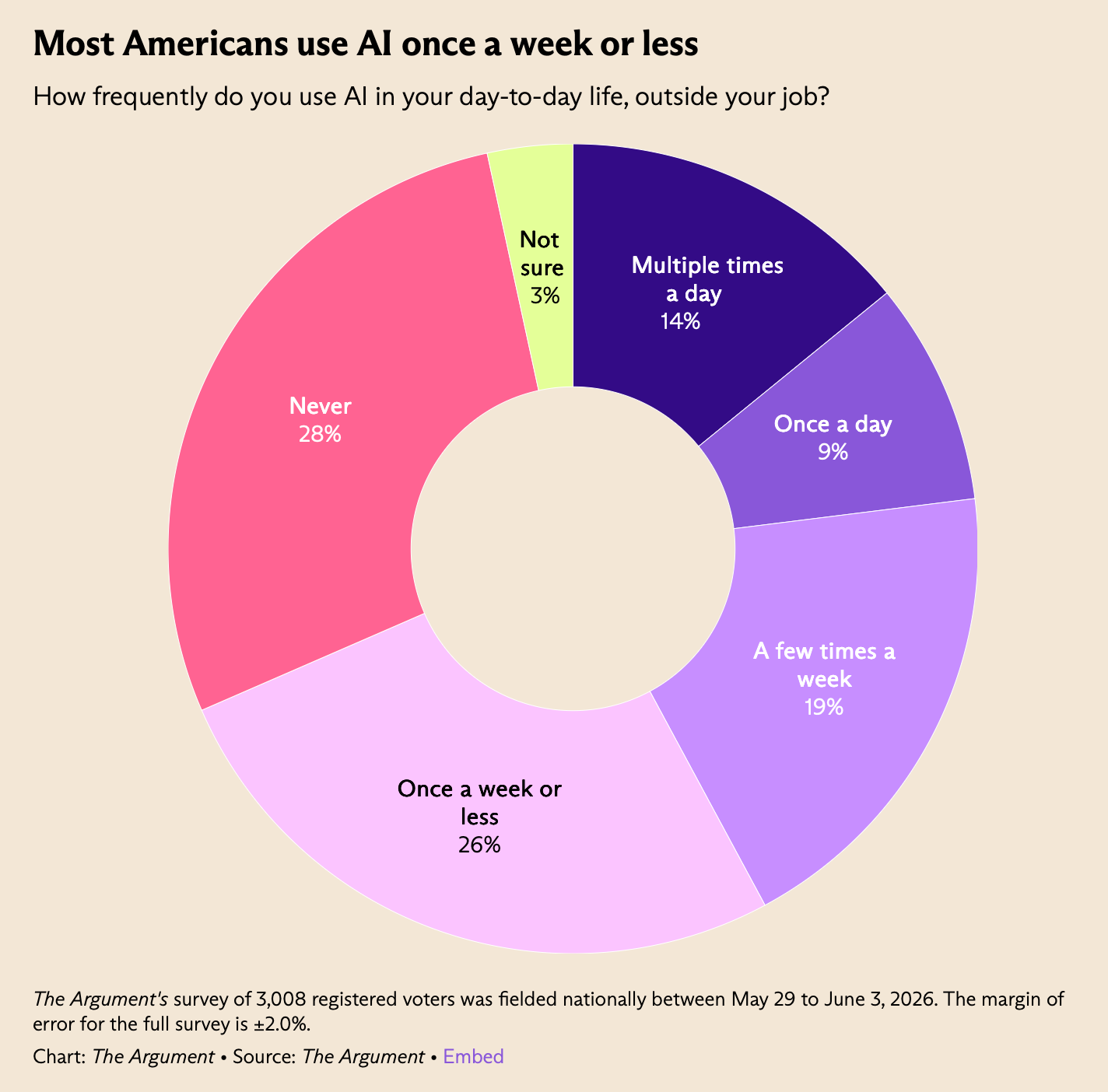
All of this triangulates to AI use in America at approximately one third actively using AI, one third occasionally using AI, and one third never using AI, with some movement depending on how you define those terms. In any case, this split is a far cry from “everyone is using AI for everything;” it’s much closer to “some people are using AI for some things.” AI use also hasn’t shifted that much in the past six months to a year. In fact, the only thing that has substantially changed is negative sentiment about AI has gone significantly up, for example the Gallup’s Gen Z poll reporting anger about AI jumping about 40% relative year over year.
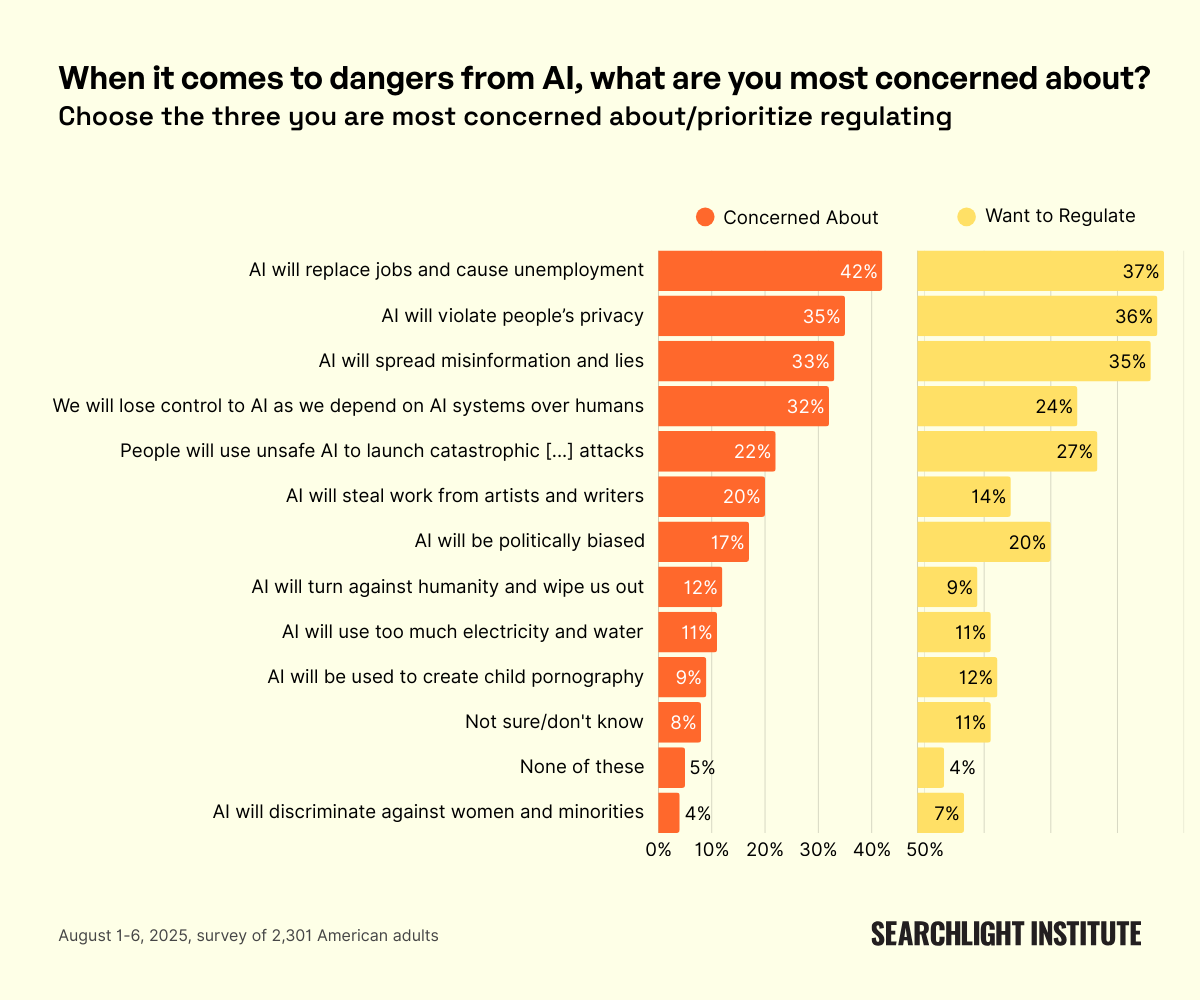
I think it is a reasonable conclusion to draw from all of this data that a significant percentage of the population is actively limiting their AI usage. The Searchlight study examines a big reason why: real concerns people have with AI. The top three concerns found are “AI will replace jobs and cause unemployment” (42%), "AI will violate people’s privacy” (35%), and “AI will spread misinformation and lies” (33%).
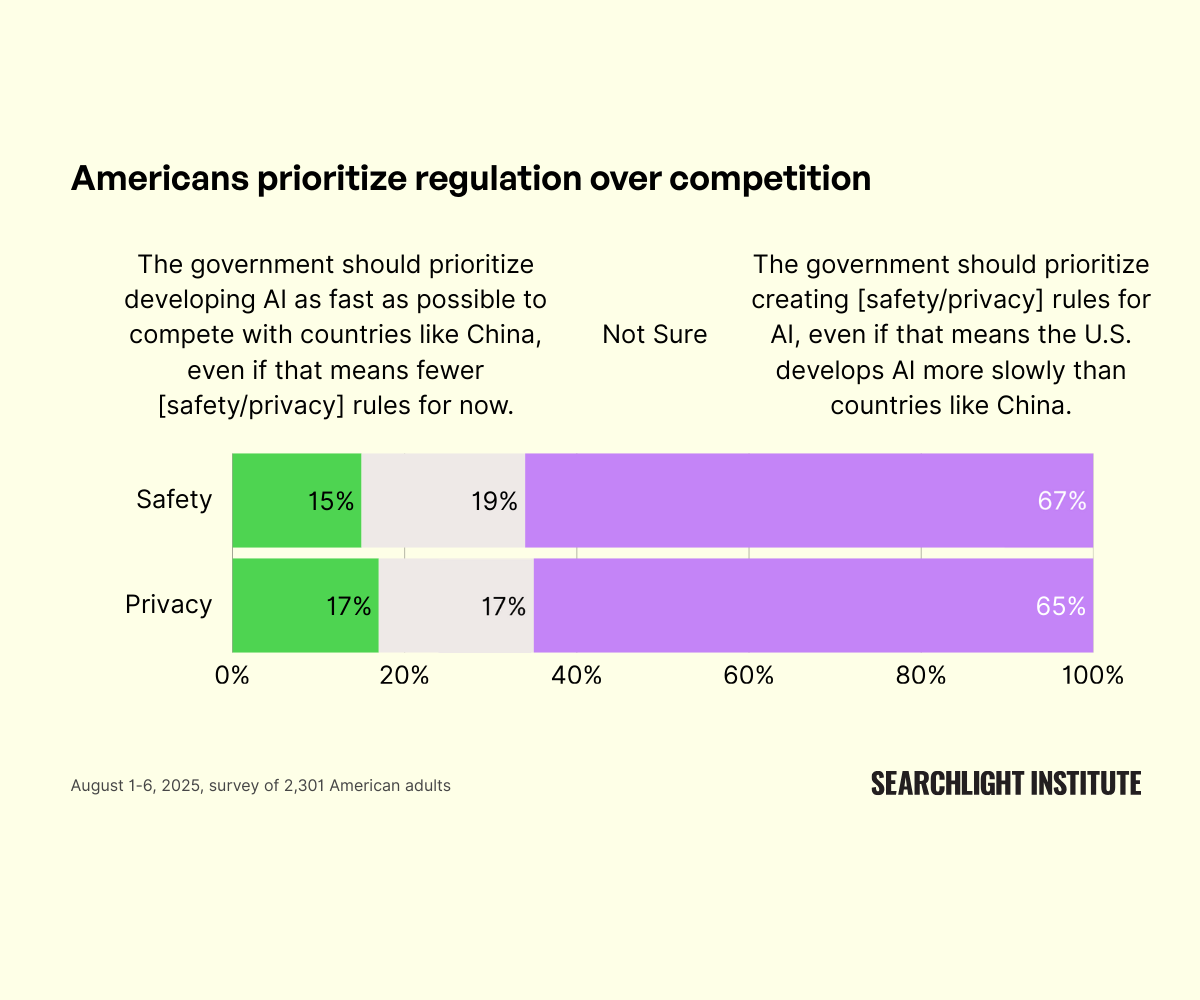
This sentiment also matches a strong desire for safety/privacy AI regulation. A solid majority thinks “the government should prioritize creating safety/privacy rules for AI, even if that means the U.S. develops AI more slowly than countries like China.”
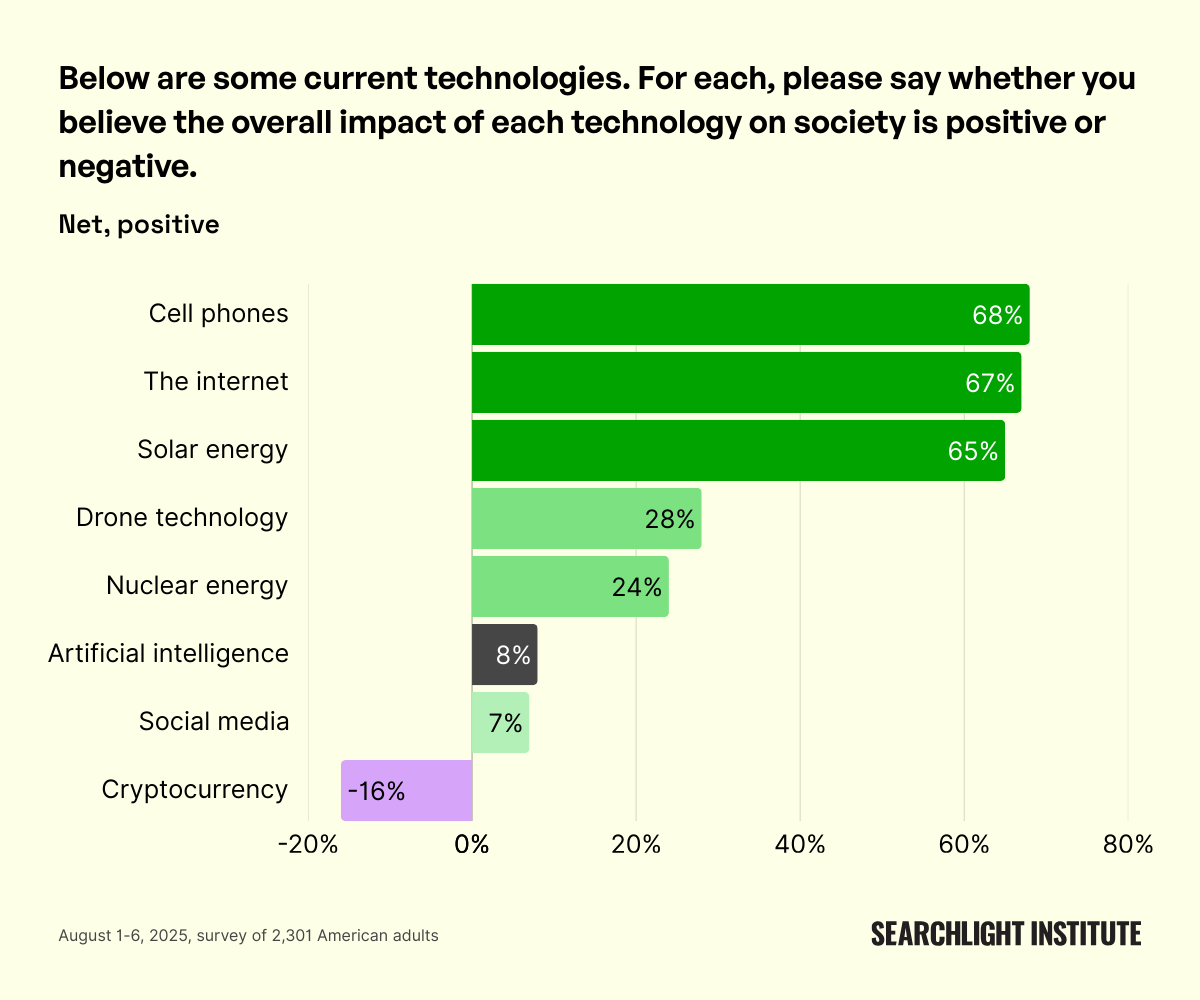
Another big reason is skepticism in AI usefulness. SearchLight asked about a range of technologies and to say “whether you believe the overall impact of each technology on society is positive or negative.” AI only has an +8% net positive rating right now, right next to +7% for social media, which were only greater than crypto at -17%. Meanwhile cell phones, the internet, and solar energy are at +68%, +67%, and +65%, respectively.
The Argument study broke this down further, asking about specific societal benefits from AI, finding broad skepticism and concluding “people aren’t really buying the bullish case for AI that CEOs and boosters alike are selling. In other words, the skepticism about AI’s effects is real and deep-running. And given how many people use it daily, this is not just an ill-informed set of opinions on something respondents have never seen before (like tariffs were before 2025).”
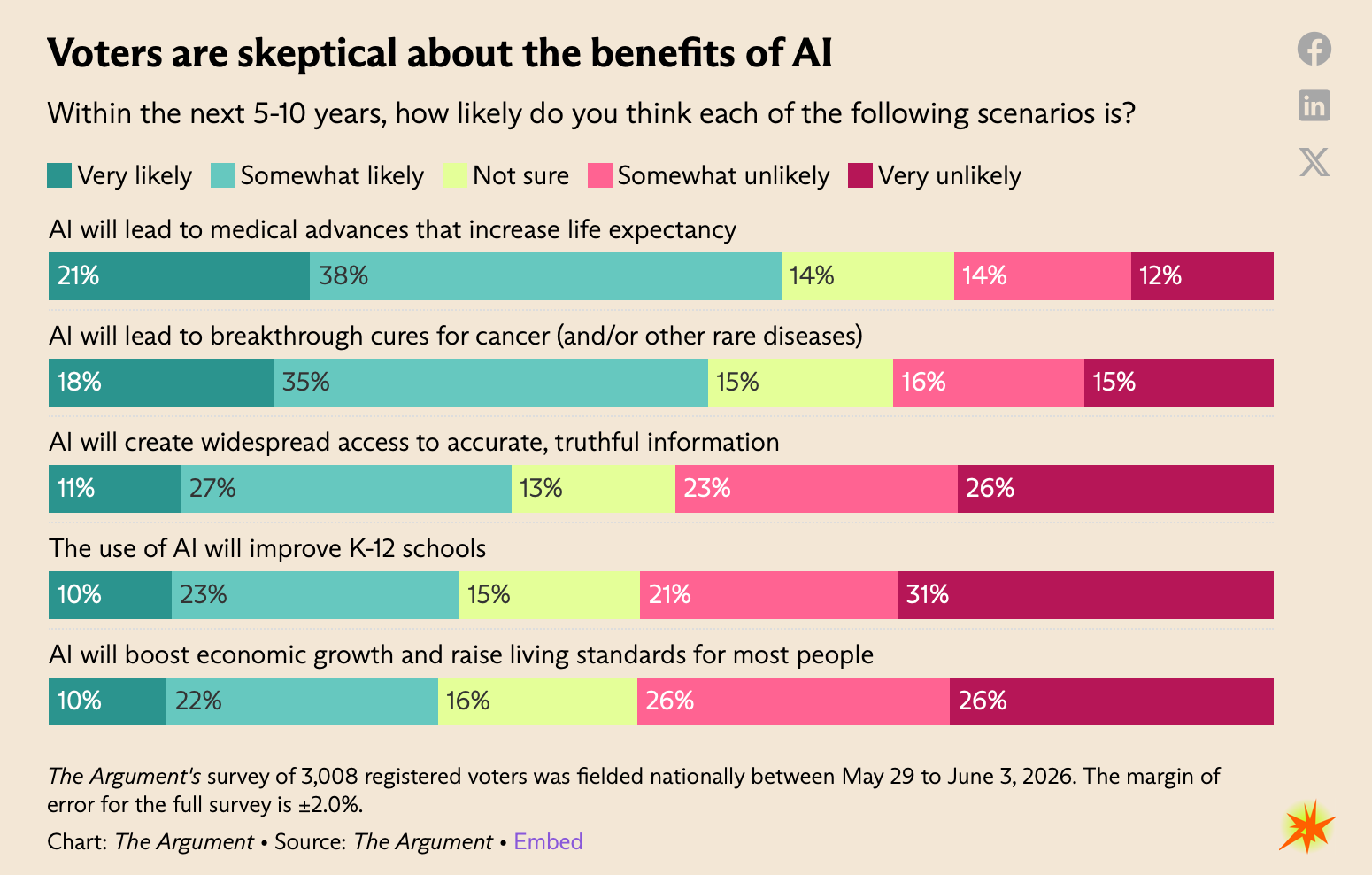
It is possible for people to have one view at a societal level and then act differently at an individual level, but that does not seem to be what we’re seeing here. The plurality occasional usage and large percentage of complete avoidance speaks to the fact that a lot of people seemingly aren’t yet finding enough individual value net of their concerns to justify daily or even weekly usage. The gap in media narrative (that everyone is using AI for everything) relative to the reality (that some people are using AI for some things) perhaps reflects a bubble around early-adopting knowledge workers that includes much of the tech press (and me for that matter, though I’m trying really hard to stay connected to reality).
It’s a mistake for companies, pundits, and policy makers to ignore how people are really feeling and acting about AI. It’s not all sunshine and rainbows. It’s also clearly not binary (all use or no use), but instead a continuum of AI opinions and use, with a lot of people in the middle.
I think there is an apt analogy to be made here to preferences around meat consumption. Another thing that seems to be everywhere right now is protein. Telling us how important protein is in our diet is analogous to telling us how useful AI is for productivity. And, meat being a primary source of protein is analogous to AI chat tools being a primary source of generative AI. And yet here’s how Americans break down in terms of their meat consumption preferences, based on a handful of U.S. studies from this decade:
95% eat meat (Gallup, 2023)
70% report reducing red meat consumption (Rutgers, 2024)
30% eat (all) meat only rarely/occasionally (Gallup, 2020)
12% don’t eat red meat (Nature, 2026)
4% don’t eat any meat, that is are vegetarian (Gallup, 2023)
1% don’t eat any animal products, that is are vegan (Gallup, 2023)
That is, not everyone eats meat, a majority actively curbs their consumption of red meat, and a significant percentage don’t eat it at all. Different people have different (not mutually exclusive) reasons for limiting their meat consumption, including health, cost, environment, and ethics. Those are all also primary concerns for AI consumption!
The analogy also highlights market opportunities to appeal to people across the continuum, speaking to their feelings on AI and addressing their particular AI concerns. For example, we (at DuckDuckGo) make all AI features optional and one of those features, duck.ai, is a private chatbot alternative that helps address AI privacy concerns. To extend the analogy in this way, we’re a restaurant with a variety of options on the menu, from healthy meat dishes (private AI) to vegetarian (turn down AI) to vegan dishes (turn off AI), which most eaters across the spectrum can appreciate.
Does this mean about one third of the population is bound to use AI only rarely/occasionally forever? No. Unlike with meat, the AI technology landscape is changing so rapidly that it is very unclear both where AI products and regulations will end up. Product evolution could make AI more useful to the average person, and regulations could reduce concerns. However, we can say that, as of right now, a meaningful percentage of the population has tried the current state of AI and has decided to actively limit their use of it.
I'm unlikely to run into many of the problems that (for example) the PornHub developers hit, several times an hour.
In that case, I benefit from folks like you, that allow me to have solutions that scale down to my level.
That's one of the things that I appreciate about the PHP that the LLM provides. It uses modern idioms that make better use of the modern language.
Which might not be ideal, because "orging for the sake of org" to my understanding consumes significant resources not going into building products/marketshare/shareholder value.
But then again, I'm no hiring manager in such a structure, so this is probably just an uninformed take.
Update:
Every street corner has a yellow garbage bin for recycling. That is where your plastic bottles go. Seems like a better system than having elderly going through bins.
Code is obscenely low level.
Some systems do support issuing refunds, among many other actions, by creating an appropriate row in a database.
No one has ever needed to do that for something that is new. And if it’s not new, you want to do it repeatedly with some guarantee of reliability. Not just in an uncontrolled manner.
That is why we have snippet systems, macros and code generators. And the best with code is to solve problem once and reuse the solution. Which we have done with libraries, frameworks and supporting software.
It's… like… not that simple.
There's a whole level of ignorance out there that is honestly dumbfounding to even comprehend. The numbers for numeracy and problem solving are even more horrifying.
(It's for this reason that the most popular apps in the US are algorithmically generated feeds of photos, and often-non-verbal videos shorter than a TV advertisement.)