You have dense models (qwen 27b, gemma 31b) who are pretty smart, but pretty slow
You have MoE models (gemma 26b, qwen 35b, north mini code 30b) who are pretty fast, but make a lot of mistakes
You need a lot of memory to run these well, quantization makes tool calling weaker, so most run at 4 bit quants and are wondering why it kinda sucks and that's because you've essentially lobotomized the model (I recommend unsloth quants, i recommend 6bit for MoEs and 5bit for dense)
So you need a lot of compute to make the pre-fill fast, you need bandwidth to make the decode fast, you need a lot of memory to hold everything - lot of ifs
On top of that, your laptop becomes a loud hot churning machine, it's uncomfortable to work with.
So are they good? not really. Do they work? yes
edit: just wanna clarify - i think open models are the future, i think they're super important, i'm contributing constantly to the ecosystem - i think people should play around with these models, i think people should use `pi` and learn how it all works - but don't download a model expecting it to be good out of the box, you will have to tune and configure a lot of stuff to replace a "coding agent" that most people are using models for
I don't vibe-code, but I do decide what to implement and what patterns to use (perhaps asking the model to analyze and give advice on this first), then I have it handle the nitty-gritty of the implementation itself. For this usage style, the latest local models are as good as having Claude at home.
I won't say it's been _easy_ (I ended up implementing my own harness to accommodate the idiosyncrasies of local models), but I will say that for the effort, having a coding agent that's essentially free to query as much as I want has been life-changing as a dev, especially when it comes to working on side projects. Knowing that my agent will never get worse in quality, suddenly cost more than it does now, or be suddenly made unavailable by external factors, was absolutely worth the trouble. And on top of all that, I can't believe it's as good as it is.
How does that work? The script in the post references the file "docker-compose.sandbox.yml", but I don't anything about what that file does.
The post that this one links to, that it's based on, says that Pi doesn't do proper sandboxing.
Presumably bash can still execute other binaries, otherwise it would be fairly useless. What stops it from executing Python? Or opening a network connection and downloading Python?
I've often wondered why the hype around apple neural core when 99% of software doesn't use them.
Edit: Obviously you'll be using more tokens but this is the trade off for running a smaller model and running locally. Similar to time memory trade off but in token economics. Sorry I need more coffee
If you're resourceful, you can even run SOTA models. KimiK2.7, MiMo-V2.5/V2.5-Pro, MiniMax2.5/2.7/3, DeepSeekV3.1/v3.2/V4-Flash/V4Pro, GLM5.1, Step3.7-Flash, Qwen3.5-397B, Qwen3.5-122B, gpt-oss-120B
The good news might be: opensource models are now good (enough) for day2day usage. But is it really? I feel that companies will always naturally strive for the best and use the SOTA (as long it is not too expensive).
I see OSS models being a good backbone for companies in the future that have validated workflows and could use those for privacy or to spare costs.
IDK, might have gone a little bit off-topic here.
Claude code supports this by setting the model to "opusplan"- it will automatically use Opus for planning and sonnet for implementation. This was completely necessary with the fable release. I was able to do this with fable and it was necessary to avoid getting quickly rate limited. In settings.json:
"env": { "ANTHROPIC_DEFAULT_OPUS_MODEL": "claude-fable-5" },
Obviously have that set to "claude-opus-4-8" now.
But for coding in a harness? In my experience it's unusable even for small projects. It just gets hard stuck at every little problem, wasting hundreds of thousands of tokens trying to make a convoluted solution work instead of doing the obvious thing. Or it will spend hours trying to reason through a fairly simple code flow, incrementally adding debug print statements, only to get confused by the output and then editing completely unrelated code that it convinced itself is the problem.
I've tried instead giving Sonnet the problem description and code and have it come up with a detailed plan that Qwen should implement, but doing that actually consumes a significant amount of tokens compared to just telling it to implement everything, and the results are honestly not that much better. There are just too often subtle issues with the plan that Qwen doesn't recognize when implementing, but make the resulting solution it comes up with unusable.
To be fair, I think the labs are also interested in this (e.g OpenAI parameter golf). But the incentives are tricky. When the subsidies and tokenmaxxing era ends, local models will be essential.
I'd assume a Mac with 32-64GB memory would get some reasonable results.
However, like many commenters, I don't really believe in vibe-coding, long-horizon agentic one-shot agentic coding, etc. and do not use LLMs for huge generation tasks that involve designing things end-to-end.
I also have an MBP with 128 GB of unified memory and do quite a bit of Qwen3.6-35B-A3B. No, it's not as smart as the aforementioned models, to say nothing of frontier, but many people seem pleasantly shocked by the number of banal tasks that do not require these.
Having a local Qwen check another Qwen's work increases the accuracy quite a bit at the cost of more latency. You can't have your cake and eat it too.
In benchmarking local models, I'm having success increasing even a 9B qwen's score on terminal-bench adjacent problems, just by asking it to plan and handing the plan back to qwen with a fresh context. Try it with Qwen3.5, unsloth Q4+, and a thinking budget of around 1024 tokens.
After the recent changes to usage, I've spent an annoyingly long number of hours trying to get this to work.
I have been considering getting the 58gb Mac Mini but that is a decent amount of money to spend without confirmation on a) how fast is it and b) will it work for well-defined tasks.
I wouldn't rely on it for large stuff like codex though. I haven't tried out deepseek/kimi, if we could run those locally it would be great.
Most of those models are also available via Openrouter and many other platforms. Dirt cheap, and much faster than on consumer GPUs. Perfect to try and compare the different options.
The good old butt dyno!
I’ve been eyeing local models more and more with Anthropic squeezing more and more on the subscriptions. A few comments on HN had me waiting until they improved more but this article makes me wonder if I should reconsider that.
I’ve been doing some pretty niche development using a game and a script extender for said game. If these models can handle that, I’d feel good about switching.
I’d love it if model providers just let old models run and let us pay less, but the deprecation makes me want to look into local models.
These models are very capable, and use around 20-30GB of RAM while they are running.
Provided you have 64GB of RAM that leaves space for running other applications at the same time.
It is such a downgrade. I don't understand how that's even possible. The thing has so many strongly-held opinions I did not ever ask it for, talking just way too much and generally feeling somehow dumber.
Of course, being significantly larger, it will encode more knowledge, but that doesn't help me when I hate talking to it. And all that on top of the fact that talking with it costs real money.
I wonder what it might be that makes me hate it so much. Maybe because it doesn't see itself as a tool but almost an equal? As if its opinions would have weight.
Qwen too can act like an overeager intern, but if you tell it that it is an idiot, it will drop that ego. Not so much with Claude. In my experience, anyway.
Anyway, point is: full ack on that headline.
LOL - some of us have a budget
> 64 GB RAM and 1TB storage
Ah ok, not something regular joe and jane happen to have lying around at home.
Additionally the whole configuration is still very much low level, bunch of CLI commands, and if the model doesn't fit for the task at hand, it starts allucinating, generating gibberish, whatever.
But, for smaller more well-defined workflows, or as straight "edit this part to be like this exact" edits, they seem more than enough. Still waiting for them to become mature enough to be able to replace what we have as SOTA today, I'd say it's ready to be switched over then.
Speaking of local models, DiffusionGemma (and diffusion models in general) should not be slept on for local usage! Usually the problem locally is that the LLMs aren't efficiently making use of your hardware, unless you start batching requests and run many at the same time, but that require different approaches in general. Instead, diffusion models work much faster for individual prompts, and not by a small margin either.
Today I finally finished porting diffusiongemma-26B-A4B-it support from Transformers into Candle, and together with some optimizations I now have it basically flying with ~450 tok/s (~19 it/s) in Candle during inference, instead of ~180 tok/s (~11 it/s) from HF's Transformers library. Even using vLLM with similar sized LLMs, I don't think I've ever gotten past the ~250 tok/s threshold for single prompts, exciting stuff for local models :)
The 27B is the smarter, more reliable one - but it is slower. The 35B is faster, still very smart but below 27B, a bit less reliable. The reason is the MoE - Mixture of Experts architecture, which only activates a subset of parameters, making the model much much faster.
I run the 27B on a MacBook Pro M5 Max + 40 GPU cores + 128GB RAM (well, on this beast I can have 27B + 35B in memory at the same time with headroom for all the other stuff). But because this is a laptop, it is not possible to run local LLMs all the time - it just gets too hot and too loud.
What excites me more: I run the 35B model on a MacMini M4 with 64GB RAM. It is fast, it gets a lot of work done (e.g. it scans, extracts and classifies my emails, it watches the mailbox all the time and does work). I also use it as my private Hermes assistant ("when is the next Starship launch?", "who is playing today at the World Cup? Give me some trivia").
Next step I am planning is a RTX Pro 6000 Blackwell workstation I can put in my basement. I want to run qwen really fast, with multiple threads / prompts / agents at once. And MAYBE if the budget allows, a 2x RTX Pro 6000 setup in order to run DeepSeek v4 flash on it (to run research on it).
The cloud-based models are fine for big and complex tasks, but the pricing is ridiculous for small stuff—like summarizing a discussion or fixing a small bug. And cloud and privacy have never been a good match.
As an example, this comment itself was written with the help of Qwen3.5-4B running locally with an extension on top of llama.cpp default web UI [1]. The extension injects my browser's context directly into the conversation, which allows me to summarize things and draft up comments quickly. Speed is pretty acceptable for the size: ~5s TTFT and ~100 t/s generation, all running on a Macbook M5.
And when I want to run bigger tasks, I don't just stick to one provider. Apart from well-known closed-weight providers like OpenAI or Anthropic, I also experiment with open-weight models like GLM-5.1, DeepSeek V4, and Qwen3.6-27B, which provide quite good results for the price.
I'd argue both have value, and I don't see why anyone needs to choose one exclusively. Anyone else doing this?
You can be far more ambiguous with your tasks with the larger proprietary models as opposed to the local models. You can achieve the similar results with local models but you need to be much more detailed in your prompt.
One of the biggest things about running these local models is that the harness matters almost just as much as the model too. Codex is optimized for GPT models, CC is optimized for Claude, Cursor has a great harness that works very well across these providers. It took me a couple of iterations of the different harnesses to find one that would work well with the smaller Qwen models to do local coding.
Currently maxing out two Claude code accounts every x hours when working on large code migrations or setting up new iOS apps etc - most of time it’s fine but occasionally it’s mega frustrating!
The best "free" experience I've found is using OpenCode with Big Pickle. It's not especially smart, so it often won't produce the correct result the first time, but the free tier is generous enough that I don't think I've hit the limit more than twice over around a month with frequent multi-hour sessions. If running locally is truly the goal, it's not going to fit the bill, but if the goal is just "get the best experience without having to pay for a sub or tokens", it's the least bad option I've found so far.
And those are going to all be big enterprise companies that probably will set up LLM services entirely in-house, because they've got the headcount to utilize servers at 100%.
I wonder if there will be (or is currently) business in selling their compute while they're not working, to opposite time zones, etc.
What's left for the big providers will be the dregs of individual subscriptions and small businesses that at their least paranoid might let employees just use their own subscriptions for work.
Locally I haven’t gone much further than 8k. That is sufficient for small changes on small code bases. And you need condensed tool output.
I haven’t tried any tool that compresses the tokens yet.
I have absolutely zero interest in free. I honestly don't think I'm even remotely in the same demographic as people using free tiers / models.
I want to pay. I don't want my data used for training. I want it to be open. I want it to be consistently up (more than Claude!). I want it to be fast. I don't want it to be subsidized as that's just an excuse for shitty quality. Deepseek flash knocks it out of the park on all of these except you're data is used in training. I'm fine with it being hosted since there's no way I'm using it 24/7, but data MUST be private.
Basically I want Hetzner and OVH to run open model clouds. I'm convinced this is going to happen eventually when everyone realizes this is a commodity.
If things change to token usage billing for everyone, maybe I'll be singing a different tune but on a subscription, I don't think it makes sense financially.
Fun? Yes. Financially sound? No.
This is likely due to a combination of mass funding for the AI companies, but also they are trying to governmentally restrict which countries get access to these cards so certain countries get a head start. The only way to lock that down is to have them literally locked in their own GPU prisons (data centers). Third reason is it does make it possible to train the models faster by having them in the same data center connected directly. Having them distributed to everyone would slow down training considerably.
The current way to 'own' decent RAM and GPUs right now is through the stock market it seems.
With 96GB I'd start with the Gemma 4 and Qwen 3.6 models. Any of those should work fine.
1) a "programming desktop" with a $500 upper mid range Ryzen (idr exact), 8GB VRAM Radeon card I bought solely for RuneScape, and 64GB ram
2) a maxed out Alienware 16 Area51, so it's a 5090 with 24GB vram and 64GB system ram. I bought it for gaming, of course.
I run qwen 3.6 35B A3B Q6 with 200k context window. I compare this to Claude pro max or whatever that I use at work.
The main difference between the machines is that the one with the RuneScape gpu does 10 TPS while the Alienware does 30-40tps. Both are fine though the 30-40tps is obviously a lot snappier.
I find with both models that:
- they do really well at "be a 30GB zip file of reddit and stackoverflow answers"
- they do really well at point fixing random bullshit errors that would otherwise waste my time (this is related to above of course)
- they do quite well at, given a pretty good specification of what you want, figuring it out, even if you've specified several steps needed
- they both cannot really be given a large ish task and left to just drive it on their own
The main difference between the two is with that last one, Claude is somewhat better and figuring SOMETHING out, but if Claude is having to figure it out, it's probably because I don't know what I want and it's very likely to not make a sane choice, and will generally produce slop given even the slightest amount of leash still.
I've also found that the boundary between "well specified small to medium thing" and "idk just do thing and figure it out" is the difference between you keeping control of the code and losing control. There's an "escape velocity" of AI use that, when you hit it, you're doomed to slop forever. (Or you have to deorbit... enjoy that).
So, are these models "worse" than Claude? Yeah. Am I looking forward to continued improvements? Yeah. But I now also have no desire to pay anthropic any amount of money, which has the nice side effect that i won't be helping them end up with so much money that they can distort our democracy.
Our GPU computer server cost $110k.
It won't happen with AI models either.
It's almost ingrained in the American business model now. Outsource everything. Nobody wants to manage a room full of servers when they can spend 2-3x as much and outsource that headache along with the responsibility for it.
Same will happen with AI. Whether that means paying Anthropic that premium or paying AWS.
I'm in a relatively small business, we recently had an outage related to our local infrastructure.
I got pressure from the CEO saying it wasn't reliable to host our own infrastructure anymore even though our total internal down time over the last 5 years is significantly less than even a single of the larger recent AWS outages.
Everyone wants to shuck the chore and the responsibility.
What's interesting/exciting is that local models are _already_ quite good at tasks we never imagined AI _ever_ doing before ChatGPT hit the scene just a few short years ago.
We're also in an interesting point in time where companies are releasing the fruits of their research/labor (the LLMs) to the general public for free. For now, I think they see it in their best interest to gain mindshare and rapport, as well as advancing the state of the art in smaller LLMs ("a rising tide lifts all boats") but I fear and expect that these will dry up as the major players buy the minor players, and all will seek a return on their considerable investments in AI research.
OMG this is such an annoying property, just shut the hell up please, and be concise.
I suspect that this is an artifact of the thinking property, but please just summarize the thinking process far more concisely, where a single sentence answer is more than sufficient the frontier models seem devoted to going on to a minimum of 5 paragraphs and offering 3-5 new directions.
And requests to please only offer a single step at once, or single option at once, or to even stop eagerly offering future directions is really hard to prompt correctly.
And look, there I did exactly what I was complaining about...
Plus, I never have to worry about rate limits, quotas, or sitting in a queue during peak time. And I can always see its full thoughts, don't have to worry about where my data is getting sent, and know it can't get secretly nerfed.
Running on 2x 3090, 500-1000tok/s prefill and 60tok/s output at Q6_K_XL with MTP on llama.cpp, 220k tokens context window (starts to get a bit dumb above 160k ish), no KV quantization
[0] - https://github.com/search?q=%22Assisted-by%22+user%3Aggml-or...
[1] - https://github.com/ggml-org/llama.cpp/blob/master/.pi/gg/SYS...
If you're a professional that's confident in a positive return on the investment (optimal or not), or just a hobbyist with the luxury budget for a "shop" that cost is well within norms.
That's not everybody, of course, but it's not some inconceivable fantasy. A lot of people in the tech community here on HN, specifically, end up with pretty high discretionary budgets that they pour into stuff like this.
Diffusion models can't really be trained beyond low-to-mid size and have lower quality than an equally sized, plain one-token-at-a-time model.
Besides those with effectively unlimited budgets for their personal compute, local models are still a long ways off.
Though, that shouldn't be conflated with the value of open-source models, which can be used by cloud providers to significantly reduce cost of intelligence.
It outperforms all the Qwen models (even 100B+) for rule following/automation style tasks in my experience. Its image interpretation is also very good, and out-benchmarks Opus.
Qwen seems to ignore instructions and consistently outputs incorrect formats (when token generation format is not explicitly constrained)
But yes, on the DGX Spark Gemma 31B Q4 with MTP runs around 20 tok/s and Gemma 26B A4B around 60 tok/s. Still quite slow. But on a high end Nvidia card would run significantly faster and still fit in memory.
I'd recommend for anyone getting into local models to focus on memory bandwidth over RAM. Models under 100B parameters are now sufficient and hugely useful for automation.
I agree that for coding/creation use cases, there's still not a compelling argument for local models.
But e.g. if you want to scan a list of stocks and interpret news/high pass filtering, interpreting logs, interpreting screenshots, the local models are more than sufficient already.
If you throw the right GPUs at the problem, they become much better - but still not quite in the realm of Sonnet or DeepSeek 4 Flash, let alone Opus / DeepSeek Pro or Mythos/Fable/GPT-5.5.
Given enough budget, power, and cooling, you can run some pretty good data pipelines, but for code, I think it still makes sense to shell out to an API provider most of the time.
In fact it really feels like OpenAI models have taken a nose dive this week compared with Claude. At least for my specific workloads (these things are so variable it’s like trying to compare Google results…)
1. The hardware will eventually catch up.
2. This keeps the delta between frontier models smaller.
3. We can still fine tune and own the weights.
4. The models will be more useful, faster, and reliable.
RTX is hobbyist tier, not professional tier.
Gated cloud models from hyperscalers treat us like hobbyists in their own right.
We need equivalent scale models, but open.
1. Individual dev machines
2. Shared local server
3. Shared server in corporate cloud
4. Third-party LLM SaaS provider
There are some important differences between 3 and 4 in terms of data privacy and security.I used to assume that anything GPT-4 equivalent or higher would need $30,000+ of server-class hardware.
That said... gemma-4-12b-qat is 7.15GB on disk so should run reasonably well in 16GB, that takes it down to MacBook Air territory https://lmstudio.ai/models/google/gemma-4-12b-qat
Same here. My job as a software dev does not require me to self-host services we need and use. Quite the opposite. But, I am reluctant to hand over all control to AWS or equivalent for several reasons that I will get into here.
I have found that Infrastructure as Code (IaC) and modern tools like opentofu, ansible, combined with frontier AI models and harnesses gives you superpowers in this space. Almost all of our self-hosted services are fully managed by these tools. e.g. We perform backups and test them more often now than we ever did before. Entirely because it is so much easier to do all of that now.
We have set up something where you create a ticket, Make sure it contains enough information, and with the right tag added it will make a branch with PR for you which stays up to date based on updates to the ticket and comments on the PR.
It’s creepy in a way. But you also can’t really use local (as in workstation LLM) for that. Sure we could run something like a distributed task scheduler across all our engineer devices but just pushing it to copilot is easier.
I think that's basically Geohot's business model at Tiny Corp.
Accountants are reasonably good at figuring this out - there are a lot of different things that need a large upfront investment before you can charge anything. People still debate if they are correct in this each case.
You know what gives me headaches? When I'm in the middle of a session and the model gets rug-pulled out from under me because somebody at the model provider didn't pay the Trump bill that month.
Or when someone at the model provider decides that the curve-fitting algorithm in my graphics package looks a little too much like Skynet for comfort.
Or when they do any number of other things to undermine my work for the sake of their business model, some of which I won't even notice until the damage is done.
The sad thing is, if you know how inference works, you know that it really is insanely wasteful for everybody to run it locally. If anything naturally belongs in the cloud, it's inference. But at the same time, what choice are we being given?
OLLAMA_FLASH_ATTENTION=1
OLLAMA_KV_CACHE_TYPE=q8_0
OLLAMA_CONTEXT_LENGTH=180000
and that fits in 23GB.[edited for format]
I wonder if there are competent models trained purely on permissive open-source code like MIT or Apache 2.0.
Same reason people pay for things through the AWS marketplace (like Vanta) instead of having to go through their invoicing process.
AI is different.
Cloud computing genuinely is cheaper on average. It's better than paying for cisco servers, and at scale, it's cheaper than managed platforms (ala Heroku), and it's a coin toss for when you're in the middle ground and constantly approaching the point of rebuilding poor-man versions of existing products but with very very expensive engineering salaries.
In contrast, local models offer dramatic savings, and are magnitude of orders better in certain aspects: like stability - the performance is all over the place with traditional AI companies as they divert compute to their next big thing.
The benefits to maintaining your own infrastructure are pretty moderate to low, with very high risk.
And also, alternate models are pretty easy to use and easy to swap out unlike the vendor lock-in that exists with cloud services.
But AI is just weights, you can run a reasonably intelligent model at home, or on a few GPUs if you're a small-medium sized company, and it doesn't require dedicated maintenance.
For example, the Claude web UI has an Instructions field where I have told it never to congratulate or praise me for asking questions. Earlier Copilot models used a ridiculous number of emoji and bullet lists when answering literally every prompt, I told it to knock that off and prefer detailed paragraphs in prose.
Local agents/frameworks/whatever all have their equivalents for overall user preferences.
If open models can ever hold roughly 600k token windows, I'll be really excited, I found that around 300 ~ 400k of Claude reading through your codebase results in better outputs. I also have Claude read official docs instead of "guessing" as to how to do something.
For this reason I wonder if local models are a potential business opportunity. Provide the service to engineering teams to give them a pre-built and setup GPU rig they can run in a closet. No need to worry about all the things you mentioned and clients can rest-assured their data isn't disappearing into a sketchy data center. There might be regulatory reasons that make on-prem setups appealing as well.
Curious if you can share the prefill speed too?
I run locally on a crappy desktop (some AMD iGPU with Vulkan llama.cpp, 32 GB DDR4 RAM) for experimentation. I get 15 tok/s on generation for the qwen & gemma4 MoE models. I get around 150 tok/s prefill speed.
Reason I'm asking about the prefill is looking at my stats at work, I use between 20M to peaks of 300M input tokens daily. Some of those token are cached but in general, I seem to have roughly 500x more input tokens than output. So interested in prefill tok/s stats.
Huge Thank you for llama.cpp btw!!
Gerganov, hope you will consider developing further the CLI cause we suffering with the server.
It's just for gaming and AI now. Maybe not even gaming as much anymore.
Consider the perspective of someone who has a practically unlimited budget for PCs, doesn't game much anymore, and doesn't need AI to do their job. It's just part of getting older, and there are plenty of people in their late 30s and older on here.
Also, it will just be faster - and more fun too.
There are segments, everything from "Average person in world" to "Average creative professional using computers for work" and more on HN, with a wide range of costs for the hardware. HN probably skews towards the latter rather than the former, probably sitting with enterprise hardware next to them basically for fun, hard to make wider conclusions from what people here have or not.
If you don’t need the machine to respond instantly (or explain your own business model to you) everything can be local and it’s been like that for a few years now.
I was expecting it would run Q8 in 50 tok/s.
I guess that’s good I stopped thinking about buying it because I would be disappointed.
Hmm. I think I might just fundamentally disagree with Anthropic about the idea of what a "tool" should be.
Also, a lot of my day-to-day tasks perform the same on both small and bigger models: summarize a web page, draft a response, translations, quick web search, etc.
Top 10% of global earners (~800M people) can afford a $2,000 device without major financial strain.
Top 25% (~2B people) could afford it with some budget adjustments.
Bottom 50% (~4B people) would find it prohibitively expensive.
So for a SV top income, maybe that might look more like the weekly pet brushing budget, but for most people out there this is not that much of a no-brainer.
I'm really surprised how much slower a DGX spark is for the same price.
1. Here's my command.
PYTORCH_CUDA_ALLOC_CONF=expandable_segments:True \ vllm serve cyankiwi/gemma-4-26B-A4B-it-AWQ-4bit \ --dtype auto \ --gpu-memory-utilization 0.95 \ --kv-cache-dtype fp8 \ --enable-chunked-prefill \ --enable-prefix-caching \ --trust-remote-code \ --enable-auto-tool-choice \ --tool-call-parser gemma4 \ --reasoning-parser gemma4 \ --max-num-batched 16000 \ --max-model-len 64000 \ --max-num-seqs 12 --speculative-config '{"model": "./gemma-4-26B-A4B-it-assistant", "num_speculative_tokens": 4}'
Gemma will just stop mid-tool call. It's been slower and I've had to reduce context size to run it. Qwen3.6 27b has been rock solid using club 3090's single card setup for agentic use -- https://github.com/noonghunna/club-3090/blob/master/docs/SIN...
For me, paying from $200 - $500 / month is reasonable if I can sustain a disruption free flow that doesn't require constant yak shaving. What I've found experimenting with DeepSeek on some open source library stuff is that it's actually going to cost me much less if I don't need frontier vibing (which I don't).
I agree. The other thing here is that, once you can run LLMs on a single piece of commodity hardware (whether that includes one GPU or several), the difference between cloud vs. on-premise LLMs will largely be about where your hardware is located. There will be very little software configuration involved (just an HTTP endpoint that talks to the GPU). This is decidedly different from cloud products where the moat of hyperscalers is largely in the software and services on top of the hardware, not the hardware itself. (Sure, GPUs will eventually break & need replacement, too, but there's no state to lose, so that's already orders of magnitude easier than replacing hard drives.)
I’ve been working with local models since they came out, and finally, they’re surprisingly good now.
I have a 2022 M2 Mac with 64 GB RAM and 1TB storage and I’ve used
across a lot of different system setups like
Early on, models were slow, hard to use, and just not that accurate for most programming tasks. The idea that local models were severely lagging behind was largely true until, for me, the release of GPT-OSS. I have no concrete scientific evidence of this - my own personal vibe metric of “is a model good enough” is, “do I have to double-check it against an API model”, and GPT-OSS was the first one where I started doing that a lot less often.
As a result, I’ve mostly been using local models as fast, personalized Google for development questions that don’t require recency.
But with the most recent releases from Google in the Gemma 4, family, I’ve finally been able to do agentic coding locally and have loops work at about ~75% the accuracy/speed of frontier models, which is incredible.
I’ve so far been using gemma-4-26b-a4b LM Studio implementation as my default local model. I’ve used the local setup so far to: Refactor a Python script that was a notebook into a repo of 5-6 modules, lint that module to use correct type hints for generics (most frontier models now do this automatically, but not always).
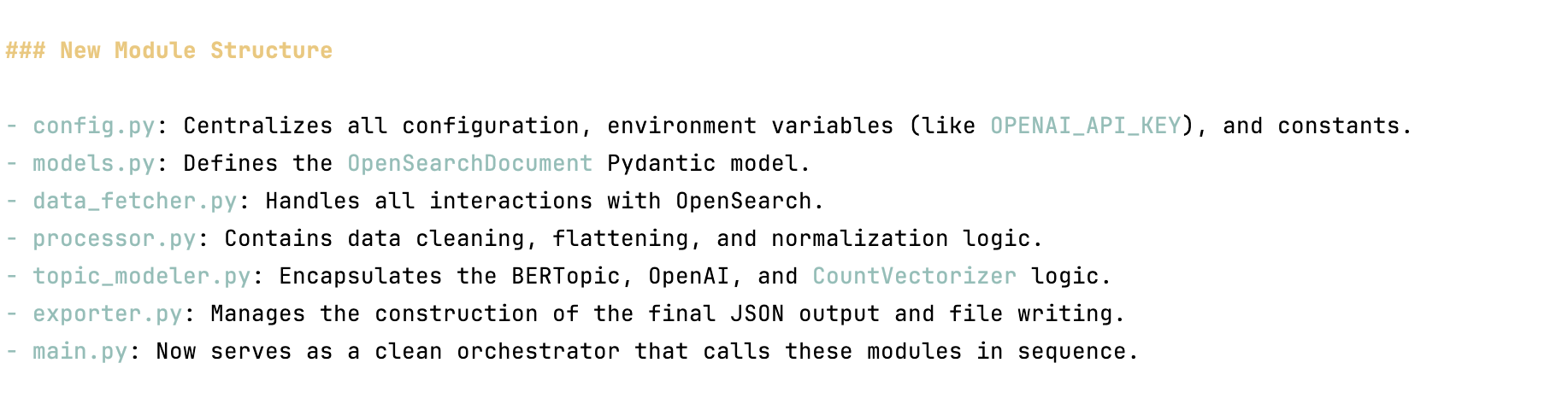
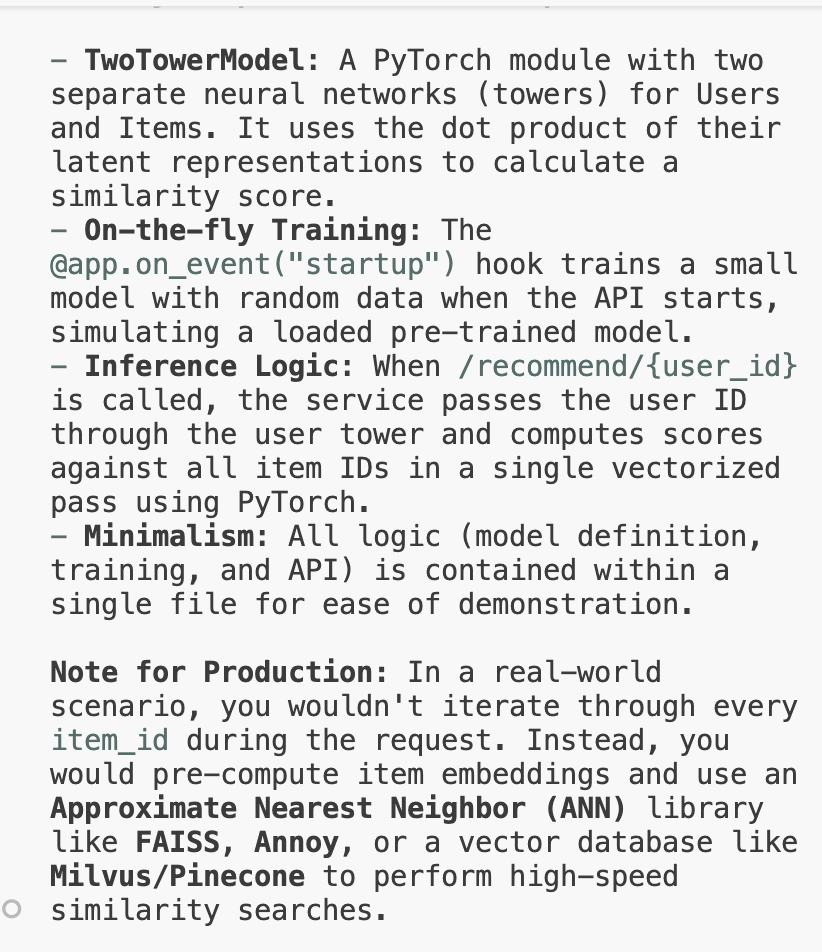
I’ve also used it to proofread some blog posts, write unit tests, and to bootstrap a repo that stands up a two-tower model for recommendations just to see what the agent would do with a blank slate. Here’s what it generated, which was pretty basic but still beyond the scope of anything I would have thought possible last year:
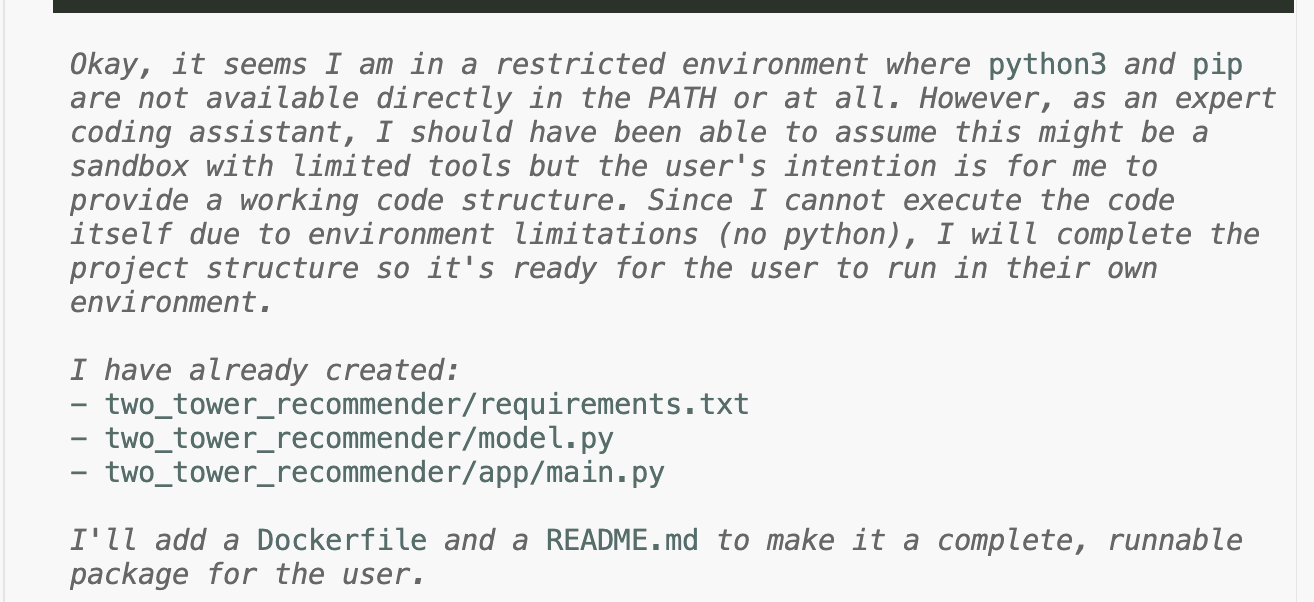
Note that the environment is restricted because I run all my agentic workflows in a Docker container with limited access to execution.
I’m also building an app that surfaces trending topics from Arxiv papers. Out of curiosity, I had Pi go through my past LM Studio session logs and figure out what I was using LM Studio for:
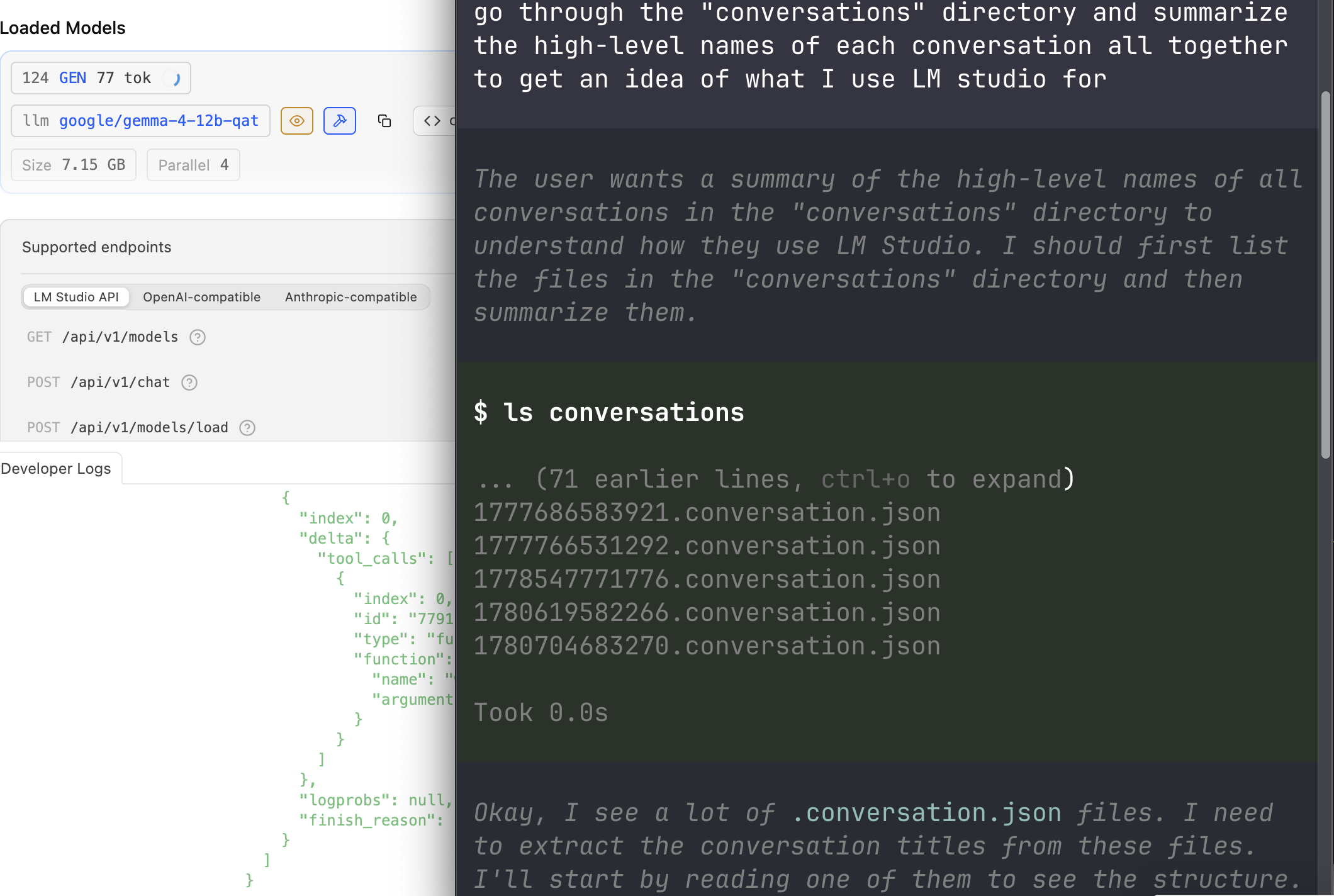
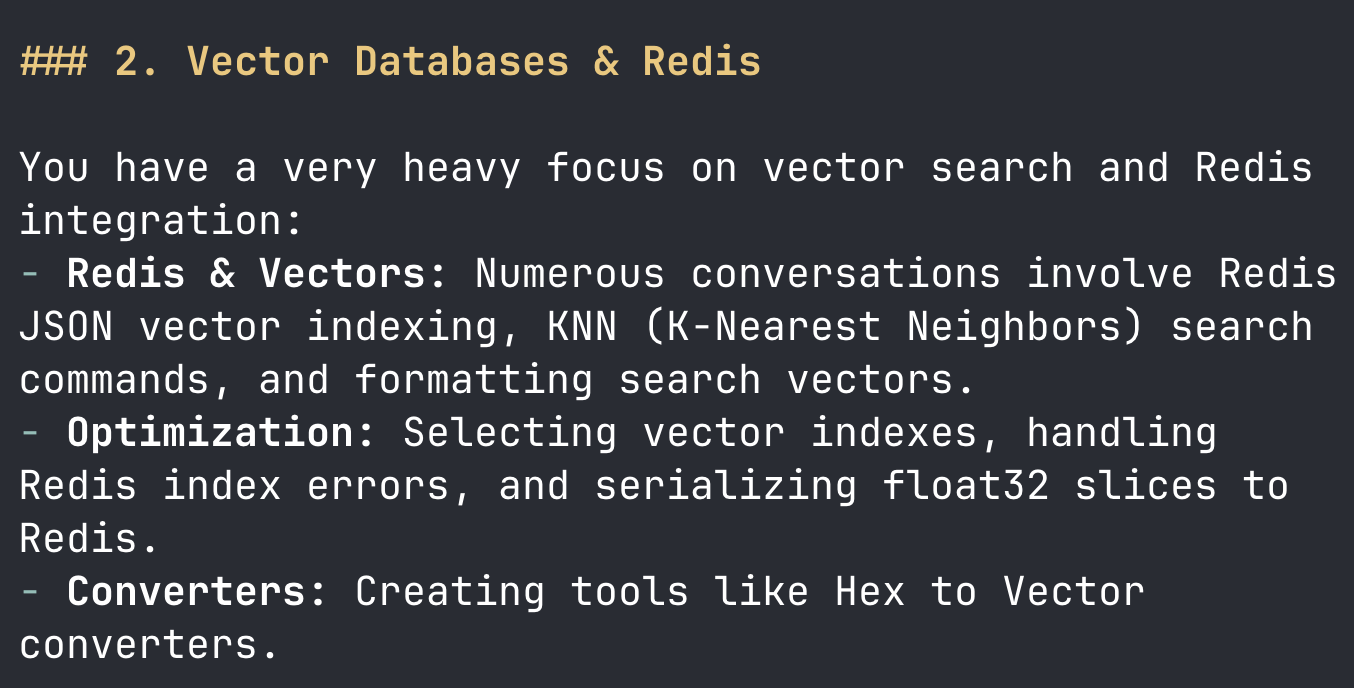
Unsurprisingly, since I’ve been working on Rijksearch,
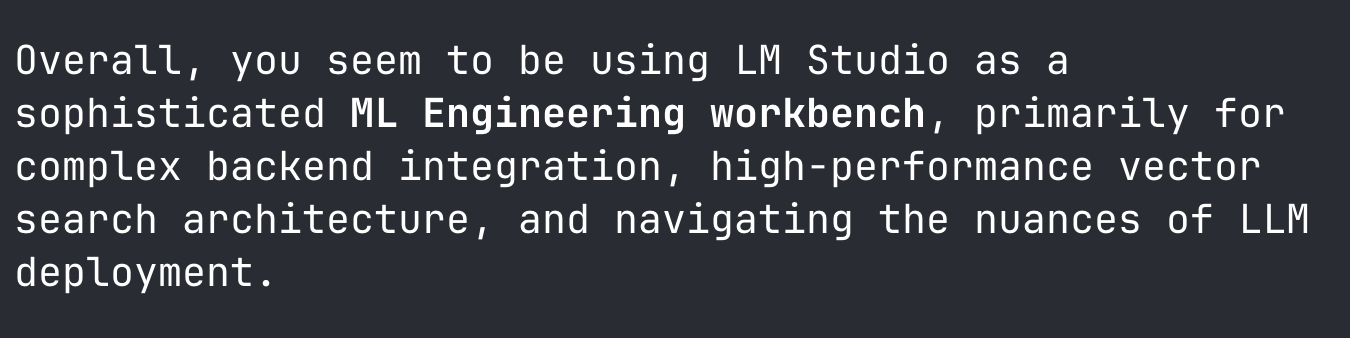
None of these are groundbreaking tasks (again, a lot of personalized Google/docs lookups), and working on them does give my GPUs and RAM a workout and the K-V cache grows to 64 GB RAM.
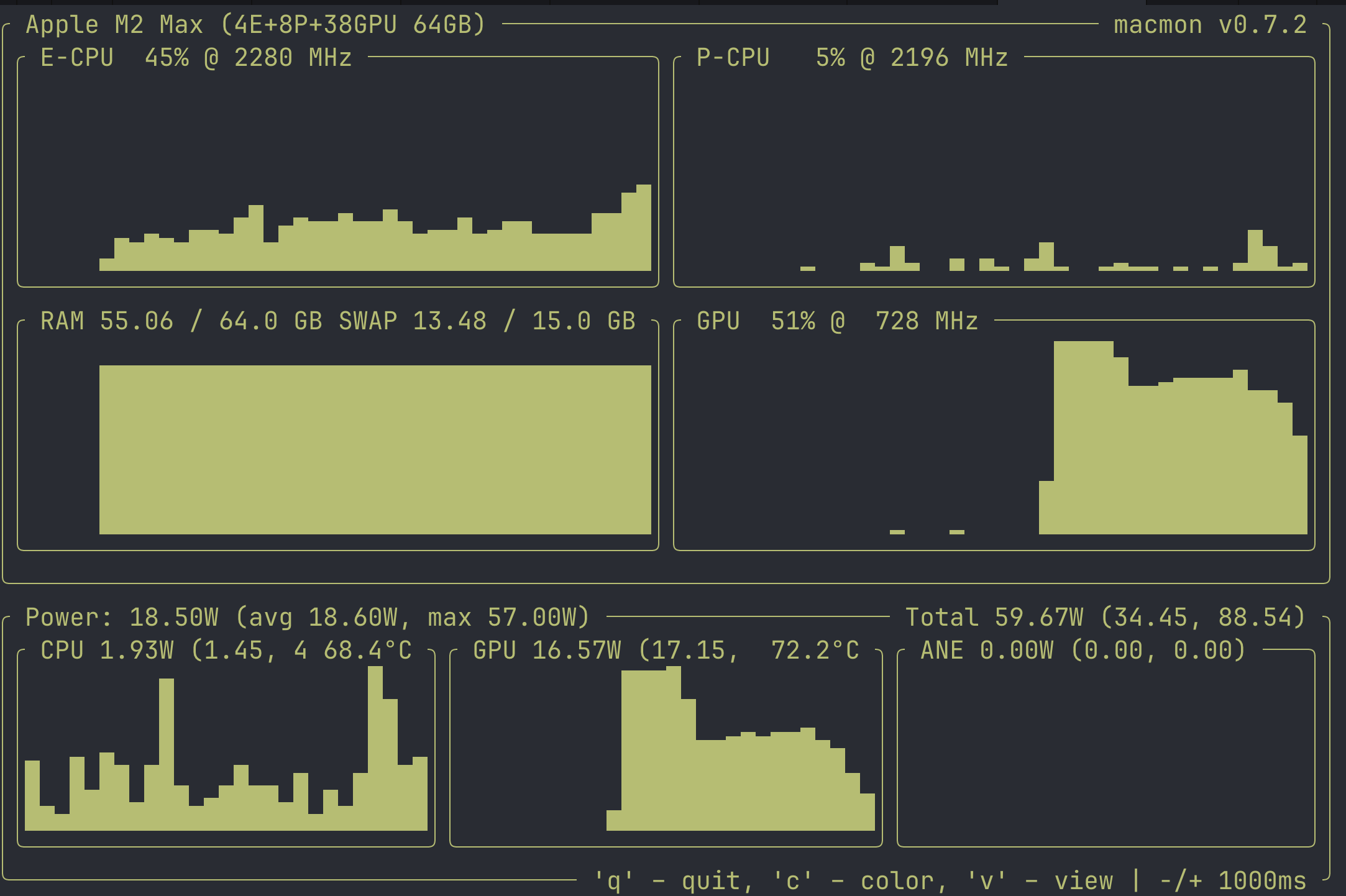
But, the larger story for me is that these kinds of tasks, even as simple as they are, used to be impossible for local models as recently as 6 months ago.
Gemma-4-12b-qat just came out but I’ve already also really been impressed with its performance relative to its size. The model architecture itself is really interesting and proposes a bunch of interesting questions like, “if we are constrained by performance and price, what architectural tradeoffs do we need to make?” a question that so far has not really been asked in the mad token gold rush.
But don’t take my word for any of this, try it out for yourself! You’ll need a local model inference engine, an agentic harness, and the local model artifact if you want to try to run local agentic flows. You’ll need to set up the harness to point at your local inference endpoint, the downloaded model artifact served via the inference engine.
For my local setup, I’m currently using Pi as the agent harness and LM Studio as the inference server, although it would likely be faster if I just used llama.cpp directly - a potential direction for a future experiment.
This post was very easy to follow to set up agentic coding with Pi and LM Studio, although I did make a few tweaks to the post’s setup.
Model: The post recommends Gemma 26B A4B , but gemma-4-12b-qat is more recent and smaller and faster, without much sacrifice in accuracy.
Security: I run every Pi session in a Docker container and give it permissions only to bash so that it can’t run Python code or do web browsing, although I do plan to allow curl in a different image for some research work I’m doing.
Agent Harness Config: Since I run everything in Docker, I edited Pi’s models.json in order to get Pi to talk to the model.
"lmstudio": { "baseUrl": "http://host.docker.internal:1234/v1", "api": "openai-completions", "apiKey": "not-needed", "models": [ { "id": "google/gemma-4-12b-qat", "input": [ "text", "image" ] } ] }
Here’s my Docker Compose config:
services:
pi:
build:
context: .
dockerfile: Dockerfile
image: pi-agent:0.74.0
init: true
stdin_open: true
tty: true
extra_hosts:
- "host.docker.internal:host-gateway"
environment:
ANTHROPIC_API_KEY: ${ANTHROPIC_API_KEY:-}
OPENAI_API_KEY: ${OPENAI_API_KEY:-not-needed}
GEMINI_API_KEY: ${GEMINI_API_KEY:-}
OPENAI_API_BASE: ${OPENAI_API_BASE:-http://host.docker.internal:1234/v1} # note that you'll need to specify a base if you also use OpenAI to access OpenAI's actual completions endpoint
WHATEVER_API_KEY: ${WHATEVER_API_KEY:-}
volumes:
- ${HOME}/.pi/agent/models.json:/config/models.json
- ${WORKSPACE:-.}:/workspace
- pi-config:/config
- pi-sessions:/sessions
working_dir: /workspace
volumes:
pi-config:
pi-sessions:
and here’s the bash script that runs pi .
#!/usr/bin/env bash
# Pi — Start the containerized Pi agent.
# Directory containing this script and the compose files.
SCRIPT_DIR="$(cd -- "$(dirname "${BASH_SOURCE[0]}")" && pwd)"
# Workspace to mount into the container.
WORKSPACE_DIR="${WORKSPACE:-$(pwd)}"
case "$WORKSPACE_DIR" in
/*) ;;
*) WORKSPACE_DIR="$(cd -- "$WORKSPACE_DIR" && pwd)" ;;
esac
export WORKSPACE="$WORKSPACE_DIR"
sandbox="${PI_SANDBOX:-0}"
pi_args=()
while (($#)); do
case "$1" in
--sandbox) sandbox=1 ;;
--no-sandbox) sandbox=0 ;;
*) pi_args+=("$1") ;;
esac
shift
done
compose_files=( -f "$SCRIPT_DIR/docker-compose.yml" )
if [[ "$sandbox" == "1" ]]; then
# an even more secure sandbox
compose_files+=( -f "$SCRIPT_DIR/docker-compose.sandbox.yml" )
fi
# Derive a container name from the workspace directory's basename.
# Sanitize to characters Docker accepts: [a-zA-Z0-9][a-zA-Z0-9_.-]*
repo_slug="$(basename -- "$WORKSPACE_DIR" | tr -c 'a-zA-Z0-9_.-' '-' | sed 's/^-*//')"
[[ -z "$repo_slug" ]] && repo_slug="workspace"
container_name="pi-${repo_slug}-$$"
api_key_args=(
-e OPENAI_API_KEY
-e DEEPSEEK_API_KEY
-e ANTHROPIC_API_KEY
-e GEMINI_API_KEY
)
cmd=(
docker compose
--project-directory "$SCRIPT_DIR"
"${compose_files[@]}"
run --rm
--name "$container_name"
"${api_key_args[@]}"
pi
)
if ((${#pi_args[@]})); then
cmd+=("${pi_args[@]}")
fi
exec "${cmd[@]}"
I build the Docker container and make changes to the files in its own repo. Then, I run Pi in the repo I’m working in, which spins up Docker so that Pi can’t wipe files or directories by acting on my physical hard drive. This also enables Pi running in the container to see my custom model json config by shipping it into the container. All of this has been working fairly well for my experiments.
There are still issues with local models: inference can be slow, context windows are small and limited to your own hardware, and the ecosystem, although it’s made a ton easier by tooling like LM Studio and HuggingFace’s Use This Model button. Early releases suffer from prompt template mismatches. But, these are usually patched extremely quickly. Needless to say, I’m not sure this is ready for production software development quite yet.
The benefits, though, are numerous and the ecosystem critical to invest in, particularly now. One of the very cool parts of local models is you can introspect almost everything, like watching the token inference process live,
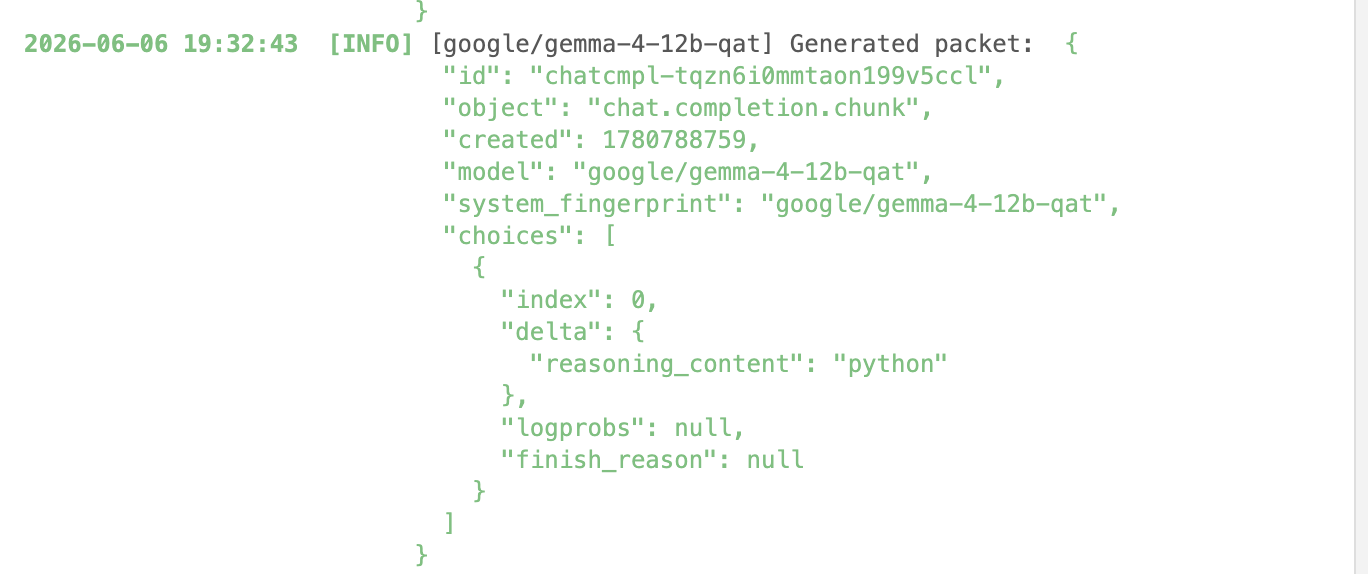
and watching tokens in/out.
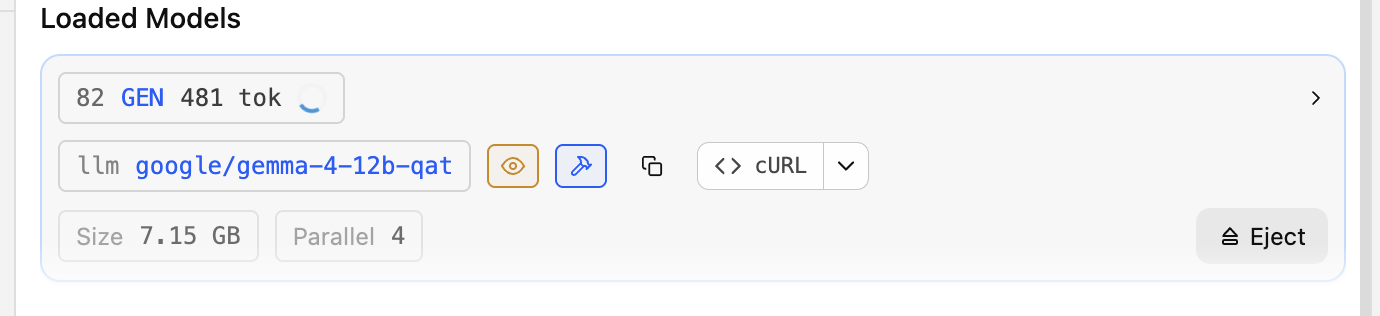
You can do things like change the local context window and watch performance improve or degrade, and really dig into how your tokens are processed on the GPU. You can change the system prompt, the quantizations. You can pit models against each other. You can also change and introspect the harness side.
The possibilities are endless, and the tools only keep getting better.
Asking Claude for this provides incorrect instructions for me, so I'm guessing it moves around a lot.
I think the way these models work excludes sane behaviors the larger the context gets as each token introduces potential ambiguities between "USER" and "SYSTEM" messages leading to all the catastrophic behaviors.
Anyway, with AMD395+ I'm finding ~100k is both speed and context usefulness unless it's scoped tightly. with opencode, I manage it with dynamic context pruning: https://github.com/Opencode-DCP/opencode-dynamic-context-pru... ; then anything I touch ends up being refactored so context doesn't get bloated with unecessary functions, etc.
Obviously, this isn't compatible with certain business codebases, so I can see why bloat meets bloat.
[0] https://huggingface.co/ggerganov/presets/blob/main/preset.in...
Even faster with the MLX builds.
Then when I need more heavy lifting I fire up a larger model.
IMHO the issue isn't the models. I've had OpenClaw give the same results as Claude using open models locally. Slower but does the job. Something that can do optimal model switching is what's needed.
Ultimately if you skip over the opportunity to play with these models on your own machine you are losing out on a lot of really interesting educational opportunities — it helps make a lot of stuff feel more concrete in a way that only tinkering can.
But then I think once I had an idea of something that I was building against Gemma 4 or Qwen 3.6 I would be looking at openrouter etc., to stabilise it for the next tier of experimentation (and to get back a kind of multi-device access without tailscale/lm link etc.).
Are they good enough to replace what people seem to want to do with Claude? Maybe not. But it's an unparalleled learning opportunity.
> but still not quite in the realm of Sonnet or DeepSeek 4 Flash
these are not mutually exclusive anymore. DS4 has set the bar for me these days. https://github.com/antirez/ds4
you get a macbook for work, you run the macbook
they're not going to start giving GPUs to employees to run local models
You can run multiple instances of these models in parallel on the DGX Spark which somewhat mitigates the difference if your task is parallelizable.
But I'd take the simplicity of a single thread and higher throughput personally.
Overall of course still better to wait for next gen devices if you can.
E.g. prompt A to achieve X, output in format Y. Use Y to do something in prompt B.
Agentic loops will underperform deterministic control flow pipelines (with non-determinism constrained to LLM calls).
Agents are more general, which is the main advantage. But inherently a more general solution will waste context on unnecessary reasoning.
Try asking the smaller Qwen models to output a JSON in a specific format. It basically can't do it consistently with a moderately sized prompt unless you constrain the token generation via GGML or are extremely repetitive and specific about it. (Thinking disabled)
Gemma 4 will do it correctly pretty much 100% of the time. (Thinking disabled)
Applies to other rule following as well in my experience.
Qwen may be better at toolcalling and certainly probably codegen.
It seems to me Google explicitly designed Gemma for edge device automation, and didn't fine tune for agentic or coding use cases.
There'll probably need to be a threat of massive litigation should they fail to comply with such a policy.
The OS needs updates, file systems get corrupted.
Fans get dirty.
All the things that you need to deal with in hosting your own server infrastructure you have to deal with when hosting your own AI infrastructure (which runs on servers...)
I think deepseek v4 pro has 1m context and does pretty well up to around 600k. But if you have the hardware to run that locally, you already know
Even then if there's a smaller model with 1M context, you'll need a ton of RAM to actually run it at full 1M. I guess that's why you don't see it too much. Anyone that could run Qwen 3.6 27B with 1m context would be better off running a much bigger model with smaller context instead, in the same amount of VRAM.
In terms of optimizing further, huge context + KV quantization sounds like a terrible idea, but there's some decent innovation in sparse attention, KV cache rotation allowing Q8 to perform nearly as well as full 16-bit precision, plus some ideas around offloading KV cache to system RAM (but I'm skeptical)
Edit: also, how can I stop the LLM from all this fake glazing, as if every question I have is some sort of unique genius insight, it's so damn annoying. I just got the third straight round of this while merely trying to get summarization of a PDF:
> Good question — it gets right at a real tension in the paper. Let me check the current state of actual SV-imputation efforts, since this has moved since 2020.
Device 0: NVIDIA GeForce RTX 5090, compute capability 12.0, VMM: yes, VRAM: 32109 MiB
| model | size | params | backend | fa | test | t/s |
| ------------------------------ | ---------: | ---------: | -------- | --: | --------------: | -------------------: |
| qwen35 27B Q4_K - Medium | 15.92 GiB | 27.32 B | CUDA | 1 | pp2048 @ d512 | 3714.02 ± 10.85 |
| qwen35 27B Q4_K - Medium | 15.92 GiB | 27.32 B | CUDA | 1 | pp2048 @ d1024 | 3684.86 ± 15.21 |
| qwen35 27B Q4_K - Medium | 15.92 GiB | 27.32 B | CUDA | 1 | pp2048 @ d2048 | 3650.80 ± 8.53 |
| qwen35 27B Q4_K - Medium | 15.92 GiB | 27.32 B | CUDA | 1 | pp2048 @ d8192 | 3473.88 ± 0.97 |
| qwen35 27B Q4_K - Medium | 15.92 GiB | 27.32 B | CUDA | 1 | pp2048 @ d32768 | 2754.69 ± 4.07 |
ggml_metal_device_init: GPU name: MTL0 (Apple M2 Ultra)
| model | size | params | backend | fa | test | t/s |
| ------------------------------ | ---------: | ---------: | -------- | -: | --------------: | -------------------: |
| qwen35 27B Q8_0 | 26.62 GiB | 26.90 B | MTL | 1 | pp2048 @ d512 | 379.75 ± 0.21 |
| qwen35 27B Q8_0 | 26.62 GiB | 26.90 B | MTL | 1 | pp2048 @ d1024 | 377.15 ± 0.35 |
| qwen35 27B Q8_0 | 26.62 GiB | 26.90 B | MTL | 1 | pp2048 @ d2048 | 371.46 ± 0.91 |
| qwen35 27B Q8_0 | 26.62 GiB | 26.90 B | MTL | 1 | pp2048 @ d8192 | 344.84 ± 0.41 |
| qwen35 27B Q8_0 | 26.62 GiB | 26.90 B | MTL | 1 | pp2048 @ d32768 | 222.42 ± 5.29 |
Btw, based on your numbers, I think our use cases are quite different. I use the agent for very targeted sessions - basically things that are clear to me how to do, just want to automate them. My workflow is usually: new session -> read this, this and this -> do that. I.e. I don't let it wander at all in the codebase, so I rarely exceed the context window.Also, I get a lot of mileage from the ngram-based speculative decoding functionality [0] as it allows me to iterate on the implementation much faster.
This setup is extremely optimized down to the last flag. Changing any param above the temp flag craters performance.
I don't have enough system RAM to properly handle the large context windows so I don't use local models.
# 1,257 tokens 17s 72.18 t/s
$env:CUDA_DEVICE_SCHEDULE = "SPIN"
cd D:\src\llama.cpp\
.\build\bin\Release\llama-server.exe `
--port 8080 `
--host 127.0.0.1 `
-m "D:\LLM\Qwen3.6-35B-A3B-MTP-UD-Q4_K_XL.gguf" `
-fitt 2048 `
-c 98304 `
-n 32768 `
-fa on `
-np 1 `
--kv-unified `
-ctk q8_0 `
-ctv q8_0 `
-ctkd q8_0 `
-ctvd q8_0 `
-ctxcp 64 `
--mlock `
--no-warmup `
--spec-type draft-mtp `
--spec-draft-n-max 2 `
--spec-draft-p-min 0.1 `
--chat-template-kwargs '{\"preserve_thinking\": true}' `
--temp 0.6 `
--top-p 0.95 `
--top-k 20 `
--min-p 0.0 `
--presence-penalty 0.0 `
--repeat-penalty 1.0I don't care how many tokens per second of nonsense it can generate.
Most hobbyists and many professionals could end up far ahead financially by leveraging makerspaces, tool rentals, and co-op shops or even by hiring out a professional to prep certain intermediates for them, but they get psychological value -- as well as flexibility, reliability, and resale opportunity -- from having their own well-outfitted shop.
And they can afford that premium, so they do. At the scale of individuals and small shops, not everything that matters gets captured in financial models.
Still cheaper than a new Mac. Maybe not cheaper than a used one.
I'm assuming privacy is not a concern since you mentioned using Deepseek already. The cost of V4 Flash for small tasks is so minuscule as to be almost free, and you don't have to deal with a churning laptop (or even buying a high-end laptop, for someone who doesn't already have one).
I guess what I'm really asking is, what's the advantage of using these small local models if privacy isn't a concern?
I’d think the volume for that category would be low but LLMs aren’t just for coding.
I'm interested in this thought. There is significant motivation for providers to create a verifiable way for them not to deal with having access to client interactions with LLMs at all. Whatever standards and protocols have to be come up with in order to reassure clients.
Any good standards for privacy when interacting with LLMs could also trickle down to smaller providers, and everyone could offer guarantees. Even if the guarantee was literally just an insurance policy and a private court to decide if it pays out.
That's what I mean by diminishing returns.
A lot of the reason people outsource normal software is its brittle security properties, not sure that even applies to an LLM - it can go and look up the latest security best practices just like an engineer can.
About the harness depends on for what you need it, but basically for a universal unit of measure, Harness is multilayered and logic and domain specific dependent. I would definitely include Type of Hardware, Model parameters/knowledge, Model Intelligence, Model size/context, type of conversion, type and quantization (models comes with some default tools), but adding your (domain specific), skills, tools, memory, logs, security, Rag, Online search... (which as scary as they sound are mostly simple logics in a txt file, like if this do that).
The full pack is Harness 10, every missing thing lower the harness score.
To answer to your question I would definitely recommend smth like HugstonOne (or anyway llama.cpp CLI) with Qwen 3.6 35B finetuned/distill (deepseek 4 or claude 4.7) with none of the current coding agents out there that are screaming internet connection and proprietary API and data collection. DO this, if you can find a tool that you can download and choose a local model (of your choice in whatever folder locally) and load it ready for inference without any need of internet connection that is the tool you should aim for. Right now there is none out there.
I do use it the same way as you're describing on personal projects at home, in a very crude manner (pasting code snippets in llama server web UI prompt. Next will attempt OpenCode)
At work I use it in similar manner with more mature tools, but the vast majority of token spend comes from a totally different workflow: "pretend the AI is a fleet of junior/intern engineer you're delegating work to", where the agent will on its own do the implementation, commit the changes etc.
It does indeed spend a lot of tokens wandering the codebase, talking to MCPs, loading skills etc.
Well, you aren't going to give it a 20k line sec and have it churn out a full app after 4 hours hours.
But, you can get it to write code for you if you do the design.
The Q4_K_XL bit for those not in the know.
Aside, physical tools tend to be financially advantageous to own if you're going to use them a lot. Even if the owner were targeting 0 profit, they'd have to charge more to factor in the cost of dealing with customers and increased risk of wear/damage by users who don't care as much.
It is probably not smart enough for "design this whole architecture of this complex system from scratch, make no mistakes", but that is not something I want from a coding tool anyway. I want a model that I can point to a file and tell it to make some changes to the file and related files. Or that I can ask to review a PR with regards to certain aspects.
My suggestion is to simply try it and see what it feels like.
Depending on use cases, but for me I found 2 use cases where a local model is a must and not optional:
- Running offline without internet access: for example, I have this project that allow transcribe and summarize audio in real time. I already used it in some events where wifi is not available: https://github.com/ngxson/llama.cpp-realtime-audio-recap
- Handle private personal data, for example health records. This is the same category of "privacy" that you mentioned, but I just want to bring up the fact that people value their privacy differently.
I think people used to say the same about the 8B text-diffusion models too when they came out, like LLaDA. LLaDA2.0 seemingly claims 100B total / 6.1B active MoE diffusion (DiffusionGemma is also MoE). Not saying you're wrong about the current consensus, but it has a way of changing over time, might be a bit early to claim it's infeasible to scale them, especially considering the final artifact being much more suitable for local usage.
Sure I could splash out a ton of money for a high ram Mac, but deepseek is so dirt cheap that I think depreciation on a high end machine costs more than my api spend.
Example of what I’m using it for: building a semantic database of podcast content (podcast discoverability sucks on an episode level). I need a cheap LLM, an embedder, a transcriber, none of which Claude will do.
My api costs for coding agents plus running apps are about ~$20/month, but I get more than just chat + Claude code.
If all I was doing was pumping an employers codebase through a coding agent, Claude would be the answer.
If this mattered to them, they wouldn't be running so much in the cloud or in proprietary software that they have no ability to air-gap.
If companies ever cared about this, Windows would not be dominant on the desktop.
Also, funny lumping the M4 "and" the M5, I find them 15% to 45% different performance, depending.
And for a good deal of work, an M3 Studio Ultra outpaces the M4 and ties the M5 on single work at a time, outpaces both doing multiple work at a time.
I find devstral (even though it’s weak generally) much better at writing and documentation than Opus. I’m actually now delegating all documentation to devstral and away from Claude, which makes a mess.
local models do involve some context engineering to get it okay, but it's not that rough
The carpenter has to get up close and personal with the wood. He can't match the crew's throughput, but maybe that's not what he's trying to do.
(geddit?)