Seems to be playing out.
Not only that, but real innovations like cancer treatments require decades of unprofitable 'basic science' grunt work. Musk and his friends don't care about saving humanity 30 years from now. He talks about going to Mars with nonsense lies to fatten his own pockets. And by filling the science advisory committee with VCs instead of scientists, he has turned science in America from a 'pursuit of truth' into a 'Silicon Valley VC portfolio.'
Elon Musk is a genius. He will destroy the growth engines that could produce his future competitors, and he will reign forever.
The smart thing about Elon Musk and his friends is their ban on international cooperation among scientists and their word censorship. They seem to think that viruses like Ebola will enter the country by getting a Trump card issued. Clearly, smart people like them cannot understand ordinary people like us. To them, it's only natural that everything comes through a visa, so they probably think viruses come through visas too. Elon Musk's lecturing about border etiquette for viruses can be described as a kind of elite duty. Indeed, injecting morality into something immoral is 'noblesse oblige.
And it's not just particular topics they hate, they hate the entire system and institutions. And they try to either break them and force them to adopt their political views, or they attack their funding or use any other powers to dismantle them.
Maybe time to sue the richest man alive for helping destroy American science.
More efficient than any foreign actor
Anything that depends on a basic understanding of the scientific process, and resulting scientific facts is absolutely a partisan issue right now.
If the scientists haven't left science behind after an experience like this, probably nothing will. What an absolute kick in the nuts to have a decade of your life erased because someone did a keyword search for science projects to stop, in the name of saving money, while at the same time wasting even more money on other things.
I think I should feel angry, but I just feel sad for all the humans involved here, I hope they manage to come out with a more positive perspective than I'm able to here.
Now we lament that in 70 years somebody is going to chuckle when they read such non-sequiturs as: The great Texas protein crisis of the late '20s was made several orders of magnitude worse - if not right out caused - by the first trillionaire's purge of the government. At the time justified as a cost saving measure while the president would spend >35% more than its income while saying things were going great and had never been so great at anytime in history.
There has been a massive, decades long educational failure in the United States, and probably the entire western hemisphere of culture: no where are people taught how to manage disagreement. due to that, we have this moronic destruction taking place where "idiots of authority" see no reason not to dismantle anything that irritates them, and nobody has the langage to explain nor the peer power to stop the desolation of our entire supporting infrastructure. All because idiots of power do not like being told and proved they are wrong. So, power removed the education that taught people how to debate without emotions, and here we are.
That's the simple reality. Administrations impose their politics, but also universities do the same, and they're not any more noble for doing so.
Research groups need to have more independence and that can only happens through a very meritocratic funding process, and also, at the risk of sounding like a STEM lord, by being very cynical and realizing that not all fields of research merit the same amount of funding. Countries like China have already realiezed this.
He is a genius though, great results on the market.
What I mean is more centralized oversight over research priorities, metric-driven rewards, and preference for political favorites?
The rest of your comment is just nice fiction.
And if you think this administration is prioritizing science with actual applications, I have a bridge to sell to you. The cuts they made are not sensible policy, they are inherently destructive and wasteful. They aborted studies that were still running, so a lot of money was spent and we'll never get any results from that because they were not finished.
Science will appear political to you if you claim that climate change isn't real, that vaccines and Tylenol give autism, that oil prices will soon go down when the wells are destroyed, that the economy is hotter than ever when everything's going to shit, that the weather channel is just anti-American and woke when they predict rain for the UFC Freedom 250 held for the emperor's birthday...
Unless america does it _very_ different than the rest of the western world, this is already the case. STEM research receive way more public funding and have way more PhDs than other fields, in my country it's almost two order of magnitude (this has to do with the cost of instrumentation mostly, but not only).
On the "science have turned political", yes, but that has always been the case. You can be political and non-partisan. UNSCEAR has been political from its creation, but is still non-partisan, anybody can use its research to make partisan proposition on nuclear. Same for WHO, it was _obvisouly_ political, advanced the interest of the first world in poorer countries, but it stayed non-partisan. This is probably the same for any medical research: obviously what is researched is political. Non-partisan though. Just because heart attack research was done by, with and for men, women also benefit from the research (although to a way lower degree until like 2010).
The only counter-example i can think of is the GIEC group3. I don't think it is partisan, but i can hear arguments that say that it is, and debate. But it has the lowest amount of funding of the 3 groups, and Group 1 and 2 are not partisan at all.
Not only is it destructive, it's randomly destructive, nothing is sacred, there's no stability at all. Why would you invest or take out a mortgage if dear leader could destroy your life for no reason at any moment? It's like living in space where a random piece of debris could puncture any point on your hull at any moment and there's nothing you can do about it.
Scientific projects, especially the massive ones, go through several cycles, and they get completely stopped or even canceled during their life, and then later, sometimes decades later, they do restart.
This happened with the LHC, ISS, James Webb telescope, the Hubble telescope, ITER, etc, etc, etc
Now, I know that in certain circles is very common these days, to go around pretending that the likes of many current decisions never happened until now and that whoever is governing the USA is doing something unheard of and absolutely terrible that nobody else would even think of. But it's not, this is something normal (I'm not saying it's good, but it is quite normal in science).
Take AI for instance. The US grid is struggling to keep up with demand, while Chinese one has a lot of headway [1]. Usually, this could be solved by an increase in spending lasting a few years which would make the debt tick up, but that would've been an absolutely fine use of debt since it buys some shiny new infra that will pay dividends for the next 20ish years.
Now? Not possible. The US is already drowning in debt and the usual buyers are not showing up to buy it because of the Iran fiasco. With oil so expensive everyone was using their USD reserves to buy oil, not debt. Which mades interest rates go up considerably, and for a country with already ~130% of debt/gdp ratio these are terrible news.
So, I don't think there will be a great power race. Europe is fucked by both high debt, and lack of innovation. Russia is struggling already to finance a war of conquest they started. China is the only one that can run if it comes down to it (unless of course the numbers coming out of China are mega bogus, but for that I don't know enough to have an opinion).
[1] https://fortune.com/2025/08/14/data-centers-china-grid-us-in...
This is the most recent shock, and probably the biggest one, but academia has been becoming toxically metrics-driven, authoritative and political for a long while, weirdly more than in industry.
It has nothing to do with scientists of course, they are the last ones that would want this. It's a never-ending squeeze from the top.
And also the fact that so many students were pushed to study pure sciences, which is great in principle, but some of these degrees only prepare you to stay in university as an academic, and there's only so much budget for that.
Whoops, keyword match.
Most of the "research" done by graduate students and even tenured faculty as a whole is laughable at best. For every lab that produces groundbreaking output, there are countless humanities graduate programs that do nothing but produce and spread left-wing propaganda.
In fact if the US hadn't had its huge influx of foreign scientists fleeing the Nazis, who knows where we'd even be today.
I object. The CCP is much more deeply indebted than the US when taking into account provincial and local governments as well as state-owned enterprises.[0] And of course the US debt is financed in its own currency while Chinese foreign debt is financed in dollars or other currencies.
The problem in the US is regulation. An environmental impact study takes 54 months in the US.[1] The CCP, which has no problem poisoning its people or even launching rockets over inhabited villages, doesn't delay itself at all.[2] I'm glad we don't poison our people or place dangerous industry in places that could harm populated areas, or even perform some prophylactic measures to protect nature, but I'm confident that we could do this in less then a year (less than six months?) and make much faster progress. Even for something like nuclear, the ten years (mostly caused by red tape) are really onerous.
> China is the only one that can run if it comes down to it (unless of course the numbers coming out of China are mega bogus, but for that I don't know enough to have an opinion).
Yes, the common opinion among China watchers is that any number the CCP touches is "mega bogus." They're actually in the midst of something of a financial crisis at the moment because of the high debt.
[0]https://www.statista.com/topics/11662/debt-in-china/
[1]https://www.rff.org/publications/reports/how-long-does-it-ta...
[2]https://arstechnica.com/science/2019/11/china-keeps-dropping...
People in the 1950s were convinced that the nuclear family was a disaster and the leading cause of divorce/poverty.
> Applying for highly competitive grants with limited funding is what scientists have always had to do to carry out the science—a flawed process with few alternatives. But arbitrary cancellations and delayed disbursements are unprecedented. And justifying them on the basis of politics—prohibiting, for instance, grants that include language referencing diversity, equity and inclusion (DEI)—was unheard of until now.
Spoken like somebody who has no idea what they are talking about.
Apart from the large share of fundamental science which Europe has always been bigger in and better at (I mean, there's a huge tunnel in Texas to show that Americans at some point understood this and tried to compete), Europe is funding the military tools of the next generation in Ukraine.
Americans used to be excellent executors, then China took that role. What's left?
They thought we were crashing, rushed the cockpit, and pushed forward as hard as they could on the stick. Forward is up, right?
Not a policy I'd usually support, but I think a certain South African has really done enough damage to justify it.
Given the massive pay gap with industry and scarce funding, it's natural lots of innovation has shifted to industrial labs.
The goal is - and I am not picking on the reactionary wing alone, this impulse has broad support across our ideologies - de-industrialization. The complexity of post-Enlightenment civilization is being rejected, in favor of some hypothetical state. This puts the past timeframe as far back as the 17th century.
But not a "real" past. No one can recreate the past. Only their idea of the past.
And of course, when you "create" anything, too much and too quickly, you risk systemic collapse. Not a problem if you imagine you will be Immortan Joeing around in your Death Wagon, but odds are, I'm sorry to say, against it.
The reconstruction, if it happens at all, will take decades. It was all so unnecessary, so foolish.
This is a classic monopoly strategy that cloud companies used to employ all the time: destroying the customer's internal capabilities[1]
[1]https://www.medianama.com/2024/09/223-google-files-antitrust...
The bigger issue is that NIH, NSF, NASA, and public health agencies are no longer perceived by the US right as neutral expert institutions. They see these institutions as strongholds of left wing elites. So this is less about fiscal policy and more about cultural policy retribution.
That's why from the perspective of an outsider like me, it looks like 'they are killing their own country's science,' while someone like you might see it as 'smashing the power institutions of the opposing camp.' I think this is simply a difference between an external and internal perspective.
Honestly, just looking at the ban on international cooperation mentioned in the article, it comes across as nothing more than a desire for control.
They want the 1850s.
Don't get me wrong, I rather lose the superpower race but enjoy my privacy and work benefits that folks in the US dream of. But the topic was superpower competition and I don't see the EU going anywhere in that front.
We are fragmented, among the top 4 EU economies 2 are struggling with debt (France & Italy), Germany economy is stagnating and the amount of bureaucracy hinders any attempt at innovation, ... .
I mean when the US replaced the Brits as Hegemon a large part of the world wasnt nervous about it.
This is great news. It was "unheard of until now" because everyone before this madness started ~ 2010, was sane enough to not put DEI criteria in grant allotments.
I'm glad something is finally being done about these appalling discriminatory practices. The grants should go the best proposals, not to those with the proper genitalia, melanin content of the skin, and correct religion of those applying.
Let's take this moment to welcome real science back.
Not that the university is paying much anyway, often the opposite: the researcher gets their own grant and they are forced to pay a cut to the host university, or to their group leader. It can get rather feudal.
Reminds me of the when all the catholic priests were molesting kids and being moved around instead of outed and prosecuted. This was also a controversial topic too for the same reasons. Some people wanted to take action, while other (more powerful) people wanted to ignore it.
It’s entirely possible Russia will find itself with a pacific warm water port.
Perhaps tons of tundra frost will become fertile farm land.
Of course this is at the costs of billions of climate refugees having to migrate as well as a bunch of other side effects
Everybody thinks he knows everything about the subject, but nobody ever checked anything. If people go into the details of some absorption spectrum they risk to get cancelled.
It's religion - and a strong one. With dogmas, taboos and holy authorities.
They have drowned their municipalities in debt cumulatively equivalent to the US federal and state debt as a percentage of GDP. Localities aren’t allowed to tax but are responsible for local services and industry. Local governments borrowed heavily to hit GDP growth targets and compete with each other for investment and talent.
There is now a backwards migration of the working class back to rural towns from the cities because the incentives China gives is towards technologies that only benefit their already upper-middle class workers. About 500 million Chinese live in rural areas and over 20% of their workforce toils in the fields. That’s not changing anytime soon. Youth unemployment has been 15-20+ percent for some time.
If you’d like to do your part against climate change, you can start by walking everywhere today, avoiding heating and cooling your home, and never flying a plane again. These are changes I’m not willing to make, so the issue isn’t just inconvenient for the wealthy—it’s inconvenient for everyone. It’s easy to shift the problem onto others without doing anything about it yourself.
I think it's difficult, if you're a millenial/zoomer/whatever we're calling these things, to understand just how much of the world genuinely liked and respected and wanted america involved in their local affairs.
America obviously wasn't perfect and many, many more people than trump were involved with squandering all of this goodwill, but we still had some left over before he showed up.
I would assume majority of US middle class' savings are in the real estate or securities. Why would hyperinflation kill these?
What practical machinery and infrastructure has the US innovated in that time frame?
Here is a scientific outcome that directly impacts the quality of medicine a majority of American citizens receive: https://jamanetwork.com/journals/jamanetworkopen/fullarticle...
Research in progress to address these issues was cancelled by DOGE because "melanin content of the skin." "Do your own research" if you care to, or fuck off.
I'm confused. At least at the NSF, about 60-70% of their awards go to white men. Are those the appalling discriminatory practices, or what do you mean?
Inclusion Plan Both PIs and collaborators recognize the negative effect that systemic barriers have on academia and the importance of facilitating the full participation, belonging, and contribution of different groups and individuals within our work environment in general and the proposed project in particular. The proposed project is small in scope with few paid contributors and a well-defined group of collaborators, but it is always important to have a strategy in place to develop a positive and inclusive work environment. The PIs identify three areas where systemic barriers may affect our working environment or where questions around inclusion are critical:
1 Hiring strategies. The most obvious barrier against inclusivity in academia and STEM is bias (whether explicit or implicit) in recruiting staff and students. They will work closely with the recruitment and Diversity Equity and Inclusion (DEI) offices at their respective institution to create recruitment strategies which are as unbiased as possible. One of their affiliations is a minority (Hispanic) serving institution – a transformative engine of social mobility – that offers a remarkable opportunity to (i) ensure student recruitment plans include underrepresented individuals and (ii) increase participation of a diverse and inclusive talent pool in climate change science. Both PIs will also participate in hiring workshops and training offered by their respective universities. Finally, they will leverage each PI’s background and earlier experiences by providing feedback in recruitment strategies and hiring decisions to each other, along with collaborative feedback from the associated offices at their institutions.
2. Work relationships with Post Docs and between collaborators It is also critical to create an inclusive working environment between PIs and Post Docs, enabling a positive collaboration between all members of the team. The two PIs will work with the hired Post Docs to write a career development plan during the first three months of their employment. They will also actively promote external mentorship for the Post Docs, either informally or via established mentorship programs, including AGU-endorsed programs Mentoring365 (a free and global mentoring platform for the Earth and space sciences community) and Mentoring365-circles (a peer-to-peer group mentoring program that allows early-career scientists to build skills and grow their network around common interests and objectives). Finally, they will ensure that the Post Docs are informed about how to report discrimination and how the University can support them during onboarding.
Both PIs have participated in management leadership training and have experience in organizing the kind of collaborative work that the proposed project requires. They will continue their learning process by participating in leadership workshops with a focus on DEI provided by their institutions.
3. Interactions with stakeholders. Inclusivity in stakeholder interactions is critical for a successful result. PI 2 will be the main lead for working with stakeholders, and as such leverage their experience and expertise from earlier projects where stakeholder inclusivity has been a critical component.
You are 100% right. Yes, some people could believe that huge mistake.
Global effects will still catch them. The atmosphere and the oceans are global systems that don't care about frontiers. Warm oceans in Russia means extra hot waters in the equator belt, that means Hurricanes on steroids. This nice Russian port in Putingrade could be destroyed each year by the extreme weather. And nobody could navigate safely in huge stormy areas of the oceans.
> Perhaps tons of tundra frost will become fertile farm land.
Perhaps we will find that the peat soil starts releasing methane at a level never seen before. And that we enter in an unstoppable cycle of global extinction, just after dismantling science for fun. Weee!. This planet has resorted to that nasty trick a few times before.
Once it starts and self-feeds there is not enough money in the planet to bribe the ecosystems. They will fall until the next stable level of energy available. A level that may grant, or may not grant, minimum conditions for plant survival. Humans can't live without plants.
But a few rich choosen ones will go to Mars, party all night and it will feel like a Tattoine's adolescent dream!
Being rich only works if there are a much bigger amount of people that fix your needs and breeds your food. Money in Mars can't buy you a tuna sandwich when all tunas went extinct. Mars will became a very disappointing place in no time. A place that hates us with passion, with probabilities of survival abysmally lower than the earth. This people will be done the first time that the life-supporting machines will fall. Something that would never happen in the Earth.
The earth? will be fine. Go fast-forward several million years in the future and some organism will be seen traveling in machines fueled with petrol made of human corpses.
I’m sorry but this is demonstrably wrong as the simplest search of reputable scientific journals would show.
In Australia we established a Royal Commission into Institutional Responses to Child Sexual Abuse, looked at all the schools and institutions regardless of creed (and, it turned out, the Christian Brothers were the clear worst of the worst - although few came away unscathed) and then put a senior Vatican Cardinal on trial.
TBH it's been a lot harder to get the worst carbon offenders under close scrutiny in a very public eye.
So no to dumb fuckery EU did with biofuels (for which vast rainforests in ie Borneo had to be cut down forever), no destruction of local automotive industry while rest of the world couldn't care less. And Yes to many other, saner activities, of which some are done, in some places.
Probably a good opportunity for them to stop and reflect that they're not from a special caste or class, and gravity / global warming / all the rest effect them and the plebs all the same and that includes their exposure to the labor market. Their pleas that it is somehow special when it happens to them falls on deaf ears considering the government funded or employed scientists who have any expertise or position to comment on economics (like Milton Friedman) would preach with their loudest voice from the ivory tower that the plebs duke it out in Darwinistic free-market competition.
> If people go into the details of some absorption spectrum they risk to get cancelled.
On the flickering smidgen of a chance that you are making this complaint in good faith, the reason why nobody feels obliged to walk you through the science is because for decades there has been a raging denial-of-service battle where the anti-climate-activist side spams questions under the pretense of "I'm just a curious individual, just asking questions" (JAQing off) when in fact they are exploiting the asymmetry between asking and answering a question. It takes 1x effort to ask and 100x effort to compile a good answer and you can only tell that the question was being asked in bad faith at the end when, after having the question thoroughly and convincingly answered, the JAQ-off completely fails to update their priors and immediately rotates to another misunderstanding that validates their politics. And then another, and another, indefinitely, because the JAQ-off never wanted to learn, they always just wanted to promote their politics.
If the science community opens its arms to this, it gets stabbed in the heart. Ask me how I know. Our response is twofold:
1. Don't assume good faith until someone invests effort to demonstrate it
2. Point to the IPCC reports, which are one of the most monumental assemblies of knowledge, observation, and experimentation in human history.
These days, "the simplified IPCC reports are still too hard for me" isn't even an excuse because LLMs exist and are good at explaining the scientific basis for climate issues. Whichever detail of whichever absorption spectrum you have in mind has almost certainly been studied by a hundred authors across a dozen labs who have also studied and answered 5 more questions about the absorption spectrum that you didn't think to ask. But the information is out there: go get it!
Once you have invested effort in digging into the IPCC report, finding a study, reading it, building a question -- then you can go to a particular researcher and ask a particular question. You will get an answer, because you pass gate #1. But right now you are very far from passing gate #1 because you have put in no work to formulate a good question.
Wat
I am just a climate science hobbyist: my graduate work was in another science field, but I follow the field a bit and read some of the hot papers. But even in my day job we still use a fair bit of atmospheric physics.
I have to run into atmospheric physics a fair bit and it's not my area of training. I know that the friends and colleagues who are in research deal with it much, much, much more intimately.
This comment is wildly, and weirdly, off the mark. Atmospheric physics is no more a religion than steel metallurgy or rainforest ecology is. It's grounded in hard experimental data and observations.
"Climate Change" isn't caused by flying a plane, it's caused by flying thousands of planes every day. This is a real distinction because the individuals you are talking to do not have any meaningful way to affect the 40,000+ flights per day. Just as a random example.
If your next response is going to be "well if everyone stops taking flights that would affect them all", then yes, congratulations, you've discovered what laws are and how democracies work.
Required reading: https://orionmagazine.org/article/forget-shorter-showers/
A whole planets' society's structural problems cannot be solved by an individuals action. Your own attitude explains the 'why'.
This is a systemic issue that needs systemic fixing.
It's like someone saying "tax fraud by billionaires is a massive issue" and responding "well, did you declare every single dollar on your tax forms hmm?": they're both issues, but the former is obviously a much more impactful, structural and relevant one. You're trying to nullify their argument by attacking the "purity" of the person, but that doesn't negate the truth of their point. This is like a greatest-hits of common logical/debate fallacies (strawman, false dilemma, non-sequitur).
Oh yes, the false moralizing fake outrage trick. Very good. But now that we addressed your attempt at diverting the issue:
People in this thread are complaining about canceling DEI initiatives targeting the melanin levels of the researchers, not of the test subjects. In fact, the lengthily answer from the grandparent that you praise, says exactly that.
Sorry if it was too simple to call out your attempt at confusing the subject of the discussion.
It's so easy to sit in an air-conditioned house, with our 2-day delivered Amazon stuff, and just make pronouncements like degrowth, etc.
Meanwhile about 99% of the humans who live in places that haven't fully industrialized are either working feverishly to industrialize like us, or are trying to find a way to move to an industrialized country because of how incredibly hard it is to live where they are.
I also suspect that our most committed enviro-leftists genuinely believe that their lifestyle is already fully aligned to their values -- they don't even own a car, take transit everywhere! They pay an extra $25 for carbon offsets when they fly, and they "recycle everything"! They live in a blue state that mandates high levels of "clean energy" in the power grid.
They do not ask themselves where the factories are built that make the wind turbines or solar panels, what powers their buses and trains and makes the cement that the streets are paved with. What powers the diesel trucks that bring their organic produce and manufactured soy products to Whole Foods for them.
All this isn't to even comment on where climate change actually is on the 2 axes of "Non-issue ----> existential threat" and "Completely avoidable if we start now ----> Entirely outside human control." I'm just saying that I suspect nearly every Western climate change activist would be filled with regret if we started making every societal decision to truly optimize for climate concerns to the exclusion of all other priorities.
When I was younger and more naive, this > "the debate (not controversy) should be about which steps are most efficient") i
is what I thought (american) politics meant. When people talked about things being political or arguments related thereto, this is what I imagined happening.
Then I grew older and saw it was mostly people whining about gays getting married or who was allowed to have an abortion or what activities minorities were allowed to participate in.
Very depressing, frankly.
USDA is doing the same thing with ag funding, though I don't think the same level of chaos is appearing because there are still at the moment competent people below the true-believer management. But not for long, as soon as they complete their return to Kansas City, inevitably losing DERP holdouts (exactly as happened during the last Trump admin).
That seems like a more severe response than a single cardinal getting arrested.
The church in Rome was blowing it off as an American problem for many years.
That Australian commission was established in 2012. The battle had already been going on for well over a decade in the US.
If you want to see how things were going early on you can look at things like Sinéad O'Connor stuff from 1992:
https://en.wikipedia.org/wiki/Sin%C3%A9ad_O'Connor_on_Saturd...
Effectively no one is arguing for this. You're ranting about a ghost.
State banks backed Evergrande’s with cheap credit and govt guarantees.
Local officials were promoted for hitting GDP growth targets - see above how they put localities deep in debt by speculating on real estate.
The CCP gave households social credit for moving to cities and buying real estate.
The CCP is not protecting consumers in the aftermath. They won’t let consumers out of mortgages for unfinished condos because they don’t want the crisis to worsen - effectively bailing out developers.
If I had to choose, I'd rather I lost my job for some reason, but my country is passionate about science and curiosity and understanding, compared to living in a country where I kept my job but the culture was inimical to science.
The only thing going for them is the argument from authority. But once you know people in academia this doesn't work any more. I personally know a climate scientists (he published 40 papers). He showed a lot of signs of mental issues - most likely he is completely nuts - From experience I've seen that competent guys don't go to work in academia - it's mostly a cargo cult society for guys from the 2nd and 3rd intellectual league. Just look at them - I've seen more religious nuts and real flat-earthers there than anywhere else. I know a lot of guys in academia and even the most sane one is still leading the UFO-club...
Maybe try to be honest to yourslef first and then you'll understand, why it is really just about opinions that vary. No need to labeling opposition.
I think the generic idea of the science and global warming is real but there is a whole industry around gaming the conclusions and gamifying what concern pops up when to magically align with whatever the guy with the most influence and self-dealing is hawking at that time.
Voluntarily opting out of a high-CO2 lifestyle will do exactly nothing. Demanding that anyone recognizing the threat of climate change and demanding a different approach "first change their lifestyles" or using their lifestyles as an indicator of commitment is ludicrous. This is a global systemic issue that cannot be fixed by individual action. Game theory tells you why.
Besides that; all the nice and shiny things you mention - the busses and trains and the cement - can be produced and operated at fraction of their current CO2 cost. Wind mills and PV panels offset their CO2 cost by magnitudes if they are replacing fossil fuel industries.
There's a middle ground between "lets burn it all to the ground" and "let's go back to the savanna".
You did it, you torched the strawman.
Then we can more easily get rid of these discriminatory measures in practice (the real DEI ones) and keep the false flags.
Is that fine for you? Or that was just some red herring you were trying there?
Potato monocultures fed literal millions for a good while, Shirley it can't hurt to see grain cropping go that way.
We can talk about Indian coal companies (Thermal), global steel demand (Metallurgical), US natural gas extractors, etc.
Still, at least we have the vast areas untouched by modern man: https://www.youtube.com/watch?v=Rh9IkUUgaww
But all this has been explained and cancelled again and again... It's no good topic in any religious environment where nobody has bothered to get basic knowledge about the physics before.
I'm pleased to hear a response was made and hope Eddy_Viscosity2 sees your comment.
On the other we have adornKey, with vague accusations and smack talk that feel like they came from a LLM, still stuck at gate #1. Sad.
> The only thing going for them is the argument from authority. But once you know people in academia this doesn't work any more. I personally know a climate scientists (he published 40 papers). He showed a lot of signs of mental issues - most likely he is completely nuts - From experience I've seen that competent guys don't go to work in academia - it's mostly a cargo cult society for guys from the 2nd and 3rd intellectual league. Just look at them - I've seen more religious nuts and real flat-earthers there than anywhere else. I know a lot of guys in academia and even the most sane one is still leading the UFO-club...
Thank goodness honest citizens like "AdornKey" are around to pinpoint the precise reasons why the international community of climate scientists are crazy, stupid, closed-minded, and ignorant. I am certainly glad that "AdornKey" made this laser-focused contribution to my understanding.
Elsewhere in this comment section you're defending politicians as customers of scientists demanding politically convenient science. But that's exactly what produces the non-scientific conclusions you're talking about in this post. What you really should want is for science to be held to a gold standard of fidelity to the facts, and for politicians who push them in other directions should be voted out of office.
I have also not used any rhetoric that wasn't first introduced by the parent, so you also have no evidence of my rhetoric.
Do you see how that is a dogmatic (some might call it religious) response?
To the point: the evidence is overwhelming, and there is nothing alarmist about reacting rationally to it. Anyone denying human-caused climate change is also doing so in the face of this overwhelming evidence, so the label is rather accurate. I would happily label climate deniers with any negatively charged label you can think of: simpletons, propagandists, accelerationists, fundamentalists, reactionaries, fascists, useful idiots. Depends a little on what their role is which label sits best, but they all apply.
Nothing will change (and nothing has fundamentally changed since the climate scaremongering started), because people in the West do not want to change their lifestyles, and people elsewhere aspire to a Western lifestyle. There is nothing you can do about this. I am not not going to eat less meat or drive my car less than I find convenient to please some leftist eco-warrior.
I think most likely the banning was good - but the reasons don't really make sense.
That ignores all the other things that happen besides co2 forcing alone.
But in all the places this was happening, it was an open secret that it was happening for years before any meaningful response occurred. The first victims to speak out were not believed and even punished for how dare they accuse the holy priests of such behavior.
Will we see a similar tipping point for climate change where people on mass begin facing the issue head on? It hasn't happened yet.
Sure, but again, this misses the point. Regardless of how conservatives talk about science, if Congress keeps on broadly funding research, then scientists can fairly focus on actions over words. It's only when Congress cuts funding that we're forced to reckon with the fact that most Americans don't actually prioritize science.
So: yes, it's the funding cuts that cause the frustration and sadness. But not because this results in a personal job loss, but because this shows how our country is going downhill.
Speaking personally, two of my siblings took government buyouts, but still then moved out of the country. You can be ok with your own personal job loss (particularly when it comes with a fat check), but unhappy with the direction the country is going.
It's kinda weird that you keep making this about the impact to personal finances, rather than the impact to principles. Wouldn't you feel frustration and disappointment if your homeland was acting contrary to your principles?
You won't likely "more science" your way into thumbs off the scale, that is going to have to be achieved from largely non-scientific means.
>Elsewhere in this comment section you're defending politicians as customers of scientists demanding politically convenient science.
This is a cleverly packed lie, one attempted to paint me as a hypocrite, that you not only not quote but also chose to not address directly. The reason why is obvious -- flood the zone with indirect pointers to supposed lies to wear down the counterparty. But just this once I'll entertain it, though I know this deceit doesn't stop once engaged.
> defending politicians as customers of scientists
I am stating the politicians are the customers of the government-employed scientists. What I am "defending" is not living in a fantasy. Of course you can wax philosophical about "we the people" or whatever but at the end of the day the summation of congress+executive has constructive possession of the purse and executive management of scientific employ.
> ... demanding politically convenient science.
and I used the verbatim word 'retarded' alluding to what I thought of it ... a very strong defense of that particular customer, after which I suggest they might get a new one.
> ut that's exactly what produces the non-scientific conclusions you're talking about in this post.
There's a genius amount of terse deception to unpack here. The slight of hand is you use 'customers of scientist demanding politically convenient science' but then claim 'exactly what produces' these conclusions are ... the non-scientific output of work of scientists rather than the output of politicians who are customers. If they are producing non-science they are not acting in capacity of scientists yet somehow they escape your damnation here despite being the very people producing it by reading of your statement. Your sentence is one tightly packed logical contradiction that simultaneously guards scientists as providers of facts while simultaneously claiming the scientists themselves are producing non-scientific conclusions by chaining that as the output of the work. If they are scientists of fidelity acting in capacity of such then practically by definition they aren't to be blamed for non-scientific conclusions and are not the "producers" of such regardless of whom their customer is.
> What you really should want is for science to be held to a gold standard of fidelity to the facts
The scientist who depends on a salary to survive who wants fidelity of facts should look for customers demanding that. Expecting to produce fidelity from someone demanding infidelity means you end up broke or you become corrupted. The demand from government is infidelity. In fact what I'm "defending" is looking elsewhere away from politicians at this time because your aspiration of "should be voted" is at odds with the current reality of "they were not."
Searching "cfc concentration in atmosphere" on scholar.google.com returns 60000 papers. Cruising the first few pages, most of them easily qualify as "bothering to check." Your estimation of the scientific community is five orders of magnitude off.
Those are not the same claim. You went from arguing that the research doesn’t exist to arguing that you haven’t personally seen research that satisfies you.
Last year Christopher Reynolds started to worry that his space telescope was going to be killed.
The mission had started taking shape nine years earlier, a billion-dollar orbiting observatory that would look back in time into the early universe to study the first black holes, the formation of galaxies, and more. Eight teams of researchers pitched NASA their ideas; Reynolds, an astronomer at the University of Maryland, was part of a group that wanted to deploy a new technology: x-ray mirrors made of single-crystal silicon. It sounded promising enough that in October 2024 Reynolds’s group got a $5-million grant from the agency to refine the idea—the Advanced X-ray Imaging Satellite, or AXIS. The scientists teamed up with spacecraft builders at the nasa Goddard Space Flight Center. “Everything seemed to be going pretty well,” Reynolds says. “And then we started to get hit by programmatic chaos.”
Last June the budget hawks in the Department of Government Efficiency (DOGE) pushed NASA into offering a broad package of buyouts, paid leave and early retirement. Over the next few weeks nearly 4,000 NASA employees—about a fifth of the workforce—took the deal. Reynolds’s AXIS team lost 20 people. The engineer designing the heaters to keep the x-ray mirror at a constant temperature: gone. The lead project manager: gone. William Zhang, the astrophysicist who invented the telescope’s mirror technology: gone. “We were literally left with their PowerPoints, trying to figure out what they’d done and where we were with aspects of the design,” Reynolds says.
If you're enjoying this article, consider supporting our award-winning journalism by subscribing. By purchasing a subscription you are helping to ensure the future of impactful stories about the discoveries and ideas shaping our world today.
Around the same time President Donald Trump’s budget proposal came out—with massive cuts to science funding. In the U.S., private money funds vast amounts of scientific development research, and philanthropy contributes a bit, but something like 40 percent of all the funding for basic, blue-sky, exploratory research comes from the federal government. The program that would have funded AXIS was zeroed out entirely.
That was just the request, Reynolds figured at the time; Congress still has to do the actual appropriation. “In any normal year, that’s what would have happened,” he says. “But the center leadership started quite quickly aligning their priorities to the president’s budget request.”
Goddard reassigned engineers to projects that would be funded if Congress approved the budget as written. Reynolds’s team lost its systems engineers, which in turn delayed sharing of AXIS’s proposed design with Goddard’s cost analysts and schedule specialists. “We got our very first cost estimate in the middle of September 2025,” Reynolds says. “We were 10 percent over budget.” He started trying to find things to cut. But then, in October, the federal government shut down. “The whole center just stopped,” he says. “Everything stopped.”
When the shutdown ended in mid-November, Reynolds’s team had just two weeks to get on budget. It failed. The plan the group submitted would cost too much and take too long. “Our last hope was that NASA headquarters would understand what had gone on and give us some leeway,” Reynolds says. NASA did not. After nearly 10 years of work, AXIS was dead.
Now, Reynolds says, he’s fine, mostly. He’s a tenured professor and has other research to work on. “The jobs that are lost are the future jobs,” he says. “And there’s an entire field of study in which U.S. leadership is at stake.” The hardest part, though, is how it happened. DOGE’s cuts sliced through American research grants like a thresher, “but this was much murkier,” Reynolds says. “We were never canceled. We were just starved to death.”
Countless scientists around the country are going through the same thing. Thousands of federal grants have been frozen or canceled, with perhaps 2,600 still in limbo—about $1.4 billion worth. The National Science Foundation and the National Institutes of Health are awarding three quarters of their usual number of grants. Fewer people are entering graduate programs. Nearly 95,000 scientists have left federal government employment. The NIH used to issue as many as 850 “Notices of Funding Opportunity” every year—requests for proposals that sought specific kinds of research. In 2025 the agency issued 120. By mid-March of 2026, the NIH had sent 14.
What’s going on is nothing short of a generational change in how the U.S. organizes its scientific enterprise. More than that, science feels different. Its purpose, its existential vibe, seems to have shifted. The cultural status of the people who do it has changed. And they don’t understand why.
The prevailing emotions among scientists right now are rage and shock. A survey conducted by science news website STAT found that more than half of researchers with grants from the NIH—once a reliable source of $40 billion a year—reported some level of disruption to their funding: a total freeze, a delay in disbursement or a reduction in amount. And 81 percent of researchers in tenure-track positions said they were concerned that funding disruptions could affect their productivity enough to jeopardize their chances of getting tenure.
Now, to be sure, the end product of science is supposed to be science, not grants or tenure. Applying for highly competitive grants with limited funding is what scientists have always had to do to carry out the science—a flawed process with few alternatives. But arbitrary cancellations and delayed disbursements are unprecedented. And justifying them on the basis of politics—prohibiting, for instance, grants that include language referencing diversity, equity and inclusion (DEI)—was unheard of until now.
When Jenna Norton, a program director at the National Institute of Diabetes and Digestive and Kidney Diseases (NIDDKD), first got to the NIH 12 years ago, she wanted to increase research into the social determinants of health—structural racism in home-loan practices meant that nonwhite people got iced out of home ownership and generational wealth, which forced them to live in neighborhoods closer to toxic sites such as factories and highways, without sidewalks and amenities. “It’s a challenging field to quantify, but we’re getting to a place in science where we can start asking these questions,” Norton says. Now the topic is verboten in U.S. grants. “That whole line of research has been shut off and censored because some people find the words ‘structural racism’ offensive.”
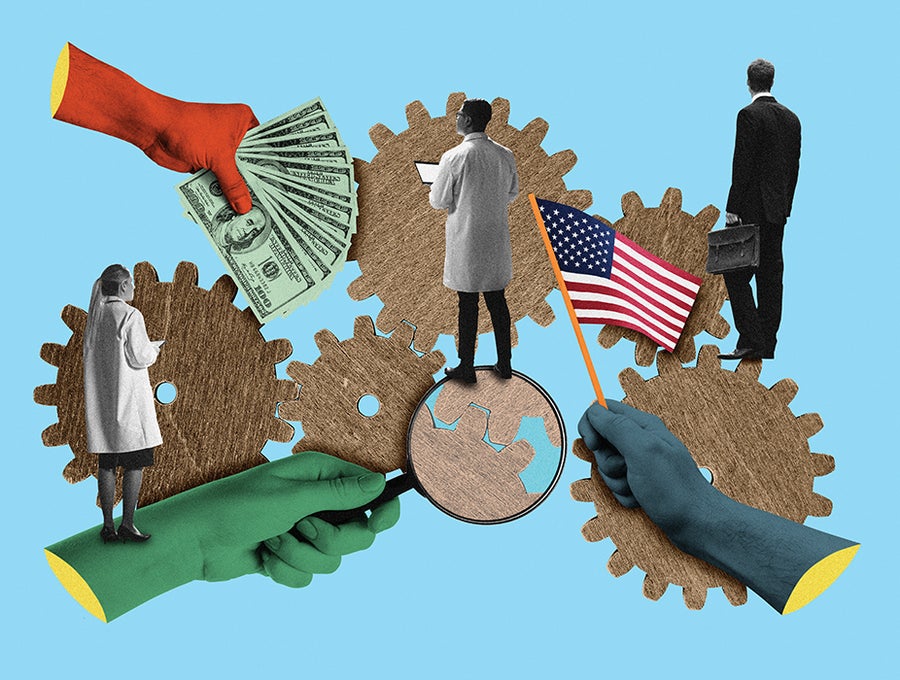
Mari Fouz (illustration); Getty Images (photographs featured in illustration)
Political operatives at the NIH passed around lists of words that grants weren’t allowed to use—in either applications or existing, funded projects. Program managers across the NIH and the NSF were told to ask affected researchers whether they’d care to change the language in their research descriptions or risk losing their funding. Some researchers whose grants Norton managed at the NIDDKD called her to say they wanted to preemptively change the language in their grant applications—before they’d been dinged. Norton complained so much that she was placed on administrative leave, although she has since been reinstated.
Of course, not all lost science had obvious political implications. As Reynolds, the AXIS lead researcher, puts it, “whether there are black holes at a redshift of 10 or not is not a partisan issue.”
These kinds of obstacles are a new experience for most researchers. Getting into a career in science was already hard—students often undertake intellectually taxing and physically grueling academic work lasting years longer than most people spend in school, with limited remuneration. The people who do it tend to be mission-driven: they want to help others, learn something about the universe or invent something new. If they consider the political implications, it’s because they’re intrinsic to the work. “It’s not just that people feel their career is under attack,” says one longtime public health researcher. “They feel they personally are under attack.”
DEI associations aren’t the only topics that get captured by the new political filters. Now, for the first time, grant recipients aren’t allowed to subcontract to collaborators on projects overseas. “That’s obviously a problem when you study nasty diseases such as Lassa fever and Ebola, because they’re not in this country,” says Kristian Andersen, an evolutionary biologist at Scripps Research in La Jolla, Calif. “That’s my whole career. This is why I came to the United States.”
Most years, when Andersen advertises a postdoctoral research opportunity in his laboratory, he gets up to 200 applicants with perhaps a third of them from Europe. This year he had 100 applicants and none from Europe. Typically his lab would apply for two or three so-called center grants every year. This past year there were none in virology, immunology or viral immunology to apply for. So what’s next? Andersen, who’s Danish, says that “for people like myself, I think the best option is probably to leave and do science elsewhere.” And he isn’t the only one thinking of getting out. Of about 1,650 scientists who responded to a poll by the journal Nature, 75 percent said they were considering it.
“The most passionate and creative scientists are very intuitive and very driven by emotion and curiosity,” says Gregory Feist, a psychologist at San José State University who studies scientists. “Until Trump, they’d been able to keep political questions out of mind.” Their work was, if not above politics, at least outside it—essential to everyone, regardless of where they were on the political spectrum.
Now they see things differently. “The big eye-opener for me this past year is how quickly things can change,” a NASA climate scientist says. This shock at the ease with which the government can rewrite the system came up in multiple interviews. “Is your grant going to be frozen? Is it going to be terminated? Is it going to be reinstated? Is it going to be delayed because you’re required to change the wording?” asks Scott Delaney, a former Harvard University epidemiologist who co-created the watchdog group Grant Witness. “The reality is, because of what happened and what’s happening now, the trust between researchers and the federal government is completely broken.”
Without that trust, the entire system could blow apart. “Laboratories are going to close. Trainees are going to go to other countries or pursue nonscience careers,” says Carole LaBonne, a developmental biologist at Northwestern University. “This compact that has existed since World War II, that made the U.S. the successful, prosperous nation that it is, is being dismantled.”
What broke the compact? Several researchers identified the response to the COVID pandemic as a flash point. Public health guidance flailed initially on questions of masking, school closures and frontline drugs. It also produced a good vaccine in under a year, an unheard-of success. Ultimately around a million people died of the disease within the first two years.
The experience damaged trust in science and scientists. It’s still high—the number of people saying they have a lot of trust in science has hovered around 77 percent for years. But it was 10 points higher before COVID, and it now splits hard along lines of political affiliation. “Especially in the U.S. and with social media, all of a sudden everybody was an expert on COVID. So much of it was just bullshit,” Andersen says. “And then at some point bullshit was all that was left.”
That helps to explain how a nonscientist such as Robert F. Kennedy, Jr., known for unorthodox and unproven ideas about health and medicine, became leader of the Department of Health and Human Services with oversight of the NIH. But it doesn’t explain how Elon Musk, an industrialist and the richest human to ever live, got the power to excise so much of the country’s research. It doesn’t explain why the former conservative think tanker Russell Vought could use control of the wonkish Office of Management and Budget to zero out research funding.
“I would like to see more people speaking up, but the fact is, mostly people don’t.” —Kristian Andersen Scripps Research
There’s a strain of antipathy to universities and academic truth-seeking in far-right conservatism, certainly. But other than burn-it-all-down nihilism or anti-intellectualism, why nuke the social contract between government and science? One possibility is that the deal was already dying.
In the first half of the 20th century, businesspeople, policymakers and scientists trying to figure out how airy academic research got turned into useful stuff came up with what’s now called the linear model of innovation, a theoretical (and contested) sequence that went from funding to basic research to applied research to the development of a technology or product. The best-known codification of the model came toward the end of World War II in a report called Science: The Endless Frontier, by Vannevar Bush, an engineer who had headed the wartime Office of Scientific Research and Development. Bush understood that applied science had won the war for the Allies—not only the atomic bomb but also radar, penicillin, food preservation, cryptography, and so on. Nerds saved freedom’s bacon, but Bush and others had had a hell of a time getting that nascent scientific potential onto the battlefield. So Bush proposed putting all of U.S. science on retainer.
Basic research, Bush wrote, was “performed without thought of practical ends” and “creates the fund from which the practical applications of knowledge must be drawn.” So he proposed a vast expansion of the state’s capacity to do science, via funding managed by agencies such as the NSF and the NIH. The government would give tax dollars to scientists so they could cast around in the dark doing basic research. Irregularly, some of that work would lead to new drugs or communications satellites or optimized food crops. Not every dollar of government support for science would result in a blockbuster drug or a billion-dollar technology, but a majority of blockbuster drugs and billion-dollar technologies would derive from government support. So the government promised to fund a lot. And in return, the scientists promised to jump through the government’s hoops and respond to an occasional Bat-Signal. “That’s the handshake between science and the market,” says Benjamin Jones, an economist at Northwestern, who studies innovation.
It sounds like a business- and defense-minded strategy. But as innovation researcher Benoît Godin points out, even though Bush agreed with business interests about the fact that research and the training of scientists led to industrial progress, his rationale was explicitly social. “Without scientific progress the national health would deteriorate; without scientific progress we could not hope for improvement in our standard of living or for an increased number of jobs for our citizens; and without scientific progress we could not have maintained our liberties against tyranny,” Bush wrote.
In fact, by the 1960s military and industrial interests had mostly lost patience with the ivory-tower exploratory side of the equation. The leaders of American capital and finance certainly wanted to goose scientific and technical innovation, but they thought the real problem was where the money went and how much was available. Banks didn’t want to risk loans to iffy tech start-ups with no collateral. But a special kind of investor—a venture investor—would bring high-risk dollars to research in return for partial ownership of the company doing it.
That approach seemed to stall out, too. In 1977 William Casey, future director of the Central Intelligence Agency, wrote a report for the U.S. Small Business Administration arguing that it was because venture capital didn’t have access to enough money. His new model for innovation, says M. R. Sauter, a historian of technology at the University of Maryland, brought to the center not basic research or even applied engineering but, simply, money—and the investors who had it. Casey’s report recommended changing the regulations in the Employee Retirement Income Security Act of 1974 so that institutional capital, like retirement funds, could enter the riskier venture game. In 1979 Congress did just that.
And in 1980 Congress passed the Bayh-Dole Act, moving ownership of the results of government-funded university research from the government to the universities. Now a blockbuster new drug or search algorithm could be a windfall for a university, and university administrations had common cause with venture investors. More basic discoveries started getting turned into dollars. But the alliance shifted the emphasis from state capacity to financial outcomes.
Today the most influential private-sector developers of technology are in Silicon Valley, and their perspective on innovation is that it should move fast, disrupt markets and make money. That perspective is influencing government financing of science more than ever before. “Right now the [Trump] administration is very destructive and is changing its mind all the time. It has this dimmer view of science and also sort of wants to win in technology,” says Jones, the Northwestern economist. “That is fueled somewhat by the disruptive orientation of successful people in Silicon Valley who are having an influence.”
“I think that perspective is flat-out wrong,” Jones adds.
For most of this century pretty much every metric of scientific productivity—new results, new discoveries and new inventions—has appeared to be down. This idea is controversial, and the data are difficult to measure, but that’s academic because this nominal downturn opened the institutions of science to criticism that it was scientists who were failing to honor the bargain. Maybe it’s no surprise that the whole thing has turned into what Arizona State University sociologist Edward Hackett calls “academic capitalism.” Today’s investors and policymakers think all research should be economically relevant and assist in the accumulation of capital. A “knowledge-based economy,” says Lancaster University sociologist Bob Jessop, wants all scientists to be entrepreneurs. Which all sounds familiar.
This view might be why the newly reconstituted President’s Council of Advisors on Science and Technology includes just one scientist, a physicist. The other 12 members are Silicon Valley luminaries such as venture capitalist Marc Andreessen and Jensen Huang, CEO of computer chipmaker Nvidia. And in March, Trump nominated venture capital investor Jim O’Neill as director of the NSF. Companies that work on artificial intelligence, the hot tech of the moment, tout the ability of their products to take over the labor of doing science, from analyzing data to formulating hypotheses. “GPT-5.2 is kind of already intelligent enough to be a soft collaborator in many scientific inquiries,” says Sébastien Bubeck, a computer scientist at OpenAI.
That’s not the world scientists want, but it’s the one they’ve got. The problem is, subjecting science to political taste tests and a more commercial mindset almost certainly means fewer world-changing results. No one can ever know when noodling around with Gila monster saliva will yield anti-obesity GLP-1 drugs. And putting politicos atop the pyramid of grant evaluations, scientists say, will be a disaster. Researchers who manage to get grants to study health outcomes on the condition that they ignore the effects of variables such as socioeconomic status, gender and ethnicity won’t even be able to publish their findings, because peer reviewers, an NSF director says, “are not going to suddenly indulge this fantasy.” They’re going to demand that studies factor in relevant variables.
Last year a team of economists imagined what this new future might look like by creating an alternative past. In 2025 the NIH cut the amount of grant money awarded by more than 40 percent compared with years prior. What if, the team members asked, the NIH research budget had been 40 percent smaller for the past few decades? Grants in the bottom 40 percent of the priority queue, they reasoned, wouldn’t have been funded. The team tracked those grants to their outcomes—research that never happened in this parallel universe—and found that something like half of all drugs simply wouldn’t exist today. The lost therapies include imatinib, the first real treatment for chronic myeloid leukemia, and the lung cancer drug erlotinib.
What are scientists supposed to do about all this? “I would like to see more people speaking up, but the fact is, mostly people don’t,” Andersen says. “They don’t want to be a target of the federal government. Having been in that, and still being in that, [I can say] it’s not very pleasant.”
Like many other scientists, Andersen expresses disappointment in what he sees as a failure of the institutions of science—the national academies, the American Association for the Advancement of Science, universities—to mount a louder opposition. “We have seen none of that, especially from the academies,” he says.
Some scientists try to just keep their heads down and keep working. Others know they can’t. “In public health, we have a proud history of organizing, right? We were campaigners,” says Gregg Gonsalves, an epidemiologist and policy professor at Yale University. By the 21st century that had changed. “We were told it was not important, that what mattered was the number of grants and publications you had. ‘Forget all the social and political things; those are incidental.’ Turns out they were not. They’re core to it.”
Gonsalves, who was involved in the fight to care for people with HIV and AIDS in the 1980s, says that scientists now have another job: “bearing witness and putting evidence on the table. It may not be persuasive to Russell Vought or Marco Rubio, but it is for the dossier, for the truth and reconciliation commission, for the Nuremberg trials that come after,” he says. “Keep the receipts. Write down what you see. Tell them what they did. We’re very good at documenting how X leads to Y.”
That’s the thing about generational shifts. There’s always a next generation after this one.