This is probably the one area that most cities in North Carolina excel at. We don't have great sidewalks or transit, but we have a ton a trees. Less than we used to though. But from my current apartment, I'm closer to seeing 300 trees than 3. The post-hurricane-Hugo effort to buy out houses in flood prone zones and turn them into greenways was probably the single smartest thing Charlotte and the surrounding towns have done (though I'm glad we got our light rail too - too bad for Raleigh). It's a good pattern - protects the natural watershed, gives wildlife a safe place to live, makes flooding less impactful, and creates pleasant away-from-road paths for walking and biking.
-- Picard
Here we go, correlation does not equal causation. Simple as that. Planting 3 trees will not give you a better mental health nor will planting 10 trees. But moving in to an environment where many trees grow in front of your window will probably change a lot more than just putting trees in your view.
Edit: for canada map since the article ignores the country entirely, check https://www.globalforestwatch.org/map/country/CAN/
Having lived in Europe for many years before, this is something that's most striking about Australia. I live in a state with one of the highest population densities and yet it still feels very sparsely populated relatively speaking.
Person walks along main roads in London and complains they see no trees. Meanwhile in other news .... :)
London is one of the most tree-ridden cities on this earth, so I dread to think what "main streets" you were walking along.
30% tree cover looks very different depending on the trees your municipality chooses.
For example, Barcelona covers everything with a variety of Platanus, which is easier to keep than other trees, but it’s quite dirty and produces A LOT of pollen. For me, that I’m allergic to it, it just makes the city unavailable for 2-4 weeks every year.
Having smaller plants, with more variety also feels much better than just sprinkling the right amount of massive trees with equal spacing. I’m pretty convinced part of the “we need more green” feeling people get is actually “I need something in my environment to not look like a grid”.
It took me a few days to understand - there are no trees in central London (the City).
Sure, you have a small/big park here and there, but no random trees on side walks. It's literally a (beautiful) concrete/glass wasteland.
Note: I only walked a few of the main streets, I'm sure I'm exaggerating a bit, but it's quite noticeable compared with other cities after you realize it. And there are random trees in other areas, outside City of London.
I can, however, easily explain the division in Europe: In Italy (for example, in Palermo), the vigorous growth of many species very often leads to significant damage to infrastructure.
Here in Vienna, there’s a directory of trees[1] where you can see, among other things, the species and age.
I've seen suburban development that would easily satisfy the three tree test from any window on any property, but they still come off as desolate wastes. The age of the trees seems to be a non trivial factor.
Now I am curious if there is a dataset for the location of every tree in every city in the world? https://overpass-turbo.eu?
Could have been 200 meters or 500 meters or 4 trees or 2 or flowers.
This is the kind of ideology that is ruining public policies instead of being grounded on concrete and scientific facts and goals.
Vienna cheekily cheats statistics by counting several adjacent forests as "urban green spaces" within city borders. The roads within the city, however, are mostly barren concrete deserts.
First of all, I'm skeptical about the study that proves that people seeing three trees have better mental health. There are so many factors that it's hard to separate one. A solid study would compare families living in the same building, roughly at the same floor, and with similar parameters (family size, income, education, street noise, etc.). Comparisons from different buildings induce too many side factors. I think that collecting this sample would be very hard. I can't access the full-text behind the paywall, so I don't know their methodology, and their abstract is vague, so I fear the paper is meaningless.
Then do people really watch that much through their windows? I'd be surprised that having a glimpse of a few trees at home once a day could change anyone's life.
Even if trees did has a positive impact on mental health, I suppose inciting people to bike or walk (at least partly) to workplaces and stores would dwarf that impact, for mental and physical health.
Lastly, the 30% of tree cover seems arbitrary. For the same percentage, would covering every street with trees have the same impact as keeping trees inside parks? I think the goal to provide places where people go for a walk requires different solutions than the goal to reduce the heat in a concrete jungle.
The thing people want from trees is shading and general cooling of the environment. Small plants provide much less of that and the summers are increasingly hot.
https://jamiecurle.com/posts/trees-3-30-300
Northumberland, UK.
Espoo is much more spread out, and the areas between them are all full of trees and greenery. So I very much agree with you, I've visited Espoo a few times but without a car I wouldn't want to live there.
I agree that the public transport is not particularly great if you don’t live on the metro or train line. It’s usually faster to drive and even with one person cheaper even when paying for gasoline and parking. Public transport is ridiculously overpriced in Finland.
Even Helsinki leaves much to be desired on that front, the coverage is okay but the ticket prices are ridiculous. It’s not feasible to drive in the center though, takes forever to get anywhere.
That's like explaining frost-jacking of a wall in terms of temperature instead of hydrology.
Yes, it's pretty green here.
Now, if we could ban street parking like Japan did [0], and perhaps take some more inspiration from Dutch traffic planning..
[0] Ideally we'd get the Gahmen out of the car parking business completely.
In other climates, like European ones, this becomes much more complex. Germany struggles even to keep its forests alive with long stretches of missing rain, higher temperatures, and new pests. Single trees in cities constantly die. Spain is in large parts a desert etc.
I really hope we find a solution/adapted plants to keep cities from heating up so much.
The inner center and hot south can be more dusty and discouraging, but you can still be surprised by a few, not well known, jewels like Cabañeros, Valsain's pine forest, Alto Tajo, or Grazalema and the last relict Mediterranean -humid- forests in Cadiz. Plenty also of lagoons, marshes and aquatic ecosystems to visit, like Doñana or Daimiel. The biosphere reserve Hayedo de Montejo is located in Don Quixote's land.
For this reason, I'd prefer to have compact cities with a good amount of high-rise buildings and city parks dotted in between. As opposed to large sprawling suburban zones.
That leaves more space for natural areas outside cities where people are few & far between.
Alas, doesn't work very well outside of britain, but it's a good metric :)
[0] https://www.london.gov.uk/programmes-and-strategies/environm...
Does every city in America have the rules you mention, or specific ones?
Mind you, wars and sheep did have a pretty devastating effect on the Caledonian woodland cover of the highlands. The current population of the red deer aren't helping with natural regeneration. This is one of the reasons for the case for re-introducing predator species.
But that's a complex topic with no simple answers and easy divisions.
It's a competition about which municipality can remove most pavement tiles & replace with greenery.
People do this on their own too - guerilla gardening style. It's not uncommon to ride through a city street, and see a strip of pavement tiles removed & some flowers in there. Or some plants dangling from a pot attached to a street light. As long as postal workers & elderly people with strollers can still pass, most municipalities support this.
If you're in the very new, constantly rebuilt, concrete jungle that is the very small part of the city, then OK, greenery is going to be hard to spot. Particularly as they tend to nearly always choose the wrong species to plant and aftercare is an afterthought. But your assessment is factually incorrect.
See for yourself. Go to Google maps, drop a good few street view randomly around the city and you'll see that more often than not you'll see trees.
Also, I have a networks in arboriculture who work in the city and they're never short on work.
I'm not doubting your experience of unease or a concrete/glass wasteland (that's yours and not mine to question) but the facts don't support the statement of no random trees on pavements (side walks).
I live in the North, but I'm often in London.
Elsewhere though, possible to plan continuous walks through greenish spaces. One starting at Victoria: Belgravia back streets, Hyde Park, Grosvenor Square, Marylebone High Street, Regents Park, Primrose Hill, Belsize Park, Hampstead Heath.
The City is a specific area, more or less covering the same area as the original Roman city. It's the original financial district - though a lot of that moved to Docklands at the tail end of the 1900s.
It's much more built up than even adjacent Westminster ("The City of Westminster") and definitely has far fewer trees.
Here's a map of the canopy data.
Same shock, different direction, much nicer.
Ailanthus[0] is invasive as heck and Paulownia[1] grows everywhere too.
Eh, have a look at other tropical cities like Johor Bahru or Jakarta or Kuala Lumpur and you can see that it's very much possible to have way less greenery than Singapore.
The recent trouble with the Borkenkäfer was just a consequence of monoculture. Germany doesn't struggle with keeping forests alive: it's normal at any one time for individual trees in forests to die. Decaying dead wood is important for the ecosystems.
Big cities in Europe are usually surrounded by more rural areas in most of Europe for historical reasons (surrounding farmlands used to feed the city), lessening the need for city parks and greenery since the countryside was surrounding the city. If the city IS the country and even isolated on an island, that's of course not an option.
Another factor is also rooted in history. Like most cities in Europe, Singapore is old, though most of its growth happened in the past 60 years with proper urban planning. Europe's cities on the other hand grew over centuries without any kind of modern urban planning and the pressure of rebuilding quickly after the many devastating wars didn't help either.
Finally there's the issue of money - being one of the richest countries/cities on Earth helps tremendously with building a nice, liveable urban environment compared to some cities struggling to keep basic infrastructure running.
My biggest bugbear in London is the number of developments that have a "token tree" with one lonely tree in one corner, often doing quite poorly, presumably included to check some item on a planning consent checklist.
Of course, London has many green spaces and on the whole has plenty of trees, it's just they're quite unevenly distributed.
It gets greener as you go further out.
One of the big problems in the UK has been the rise of low maintenance gardens, replacing plants with decking concrete, gravel etc.
The City is indeed pretty non green
79% of all German trees are sick. Monocultures and beetles play a role but the problem is much bigger than that: https://www.bmleh.de/DE/themen/wald/wald-in-deutschland/wald...
Even worse. It was monoculture of trees that aren't even native to the climate zone. The trees were imported from Scandinavia for their superior lumber quality, and were on edge even without the added stress from droughts and heat waves.
As you have pointed out the solution is to eat more venison, but most local butchers stock hardly any of it because of low demand.
I'm nearly always on foot. Perhaps it's just because I'm also an arborist and I'm hard wired to see trees and avoid places that don't have them?
The token tree thing is a problem. Daisy Barrington was part of webinar on the topic as part of the Arboricultural Associations webinar series [0]. Rarely do the species planted get based on local ecology and or have a solid aftercare plan. They're normally chosen for immediate aesthetic look (Paper / Himalayan birch being the most common) rather than how they'd exist over time.
In short birch being a pioneer species is short lived (80 years), grows fast towards light and dislikes being pruned. Where as oaks, norway maple, London planes ( some of which are "climax species") etc live for longer, grow slower and respond to pruning better, support local ecology better and some don't mind the pollution of an urban environment so much.
I would say they are pretty well distributed through places where people actually tend to live. I live in a pretty average residential area in zone 3 and not only are there nice parks nearby but there are plenty of trees. London is of course massive so I can't say it's the same everywhere but most residential areas I've visited have been quite green. The City and West End (very much commercial/touristy areas) are the exception in my experience.
My guess would be that the bio-diversity net gain calculations put the ecological investment off-site where it was more practical.
It's a shame though as trees and architecture can happily co-exist with each other. Living walls and well kept green areas are entirely possible.
Clicking once into Canon street towards those trees presents me with the trees. They're now in leaf and look like Sorbus intermedia "swedish whitebeam" and the key id is the margin on the leaf and the green fruits. Photo was taken July/August as prior to that they're in the flowering phase (beautiful to see btw).
When I spin the view down Canon street I see three mature trees in full leaf on pavements / sidewalks.
As I said in another reply, I'm an arborist and I'm hardwired to see trees and perhaps I subconsciously avoid areas that have none, so maybe that's bias on my part.
Personally I have always felt that most Japanese cities are very devoid of urban greenery compared to UK towns and cities.
British eating habits have become really narrow over the years. Its hard to find offal (healthier and greener than just eating muscle meat). Rabbit seems to have pretty much disappeared too.
It makes me wonder whether they know which bit is actually the City.
later on:
> Sure, you have a small/big park here and there
What big park is there within the City? The whole of the City is smaller than Hyde Park (including Kensington Gardens).
Me again! I'm so happy you're all here. Thanks for letting me nerd out in your inbox week after week.
💙 Amanda
Look out your window. Can you see three trees?
That's the first question of the 3-30-300 test — a standard that has become the go-to for solving a universal urban problem: Does this city have enough trees, and are they in the right place?
The 3-30-300 test is simple. Every home, school and office should have a view of at least three trees, be in a neighbourhood with 30% tree cover, and be within 300 metres of a park.
Proposed just a few years ago by Cecil Konijnendijk, the rule has spread quickly. The Italian city of Florence committed to planting 50,000 trees by 2030 under the framework. Fort Collins, Colorado made it a formal planning target. Cities from Haarlem, Netherlands to Saanich, British Columbia have followed suit.
Its popularity makes sense: 3-30-300 is a catchy, straightforward test that sets a clear benchmark for measuring equal access to nature.
But is it achievable?
Having greenery in sight, not just nearby, is good for your head. People who can see at least three trees from their window have better mental health than those who can't.
It seems like the easiest of the three goals to achieve, but a study assessing the 3-30-300 rule in 862 European cities found that only about half the population has a three-tree view.
Population, by city, that achieves the three-trees rule.
When it comes to seeing green, Europe is roughly split down the middle. In half its cities, most residents have three trees in view; in the other half, the majority don't. Cities with the poorest tree visibility tend to be in southern Europe. Valencia, in Spain, has one of the worst records: Only one in ten residents can see three trees.
How do I compare?
I can only see two trees from where I'm working today. That's one tree too few.
How do you compare?
This one's easy to assess. Just look out the window!
Viewed from above, one third of your neighbourhood should be covered by trees. As our planet warms, the consequences of not meeting that standard are measurable: Hitting the 30% goal across all European cities could prevent 2,644 heat deaths each summer, found a Lancet study. And that's the bare minimum. Researchers in Madison, Wisconsin concluded that meaningful cooling really only kicks in at 40% tree cover.
Unfortunately, that study of 862 European cities found the tree-cover standard is rarely met.
Population, by city, that achieves the 30% rule.
In seventeen cities, at least three quarters of residents live in an area that meets the 30% tree cover requirement. However, these are all relatively small places, with populations of just a few hundred thousand. Interestingly, ten of these cities are tightly clustered together in Western Germany, near the Dutch border.
How do I compare?
Apparently the tree cover in my area is only 17%, which I worked out using Tree Equity Score. That's disappointing.
How do you compare?
US and UK readers: You can use Tree Equity Score to find canopy cover percentages for your neighbourhood. Everyone else: Consider getting a rough estimate by using Google Maps to look at your neighbourhood from a bird's-eye view.
Of the three criteria, this is the most-often met. Regular use of parks and green spaces is associated with lower rates of obesity, improved cardiovascular health, reduced stress and better mental health. But these spaces need to be close enough; park use drops sharply when it's beyond a 300-metre walking distance (roughly a five minute stroll, or the length of about three American football fields).
Again, northern countries fare better. Nearly all cities with the best park access are in northern Europe.
Population, by city, that achieves the 300m rule.
How do I compare?
I was absolutely convinced I would pass this last rule! But using Google Maps, I found that my closest park isn't 300 metres away, it's 400 metres. That's close, but a fail.
How do you compare?
Open Google Maps, drop a pin on your home and draw a 300m radius. Do you see a park? Or use the navigation feature to get walking directions to your nearest green space. It should note the distance.
The 3-30-300 rule is simple, but that doesn't mean it's easy to achieve. In fact, only 14% of Europeans live in an area that meets all three criteria. And 21% live somewhere that doesn't meet a single one.
Portion of European population living in areas that meet 1,2,3 or none of the requirements.
There are only two European cities where more than half of residents satisfy the rule: Espoo in Finland and Varese in Italy. There are also only about 20 cities where this percentage is above 40%, most of which are located in Scandinavia, Germany and Poland. These low percentages are primarily due to the lack of places meeting the 30% tree cover requirement.
The global picture is equally sobering. Testing the rule across eight major cities, different researchers found that only Singapore met the standard.
Percentage of buildings in each city that passes each part of the 3-30-300 test.
It doesn't seem like too much to ask: Trees in your eyeline, shade over your street, a park down the road. And not just in the best parts of town. (As I wrote back in March: Shade, like so much else, is often a privilege of the wealthy.) These are meant to be minimum standards, not aspirations. But the findings of these two studies show that cities across the world aren't meeting them.
And the 3-30-300 rule isn't just for making nice places to live; it has measurable health consequences. People living in areas that achieve the rule have better mental health and use fewer medications. And as summer heat grows more dangerous, adequate tree cover is increasingly vital.
If you tested the 3-30-300 rule yourself, how did it turn out? I live in a beautiful, leafy city with lots of parks. So, I was confident about passing at least two of the three measures. But I was wrong! The data show I'm certainly not alone. And it's likely you were surprised by your results, too.
So how can the 3-30-300 rule actually be implemented? I like what the researchers behind the eight-city study concluded. A simple but powerful call to action:
Tear up the asphalt; plant trees.
I absolutely did not employ the pun 'tree-o' in reference to the three tree-based metrics in this piece. Not once. Not. Even. Once.
The 3-30-300 rule exists to make nature accessible to all, regardless of income or neighbourhood. Not-Ship runs on a similar principle: 10% of readers pay so the other 90% don't have to. Data, like trees, should be available to everyone. If you agree, it's only $9/month ($90/year).
Here's what I found interesting, important or delightful this week:
The handmade web. The Tiny Awards celebrate the Internet's small things. I particularly like the 2024 winner, One Minute Park, which lets you spend time in a public green space somewhere in the world. After 60 seconds, it shifts to a new one.
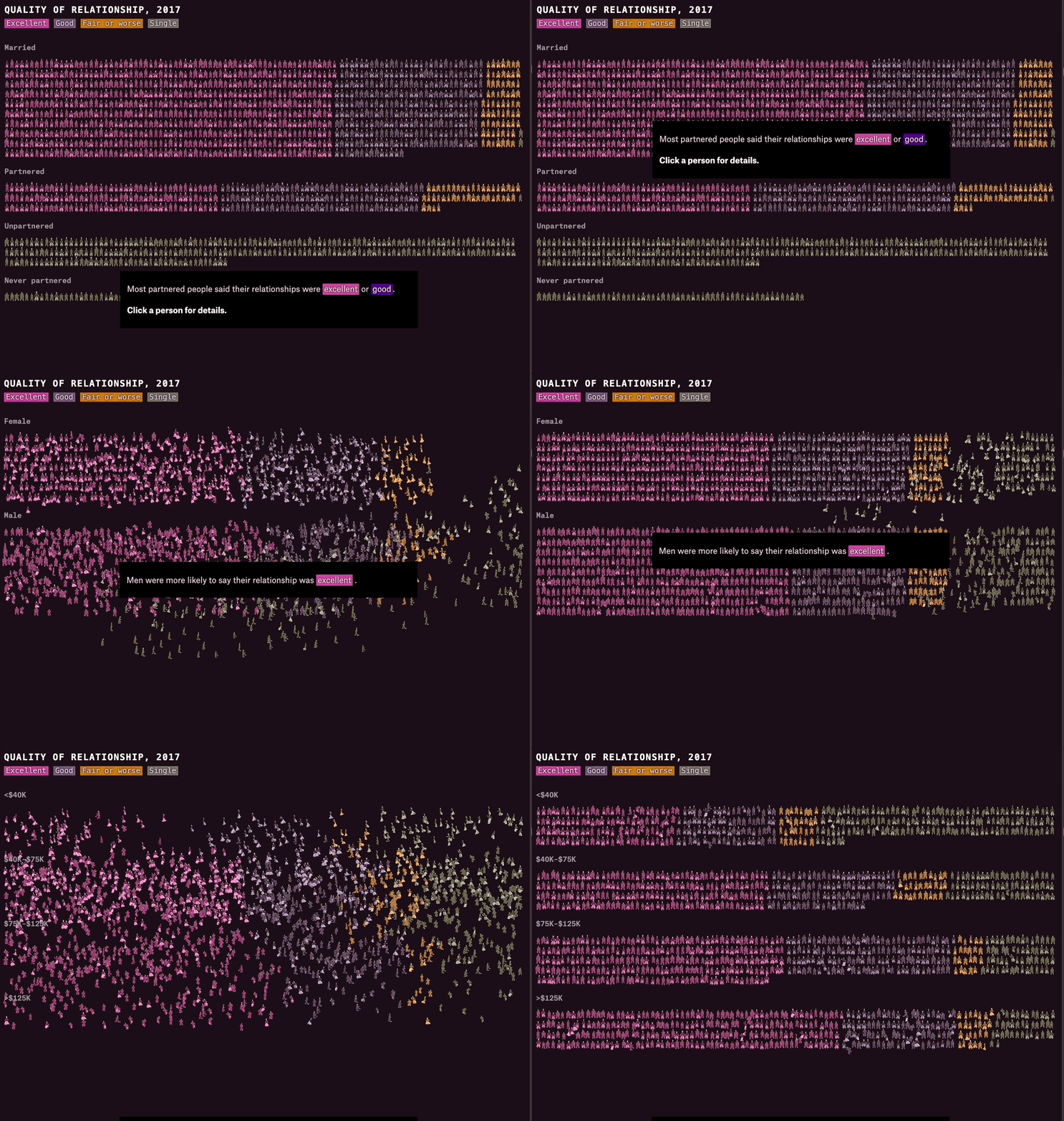
What's normal? For the Pudding, Alvin Chang tracks 1,000 people through the ups and downs of their relationships. I love how the charts come alive with the small people icons.