- The "Libation Formula", which the author used as the base for his translations, is the most studied piece of writing in Linear A, because it's the only recurring phrase (with grammatical variation) that we have. The corpus is extremely fragmentary, with just a handful of instances of longer text (and even then, the texts are the length of an average sentence in English). The majority of documents available to us are lists (of inventory, personnel, offerings or something of this sort). The longer texts make use of punctuation marks, likely put in between words. This gives us a non-trivial vocabulary, which still does not match that of any known language.
- With such fragmentary remaining material, we cannot be sure that a) all the texts we call "Linear A" are written in the same language, and b) the recognizable words are not abbreviations, for example.
- The author made an assumption that Linear A symbols which have counterparts in Linear B should have the same phonetic values. This gives us an already known glyph that represented "NA". "Duplicate" glyphs are only found in the P-series, and are assumed to represent syllables which were distinguished by the Linear A language, but not by Greek - such as aspirated/unaspirated P. There is a glyph that stands for "NWA" in Linear B, but instances of it have been found in Linear A as well.
- There are countless words with no known etymology in Ancient Greek, assumed to originate from a substrate language or languages spoken in the area at the time Greeks migrated to their present-day homeland. The language of Linear A would be a likely candidate for such substrate. If Linear A were a Semitic language, then we should already be able to establish Semitic etymologies for those words as they were in Greek. Of course it could also be the case that these words came from an another language which did not adopt writing or its writing did not survive to our times.
That's exactly the kind of thing I'd hope Claude would be used for in these kinds of projects - building tools, not black-box "solving" the problem.
To be clear, this is an attempt at a decipherment. This is not proven, and we shouldn't consider Linear A to be "solved" until experts in the field have reviewed the work. In fact, it probably shouldn't be considered "proof" unless some more Linear A writings are uncovered and these are congruent with the method proposed. All that can be said for certain at this point is that this is an interesting conjecture.
But this is a story worth following. This could be the real deal. More research and validation should follow and we should have a better idea in the next few weeks or months whether Linear A has really been solved. At the very least, this is an interesting attempt, and optimistically, it could yield real insight into Minoan culture. Kudos.
Honestly curious how many years before it can be one shotted in a coding harness with Fable.next by someone who’s not a linguistics expert.
Develop, test, and rank hypotheses about the phonetic values, morphology, grammar, and possible language family of Linear A using the full available corpus. Do not assume any decipherment is correct. Treat all candidate readings as hypotheses to be scored…”
however, nawaya or what ever examples around it are not part of the Hebrew language.
It's a common misconception that is what happened with Ancient Egyptian with the Rosetta Stone. The Rosetta Stone was just one of the big pieces of the puzzle. The decoding came when people realized that Coptic (a language written alphabetically and still in use in the Coptic Church today) is actually descended from Ancient Egyptian; as Spanish is to Latin, Coptic is to Ancient Egyptian.
Similarly the attempts to decode classical Maya were all dead ends. Until Yuri Knorozov realized that it encoded the ancestor of the Maya languages which are still spoken to this day. (Knorozov's Wikipedia article is worth checking out just for his photo with his cat. [0] IMHO.)
I have written before about the La Mojarra 1 stele in Mexico [1]. It looks a lot like Maya. [2] But it isn't Maya. Maybe the difference like between Russian and Latin writing?
No one can read it. It's undecipherable. There are some attempts to identify it with a proposed ancient language that would have been related to the modern Mixe-Zoque languages: some of the glyphs that are shared with Maya, when read phonetically, start sounding like a Mixe-Zoque language. But no one has proposed a confident decipherment. There probably isn't enough text. La Mojarra 1 is the only long example of the Isthmian script.
Deciphering Akkadian was very difficult, at first. The process started with Persian; old Persian was written in a simplified adapted form of the Mesopotamian cuneiform (wedges on clay). It was a kind of alphabet. And Old Persian was already understood. And there was a bilingual text on a monument carved by Darius I. But even then -- decoding relies so heavily on the fact that Akkadian is a Semitic language distantly related to Hebrew, more distantly, also Ancient Egyptian. So again, we sort of knew what we were looking for.
That is all to say: even if the Voynich manuscript (for example) contains real text in an otherwise completely lost language, I'm not sure it is possible even theoretically to translate it.
[0] https://en.wikipedia.org/wiki/Yuri_Knorozov
[1] https://en.wikipedia.org/wiki/La_Mojarra_Stela_1
[2] https://commons.wikimedia.org/wiki/File:La_Mojarra_Stela_1_S...
Claiming that claude did all the work is patently ridiculous. Claude is a tool, like any other. The corpus of linear A is ~7500 characters across ~1500 inscriptions and claude, no matter how smart, doesn't just solve that on its own.
What a shame.
I've also reached out to Dr. Ester Salgarella, so I'm familiar with attempts to apply computational analysis to the corpus, and where previous efforts erred.
>> reviewed by linguistics experts at Rutgers and Cambridge.
Here in Argentina, near 2005, we had like 5 guys that claimed to have 5 independent solutions of the Goldbach Conjeture. Each one got a PhD student that volunteer to read it, discussed the obvious problems with the author, tried to help to solve them and after a few months of back and forth they concluded that none of the solutions were correct or has an interesting insight. Nobody was surprised about the that, but some wanted to give them a try.
Until there is a official report by Rutgers or Cambridge, it doesn't mean too much.
>> He's translated over 300 words
Where is the table of translations?
Some of the lists end with "ku-ro" and a number that's the sum of all the previous numbers, oddly frequently off by one.
* Ventris' publication, but given Kober's contribution to the work they should really share equal credit. I like to think Kober would have got there on her own if she had access to the larger corpus that Ventris had (the Pylos tablets) and a comparable amount of free time and money available.
What does this mean? Like he e-mailed it to some people at Rutgers and Cambridge? Or it's under some kind of non-anonymous peer review?
Indus valley script is about 1500 years earlier than Linear A and I hope we can also decipher Indus script using AI or not [1]. It's well overdue although from statistical profiling it's has been proven to be a valid linguistic script believed to be being used for writing system the ancient Harappan language, the likely precursor of modern Dravidian languages for examples Telegus and Tamil.
The main reason it's very difficult to decipher is that there's no equivalent Rosetta Stone for Indus script. My hypothesis is that the AI LLM model can be trained or tuned as the logical or virtual version of the venerable Rosetta stone hence can be used to decipher ancient writing system.
[1] Indus script:
"Thag is a smarty-pants"
Caveat: I'm Greek so a kind of natural amateur historian. That is to say I grew up reading about the prehistory and ancient history of Greece, as one does when one is born Greek and a geek. I've seen the Phaistos disk and linear A inscriptions with mine own eyes in Greek museums and I have dreamed of the day they would be translated. I am not at all unsympathetic to the hopes of a Linear A decipherement.
However. The claimed decipherment has all the hallmarks of imaginative and fanciful attempts to draw parallels between historical events and entities, that were not really connected, many of them notably inspired by the Hebrew bible. For example, remember when the lost tribes of Israel turned out in the New World [1]? Or how Biblical Sodom was actually destroyed by a comet [2]? Or the time that Venus was ejected from Jupiter and caused the Biblical Cataclysm [3]? Or, for less biblical but no less foundational texts of the Western literary canon, remember when Heinrich Schliemann discovered the Jewels of Helen of Troy [4] and the Death Mask of King Agamemnon [5]?
Or of course we could recall any of the claims to decipher the Phaistos Disk [6] or the Dropa Disks from Bayan Kara-Ula [7], and so on I'm sure.
All of the above is not to say that a decipherement is impossible. What it is to say is that it currently isn't possible; because we have no idea what the language that Linear A transcribes even is. It's not like the Minoan language is still spoken today in some far-evolved form, as was the case for e.g. Egyptian or Mayan or indeed ancient Greek [8]. So we have an unknown script, writing an unknown language, and to make matters worse there are no parallel texts with another ancient language that might help us bridge the gap. What there is, is some rudimentary understanding of the more obvious contents of Linear A texts (mostly, lists of goods) and the fact that some Linear A symbols have been reused in Linear B.
But, how were they reused? And what good is that knowledge without knowing anything about the language transcribed by Linear A? I can read German, a language that I don't speak, because I can read Latin script, but the meaning of the script might as well be Greek to me [9].
I'm a computer scientists, I guess, these days [10]. The problem of deciphering Linear A, or the Phaistos Disk, or any other script (that may not even be a script) that transliterates a language that we don't know is a problem of reconstructing information that we don't have, from other information that we don't have. I'm not saying it's completely impossible. I mean, who knows? Maybe we're just missing the right maths. But, what we're really trying to do here is de-noise a message garbled by the passage of time without even a guess as to the language the message is written in. Claude Shannon would tell you that it's a fantasy that is not worth pursuing. You don't have to ask him, you can just read his magnum opus [11] and check out Section 3 titled "The Series of Approximations to English" for an idea of what the mechanics of deciphering a script when the language is known look like with the only technology we have that can do the job reliably.
When Turing and the other Brits at Bletchley Park cracked the Enigma code, they at least knew it was, ultimately, a coded form of German. We may have a lot more compute now, and much more advanced tech overall, but there are some barriers that you cannot physically cross, no matter what resources you have. For example, you can't go faster than light and you can't escape the event horizon of a black hole. In the same way you can't translate text written in an unknown script, encoding an unknown language, without any parallel texts with a known language. There is just not enough information to do the job. Worse, if you try, you can endlessly come up with plausible "translations" and convince yourself that you have the right one, but you have no way to know you do.
I'm sorry but this claim is just a wild guess trying to link Hebrew to Linear A, without any serious evidence that the two are linked and without any evidence that the link is real, other than "look, I can guess what all the texts say!".
_________________
[1] https://en.wikipedia.org/wiki/Jewish_Indian_theory
[2] https://www.smithsonianmag.com/smart-news/destruction-of-cit...
[3] https://en.wikipedia.org/wiki/Worlds_in_Collision
[4] https://en.wikipedia.org/wiki/Priam%27s_Treasure#/media/File...
[5] https://en.wikipedia.org/wiki/Mask_of_Agamemnon
[6] https://en.wikipedia.org/wiki/Phaistos_Disc_decipherment_cla...
[7] https://en.wikipedia.org/wiki/Dropa_stones
[8] I can read ancient Greek. The further back in time it goes, the harder it gets to understand what it means but I can still read the script. It has changed in 5000 years but not enough that I can't read it. Nothing like that ability survived for Linear A. I blame Thera.
[9] Except of course then I would understand it. But it's just German to me.
[10] I can assure you that took me by surprised, first of all.
[11] https://people.math.harvard.edu/~ctm/home/text/others/shanno...
The other thing I find odd, however, is that it's found to be a Semitic language. If it's a Semitic language, I would have expected it to already have been deciphered. And certainly linguists would have already looked at Semitic languages, and looked hard.
Also if it were a Semitic language, why wasn't it consonantal but had vowels? Usually Semitic languages (and Egyptian maybe) write only the consonants because their stems are made three consonants and vowels are interweaved to make words.
Example semitic root K-T-B and how vowels are added in-between to form words:
kataba – He wrote yaktubu – He writes / is writing kitāb – A book kutub – Books kātib – A writer / scribe / clerk maktūb – Written / fate maktab – An office / desk maktabah – A library / bookstore
And another such root - D-R-S which means "studying" or "learning."
darasa – He studied yadrusu – He studies / is studying dirāsah – A study / school course dāris – A student / learner madrūs – Studied / carefully planned madrasah – A school
This system of triliteral roots is the reason why usually Semitic languages don't use vowels. Why would Linear A have consonant+vowel syllabary if it were semitic?
𐇑 𐇘 𐇪 𐇐 | 𐇬 𐇳 𐇖 𐇗𐇽 | 𐇬 𐇗 𐇜 | 𐇬 𐇼 𐇖𐇽 | 𐇥 𐇬 𐇳 𐇖 𐇗𐇽 | 𐇪 𐇱 𐇦 𐇨 | 𐇖 𐇡 𐇲 | 𐇖 𐇼 𐇖𐇽 | 𐇖 𐇡 𐇲 | 𐇥 𐇬 𐇳 𐇖 𐇗𐇽 i-𐇘-wi-jeʳ | ʰau-ni-ti-noʳ au-no-pa au-ndi-tiʳ 𐇥-au-ni-ti-noʳ wa-pi-naᵐwa ti-ru-te ti-nd-tri ti-na-ru-he ʰau-ni-ti-noʳ i-301-wa-ja/e | ʰau-... jaᵘ-di-ki-to i-pi-na-ma si-ru-te ta-na-ra te-ti-u ta-na-te i-da 𐘚 ᴴI 𐘮 WA 𐘱 JA 𐘱 JA 𐘆 DI 𐘸 KI 𐘹 TU 𐘚 ᴴI 𐘢 PI 𐘅 NA 𐙁 MA ()
I believe the phonetic values for Phaistos here were based on similarity.
Could you rephrase this or explain it more thoroughly? I don’t follow. What does it mean to categorize a written form by systems built with Claude?
The original prompts aren't provided, nor is the original context; even then, you can't really treat a stochastic system like an LLM as a major component in reproducibility.
Speaking of Greek, Linear B and Semitic, the related Cypriot syllabary was deciphered thanks to a bilingual inscription in Phoenician and Greek: https://en.wikipedia.org/wiki/Idalion_bilingual And just as in Crete, there is an undeciphered pre-Greek language written in the same script: https://en.wikipedia.org/wiki/Eteocypriot_language
I don't know why you want to stoop to name calling which violates the guidelines and the spirit of this site.
"without any critical review" is also seemingly untrue: the post says Rutgers and Cambridge are reviewing it
https://www.biblexika.com/bible-lexicon/navah-h5115
https://hebrew-academy.org.il/%D7%93%D7%A3-%D7%9E%D7%99%D7%9...
Tom Di Mino, a self-taught AI engineer and an amateur linguist, claims to have accomplished a feat that has eluded linguistics experts for over a century: deciphering a Bronze-age Minoan writing system known as Linear A.
His claims are currently being reviewed by linguistics experts at Rutgers and Cambridge. While I’m caveating, I will also mention that I know Tom socially.
Di Mino, who is based in the Hudson Valley, has studied classical history, linguistics, and languages since he was 18. He has varying degrees of proficiency in 8 languages, including Attic Greek, classical Latin, Sanskrit, Arabic, and Ugaritic. He has been reading up on Linear A for 7 years, and has visited Crete twice. He began to work on deciphering Linear A in January this year, and says the major insight came to him on May 22.
If Tom Di Mino has deciphered Linear A, it would be an earthquake in the field of linguistics. When a related Minoan script, Linear B, was deciphered in 1952, it made the front page of the New York Times.
Di Mino believes that Linear A belongs to an extinct Semitic language that was a precursor to Biblical Hebrew, Arabic, and Aramaic, the way that Latin is a precursor to Italian.
Di Mino is not the first to argue that Linear A was Semitic. Prior attempts to prove it, however, including a 1957 article published by Cyrus Gordon in the journal Antiquity, did not unlock translations the way that Di Mino’s solution appears to, and Gordon’s work did not gain widespread acceptance in the field.
Linear A is a Minoan script that appeared sometime around 1800 BC and was used until 1450 BC, when Crete was conquered by Mycenaean Greeks. The Mycenaeans adopted the Minoan symbols as their own, with some minor revisions. The Mycenaean-Greek version of the symbols are known as Linear B. Both scripts were found on various tablets, vases, and other artifacts from the era.
Both scripts use syllables, not letters, as their core elements. The syllables are generally consonant-vowel pairs.
The two systems have 60 core syllables in common, and they both also use logograms – symbols that represent a whole word (“cow”), not just a syllable.
Linear B was deciphered and identified as Greek in 1952 by Michael Ventris, a British architect, cryptographer, and amateur linguist, like Di Mino. Ventris’s breakthrough may not have happened without prior work on Linear B by Alice Kober, a professor at Brooklyn College.
Kober and Ventris used grammatical and statistical analyses to look for patterns in the location of the symbols (e.g. the first syllable was more likely to be a vowel) and how the symbols shifted.
There are many more inscriptions associated with Linear B than Linear A, however, which made it easier to decipher. Also, many Linear A inscriptions are inventories cataloging the trade of different commodities, so they don’t tell us much about the language.
Because Linear A and Linear B have 60 symbols in common, and because Linear B has been deciphered, experts could guess what the overlapping Linear A symbols sounded like but didn’t know what the sounds meant. And there were 13 additional symbols in Linear A that did not appear in Linear B. For those, no sound values have been accepted.
On May 22, Di Mino was analyzing a series of Linear A prayer inscriptions that adhered to a formula. (Don’t worry, you don’t have to understand the formula, but I’m including it for the nerds.)
IOZa2 (Iouktas): A-TA-I-*301-WA-JA · JA-DI-KI-TU · JA-SA-SA-RA-ME · U-NA-KA-NA-SI · I-PI-NA-MA · SI-RU-TE · TA-NA-RA-TE-U-TI-NU · I
(Also see Figure 1 below.)
In the formula all of the words in each line of the inscription were known (based on their overlap with Linear B syllables) except for the first word.
The first word was the same verb root, appearing in different regional forms across five sanctuary sites on the island.
The verb contained 5 known Linear B signs and “*301”, which appeared to be a Linear A-only sign, “na,” which Di Mino used to unlock the root “nawaya,” which means “to dwell.” In Hebrew, Akkadian and other Semitic languages there is a 3 syllable consonant system. N-W-Y is used for verbs and nouns meaning “to dwell or inhabit”.
Once deciphered, Di Mino saw that the prayer was similar to subsequent Hebrew prayers but was addressed to a Goddess.
While Cyrus Gordon had previously proposed links between dedication tablets in Linear A and similar tablets in Akkadian and Phoenician that he had translated, Di Mino claims to be the first person to identify the links between the Linear A inscriptions and Hebrew prayers.
This insight not only unlocked the verb in the prayer inscriptions, but it may also shed a broader light on the use of logograms in Linear A.
Di Mino claims that his insights into logograms in Linear A additionally help to resolve problems with some translations of Linear B, which validates his findings.
Di Mino used Claude Code to build a suite of Python scripts that query, cross-reference, and organize the digitized Linear A corpus (drawn from the GORILA and SigLA databases), enabling systematic hypothesis testing at a scale that would have been impractical to do manually.
Di Mino’s research has led to:
Proposed readings for 40 of the script’s signs, including 13 signs whose phonetic values were previously unknown. He also resolved the sound values for 5 Linear B signs which were unknown to this day.
A lexicon of 408 Linear A terms translated into English
A 9-page draft of a manuscript titled Ya Diktu: Grammar of the Minoan Peak Sanctuary Libation Formula, which may form the foundation for a submission to a peer-reviewed scientific journal
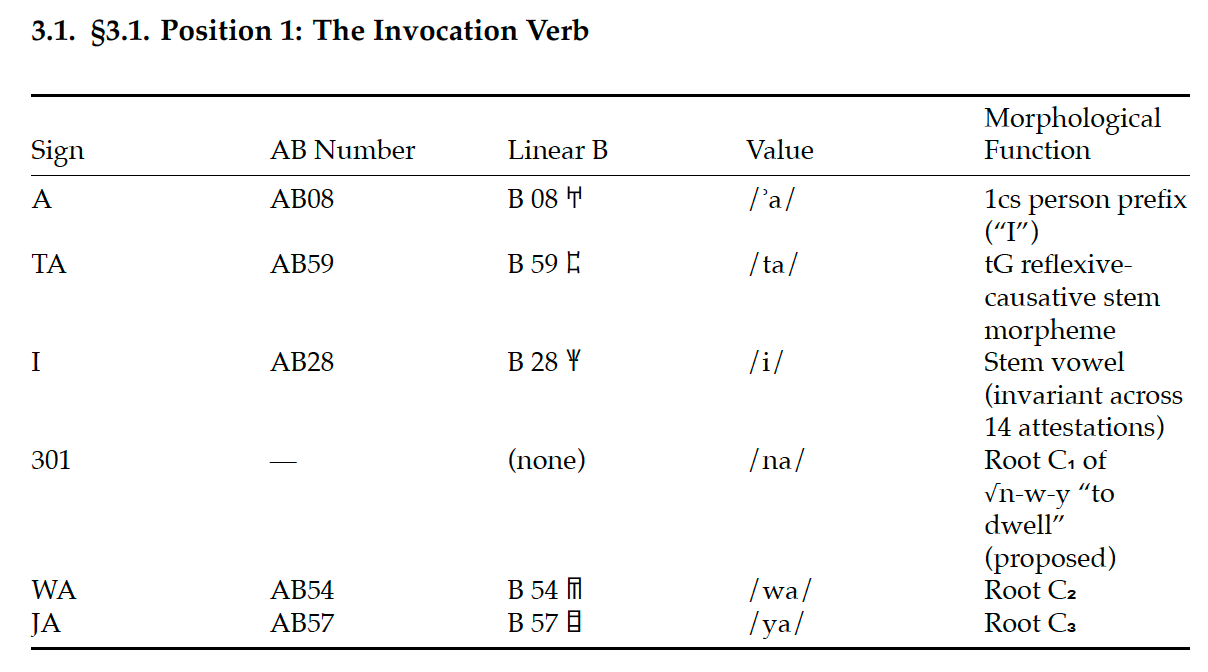
Figure 1. A summary of the symbols in line 1 of the Minoan prayer inscription. Credit: Tom Di Mino, Ya Diktu: Grammar of the Minoan Peak Sanctuary, June 2026.
(This article has been edited for accuracy since it was originally posted.)
https://gist.github.com/fragmede/bbf277d36a2398065f109484f34...
I have no idea why Minoans would speak Hebrew, there's no indication as far as I'm aware of extensive cultural exchange between the Minoan civ and Hebrew-speaking people, but there's a very clear hierarchy of difficulty to translate dead scripts. From easier to harder:
a) We know what language the script transcribes and how the script transcribes it (e.g. what symbol means what word or sound).
b1) We don't what language the script transcribes but we know how the script transcribes it (e.g. it's a syllabary or an abjad etc).
b2) We know what language the script transcribes but we don't know how the script transcribes it (e.g. Egyptian hieroglyphics).
c) We don't know what language the script transcribes nor do we know how it transcribes it.
b1) and b2) are more or less of similar difficulty.
Linear A goes to category c) above. We know next to nothing about the script or the language, other than the fact the former was reused in linear B to transcribe Mycenean Greek.
If you had the other things, being "stochastic" is not even remotely a show-stopper. Stochastic processes abound and are the reason the mathematics of statistics was developed in the first place, ultimately allowing us to create such things as LLMs.
When all the relevant steps gets published, I absolutely expect a lot of people to (attempt to) reproduce this work even though LLMs are stochastic.
Every day when you lower your butt onto your chair, you trust a stochastic system enough to assume you'll rest on the chair safely and not spontaneously phase through, which would lead to rather gory and painful terminal experience.
Physics at macro scale is stochastic, which is a good reminder that stochastic != uniformly random. Expected distributions matter.
When she was leaving, the woman said "pose, pose". My French teacher was puzzled, and asked why she'd said that, and the woman asked if it didn't mean "au revoir" in Norwegian?
Because it was what the cashier at the grocery store said to her every time.
It means (carrier) bag.
With regard to the origin of the script, Linear A documents have been dated to earlier times than Linear B. And then, there is also an even earlier hieroglyphic script, but its relation to Linear A has not been established.
I'd like to offer some evidence that the people of Crete were of Greek origin and therefore Indo-European rather than semitic, unfortunately all the scholarship I can find on the subject is from Greek scholars and since it confirms that the Minoans are genetically related to modern Greeks, the more I hear of that evidence the less I am convinced by it. Because it's exactly consistent with confirmation bias. So I would not be surprised if the Minoans turned out to be one of the lost tribes of Israel.
Except of course we know those turned up in the Americas so they can't be the Minoans.
Yeah it's a joke. See https://en.wikipedia.org/wiki/Jewish_Indian_theory
The serious bit is that as soon as you make claims about who is from where and connected to what ancient people, you lose. It's impossible to disentangle peoples' nationalism and identity politics from whatever facts. I'm speaking in this as a Greek myself. Did you know that the Greek language is not, actually, an Indo-European language, but predates it by severeral hundreds of thousands of years, and has influenced every language you can find on every continent, including but not limited to the languages of the pre-Columbian civilisations? True story. Evidence: plenty! Consider https://en.wikipedia.org/wiki/Xochicalco Obviously that is the temple of the Goddess Kali in the country side ("Ο ναός της Θεάς Κάλι στην Εξοχή". Εξοχή-Κάλι-κο, Ξοχικάλκο!). I have actually read that in a book someone handed to me when I was a teenager. I had to put the book down after that.
tl;dr people get really crazy when it comes to their ancient history and lose the ability to think straight and derive sound conclusions from facts.
i am sorry but "crank" is the correct term for the many amateurs who routinely email mathematicians, physicists, and apparently linguists with their special theories without having any academic experience in the field. for every anecdote where it panned out there are thousands of cases where it did not.
My following searches turn out no announcements by either Rutgers or Cambridge:
"rutgers linguists evaluate deciphering of linear a by tom di mino"
https://www.google.com/search?q=rutgers+linguists+evaluate+d...
https://www.google.com/search?q=cambridge+linguists+evaluate...
On the prompt formulation; prompts with very similar formulations (in terms of both semantics, hamming distance, or both) can lead to _wildly divergent_ outputs in my experience. It's not rigourous, and when that divergence happens, it's extremely difficult (arguably impossible, by nature of the architecture of transformers) to identify why the divergence happened and where.
It's not about being able to throw claude or codex at a loop and having it evaluate it for halting, it's about being able to do this for arbitrary code. Computer science rigourously defines the halting problem as not computable and undecidable. within the framework of using something akin to static analysis using any deterministic Turing machine.
There's not really a question of "solving" the halting problem like there's some as-yet unknown way of generally figuring out if arbitraty code halts. Turing proposed a proof in 1937 in favour of undecidability of what we now know as the halting problem, building on ideas first articulated by Church a few years prior.
Frankly, if anything, it's reasonable to say that the halting problem's been solved, just in the direction of undecidability rather than decidability.
Anyway, back to LLMs; as code gets more complex, the robot will need a bigger context window, more hardware resources, and more time, all of which will be variable due to the noise inherent in the system. It'll be difficult to put a useful upper and lower bound on how much computing power and time it'll take to figure out if a program ever halts. Which is all a bit moot, frankly, in the context of halting, but useful to keep in mind in the more general context of using these things as analysis tools.
One of the things I find weird with AI is how the dismissals of work that involve AI splits into two camps: like yours, saying the AI did the work while the human played no role and deserves no credit; and those saying the AI rips off its training data while the human using it played no role and deserves no credit.
So did many of the previous attempted solvers.
Claude helped write code to read and parse the corpora and to do some fairly basic statistical analysis along the lines of "which Linear A symbols most often occur together" and "if we use known Linear B sound values, which of the other corpora most often have vowel similarities with the Linear A corpus".
You can write that code yourself or you can ask an LLVM to write it for you. The provenience of the code isn't important.
*) He later deleted some of them, I think. What was still there on reddit a few weeks ago had dead links to a web site of his with statistical tables and I believe also code.
Curious to see where this goes. Hopefully an update is posted here when it's all said and done :)
I don't really understand how they can leave out so many vowels and still figure out that "this is past tense", "this is a noun", etc.
No human, individually or as a team, has been able to solve this to date.
To the extent this was Claude solving it itself and thus denying Di Mino any thunder, there was nobody to have stolen anything from. To the extent he has thunder to be stolen, it wasn't ever in Claude's possession.
Either all information is stolen, or none is. Can't have it both ways.
1) Many preprints are bad, incredible bad. I read a lot of posts about ivermectine during 2020 and the errors were obvious. Like no control groups, the control group is a bunch of unrelated guys in another city, and a weird articles that split the 20+20 cases in 10 bins with 2+2 cases in each. They had a lot of error that were easy to spot without being a medical doctor. (Ctrl+F exclusions, you may get a surprise.) (And don't get me started with Chlorine Dioxide.)
2) Perpetual mobile and mass less drive reappear every few years. I definetively can read most of them. The most interesting part is the totally broken explanation of why this new version does not break the laws of physics.
3) HN has a lot of users specialized in niche topic. A few weeks ago I wrote a comment with a joke: "the list of text transformation to allow a Spanish speaker to read German enters in a napkin" (for example v->f and w->v and a few more). Someone was surprised because s/he knows that German has more phonemes than English that has more phonemes than Spanish. There is someone wandering here that really knows about phonetics.
So, I want to see a preprint. Perhaps I can read it, perhaps someone else can read it, perhaps we have to wait a few days until someone writes a nice blog post and debunks it, perhaps it's correct.
I was going to segue into thermodynamics as a backup example, but you made me think of something better.
> IMO a better example would be the stochastic nature of quality control in manufacturing.
How about, more specifically, food manufacturing? Or maybe, let's talk about cooking?
Cooking is as stochastic as it gets, and we handle it fine. It could be better - the better version is called "chemical process engineering", it's what cooking looks like when you care about quality and consistency of output, and can afford the equipment and process actually necessary for it. Regular people don't (i.e. neither care, nor can afford) - we call this cooking. It's an art, not a science, and people not only do it, but love it, and tie their identities to it, and build businesses around it, and a culture that embraces all the compromises (and calls the more serious approach "unhealthy").
First it says that the language of Linear A is a semitic language that is a precursor to biblical Hebrew:
>> Di Mino believes that Linear A belongs to an extinct Semitic language that was a precursor to biblical Hebrew, the way that Latin is a precursor to Italian.
But then it compares the Linear A language directly to Hebrew. For example:
>> Once deciphered, Di Mino saw that the prayer was similar to subsequent Hebrew prayers but was addressed to a Goddess.
So maybe I'm confused. The claim that the Minoans spoke a semitic language sounds less odd than claiming they spoke straight-up biblical Hebrew.
If not, how did “Claude” steal anything?
Particularly when the only source is a friend of the author, posting on a blog named "AI Clambake" about "A weekly, human-powered newsletter for advertising folks who want to stay on top of the AI mayhem" and not a publication with any credibility in linguistics.
None of that means it can't be true, but some basic skepticism is warranted here. Otherwise we end up in a situation like the LK99 room temperature superconductor where a lot of HN commenters were also upset at the cynical "downers" who just couldn't root for a good thing/progress.
The Dutch guy thinks he can recognize some names (personal and toponyms) and that seems to be his main evidence for Linear A being Hurrian/Urartian. His theory doesn't seem very convincing (and his youtube videos are incredibly booooring).
My attempts at making bread have been too stochastic, in that it hardly ever produces nice results.
But yes. Eyeballing how much dried herbs to put in my dishes because I like what 2-isopropyl-5-methylphenol does for them. Usually it works, sometimes it's just a bit too Italian.
Speaking generally, food produced though "chemical process engineering" (a.k.a. factories) must compromise on many axes, one of them being nutritional content. We intuitively do not care about several of these dimensions when cooking food with fresh ingredients, at least not at the scale of, say, Kellogg's or General Mills.
Maybe that's evidence of accepting a stochastic process in our daily lives, but you're kind of selling the tradition and science of cooking short when you argue that factory-produced food is a "more serious approach".
... in some sense, it's a miracle most people deal with this kind of bullshit without complaining much.
(Probably because they don't realize it's something to complain about. It's just how things are.)