Now I’m sitting in a room full of hard core technology, wondering if I shouldn’t talk to my local technical museum about setting up an 8-bit lending library with a catalog of fully operational machines ..
You can even check out a banjo, which seems like the sort of decision that says a great deal about a community's acceptance and tolerance.
Electronics: https://alpl.org/equipment/ Instruments: https://alpl.org/musical-instruments/ Bikes: https://alpl.org/borrow-a-bike/
It's a pretty dope library. They also let you borrow movies, videogames for all consoles and even board games, vinyl records and a few music instruments.
The libraries in Belgium at least are absolutely amazing!
They are filled with :
- books (obviously) beautifully curated
- comics
- magazines
- sometimes even audiobooks in the form of CDs
- sometimes also events with authors on absolutely important topics like ... what it means to be human
and they are also
- basically free (few Euros per year, at most, and if you cannot pay)
- staffed with people who absolutely love the mission
... and empty.
It's totally nuts. They are basically full of top materials with dedicated staff, but nobody goes there. We even have toy libraries and... it's the same. Sure during some moments of the week it's relatively busy but mostly empty. Meanwhile we can order online any book or toy or video games for very little money... but also we don't use them for very long.
It's a very strange tension that we somehow manage to setup a very inclusive infrastructure for knowledge in few centuries, or arguably decades, yet in few years we totally cancelled ALL that effort.
Now libraries are looking for events because nobody "needs" content anymore.
I believed you can't teach a child to love libraries. You keep taking them, and let the room do the rest. That room do wonders and it did that to me and I am sure will do that to her too.
SFPL used to have tools until it got ruined.
GASP, SHOCKER!
This article is also directly related to https://news.ycombinator.com/item?id=48596911 "The room the economy can’t see"
Capitalists won't willingly fund 3rd spaces without a demonstrable profit. So they're at the behest of public funding (read: government). And when the new ruling party gets in, they can demand their bullshit on threat of funding or be shut down.
I've checked out a KitchenAid stand mixer, synthesizer, guitar, stud finder, drum machine, ukulele, air quality detector, and many more things.
They also have a sewing machine and a. Vitamix.
It's amazing! I love being able to check out new things from our library!
I think there's an effort towards tool checkout as well in the future! There's a tool library in a couple cities east of us as well that I keep hearing about!
PDX has it going on!!!
This is the Charleston County library system.
Compared to a book, a sewing machine is a space ship, and you should see what people can do to a book. To be sustainable it needs a replacement value deposit, which isn't easy for someone who can't afford an entry level model.
Libraries are a place of possibilities and fun, and it makes people want to be there. You can imagine the long-term positive impact this has.
I can borrow CDs, DVDs, records, sheet music, games, but those were probably a pretty logical continuation of lending out books, so the jump to random items is probably one that needs justification to the people higher up the chain. Hopefully this will serve as a good example.
some of the libraries I've seen have morphed more into like makerspaces and/or meeting spaces rather than just places to get books
Wait what? That seems insanely high even for a progressive society.
As a reference point UK is at 30% on YEARLY STATS NOT MONTHLY
>In England, 30% of adults aged 16 and over used a public library service at least once in the previous 12 months.
Also it's an incredible women magnet :)
Maybe someday.
These are just echoes of Soviet Era "Cultural Palaces" aka "Folkets Hus" in Socialists-run Sweden. For the "Culture" no one wants to pay their own money for.
I visited it only once, using the Toilet. Kinda Scary. It was gender-free, consisting of large locked cubicles, which were mostly occupied as kiosks for drugs and sexual services. Romanian Romas also had permanent presence there. But sadly this gender-free dream was destroyed by the order of the Nazi Polizei.
Really great way to test before you buy.
We have a few sewing machines that are finicky. Tension goes off rapidly, binds a lot, lint buildup constantly has to be cleaned, clunks mysteriously sometimes. We also have a Singer manufactured in 1899 that just does what it's supposed to reliably (and you can still get parts for it!). Now mind you, it doesn't do fancy stitches or buttonholing or anything but straight stitching and a basic zigzag and you do have to keep the treadle properly lubricated but it even works during a power failure.
Sewing machines, like stand mixers and vacuum cleaners, in the end are power tools as much as radial arm saws, hammer drills, and routers are. It's great to have all the fancy features, but sometimes lowest tech is the best.
I’m also a complete sewing machine noob. We have a sewing machine at our hackspace, someone gave me a minute long tutorial and I had zero trouble with it afterwards. I think the whole “tutorial” was just: follow the arrows when threading it, don’t push down the pedal when your finger is under the needle. And it just worked as it should.
Maybe i just got lucky! But my experience was so different from yours that it made me think that maybe your sewing machine is either bad quality or has some hidden defect.
However, I highly recommend everyone get and learn how to perform basic stitches because hand stitching is a lot hard to get a good quality stitch out of, especially for doing things like repairs in areas that wear.
And that one room where they had periodicals (magazines, newspapers, and such) but you had to read those there in that room.
And encyclopedias, for kids to use for their research reports.
And a story hour for kids (and, let's face it, for the parents).
And that one computer in the back that had Oregon Trail and Summer Olympic Games on it.
But mostly I remembered the books, and that's what I felt like libraries should be about.
Now I feel like a library's purpose is to support it's community. Mostly they lend books because that's what they're known for and they're very good at it. They're expanding into eBooks because that's another big thing people read today. And music CDs and DVDs which is very similar to lending books, and people like those.
Expanding out to lending things is a bit of a mind-bender for me too, but I think it's in line with what libraries have always done - help the community.
The purpose of a library is what it does.
They used to lend books, to promote literacy & education. For youngsters to explore fields of knowledge & discover what they're interested in. Offer a selection of newspapers & magazines nobody can afford on their own.
Fablabs, places for students to work on their laptop, workshops etc fit right into this.
But the community center aspect has always been a thing. These days that might be extended in hosting a repair cafe, puzzles / board games, whatever that local community regards worthwhile.
If you think that's a no-go, maybe public libraries aren't for you. Or just stick to the book area.
I am blessed with a huge apartment but even i have to make decisions about what tools to keep around given the space. Yeah i could buy something from harbor freight and use it once and donate to the thrift store, but how much better if my neighbors and i could just share a big collection of stuff we all might need once every year or two
Yes, the quote is naive in expecting a world where those who own share with those who rent without nefarious motives. But sharing, particularly in this context when profit is out of the equation, is a great idea. I don't have the money nor space for my own 3D printer, but thanks to my local library I own objectively more 3D printed stuff than I would without them.
I’d love to be able to borrow a sewing machine, tools, etc. I live in a small flat and I don’t need permanent ownership of those things. They spend 99.5% of the time sat taking up space. What good is that? For a lot of machines it’s not good to leave them idle, or sat in a shed collecting mould and rust.
https://oodihelsinki.fi/mita-oodilaiset-lukevat-syyskuussa/a...
The soft-play area was heaven for him, and he liked flicking through the donald-duck comic books.
Even now, when he's nine, I go every month or two with him for an afternoon. He has no shortage of books at home, but he gets to run around, look at books, and play with other kids. He enjoys himself enormously.
I will say it’s very very common for folks to use the library for its primary purpose of renting books - which of course requires a visit twice in a month - once to collect and once to return.
Rental of expensive stuff will always be expensive too due to insurance, maintenance and fraud. It's not really helping to make stuff more accessible, more a convenience for the pro's that need stuff for a gig.
They’re decidedly NOT productive to business. They’re yours as a person. They’re your time, your leisure, your enrichment.
I suppose they’re productive to business in the long run because the create more thoughtful and effective people so maybe they’re not all good.
Still, a good reason to lean into them.
(If the argument is that subsidizing books helps the poor, I’m all for it, a nonprofit or a charity would be a much better framework)
This is the public sector M.O, instead of admitting something is obsolete they grab more scope and funding.
My local post office now sells iPhones. And why shouldn’t they? Nobody stopped them when they just sold SIM cards, and then cases and chargers. It’s like a law of nature.
Libraries should be places where people pickup books and read them, that's it.
They should not be community centers, DYI hobby centers, convention/exhibition places.
I feel they have been co-opted by people who have no interest in knowledge acquisition.
My local library (PEI Library Service) has a telescope, radon detector, a basic (and I mean basic) toolkit, some gardening tools among other things. The collection has a couple of surprises, but mostly underwhelming.
I did request something more practical, like a bicycle disc brake flushing kit, but this has not happened yet.
40 years ago books were the only way to obtain knowledge. Nowadays even those who come for the books do so with a laptop for taking notes. If I were a librarian, it would be naive of me not to ask the question "if all the books are online, then why are we here?"
Anecdotally, on the topic of "knowledge acquisition", I used to run a drawing group. Finding a place to do so was a major problem because nobody wanted to invite strangers home and not everybody could afford the ~$20 it would take to stay at a cafe for long. A library with a meeting room would have been our dream solution and perhaps would have kept the group from dissolving.
Adapt or die is the way of life.
Given all the stuff I've taken advantage of, if the libraries here were only for borrowing books, they would seem kind of useless. And this is from someone who has the max 30 books checked out right now.
I hope wherever you live can pull out of the dive.
Libraries are amazing and I would say that the fact they are so under funded and eventually turn into little more than a place to sleep, is very unfortunate.
I have woken up so much, sitting in a library for days, reading, reading, reading ..
If it weren’t for libraries, I’d have only read 1984 and not Down and Out in Paris and London, nor the one about Aspidispira, works with gravitas which fundamentally changed my opinion about personal responsibility at a respectable age.
I wonder if any of those homeless folk get a chance to talk to the ghosts of those aisles. Probably the library worked, once.
I’ve had experience with two university libraries with 3d printers. They both advertise them similarly, and they were nominally similar services, ostensibly letting students and staff both 3d print and learn about 3d printing.
At one, the arrangement was that they’d show you around the machines, give you a link to a list of notes and rules, and then you could come in and use the printers. If you wanted to do something unusual or use an exorbitant amount of filament, they asked that you talk to them first. That service is what initially introduced me to 3d printing.
At the other, the library staff decided they’d rather handle everything themselves. You’d submit an stl, then they’d print it at some point, potentially weeks later. Random color pla only, no slicing and providing gcode or even requests for settings. In practice staff decided they would only accept links to popular stls online; submitting your own stl would be rejected. They printed at such bad settings that everything would come out horribly. The service was worse than useless, taught nothing, and may well have turned many students off 3d printing entirely, if they thought the results were indicative of what 3d printing could do. We essentially have to warn students that the service is not practically usable.
But both, of course, say they have 3d printers.
Some ideaLAB locations (like my local one) have fancy machines like embroidery, quilting, and industrial sewing machines. There's also lots of other tools, from basic hand tools to laser cutters and 3d printers (again, location dependent.) There's always staff on hand to help during open lab hours. All free to use. Really an impressive system that I use frequently.
… hopefully the effective wait time is considerably shorter if a long line is taken as a demand signal, leading them to buy more.
Usually the way it works is you "buy" the tool and then "return" it.
With the right gear, the job is still horrible. SRAM brakes give me an unlimited number of maintenance chores.
15 years ago I lived in East London, and when I came to borrow books (e.g. to the "Idea Store Whitechapel"), I felt some sort of proudness seeing homeless people hanging out there, listening to mp3, having a coffee in the cheap cafeteria or - yes! - reading: True inclusion seemed to work in so few places in the country - at least there it was tangible. I live in Marseille/France now and haven't noticed this here; but a homeless person is not necessarily obvious - next time I visit, I'll have a look!
103 - number of ppl in queue, 4 - up to X weeks per person, 2 - number of machines 12 - ??
Maybe you initially wanted to use full months for how long a person can hold an item, but then switched to weeks, and accidently still used number of months to get the number of years?
Anyway, for an imprecise number, you can do with months - 104*1/2/12 ~4.3y.
For more precise result, use seconds, as that's the unit used for the precise length of the year. Year is not 365 days. It's actually longer, quoting Wikipedia for (tropical) year,
> Approximately 365 solar days, 5 hours, 48 minutes, 45 seconds
That gives
104 * (4 * 7 * 24 * 60 * 60) /2 /(((365 * 24 + 5) * 60 + 48) * 60 + 45)
Which results in 3.986 years. At maximum. Much less than 17!Edit: getting asterikses * right
Library staff in my city are instructed not to do anything themselves about homeless. If there's a problem then they just call the police, who are equipped to handle it. Same as the city bus drivers are not going to enforce paying fares or making sure no riders are causing problems. They just pull over and call the police.
Their is no polite "middle ground" where a librarian can just confidently ask a disruptive homeless person to vacate the library. 9 times out of 10 that confrontation will escalate into a full blown incident. That's why the rule is always just to call the police.
I understand it's tough for them but some of the homeless people are not people you enjoy you want to be around. I don't understand this need to spread this sentiment.
Easy way to verify this: assume only 1 person in the queue and only 1 machine. Then the original calculation yields 4/12 of a year, even though the actual wait time is (about) 1/12 of a year.
But we can check out a Netflix Roku, and the wait time really is what it says on the tin + a bit more; which works out to about once a year, which is about what we need ...
Also laminated fabrics tend to be much easier to sew since they are so rigid
As for making things, curtains. They're not hard because they're rectangular, and mainly just need cutting and hemming, but the result is sizes and materials that would require buying something custom made.
I've also repaired a non-insignificant number of clothes from friends and family. I know I used to roll my eyes when people used terms like "upcycling", but I have to say that I've come around since.
You say libraries purpose is to help the community. If that's true, what you're saying makes sense. On the other hand, if their purpose is to promote literacy and reading, well, this is off mission.
I think of the former mission as more being a community center. My mother loves this form and spends a lot of time at her local library. I'm a curmudgeon and an intellectual snob apparently. I don't even like them having popular books, but I'm trying to be less rigid and more honest here and admit that some scope creep is probably healthy and the question is just where you draw the line.
> a nonprofit or a charity would be a much better framework
Why?
I do agree that libraries (in the UK at least) have mostly failed to see the writing on the wall and diversify. I used to live near a library that was on the edge of a super popular park. They had a "give us improvement suggestions" thing and I spoke to them about taking advantage of the park - it would have been a prime spot to open a cafe attached to the library. They actually couldn't comprehend that idea. Like, that's not what libraries are.
The problem is not homeless peoples' reaction to the world. The problem is societies place for them.
Homeless have always/will always exist. The problem is our brittle/zero slack society that has optimized a middle class existence to be so high stress is long past optimizing away the edge cases/margins that allowed vulnerable/those that tend to homelessness to exist on the peripherals of society invisibly without being thrust into constant crisis. A society that also requires a model of growth that needs ever more housing while also removing the economics that supported old school boarding houses/residential hotels and other ultra low cost housing for the very poor. Demanding all people fit into a middle class model is cruel and it's even crueler when we act surprised/judgmental when the people we as society left nowhere to go have nowhere to go.
It’s a lending program, for free. With a deposit for full value so it becomes a purchase if you don’t return it in time. Same structure but the phrasing matters.
Cool idea.
My overlocker was made in West Germany (when that was a country), and is still going strong.
Threading was a bit tricky the first few times, but the manual is really exceptionally well written.
"In 8 states, over 50% of unsheltered homeless individuals are registered sex offenders.
National average: ~13% when including those with “unknown addresses.” "
Homeless shelter just isn't that much fun for me. If I want to be virtuous and go to a soup kitchen or otherwise try to interact with and help homeless people, I'll just do that.
What people in general don't seem to realize by taking things that almost everyone likes (libraries, as one example) and requiring one to go through some virtue test to go is that in the end, public support for the good is going to collapse, it will lose funding, and then no one can have it.
I think we're going to lose libraries.
I've had this idea for a business kicking around for awhile, basically a private library with membership fees. It would have all the accomodations you wish a library would have but that it can't have due to being public commons, like free coffee, private reading rooms, locker storage, and of course no vagrants.
1 day ago
Erika Benke


Oodi Library, Helsinki
(Credit: Oodi Library, Helsinki)
Finland's libraries are increasingly being valued not by how many books they lend, but how they help societies function.
On a freezing January morning in Helsinki, around 20 people gather outside Oodi, the city's central library, waiting for the doors to open.
"I have tears in my eyes when I see people almost run into the building at 08:00, heading straight to their favourite spots," says Katri Vänttinen, director of library services for the whole of the Finnish capital. "It shows that the library really belongs to the public."
By lunchtime, the building is so full that visitors wander between floors looking for an empty seat. Students work on laptops beside huge windows overlooking Finland's parliament and parents read with babies and toddlers in brightly coloured play areas.
A small group sits in a circle: they're knitting woollen socks, those with more experience helping newcomers with techniques and patterns. In a library music pod, a middle-aged man records his first saxophone track. In the library café, an elderly woman holds a Finnish conversation class for two foreign girls. By the entrance, a teenage boy picks up a basketball he's borrowed and joins his friends on the library court just outside.
Research emerging from these initiatives – not just in Finland, but also in Norway, Sweden, Denmark and Canada – already suggests that libraries play a significant role in promoting social inclusion, making a poignant argument: what if the value of libraries is not in how many books they lend, but more in how they help societies function? And what can the world learn from this Finnish model?
Finland has more than 700 libraries for a population of 5.6 million, offering everything from podcast studios and 3D printing to tennis rackets and swimming pool passes.
According to Vänttinen, the most borrowed items after books in Helsinki libraries are spaces: rooms that can be pre-booked, free of charge, to meet, study, hold political discussions or make music. Among portable items, board games and console games top the list.
Oodi Library, Helsinki
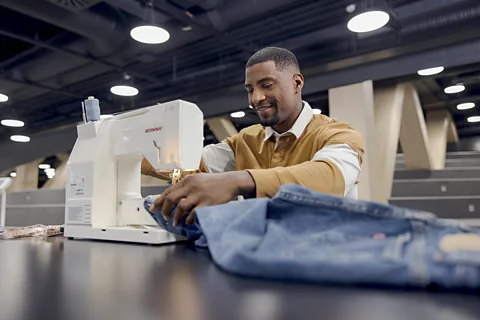
Users can borrow sowing machines, tennis rackets, and swimming pool passes from Helsinki libraries (Credit: Oodi Library, Helsinki)
This culture of borrowing, Vänttinen explains, is rooted in deep-seated pragmatism that stretches back to Finland's rural past, when people routinely shared farming machinery. "Today, many people in cities live in small homes, and they might need a sewing machine only once a year," says Vänttinen. "So why buy one? People prefer not to spend their own money when they can access a sewing machine for free, funded through their taxes."
Six hundred kilometres north of Helsinki, the city of Oulu's newly refurbished central library Saari reflects the same thinking, says library clerk Chris Stephenson while loading a microfilm reader for a visitor to browse an old newspaper.
Around him, readers fill long tables beneath soft lamps. A newly retired teacher is printing sheet music for the choir he sings in and the band where he plays the guitar. One floor up, a young man arrives to shorten his jeans after booking a slot for a sewing machine. In the same room, a 3D printer hums behind a schoolgirl using a heat press to make a T-shirt she's designed for a friend's birthday. A laser cutter sits idly by.
We reach practically everyone, regardless of societal or cultural status. This is true everyday democracy – Katri Vänttinen
Before moving to Finland, Stephenson worked in libraries in the UK for 20 years. "I saw many libraries closed down, and communities losing something important," he says.
According to Noora Hirvonen, professor of information studies at the University of Oulu, cutting underused services to save money can become a self-fulfilling prophecy. "We first cut library opening hours and, as a result, library visits drop," says Hirvonen. "This is then used as a reason for additional cuts or even closing the library."
Instead, Hirvonen argues, institutions should ask why the service is not used. Is it because people do not find it valuable, they do not have access to it, or they do not know about it?
"Usage is not only reflective of the value of the service: it's shaped by things like visibility and availability," says Hirvonen.
But the significance of Finnish libraries extends far beyond tools and meeting rooms.
Professors, unemployed and homeless people all use the same library spaces, making libraries a key part of Finland's democratic infrastructure, says Hirvonen. "They're places where anyone can access knowledge, meet others and take part in public debate, regardless of income or background," Hirvonen says.
While these are core values of librarianship everywhere in the world, says Hirvonen, in the Nordic countries, they are embedded in law. Under the Finnish Library Act, public libraries must promote democracy, freedom of expression and active citizenship. (Some other Nordic countries have similar policies too.)
More like this:
Finland's investment reflects this commitment: in 2025, the country spent nearly €371m ($430m/£321m) on its public libraries – that's €65.78 ($76/£57) per person, compared to the average £10 ($13.5) per person spent in the UK, and a total public library expenditure of $15.2bn (£11.4bn ), or $45 (£34) per person in the US.
"Libraries can directly support democracy – this is one thing the world can learn from Finland," says library scholar R David Lankes from the University of Texas, who believes libraries thrive when communities actively use them to learn, debate and create knowledge together.
Erika Benke
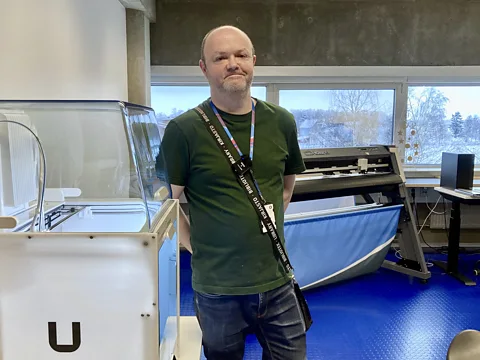
Before moving to Finland, Chris Stephenson (pictured) worked in libraries in the UK for 20 years (Credit: Erika Benke)
Librarians help customers navigate online bureaucracy, from tax services and bank accounts to pension portals and digital health records, and they routinely provide assistance with writing CVs and job applications. As a result, a recent study of Finnish libraries concluded that libraries function as critical inclusion infrastructure.
"This promotes inclusion," says Mervi Vaara, a manager for regional library services in Oulu. "The library is like a shared living room for everyone."
The whole Finnish welfare system in one building – Nasima Razmyar
As a result, an analysis of 38 studies from around the world found that public libraries consistently return more value than they cost, giving back from three to five dollars for every dollar invested. The study emphasises that libraries create both direct benefits – such as savings from borrowing rather than buying, and support for jobseekers – and indirect benefits, including improved literacy, digital competence, employability and community wellbeing.
In annual evaluations carried out by Finland's regional authorities, libraries consistently top the list of most valued public services. "We reach practically everyone, regardless of societal or cultural status," says Vänttinen. "This is true everyday democracy."
In the 2023 report, Finns described libraries as trusted sources of information and digital content. "Trust in government institutions has been declining for decades," says Lankes, nodding to global surveys like the Edelman Trust Barometer, which shows a steady long-term drop in trust in public institutions in many countries. "But trust in libraries and librarians remains extremely high."
Libraries, Lankes argues, are among the few public spaces where people can simply exist without being expected to consume. "You can't go to town hall and just hang out. You can't go to the police station and just hang out," Lankes says. "But you can come to the library and just be."

Sanna Krook
Librarians help people with practical tasks such as accessing pension portals and digital health records, as well as writing CVs and job applications (Credit: Sanna Krook)
And while Finns actually also still enjoy high levels of trust in public institutions, according to surveys, they face what researchers call a "participation paradox": despite trusting institutions, many citizens still feel they have little real influence over political decisions. Ultimately, libraries can bridge that gap too, says Elina Eerola of the Finnish innovation fund Sitra, who worked on a report on how libraries can promote democracy.
Eerola says libraries can create accessible spaces where citizens can meet decision-makers and take part in debates. Sitra's pilot projects have used libraries to host community discussions and events to connect citizens directly with politicians and public institutions.
For some Finns, the impact of libraries is not measured in statistics. Nasima Razmyar, now a member of the Finnish parliament, arrived from Afghanistan as a refugee at the age of eight. She still remembers the moment she received her first library card: the first physical object she owned in Finland. "When I signed my name and received it, I suddenly felt this place belonged to me," says Razmyar.
Growing up in the Helsinki neighbourhood of Käpylä, she spent afternoons studying in the local library after school. "My parents didn't speak Finnish, so the library workers sometimes helped me with my homework," she says. "That local library was equality," she says. "The whole Finnish welfare system in one building."
As the afternoon light fades outside a Helsinki library window, Razmyar now watches her young children choose their books. "I think it gives children the feeling that they belong here, and this is for them, which is really important," she says.
--
For more science, technology, environment and health stories from the BBC, follow us on Facebook and Instagram.
I picked woodwork, as 95% of the boys did, and about 80% of the girls picked the home-lessons instead.
I do recall doing some sewing lessons outwith the home-ec classes, but it was very irregular. I know I skipped some stuff because my grandmother had already taught me to knit when I was six-eight years old. Only at home did I use a sewing machine, never at school.
If someone doesn't go to the library because of homeless people, the problem is with the person who doesn't go to the library.
If someone doesn't go to the library because they are being harassed, the problem is with the library. Let the library know about specific incidents so they can handle it.
I'm not saying the situation is ideal. Yet plenty of homeless people go to the library to access the services they offer, or simply to have a safe place to read a book (even if the book part is incidental). If people sleeping in the library is disturbing, well, let's just say that library security would be kicking out a lot of university students in my area.
They're just people and the library is for them too.
Library staff is not equipped to kick homeless people out for fear that it will cause a scene and possibly escalate to an aggressive situation. They will just call the police. So then the police will come and remove the person, but they will come back the next week, or maybe the next day. So then what happens? Call the police again? This time maybe they get charged with trespassing and put in jail? This goes on and on. The library is supposed to be a safe place but that also means that it is somewhat of a helpless place for staff and quiet citizens. And over time it slowly becomes more and more uncomfortable to the point that regular people just stop going.
It's nobody's "fault". It's just a tragedy of the circumstances.
I guess it must have been dependent on the school then?
It was useful - I'm quite sure I wouldn't have gotten any exposure to those subjects without it.
Plus all the trust issues of having lived in the street. Only someone who hasn't interacted a lot with the homeless would say they are just like everyone else. Even if the reason they became homeless was just random by the time they've been homeless for a couple of years they are a different person.
There's a reason many of the homeless avoid shelters, if you talked to one you'd know why, and it's not because the other guests are lovely kind people to be around.
Housework, sewing, knitting and stuff I'd been exposed to at home due to a pretty large family already. Though otherwise I would have probably benefited from it, and it did strike me even at the time that it would be best if we could do both classes, rather than having to pick only one.
These are regulars at that library who never caused enough disruption to be banned, and aren't dangerous enough to be in jail. They also have more to lose by getting banned than housed patrons.
That's the whole point of that post.