Also, who hasn't worked at a company that produced a product and then abandoned it? I feel like that has happened often to me - many years of effort for nothing. It's not fraud exactly but it represents almost the same thing other than the intention.
From my perspective, you're a victim of this fraud too. I think the pursuit of meaningful work is an important way many people find meaning in life, and it sucks that someone took advantage of you. From this piece, I get the impression that you would never have spent so much time and effort on this role if you had known it was just a way to scam investors.
So, don't be hard on yourself. It's normal to feel guilty, but if you didn't have a perspective on the entire company or knowledge of the fraud, I don't know what you could have done.
Sure enough, he is a founder of an "AI That Knows Why" company.
It became pretty obvious to me from the get-go that nothing was being built, and the startup was just siphoning money off the parent company. I'm not sure if there was any fraud going on beyond a bunch of people collecting a paycheck.
I think the boss was skimming off of the captive H1Bs, and there was a guy in NYC who never did anything as far as I could tell. I wouldn't be surprised if there was some kind of kickback going on there.
My first day, I went out for sushi with the top devs, who proceeded to tell one horror story after another about the boss. Awesome way to start a job. I lasted 3 months.
At the other end of this extreme is if you have a good job in a bad industry, like gambling or boiler room frauds. You should feel responsible even if your job is just maintaining the servers.
The VC business model is predicated on extreme growth. The last thing you would want to do is siphon dividends out vs reinvesting into growth.
They must have preyed on newbie founders, dangling large valuations. Oh the fees? Well you will make it big and it will be a drop in the bucket!
Second, very few things in life are so cut and dry. Legal cases are by nature simplified abstractions that attempt to render a three dimensional situation that unfolded over a long time in a few pages of a graphic novel.
Third, this sort of thing is so incredibly common. Often the only difference between fraud and IPO is whether it worked or not. That's not cynicism, just pragmatism.
If you ever read David Graeber's Bullshit Jobs - and you should - you'll quickly decide that the real fraud is late capitalism writ large.
And yes i can relate to that. In 26 years of career, about half of the money i made and all of the money i saved, came from 3 clients (over the course of less than 5 years), all 3 of them being scams - one swindled investors for a thing he knew can't work, another one did a legit thing but when he realised it failed, exited to a dumb megacorp and ran away (literally vanished) when they started to realise they've been duped, and one more was in crypto field and whole project - which to me, all the way until past release, looked like a legit porn site - had a goal of imitating activity/interest to boost value of a crypto token.
Even before i picked up coding - and i did it when i was in early teens around the fall of Communism - i knew coding as a separate field and a business was invented exactly for that purpose: it's a lot easier to steal money that way because it's a lot easier to inflate costs vs buying physical products.
No surprise the party is over. People can't be duped for too long.
if you don't own the capital and have full autonomy, what's the difference on fraud (that you know nothing about), some imoral thing like flock/advertising/surveillance, or some inane thing like animating characters for ads, or mailing spam letters for a small business, etc, etc, etc?
Senior management routinely seem baffled that they could announce redundancies or hiring freezes, yet technology costs would continue to rise.
One pattern I saw repeatedly was a contractor being let go, only to return via a large outsourcing provider. The provider must have added a substantial markup despite supplying the same engineer back to the same team, without having incurred any procurement costs.
I once asked a more senior colleague how this made any sense. His answer stuck with me:
"You can’t stop people from doing their jobs. If someone thinks their job is to deliver X, they’ll find a way to deliver X. Sometimes that means working around processes and incentives in ways that look very strange from the outside."
The project was $1M+ which was enough for prison time. He had gone into our billing software and edited my entries - it wasn't as if he was submitting the fraudulent totals only - he was changing what I was entering.
I gathered as much documentation as I cloud and went to a law firm. They told me I had two options - report it to the Government Accounting Office or report it to the head of the project, an academic.
So I simultaneously resigned and reported it to the professor. I covered my butt. I'm pretty sure the professor hid the fraudulent billing but I didn't look into afterwards because basically that was what I was hoping he'd do so I wouldn't have to go to court and defend that my reported hours weren't really mine.
The full project was eventually awarded to another academic group.
Most common people throughout history made their living working in the systems owned by aristocrats whose wealth was usually built on both corruption and theft. Guess that hasn't changed much.
> Did my old job only exist because the Product Owners didn't realize we didn't have product-market fit?
The owner was the son of an old school magnate out of PA.
Among other things his line has always stuck with me: "A whale that surfaces is soon harpooned."
The company never made money. I think the whole thing was run as a loss on purpose for tax purposes. I became tired of the head manager/engineer combo (big fish in this tiny, tiny world) and left.
Even they knew this company was never really trying to do anything serious. Strange indeed
You weren’t committing fraud. You did real work. Now you’re in the US with a family and a career.
Happy Father’s Day.
It reminded me a lot of the Bill Cosby skit about the game Keno, he used an example of a Keno Card that had two numbers on it, you picked one and took it up to the cashier with your $1 bet, the cashier drew a number and said, "Sorry not your number, try again."
The sad truth was that a lot of people who had become wealthy because they happened to be working at a company that went public and had stock, were not particularly sophisticated when it came to the reality that even people "like you" were not your friends. I spent my Jr High/High School years in Las Vegas and got to see so many 'confidence men' fleece tourists with so many schemes. There is a great book called 'The Confidence Game' by Maria Konnikova. It is excellent and reading it you'll come to understand that not only is it possible for even 'smart' people to be taken, there are lots of people who work on being good at it.
But taking all of that into consideration, if you worked at a company, did your job to the best of your ability, and it turned out that it was a "fake" job because some third party was using it as part of a scam, you aren't part of the scam. Any more than happening to be in a bus when the driver whose been drinking kills a pedestrian. You aren't responsible for that pedestrians death and you're not being on the bus wouldn't have changed anything. So you can let that go.
imagine a world where SBF didn’t defraud the crypto world.
in that world anthropic may have not existed.
That's 'normal' in Canada and France.
Management just really needs to make the next earnings look like what it should look. Next quarter is next quarter's problem.
If you have a lot of money it’s fun to LARP the startup life. The experience working for such a company is highly varied and completely depends on the personality of the founder. But even if it’s a healthy place, it’s usually a black hole from a career development POV.
I have been on the other side of this, building a frontend that connected to an external service robot that we, with a 5 minute script, managed to successfully prove internally was just a if/then/else state machine.
We got paid to make it, so we didn't care, but we knew someone was losing money.
It could’ve been worse, it could’ve been a fraud! But it’s merely a business designed to lose money. It won’t land you in jail but it’s not a place anyone would advance a career.
It's a pretty frustrating experience -- was it all for naught? Maybe it's useful to vent about it a bit.
The years I spend on nonsense will never come back.
In this regard, we aren’t standing on shoulders of giants, we are like an immense asshole of a dad climbing ontop of his young child’s shoulders to win a chicken fight in the pool while his kid drowns below.
The passengers on the bus are not blameless if they know or have reason to know that the bus driver was drinking before or while they went down a road with pedestrian crossings. They are not blameless if they take no action, but to sit in the seats and wait to see if anyone gets hit or they all get away with it and arrive at the destination.
Or if they remain in the seats after the first pedestrian and 'hope' it wont happen more.
And how 'blameless' are the 'non-passengers' along for the ride to perform ongoing maintenance and provide fuel and snacks to the driver while on this imaginary trip to hell.
So, I'm all out of 'you're not really the asshole' cards as we watch the whole kleptocratic SV system run Theranos' style over the total sum of human creative production.
Anyone who participates in building the toolchains of tyranny is complicit in the abuse of people with those tools, even if it just a tiny bit.
Sorry, not sorry, if that pricks the consciences of a few pricks; those that can feel shame are the better for it, and those who feel it not we must all be wary of.
Your bosses might not actually care about the work you do, but your users and customers sure will.
I did that in the health sector of my local gov, the whole place was full of consultant who either got contracted directly from Oracle, used to work at Oracle before but moved there or took the Oracle pill early on and never got the idea to see how things get done elsewhere. It was impossible to ship anything that's not made of Oracle technologies and that was not an accident but a deliberate construction.
the bank would go through cycles of "we need to reduce our headcount and outsource everything" and then 4 years later "we need to reduce spend on contractors and retain more knowledge and expertise in house". he'd survived multiple waves of it, switching back and forth between being an employee or a contractor through some external agency, as management trends changed, while essentially doing the same job.
Bit that doesn't really work in knowledge systems. Even with the best documentation people will build up knowledge that no one has, and their departure is costly.
Equally at the end of their contract a lot of time will need to be spend on a handover which slows down others even more.
So what happened? The contractor went via another middle man, which checked the correct boxes on the form, and everybody was happy.
I dont think they're baffled, they just trying to show they're attempting to keep costs under control.
>the finance department tells some director...
Don't shoot the messenger. The finance department is implementing the board's policy.
Understanding a bit of accounting / corporate finance opened my eyes to many things.
I often reflect on how much I've grown personally in companies that are clearly not going anywhere. Trying to do more with less can lead to... interesting... technical solutions. And in every company I've worked in, I have at one time or another been on a "cloud costs reduction" squad, which normally shortly precedes my deciding to move on from said company.
I've also worked at the opposite end of this scale – companies with so much cash and no desire to turn a profit any time soon - and that's more problematic, as there's just no pressure to actually ship anything and every problem (and I mean _every_ problem) is solved with money or by hiring specialists.
There's sometimes a fine line between a legitimate business pursuing ambitious goals that are ultimately doomed to failure and one that exists to commit fraud. And it's often not possible for an employee (even a fairly high-ranking employee), who often has limited information, to determine which is which.
"We're not shipping? Well, that's a bummer, but also, what a relief! If building it that was this hard, I can only imagine how bad shipping it would've been; now we can delete that code and with it all of the maintenance we would've had to commit to for years."
The personal attachment just had to go eventually. It proved not to be terribly helpful or healthy anyways.
I accepted a long time ago that it is all for naught :)
Enjoy our time on this earth, do what we can, focus on people and it'll be alright
I knew this, but took the job because I was burned out and knew I could spend a year or two coasting and padding my resume with some interesting things.
I came to the conclusion that the company was a grift, but at least they took care of their employees and included them in the profit part of it.
We had startup perks that were basically paid out in cash when the pandemic hit. The “gym” perk became $500 in cash which could be spent on anything vaguely fitness related, like an Apple Watch. The commuter benefits rolled into our accounts which gave me free tolls for years afterward. Instead of taking all the money, they cut us in.
So yeah, maybe frustrating if you expected your startup to be successful, but that’s so often outside of the control of any engineer. It’s always a crap shoot. Get your best offer and make the most of it. You can do resume driven development even in the shadiest of firms.
However, I was quite surprised a few weeks ago, on a client project, to find in one of their repos a chunk of example code that I’d worked on 22 years ago.
[0] Being real, a lot of the ephemerality actually stems from questionable commercial decisions, working on the wrong thing, etc. But some at least is a legitimate result of evolving markets and needs.
I would have thought most people would grow out of having this kind of feeling after their 1st job. But I also definitely work to live, not live to work, so YMMV.
So yeah, it is going to test you and you might come up short. I don't judge people who stay when they know, but I do grieve for the damage they do to their souls when they see themselves as someone they no longer recognize.
I work in civil service but in a very specific job that needs certain degrees by law.
I've heard they were going to outsource my job (because civil servant are expensive) and registered a company that delivers the requested services. I entered a public procurement and upped my price a little because I knew there aren't many people with the right certifications. I won the public procurement and went from a civil servant to a self employed expert with a company car and all the perks.
Near the end of my contract they thought about hiring their own expert again because... money.
I applied for the job and went through an external hiring process and got selected. Because legislation changed my job went from middle management to a senior management position with extra benefits. Had to drop the car though...
A few months ago my colleagues were doing prekilinary budget talks and considered on finding an external company to do my job and getting me another position. I had to point out the cycle they fell into and somehow they forgot about it.
Early on I used to try to explain that things don't work as advertised. There are a lot of advantages but you need a human reviewing and directing.
These days I don't even bother. Call it being desensitized to the bullshit, but I'm waiting for some fancy AI agent to take out stuff in a way that no one can do anything. Past that I don't see a way for C suite to wake up.
The uncertainty never goes away. You can pay someone else to suffer it, but it will always cost more than dealing with it yourself.
And that can be ok. Just don't fool yourself into thinking you're getting a bargain.
I think that's the part management teams are missing. They assume that employees are just human resources and they can replace a senior engineer with a 100% equivalent one when needed.
The people involved weren’t stupid. They were trying to achieve one outcome and got a different one because the rest of the organisation adapted to the incentives in front of them.
The money doesn't go to the start ups - it all goes to large tech companies like IBM, etc, because, obviously, IBM knows about innovation.
The cover is that the government doesn't know tech so it will give money to trusted partners and they will choose who to give the money to because they've been doing such a great job innovating in Canada. Surprise: they gave the money to themselves!
You might have wondered why all these incubators in the crypto era were desperate to get you to go to their office. You might have also wondered: what fool is paying for this nice office in downtown Toronto where the prices are crazy-high? The taxpayer.
All of that money was completely wasted and worse, little of it went to actual start ups.
Yes I know it’s not all that rare, BECAUSE people can’t be bothered to blow the whistle.
Spend the budget or next time people will ask why you need all that money when you didn't spend it last time. Expensive projects are important projects. Important projects make careers. That is baked in several layers deep. You'd need to report it to a waste and fraud line, ombudsman, or similar.
I'm not sure its unusual enough to bother, though.
The reason they're based on actively deployed capital isn't that the LPs (people who give VCs money to invest) want them to deploy the money in a stupid way, but they definitely don't want VCs to get the fees if the money wasn't invested. Therefore, VCs:
1. Want to raise as much money as possible 2. Want to deploy as much money as possible
Ideally, as quickly as possible.
There's nothing fraudulent about the idea of calculating VCs fees in various scenarios.
There's however the extremely dodgy part of the portfolio companies paying their investor (VC) fees for anything. This is an obvious conflict of interests, and should never happen, but I personally know of multiple VC funds here in Europe (will skip the names to not get sued, lol) who base their entire operational model on funding shitty companies that have 0 chance of success, charging them for the office space and often "shared services" they provide. Unsure if this is a regulatory overlooking, or something that's deliberately legal, but IMHO shouldn't be. Probably they talked their LPs into agreeing to this on paper.
One thing I learned is that a some people running startups are "poker players." They run the company to keep up appearances: Their goal is to get more investment and eventually sell the business at a profit. (And then what the purchaser does is their business.)
There's nothing wrong with working for companies like this! You might not realize it going in; or the investors might see through the bluff and replace the leadership, creating a great job for you.
In contrast, you could join a business run by honest people, and they could sell out to a poker player who then ruins it. Or, more typically, the honest people turn out to be so-so business people and the business fails. (This is what happened when I tried to run a startup.)
At the end of the day, working for a startup always involves risk and the leadership structure will always change as the company grows, pivots, or fails.
I noticed this early, and spent the first half of my career leaning into it. If you negotiate every gig as a contract, you get to double (or more) your salary. And the only thing you're trading away is job security which, if you pay attention, you'll notice doesn't actually exist for your salaried counterparts either.
To nitpick, you also have to pay for your own health insurance. So subtract $200/month from that extra $15,000/month for the sort of catastrophic coverage plan that a 27 year old needs.
But then they have to hire good managers and for that you need to be a good manager yourself.
Banks had a very low risk appetite and so had to let these people go. What was going on in a lot of places was that vital staff who had to be dumped were intermediated by outsourcing providers. These companies either then paid the staff a very high salary and sold them in as temp labour, or took on the risk themselves and hired them as contractors for the same purpose.
This all made sense, but for a lot of contractors at the time, it felt like the apocalypse. The net effect was that HMRC exchanged flexibility in the labour market for immediate tax take. This may not have been a sensible decision.
When I worked (well, was a contractor at) a very large company, they'd kicked out all their small contracting providers only to get the same people back via a single big one. I was told this was part of a vendor consolidation move, because maintaining their existing direct relationship with literally hundreds of thousands of vendors had a huge cost in itself.
I doubt they were dumb enough to think there was no markup, but going direct isn't free either. There ain't no such thing as a free lunch.
Now, was it a net good move? That's both above my pay grade and not my expertise. But from the fact it took me a month of billed time to buy a license of that same company's own product[1], I wouldn't have called it an efficient bureaucracy.
[1] all purchases of own-company product had to be done through the 99% internal billing discount program.
Didn't you mean to temporarily realign? I mean give it 2 years and another manager to show up, ready to get their bonus for the next attempt at it.
That's our reality and how we've structured our markets
So, can Genai san do his job?
This is true, but it's not the whole of it. In some cases the manager goes to a cabin in the woods to drunkenly shoot at moose with the head of the contracting company.
It's a saying that "the purpose of a system is what it does". I think it's a pretty dumb saying. But it is often worth talking a look at a system and see if the "mistakes" it makes (such as wasting money on contacting companies) aren't in fact desired by some people in the system.
Payroll is an ongoing commitment. Consultancy is a temporary service. Moving people from payroll to consultancy means they can reduce overhead in financial projections. Even though consultancy costs more, and employs the same people, it makes sense to do if it means you can convince shareholders and analysts that Opex will shrink in the future, and therefore profitability increase, and therefore the share price increases.
I knew multiple people there who made more in signing bonus, pay during training, and severance than they made for work actually performed.
The CEO is convinced that this is the path to "top tech talent."
https://www.youtube.com/watch?v=wKDdLWAdcbM
"Bernard, I have served eleven governments in the past thirty years. If I had believed in all their policies, I would have been passionately committed to keeping out of the Common Market, and passionately committed to going into it. I would have been utterly convinced of the rightness of nationalising steel. And of denationalising it and renationalising it. On capital punishment, I'd have been a fervent retentionist and an ardent abolitionist. I would've been a Keynesian and a Friedmanite, a grammar school preserver and destroyer, a nationalisation freak and a privatisation maniac; but above all, I would have been a stark, staring, raving schizophrenic."
I love watching them cringe when they see my new daily rate.
I don't think you have to be a full saint to fulfil your moral obligations. He ensured he wasn't implicitly participating and reported it to someone who had a responsibility to investigate/do something about it. That is a reasonable amount of effort to rectify the situation in my opinion.
> Yes I know it’s not all that rare, BECAUSE people can’t be bothered to blow the whistle.
The person you are responding to did "blow the whistle". They reported it to the project head. That is blowing the whistle.
I think most people would blow the whistle if they had evidence of personal-enrichment fraud. Suspecting that incentives are producing strange outcomes is one thing; accusing specific people of criminal conduct is quite another.
Hilariously, in the one case I heard about where an MD was eventually fired for taking kickbacks from contractors, the department then struggled to recruit competent staff. It turned out he had only been skimming from people who could actually do the job.
1. No mens rea.
2. He did what was expected of him.
3. You're always free to break into prison if you find yourself in his position, but you might discover yourself sitting in a pool of shit that was not of your own making.
4. Do you really want the parent poster to face the possibility of criminal prosecution, because his scumbag boss convinces the DOJ that the parent poster were the one fucking with the hours, and tried to pin it on him?
It doesn't matter if it costs a lot of money to maintain. Yachts and sports cars do the same. That's actually like the whole point of it, after all.
Also, when you do a good job, ex-coworkers will often reach out to you to give you better opportunities.
I suspect some of my open source contributions will live a long time. Not my personal projects that I make open source just in case, but the (very small) contributions to fix things in the dark shadows of established projects with longevity. Some of that will become obsolete and hopefully be removed, and some might get refactored eventually, but if the project is older than my career it's may well last beyond me.
With that mindset (or work-to-live or whatever you can call it), these things are just an afterthought. That after-work climbing session and that weekend meeting with friends or hiking trip in the mountains with kids mean world to me, and I fully indent to keep that mindset till retirement and continue with it further. If it means I won't get into top 1% or whatever I am fine with that, QoL is firmly above that and career rat races are meaningless (and fruitless) ego polishing / insecurities managing exercises.
If you suspect that it's fraud, you should seriously consider whether you want to be a part of it, even if you can't prove the fraud. Examples are companies centered around cryptocurrencies: not all of them end up being rugpulls, but enough of them do, making every new company potentially morally risky for each engineer.
If you only suspect that it's an overly ambitious project, but not fraud, the moral risk is obviously lower. Sure, it may be economically risky - as all unproven business models are - or you may discover the fraud later (like the author apparently did). Examples are startups like SpaceX in its initial stages: there was nothing ostensibly fraudulent in trying to make and sell better rockets, just very economically risky.
Obviously, the devil is in the details, but if you're honest with yourself, you should do your due diligence (i.e., does it seem like fraud or not) and determine your moral risk appetite. It's up to the wider society to reduce and punish the unacceptable levels of moral risk, regardless of the appetites of individual engineers.
Then again, if it is doomed to fail from the start, it is unlikely that I would really enjoy working on it.
I was with a startup for almost a decade. During that time it had four different owners. At one point it was "clearly managed by too ambitious people and will never succeed", but the parent owner and remaining founder saw this and found a legit buyer.
When this happened, we were wholly owned by a major conservative company but operated independently; the fact that "adults" controlled the purse strings was what made the situation work out well in the end. (For me, that is. Other people who drank the kool-aide were given nice severance packages.)
---
Thus, you really have to know the whole story: Who's the investor? Who has power? Who's controlling the purse strings? If the business has potential, the investors will fire "poker player" leadership in situations like this.
Sure, 99.9% of startups may not get there but we saw in the past some wild unexpected successes. Plus things may change along the path as markets evolve and if they pivot successfully into new areas they may win the first mover situation, even if original mission won't ever be accomplished.
I still have new „business„ guys joining org who try to make „cloud migration”.
We are cloud as a SaaS, we are running on VPS with virtual networks. But they come in and think „to be professional” we should be in „real cloud” like Azure or AWS.
That system however is no law of nature. It's just broken nonsense no one bothers to fix because we haven't yet run out of money.
If we called it by the literal term, decimation, you would get a good sense of the effect. "I have a new policy, I'm going to decimate my own company"
https://thecollectivehk.com/%e7%a7%91%e6%8a%80%e5%88%b8%e8%a...
First and last time I ran into something so blatant. We didn't fall for it btw.
You know, just something that could provide a little leg up to every small business until they’re not small anymore. But no, inflation doesn’t exist!
I'd be very interested in reading about this fraud.
Now wouldn't it be interesting to dive into how old the extortion tactic of creating the problem you solve goes?
Think about it logically. If you’re the prosecutor, the guy whose time is fraudulent is presumptively the criminal. It could very well be that he was actually the one who was engaged in the fraud, but went to the authorities to protect himself by making it look like his boss did it.
I've always heard of this nugget of wisdom but never really understood it. By punishing those who underspend (by making the next application harder), wouldn't you incentivise inflated research costs, or worse, fraud. Seems like a quick path to a positive feedback loop towards the degradation of trust in academic spending, leading to "poor government efficiency".
Which is maybe as it should be, but it does pit agonized debates over detailed technical work in perspective.
It also feels like willfully abandoning the bit of agency you still have if you don't even try to understand why the world around you works like it does.
All good grifts let some "little people" in on it so they go to bat for it.
Investing in your own employer is an idiotic risk..... If the company goes titsup, then you lose your job and your savings. This happened to many people during the dotcom crash.
> "in a business that is clearly managed by too ambitious people and will never succeed"
> "given that you are legally not a part of the potential fraud ring that you can't prove"
Consider:
1/ If it's a biz that's purposely mucking about without success...or a loss making entity for tax breaks: I have no problem in working here (Consider that I am in my 40s, used/abused in various "start-ups" and burnt-out. I need the money, and I'll take it.)
2/ If it's a company involved in criminal fraud: I'd run away as fast as my feet could take me. The problem with fraud is that eventually the authorities will catch up. If the owner is a criminal, he'll do anything to save his backside...even throwing innocent employees under the bus. You might be exonerated eventually. But that eventually might take years...decades.
OP is simply describing what is common throughout government in the UK. This is known as the Revolving Door.
Private Eye magazine wrote a special report on it some years back as, frankly, it is scandalous https://www.private-eye.co.uk/pictures/special_reports/revol... [PDF]
If not, will become Genai Sans job.
Isn't that just fraud?
Not coincidentally, this results in massive overspend until someone notices and has to painstakingly go round checking what all your instances are for. And AWS is very profitable (well, margin rather than accounting profit).
Now, look at the billing model of AI, especially once flat rate goes away. People can spend millions on tokens without ever having to ask a manager! Obviously this is going to rake in money hand over fist, because it will be years before anyone catches up to ask "are we actually getting value for money here?" rather than "quick spend more tokens".
And the big accounting firms.
It's incredible how efficiently they divert all activity and attention from the core task, and then wonder why things don't take off.
Don't confuse a hobby business with a failing business.
Plenty of people with independent means run loss making businesses for fun and/or support wives/children doing just that.
> They assume that employees are just human resources and they can replace a senior engineer with a 100% equivalent one when needed.
they don't assume that, they make it happen by doing this regularly.This process goes both ways. The people in the system align to the process. So maybe the "mistake" wasn't desired to begin with, but once it's there someone things: if that's the way they want it let's change our ways to fit. That's why these things seem to dumb from the outside.
I guess it may not be normal but I got straight time overtime when I worked for a contractor. Made those weeks I really did do 80 hrs nice. But if they have any system involved the fact you did not get paid for the time would be a big red flag.
For almost everyone, working is not the best way to spend their time, it's just how they can afford the stuff they do the rest of the time. Obviously it's preferable if it's useful and/or enjoyable, but they're not necessary qualities.
>It also feels like willfully abandoning the bit of agency you still have if you don't even try to understand why the world around you works like it does.
Odd. "Agency" usually refers to the ability to exert will. Understanding would not seem to contribute towards that.
'Useful' is not even a thought that's ever entered their brain.
When the world starts paying people for the best use of their time, people will start prioritizing that.
In contrast, the issue with civil servants being let go and re-hired as contractors is a simple issue of inefficiency. The same person doing the same job has the same incentives, they're not being corrupted. However, our public resources are being spent inefficiently to hire the same person to do the same job for more money, with an added bonus of spending resources on the acquisition process itself.
You look at your monthly outgoings and think about how long you have to look before your cash runs out.
I stuck it out too long several times. The most recent one left me unemployed for quite a long time and I was lucky to be in a position for it not to matter.
Now I'm in a job that's a step down - in a sense it's humiliating. On the other hand it more than pays the bills, it's low stress, I've lost 13 kg and I don't wake up in the middle of the night and instantly start thinking of the terrible things that happened in the week so that I can't sleep again.
Now I spend my spare time working in the garden instead of desperately trying to build the new feature on time. I'm digging a driveway. Perhaps this won't last but I realise how much I was killing myself by trying to stay in something bad.
Places are bad essentially because of bad people - it only takes a couple of idiots and it's impossible to fully judge that from an interview. You always get bad vibes from someone or other but you're trying to convince yourself it's ok because you need a job.
Mostly for money, of course. And all the attendant improvements that can bring to one's life. Some people need it more than others, e.g. a H1B worker who is attempting to pull a whole family out of poverty.
I bet many go in thinking they will do it temporarily, until they pay their college debt, to give one example. But money is very addictive.
Life gets in the way, you don't have the energy to apply, you're afraid of rejection, you are afraid you might end up in a worse environment, you justify it to yourself in any number of ways.
Inertia, herd mentality and self-deception are much more powerful IRL than most people online seem to think (or at least write).
I don't know that I interacted with anybody senior enough to avoid this process in the time I worked there.
He's not really in a position to act usefully on this information, so had no reason to feel any culpability for not acting. It is only an interesting question when put to people were in a position where they had to make a choice.
In this case, either (1) the peon was lying about reported hours, the boss didn't notice, and then the peon reported himself... or (2) everything happened just like you said.
Aren't there bounties for reporting things like this? At the very least winning should include reimbursement for legal expenses.
The crazy thing was that if she worked for 10 hours on SBIR stuff, then worked 40 hours on her normal work stuff (so overtime), the SBIR billing would get scaled down to 8 hours (that is, 25% of 40 hours). There would be no way to bill 80 hours.
The other thing that seemed somewhat crazy is that it was also common to have multiple SBIR contracts going on at the same time. If they bought a $10K tool for SBIR grant #1 and SBIR grant #2 needed it two, they'd have to buy a second one. So the tool would be out, then when switching between work on the grants, the tool would go into a locked cabinet, then the second copy of the tool would get unlocked from a different cabinet. I understand that firewalling like that prevents a company from "borrowing" expensive equipment for their own work, but it lead to waste like I just described.
So let them do damage. I do what I am told, I have the strategic thinking but not many have made use of it. OK. It's their right. I still pocket a wage. They could have gotten more for their money but consciously chose not to. Who am I to stop them? (And not like I actually can.)
Early in my software engineering career, the UK-based startup I worked at, GenieDB, was taken over by a US Venture Capital fund, Frost VP, owned by Stuart Frost. I was functionally the only piece that came to the US. The code was rebuilt, the rest of the team eventually rotated out, even the core strategy was replaced. But I was early in my career and excited to be working in the VC tech-startup world. I ended up making my life in the US, so this was a pretty pivotal phase in my life.
For a while I lived the start-up life: building rapidly and playing Foosball1. GenieDB actively rejected revenue opportunities (a la Silicon Valley) with the aim of getting acquired for pioneering technology. We limped along for years with never more than 3 customers, even when big-tech and eventually open-source did what we tried to do better than us. I left with mixed feelings and eventually came to realize we never had the serious footing it would have taken to actually develop significant technology.
A decade later I heard from a former colleague that Frost was being sued by the SEC for fraud. Still not sure what to make of my time at GenieDB, I was curious enough to skim the complaint, where I saw this line:

Was GenieDB involved in this fraud somehow? I chewed on this question and it evolved to a form that began to haunt me:
Did my old job – the one that brought me to the USA and changed the course of my entire life – only exist because of fraud?
With this burning question I dove into the record of the case. The alleged fraud was simple: Frost VP operated as an incubator, providing services to the portfolio companies, and the investors say these fees charged were excessive.
The case went to binding arbitration2 and the investors won, after which the SEC sued to bar Frost from managing funds in the future. There’s some great elements like claiming a personal chef and cleaner as expenses, telling investors no salary would be paid by the fees (it was) and starting a marketing company just to sponsor someone’s visa.
But what about GenieDB? Both the arbitration and SEC suit elaborate on this idea of creating companies just to charge them fees:
This allegation was never litigated though, neither court nor arbitrator were kind enough to rule on why GenieDB was in the portfolio. I had to dive into the evidence and decide for myself. First of all, my old CEO testified that GenieDB was paying excessive fees:
I was only really shaken when I saw what the insiders at the VC fund saying to each other:
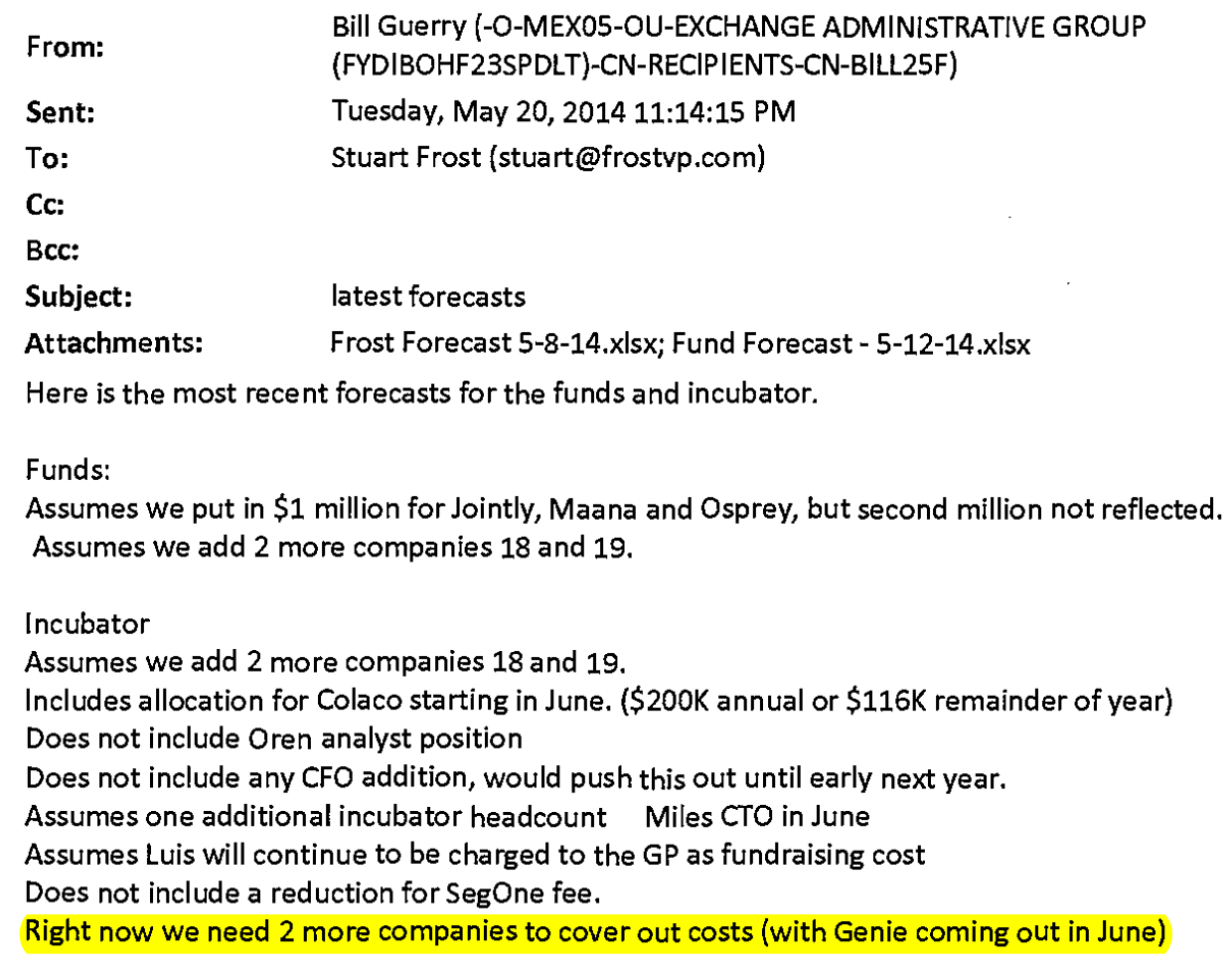
To me, this email shows that the investments were motivated by the fees3 and GenieDB was being used to siphon investor money away. I felt like an ant. My career, my family, my citizenship all would be completely different except for this fraud. This story plays out between investors, multi-millionaire VCs, judges, and my entire life isn’t even a footnote.
I took a deep breath. GenieDB did have a concept at the core, which pre-dated Frost turning his eyes on us. A concept which turned out to be quite useful when more serious players took it on. My colleagues and I were really trying to build it, even if the fund manager was eating up our runway with spurious fees for his personal gain. I wasn’t just some instrument of fraud working on nothing.
Besides, turbulence from chance events, lighthearted decisions and even crime alters the course of every life. Stories of chance meetings of a spouse are dime-a-dozen. I just looked in my wake and was surprised by a dark current.
There is always something you can do — whether you are going to bother is an altogether a different matter.
Most solutions to this problem are essentially what the OP recognized as nakedly illegal---that is, exaggerating productive hours---but most contractors are savvy enough to do it in less auditable and more positively regarded ways, such as stretching out timelines (four 20-hour work weeks raise fewer flags than one 80-hour week), adding more chefs than the kitchen calls for, or funding unnecessary little side projects. Straight-up tampering with timecards is an impatient and dangerous way of achieving (IMO) the same wasteful evil as happens everywhere else in the public and private sector.
1 https://www.nrc.nl/nieuws/2024/02/15/het-subsidiepotje-moet-...
At the end of the day, if they choose spend their magic beans on shitty features, I’m still getting paid. Then again, I’m at a larger company, not a startup.
Like wich? In my experience all workplaces have something that's gonna be wrong with them, and you just need to compromise if what's wrong with THAT ONE is acceptable to you.
Like for example honest and decent places to work at tend to also come with lower pay, or pigeon-holing career-limiting type of work, discriminatory gatekeeping, or other such compromises. There's no free lunch where you can have your cake and eat it too, unless you're very lucky.
Really small “lifestyle” companies might be fairly immune, but it doesn’t take much for them to fail, there’s a different risk profile.
This point is underappreciated as it appears in many forms and can really help reconcile things that seems obviously wasteful (they may actually be wasteful, but sometimes financial structure makes this hard to determine in an honest capacity).
Capital costs and operational costs are a similar dichotomy. When I was in graduate school, the university was breaking ground on new buildings at the same time that staff layoffs were underway. On its face this seems grossly unreasonable, but staff salaries were paid from one funding bucket and capital improvements (new buildings) were funded by a completely independent state-level allocation process and those buildings that were breaking ground had essentially been locked in 5 to 10 years prior.
The company has a project manager with a large spreadsheet to keep track of everything so that no employee would accidentally be officially double booked because that could be detected as fraud.
Some real work was done, but the meetings with other partners were a farce. You had these tiny companies whose only existence was to feed off the European money.
One day our manager asked if the architecture document of a 100kbps modem that I had worked on could be repurposed for a 1 Mbps modem project that was European funded…
However, things are changing... As of this current government, nobody is scheming anymore. The corruption and wealth extraction happens openly. They are really testing the waters in what they can get away with. It's almost US level audacity, tho not yet as undignified. The sad part is, although people here are universally frustrated about it, they flock to the one party evidently more corrupt and incompetent than the CDU: The AfD.
Honestly, despite political disagreement, all my life I considered myself lucky to live here, but for the first time it makes me sick thinking about Germany's future, working here and paying taxes. And the base motives showing as reactionary malice by my fellow citizens disgust me. It's shameful to admit, but this country is truly ill and deeply corrupt.
From above(the manager of the program) the job is to budget the funds thriftily and fairly, each project getting the amount it needs.
From below(the team working on the project) this feels like you are punished if you are able to save money and rewarded when you waste money.
I suspect this is probably the major problem with having a more command orientated economy. While it should be fairer(free market economies are notoriously unfair). The inversion in incentive hurts performance.
The rank above you has decided "we need $1 million of software, go buy that." They don't know exactly how much stuff costs, so they use a dollar value as a rough proxy.
If, as manager, you cut corners to save money, you're doing the wrong thing. They want the software! They don't to keep want the money, that's why it was allocated in the budget. Go buy us more Useful Stuff!
It’s also still a reasonable question to ask “well, last year we budgeted $15M and you got acceptable results while spending only $14M; perhaps you only need $14M/yr…” And despite its reasonableness, many people would prefer to oversee a $15M/yr budget.
I feel like these discussions always devolve into "government is doing a thing badly" > "governments always do things badly" > "governments should stop doing things". But governments are basically the only party that can act with the well being of citizens, as opposed to shareholders, in mind.
So, I would much prefer "government is doing a thing badly" > "here are ways we could fix it", which just should be perfectly achievable. Of course no bureaucracy, public or private, will ever be perfectly efficient, but that doesn't mean it can't be better or can't be net good.
Also, I do think people tend to miss all the successful things governments fund, like science research.
Public-private partnerships are a breeding ground for corruption. The government either needs to own what it owns or completely give up and leave it to a well regulated private market.
That's not to say one off contacts need to be eliminated. But when it comes to things like building and maintain roads, these private contacts end up being huge sinkholes for public funds.
In local forums, so often you see (paraphrasing a pattern) "why are the government interfering with landlords, they should stop so many barbers opening instead". That is, why are the gov interfering in property markets, instead they should interfere in property markets AND plan the economy (where economy here means 'financial system').
The people promoting planned economy without realising it are always 'right wing' 'all Communists should be shot'-types. It's fascinating.
but the problem here is how budgets are assigned. instead of a fixed number it should have a lower and an upper bound. at least X, but no more than Y. the closer to you get the better, but next year the budget will be the same range. only if you drop below X you run into the above problem, but then it's much less likely and if you really spend that little something else is wrong or the budget really was to high.
It’s little surprise what happens under such a system: logical people over-reserve.
Founders that hasn't gone public yet and sold out are the only ones. The government has already sold out to shareholders, at least in USA.
And no its not just "hire good people", its not just "raise wages". What happens if you raise wages is that the useless people get more money, since the ones who decide who to hire are still bad at hiring, so them raising wages without hiring better people is also a form of corruption.
In the end you need to do a deep cleanse to fix it, there are no easy fixes. Root out all plants from all interest groups, everyone that has been bribed via lobbyism money etc, in the entire government...
A big problem in the Anglosphere in particular is that the government is too focused on politics and catering to internal stakeholders and not enough on measurable results.
I think a better way to look at it is people demanding the government to intervene whenever intervention is beneficial to them personally, while demanding the government leave things alone whenever intervention is detrimental to them personally. Which is just a long winded way to describe the basics of democracy - people voting in their own interest.
They have 3 tiers. Its called 新基建 - *Xīn Jījiàn
Top tier is for essentials like food, electricity, internet/comms, water, sewer. Heavily controlled, usually state owned companies.
Middle tier is stuff that's integrated into essential tier.
Lower tier is forefront of tech, and not at all critical for life.
And a reminder that even fucks like Nestle said that water is not a human right. But every capitalist would do their damndest to put a sale price on anything they could. They'd charge breathing if possible.
Have you ever wondered why kids climb trees?
That being said, there are some good examples too. And even a few good examples might be better than the partnerships in Canada.
https://www.goodreads.com/quotes/70896-the-state-is-that-gre...
There are some people who care about policy, care about a generally healthy environment. Which has a strong self-interest aspect, as it should, but not narrow.
Few people manage to vote for their own narrow interests in a reliable coherent way. Even the rich and powerful reliably foot gun themselves.
I believe the vast majority, the vast majority of the time, reliably and enthusiastically vote for their group's shibboleths. Regardless of what they might say or believe their own motivations are. Even seemingly sophisticated and principled thinkers. It shows via the reliable, trivial to resolve, but reflection impervious group-coded "misunderstandings" that even "serious" people defend and nurture. The group reinforced, often meme-reflex deflected, unthinkables. Across the political spectrum.
People vote for brands.
alternatively, non capitalist eras had real famines and lead to millions starving and dead. but sure putting a price for product/service after risking lots of capital is the real enemy, lmao. why biggest famines mostly happened in non capitalist places is real historical detail with lots of facts.
Right, so the government should be based on brands rather than people. USA trying to make a people centric system still ended up into a brand centric republican vs democrat, just that now those brands changes dramatically every 4 years just people still vote for the brand even after it changes.
Its much more stable when you have stable political party brands like in multi party system, then a person voting for the same brand for 40 years will vote for roughly the same politics instead of it changing all the time.
In most countries, water, electricity, waste management and public transport are government controlled through and through, even if the government might sell shares to the public markets or induce competitive bidding. Except in dysfunctional countries of course.
Of course in the USA, "Nobody dies due to capitalism!" It's always a 'personal decision'.
Medicines gatekept? Talk to a doctor (state-controlled monopoly)
Go to the doctor? Cant afford it? Go die! :)
Have a nasty disease that will kill you, but pills purge it? $80k please. And insurance wont pay. Hope you can afford it. Solvaldi says hi.
Cant afford housing? There's an underpass or park for that!
Oh you're homeless now? Well, we criminalized that.
OH, so you're in jail? Enjoy substandard living conditions, lack of effective medical, poor food, and slavery. And die in prison? Not a life sentence? Fuck you, you deserved to anyways!
Groceries gouging on food (like meat or eggs or whatever)? Thats a capitalism correction.
Industry polluting your area and causing life expectancy to drop and massive reproductive harm? SHoulda chose a better neighborhood.
Even with Solvaldi, a hepatitis cure costs $84k. But it costs $300 to synthesize at home. And over 6 million people have needlessly died because the cure was capitalistically priced above their legal means. But they will all be labeled as "poor life choices", and not the correct capitalist death. https://kolektiva.media/w/uvD1wWTRoh7HEto8zeSswr - Four Thieves Vinegar Collective video in synthesizing your own pharmaceuticals to bypass capitalist deaths.
The key to capitalism is the magic word "externality". If it's external to what you're doing, you can make others suffer and die and keep your hands clean. And all of this then get shoved on the individual for "Poor Life Choices". In reality, these too are capitalist deaths, but you will *NEVER* see them marked as such.
Nope. Most non-capitalist systems have a competitive school environment. Students compete for education slots for the careers they want to work in. The only people who end up assigned work are those who have basically no aptitude for higher careers.
> force you to obey some rule or law they wrote for their own interest.
There is no society, capitalist or otherwise, that isn't governed by some set of arbitrary laws, usually for the interest of the state but not always. See, for example, the MJ ban in the US.
> you don't want to do the job? or dont want to follow the law and rules? fine! go to gulag and enjoy it there.
What happens if you don't want to work in a capitalist society or you don't follow the laws? We have a gulag in the US that people are being sent to. Utah just recently criminalized homelessness.
> alternatively, non capitalist eras had real famines and lead to millions starving and dead.
Non-capitalist eras? I don't think there has ever been a true non-capitalist era. Even under the feudal system, that was still capitalism just at it's extreme "might makes right" era. Serfs were forced to do their work because of contracts they signed with their lords for protection. They had to work the fields, in exchange for housing.
There's also plenty of famines caused directly by capitalism. The most infamous one being the Irish potato famine. Ireland is extremely fertile and at the peak of the famine they had bumper crops. The reason the famine happened is because poor irish citizens relied heavily on growing crops for personal sustenance in small gardens. Potatoes being one of the most calorie dense foods for a small patch of land. When blight hit the potatoes, there was not an alternative crop these citizens could get the calories from their small land plots.
Meanwhile, they'd be working giant grain fields and maintained cattle herds which were already sold to english markets.
This famine was entirely from capitalism. The land and the people grew plenty of food, but the capitalists cared a lot more about the wheat and cattle and not the people so the Irish starved.
> putting a price for product/service after risking lots of capital is the real enemy
Yup, in the Irish market that was literally the real problem. The price was higher than the Irish wages.
> why biggest famines mostly happened in non capitalist places is real historical detail with lots of facts.
I think you are mostly just unaware of famines. Not all, for certain, have been caused by capitalism. A decent chunk have been.
Now tell me name of the great "Communist countries" that exist today and they are big and have lots of great things to pursue humankind and human lifespan.
I will wait for the name of those counties :)
Unfortunately thats only a portion of the story. They had LOTS of crops and meat. The Irish were not *permitted* to eat any of it on threat of death by the English.
Ireland was an occupied country since Elizabeth met with Pirate Queen Grace O'Malley in 1593 up to 1921, where half the country won their freedom. Northern Ireland still is a territory of England.
Prior to that, during The Famine, the Irish were forced to ship all "good" food to England. That left them to eat predominantly potatoes. We all know about the monoculture, and the potato blight.
As a corollary, Irish are to Potatoes, as Black Americans are to chicken and watermelon. Its a massive racial insult, and similar in magnitude.
But no, it was the predominant capitalist country of that age that systematically drained all wealth from Ireland. As is the story of capitalism everywhere.
This is not accurate. We really need to stop getting offended on behalf of other people. Black people like fried chicken and watermelon, irish people like potatoes. In fact, black people like potatoes and irish people like watermelon and fried chicken.
Nothing about that is racist or offensive.
> Meanwhile, they'd be working giant grain fields and maintained cattle herds which were already sold to english markets.
> This famine was entirely from capitalism. The land and the people grew plenty of food, but the capitalists cared a lot more about the wheat and cattle and not the people so the Irish starved.
This is just silly.
The US has such a large lead in research output because of direct government intervention and funding since about the 1950s. That is a big part of why up until the Trump admin the US has been a powerhouse in medicine.
China is very likely going to be the next world leader in medicine. They've been investing heavily in biomedical research and they are sucking up all the talent that the US is defunding.
> They don't get invented or they are not allowed for your use, by design. This is a very narrow view and what a word salad.
That's a wild conspiracy. Governments want healthy citizens because healthy citizens power a government's economy. But further, governments are made of people and most people realize that general medical research is beneficial to all.
> Now tell me name of the great "Communist countries" that exist today and they are big and have lots of great things to pursue humankind and human lifespan.
China is the best example. Few communist countries have been able to be successful because it's been US policy to undermine them at every turn. Cuba is perhaps one of the best examples of this. And also, remarkably, even with the trade embargo of the US, cuba has a relatively decent healthcare system. The number one thing holding it back is they can't import what they need. Ironically enough, because the capitalists have decided to forgo profit because hurting a communist nation is more important than making money.
China got it's special status because for whatever reason Nixon fell in love with them.
But when communism wants to compete with capitalism, suddenly competition is evil and you're godless and all the slurs capitalists use.
And we see with mild socialists like Mamdani, its easy to see the hate and slurs.
Like, do you or do you not like competition?
They sure have. They created a global pandemic! And convinced the world it was from bat shit. Incredible.
Good to know.