I also had the same reaction to Crime and Punishment as the OP did.
If ever we needed you...
"Oh? Not even Dostoyevsky?"
"Oh come on now, he was the main offender."
- The Guard
I'm currently reading Karamazov and it's good to have something a bit more jovial and dry witted.
The main difficulty is the names. The names make it so hard.
I love the Space Trilogy by Lewis but I lose my place when he describes a place. Dostoevsky is better at describing people (and bringing them to life in your mind) than Lewis is at describing a landscape.
Those who find time later in their adult life will re-read the classics and appreciate it, but many will not, and that's probably a result of forcing the kids to deal with something most of them are not ready for.
I’d like to say the story stayed with me, but alas it was the reaction of adults to my reading matter that I remember.
Part of growing up was realizing that being precocious really isn’t a thing anymore at some point.
The scene where he commits the crime is an absolute stunner, edge-of-your-seat, thriller. Who does that? Who can pull that off? Dostoyevsky
I’m sure it’s good but I don’t think I have it in me to try again.
Same. TIL this is not just me being lazy.
Here's some of Norm's thoughts about Russian literature and how to read it:
Norm Macdonald @normmacdonald · Feb 9, 2016
Tolstoy is the best writer who has ever lived. Some people are intimidated
by that fact.
Norm Macdonald @normmacdonald · Feb 9, 2016
Read, in chronological order if possible, everything Tolstoy has ever
written.
Norm Macdonald @normmacdonald · Feb 9, 2016
People think Tolstoy would be too difficult to understand since he is the
greatest writer to ever have drawn breath.
Norm Macdonald @normmacdonald · Feb 9, 2016
Since I am asked about Tolstoy I will suggest all read him. Read all he has
written. Here's the thing about Tolstoy.
Norm Macdonald @normmacdonald · Feb 9, 2016
Tolstoy could write a massive book like War & Peace and have every word be
necessary.
Norm Macdonald @normmacdonald · Feb 9, 2016
Dosto is a fine writer. Better are Tolstoy, Chekhov, Gogol, Turgenev and
Pushkin.
Norm Macdonald @normmacdonald · Feb 9, 2016
To be a great writer you must be able to communicate with the reader.
Tolstoy communicates better than anyone else ever.
Norm Macdonald @normmacdonald · Feb 9, 2016
Dostoevsky was far the inferior to Tolstoy, he was inferior to most of the
great Russians.
Norm Macdonald @normmacdonald · Feb 9, 2016
Agree completely. Should read both actually. and P&V have not translated
most Tolstoy, so then go to Constance.
Norm Macdonald @normmacdonald · Feb 7, 2018
Well, Jocelyn, I don't know of what other authors you refer to, but Tolstoy
isn't a nihilist. X.com/FLEURdian_slip...
T.L. States @epmornsesh · Dec 21, 2018
@normmacdonald Any authors you would recommend that are writing killer
comedic fiction?
Norm Macdonald @normmacdonald · Dec 21, 2018
Tolstoy, Chekhov, Philip Roth, Salinger, me.
Norm Macdonald @normmacdonald · Jan 21, 2019
@GaryGulman Read great works of Literature out loud. If you do not
understand what you are reading, stop, figure out what it means, then
repeat the exercise. Do this an hour a day and in time, your own voice,
your own thoughts will become the same as Tolstoy, Faulkner, Twain.Prefered Demons, personally. Probably becuase I read it when more mature.
Why are the classics classic? I doubt being a great read is sufficient or necessary; I struggle to read most classics, Dickens being the only exception.
I'm not reading to study, I want to be entertained! I want engagement, I want clarity, I want suspense! I don't want to wrestle with the author's intentions, I want to be gripped by the character and their situation.
(I used to be a professional translator for the relevant languages, so I have opinions™)
I found Dostoyevsky a slog to get through and it might have been made worse because he was sold to me as this 'great psychologist' when psychological realism is often missing from his stories and characters become page-long megaphones for some version of Orthodox Russian nationalism or Christianity.
Looks like there are English subtitles that are quite decent.
I'm sure many books offer this experience, but War and Peace explores the human condition across a lifetime in a way few novels do.
* The joke being they do a huge running one upmanship sketch on how much they know about Dostoyevsky before the quiz.
Edit: except for The Double.
That's like publishing Hamlet (2010), King Lear (2017), and Thus Spake Zarathustra (2022). I wonder what her thought process is in choosing these titles? And what will her next work be?
I think its ok not to like Dostoyevsky, de gustibus - but you are implying that people read him to feel smart or that they need to put a great amount of effort in reading... great books have an healing effect even when tired and at the end of the day...
When I'm starting to read a non-English novel, the process of deciding which translation to use is half the fun. The Kent and Berbera (revised Garnett) version of Anna Karenina was mesmerizing.
The film is hilarious but probably hard to enjoy for someone who's not deep into the cultural context, it's not just the language.
I am sure I'd find them different if I re-read them, but I could relate to characters and their struggles quite easily.
I do not necessarily think that those who wouldn't appreciate them as teenagers would ever appreciate them as adults either — maybe a small percentage would.
One of the best gifts I ever got was when my dad plopped down a big box full of old classical adventure novels (Twenty Thousand Leagues Under the Seas, King Solomon's Mines, Captains Courageous, Three Musketeers, Count of Monte Cristo type of stuff) and I devoured all of them over the course of the next year or so. I'm sure I would appreciate a lot of different things about them if I read them now, but they certainly held up in terms of being engaging in spite of them all being 100+ years old by the time I got my hands on them.
I was a precocious reading kid too, and I sometimes wonder how much I understood of all the stuff I read. I feel like I remember it decently enough, but there must have been a lot going over my head.
I remember being most interested in Konstantin Levin's efforts to modernize his farm estate.
I think that at the time I thought that I understood the difficult books that I was reading fully, but looking back on it I must have missed so much. I'll need to have a re-read one of these days.
To give you one idea of the approach - the accurately translated title is The Karamazov Brothers. Every other translator chooses the usual way because it sounds grander or eccentric or just because that’s how others did it before them, even though it’s simply incorrect as a translation.
P&V - one of them edits without even knowing Russian, a polar opposite
Karamazov is basically YA fiction though. Find other works if you’re not into it as an older adult, it’s fine
As he wrote to his brother the same day:
"When I look back into the past and think how much time has been wasted, how much of it wasted in delusions, mistakes, idleness, in the inability to live; how little I cherished it, how many times I sinned against my heart and my soul — my heart bleeds. Life is a gift, life is happiness, every minute could have been a century of happiness. Si jeunesse savait!"
The murder scene is so vivid that it's easy to forget how the long middle of the novel is the cat-and-mouse game between him and the detective whose name I forget.
* I think I remembered. Thank you Roman! https://www.dignitymemorial.com/en-ca/obituaries/calgary-ab/...
Funnily enough, I'm currently reading a book by a Russian author. 'Metro 2033' by Dmitry Glukhovsky. It's post-apocalyptic and set in the Moscow subway.
Yes, I did imply that. Maybe my experiences have been more challenging than I expected.
Ok, I will try Crime & Punishment again. I really do want to have that feeling of reading something great.
Technically they can handle the text and it may improve their reading and writing, I assume this is the justification for setting these texts.
Emotionally and socially they are nowhere near ready to deal with Dostoyevsky’s nihilism and angst and Austen’s witty social comedy of manners about a situation young girls no longer find themselves in.
Compared to Dickens or Shakespeare for example though they are unlikely to engage teenagers and very likely to actively put them off reading.
Would I rather have waited until 35? No, but I’ll probably go back and reread a lot of those books I read when I was younger.
I still have a bit of reticence toward admitting that I find some books hard or haven't finished them. I found the Iliad enthralling and the Odyssey very good, but basically any other English epic poetry or drama is such a grind and I've given up many times.
I loved excerpts of Karamazov (The Grand Inquisitor, Dimitry's troika ride, any passage with Grushenka) but I also found it rough to get through. I really don't think I was ultimately able to appreciate it as a whole.
C&P felt much smoother and finally I devoured The Idiot. Those novels felt like night and day compared to Karamazov.
With Karamazov, I feel like there is some subtext or context I'm missing and would have loved to have had a companion text or course to help me.
When I first Master and Margarita, it came with incredible footnotes, and rereading it again I found I sometimes recalled the footnotes more than the text. I recommended the book to a friend, but their edition didn't have the footnotes so they bounced right off it.
Anyway if anyone knows of an edition better than the Penguin Classic of BK I'm all ears.
But if you're 600 pages in and it's a slog you might have lost the train of thought of the novel.
It is a lot to keep in your head!
Tamil translators have done astonishing efforts in presenting the worlds and sentiments of Dostoyevsky, yet I cannot compare it with OG Russian versions as I do not know Russian. I might one day be in a position to read his classics in native versions (I want to learn Russian for this).
I think that's an exciting part. When I am bored with names of similar kind, the names make the characters somewhat exotic. I don't know about you, but the name "Grushenka" adds to everything that is going on with that woman.
If you really want a challenge, try the Malazan series:
Pretty relevant for the contemporary tech world, if you ask me.
But the average person in the US atm can't even read a children's book, and this includes recent college students:
https://www.theatlantic.com/magazine/archive/2024/11/the-eli...
https://futurism.com/future-society/college-students-losing-...
We're becoming an oral and pictorial society.
I read his writings because they read like my own thoughts from the very start and I never had any trouble finishing. He is the only writer who's works I've read countless times (never thought about counting, but Idiot, Karamazov at least 20 times). That would make him what would normally be called my "favorite writer", although I do not say that either. On the other hand, I have difficultly reading most other writers.
A somewhat gifted teenager will race through it, as will an average adult.
Today kids hide comics inside books to avoid Dickens; someday kids will hide something new inside books to avoid the mandatory comic reading.
Then again, so would reading Shakespeare in Spanish - even though I'm more comfortable reading in eng, I'm better in Spanish than i am 500 year old English
edit: I read the Barnes and Noble translation. And I would encourage reading some passages aloud.
I did find Vonnegut and a small handful of others to be more engaging.
They are prolific and have cornered the market, which is part of the problem.
What's wrong with the names? I find Chinese novels much harder to read because everyone's named C{V[n[g]]|ei|ao|ou} C{V[n[g]]|ei|ao|ou}C{V[n[g]]|ei|ao|ou}.
Bookish teens have been reading these books since they came out.
And the average teenager has way worse things to do than reading a classic novel.
As for "barely understanding characters' motivations" that's how you understand characters motivations, and literature in general, by getting into even without understand it at first. That's true in almost every field in life.
A lot of 19th century novels were published as serials. The TV of their time I suppose.
With the final installment arriving by ship, crowds in New York shouted from the pier "Is Little Nell dead?" - https://www.charlesdickenspage.com/charles-dickens-old-curio...
I'm so glad I get to read the Russians and Kafka and Calvino and Murakami and Camus and Marquez and Homer and Plato and, heck, the Bible.
I do know the feeling. I struggled through the start of My Brilliant Friend because I ought to read it in Italian, because I speak it pretty well. So then I didn't read it for years. Finally I just read it in English and enjoyed myself.
Translation is an art I think equal to authorship. Someone below mentioned My brilliant friend which was originally written in a Neapolitan dialect but the English translation, at least for me specifically, is a monumental achievement.
"Russian literature consists of suffering. Either writer suffers, or protagonist, or reader. If all three suffer simultaneously--then it is a masterpiece. In every difficult situation always read Russian classic literature--it is even worse in there."
On the other hand, some of the kids actually like the books they are given. I know I did. Not every single book, but a lot, and maybe that's the whole point- you find out what you like by trying a bunch of stuff that you don't
I watched "Hamnet" last night, which was okay, but I dread to think what that film would have been like if I was made to watch it at school.
When I was twelve or fourteen I got halfway through War and Peace. Unfortunately, the vagaries of Russian names befuddled me, and pretty soon I didn’t know what was going on and didn’t really care. But for a long time after this point, I carried the fat paperback around, and read it ostentatiously at the coffee shop where the pretty barista worked. (For the record, this gambit was not successful.)
It would be a while before I next visited Russia, in my grandmother’s apartment. I picked an old copy of Crime and Punishment off the shelf by the fireplace. It was inscribed to my great uncle. Just the title sounds foreboding: a serious, difficult book, to be read with spectacles and pursed lips.
I started reading. This was my introduction to Dostoyevsky, whose reputation preceded the meeting. I found myself breezing along, smirking at the descriptions of human nature.
Yes, the classic Russian novels run long. Yes, the names are a nightmare to figure out until you’re used to it. (It was even worse for me: I discovered that I don’t actually read names, I just pattern match, and I have sometimes gotten hundreds of pages into a novel before I realize that I have no clear sense of the the middle syllables of the protagonist’s name.)
The Russians, now that I was slightly older, were nothing like I expected.
The Russians are hilarious. And the prose is easier to read than Dickens, let alone Joyce. Yes, the content is often difficult, and disturbing. But the prose? The prose is clear as water! English translated from Russian has a glorious clarity, and, I think, an inherent dry wit. It’s totally different from the interminably-meandering frankenparagraphs of, say, Michel de Montaigne.
Go read a bit of the old Tolstoy, it’s free on Gutenberg. Isn’t it downright lucid? Not only is it clear, and full of descriptions of people and their foibles that make the mouth twitch, plenty of it is downright vulgar. The Classics aren’t some highfalutin thing; they’re stories, made up by flawed human beings who spent more time than average watching other flawed human beings being human. What elevates Dostoyevsky over a newspaper reporter is how tangibly he cares, because, it seems, he’s been though it himself. (Many pieces fell into place when I read just how short and hard a life Dostoyevsky lived.)
I read the out-of-copyright Constance Garnet translation of War and Peace. I found it eminently readable, and I sought out Garnet translations for all the Russians after that, even though Pevear and Volokhonsky et al. are generally better regarded these days.
I’m not the first to observe these facts about the classics. I think it was G.K. Chesterton who wrote a wonderful essay on the fact that the Great Books are often, themselves, eminently readable, and it’s only the lesser interpretations of them that are difficult, and require (further) interpretation by professional academic interpreters.
I’ve read books that I understood every word of but had no clue what was going on (Voyage to Arcturus); and books where I understood very few words and had only a vague sense of what was going on (Goethe’s Faust; the rhymes were nice); and books that scrambled my brains like duck eggs (Ulysses); and books that made me cringe but also feel stupid (A.E. Van Vogt after my A.E. Van Vogt phase); and books that made me go Aaaah (Gödel, Escher, Bach); and books that made me yawn loudly and give up (The Glass Bead Game); and stark books (the Remembrance of Earth’s Past trilogy; Blindsight). These books, in their peculiar ways, I found difficult.
These books all made me realize: the Russians ain’t the difficult ones. Dostoyevsky’s stories endure, near as I can tell, not because they are difficult, but because they are beautifully, beautifully simple.
Re-read the last chapter of The Brothers Karamazov before you tell me I’m wrong.
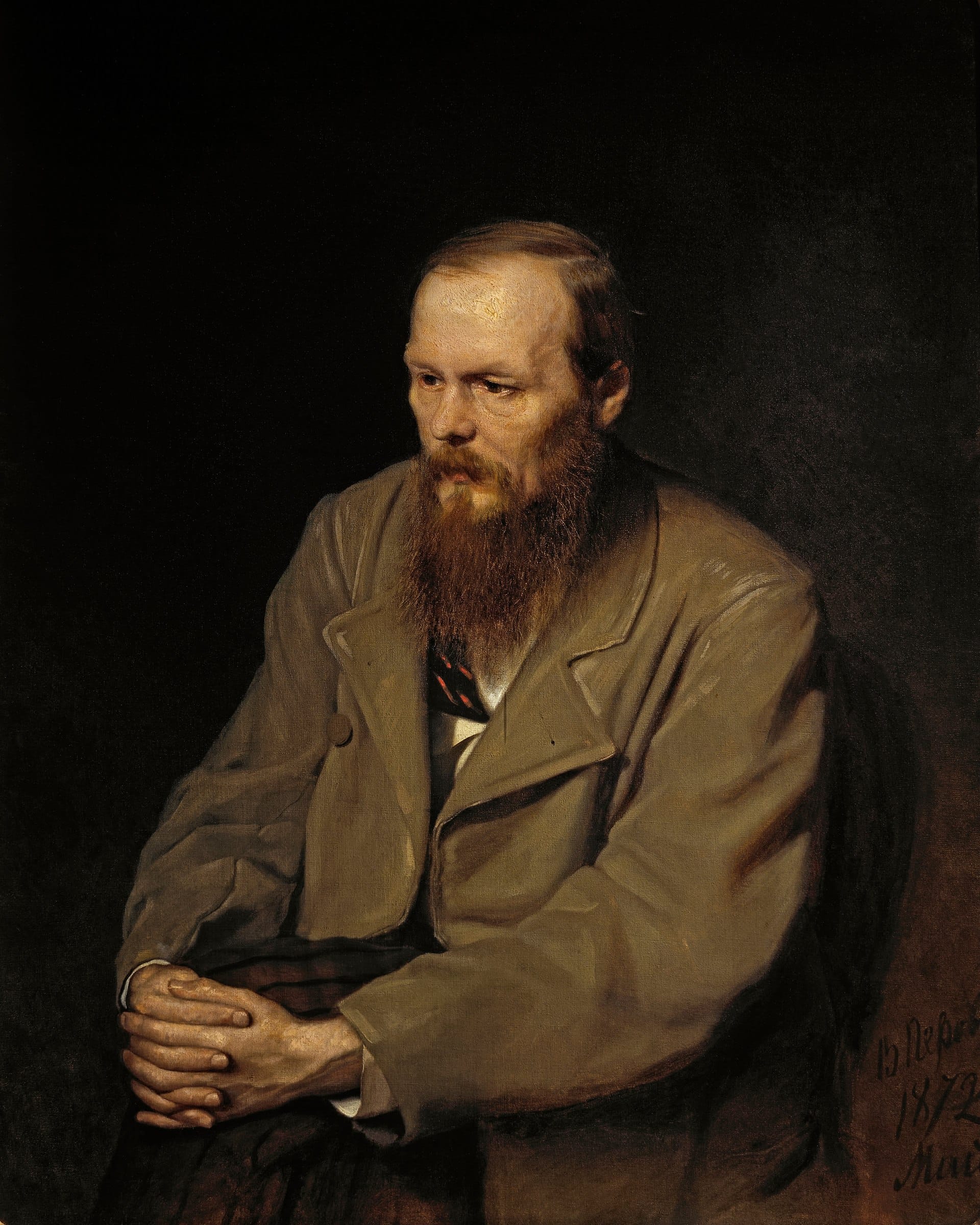
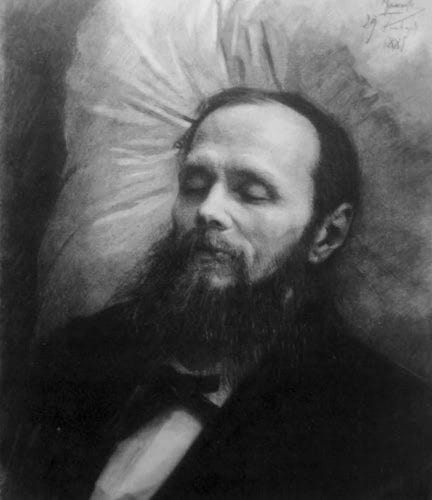
the feeling at the middle (left) and the end (right) of a dostoyevsky novel
So, as a baseline, I think most people have or can understand internal monologues. That's not what I mean, though that is a prerequisite.
But many real-life people, especially those that have gone through phases in their life where they were Raskilnikov (not criminals, not necessarily egomaniacs, but the whole melodramatic shut in deal) would tell you that they both understand Raskilnikov type people and would tell them to shut up.
For me, it was honestly a bit depressing. Raskilnikov reminded me of me in my worst moments. Honestly, a lot of the characters did. Having these strong, abstract, high and lofty ideals is contrasted against the real, practical characters like Rahmuzkhin. Every single one of the lofty idealists (besides maybe the full commune living guy - what he says is weird, but not his actions) is contrasted with the people on the ground, doing good work. Even Sonya - she's devout, but not so devout as to become a pastor, abstractly preaching about goodness and kindness, but blind to the suffering around her.
And isn't that what the lesson is at the end of the book, anyways? (trying to be vague to avoid spoilers).
Though it's not like just "doing good work" will bring you the sort of the "ultimate" that many of these characters seemed to have wanted. Once you try to formalize it and intellectualize it, you can point to how Crime and Punishment is such an illogical novel. And yet it feels so real.
Ah whatever. Enough armchairing from me :)
In my little hometown back in Lithuania we played the game as teens so much that everybody knew the optimal strategy, and it was more about either sheer luck, or who misremembers other people hands.
A bit like checkers after a certain level.
Everyone who knew Lermonotov personally thought Michel was a massive asshole. His biggest hobbies were destroying existing relationships by seducing the women and badmouthing everyone in his vicinity.
The classics are the cause of reading hate, not the victim.
I only learned to appreciate Tolstoy as an adult though - it was extremely boring for me as a teenager barring some smaller pieces
I was generally an avid reader as a child, regularly blowing through the (age appropriate) summer reading lists every year as far back as I can remember, and then finding new things to read. During the school year when I had a 9pm bedtime, I would regularly bring a flashlight to bed, pull my blankets over my head, and read until much later. But The Idiot was tough, and I don't think teens should read books like that.
I've considered re-reading it as an adult, but I still have some scars from my first read-through, even if those scars aren't fair to the material at all.
The only problem is the language.
Less famous authors? Everything you say and more - again, just like any other books and author.
I didn't like the flow of translation of Bengali versions of "adult" books, and read them in English.
My favourite Russian writer has to be Bulgakov who fell from grace of the Party, and his work was not translated. I am yet to read Solzhenitsyn.
Nowadays, there are indie blogs that scan and preserve those Bengali books. A lot of people I know download and print those books. You can still find Moscow-printed Bengali books in used-book stores of book fairs.
Of course, that "just" is doing a lot. I'm saying it's doable, not that it's easy.
There is also the role of simply communicating to the next generation that society values these books, and they are important for some reason. Even if you only get one shallow layer of meaning at the time. Same with history and everything else. It's a time to get a first taste of what these things feel like.
That's how you get to understand something you "barely understand". You dive into it, and gradually you understand it better.
I understood classic novels in high school just fine. Further experience reveals more layers, but you still get lots of life lessons, and poetic moments, and better grasp of people and life, and introduction into a culture that's not just consuming slop, from reading them as a teenager.
So the question really is how does one find out about classic writing overall? Outside of school?
Leftist parts of society looked up to USSR a lot, and a lot of humanities professors, teachers all over the world were left-leaning, and promoted these books as Russian culture.
This is one factor, and doesn't explain the whole thing, of course.
See: https://news.ycombinator.com/item?id=48673777. Neither our family nor I ever leaned towards the Party or any form of Leftism, but books are always kosher in our culture.
Like "Mrs. Thatcher", "Margaret" and "Peg"?
A non-Russian speaker is going to be confused when the same character is referred to as both Alexander and Sasha, for example, and will think they're different people.
Just because you aren't ready for it doesn't mean it's bad literature. That's basic.
I really like Dostoevsky. He was really onto something. What he wrote was deep and meaningful and profound.
Tolstoy is also great. His short story "The Three Hermits" (1885) profoundly impacted how I look into these things.
Giving them the option to do so in school, I would imagine would be met thankfully by them if done well, and a "no thanks" from the less-bookish - who very possibly will go on to read them later on in life.
The whole point is to read the actual primary text that has been so done, re-done, overdone. And hopefully to recognize there's some real beauty and drama in there
My liberal arts classes in college didn't involve Russian lit either. My freshman year English I and II classes were very unserious, we read Philip K Dick and a (somewhat distasteful) book by the current governor of Maryland. I could have taken a Russian lit class but instead decided on Appalachian studies which was surprisingly interesting and probably helped shaped some of my politics. I did read A Day in the Life while I was taking summer classes. Admittedly, I was on Adderall at the time which led to me reading at a rate that matched when I was a kid and was tearing through books faster than I could get to the library. I listen to a lot of audiobooks now and miss when I had the attention span to actually crack a book (or at least use a kindle). I've got a copy of Crime and Punishment in my queue but I've been reluctant to start it.
(My first grade teacher in the 80s was named Margaret, but went by Peg with her students' parents, so I know this one. I wouldn't fault most native English speakers under the age of 35 or so if they didn't know it.)
Do you have any sources for that? I'd like to read about it.
Isn't that exactly the idea? Ask everyone to spend time reading a book is a way to give them time to do it. So that some may discover they are bookish. As for the others, it doesn't exactly hurt to try.
The kid who played Joffrey on game of thrones also always came across as a very smart, thoughtful kid, he just played an intensely hateable character. Similar to the actor who played Marlo in The Wire, I saw him host an actors roundtable and had to blink twice "wow, one of the scariest villains in a gritty show is actually this cheerful, charismatic guy.
I don't think all actors are smart, and I certainly think some actors think they are smarter than they are, but I don't think being smart hurts if you're an actor.
so do the other literary traditions I guess. What's so special about Russian. It seems as if the interest in Russian literature comes at the expense of the others.
https://librivox.org/crime-and-punishment-version-3-by-fyodo...
(FWIW, it lists: Sasha, Sashka, Sashulya, Sashenka, Sanya, Sanechka, Sancho, San, Shurik, Sashunya, Sanyusha, Sanyok. I myself have heard native Russians use Sash - should be written as Сашь -, and e.g. Mish - Мишь -, which is a similar "lazy" conversational short form for Misha/Mikhail.
I've learned some Russian, and once you start sensing the endless magic they can do with verb prefixes and sufixes, you realize what a versatile language this is. Somewhat the same counts for first names, I guess.)
I've been reading Tom Clancy recently, and that's basically the Jack Ryan books. Somehow, "Jack" is actually a nickname for "John".
I'm bad with names to begin with, so I usually make a chart to keep side characters straight.
E.g. Dima (widely used in modern Russian, and it’s clear that it’s short for Dmitry) instead of Mitenka or Alex instead of Alyosha (Lyosha is commonly used in Russian, but Alex would be easier to make a mental connection... until you have an Alexander and have to shorten that to Sasha; that one is probably a more widely known diminutive though)
The best part about Tolstoy is how he depicts the intricacies of human relationships, and that's a thing most people cannot appreciate until they hit like 30
Note: these are written without soft sign a the end: Саш, Миш.
https://librivox.org/crime-and-punishment-version-2-by-fyodo...
There are lots of similar names, and the seemingly random use of full names, first names, last names and nicknames, throws off new readers.
There are also just a lot of characters.
The recall of words you aren't familiar with tends to be pretty poor. This is also visible in how hard it can be to build vocabulary when learning a new language, and how you can completely mix up words at that stage - there's nothing about names that makes this any easier.
Ipso facto:
Bill = Billiam
Mutatis Mutandis:
Jim = Jimothy
To add confusion, the choice of which to use is usually context-dependent (time period, age, status, situation, relationship between characters) but sometimes the author will switch between, say, title and surname within the same paragraph simply as a matter of style or to avoid repetition.
The author Jack London was originally John London. John F. Kennedy was familiarly known as Jack ("Senator, you're no Jack Kennedy"). The British racing driver John Stewart is far more commonly known as Jackie Stewart. In Patrick O'Brian's naval fiction, Captain John Aubrey is almost always referred to as Jack.
That has never made one iota of sense to me. The whole "Dick" / "Richard" thing makes more sense than "Jack" / "John" to me (and it's nonsensical, too).
Only issue I recall might be with female Aleksandra (abbreviated to Ola) and male Aleksander (abbreviated to Olo, or Olek).
Others usually (if I remember correctly) have similar prefix.
So, Aleksandr-Aleksasha. The dropping of "Alek" is the only inconsistent part, on par with Agrippina-Agrusha-Grusha.
One of the potential diminuitives for "Aleksandr" is indeed "Lesha", although I think it's more common as a diminuitive for "Aleksei"?
- Jehan (Old French form of "John") -> Jan
- Jan -> Jankin (diminutive)
- Jankin -> Jackin
- Jackin -> Jack
This does give me a reason to preserve some fact about one of my favorite cats ever in perpetuity (given the similarity of the John / Jack transition to Joe the Cat's life).
A friend's cat (who I knew as Joe the Cat) went from being called "Ivy" to "Joe" over the course of the cat's 15+ year lifetime by way of being called, successively: Ivy --> Jivey --> Jive --> Java --> Joe
Joe was calm and compliant, and arguably "a good kitty" (albeit I only knew him late in his life). My friend once described Joe as being more frantic in his youthful vigor but being "pacified through years of routine and systematic abuse".
No, my friend and his and his family didn't actually abuse Joe the Cat. He was much loved. I get to use the phrase "years of routine and systematic abuse" in my life (as often as possible!) now, though (often referring to my experiences with various pieces of software).
It's archaic, used in Peter I times. Modern one is Kolya