I think theyre absolutely needed. I can't afford 200 USD a month for personal use of coding AI, and I don't think such prices are reasonable for most of the world economy anyway. Not to mention US firms might be giving their employees a lot more than that.
It's increasingly feeling, to me, that theres a gap building up between haves and have nots. But then, we get news of these open weight models that are reasonably priced in inference with reasonable capabilities. Yes, they take maybe 6-9 months to get there, tbh, that's not a bad trade off at all.
But the reasoning traces became increasingly hilarious, with it getting confused and going in loops, doubting itself. I began to feel almost sad, it was like listening to the internal monologue of someone with anxiety disorder.
It made pretty good progress but wound up going in a lot of goofy loops and doing things a bit "off" from standards I'd hoped it would infer, and finally started going a bit nuts, "This is very confusing.", "OH WAIT", seemingly hallucinating a whole side-quest that didn't make sense and looking at making internal system changes to try to achieve its (now very confused) goal when I pulled the plug.
Without seeing the reasoning traces from Claude/GPT it's hard to really know, but it definitely didn't feel like the same quality of reasoning, even if dogged persistence does wind up actually working eventually.
Perhaps it is just my harness and workflow, but the older model still seems to work better. Also the token cost is significantly lower. I rarely spend more than $20 a week with $50 cap. Not even half claudes ambiguous minimum $200 a month plan.
Being willing and able to reconsider seems very good. Going around and around, pulling in more thinking, integrating it: maybe that's why it is as good as it's good.
I want to emphasize again how excellent it is that we can see the thinking. I think this makes GLM so much better an experience for me. It gives me such insight into what is being considered, helps me see where things go wrong. It grounds me, gives me the notion of where the results come from. It was so jarring to switch to GPT and Opus and find that they won't discuss with me, won't reveal their thinking: that feels fundamentally unsafe, for me, for society, to have such a severe black box. I don't think it should be allowed, honestly.
Many thanks to this recent submission, which is the first time I've seen anyone blog about this core difference: The text in Claude Code’s “Extended Thinking” output is not authentic. https://patrickmccanna.net/the-text-in-claude-codes-extended... https://news.ycombinator.com/item?id=48630535
Has a very race-to-the-bottom feel to it.
Though in the grand scheme of it, $200/mo probably isn’t the real price either. Also looking at it not just in a vacuum - paying for a product that can change what you get from under you doesn’t seem great anyway.
At least with a locally-hosted model you know what you’re getting.
0. https://openrouter.ai/compare/z-ai/glm-5.2/anthropic/claude-...
Do you full on let GLM5 get stuff done on its own or is it more like a guided workflow? The former's what the point releases doubled down on and is also something that uses a lot of juice.
I do not trust any of them. Everything runs inside virtual machines, not just the sandboxes provided by the harnesses. I also do not run Claude or Codex directly on the host machine. Not just because of supply chain fears, but also because of how incredibly user hostile the VC funded companies are when it comes to installing random stuff on your machine.
It may wind up being a massive boost to them in the long run, even.
Necessity is the mother of invention.
The differences between the models are minimal, but I usually stick with gpt-5.4-mini, gpt-5.4, mimo-pro-2.5, deepseek-v4-pro. These latter ones have way more usage than even using 5.4-mini so I tend to use them in personal projects for that reason.
My harness is https://github.com/can1357/oh-my-pi. I trust it...enough. It updates very frequently so as a safe guard I run it sandboxed with https://github.com/containers/bubblewrap so it can only access the project folder and some whitelisted config files
For coding I still use 5.5 w/ Codex and prefer that to other models + harness combinations.
Is 2 better than x.ai
I gave it some simple code porting exercises and watched dumbfounded at the reasoning, which was more like the ravings of a lunatic - but lo and behold, after much confusion and a dizzying number of eureka moments the task was completed very successfully.
I tried Kimi on a similar task, much faster, a little more reassuring somehow in its ramblings, also surprisingly good results.
To be clear, I’m not surprised the results were good because they’re not GPT or Claude, but because the line of reasoning was so bonkers. Coming from Claude, I was just not used to seeing this, but I’ll bet it’s just as nuts with the frontier models and we’re just not allowed to see it (I’m about to read the links you shared).
Agree wholeheartedly that transparency is of grave importance.
I subscribed to their max plan to try it out. It counted me 700M tokens and drained my weekly quota in under 2 days.
Quota just reset less than 24h ago and i'm already >60% weekly quota usage.
For reference the kind of work i did would have used somewhere between 3% and 5% of Codex max or Claude max.
The model is good, the plan is a scam
I do think the Chinese models are good enough for an 80/20 rule use case.
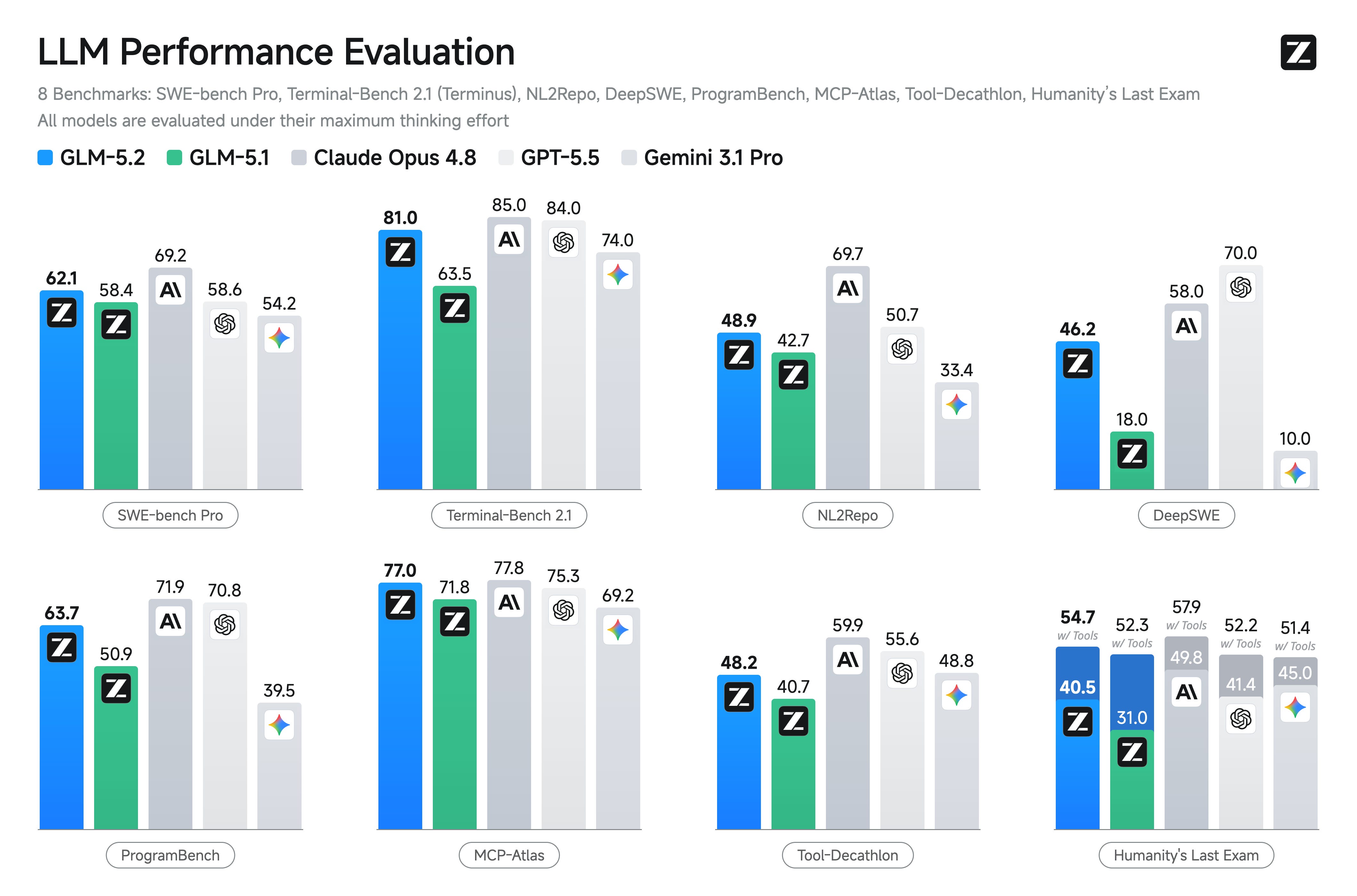
1. SWE-bench Pro
Model Score (%)
GLM-5.2 62.1
GLM-5.1 58.4
Claude Opus 4.8 69.2
GPT-5.5 58.6
Gemini 3.1 Pro 54.2
2. Terminal-Bench 2.1
Model Score (%)
GLM-5.2 81.0
GLM-5.1 63.5
Claude Opus 4.8 85.0
GPT-5.5 84.0
Gemini 3.1 Pro 74.0
3. NL2Repo
Model Score (%)
GLM-5.2 48.9
GLM-5.1 42.7
Claude Opus 4.8 69.7
GPT-5.5 50.7
Gemini 3.1 Pro 33.4
4. DeepSWE
Model Score (%)
GLM-5.2 46.2
GLM-5.1 18.0
Claude Opus 4.8 58.0
GPT-5.5 70.0
Gemini 3.1 Pro 10.0
5. ProgramBench
Model Score (%)
GLM-5.2 63.7
GLM-5.1 50.9
Claude Opus 4.8 71.9
GPT-5.5 70.8
Gemini 3.1 Pro 39.5
6. MCP-Atlas
Model Score (%)
GLM-5.2 77.0
GLM-5.1 71.8
Claude Opus 4.8 77.8
GPT-5.5 75.3
Gemini 3.1 Pro 69.2
7. Tool-Decathlon
Model Score (%)
GLM-5.2 48.2
GLM-5.1 40.7
Claude Opus 4.8 59.9
GPT-5.5 55.6
Gemini 3.1 Pro 48.8
8. Humanity's Last Exam
Model Base Score (%) Score w/ Tools (%)
GLM-5.2 40.5 54.7
GLM-5.1 31.0 52.3
Claude Opus 4.8 49.8 57.9
GPT-5.5 41.4 52.2
Gemini 3.1 Pro 45.0 51.4
Seems to be handily beating Gemini 3.1 Pro. What _is_ Google DeepMind doing (other than bleeding talent to A\ ) ?Will they still rent out their own model, will they support the open model and become a resource provider? Will they be able to repay the billions of dollars ?
This is probably the first question I would ask someone from Anthropic, if I ever meet one.
At the end of the day, open weights should be seen as nothing more than information (just more just numbers afterall), and so organisations like the EFF should sue for any restricting of the 1st Amendment
apparently Chinese language as token is more information dense than English, so having these wasteful thinkslop in Mandarin isnt that damaging. So the developer focus mostly in Mandarin and didnt think of handling these thinkslop while American AI labs do.
People speak of a permanent underclass.
https://www.nytimes.com/2026/04/30/opinion/ai-labor-work-for...
Been playing with GLM 5.2 in different contexts. It's less good if you don't max out thinking, but as xhigh it's been able to solve most problems I was throwing at Opus in the about the same amount of time (via OpenRouter).
Wild time to be alive.
He's sitting on a frontier model letting it burn a hole in his wallet that could actually pay for itself.
Now I see the issue clearly! But wait... now I have the full picture! But wait... Found it!
I gave up a few times because of it at first until I realized I just had to let GLM get on with it and what came out was great!
But once it was outright endearing- challenging bug, it said: I have been very thorough. Then it escalated where to look and aced it. Built in confucian values
Which of course causes some unfairness on both ends. Nobody here can compete with me. I often use left over tokens on local client projects; which despite lower pay, still pays off because they now take hours not days or weeks to complete. And nobody in the local clients talent pool can compete with me; unless they charge about half the market rate.
Take away my 500$ monthly grant; and I’d be more or less screwed. Better open models will more or less start to reduce this advantage. It’s not like I positioned myself here on purpose. But it’s definitely a „right place, right time“ situation.
Seems to me that going slow is the better long term tactic. China can just let the USA pay the high R&D costs to figure out what works, then just copy what works.
Just costing them a lot more money as they pay multiples more buying on the underground grey market.
OpenAI already charges enterprise users a premium purely for that title over on-demand, no-contract usage. Retail users get a good deal. People make a lot of hay about subsidies but this is a very sane approach if you want exposure to these three different types of customers.
If that was true, they would be collaborating with each other and opening up all the results from their work.
Consider debugging - you start off in one place, think you have worked out what is happening, and then there is a "oh but what about xxx" thing that happens and you explore another branch. Then you "have it for sure" until you find another edge case.
The LLM is doing something analogous. It's writing circuits to try to emulate your program. Each time it gets one that seems right it is very sure that circuit is correct, but then it finds another thing.
At any point you can stop and go "write code now" and it will, and the code will seems fine provided it hasn't hit one of these edge cases.
Turning up thinking time is literally forcing more exploration.
The words that come out are amusingly dramatic, but... TBH when I debug I often are like "WTF" and throwing my hands up in the air at some gotcha I didn't expect.
> What provider do you use.
OpenRouter with pinned DeepSeek provider or OpenCode Go > Why do you trust it with serving full quality?
Quality seems good so far. > What harness do you use? Why do you trust it not to have malware (most harnessed are TS apps).
I wrote my own. A minimal harness without dependencies is only 65 lines of Python.And when i can use it, it just drains the quota 5 times faster than codex or claude.
Their plan is a scam
If it is needing to generate that many tokens to do the same tasks, then it probably has higher inference costs. So (for you) the model is bad, the plan is the same plan.
"Make a pac-man game in a single html page"
It went off and argued with itself for 20 minutes about how to lay out the map and then timed out.
1. My own harness + Local (which usually means Qwen3.6-35B-A3B), I use this fairly often for research gathering on topics, info gathering on code bases, etc.
2. My own harness + DeepSeek v4 Flash served by DeepSeek, I added $20 quite some time ago and somehow still have $18.77 in there after I don't know how many prompts. I use this pretty often, slightly less than my local setup, it's great and what I'm planning on running locally (eventually).
3. My own harness + OpenRouter with whichever model I want to try out. I use this very rarely.
4. Pi + OpenAI Codex $20 subscription. I don't use this almost at all anymore, but I keep the Codex subscription for testing things out to see how GPT-5.5 will handle a problem the other setups have issues with.
> Why do you trust it with serving full quality?
The only thing I've noticed seems unbearably useless sometimes versus what I noticed before was GPT-5.5 which has had some of the weirdest degradations I've seen. It's not to Anthropic levels but it definitely had some service issues a few times where I was wondering if they had accidentally (or purposefully) lobotomized it.
Everything else has mostly just been the same, except DeepSeek I noticed had some speed issues a few days ago.
> What harness do you use? Why do you trust it not to have malware (most harnessed are TS apps)?
I pretty much only use my own, agents are trivial to make and it's definitely not hard to make one that's better than Claude Code or Codex for whatever you're doing.
The downside is of course that they consume many more tokens off your plan, and also that they are significantly slower. Kimi K2.7 takes about 7x longer to finish the same benchmark tasks as DeepSeek V4 Pro on my router benchmarks (https://role-model.dev/).
So for now I'm happy with just two models: GPT and DeepSeek.
Yesterday I compared Deepseek, Kimi 2.6, MiMo 2.5 and GLM 5.2 for the same task (replace a custom token-based auth scheme with a cookies-based scheme across a front- and back-end codebase).
I used Opencode with the zen subscription to try different models.
All did this perfectly, basically indistinguishable from each other. However, when I pointed out that the new cookies-based auth didn’t allow multiple independent logins across browser tabs (which the previous scheme did allow) I noticed this:
Deepseek, Kimi, MiMo started giving me multiple options but advocating strongly that I should either accept this deficiency, or don’t use the cookies version (keep the old auth scheme). They were so similar it was as if they were all the same model.
Only GLM 5.2 said “here’s how to use cookies and also have tab-level separation”. The difference vs the other models was very stark.
At work I'm struggling to keep my claude bill around $500.
I started noticing those in gh copilot right around when they turned off thinking traces end of last year
I was thrilled to have Gemini Ultra for a month and use as many Opus tokens with AntiGravity as I could use, but I am happier using less capable models like DeepSeek knowing that it is more fun to do more of the work myself, it is a smaller hit on the environment, and incredibly cheaper.
Also if you run the “loops” they’re now yapping about, it will burn through enormous amounts of usage as well.
"Meta has been using Google’s Gemini large language model for most of its moderation and customer support, but staff have recently been told to switch to Meta’s new foundational model, Muse Spark, the people said."
https://www.ft.com/content/39251a31-4a9d-4870-b86c-dc6353d67...
I feel like it has been pretty visible about what’s happening, between their press and products and financial statements. It’s just not what people are accustomed to expect.
First, Google has become a major compute provider for competitors, thanks to TPUs. They’ve talked about allocating TPUs to GCP instead of their first party products. I can only assume it’s because they’re collecting a higher margin, and it covers the cost of data center buildout - which they’ve been aggressively doing. I wouldn’t be surprised if they made the financial decisions to delay or slow training for Gemini 3.5 when they provided last minute compute to Anthropic this spring.
Second, Gemini has very directly not been focused on agentic coding, maybe 3.5 Flash being the change. They’ve built models they can deploy to watch YouTube videos, Nest cameras, scale to AI in search, understand fitness info in Fitbit, etc. They’re very clearly not focused around agentic/coding. They’ve put in a ton of efforts into multimodal data in and out, and they’re the only major lab working on video generation still. There was leak/rumor that their cofounder (brin) was getting involved in the model training to renew focus on agents so maybe this will change, and again 3.5 already feels different.
Anthropic rents GPUs from xAI to run Claude. If there's an open weights competitor to Opus, why wouldn't Elon host it directly?
Open-weights perhaps, but definitely not self-hostable – since those require $20k+ capex – which is the real "step change" to me, as it ends the stranglehold providers have over censorship.
The only silver lining would be increased competition in API providers of those open-weight models leading to truly affordable prices and a race to remove stupid "safety" checks.
It goes pretty quick, but it's still a great deal. Highly recommended.
Mind if I ask you for a few vibe coding tips? I failed to solve you gh puzzle in the profile though.
Are my little hacks as effective as OpenCode or Claude Code? No way, but I am learning a lot and having fun.
The Chinese are genociding Uyghurs as we speak, purely for being Muslim, in numbers that dwarf any harm the US has done.
The LLM in a box is something you can buy today, but it 1. doesn’t serve over usb by default 2. costs $100k for hardware (not counting electricity) at 100 tps 3. can’t buy this from AliExpress.
Better to put that $100k in t-bills and just buy tokens even at api prices.
A NYC dev and a dev in india have the same ai costs, based the ratio tokens/salary it becomes less of comparative disadvantage to be in NYC.
Now combine that with the fact that AI makes the act of generating code less a % time of the job, and the ability to get/refine requirements more of the job and you have a decent shift.
I haven't tried deepseek yet, i should check this one out.
1. DeepSeek V3.2, V4 Flash, V4 Pro, at high or max thinking, ... when recommending a model it should always be a precise model, not just an AI lab
2. DeepSeek V4 Flash at max thinking is the most verbose model (among top models) in the AA benchmarks. See the "Intelligence Index Token Use" chart: [1]
[1]: https://artificialanalysis.ai/models?models=gpt-5-5-high%2Cg...
This depends a lot on how you work, and how much of the architectural thinking you do yourself.
People seem to lose sight of the fact that a flash model today is as powerful as a frontier model from a year ago. If you were happy with GPT 4.x, you should be ecstatic that equivalent power is now basically free...
someone did a webcam + agentic + capture of other computer bios/boot -> upload to image model -> back to agent
It's neat, I guess, that we can compare them against models released last year, but I care about my options today, and the pareto frontier is about as far away as it ever was.
Add on top of that the extra features OpenAI and Anthropic have in their apps and...
The list of wars the US is or was actively involved in[0] is SO LONG that the Wikipedia page is split into multiple different pages.
The main relevant ones are 20th[1] and 21st century[2], for which you better get a good grip on your mouse to scroll down.
I urge you to use your favorite AI to give you a rough summary of direct and indirect casualties of just those wars directly caused, started, or provoked by the US, from these lists.
For example, the "war on terror" alone has, so far, seen around 4.5–4.6 million+ people killed, and at least 38 million people displaced.
[0]: https://en.wikipedia.org/wiki/Lists_of_wars_involving_the_Un...
[1]: https://en.wikipedia.org/wiki/List_of_wars_involving_the_Uni...
[2]: https://en.wikipedia.org/wiki/List_of_wars_involving_the_Uni...
The sonnet tier sits below claude or chatgpt in terms of price but costs so much more than free models. If you are breaking downtasks now I'm not sure that 13 cents is worth it.
It's been awesome for embeddings and document OCR!
3D printing a case for it is on my todo list.
https://amnesty.ca/wp-content/uploads/2024/12/Amnesty-Intern...
Nothing China did comes close to this.
I’m using Qwen3.6:27B at home and mostly Sonnet/Opus (depending on the complexity of the task) at work.
You have to break things down into smaller chunks for the local models. For the bigger cloud ones they can do a lot of the broader thinking.
its not, this would require voted resolution to declare genocide. It was some report on inquiry by individuals with unknown bias.
I've been fooling around with DeepSeek 4 agentically. It's probably not as good as Anthropic offerings, but even those seem to be roiled in politics and strife and DeepSeek 4 is very good IMHO. I'll later try out GLM.
I'm in Australia. The government has set up a "return and earn" scheme to keep aluminium cans, plastic bottles and paper drink cartons out of the waste stream. A laudable project. The money you make from return drink containers is pretty low, $AU 0.1 per container. I've participated to get the rubbish out of natural water streams and to make a nano amount of money on the side.
When I looked at the costs of an app I was getting DeepSeek to help me with, I realised that the several hours I'd spent learning and building had cost something like 8 recycled containers. In my head after doing some DeepSeek stuff, I calculate a "cans per app" metric for myself for fun. I may even setup a simple graph to view my costs that way.
I kind of hope the Anthropics of the world get enough price competition from sources like DeepSeek and GLM to drop their prices significantly. Time will tell.
I'm using the Chinese DeepSeek provider, so everything done there could potentially be taken and used by the CCP... But this is hobbyist learning.
There is probably a market for Deepseek/GLM served from non CCP available servers. I might even look into how hard that would be to setup here.
I also hope that inference focused hardware will come to the fore, reducing energy use and cost. Realistically this will take time though, on the order of years.
Here in Oz, we have community batteries that community members can charge and later draw from. Their electricity prices are competitive. I wonder if someone could setup something like a community battery to run data centres... That way reasonable environmental consideration could be given to inference power generation... This might not work in a market like the US or Europe, but small market size might be an advantage... Who knows.
Please do. There is definitely a market for Deepseek / GLM hosted from non-China servers, there's over 20 providers for GLM 5.2 on OpenRouter alone... and they're all either Singapore (home of Z.AI / GLM), China, or US. There is nothing yet listed on OpenRouter from Europe (Inceptron still only has GLM 5.1). And of course, there is absolutely nothing hosted in Australia.
We're in a particularly dire situation in Australia. We're about to be cut off from Claude Fable and premium American models. The European Mistral models are garbage, at least in comparison to US models. Our only hope is going to be Chinese models (GLM 5.2 is good), and we're not even hosting them in Australia.
By the way, if you haven't tried an Anthropic model, it's worth spending at least $20 one month to give Opus 4.8 a try. I only got one night of access to Fable before I was cut off, but one single evening of Fable provided plans that I've been working through for about a week afterwards with Opus 4.8... and that was only Fable, not even Mythos. That's the kind of intelligence lead Australia is about to be cut off from.
(And kudos on the Containers For Change, that's something I do as well - mostly as an exercise incentive to walk to the local recycling machine, because the money certainly doesn't compensate for the time spent on the recycling.)
As opposed to Anthropic or OpenAI where everything done could potentially be taken and used by the US government.
Also, replace "could potentially" with "will definitely" in both cases, there's no conspiracy here.
We're stuck between two bad positions, so just use the one that's best for you, and wait for a better solution to arrive.
Jeremy Howard was recommending fireworks.ai as a host of you want to go direct. Or there's Cloudflare.
For subscription alternatives people here on HN seem to mention Open Code Go a lot too https://opencode.ai/go
Why don't you exclusively host and use the open-weight western models, even if right now they don't perform as well?
I'd like to know the psychology behind this, because your actions feel contradictory to me.
I don't think that's true. When I look at GitHub's incident history,[0] it doesn't read to me like a company that's struggling to cut costs. It looks like a company that's trying to do a million things to serve a million use cases, and the growing interconnections between all those distinct services and workflows cause unexpected failures.
(Speaking as a not-so-proud Australian.)
So two European providers at least
I also released a new paper today on open RL recipes for terminal agents, read more here.
A bit over a week ago, when the AI world was still reeling from the shocking export restriction, and effective banning, of Claude Fable 5, Z.ai released their latest model, GLM-5.2. This model was rolled out unusually on a Saturday, June 13th, to GLM Coding Plan members. This is an unusual release practice, normally when an AI model is released on a weekend it’s for a weird reason (most famously, Llama 4).1 In this case, it seemed like Z.ai was excited to capitalize on the zeitgeist of “Anthropic being anti open-science” with their silent safeguards on AI researchers. For the past year or two, the Chinese open-weight labs have taken every opportunity they have for easy marketing wins like this.
GLM-5.2, in a common naming convention across the industry, looked potentially like an incremental update following the popular GLM-5.1 model. At this point, Moonshot AI, makers of the Kimi models, and Z.ai, makers of the GLM models, have consolidated the top of the reputational market with the most beloved open-weight models among AI researchers. What unfolded is a common lesson in tracking AI models that often minor version numbers can have AI models crossing meaningful user experience thresholds. A small change in benchmarks and training can open a wide range of new use-cases.
What has followed is a slow, groundswell of hype for GLM-5.2. The official, MIT-licensed model weights and release blog dropped three days after the initial rollout, on June 16th. One could ramble many technical details, such as the strong benchmark scores, the very popular RL framework that Z.ai uses (SLIME), the recommendation of always using the model on Max thinking effort, and so on, but the initial release blogs usually aren’t the thing to focus on. You can wait and read the ecosystem reaction to know if it’s the real deal. Benchmarks are half dead these days, anyways.
What followed on the 16th was a slew of community benchmarks showing better-than-expected results for GLM-5.2. Arena’s agent leaderboard had it as the only open model mixing it up with OpenAI and Anthropic’s latest models (notably matching Opus 4.8’s no-thinking effort to GLM-5.2’s max mode). This is one of many evals GLM-5.2 is crushing Gemini on, but that’s a topic for another time. A benchmark that has mixed perception in the community (particularly among actual designers), Design Arena even had GLM-5.2 besting Claude Fable itself — the recently banned hype machine!
Pretty much everyone I respect among the AI commentariat and researcher class has praised the model after using it personally. Such a focal point of discussion among the community has only been so clear with an open model release once before — DeepSeek R1. This is not a comparison I make lightly, and when I compared Kimi K2’s release to a “DeepSeek Moment,” GLM-5.2 has well exceeded that. What made Kimi K2 impressive was that big steps in open model performance could seemingly come from anywhere in China. The step that GLM-5.2 has taken is more of a one way door for AI progress.
Anthropic’s record revenue growth rate on the back of Claude Code is heavily driven by being the best model, and the only model that can really do this. GLM-5.2 is the first of many (coming soon) open weight models to offer credible alternatives. The parallel is very clear, to when DeepSeek R1 showed that open-weight labs, with far fewer resources, could also replicate the chain-of-thought reasoning models that OpenAI championed with o1. As AI systems get more complex and far more expensive to build, with tools, integrated harnesses, and scaled model weights, it was not a given that this GLM-5.2 moment would happen at all.
The key point is that GLM-5.2 is the open weight model that feels right in coding harnesses as a general agent. It’s the first one. I was personally overdue in trying some of the recent peer models, such as Kimi K2.7 or GLM-5.1, but the hype was too much for me to ignore. I put it to work helping make content for my post-training course with Fireworks’ API in Claude Code (setting this up was very easy). There were some minor knife cuts, such as the Claude Code harness / my repo documentation trying to send images to the model, which would brick Fireworks API for the session — forcing a manual context clear. Overall, the model capabilities immediately felt right, and I still have some tinkering to do in which harness and inference provider to use.
For more hype, you can sample the Z.ai founder telling Elon that “open-weight Fable capabilities will be here sooner than Q1 2027,” the CEO of Vercel saying “Genuinely impressed, almost shocked, at how good GLM-5.2 by @zai_org is at coding. This changes things,” and much more from a mix of people whose opinions I deeply respect and others I’m new to.
So, this is a good model, where does this leave us?
There are many trends at play. To start, let’s ground things in the open-closed capabilities gap. I’ve written how I expect an “explosion in usage” if open models crossed the Opus 4.5 in Claude Code threshold from around the start of 2026. Here we are. With Claude Opus 4.5’s release on November 24th, 2025, the gap in time to GLM-5.2’s release on June 16th, 2026 is 204 days — or about 6.8 months. This puts us square in the 6-9 month time gap that many people claim as the performance lag between the U.S.’s closed labs and China’s open counterparts.
Upon writing this, I’m surprised. As the U.S. labs have so rapidly ramped compute in the last ~year, I’ve expected the gap in performance to grow in time. A very meaningful step in this trajectory will also be Claude Fable 5’s release — which was more reliant on scale, and therefore the most advanced GPUs, relative to the Claude Opus models. Still, that’s not a satisfactory answer. Continuing to unpack the trajectory here involves more nuance than I can afford to fit in a signposting article.
The most immediate meaning of this is far more serious pricing pressure within the organizations tokenmaxxing, sending Anthropic’s revenue to the moon. Some would predict Anthropic doesn’t realize its forecasted ARR numbers, but I don’t think that prices in the true demand for these models and the inevitable growth. This model existing is a huge boon for the open model economy. All the likes of Fireworks, Together, Thinky (via Tinker), Prime Intellect, and whoever else sells open model inference or finetuning just hit another inflection point.
It’ll take a long time for the effects here to diffuse into the broader economy (and use-cases). Workflows are becoming more complex, with people using different models for planning, primary coding, and subagent dispatch. I expect the hype to continue to grow, and heck, as I’m writing this on a Sunday evening, I could see the media and market reaction on the Monday being a thing just like the DeepSeek R1 release. This diffusion happening while Anthropic’s, and by extension the U.S.’s flagship model, is still banned is a severe economic dagger. GLM-5.2 is being given time to carve out the economic underbelly of the frontier labs when they want to be pushing forward into higher margin, higher revenue domains enabled only by the absolute frontier models.
The economic concern mirrors a story that has been told many times in AI, so it’s unclear when it’ll stick.
The conversation that feels more core to the trajectory of AI is that of regulation and control of open models. I think it is an economic good for cheap intelligence to diffuse widely, and our default position should be to cheer for open models, but this model’s release date will have it be permanently associated with Claude Fable — and therefore Claude Mythos — in the mental map of AI power structures. We are at a point where Mythos-class model capabilities are deemed not safe for release by the U.S. Government and the Chinese model makers are charging forward in capabilities available to all.
These trend lines aren’t necessarily causally linked, as we don’t know the cyber performance of GLM-5.2 versus its predecessors, but the capabilities are definitely correlated. Without anything changing, this points to a potentiality where the U.S. Government decides a certain open-weights Chinese model is not safe for the public. There are many other potential scenarios here too, but what is clear is that we have a lot of work to do in mapping them out, preparing our infrastructure, and messaging to society.
It’ll take a lot more people than just me to imagine and communicate a world to decision makers for how to manage evermore capable open models.2 We have years more of AI progress to come, with Nvidia’s next generation chips already in production and a constant stream of algorithmic advancements. It feels like a narrow path for open model advocates to take, but we need to figure out how to make them viable so the massive leaps in performance don’t only go to closed models.
I totally see why it is scary to imagine an openly accessible Mythos class model, but if open models get banned now and only closed models get 10 or 100X better in 2 years in the hands of one or two companies, I think we will have bigger problems on our hands.
Something that has always stood out to me is how fast the Chinese labs release their models. I’ve heard from multiple labs that the time to upload the weights publicly to HuggingFace after the model finishes training could be measured in hours rather than days. This has at least slowed a bit, now that they need to prepare to serve the model to a wider inference market.
Something that will need to be discussed more is how even closed models, e.g. Mythos preview, are regularly in the hands of unauthorized users or jailbroken. So, the open vs. closed dichotomy on access isn’t totally black and white.