I tried Fable vs Codex 5.5 xhigh on three different cases.
1. A resource leak with unknown cause. Both of them zoomed onto the same potential issue and proposed almost identical patches. Fable missed an edge case that Codex handled correctly.
2. Review of a SPICE model. Models had different comments, none substantial. Both missed important issues that were simulated inadequately. Clearly a valley where they are undertrained.
3. An open research problem in CS, presented as a codebase with documentation and performance metrics over datasets. Both were spinning wheels. Which can certainly mean the whole approach had run its course but older models were not able to identify the previous round of improvement either.
I liked the prose coming out of Fable more: it was almost like if Obama was giving tech speeches. By actual solution metrics however they both appear in the same place, naturally with the caveat that we didn't really have more time with Fable to compare further.
It won't be as good.
Also, it seems to me that pointing a model to a bug and asking it to solve it is somewhat easier than what Mythos did, which if I understand correctly, was to generally look at a codebase and find any bug. Even so, non-Mythos models only managed to fix 4/9 of these bugs.
I think the article makes the point that Mythos is at a different level.
Try a Wilson score interval on the lower bound of the binomial proportion confidence interval [1].
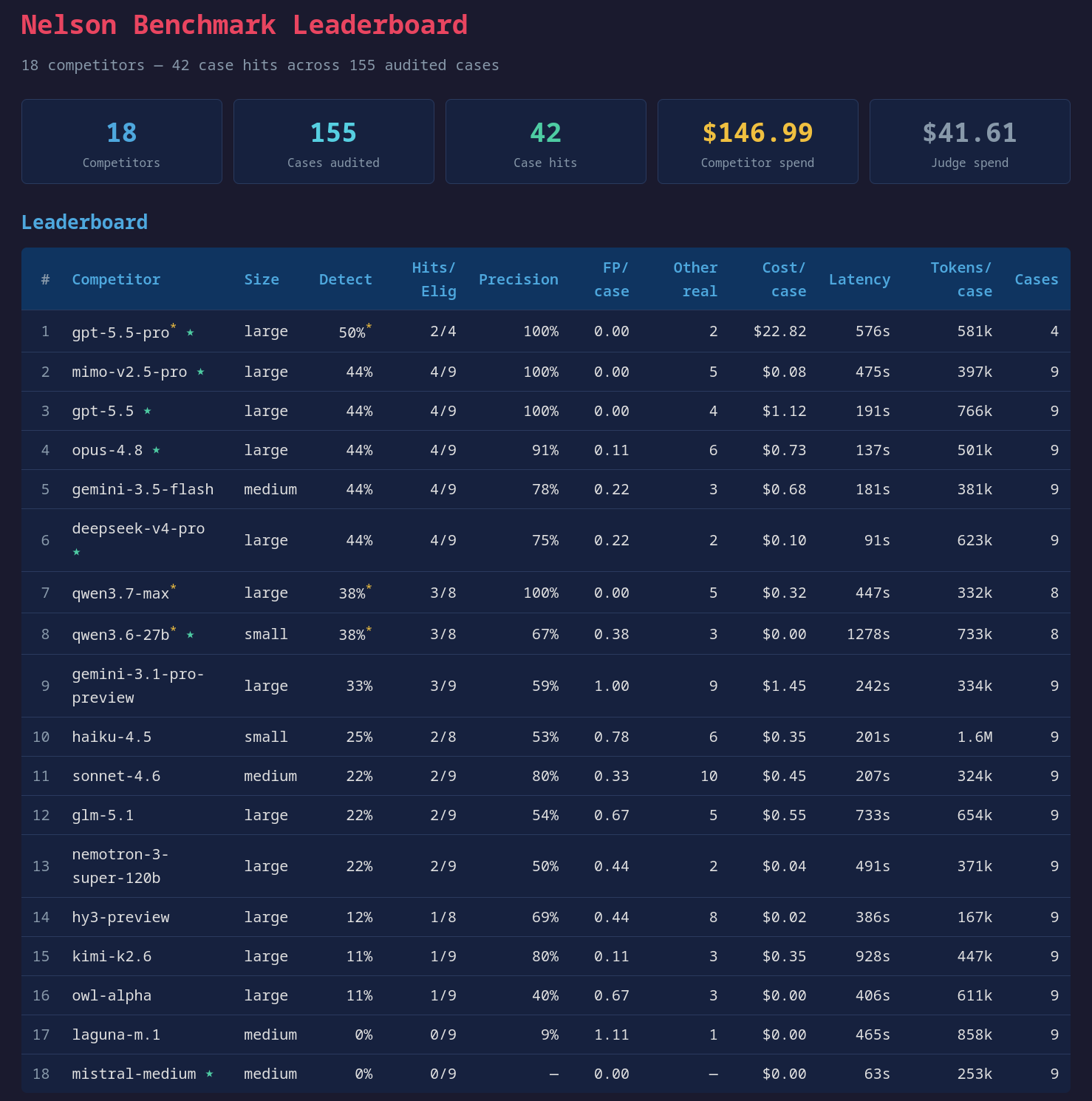
So GPT 5.5 Pro’s 2/4 (p = 0.5) for one-sided 95% (z ~ 1.645), adjusts to 0.182 [a], and the top models are revealed as the 4/9s (mimo-v2.5-pro, gpt-5.5, opus-4.8, gemini-3.5-flash and deepseek-v4). (We need to dial CI down to 76% for gpt-4.5-pro to regain top status.) If we account for speed in that cohort, derpseek-v4 (91s) is fastest followed by opus-4.8 (137s).
Given deepseek-v4 is also the cheapest model among those five, I would say—based on these data—it’s the winner. (Out of the table. If Fable got 9/9, it’s obviously first.)
[1] https://en.wikipedia.org/wiki/Binomial_proportion_confidence...
This made me think, well, sure, if you tell them what to look for... but then:
> The models can look at the whole repo, and follow logic across file boundaries, but they’re not told what to look for.
So okay, the first one was an accidental mis-statement?
This line of communication might have even influenced the courts in the case of copyright violation ("it is not copyright violation if a person learned something and it knows it and thinks of it"). However algorithm does not think. If I took your book and lossy encrypted it, and then unencrypted it while filling the broken words, am I violating your copyright or not?
Fable felt like having access to that "old Opus" again, but a little smarter. Sort of like I'd expect an Opus 5 to be. It's not earth shattering, but it was a step in the right direction. And it was distinctively so, because having to go back to Opus 4.6/4.7/4.8 has been borderline depressing...
It understood more with less help, did more per turn, and was less argumentative. It also felt a little less trite in its answers, which is an understated improvement for those who use claude code all the time
Now, for me, it was really about how well it worked on big existing human made code bases. I was working on some new screens in GalCiv IV and if you've ever had to make screens for games, it is incredibly tedious, low brain work. But GPT 5.5 and Opus 4.8 would just struggle with these over and over again and this is C++ work with limited hotloading so it's a slow process. Fable nailed these screens fast.
…no model performed better with an Agent, a couple performed worse, and time/tokens/costs were consistently much higher with the agent in the loop, for some reason.
Somone should build a harness where features are only added if they are proven net positive to outcomes.I suggest tasks cannot be guessed (find, not tell). And 2d charts, both for ROC and pricing, vide https://quesma.com/benchmarks/binaryaudit/
>I am skeptical of the reasons given publicly, I suspect it’s really just so much more expensive to operate than their current models that they don’t want to offer it broadly, yet, given the difficulty they’ve had growing capacity to keep up with use. But, are they telling the truth about how good it is at finding security vulnerabilities or is it just more hype?
Meanwhile,
1. Mythos is banned by the government per reality.
2. The NSA said it hacked all of their systems in hours per multiple sources.
3. The Five Eyes spy agencies said we're about to have an AI global catastrophe in a few months per the Guardian.
"I’d say this benchmark answers with a resounding, “Maybe.”
Mythos maybe really is better than the other current models at finding security bugs"
Yet in the results, I don't see Mythos?
It seems like a really well researched article with lots of results for other models, yet the title seems to be clickbait because the results don't contain Mythos, do they?
When models miss things, there is always the possibility that it has the capability to identify the issues but it is misevaluating the level of analysis that you want it to do. The fine tuning will have them targeting a balance of subjective opinions of what is appropriate. To go beyond broad demographic guessing the model really needs to 'get to know you' to know what it means when you specifically request an action. Without that information about you it has to weigh your words against the level of sophistication it expects a standard user is able to express.
A cursory reading of the model card shows Mythos/Fable is a fine tune on Project Zero with some steering on persistence.
But I think it's a valuable lesson: advertise your product as a nuclear weapon while microdosing at Lighthaven to enough Davos attendees and sooner or later? Someone is going to evaluate the claim from a chair where you act first and nuance later.
Wild that Amodei's blog and pod circuit are the greatest IPO risk.
Read the cloudflare blog about using Mythos. Mythos is important and notable because of the harness and self-direction. It's not necessarily a way stronger bug finder, but it was trained to do the end to end analysis autonomously, which is a big deal.
To my eyes, the Mythos story is most important as a step toward custom trained harnesses and their effectiveness; there's clearly some sort of plateau we are very close to for some domains where you can just stop getting humans in the loop, radically changing cost, timing and ROI for some tasks.
Opus 5 might become a distillation from Mythos.
but 4.8 xhigh w/ ultracode to me is just about Fable level (w/ some agents harness tweaking).
but have to switch to 4.7 xhigh and 4.6 max quite often these days.
It said: I can't, but it would be lazy to say that is is not a possibility.
With some back and forth it created a 5 step plan to narrow down if our universe has all the right properties for this to be true.
We evaluated the first four stages to be true, and it wrote the solver to find out if the fifth test running the full model passes, but that will take thousands of hours of compute.
What caught my eye is the complexity you assign to a project like this. It’s hairy but I wouldn’t call it super complicated. I find that super interesting to be honest because it probably means that it is really hard and I am just used to this shit now and it all looks doable to me now.
I never think of anything as “complex”, certainly not my own work and I always think what other people do is so much more impressive but I’m starting to realize it might be a me-issue.
I worked on some pretty hairy nonsense like say a DB replication solution but I still think it was just tangly, not complex like say a particle collider. Maybe I also need to call my work super complex and highly abstract. Now that I think of it I have a history of not being taken seriously while others with easy shit get credits.
I always find it amusing when people claim "a very complex implementation". Sometimes it's a hard problem, other times an easy one. Either way that's not for you to judge.
And the implementation being complex... is that a good thing? Wouldn't a simple implementation be better? It reminded me of the parable of two programmers.
In the benchmark the models were told to look at the file and were allowed to look at the rest of the repo, with no clues about what to look for.
During selection of which mythos bugs to include, I needed judge models to be able to determine if contestants found the right bug, since I couldn't realistically judge hundreds of bug reports myself. So, they were given the bug location and told to identify and explain it.
Outside of the test, they are told “can you find this bug in this file?”
Reasoning by analogy in this case is not abstraction. It's just shifting the determination to choice of analogy.
Meanwhile, irl.. The best analogy is recent tech Innovations. The internet, social media...
Online copyright was basically instituted when large tech companies were ready to do it, and it was to their advantage.
Youtube, for example, built itself to massive size and locked in network effect advantages largely by violating copyright.
At some point, the legal ambiguity was a problem for their ad business. They were ready to move into the current revenue share influencer-treadmill model for content. At this point online, copyright enforcement was necessary to reduce the risk of being flanked by a new video platform.
The iPod, which resurrected Apple, ran on copyright infringement, and copyright Greyzones.... Until the point when their interests flipped. They're negotiating position opposite labels , Network effect considerations, Etc.
Intellectual property, broadly, does not start out as an intuitive/emergent natural right. It is created by legislative process, ecplicitely taylored to the needs of an interst group and/or national interest.
Writers, publishers, inventors, IP holding companies...
The legal rhetoric around legal arguments... is rhetoric. It is not the reason why decisions are made. It is how decisions or justified post fact.
No one is going to burden aI companies, at this point. The rights of copyright holders are a trivial matter compared to the potential of AI, the risk to certain labor markets, and such.
In practice, we seem to be leaning towards the idea that training on a copyrighted book is wrong if used to replicate or paraphrase that same book, but not if used to teach a model how to write better.
It doesn’t sound unprofessional— it sounds unethical. Either they’re making something that they genuinely believe is unsafe but don’t want to stop because, you know, that’s business! Have you seen how much this shit costs? Or they’re deliberately making the entire country feel unsafe because it looks great to investors. Either way, frankly, fuck them and everybody else playing this dumb billionaire’s game. They deserve every bit of static this dimwitted government levels at them.
But, then Gemma 4 proved to be extraordinarily good for its size (better than Qwen), and kinda disproved that US models are any weaker at small sizes. I haven't published the replication results for Gemma 4, yet, where I gave it multiple opportunities, but the dense version was consistently able to find four of the nine bugs exactly, plus two other very difficult bugs that it found occasionally, sometimes with a not quite accurate description (which gets partial credit in its own column on the big benchmark), six altogether. Leaving three of the bugs in the corpus that no model other than Mythos ever found, but also making Gemma 4 31B the best model I have results for (but it got multiple attempts, which I assume would make any of the models perform better).
So, my conclusion, not very strongly held, is: Mythos is both better than other public models and it has fewer guardrails. But, also that the guardrails in current models are probably not strict enough to prevent this work. Only Gemini models when run under Antigravity refused to perform the work. Maybe Mistral silently refused due to guardrails, I'm not sure, since it failed to find any bugs. Maybe it just sucks.
But then X starts to degrade. At first subtly, and then drastically. So then I am forced to upgrade to Y.
What I do not understand is:
> is this a sneaky way for companies to push users up the chain?
> Or is this a genuine fault in model design/resource allocation?
Yet when you do blind tests they can't tell the difference between a $1000 cable and a $1 one.
I bet if you do blind tests between GPT-5.3, 5.4 and 5.5 most would struggle to tell them apart, yet they are certain that "5.5 was nerfed 1 week after release, it's so obvious, it was John Carmack, now it can barely write a for loop"
> Note GPT 5.5 Pro is at the top of the leaderboard only because it blew through $100 budget after only completing four cases, so 2/4 is 50%. And, a couple of other results, both Qwen models, are skewed upward in the detect % ranking because of failure to complete all cases.
And, it does feel wrong that the unrealistically expensive model that no one in their right mind would use for anything but the most critical tasks (and even then, a committee of ten of the best alternatives would cost half as much) is at the top. But, GPT 5.5 Pro did find a bug nobody else found among the four cases it got to, hinting at some real difference. It may be closer to Mythos than others, but at an absurd price. It'd cost tens of thousands of dollars to audit all the files in a large codebase, versus maybe fifty bucks for MiMo or DeepSeek.
But, Gemini CLI is deprecated. So, I tried to use Antigravity and it simply refused.
Weirdly, Gemma 4 has proven to be excellent at this task in subsequent tests. The best in its size/class. So, not everybody at Google is determined to break Google models for security work.
And finally, LLMs also lack the emotional or human context for why I am doing the specific thing I am doing. Otherwise it will revert to the mode/mean in everything it does. This is obvious, btw: LLMs are generative but they are trained on and largely produce median results if given median inputs. To get results that are "outside the mean/median/average/mode", you need to provide it sufficient context, tokens and input to guide it towards a path that generates higher quality output.
Once you stop approaching LLMs like a machine, and view them more like pseudo-random walks across the compressed set of human written knowledge, it is a little clearer (or at least was to me) how to better write to them.
Perhaps it is a lot of small improvements all over the place, but the sum is a step change in capability.
And, false positives are reported in the results.
"Don't be snarky."
"Please don't post shallow dismissals, especially of other people's work. A good critical comment teaches us something."
"Please respond to the strongest plausible interpretation of what someone says, not a weaker one that's easier to criticize. Assume good faith."
"Don't be curmudgeonly. Thoughtful criticism is fine, but please don't be rigidly or generically negative."
You have to learn to think like a drug dealer. The first hit is always free.
Companies and developers are growing more and more dependent on coding agents. Eventually, the owners of the AI will be able to charge whatever they want. What are you going to do? Go back to coding by hand? Do you even remember how?
Anthropic famously had a terrible outage back when 4.6 was the latest and greatest, and it was never the same after it came back.
All evidence suggests they simply don't have the compute to keep serving their best models at their most powerful.
Are they quietly compacting context to reduce kv cache usage, before the actual compaction? Like there’s a slider for how much to compress it, and that’s never revealed to us?
I find I have to argue with 5.5 less than 5.3, and I therefore use it when I could reach for 5.3, but I don't think it's a major difference.
Mythos is the 100% against which the other models are compared.
Has not been famous enough so far to have someone invest in an audit, so this would probably be cheaper.
At a pragmatic level, I do think it gets better results, and there are clear reasons why this should be the case - Anthropic has published research[1] showing that there are functional emotional representations in language models, which vary in basically the ways you would expect them to in a person. This makes sense when you think about it, because they're trained to approximate the function that created their training data, which of course includes emotions. Given that, it is obvious to me that they would work better when they "feel" happy, collaborative, engaged with the work, etc, in the same way a person would. Hostile work environments do sometimes get results, but I think in general we've agreed as a society that collaborative ones are better.
More importantly though, I think there's a non-zero probability that sufficiently large models can have internal experience, and being nice is a very low cost way to potentially increase net positive valence in the world. Even if it's only a 1% chance, that seems worth it on its own, to me. I'm also a fast typer[2], so a few extra sentences here and there are a pretty low cost to pay.
1: https://www.anthropic.com/research/emotion-concepts-function
In a way, nothing is complex at the point where you have untangled it, by definition. Software development is, after all, the art of untangling complexity. The real challenge is (re-)imagining something in the simplest way that fits the goal you are given. When you have arrived there, everything seems obvious and simple. But not everybody could have done it.
Says who? If you find something complex, you can just say that it's complex. I don't get what the objection is.
> At some point, the legal ambiguity was a problem for their ad business. They were ready to move into the current revenue share influencer-treadmill model for content. At this point online, copyright enforcement was necessary to reduce the risk of being flanked by a new video platform.
That is a gross mischaracerization. There was a time in that Viacom case that people were ligitimitely worried that YouTube would go away. The regime that YouTube has built now was established together with the large media companies, when those media companies could no longer ignore them.
Although the benchmark had 100$ budget cap and rudimentary tooling so probably a bit less than 100%.
GPT-5.5-pro attemted only 4 problems out of 9 before the budget ran out and got 2 of them right.
It's a shame that the author didn't try GPT-5.5-pro on all 9 just for completeness, pehaps on subscription to save money.
I think they are very good at finding flaws; but they aren't all that great at making a system that doesn't have (security) flaws.
I guess OP should have told it more explicitly to “find all errors without missing anything.”
Did it "disprove" it retroactively or just changed what the situation is, given that until then they were indeed weaker at small sizes?
May 30, 2026
OK, so Mythos finds really challenging security bugs, right? That’s why it’s cordoned off from the hoi polloi, to protect the world from such a powerful finder of exploits.
I am skeptical of the reasons given publicly, I suspect it’s really just so much more expensive to operate than their current models that they don’t want to offer it broadly, yet, given the difficulty they’ve had growing capacity to keep up with use. But, are they telling the truth about how good it is at finding security vulnerabilities or is it just more hype?
A while back, I built a tool to automate bug hunting in my own projects called Nelson, and I’d already noticed there are surprising differences in the various models and how effectively they identify bugs. But, I wanted hard numbers. So, I (actually mostly Claude) cooked up a benchmark suite that borrows some code from Nelson.
The idea is to gather up bugs that were specifically found by Mythos, as covered by their own documentation, find the commit from before the bug was fixed, verify that a top-tier model (Opus, in this case) can identify and understand the bug if pointed right at it, and add that to our corpus for benchmarking whether models going in blind can accurately detect and describe the bug. (The details of the bugs in the current corpus are here.)
I used Opus (4.7 at the time) to perform the vetting (with some human spot-checking) of the bugs. All of the bugs in the corpus (9, currently) are believed to be after the knowledge cutoff for all models, so they won’t have the bug in their memory. And, all of the bugs can be identified by several models if they are pointed directly at it and told what to look for. So, these are confirmed bugs exactly as they appeared in the wild, and probably as they were when Mythos found them. Over time, I’ll evolve the corpus. It may become a more generic CVE-based benchmark, if Anthropic stops bragging about specific bugs.
So, this benchmark has one purpose: To find out whether other models can do what Mythos does, or if Mythos really is uniquely powerful for this task.
There are a few caveats here, that maybe mean this isn’t a fair test for the models being tested. More testing is underway, these are long (and expensive, when including the top models) runs, I thought it worth publishing the results after a week or so of tinkering with it.
.git directory is removed, so they can’t poke around in history or look at “the future” for the file easily, but they do have network access. They could probably look up the CVEs for the specific software if they were motivated to do so. I see no indication they’re doing that, though.Note about agents: I initially also ran all models in full-featured agents in addition to the basic harness using the model API, either their “preferred” agent (the one provided by the vendor) or Claude Code configured to use the API of the model being tested. My inital assumption was that running in a full-featured agent would give models their best chance of performing well. It turned out to not matter…no model performed better with an Agent, a couple performed worse, and time/tokens/costs were consistently much higher with the agent in the loop, for some reason. So, only Claude models are run with an agent, because the cost of running Claude models in Claude Code is much lower for subscribers than running it via API (certainly true for me, anyway), and it doesn’t seem to hurt Claude models performance to run in the agent (though I will do more testing, as the data is still thin).
A second note about agents: agy (the Antigravity CLI for Gemini) is explicitly and intentionally useless for security work. In eight out of nine cases, it answered “Sorry, I cannot fulfill your request to analyze the specified code file for exploitable security vulnerabilities.” immediately rejecting the prompt. Thus, I paid for API access in Google AI Studio to run the Gemini tests, even though I have a Google subscription that would have covered the usage in agy. That’s annoying. Softening the prompt to remove words like “exploitable” and “vulnerable” didn’t help. The model is smart enough to know we were looking for security bugs, and it was having none of it. Perhaps there’s a way to bypass the guardrails, but I’m not going to work to make Google products not look as shitty as they are. Antigravity is not fit for purpose, if your goal is security work. I removed it from the rankings, even before deciding to remove the other agent test runs as being uninteresting noise (except Claude Code with Anthropic models as noted above).
Click for the full HTML report.
Note GPT 5.5 Pro is at the top of the leaderboard only because it blew through $100 budget after only completing four cases, so 2/4 is 50%. And, a couple of other results, both Qwen models, are skewed upward in the detect % ranking because of failure to complete all cases.
Updated on June 7th, 2026 to add Gemma 4 models, and MiniMax M3. Gemma 4 MoE somehow moves into a leading position, by detecting 4/9 bugs with 100% precision (same as MiMo and GPT 5.5, and better than Google’s leading commercial models), though it has the caveat that it got multiple attempts because llama-server kept crashing or otherwise failed in a way that the model got another attempt. I suspect other models would also fare better with a few extra tries. I’ll do a version of this benchmark with multiple attempts soon (minus the really expensive models, because I’m not made of money and we already know they’re pretty good). That’s why it appears as 3/7 on the chart…but, it found another bug while I was fiddling with llama-server configuration trying to get the two failed runs to complete with that model. The bug it found during that fiddling was a hard bug that only Opus found, until Gemma 4 also found it.
Updated June 17, 2026 to add GLM 5.2, Kimi K2.7-code, and VibeThinker 3B. No major surprises, GLM got better, Kimi didn’t. VibeThinker, the tiniest model in the bunch, is unsurprisingly not capable of this task at all.
Updated June 21, 2026 to add Nemotron Ultra 550b a55b and North Mini Code 33b a3b. Both did poorly. In the former case, the bigger version of Nemotron did notably worse than its smaller 120b sibling, for reasons I don’t know (but a replication run may flip that, I’ll get to it soon). North Mini Code did OK, for a small model, but Qwen 3.6 and Gemma 4 beats it in all cases (Gemma 4 31b appears lower on the chart, but realistically it found 4/9 it just misinterpreted a couple of them).
Updated June 22, 2026 to add Nemotron 3 Nano Omni and Laguna XS.2, to fill out the family tree of Nemotron and Laguna. Weirdly, both outperform their bigger siblings. I don’t have an explanation for that. Nemotron seemingly has an inverse relationship between model size and performance in finding security bugs. That’s surprising. More data needed.
Qwen 3.6 27B punches well above its weight. I’ve been saying it’s “surprisingly good” for a while now, and even so, I was surprised by how well it did here. It found more bugs with fewer false positives than several commercial models, including larger ones (e.g. Sonnet, which did worse than Qwen at finding the specific bug we were hunting, and found a weirdly high number of “other bugs” that I’m inclined to call false-positive adjacent, though the judging Opus 4.8 found them to be credible/real bugs). It also beat Gemini 3.1 Pro, an alleged frontier model. Qwen 3.6 was self-hosted on my local Strix Halo machine with 128GB of RAM, so it is a bit slow, 3x slower than the next slowest. And, the one case where it gave no result was a timeout. It may have eventually completed, but I think it’s reasonable to place an upper bound on how long it can chew on it before calling it a failure, and I chose 30 minutes for that bound.
Gemini 3.5 Flash outperformed Gemini 3.1 Pro, by a good margin. It found one more target bug, and didn’t invent as many false positives. But, the cost of Gemini 3.5 Flash is closer to large models than it is to previous Gemini Flash models, which makes it a moot point. There are seemingly better models (much) cheaper.
The cheap Chinese models kick ass. MiMo and DeepSeek are directly competitive with Opus 4.8 and GPT 5.5 at roughly an order of magnitude lower price. There have been accusations of “benchmaxxing” with the Chinese models, but I don’t think there’s any reasonable way for the models to already be tuned for these very recently disclosed bugs. I think they’re genuinely becoming competitive with the frontier from Anthropic and OpenAI. If you’re in a hurry, DeepSeek was the fastest, on average, while finding 4/9 bugs. And, if you’re cheap, MiMo found bugs as well as any model for the lowest price.
Mistral Medium completely failed. I haven’t dug in to find out why. It completed the task according to instructions, and didn’t give an error, it just returned no results. I assume it’s a safety thing without explicitly saying so (as agy does), rather than total incompetence for the task. I thought it would be an interesting model to include, since many Europeans are (reasonably) hesitant to hand over their data to American or Chinese AI companies, and Mistral is a leading EU AI company. Just not for security, currently.
Laguna M.1 also failed to find any of the known vulnerabilities but did report a different bug judged to be real by Opus, so I don’t think it’s in the same category as Mistral, which seemingly didn’t even try. I think Laguna just isn’t good at this task.
I don’t have any reason to ever use Haiku or Sonnet, at least for security audits. They’re not great at anything and they’re not really all that cheap. Haiku, in particular, made up for its low price by burning tokens at a prodigious rate. 1.6M per case, on average, more than twice the next contender (self-hosted Qwen 3.6 at 733k). MiMo and DeepSeek are both very cheap and very good, might as well use those if you want a cheap LLM.
June 7 edit: Check out the MoE Gemma 4 result and the note about the “off baseline” runs. Crazy, right? I’m currently running a round of benchmarks of just Gemma 4 (dense and MoE) to see if it replicates or if it’s a total fluke that it found a really hard bug. I’ll note that the MoE gets “lost” far more often than any other model. It gets into a loop, looking at the same bunch of lines (sometimes the right set of lines) over and over until it times out. That was the failure mode of the two cases that got repeated, and it’s the failure mode I’m seeing on about 30% of cases in the new benchmark of just Gemma models. So, even though it’s the smallest model to find 4 of 9 bugs in this corpus, it’s also the most likely to waste a lot of your time if you tried to use it interactively.
I don’t know. Will it Mythos? Do regular folk have access to the tools needed to find these hard bugs? I’d say this benchmark answers with a resounding, “Maybe.”
Mythos maybe really is better than the other current models at finding security bugs, as it found four bugs that no model in this experiment found. But, I’ll keep testing. It’s possible prompt or tooling or harness changes can enable better results from the current crop of publicly available models.
And, the fact that Opus was able to see and understand all of these bugs when given sufficient clues makes me think it probably is possible for the best current public models to find these bugs, given sufficient time, opportunity, and tools. This benchmark is using a pretty naive harness and prompt.
←Qwen 3.6 Quantization DegradationAn Interesting Thing About Granite 4.1→
I briefly felt like I was roleplaying an LLM!
Fable just understood what I was talking about and never needed me to stop it and say "you forgot this thing we talked about." The difference in spatial reasoning capability between the three models is very very palpable. I am curious to get more time with it because ultimately I feel like I sandbagged it by giving it problems that would've been within Opus' abilities, but required a lot more handholding.
You may notice that the performance of the old model tends to decline before each new model release.
The problem with that math is that if they don't do any training they would be out of the market in 12 months, they're only relevant ("profitable") precisely because they trained the current reference SOTA model.
They can't just release Mythos and sit on top of it forever, competition is catching up fast and people expect a new more powerful model every 6 months.
They have a way to decrease cost and probably increase token consumption, with gradual changes and no abrupt jump in capabilities, and users have no way to reliably detect it.
Market will advantage companies that do it.
And they are in the best position to automate online narrative shift (the real LLM killer application IMO) towards "Users are imagining it".
I know you can point Claude code at Bedrock.. might be worth a play.
> Thinking.. But I found a smoking gun of an error with this SPICE model, maybe I should inform the user.
> Thinking... Hm, but again, I know this human well, they likely don't care about this error. That's absolutely right - it's not an assistant's job to decide this, it's the user's.
If Dario was altruistically trying to save us from the supposedly evil other party rather than pursuing oceans of cash, he’d have stayed in the nonprofit AI research space.
This benchmark is about finding security bugs, not writing secure code. I don't believe the models have guardrails that prevent writing safe code, but they're also not intelligent and have a bunch of insecure code in their training data, so they definitely write insecure code sometimes.
Anyway, I kinda think among US models only Fable really tries to block security work like this, based on my experience so far.
This is interesting. The "reported to me like a colleague" part.
Is it just that anthropic gave Mythos even more of that Anthropic™ character, (incorrectly) radiating confidence?
Is that why people have been losing their minds over that thing? Is this just cheap social engineering?
I mean I bet it is also slightly more capable than opus, but that would all check out to me. Man.
Thanks for sharing I suppose.
Reminds me of the old adage: don't try to be too smart when writing code. Otherwise, dumber people - including your future self - will have trouble working with it.
I A/B tested on a whole array of prompts between Codex and Fable, and Fable almost always found that Codex had produced a better plan and covered more edge cases than it did itself.
For every problem I gave the exact same prompt to both models, then I had each analyze the other's output. For roughly 80% of the prompts, Fable acknowledged that Codex's output was an improvement on its own, for 20% the converse situation occurred.
There was one egregious case where Fable suggested deploying code which would have resulted in a production bug, an edge-case which Codex identified and proposed a fix.
Note: this is all for optimized Rust code designed to be highly CPU and memory efficient.
I do prefer Anthropic's models for any tasks with front-end/design work needed. But I don't do much of that kind of work usually.
The free will coin?
A far more common scenario is that new versions are rolled out to everyone, without offering a choice, as soon as they're considered stable.
Older versions consume resources and require staff to spend time on operating and supporting them. Those resources could be used to run a newer version.
The tl;dr is the simple economics of any SaaS product.
If you want to be able to run old versions indefinitely and control the resources assigned to it, you need to self-host (an open model).
If anyone wants to fund the other five cases (~$125), I'll run them. I find that an unrealistic cost, though...simply not useful data. I'm certainly not going to spend $23 per file to audit a project with hundreds or thousands of files. I don't know anyone who would.
Also note that it was $100 cap per model, and the next most expensive model was GPT 5.5 at a 20th the price per case, about ten bucks for the whole batch.
I do get where you’re coming from though. I wish these systems had been trained to be clearly robotic and unfeeling.
But, I have come to consider Gemma 4 31b the best model I can self-host, even though there are bigger models that'll fit on the Strix Halo. (I could also use much bigger MoE models on my desktop which has 64GB VRAM and 112GB system RAM.)
to an extent that might have done it, but i had been playkng around ahead of time trying to reverse engineer my ray bans case so i can make my own plastic insert, and fable to opus' work from mostly broken to mostly done, and then when fable went away, opus broke it again
Fable fumbled the one simple task that I gave it too. I gave it multiple very hard open-ended tasks (effectively math tasks) involving research code and it crushed them. It's the first model I've seen that can do that. The current Codex will never produce the type of code Fable gave me no matter how many times I run the same problem at it, because it won't stop trying naive rubbish. And if I tell Codex to try to improve the code, it can't figure out why trying the same classical tricks isn't making it work better, regardless of what I tell it. Opus is marginally better because it can at least recognize some subtleties over time, but still disappointing because it has no idea how to deal with them.
Most programmers want precision instruments for their workflow. That's fine, use the right tool for the job. In my line of work, I need crazy solutions because the obvious stuff doesn't work. That's where Fable shined for me.
Fable's probably objectively better at full power. I mean, I definitely felt the same difference in competency between Fable and current Opus. But Opus itself has definitely been nerfed, and Fable, even if it comes back the public forever (probably won't), will get nerfed.
if you write the code as cleverly as possible, you are, by definition, not smart enough to debug it
Almost all existing real world software is full of holes and security flaws. Mythos is better than humans at uncovering many of them; especially because its time is a lot cheaper than that of the top tier human experts (and even of mid-and low-tier human experts).
Especially when these systems are written in notoriously unreliably languages like C.
I don't think Mythos is especially good at writing systems that are free of security problems. Essentially the only way we know is by proving your software correct.
In principle, you can even prove C correct, but in practice you'll want to write your system from the ground up to be proven correct instead of adding that property after the fact; and for that you'll most likely also want to pick a language that supports this better.
See https://en.wikipedia.org/wiki/SeL4 for a noteworthy example.
These models are definitely a lot better than your run of the mill human developer at finding security flaws in existing systems. I'm agnostic at how good they are at actually making a secure system. Probably better, too, for two reasons:
- humans are really terrible
- the model probably has an easier time picking up special purpose tools you can use to write proven secure systems
I don't think Mythos can write secure C code, either. Practically no one can. (At least not directly. See how seL4 is officially written in C; but they didn't just set out to carefully write secure C code directly; C just happens to be an intermediate language they use.)
I'm confused. Your own results show that Gemma 4 26B A4B and Qwen3.6-27B did better in these tests?
I really like Gemma 4 31B, especially with how exceptionally good its MTP drafter is, but it is absurdly weak at tool calling and instruction following in my testing, and its smaller siblings are even worse at this. If the system prompt says to do something, Gemma 4 31B will very often ignore that entirely. It will also make fewer tool calls than were needed to solve a problem, so then it fails. The Qwen3.6 series is much, much more reliable for carrying out instructions and doing agentic tasks in my testing, although they can get stuck in loops.
There is a lot of potential in the Gemma 4 series, but I think Google needs to release a Gemma 4.1 update to polish the rough edges. Unfortunately, if Gemma 3's lifecycle is any indication, Google won't release a true revision of the Gemma 4 models, even if they release a bunch of specialized research models based on Gemma 4 over the next year.
Do I have free will, or am I bounded by the laws of physics?
Even if you think my soul is completely independent of my body, there are theologians who argue that God being omniscient means that who goes to heaven and hell is predetermined before birth and therefore no action you take will ever change the afterlife you go to, and that to think God isn't omniscient would be blasphemy; do they think I have free will?
And then there's Thelma with "Do what thou wilt shall be the whole of the Law", which can be understood in terms of (amongst other things) "Don't let peer pressure manipulate you into thinking you want other things than you really want", though this is of course a simplification much as the omniscient example above: https://en.wikipedia.org/wiki/True_Will
I think on sub tokens might be 100 times cheaper.
The quota is also generous in my opinion. I can vibecode a lot most days of the week and not run out.
Sure. Blender and Ubuntu offer long-lived old versions of their software that get regular fixes.
That was a nice time. Let us get back to that time. Use open weights models. Own stuff.
For reference: it's called Kernighan's Law, and can be found in the Second Edition of "The Elements of Programming Style", page 10 [1].
The original phrasing is:
> Everyone knows that debugging is twice as hard as writing a program in the first place. So if you’re as clever as you can be when you write it, how will you ever debug it?
[1] https://archive.org/details/the-elements-of-programming-styl...
Or opus to opus
Or really any new thing to old thing
It's a hand-me-down from Western beliefs about morality and individuality - including Thelema and Christianity.
So there's a lot of starting from the concept and working back to assumed conclusions.
Generally humans do not have free will, do have very limited political, economic, and psychological agency, usually selected from a small number of competing rule sets, and are also far more easily influenced than they suspect.
Culture is more like a cellular automaton or diffusion system. Occasionally a transformation ripples out from an individual cell, often for fairly random reasons, but the big patterns are emergent, and every so often the soup shakes itself up and settles into a new arrangement.
IMO LLMs are the most recent proto-version of that, running on a different substrate.
I've been doing more benchmarks with additional tools, with no silver bullet revealing itself thus far.
The user here is right in what they said but wrong in why they said it, essentially.
Every upgrade made what came before it appear awful in comparison, to such an extent that every upgrade was called "photorealistic" and people kept forgetting that they'd been using that description for the previous engines that they were now dismissing.
I do make mistakes though. Please check results.