by Howard Fosdick
During the Second World War, America was united as it never has been since. Everyone had family and friends in the armed forces. Rationing of everyday items like sugar, coffee, fuel, and rubber was wholeheartedly (if often grudgingly) accepted as necessary to the war effort. Scrap drives continually collected metal, paper, rubber, and rags. Blackouts made driving risky at night.
Embued with this spirit, the US government was determined to do everything it could for “the troops.” Right down to and including their entertainment.
We're all familiar with the USO, but did you know that the government also shipped thousands of flutes to the soldiers?
Selecting the Instrument
To help “our boys” entertain themselves, the Army needed a small, portable instrument. One that was durable and that could tolerate getting wet. It had to be inexpensive to produce. And above all, it had to be very simple to play. (Or to learn, if need be.)
To meet these requirements, the US government selected the plastic ocarina.
As you may know, the ocarina is a vessel flute — a flute in which air resonates inside an enclosed chamber. This is what gives the instrument its uniquely recognizable sound. (The design differs from that of a pipe flute, in which air vibrates through a tube.)
The ocarina's mouthpiece functions like that of a recorder. It automatically directs the player's breath to the sharp edge, or labium, that splits it to create sound waves.
This makes learning and playing an ocarina much easier than learning a transverse flute. And like many keyless plastic flutes, the ocarina's fingering is simplicity itself. Simpler, even, than the recorder.
As it said right on the box the ocarinas came in:
ANYONE! EVERYONE CAN PLAY OCARINA WITH THE ARMY METHOD!
The Army's brag was largely true. I've left the accidentals out of this chart, so that you can see that it's “straight up the ladder” to play the C-major scale:
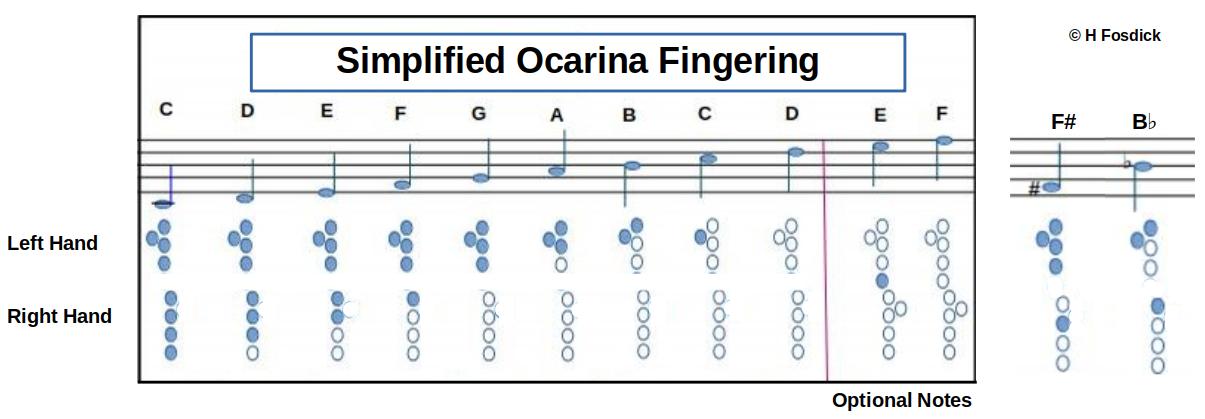
The Army felt that anyone who had ever touched a musical instrument could quickly pick up the “oc.” As they might have said at the time, you didn't have to play in a “big band” to “catch that train.”
Another advantage: the ocarina is tuned to C major, tying it to much of the sheet music circulating at the time. And, the instrument can be quickly and cheaply produced from plastic molds.
Oc's on the Mind
There was another factor in the ocarina's selection: it had a bit of a profile in the popular culture of the day.
Ocarinas show up in The Wizard of Oz (“If I Only Had a Brain”), and in a number of 1940s movies. For example, several of Bing Crosby's “Road” movies included happy ocarinists. Here Bing, Bob, and Dot toot in step:
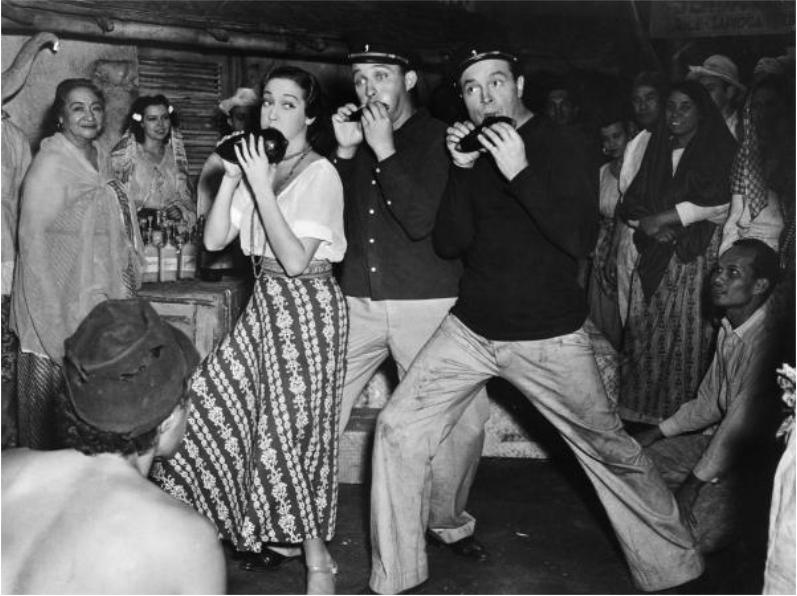
Bing Crosby, Bob Hope, and Dorothy Lamour in 1940's Road to Singapore
(Photo from the Bettmann Archive)
Irving Berlin released his hit “Dance to the Music of the Ocarina” a bit later, in 1950. And of course, POW Joey plays an ocarina in a German camp in the 1953 film Stalag 17.
Why Not Recorders?
The modern reader might well ask, “Why didn't they just ship them recorders?” After all, recorders are now ubiquitous in early music education. They're considered easy to play and virtually indestructable.
The answer is that the plastic recorder was only invented in 1946, and it wasn't popularized until the 1970s. In the early 1940s, all recorders were wood. Wood simply could not withstand the water exposure and poor conditions musical instruments would face in the field.
The ocarinas were pressed from two plastic molds, one for each half of the instrument. The two halves were then glued together. Voilà! A simple, cheap, mass-produced instrument that was as robust as possible for adverse conditions.
Another option would have been the harmonica. It's small, pocketable, playable, and inexpensive. Many soldiers did carry harmonicas during the war, a tradition that first started in World War I. But to my knowledge, the military did not distribute free harmonicas during the Second World War.
The Lucky Selections
The military selected two different ocarinas for the troops. One was the Alto C “sweet potato” or “submarine” style made by Gretsch.
Gretsch was a family-run company founded, somewhat ironically, by a German immigrant in Brooklyn in the 1880s. By the 1920s, Gretsh claimed it was the largest musical instruments manufacturer in the country.
Gretsch supplied this somewhat primitive plastic ocarina to the Army:
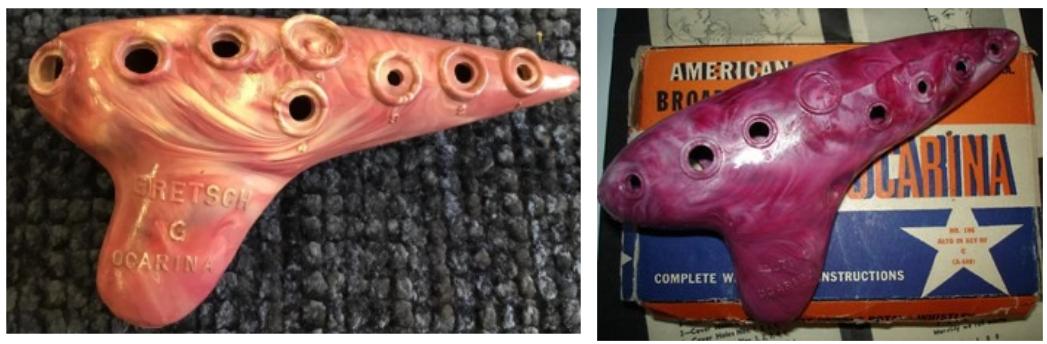
Gretsch ocarinas (photos from Jack Campin's website)
With 7 holes on top and 1 thumb hole below, this oc could play 9 whole notes plus all accidentals in range.
Note how the lefthand pinky finger rests on a filled-in hole. In the ocarina fingering scheme, you only remove this finger to play the very highest note. Leaving it filled-in makes the instrument easier for the beginner to play. But the owner can always hollow out that hole to attain the highest note after he becomes proficient with the instrument.
This is what the two “optional notes” are about in the above fingering chart. All Army-supplied ocarinas had filled-in holes for both the lefthand pinky finger and the righthand thumb. This way, the player could start with simplified fingerings. Then, after he gains proficiency, he can hollow out those holes with a penknife to gain two more high notes.
This extends the range of the ocarina by two whole notes, giving it a complete range of C5 through F6. That may not seem like a big gain, but expanding from 9 to 11 notes really boosts the instrument's capabilities.
The Tonette
The other ocarina the Army selected was the tonette. Invented in the late 1930s, this little flute took the country by storm. By the 1940s, it's estimated that half the nation's schoolchildren were learning about music by tooting the tonette. This testifies both to the instrument's popularity and its ease of learning.
Here's a 1943 US Army tonette I inherited:
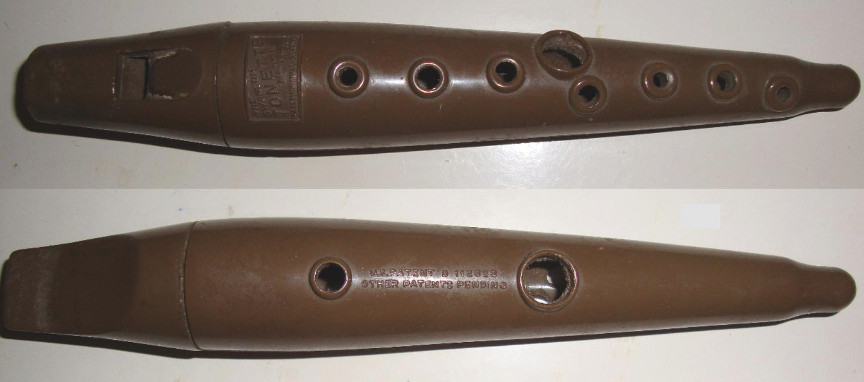
My Army-issued Tonette (photo by the author)
You can see that the tonette is a linear or “inline” ocarina. It extends straight out from your mouth when you play it, just like a recorder. Yet it features the same, dead-simple fingering system as the Gretsch sweet potato.
Tonettes also came with the two filled-in holes for the lefthand pinky finger and righthand thumb. If you look at the above photos, you can see that my relative hollowed out both these holes to achieve the two extra whole notes.
You were lucky if your outfit got tonettes instead of Gretsches. The tonettes are tunable, while the sweet potatoes are not. But more importantly, the war tonettes sound much better than the submarines. (You can learn more about tonettes in my Ultimate Guide to the Tonette.)
My particular tonette traveled on a slow troop ship from California to British India. Then it flew over “the hump” (the Himalayan mountains) in a C-47 Skytrain. As the soldiers got on the plane, my relative asked, “Hey Sarge, where do they keep the parachutes?” The Sarge grimaced and replied, “Son, if this plane goes down, you won't need a 'chute.” Flying over the Himalayas was dangerous in a two-engine propeller plane, and there was no rescue for anyone whose plane failed. Some of the guys didn't make it.
Then my tonette was lugged all over China as the troops fought the soldiers from the Empire of Japan. Fortunately, both my relative and the oc made it back.
Music
Of course, just handing out little flutes would not have met the Army's goal of music for everyone. So the services distributed a 25-page pamphlet along with their free ocarinas. It included simple instruction on how to hold the instrument, blowing, and fingering.
The booklet provides a complete training method. Starting out with tab notation, it works through a few songs. Eventually it brings the student up to reading music and playing popular tunes they know, such as folk and Christmas songs. I find the method book carefully thought out and well-designed. It manages quite a lot in its few pages, yet beginners could reasonably be expected to follow along in it.
The Army also distributed a companion booklet for ocarina quartets and “sweet potato bands.” My understanding is that this booklet was typically sold through Army PX's, rather than given away like the oc and primary method book.
Sample pages from the method books follow this article.
How They Play
Having played war-issue flutes, I find the Gretsch inferior. It lacks in both tone and range compared to modern transverse ocarinas. Yet, for all that, it is still eminently playable. Given that the goal was to bring simple music to the troops, I'd say that it fulfilled that goal.
If you've ever played a modern tonette, you probably think they're airy-sounding kids' toys. That's true of those made since the 1960s. But my old war tonette voices beautifully.
The secret is in the construction. Modern tonettes are lighter, usually with a flat or matte finish. The old war tonettes are made of a tougher, heavier plastic, and have a smooth shiny finish. They project an entirely different sound. Either the thicker plastic or slick flat surface make the difference.
Need convincing? Take a listen to a quality tonette in competent hands.
V-J Day
With the end of the war, a clamor immediately arose to “bring the boys home.” Not surprising, after four long years of war.
The military allowed the troops to keep their “personal gear,” by which they meant their clothing and other incidentals. Of course, soldiers unanimously interpreted this as including their dear instruments.
Today, many of the old Gretsch ocarinas survive. You can frequently find them and the method book on eBay. They make dandy collector items — but poor musical instruments. They don't compare to modern plastic oc's made by companies like Focalink or Night by Noble.
You can easily find old tonettes, too. But it's quite rare to find an Army-issued one. If you do buy a tonette, be careful to find an older one that sounds pure and true rather than one of the late-model kids' toys. My old Army tonette compares favorably even to many modern ocarinas.
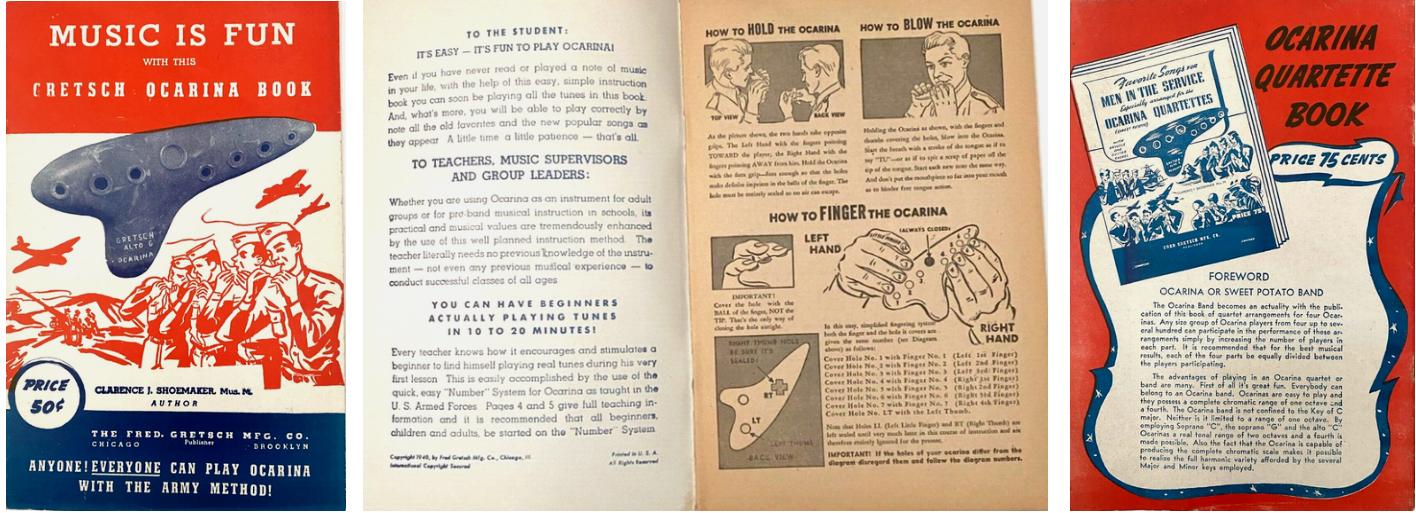
YOU, TOO, CAN LEARN OCARINA! (Photos by the author and from eBay)
About the Author
Howard Fosdick is a computer scientist who plays a variety of woodwinds. You might be interested in his companion article that contrasts ocarinas, recorders, tin whistles, and Native American flutes.