
How much of the translators bias makes these seem like academic papers instead of social media posts.
1-minute research:
Paper: 100% cotton rag or linen rag paper with alkaline reserve. Acid-free and lignin-free.
Ink: Genuine carbon ink applied with a classic dip pen.
Storage: ISO 16245 archival box, Less than 15°C, 30-50% humidity, dark, no oxygen exchange. Always store horizontally. Wear white 100% cotton gloves.
Printing: If you want to print instead of hand-write: Piezography carbon printing or pigment-based inks used by professional desktop photo printers, matte black or photo black ink, printed on digital Fine Art Archival Paper.
Place a single sheet of archival-grade tissue paper or glassine paper between every single page of your document
I think the key is to write something interesting that's worth preserving. That may be the most difficult part.
Any improvements beyond this?
But the team persevered and scanned at higher resolutions and eventually found letters: https://scrollprize.substack.com/p/finallyletters-in-scroll-...
Now they've managed to bring out the ink across the whole scroll. Truly inspiring, can't wait to read up on how they did it.
Beautifully ironic, that we find this message.
But really impressive stuff! Between this and (a particularly optimistic outlook on) the Linear-A news from the other week this is an exciting time for linguistics.
Take that, floppydisk!
“Having…strained ourselves to the utmost through research and learning…possessing the same practical wisdom…”
“…such being the goods for us, even from the opposite evils there will be neither anything good — let alone beautiful — nor anything bad — let alone ugly — nor happiness…”
Amazing!
Col. 5: "… the similar …"
Col. 6: "… impulses …"
Col. 9: "… so far as … this or to have … that …"
Col. 10: "… that befits on the whole still … there will be fear and … the great and long …"
Col. 11: "… and the impulse … For/towards each of these things in this way … we are by nature … and for/towards the fulfillment of these things that … seem …"
Col. 12: "… to men and beasts … And above all, each of the most common things constitutes these … For, [necessity? necessary?] …"
Col. 13: "… natural … therefore also … according to the … this … will be found, and lives will make no progress whatsoever, as we have no need for either pleasure or pain. In the same way, also …"
Col. 14: "… and thus lacking … I want to say … common … accomplished … to lack … and … on the right parts towards the left ones. There is an excess in the impulse …"
Col. 15: "… and of all similar things. For, according to this kind/category, according to which impulses exist by nature, there will be that which lacks nothing, so that one seeks nothing more, but completes in every respect as …"
Col. 16: "… they approach completion. Moving from these things to … [λόγος?], it [τέχνη?] accomplishes within us all that pertains to it, even though it cannot fully complete nature. And it allowed …"
Col. 17: "… we will inquire into something, but we will not grasp it, if in some way we depart from ourselves and from our own nature, and besides, in the same way as the remaining arts may be said to be perfected in one respect, but to be deficient in practical wisdom in another respect…"
Col. 18: "… being that practical wisdom … and to be about it. This [sc. λόγος] concerning the mechanical arts seems to me to be very distant from such a [conception?], and to have the technical fulfilment that is, so to speak, lame and something of such type lacking, and concerning the …"
Col. 19: "… need none. Having certainly strained ourselves to the utmost through research and learning, we will no longer be inferior to them in any respect, accomplishing in like manner the things that befit them and possessing the same practical wisdom as they …"
Col. 20: "… to happen. And such being the goods for us, even from the opposite evils there will be neither anything good—let alone beautiful—nor anything bad—let alone ugly—nor happiness …"
Col. 21: "… being greatly wise and celebrated and … to praise … as according to the eulogies …"
Col. 22: "… still … Aristocreon … to possessed things …"In a way this is sort of like the reverse of a recently aired anime (Orb: on the movements of the Earth) which talk about the opposite, people whose contributions were erased and we'll never know about them.
Do we have better imaginations? Can our sci-fi writers come up with something equivalent that is as dizzyingly far from what we know now, as now is from what Aristocreon knew?
There are lots of very smart folks working on incredible things, they just aren't as loud.
So imagine how cool it would be to find a full library with thousand of scrolls across many different topics, that can now be read with this technology.
A Post-Great Solar Flare of 2484 Step Brothers DVD Has Been Decoded
For anyone who wants to read ancient texts, there are bilingual editions, for example those of the "Loeb library".
The translations that omit the original text are just for the people who want to have some idea about the content, but do not care about the correctness of the translation.
With a bilingual edition, it is easy to understand the original text even with relatively little knowledge about the original language.
The original text is important because frequently the translator is forced to introduce inaccuracies in the translation, because of the absence of exact equivalents in the target language, which would require a long explanation of the original meaning, instead of just a translated sentence.
Especially misleading are translations where several distinct ancient words are translated using the same English word, so some nuances are lost.
Equally confusing are the cases when the translator chooses to translate the same ancient word by different English words, because even if the meaning of a word may depend on the context, many translators fail to judge correctly the context, because they may lack specialized knowledge so their guesses are not necessarily better than of the readers who may be less competent in linguistics, but more competent in the science or technology needed to understand the context. Better translators prefer to use a one-to-one mapping between words, which makes it easier for the readers to discover the meaning intended by the ancient writer, after seeing multiple examples of usage.
- Philodemus, On Gods, Book 8 Year 0. Ish. :}
I can understand in the freewheeling days of the 19th century, but I'm rather surprised that they'd be so cavalier in the 70s and 80s...
I love stuff like this because it gives a glimpse into Roman society. To me it seems like they were very similar to us today, forever contemplating learning, existence, gods.
Casual letters and graffiti would be closer to tweets.
While I step through the valley of the shadow of death,
I contemplate my life and perceive that nothing remains.
For I have hurled weapons and laughed for so long that
Even to my mother, my mind appears to have departed.
Yet I have deceived no one except him who was worthy of it;
For me to be held as a coward—that indeed is unheard of.
Beware what you speak and where you set out,
Lest you and your companions be outlined in chalk.
Apparently they did CT scans of closed books and read the content. Polevoy, Dmitry V., et al. "From tomographic reconstruction to automatic text recognition: the next frontier task for the artificial intelligence." Fifteenth International Conference on Machine Vision (ICMV 2022). Vol. 12701. SPIE, 2023. https://iris.unive.it/bitstream/10278/3687069/1/Albertin_et-...
So yeah, but lottery companies probably make it harder by engineering against it.
EDIT: Read some more into this. From Wikipedia and its sources:
> In 1969, Marcello Gigante founded the creation of the International Center for the Study of the Herculaneum Papyri (Centro Internazionale per lo Studio dei Papiri Ercolanesi; CISPE). With the intention of working toward the resumption of the excavation of the Villa of the Papyri, and promoting the renewal of studies of the Herculaneum texts, the institution began a new method of unrolling. Using the 'Oslo' peeling method, the CISPE team separated individual layers of the papyri. One of the scrolls exploded into 300 parts, and another did similarly but to a lesser extent.
> The results were mixed: one of the scrolls literally exploded (into more than 300 bits) during the "peeling" and attempts to put the scraps back together gave little hope for success. The second - PHerc.Paris.2 -, on the other hand, had survived in a slightly less fragmented state.
So this was new science being done on the possibility of unrolling the scrolls and piecing together information from the fragments. Whether the fragments from PHerc. 1667 was decoded I'm not sure. The work has been digitized (and photographed with specific wavelengths of light where the ink is more distinguishable), but I couldn't figure out if it was open to the public anywhere.
Another interesting part: > In 1756, Abbot Piaggio, conserver of ancient manuscripts in the Vatican Library, used a machine he also invented, to unroll the first scroll, which took four years (millimeters per day). The results were then copied (since the writing disappeared: see above), reviewed by Hellenist academics, and then corrected once more, if necessary, by the unrolling/copying team.
So it's not like they never got anything useful out of the scrolls but kept on trying anyways.
Emphasis mine.
They are in a variety of conditions - some of them people were able to "break" open and read. But the vast majority of what remains is too delicate and brittle to risk.
But I think they would be more surprised by how we managed to invent things like social media and AI, which destroy our brain. Ancient societies valued wisdom much more than us and were much more careful when introducing new technologies. It was fascinating for me to learn that even writing, as a skill considered universally good these days, was once subjected to scrutiny[1].
https://en.wikipedia.org/wiki/Plato%27s_unwritten_doctrines#...
Maybe, humans aren't very different, so it depends whether imagination is informed which seems plausible, or whether it is somehow fixed - modern humans don't have different eyesight than in that period, but almost all of them can read whereas back then almost nobody would have been reading these scrolls.
> Can our sci-fi writers come up with something equivalent that is as dizzyingly far from what we know now, as now is from what Aristocreon knew?
Science Fiction produces things so very different from any conceivable future for us as to certainly be "dizzying" in this sense, Hard "What if?" SF routinely ponders universes where the fundamentals are different e.g. Egan's "Orthogonal" series is set somewhere that the three spatial plus one temporal dimension are laid out differently, the maths works for their arrangement too but gives different results.
In terms of just normal human stuff but more and later, there's loads of that, near futures like Vinge's "Rainbows End" through to some of the distant future stuff Stross wrote.
Hats off!
Latin is also a very rich language and this is no snippet.
Translation is always hard, especially from a couple thousand years ago BUT this kind of translation comes with a lot of confidence.
* ἐκ- = “out,” “thoroughly,” “to the end”
* πονέω = “to labor,” “to toil,” “to work hard”
Of course the story is just a murder mystery.
> * ἐκ- = “out,” “thoroughly,” “to the end”
ἐκ is more motion away from something. It's often an intensifier in verb compounds but not really as a standalone preposition.
Ancient Greek is a very different language from English. I've found people who try to brute force it by looking up individual words without a knowledge of the grammar end up with a worse understanding of a text that someone who just reads in translation.
How does ASML make the most modern chips? You mean light and mirrors?
Though I have an interest in Old Norse and I spend a lot of time reading Scandinavian runestones. > 90% of them are grave markers for a dead father, mother, brother, sister, cousin, etc. If I've learned anything from that, it's that people across time and space all lead lives as real and complex as anyone else's. Their joys were as high as mine have been and their sorrows as low as mine have been.
(Btw, you can use the 'edit' link to fix things like this if the software gets a title change wrong.)
They would be impressed with our technology even if it has downsides. Wisdom is knowing humans and technology and imperfect tools.
I mean, sure, the beacon fire transmits at the blistering rate of roughly one bit per several minutes, assuming nobody fell asleep on watch, the wood was dry, the fog cooperated, and the enemy hadn't already lit a fake beacon to mess with you. Fiber optic, by contrast, limps along at a measly several terabits per second. Not to mention the flexibility to increase the range by just starting a bigger fire.
I feel the opposite of that feeling and am immensely proud of everything that the core challenge team has accomplished
Certainly my Mark 1 eyeballs would not obviously perform better than random guessing at this task. Although my eyeballs are, if nothing else, nerfed by only being able to see a 2D slice of the data.
Could it be automated to the point where it's faster to scan a book closed than opened?
The biggest question I have for you is why you imagine we are so interested in reading these old scrolls. Surely some of it is to see whether or not, technically, we can. Surely some of it is to get a glimpse into the human expression inscribed on them. Are we looking to learn anything, or just to connect with our ancestors? I'd like to hear your take on it, both for why you think it's important and, if you know, why your colleagues feel similarly.
It's also well known that surviving texts survived because they were copied again and again on costly animal skin during the Middle Ages, by monks who had to make a choice and naturally favored topics that were of most interest to them.
This could quite literally change everything.
[0] https://talesoftimesforgotten.com/2021/09/25/are-there-more-...
To think that there is some sort of absolute truth of how something ought to be translated is IMHO just not reality. Especially when it comes to texts that not only were oral literature long before being written down but we of course have no copies of the originals (whatever original means in this context), but only transcriptions of transcriptions of...
Take Beowulf for one. While perhaps Shippeys translation is very much faithful to the copy we have, is it "better" (whatever that means...) than Tolkiens? or Heaneys? Could we say what the poet would have liked more had they sat here in 2026 and read them all? Of course not and having a multitude of different translations is what we need to fully enjoy these texts (since not all will be able to learn the different ancient greek dialects, latin, old english, sumerian, etc., etc. I'm saying this as someone who is now studying ancient greek).
It's not that they didn't see the usefulness of books, it was more so about the overreliance on them and the effect it had on the education students would come away with, just as you say. A pretty reasonable concern, I think!
As an aside: One of the techniques students would be exposed to was the use of memory palaces, which remains helpful to this day where everyone has a computer in their pocket. Pretty cool stuff - technology of the mind!
On "Do we have imagination" - I think you are being to hard too on humankind. The answer for me is "yes, certainly", because that's exactly what these researchers imagined and then did. Bravo to them!
By definition we can't, since your premise is that:
> future humans with machines made of materials unimaginable to Aristocreon
So if a sci-fi writer wrote such a thing it'd be deemed ridiculous by the readers of our time.
I once had a sci-fi idea (I'm sure I'm not the first one who came up with this though):
> In an apocalyptic situation, humans decide to encode our whole knowledge base into bacteria DNA so it can be preserved and passed on.
> Then during the process, the scientists find that there is already another species' knowledge base encoded in the DNA, and save the world by utilizing the it.
It's quite far stretched from our current capabilities, but still totally imaginable.
I bet they can, but the danger is that if it's too far away from what we can fathom right now, it's no longer sci-fi but esoterics or something - going from fun to weird. Most science fiction is written in concepts we can understand today.
A lot of labeled data is available on our ftp server which has public access
> Though I have an interest in Old Norse and I spend a lot of time reading Scandinavian runestones. > 90% of them are grave markers for a dead father, mother, brother, sister, cousin, etc. If I've learned anything from that, it's that people across time and space all lead lives as real and complex as anyone else's. Their joys were as high as mine have been and their sorrows as low as mine have been.
A VSauce video I watched a long time ago described that realization as "chronosonder". I think trying to understand those that came before us and why they made the decisions that they did given the circumstances they were in can help better inform us of the things we choose to do given our own circumstances.
Otherwise, I think that a lot of things are worth doing just to see if it's possible. I like to lift weights and I'm training to lift the Dinnie Stones one day; a pair of stones that are a combined ~730 pounds. The physical and mental benefits of exercise and training are well documented and great but at the end of the day I just _really_ wanna pick up 2 stones. There's nothing more to it than that, and that's ok with me.
One of the things we said a lot in 2023 was "We just wanna read the scrolls" but that slogan has unfortunately fallen a bit by the wayside as the goal and path got longer and initial hype started to fade, but I think it perfectly encapsulates why: The scrolls are there. They can be read. Why not read them?
Any master stoneworker from any era should be able to carve stone to that level of precision given enough time and reason. The problem, as always, is that there is usually very little reason to put in that amount of time and effort when you can get 90% as good for 50% the effort.
My dentist is pretty good at doing this too, by putting marking paper between my teeth and having me bite down. I wonder if a similar technique could be used:
Have the blocks close together, constrained to only move on a single axis by rails or whatever. Drape a thin sheet of material over one of the blocks, the non-moving one (perhaps it's an already-placed one?) Maybe it's something that visibly shows when it's crushed, or maybe it's coated with the blood of the powerless. Smash the other block into it. Pull them apart and look where they made contact. If it's mostly everywhere, done. If not, grind down or chip out the parts that touched. Repeat until you run out of innocents.
To do the very last block, you'd have to meld two sides, remove a block, fix up the other side, and then put it back in. Which might make this testable.
But I'm just pulling stuff out of my nether orifice.
So geeky, so cool !
> assuming nobody fell asleep on watch, the wood was dry, the fog cooperated, and the enemy hadn't already lit a fake beacon to mess with you.
So you are talking about dealing with "packet" loss and data encryption, right? Those concepts were not new to them.
If I may ask, when you started thinking about achieving this, what were the first attempts, ideas on how to go about it? What were some of the obstacles that had to be overcome to achieve this ?
PHerc. 1667, sealed since the eruption of Vesuvius in 79 AD, has been virtually unwrapped and read from beginning to end.
June 25th, 2026
Read the preprint: Complete virtual unwrapping and reading of a rolled Herculaneum papyrus (PDF). The data is openly available at scrollprize.org/data, and the code on GitHub.
For almost 2,000 years, the carbonized library of Herculaneum has kept a cruel bargain: its scrolls survived the eruption of Mount Vesuvius, but only by becoming too fragile to open. To read one was to destroy it. Hundreds of rolls have therefore remained sealed, their contents preserved yet unreachable.
Today that changes. We have completely virtually unwrapped and read PHerc. 1667 — the scroll the Vesuvius Challenge community knows as Scroll 4 — without ever touching its pages. It is the first Herculaneum papyrus to be digitally unrolled and read in full, end to end, and made available for sustained scholarly study.
The complete writing surface of PHerc. 1667, virtually unwrapped — roughly 1.4 metres of papyrus and around twenty-two columns of Greek. Scroll sideways to pan; click to zoom. Download the high-resolution image.
PHerc. 1667 began as a blackened, rolled mass of carbonized papyrus. To read it, we never unrolled it physically. Instead, we scanned it with high-resolution X-rays, reconstructed the wound sheet inside the volume, flattened it into a readable surface, and used machine learning to bring out the faint traces of ancient ink.
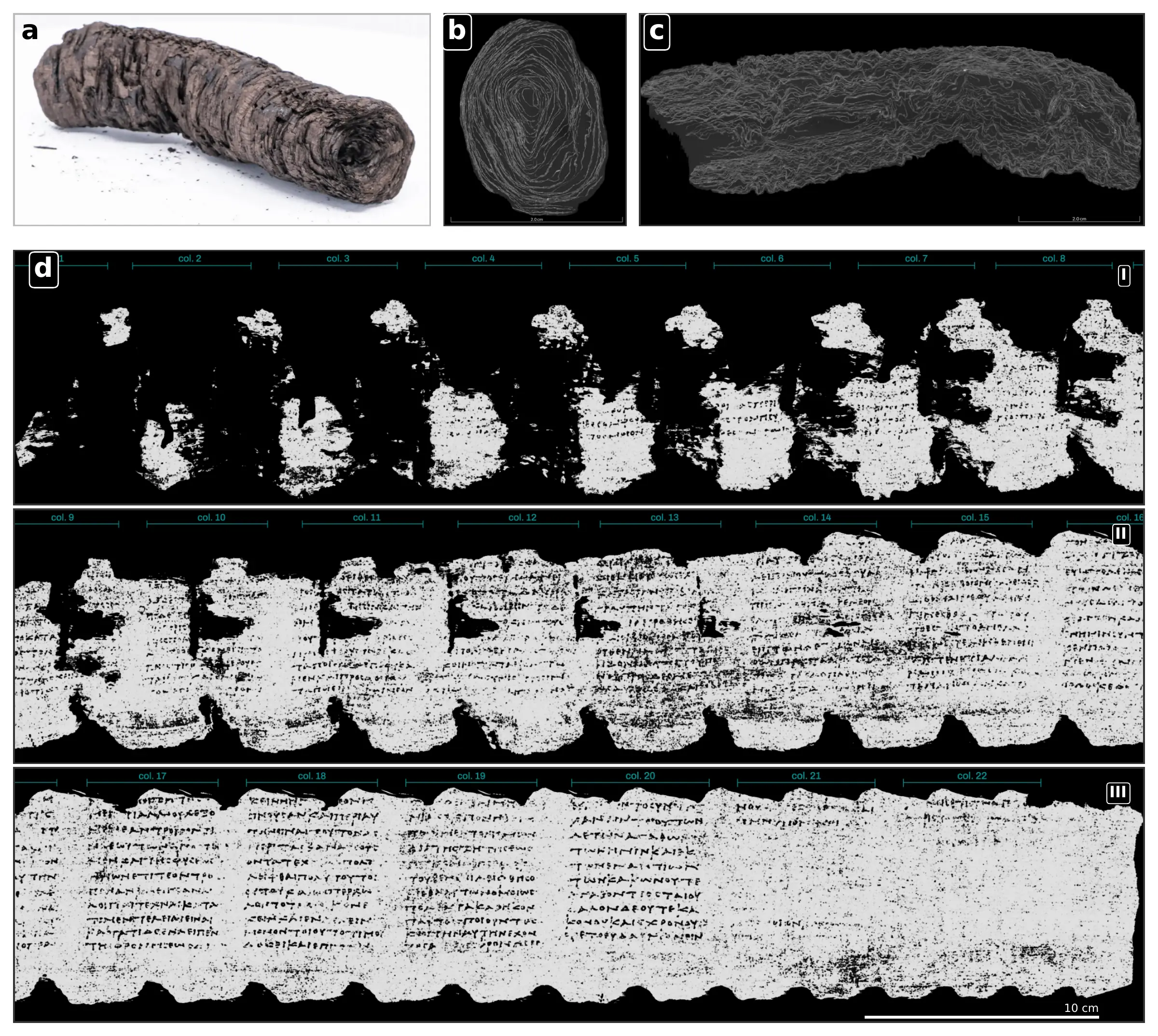
From object to text. The sealed, carbonized roll (top left); cross-sections through the X-ray scan revealing the spiraled sheet inside (top); and the unwrapped surface, where columns of Greek writing emerge as the ink signal is recovered (bottom).
The work reaches beyond a single scroll. Alongside the complete reading of PHerc. 1667, the research establishes a method that holds up under independent checks and scales to other rolls.
PHerc. 1667 is what survives of a larger roll: earlier attempts to open it by hand — in the nineteenth century, and again in 1969 and the 1980s — destroyed its outer layers and left only the compact inner core, about 8 cm of an original height of 19–24 cm. From that surviving portion we have now recovered and read the text in full — the lower parts of some twenty-two columns, transcribed and reviewed by papyrologists. It is the first time the preserved text of a rolled Herculaneum scroll has been read continuously, end to end, rather than in isolated words or patches.
The recovered text is a philosophical treatise on ethics, and the evidence points to a Stoic work: it turns on human nature, impulse, and the moral progress of human beings, and its final preserved column names Aristocreon — nephew and disciple of the great Stoic Chrysippus — which, together with the language and themes of the text, places it in a Stoic context and dates it to the 2nd century BC.
Because the papyrus is damaged, the readings are fragmentary, with gaps where the surface is lost. Even so, several passages can be read clearly for the first time in two thousand years:
“…we will inquire into something, but we will not grasp it, if in some way we depart from ourselves and from our own nature…”
“Having…strained ourselves to the utmost through research and learning…possessing the same practical wisdom…”
“…such being the goods for us, even from the opposite evils there will be neither anything good — let alone beautiful — nor anything bad — let alone ugly — nor happiness…”
Translated from the Greek; the full column-by-column transcription is in the preprint.
In a second scroll — PHerc. Paris 4, the scroll the Vesuvius Challenge community knows as Scroll 1 — a higher-resolution imaging technique makes the ink directly visible inside the scroll itself, in the three-dimensional X-ray data, for the first time. Segmented in 3D and projected back onto the unwrapped page, that ink matches the text read in the 2023 Grand Prize one-to-one — an independent confirmation, from better data, that the reading is real.
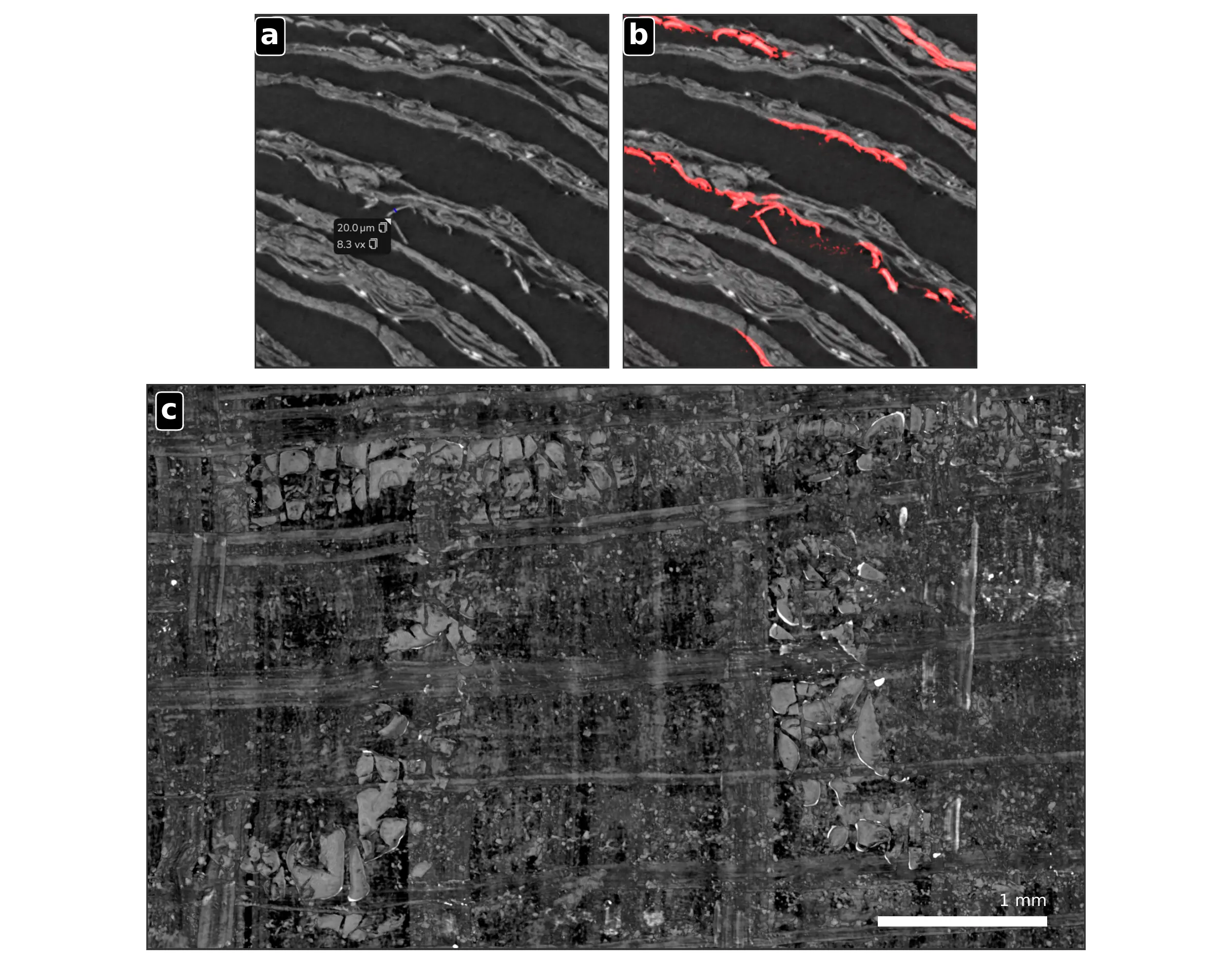
Ink made visible by higher resolution in PHerc. Paris 4 (Scroll 1). In a cross-section of the X-ray scan, the ink sits directly on the papyrus surface (left); it can then be segmented in three dimensions (red) and projected onto the unwrapped page.
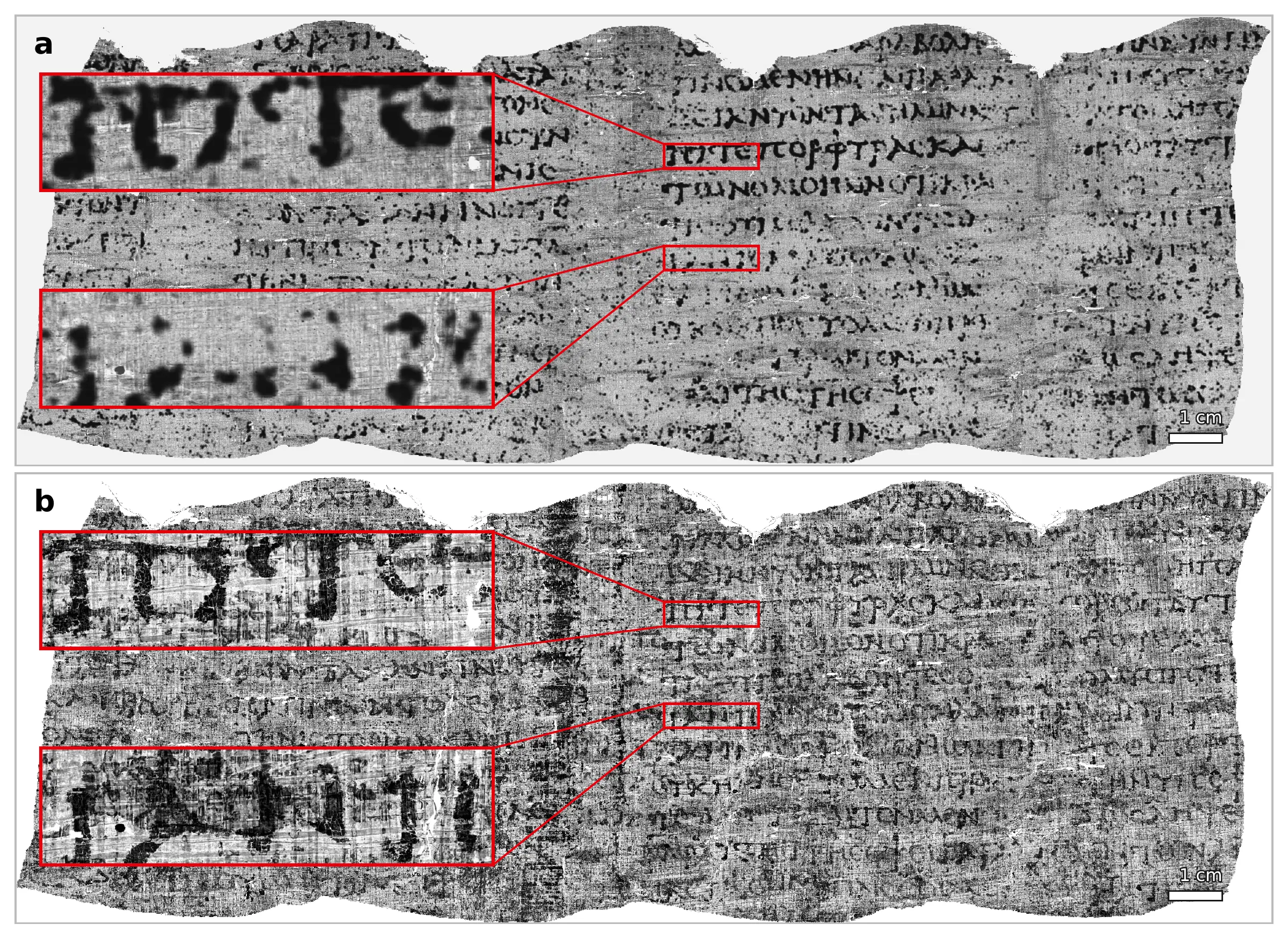
PHerc. Paris 4: the 2023 Vesuvius Challenge Grand Prize reading (top) and the new 3D ink segmentation (bottom) — the same text, recovered one-to-one from better data.
In a third scroll, PHerc. 139, we recover the scroll's title and author attribution: the work is identified as Philodemus, On Gods, Book 8 — a treatise by the Epicurean philosopher whose works fill so much of this library. Reading the title of a closed scroll tells scholars what a roll contains before a single column of its body is studied.
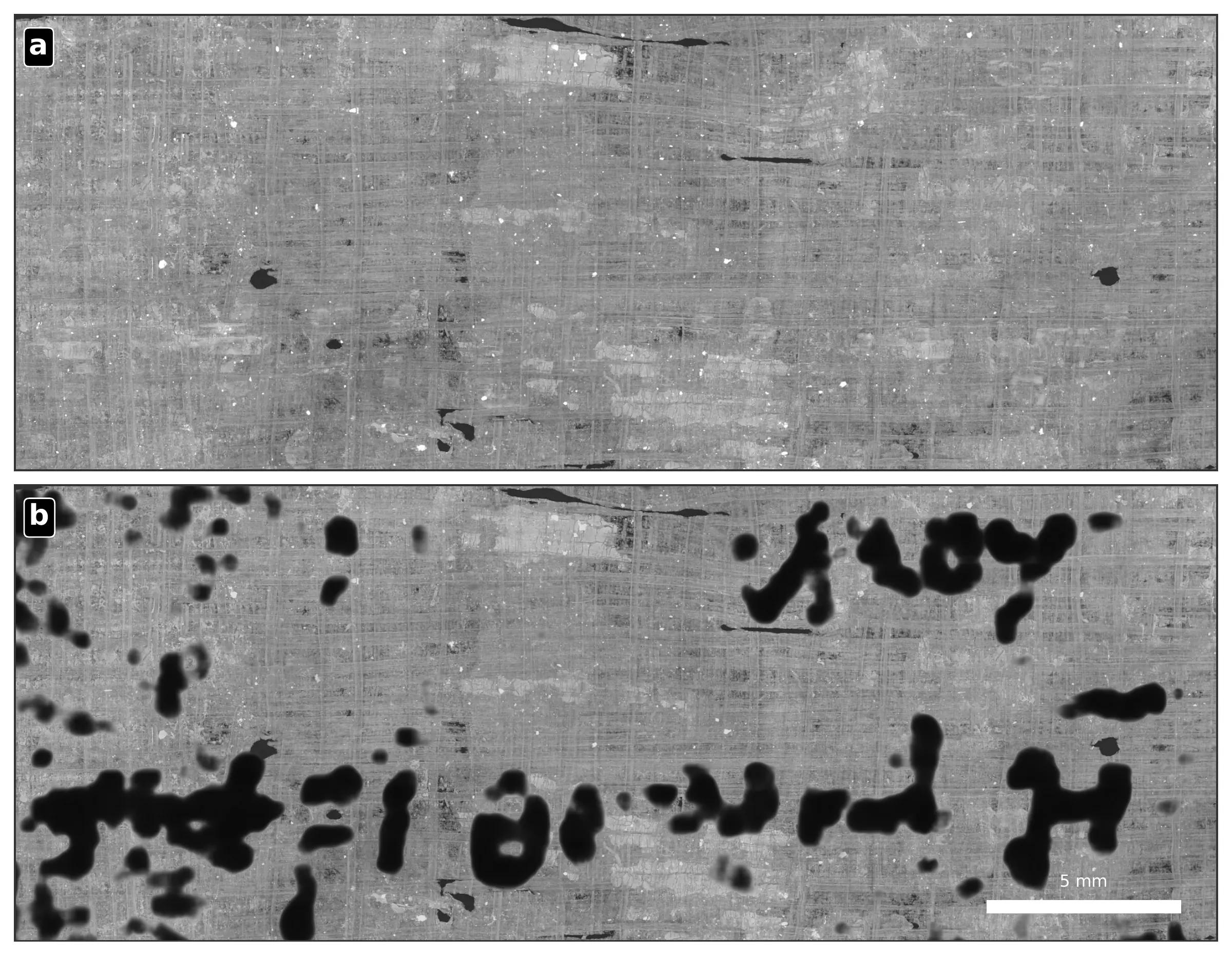
The title region of PHerc. 139. Enhancing the ink signal reveals the title and author attribution, identifying the scroll as Philodemus, On Gods, Book 8.
The scans were acquired with high-resolution phase-contrast X-ray microtomography on the BM18 beamline at the European Synchrotron Radiation Facility (ESRF) in Grenoble — an instrument able to resolve the wafer-thin, densely packed layers of a Herculaneum roll. The work was carried out in collaboration with the National Library of Naples “Vittorio Emanuele III”, which safeguards the Herculaneum papyri. From those volumes, the team reconstructed the scroll's geometry, traced and flattened its surface into a readable sheet, and trained machine-learning models to detect ink that is almost indistinguishable from the carbonized papyrus beneath it. Each reading was then examined and transcribed by papyrologists.
A cross-section sweeping through the X-ray scan of PHerc. 1667, revealing the sheet of papyrus wound inside the sealed roll.
Crucially, all of this is open. The tomographic data, reconstructed surfaces and transcriptions are released under a Creative Commons licence at scrollprize.org/data and archived at the ESRF, and the code is on GitHub. Anyone can check the work, build on it, and apply it to the scrolls that remain.
This is what open science makes possible. The virtual unwrapping of the Herculaneum scrolls was pioneered at EduceLab by its principal investigator, Professor Brent Seales. In 2023 Seales opened his lab's imaging and software technology to the Vesuvius Challenge — a public, donation-funded effort he co-founded with Nat Friedman and Daniel Gross to read the scrolls in the open — and from there a global community took up the problem. The first letters and the 2023 Grand Prize were won by contestants from across the world.
What is less widely known is what happened next. Most of the Vesuvius Challenge research team first arrived as contestants. They entered the open competition, won prizes for the breakthroughs they made, and were then recruited onto the team that has now read an entire scroll. The people behind this breakthrough are, in large part, the global community the Challenge itself created.
PHerc. 1667 is one scroll. Hundreds more remain sealed — an entire library of philosophy, poetry and prose waiting to be read for the first time since antiquity. The method shown here is built to scale, and everything needed to apply it is open.
If you want to help read the rest of the library:
The thoughts of the ancient world, sealed in darkness for two millennia, are coming back into the light — a whole scroll at a time.
They do, commonly, if you were to consider we may appear as nearly alien to Aristocreon and also consider that our contemporary idea of aliens as portrayed in sci-fi could just be humans of the future.
edit: I found this:
https://scrollprize.org/data_browser#/samples/PHercParis4/se...
The JSON seems to suggest that I'm mostly looking at ink detection output, but I could easily be using the tool wrong.
But I also found this awesome explanation:
https://scrollprize.org/data_fragments
I guess I bunch of the training was done by using fragments of scrolls where ground truth data is available using IR photography.
Also... that xray resolution is absolutely amazing!
where else do you think these techniques be applied?
https://en.wikipedia.org/wiki/Nigel_Richards
Congratulations, and thank-you!
I was under the impression that there was almost nothing left of that school of thought, and that it’s writings had been destroyed.
What would you like to have instead?
I don't think humans have changed, I don't think a human could begin to image a world so far away from their own.
Humans tend to image faster horses. A few might imagine a steam engine. But then you have the social reality of everyone having a car. Of the environmental downsides. I don't think you can extrapolate all that.
So yes, an ancient Roman might appreciate fibre optic cables. But that's still missing out the context of global communications, etc etc etc.
[1] https://www.dkriesel.com/en/blog/2013/0802_xerox-workcentres...
There is an extremely large overlap between a lot of the work we do with medical imaging, CT scanning, XRay technology, and such. A lot of the ML models and frameworks we have used and adapted for our purposes originated in the medical field for things like cancer detection or segmenting different body parts.
Ah, the good old bitter lesson strikes again
And that's just one thing, who knows what else those old Greeks/Phoenicians/etc were kicking about.
So we can just get ChatGPT to fill in the blanks.
History! That's what intrigues me the most: texts with accounts of events that have otherwise vanished from the historical record.
Virtual unrolling and reading are not terribly hard to do manually, they are just not feasable on a large scale. Like years and years of human time spent tediously clicking on papyrus and labelling ink in renders, so a large amount of automation is required.
A lot of difficulty has come from the first step: xraying the scrolls. It's hard and expensive and difficult to get right. The efforts since this all began with CT scanning 25 years ago has been kneecapped by the data simply not being good enough. We xray on what is AFAIK literally the most powerful xray beamline in the world and we would still like for it to be more powerful and faster. Not to mention the massive amounts of data. For Pherc Paris 3, our largest scroll, the raw reconstructed data is 260 terabytes. That's a lot of data to have to deal with.
The scribes were actively copying the books, this is a continuous preservation process that's familiar to everyone, it's the same thing that talking about the bees and the birds covers. It requires expending continuous effort (and funding), and planning ahead. It's toil. And, as you noted in your last sentence, it not only allows for errors, it affords errors. Translation is an act of interpretation.
In contrast, recovering text from 2000 year old charred embers is cultural equivalent of resurrection. It's like finding an ancient human frozen in a block of ice/ancient cryopod, and thawing them - which itself is a scientifically plausible subset of bringing back the dead.
I'm not sure what analogies would be best to explain that to people from 2000 years ago. Food preservation? Or hoping they can conceptualize thawing a person who fell into an icy lake indefinite amount of years earlier?
A stable base corpus and some dynamic programming will allow you to clean up the remainder[0].
2. "Real and complex lives" doesn't mean "just the same as ours", mind you.
Or of technology- steam power, mechanical computation (like the Antikythera mechanism, which is the only known example of such a thing until 1300 years later), mechanized production, mining techniques, etc
The exception though would be Greek literature. Greek literacy collapsed in the early medieval era and a large catalogue was probably just scrapped or discarded before even being collected in Monasteries. Herculaneum could represent a legitimate treasure trove in that regard.
https://www.ericweinhoffer.com/blog/the-whitworth-three-plat...
What dodecahedra were for.
Wonderful that all of this amazing technology exists
Wonderful that we used it to read these ancient scrolls
Thank you
Well that's why most people aren't science fiction authors.
Back in 1953 Isaac Asimov wrote, "It is easy to predict an automobile in 1880; it is very hard to predict a traffic problem". There are subsequent riffs on this idea, but in 1966 Heinlein observes that actually the surprise wasn't the traffic jam (Indeed Asimov is wrong, people complained about traffic jams before cars were widespread, in a large city it was already a problem at peak times) but fucking. Turns out you can have sex in a car, and people did. Importantly, since they might have access to a car but wouldn't own a house, teenagers were having sex in cars...
Don't look to Science Fiction to predict the future, and especially don't look to Science Fiction stories to define your future given that you presumably prefer to choose your own outcomes (at least tech bros only named things after Iain M Banks' spaceships, they invented whole product categories trying to reproduce ideas from Neal Stephenson's novels)
However if you are looking for visions of how different the future might be, Science Fiction excels.
Yes, there are a very great many!
The philosopher David Gray says that most modern thinking sees our way of life and liberalism and "progress" as meaning growth and change. It implies it is inevitable, a kind of always changing improvement.
Change that has occurred is for the good and its impossible to go back. I like the ${current_year} meme where someone says "it's 2026 things have changed, sweety". The joke is funny because that's what people actually say and that they say this every year but they don't notice that they say that every year.
So the modern way of life has many people who view people in the past as not real, as figuratively made of wood, who are primitive, who didn't lead complex lives.
David Gray concludes by saying that Liberalism therefore needs to be constantly fought for, that you cannot rest on your laurels and think that humanity is naturally and inexorably progressing.
These scrolls and History as a whole challenges a fundamental psychological investment in modern liberalism.
To think of the world as always improving and evolving for the better directly opposes a kind of empathy about how people 2500 years ago are the same human beings as we are. The scrolls should humble us.
Given this.
> 2. "Real and complex lives" doesn't mean "just the same as ours", mind you.
They are more like ours than we like to imagine. We prefer to think of ourselves as improved.
Once you have some unwrapped papyrus, you can render it to an image and look for ink. Ink leaves a certain texture that can be identified by the naked eye and labeled. Between these two processes you get the segmentation and ink detection ground truth. Segments can be flattened virtually through existing software and algorithms.
Heterodoxy (or really, orthodoxy) wasn't really a thing in 79ad, and you're not likely to find much of it in the private library of a wealthy Roman's vacation home. The only forbidden work you're going to see from that era is stuff critical of the emperor.
But also there are accurately hewn stones all over the world from many eras of history. It is not unique or special in any way.
The pyramid stones also aren't generally that accurate in an absolute sense. They just fit really well together. The vast majority aren't particularly flat or square, but have been worked to mate with their neighbors, which is a very different and far more mundane type of work. Some stones, particularly exposed interiors and the outer face of the casing stones were cut pretty accurately, but only the parts you can see. Inside they're usually pretty rough.
Ancient Egyptian stoneworking was impressive, even at the time, but not spectacular or exceptional. Other civilizations throughout history have built to equal skill, if not scale. People in the West just get so caught up in the mystery of the ancient Egypt myth that they think it's magical ancient lost technology. It was just regular human labor and skill, but a whole hell of a lot more of it applied in one spot than anything we can imagine today.
I was wondering, how does this all get funded?
I can see why you'd be attracted to this project from a "let's solve problems computationally" perspective (never mind the historical side). It sounds like there are some cool problems in there.
The eye toward automating the process that the project seems to be targeting is particularly cool, too. This kind of stuff that makes me have real enthusiasm for ML.
But I think it would be vastly more difficult to grind two massive stone blocks against each other than to just ram one against the other. Not unless you stacked them, anyway, and if you stacked them I'm not sure if you could move the top one side to side in order to do the grinding. Maybe with some kind of grit, I don't know. Still seems harder.
Also, grinding methods end up removing more material (bad for teeth!), and I would expect more overall physical work to be done in order to remove that material (bad for massively heavy stone blocks).
As for making them flat, that seems unnecessary to me. But then, I'm not a pharaoh. (Even for a pharaoh, it seems like only the seems would need to be straight. Nobody could tell about the faces after assembly.)
Then again, after some quick researching, it seems like there's a good chance that the well-fitting blocks (which are not all of them) may have been cast out of a concrete-like slurry, not hewn.
The Epicureans and Stoics did not care much about Christians and Jews, but after the Christians obtained the power in the Roman Empire they made great efforts to persecute and discredit the Epicureans and the Stoics, as the most dangerous kinds of non-believers. (Unlike the rational Epicureans and Stoics, the traditional polytheists could be much easier converted to Christianity, by inventing a set of Christian saints to which the former polytheists could redirect the prayers and the holidays to which they were habituated.)
The Christian propaganda has created a false image of the Epicureans, which has persisted until today.
The Epicureans were not atheists, but they had a very different conception about what Gods are. They thought that in nature there are a lot of entities that have a god-like power, i.e. humans are too small and weak to influence them in any way, but the life of the humans is strongly dependent on the actions of those entities, so they can rightly be considered as gods. Examples of such entities are the Sun, the Moon, storms, volcanos etc.
Unlike in the traditional Greek and Roman religions, where it was believed that for each such natural phenomenon there exists some sentient god, who can be convinced to change the events to a more favorable outcome by prayers and sacrifices, the Epicureans believed that the gods, even supposing that they were sentient, in any case they do not care about humans more than humans care about ants, so there is absolutely no point in praying to them or bringing sacrifices to them.
Therefore humans should conduct their life according to ethic principles, but without worrying about what gods may think about their actions.
Many modern humans would probably agree with the Epicurean philosophy, which was completely different from what the Christian propaganda claimed, e.g. that Epicureans were some kind of sinners addicted to pleasures.
Interestingly, in Jewish literature (Talmud and further refined by Maimonedes) Epicurus refers to a certain kind of non-believer, not to a sinner for pleasure. See here for example https://www.sefaria.org/Mishneh_Torah%2C_Repentance.3.8?lang...
I always wondered about that because I guess I fell for the "Christian propaganda" as you call it.
That said, they had limited resources. This is very cool
a) one who denies the existence of prophecy and maintains that there is no knowledge communicated from God to the hearts of men;
b) one who disputes the prophecy of Moses, our teacher;
c) one who maintains that the Creator is not aware of the deeds of men.
are actually accurate enough renderings of what an Epicurean might have said in a discussion with a Jew, because as I have mentioned, Epicureans believed that there are gods, but those do not pay attention to humans and do not attempt to communicate with humans, because humans are insignificant for them.
This is quite different from how Epicureans were portrayed in Christian literature, where calumnies against them were preferred for avoiding any direct controversy.