Hello,
we hope your week has been pleasant.
This week we released the 2.1 experimental. You can read the full changelog on our Forum.
Funnily enough, the changelog was too long to post on Reddit, as the limit is 40,000 characters... oops :).
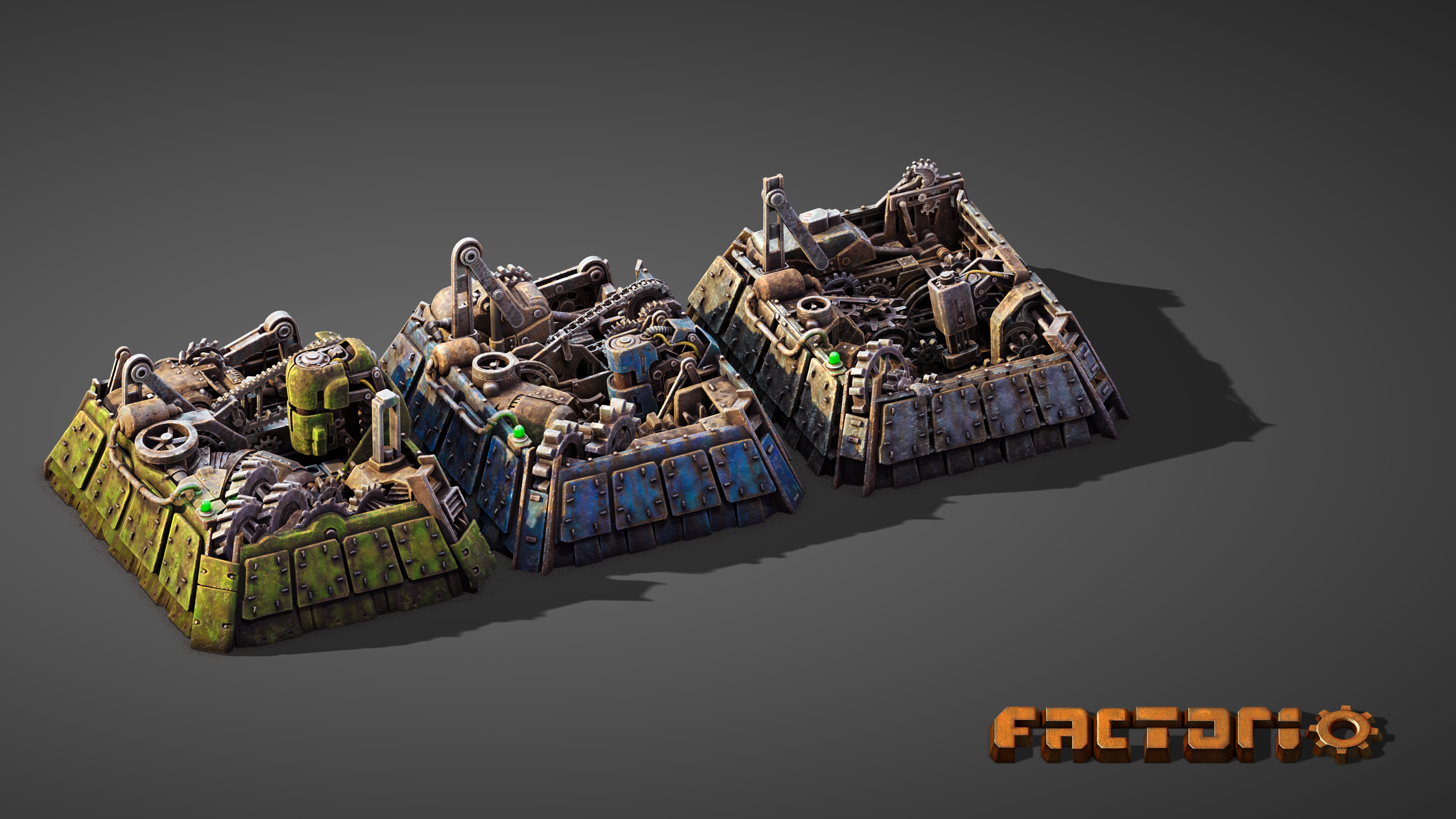
You can opt in to experimental now, and there are some things to bear in mind:
By playing the experimental releases, you can help us improve the game:
How to opt in to the Factorio 2.1 experimental:
As a part of the update of our graphics and audio systems, we have raised the minimum operating system requirement on Linux. The minimum version of the system's GLIBC is now 2.36 (released in 2022). If Factorio doesn't launch on your system, you may need to update. Headless and Steam versions are not affected.
We have also raised the minimum requirement for macOS to 10.13 (High Sierra), which officially reached end of support and end-of-life back in 2020, and hasn't been supported on Steam since 2024.
We are going to be fixing bugs, polishing remaining areas, and listening to your feedback. 2.1 is not finished and we are actively digesting all of your input.
For now it has been quite a few months of focused work getting the initial experimental releases into a good shape, and we have some vacations planned, so the pace might not be absolutely turbo 100% full throttle. That is to say, please don't expect us to be changing things in too much of a rush, we still have plenty of time before we plan to mark it stable, and we will make any decisions and tweaks thoughtfully.
Our team isn't done with the project, we aren't all immediately jumping ship and washing our hands of the game. 2.1 may be the last major Factorio update, but that doesn't mean we have lost our passion and love for the game.
With the experimental out, we are going to reduce the pace with the Friday Facts, and not keep to any specific schedule. It is quite fun to do these blog posts, and we have a few more things to share in the future, so these definitely aren't the final facts we will post.
As always, let us know what you think at the usual places.
Now that they have faster conveyors and stacking, they've become quite viable for moving large quantities long distances. Which is fine, but it feels like the right way to do that should be trains. My thought is that quality wagons should be able to hold a lot more and quality trains should move a lot faster, and/or fast fusion trains.
I did a 1m eSPM base though, and I don’t think the totality of all of that would bring me back to trains. Belts are extremely reliable, and I have never managed to make trains so.
Gleba is different, but I think that is good in a game that is as long as Factorio. There's a bit of a bumpy difficulty curve here if you approach Gleba in certain ways. But it is very different mechanically than the base game or the other planets in a way that is interesting, at least to me.
It took me two or three iterations when I first landed on Gleba. But afterwards my factories there were more robust than on the other planets and almost never stalled or broke down. And solving that was quite satisfying.
I hated Gleba at first. I have come to love it, and it might be my favorite part of space age. Embrace its organic nature, stop trying to centralize an focus on "flow"...
Nauvis is a monolith, then gleba is micro services...
https://factorio.com/blog/post/fff-441
Avadii made a great guide about good ways to farm legendaries in 2.1: https://www.youtube.com/watch?v=ZuwBnOsULkc
It’s inefficient but has a very low cognitive load.
You can improve the efficiency a little by increasing the quality floor each level, eg rare iron ore, epic iron plate, legendary steel. But in my post endgame playthrough I was drowning in so much legendary ore with this method I didn’t bother.
And a track is two spaces, thus two belts can fit. Even just blue belts gives 1440/s for the same space.
Your first item delivers a lot faster with trains, and when you're dealing with stuff that spoils the faster transit is a big benefit, but for the most part I find trains underwhelming other than on Fulgora where you don't really have a choice.
I plan to have a slow but wide platform with lots of storage that just loops around between Nauvis and to hoover up as many metallic asteroids it can find, then turns them into space platforms. When it loops around to Nauvis, it ships off the platforms to any spaceship under construction that might need them.
It all works but feels wrong and dumb.
I feel like a lot of the challenge in early Pyanodons is place-and-route and belt congestion. Unlocking trains feels amazing. They're definitely optimal for a lot of recipes in that mod I think
Also my late game experience is probably not representative of the phase just after victory where trains may have a slight edge - there could be a sweet spot there where the decoupling is worth it because you can horizontally scale through bottlenecks.
By the end I was using dedicated patches for each science so trains just get in the way.
That makes production more interesting: On other planets (or Factorio 1.x), a belt can generally get backed up and that's no big deal. In fact, it's a useful game mechanic: Decreased demand is followed up (eventually) by decreased production. With this feedback, things tend to balance themselves well-enough that the game doesn't stall.
On Gleba, though? A backed up belt means more spoilage, which I liken to trash. That trash needs to be dealt with somehow -- whether burned or converted to nutrients or whatever, it's a problem that accumulates unless it is dealt with.
So it ultimately becomes necessary to find new (for the player) ways to limit production so that there's less trash and fresher ingredients for the stuff made on Gleba. That's is a new mechanic that I'm sure that some people find fun, but some folks just don't seem to like very much at all.
I don't mind playing on Gleba, per se, but those parts are annoying to me.
So I'm pretty lazy about it: My waste management system is centered around purple chests and a continuous flurry of bots. My production limits sometimes don't exist. I make up for this lazy play style with artillery, which Vulcanus is profoundly excellent at producing.
(Vulcanus, in turn, is often oil-starved so exporting with rockets might sound expensive. But I have tankers that bring in oil from the bottomless seas of Fulgora, which themselves become efficient with a small amount of productivity research. Dealing with the thousands of empty barrels that this requires has its own challenges, but that's just Factorio things and I enjoy working on this part more than I do finding tidy ways to sort garbage on Gleba.)
Yes, you have figured out Gleba! Once you build with this mindset, you will achieve enlightenment.
I'd love to see splitter filtering by freshness (e.g. nutrients at >=80% freshness) but I don't think that's in the cards.
> keep everything flowing and accept spoilage Yeah, I still have to do this too though.
I do that. It's annoying to me. I don't like being feeling annoyed by computer games; being annoyed is not one of my kinks.
> And to never, ever have the factory stop at any point in time.
So burn more stuff -> bigger spore clouds -> even more enemies -> more violence?
eg, always produce fruit as fast as the swamp can muster, and just always burn all excess as soon as it is possible to do so?
I limit fruit production based on the number of fruit on the belt, to avoid creating a huge buffer. But after that the factory just runs continuously at the same speed. And if I have too much of a final product, it gets destroyed or burned for heat and electricity.
One benefit, especially in the beginning, is that by processing more fruit you get more seeds. And you need the seeds to expand your fruit production later.
The enemies are probably one of the not ideally designed parts of Gleba. It's trivial to handle them if you know how, and can be very frustrating if you try to approach it the "wrong" way. If you have been to Vulcanus and Fulgora you can trivialize their threat.