
Deterministic prompt-complexity routing — send each prompt to your local or cloud model, offline, with no model call to decide.
Quickstart · Benchmark · How it compares · Explainer · Changelog





| No model call to decide the route |
Deterministic and fully offline |
| Calibrate on your own data |
Bring your own key self-hosted |
Wayfinder looks at a prompt's structure (length, headings, lists, code) and its wording (proofs, math, hard constraints), then tells you whether to send it to your small local model or your big cloud one. It decides in microseconds, runs offline, and never calls another model to make the call: no API key, no network, no model call to decide. You get a score and a recommendation, and what you do with it is up to you.
Cheap prompts stay local and hard ones go to the expensive model, so you stop paying top-tier prices for "summarize this" and "fix my typo."
How it compares
Most routers decide by calling a model: a trained classifier, an LLM judge, or a hosted API. That adds latency, cost, and randomness to the exact step meant to save you money. Wayfinder reads structure and wording instead, so the decision is free and the same every time.
| router | decides by | model call? | self-host | calibrate |
|---|---|---|---|---|
| Wayfinder | deterministic structural score | no | yes | yes |
| RouteLLM | trained classifier (preference data) | yes | yes | retrain |
| NotDiamond / Martian | learned, hosted | yes | no | via platform |
| OpenRouter (Auto) | hosted auto-router | yes | no | — |
| Bifrost / LiteLLM | provider gateway (not complexity-routed) | no | yes | n/a |
The gateways in the last two rows (OpenRouter, Bifrost, LiteLLM) answer a different question: which provider serves a call, by price, availability, and failover. Wayfinder answers which tier a prompt deserves: cheap vs expensive, by difficulty, decided offline. The two compose. Run Wayfinder to make the cheap-vs-expensive call, and a gateway underneath to reach the providers.
Wayfinder is not chasing a top accuracy number. What it gives you is a routing
decision you can run offline, with no model call, and tune on your own traffic. By
default it scores prompt structure only. It can also read lexical cues (proofs,
math, constraints), but those ship off by default: a
double-blind test on independently-authored prompts
showed the lexical lift does not generalize (it catches ~20% of unseen hard
prompts and loses to a plain word-count baseline), so they are opt-in. Raise their
weights only if you've calibrated them to your own traffic's vocabulary. A prompt
whose difficulty is purely semantic (a subtle code snippet, an innocent-looking
"what is the 100th prime number?") has no structural tell, and a semantic router
will beat it there. What holds up under the blind test is the part to rely on: a
deterministic, sub-millisecond, offline routing decision with no model call. The
benchmark (make benchmark) shows where it wins and where
it loses, against honest baselines and a perfect oracle. Point it at RouterBench or
RouterArena for graded numbers.
New here, or weighing it up? The FAQ gives straight answers — including where it loses (it's no better than random on RouterBench's short-but-hard items) and why you'd still run it.
Try the demo (no keys)
Two ways to see the routing decision for yourself — no API keys, no models, nothing on the network.
In your terminal — a decision-first chat in the Wayfinder palette. The terminal
chat ships in the default install, so there's nothing extra to add — or run it with
no install at all via uvx:
uvx wayfinder-router chat --dry-run      # zero install, zero keys
# or:  pip install wayfinder-router && wayfinder-router chat
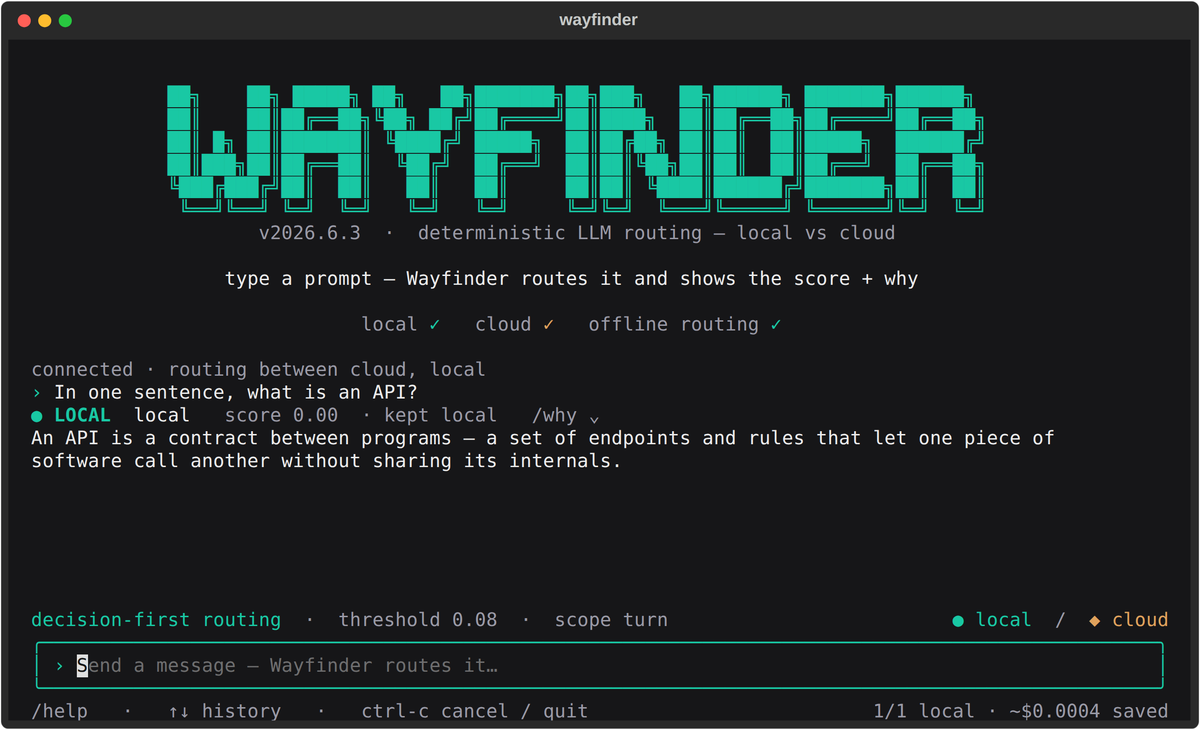
Every turn shows where it routed (● LOCAL / ◆ CLOUD), the structural score and why
(/why), and the running savings vs always-cloud. /init sets up models without leaving
the chat, /route · /local · /cloud force a turn, and conversations persist across
sessions (/threads).
In your browser — the web chat UI with a live threshold slider:
pip install "wayfinder-router[gateway]"
wayfinder-router webchat --dry-run
# opens http://127.0.0.1:8088/demo
webchat is a thin launcher over serve (the gateway and its /demo page; --no-open,
--port, --host 0.0.0.0, --dry-run); serve is the headless command. Both surfaces
show, for every message, where it routed (local vs cloud), the complexity score and why
(the feature breakdown), and the cost saved vs always-cloud. With no config both are
decision-only (--dry-run for the web; the terminal's preview), so you can poke at it with
zero setup. To get real replies, run wayfinder-router init to scaffold [gateway.models]
(then wayfinder-router doctor to confirm your keys resolve) — see Quickstart.
Works with any OpenAI-compatible API
Wayfinder forwards each call to an OpenAI-style /chat/completions endpoint — so if
your provider speaks that (and most do), it just works. A tier is one base_url,
a model name, and a key read from the environment at request time; no SDK, no
per-provider code. Pair a free local model with a hosted one, or run two cloud tiers.


…plus Groq, Together, OpenRouter, Fireworks, DeepSeek, and local servers (vLLM, LM Studio, llama.cpp) — + any OpenAI-compatible endpoint that takes a Bearer key.
Quickstart
Put Wayfinder in front of your models. Your app keeps speaking the OpenAI API; you
just change one base_url.
Scaffold a config —
initwrites a starterwayfinder-router.toml(keyless local Ollama → Anthropic cloud) plus a.env.example, then checks your keys:pip install "wayfinder-router[gateway]" wayfinder-router init # starter config (hybrid preset) wayfinder-router init --preset openai # two OpenAI tiers (gpt-4o-mini → gpt-4o) wayfinder-router init --preset gemini # two Gemini tiers (gemini-2.5-flash → gemini-2.5-pro) wayfinder-router init --interactive # pick providers/models step by stepOr describe your two models in
wayfinder-router.tomlby hand:[routing] threshold = 0.5 # below -> local, at/above -> cloud [gateway.models.local] base_url = "http://localhost:11434/v1" model = "llama3.2" [gateway.models.cloud] base_url = "https://api.openai.com/v1" model = "gpt-4o" api_key_env = "OPENAI_API_KEY" # read from this env var, never stored # api_key_cmd = "op read op://Private/OpenAI/credential" # optional: fill it from a vaultWayfinder never stores secrets: a model names an env var (
api_key_env) and the key is read from your environment at request time. There is nothing to "install" — just export the variable. Prefer not to paste a raw key into your shell? Add an optionalapi_key_cmdand Wayfinder fills that variable from your secret store at startup —op read …(1Password),security …(macOS Keychain),secret-tool …(Linux),pass/gopass,vault kv get …,aws secretsmanager get-secret-value …,bw,doppler,gcloud secrets …, or any command that prints the secret. The key is held in memory only, still never written to disk.wayfinder-router doctordetects which of these tools you have installed and suggests the exact line.Set your key(s), then run the gateway.
doctorre-checks the config and whether each model's key resolves (✓ set/✗ not set) before you start:export ANTHROPIC_API_KEY=sk-... # or OPENAI_API_KEY, per your config wayfinder-router doctor # ✓/✗ per model — is each key set? wayfinder-router serve --port 8088Point your existing client at it. No code change:
client = openai.OpenAI(base_url="http://localhost:8088/v1", api_key="unused")
client.chat.completions.create(model="auto", messages=[{"role": "user", "content": "..."}])
Easy prompts go local, hard ones go cloud, and every response carries
x-wayfinder-router-model and x-wayfinder-router-score so you can see where it
went. Want to force a tier for one request? Set model="local" or "cloud" (or
prefer-local / prefer-hosted), move the cut for a single call with an
X-Wayfinder-Threshold header, or start a chat message with /local or /cloud
(see Steer a single request).
Check it's working:
curl -s localhost:8088/healthz
# {"status":"ok","models":["cloud","local"]}

curl -s -D - -o /dev/null http://localhost:8088/v1/chat/completions \
  -H "Content-Type: application/json" \
  -d '{"model":"auto","messages":[{"role":"user","content":"hi"}]}' \
  | grep -i x-wayfinder-router
# x-wayfinder-router-model: local
# x-wayfinder-router-score: 0.00
No backends yet? wayfinder-router serve --dry-run answers with the routing
decision instead of calling an upstream, so you can feel the routing in 30 seconds
before wiring up real models.
Install
| command | what you get |
|---|---|
pip install wayfinder-router |
scorer, CLI, Python API, and the terminal chat (chat); the scorer/library imports stay dependency-light |
pip install "wayfinder-router[gateway]" |
adds the OpenAI-compatible routing gateway, the common case for serving |
pip install "wayfinder-router[ui]" |
adds the local calibrate / explain / configure UI |
pip install "wayfinder-router[all]" |
gateway and UI on top of the default install |
How it works
Wayfinder sits behind whatever OpenAI-compatible client you already use. You point
that client's base_url at the gateway once, and from then on it is invisible. The
same client serves a request whether it routes local or hosted.
  your client   (chat app, IDE, agent, or code)
       |
       v
  Wayfinder gateway   scores, picks a model
       |
       |-- low  -->  local    (Ollama, vLLM)
       |-- high -->  hosted   (OpenAI, any /v1)
       |
       v
  response returns via the same client,
  with x-wayfinder-router-* headers
A few things follow from this:
- The interface in front is yours. A chat GUI (Open WebUI, LibreChat), an IDE assistant with a custom endpoint (Cursor, Continue), an agent framework, or your own code on the OpenAI SDK. Want a chat window today? Put Open WebUI in front and point it at the gateway.
- Local and hosted are backends, not apps. The local model is just a server
(Ollama, LM Studio, vLLM, llama.cpp) speaking OpenAI's
/v1; the hosted one is the same shape. The user never switches UIs and usually never knows which model answered. - The score is computed, not a second opinion. Asking a model how hard a
prompt is would be slow, non-deterministic, and would cost a model call to decide
whether to make a model call. Wayfinder scans the prompt instead — structure
(length, headings, steps, links, code, tables) and difficulty cues in the wording
(reasoning terms, math symbols, constraints) — into a
0.0-1.0value and compares it to your threshold. Same prompt, same threshold, same answer. It is a proxy for difficulty, not a verdict, which is why the threshold is yours to tune.
Keys are read from the environment at request time and never touch the config file or the scored path.
Score a prompt from the CLI
echo "Summarise this paragraph in one sentence." | wayfinder-router route -
Recommended Model: local
Complexity Score: 0.00  (mode: tiered)

Tiers:
  >= 0.00  local <-
  >= 0.50  cloud

Contributing Features:
  Word Count: 6
  ...
Add --json for machine consumers (an agent reads this and routes to its own
model):
{
  "schema_version": "3",
  "score": 0.66,
  "recommendation": "cloud",
  "mode": "tiered",
  "features": { "word_count": 545, "heading_count": 12, "reasoning_term_count": 3, "...": 0 },
  "tiers": [{ "min_score": 0.0, "model": "local" }, { "min_score": 0.5, "model": "cloud" }]
}
Configure routing
Wayfinder reads its own wayfinder-router.toml, found by walking up from where you
run it. There are three modes, in precedence order (classifier > tiers >
threshold); the scalar-score weights apply to any of them.
Binary (the default) is a single cut:
[routing]
threshold = 0.6
weights = { word_count = 4.0, list_item_count = 2.5 }
--threshold N overrides it for one run; WAYFINDER_ROUTER_THRESHOLD overrides it
from the environment.
To switch the lexical cues on, raise their weights and cut at the knee — the one
held-out improvement over the structural default on real frontier traffic (skill
−0.038 → +0.057, 61% cost saved on RouterBench). See
docs/lexical-routing.md and the ready-to-edit
examples/wayfinder-router.lexical.toml;
recalibrate the threshold to your own traffic (a ~20-prompt bootstrap is only a smoke
test — see benchmarks/calibration-eval.md).
Tiered routes ordered score bands to any number of models:
[[routing.tiers]]
min_score = 0.0
model = "llama-3b"
[[routing.tiers]]
min_score = 0.3
model = "llama-70b"
[[routing.tiers]]
min_score = 0.6
model = "claude-cloud"
Classifier is a fitted multinomial-logistic model, argmax over per-model
linear scores. You usually generate it with calibrate rather than write it by
hand.
Each [gateway.models.<name>] block maps a routed name to an upstream base_url, a
model, and an optional api_key_env (the name of an environment variable, never
the secret itself). The gateway is the only part that touches keys or the network;
the scorer, config, and calibrator stay pure and offline.
Calibrate on your data
The cut is a proxy, so tune it against your own traffic. wayfinder-router calibrate reads a labeled JSONL dataset ({"text": ..., "label": ...}) and prints
a config fragment. It runs offline and never calls a model; the labels are your
ground truth.
wayfinder-router calibrate data.jsonl --mode threshold              # sweep the binary cut
wayfinder-router calibrate data.jsonl --mode tiers                  # ordinal multi-model
wayfinder-router calibrate data.jsonl --mode classifier --out wayfinder-router.toml
The fragment drops straight into wayfinder-router.toml; the accuracy and chosen
breakpoints print to stderr. The classifier is fit by deterministic L2-regularized
Newton/IRLS, pure Python, converging in a handful of iterations.
To pick a cut in cost terms instead of bare accuracy, use a cost-aware objective.
--objective knee chooses the cost-aware knee automatically (it maximizes
quality-recovered × cost-saved — no target to guess, and it can't collapse to
always-routing-to-the-expensive-model the way pure accuracy does on skewed labels);
--objective cost-quality --target-savings X instead holds a specific savings floor.
Add --weights to score with — and emit — custom feature weights, e.g. the lexical
opt-in, so the output is a complete, deployable config (see
docs/lexical-routing.md):
wayfinder-router calibrate data.jsonl --mode threshold --objective knee \
  --costs local=0.2,cloud=1.0 \
  --weights reasoning_term_count=5,math_symbol_count=3,constraint_term_count=1.5
Cost is metadata only — it shapes the calibrated cut and is reported on the
/metrics endpoint, but never enters a per-request decision, which stays
deterministic and free.
Steer a single request
The deployment's config sets the default boundary, but a client can override the decision for one request over plain OpenAI transport. An override only changes where the request goes; the prompt is still scored, and nothing adds a model call.
- The
modelfield is a routing directive.auto(or any normal model id) lets Wayfinder decide; a configured endpoint name (local,cloud) pins the request there;prefer-local/prefer-hostedpin to the low / high end of your router (prefer-cloudstill works as an alias ofprefer-hosted). - An
X-Wayfinder-Thresholdheader re-cuts the decision for that request, a number in0.0-1.0reusing your weights (binary routers only). - An in-message
/directive(opt-in:[gateway] slash_directives = true) lets a plain chat box steer routing — start a message with/local,/cloud,/prefer-hosted, or/autoand it pins that turn (stripped before the model sees it). Only known directives are acted on; anything else starting with/is left as ordinary text (WF-ADR-0036).
# Pin one call to cloud regardless of score:
client.chat.completions.create(model="cloud", messages=[...])
# Or move the cut for one call (keep model="auto"):
client.chat.completions.create(
    model="auto", messages=[...], extra_headers={"X-Wayfinder-Threshold": "0.8"}
)
Each response adds x-wayfinder-router-mode (scored / pinned /
threshold-override) next to the -model and -score headers, so you can see
which channel decided the route.
Drive it from a chat UI (no fork)
Because the model field is a routing directive, any OpenAI-compatible chat UI can
drive routing with no code change: the app's normal model dropdown becomes a
per-conversation routing picker (auto / prefer-local / prefer-hosted / a
pinned endpoint). The gateway lists these at GET /v1/models, so a UI discovers
them on its own.
- LibreChat — copy
examples/librechat.yamlandexamples/docker-compose.override.ymlinto your checkout, rundocker compose up, and pick the "Wayfinder" endpoint. - Open WebUI — add an OpenAI connection pointing at the gateway; it auto-discovers the routing options.
See examples/ for both. The one thing a stock UI can't express is a
live per-conversation threshold slider; that's what the wayfinder-chat fork adds,
and this no-fork path proves it out first.
See where requests go
Wayfinder's controls are spread across the tools you already run, so it's easy not to notice it working. Four surfaces show or steer routing:
| surface | what it shows | where |
|---|---|---|
| Model dropdown | the routing picker (auto / prefer-local / prefer-hosted / a pinned endpoint) |
your client, from GET /v1/models |
| Response headers | where each request went and why (-model / -score / -mode / -request-id) |
every response |
| Debug body field | the decision inside the response body, opt-in | request header X-Wayfinder-Debug: true |
| Dashboard | recent decisions, per-model counts, scores — metadata only, never prompt text | GET /router (JSON at /router/recent) |
The dashboard is separate from the off-path wayfinder-router ui console, which is
for tuning, not production traffic.
Learn from feedback
Don't guess the cut, learn it from your own judgment of local versus hosted output. The loop is: collect judgments, calibrate, route automatically.
Bootstrap it with A/B onboarding. For each sample prompt, wayfinder-router onboard runs both arms and asks which was good enough; the answer is a label:
wayfinder-router onboard prompts.jsonl --arms local,cloud --calibrate > wayfinder-router.toml
The comparison goes to stderr; --calibrate prints the resulting config to stdout.
Each judgment appends a {"text", "label"} line to a feedback log, which is itself
the calibrate dataset, so the log turns straight into a config.
To skip the manual grading, let wayfinder-router judge label automatically. It runs
both tiers and asks an automated judge "was the cheaper tier good enough?" — the same
sufficiency question, no person in the loop:
wayfinder-router judge prompts.jsonl --arms local,cloud --gold gold.jsonl > wayfinder-router.toml
The built-in judge is a deterministic text comparator that abstains rather than guess
when it can't tell. Because a bad label would silently degrade live routing, judge will
only emit a config once it passes trust gates — agreement with your human-labeled
--gold set (Cohen's κ ≥ 0.6), out-of-fold lift over the majority baseline, and both arms
represented. If the gates fail it prints the confusion matrix and refuses (the labels are
still recorded). Pass --save-comparisons out.jsonl to also keep the raw responses (off by
default — it's a body store).
Once you're routing automatically, keep it honest by recording which model was actually good enough:
curl localhost:8088/v1/feedback -d '{"text": "...", "label": "cloud"}'
Then re-fit on a schedule from cron, a k8s CronJob, or a click in the UI.
Recalibration rewrites only the [routing] section and preserves your [gateway]
endpoints, and a running gateway hot-reloads the result with no restart:
wayfinder-router recalibrate                  # log -> calibrate -> write config
wayfinder-router recalibrate --min-labels 50  # no-op until you have enough signal
The judging runs models, so it lives in the gateway layer (with your key); the scoring core stays untouched and the log carries no secrets.
Deploy and integrate
The CLI, onboarding, and UI are for operators and bootstrapping. In production, prompts flow through the gateway (transparent) or the library (in-process), so routing happens where prompts already are.
Run the gateway as a service, sidecar or standalone:
docker build -t wayfinder-router . && docker run -p 8088:8088 -v "$PWD/data:/data" wayfinder-router
# or: docker compose up gateway   (see docker-compose.example.yml)
Point your existing client at it with no app change. Anything that speaks the
OpenAI API takes a base_url, including agent frameworks (LangChain, LlamaIndex),
IDE assistants with a custom endpoint (Cursor, Continue), and gateways like LiteLLM:
client = openai.OpenAI(base_url="http://localhost:8088/v1", api_key="unused")
See Integration recipes for copy-paste setup across chat UIs
(Open WebUI, LibreChat, Jan), editors (Continue, Cline, Zed, JetBrains), agent frameworks
(LangChain, LlamaIndex, CrewAI, AutoGen, the OpenAI Agents SDK, the Vercel AI SDK), and
CLIs (aider, Copilot CLI) — plus the canonical OPENAI_BASE_URL / OPENAI_API_KEY pair.
Claude Code speaks Anthropic's Messages API rather than OpenAI's, so the gateway exposes a
POST /v1/messages adapter (WF-DESIGN-0011) that translates Anthropic ⇄ OpenAI in both
directions — streaming and tool use included. Point it at the gateway root and Claude Code
routes through Wayfinder like any other client:
export ANTHROPIC_BASE_URL="http://localhost:8088"   # client appends /v1/messages
export ANTHROPIC_API_KEY="unused"                   # the gateway uses each upstream's own key
claude
Wire feedback from wherever your users are. Your app, IDE, or chat shows a thumbs-up or thumbs-down and posts the judgment; the next recalibration learns from it:
fetch("http://localhost:8088/v1/feedback", {
  method: "POST",
  body: JSON.stringify({ text: prompt, label: wasGoodEnough ? "local" : "cloud" }),
});
The gateway forwards asynchronously and streams: a request with stream: true
comes back as Server-Sent-Events, so chat clients render tokens as they arrive. An
upstream timeout or connection failure returns an OpenAI-shaped error instead of a
bare 500, every response carries a request id for tracing, and routing decisions
and reload failures are logged. The knobs:
| setting | effect |
|---|---|
WAYFINDER_ROUTER_TIMEOUT / serve --timeout |
upstream timeout in seconds (default 60) |
WAYFINDER_ROUTER_FEEDBACK_TOKEN |
when set, /v1/feedback requires Authorization: Bearer <token> |
serve --dry-run |
return routing decisions without calling any upstream |
GET /healthz |
reports degraded and lists missing_keys when a configured api_key_env is unset |
GET /router |
read-only dashboard of recent decisions, with X-Wayfinder-Debug: true surfacing one in the body |
GET /v1/savings?period=today|7d|30d|all |
realized vs always-frontier cost and the savings between them, per route (WF-DESIGN-0007) |
WAYFINDER_ROUTER_SAVINGS_FILE |
where the savings ledger is persisted (default <config-dir>/wayfinder-savings.json) |
[gateway] retries / breaker_threshold / breaker_cooldown |
reliability: bounded retries on transport/429/5xx, and a per-target circuit breaker (WF-ADR-0031) |
[gateway] failover = same-tier|degrade|escalate |
on exhaustion, stay on the tier (default), fall to a cheaper one (never raises cost), or a dearer one (opt-in); per-request X-Wayfinder-Failover |
[gateway.models.<name>] fallbacks = [...] / context_window |
same-tier endpoints to try on failure; skip a target whose window can't fit the prompt. Responses carry x-wayfinder-router-served-by |
[gateway.budget] limit / window = day|month|all / on_breach = degrade|block |
spend cap: once limit realized cost is reached, degrade to the cheapest tier (default, never raises cost) or block with HTTP 402. Surfaced via x-wayfinder-router-budget; needs real cost_per_1k prices (WF-ADR-0032) |
[gateway.cache] enabled / ttl / max_entries / max_bytes |
exact-match response cache: replay a stored answer for an identical deterministic request — instant, free repeats. Off by default; in-memory only; raise max_bytes (default 64 MiB) for more. A hit is free and surfaced via x-wayfinder-router-cache: hit|miss; disabling purges it (WF-ADR-0033) |
[gateway.rate_limit] rpm / tpm / window |
cap requests-per-minute and/or upstream-tokens-per-minute over a fixed window (default 60s); on breach returns 429 with Retry-After. The outermost guardrail (checked before scoring); gateway-wide. Successful responses carry X-RateLimit-Limit/-Remaining/-Reset so clients can self-pace; surfaced via x-wayfinder-router-rate-limit and wayfinder_router_rate_limited_total (WF-ADR-0034) |
[gateway.keys.<id>] hash / tags / models (+ nested budget / rate_limit) |
virtual API keys: when any is set, /v1/* requires a valid Authorization: Bearer token (else 401). Mint with wayfinder-router keys new; only the SHA-256 hash is stored. Spend & savings are attributed per key (by_key in /v1/savings, wayfinder_router_key_requests_total); a key can carry its own budget/rate-limit (strictest wins) and a models allowlist (clamps to the nearest allowed tier) (WF-ADR-0035) |
Explain and tune
To see why a prompt routed where it did, ask for the per-feature breakdown: each feature's value, its normalized level, its weight, and its share of the score.
wayfinder-router route prompt.md --explain
For interactive tuning there's a local web UI:
- Explain — paste a prompt; see the score, the tier ladder, and contribution bars, and drag a threshold slider to watch routing change live.
- Calibrate — paste a labeled dataset, run a mode, and see accuracy, the sweep curve, and the resulting config fragment.
- Configure — edit
wayfinder-router.tomlwith live validation and save. - Onboard — A/B a local and a hosted model in the browser, judge each, and
calibrate from the log (needs
[gateway]for the model calls).
pip install "wayfinder-router[ui]"
wayfinder-router ui --port 8099    # then open http://localhost:8099
The UI is a thin wrapper over the same pure functions; it never calls a model, and no secret appears in it.
Python API
from wayfinder_router import score_complexity, RoutingConfig, explain_score

result = score_complexity(prompt_text, config=RoutingConfig.binary(threshold=0.7))
print(result.recommendation, result.score, result.features)
for fc in explain_score(result.features, RoutingConfig().weights):
    print(fc.name, fc.contribution)
Origin
Wayfinder started as a route experiment inside a larger requirements tool and was
split out because routing is a runtime concern, not a knowledge one: a prompt router
shouldn't make you install an engine you don't need. The result is a small, focused
tool whose scoring core stays dependency-free — you can import wayfinder_router and
score prompts with nothing but the standard library (WF-ADR-0001, WF-ADR-0029).
Repository layout
wayfinder-router/
  wayfinder_router/   the package: scorer, tiers + classifier, config loader/writer,
                      offline calibration (Newton/IRLS), explain, the feedback log and
                      onboarding harness, recalibration, CLI, and the optional gateway
                      and local UI (the impure layers, behind their extras)
  tests/              scorer, config, calibration, explain, feedback, onboard,
                      recalibrate, CLI, gateway, and UI coverage
  decisions/          design notes behind the tool's own choices
  docs/               the FAQ and the lexical-routing guide
  Dockerfile, docker-compose.example.yml   deploy the gateway as a service
Test
pip install -e .[dev]   # or: pip install pytest
make test