https://news.ycombinator.com/item?id=48739003
Someone (@rramadass) made me a good set of recommendations from the titles.
* Edit: I see now that linked comment too is from @clmul, the OP here. Thanks clmul!
These old folk tales are really entertaining. Often there’s no real moral or anything. It’s just a story. And to this day I really like these stories that are just “this happened and that person did that” and so on which don’t have to say “And the message is X”.
Unrelatedly, my wife jokes that I ended up marrying a Taiwanese woman because my childhood was spent reading folk tales about Chinese women.
0: both these are somewhere on archive.org e.g. https://archive.org/details/thelonghairedmaiden
What do soviets make great researchers? I noticed this pattern in ml, math & physics research.
Is it that they have better quality books?
There also was no centralized test system (like SAT) up until early 2000-s. People had to go and sit on entrance exams in each university where they wanted to apply. But winners of olympiads got automatic admission into good universities.
In addition, social sciences were a minefield in the USSR, especially subjects like political science or history. And hard sciences were safe.
Higher education in the US, with the exception of scholarships here and there, requires you to come from a wealthy background to afford the best schools.
In other words, it's more about perpetuating class privilege than it is about developing the best and brightest of a generation. If you're a genius with poor parents, you have to really hope to get lucky enough to get a scholarship.
In socialist societies, despite the claims often leveled against them, things were more meritocratic. If you're a genius with poor parents, you got access to the best education as that's what's optimal for society.
Americans: contact the vendor and report the issue. Then wait for the vendor to fix it, applying pressure as needed. Because of the delay, the product ends up being 6 months late, but then it works reliably.
Russians: curse the vendor, then use undocumented APIs and live code patching to work around the bug. The vendor is never told about the issues. The product is released on time, but it breaks in 1 year when the vendor makes an incompatible change that breaks the workarounds.
This mindset is very much a result of centuries of having to work around the government that is seen more as an occupying force rather than the will of the people. And it's very helpful when you're doing security research.
Incidentally, Jewish people also excel in security due to a similar cultural mindset.
Cheating was rampant, and a very common way for getting admitted was paying professors from that uni for tutoring - who would train them on the type of tasks they would do at that uni.
And it prevented you from attending unis far away a lot of time due to time contraints.
If you never learned to read, good luck getting higher education.
I'm not defending communist societies like Soviet Union or China but I think "social democratic" countries like those in Scandinavia have shown generally good education outcomes.
And in the USSR, if you failed to get into the university, you were drafted into the army for 2 years.
How do you people come up with such stories?
To add some color, here is my favorite hard-to-translate idiom in a Russian developer community:
"File away rough edges" ("доработать напильником") - adjust something to work in a way that its original creator never even realized is possible. And usually for a good reason.
Of course, all generalizations should be taken with a grain of salt. They can never be used to judge individuals or even individual companies.
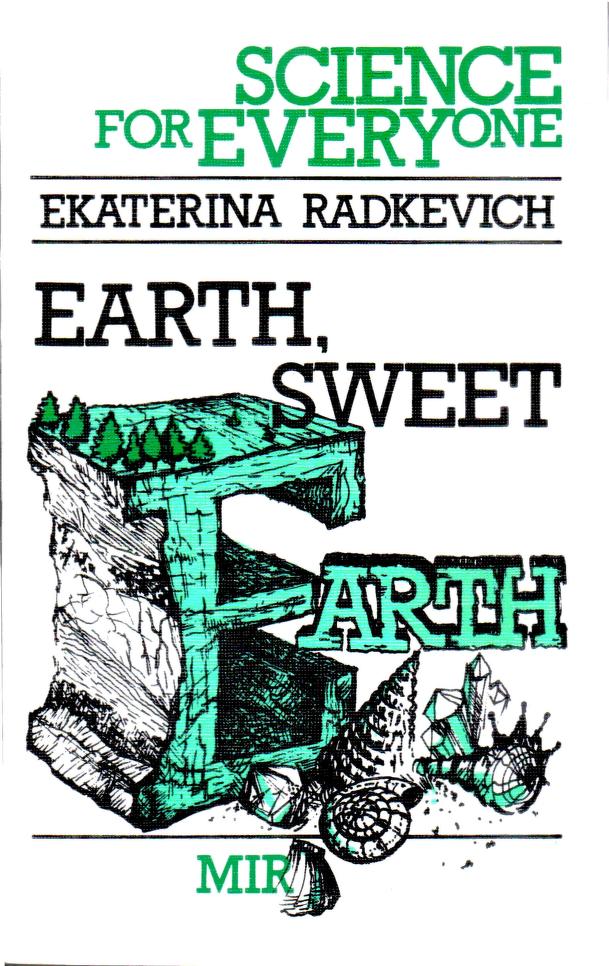
The book is based on the author’s impressions of her numerous expeditions in the many countries. It is a fascinating narrative rather than a mere record of facts irrespective of how scientifically valid they can be. The book is bound to be appreciated as a piece of absorbing reading by anyone who cares to increase the scope of his or her competence about our sweet home of a planet that must be saved from destruction at all costs.
Ekaterina Radkevich, Corresponding Member of the USSR Academy of Sciences, is one of the most distinguished geologists whose works are well known in her own country and in many other parts of the world. The overwhelming success of her publications is chiefly due to her indefatigable practical activity in the USSR and elsewhere and her unflagging interest in theoretical research which she has been conducting for quite some time at the Institute of Geological Studies in the Far East (Viadivostok).
Note: This book was the last remaining volume in the Science for Everyone Series! This completes volume the SFE series in English.
Many, many thanks to a patron who purchased and posted this book to us to complete this series. Much appreciated help!
You can get the book here and here
Follow us on
Twitter https://x.com/MirTitles
Mastadon https://mastodon.social/@mirtitles
Bluesky https://bsky.app/profile/mirtitles.bsky.social
Tumblr https://www.tumblr.com/mirtitles
Internet Archive https://archive.org/details/mir-titles
Fork us on gitlab https://gitlab.com/mirtitles
Contents
How I Became a Geologist (In Lieu of a Preface) 7
Part I. The Earth in the Universe 20
Chapter 1. The Earth as a Cosmic Body 20
Chapter 2. The Planet Earth 29
Chapter 3. The Deep-seated Structure of the Earth 38
Chapter 4. The Development of Views on the Origin of Earth and Other Planets of the Solar System 47
Part II. The History of the Development of the Earth 58
Chapter 5. The Dawn 58
Chapter 6. Life: The Earth’s Chronicle 70
Part III. Geology Everywhere 100
Chapter 7. The Work of the Wind 102
Chapter 8. The Role of Water in the Transformation of Our Planet 113
Chapter 9. The Activity of Subterranean Forces 127
Part IV. The Composition of the Earth’s Crust 147
Chapter 10. Sedimentary Rocks 147
Chapter 11. Magmatic (Igneous) Rocks 159
Chapter 12. Metamorphic Rocks 185
Part V. The Movements of the Earth’s Crust 202
Chapter 13. Mountains: Old and Young 203
Chapter 14. The Deformation of Rocks 208
Chapter 15. Fixism vs. Mobilism 216
Part VI. Mineral Resources 236
Chapter 16. The Mineral Kingdom 236
Chapter 17. Mineral Raw Materials and Technical Progress 258
Chapter 18. The Future of Mineral Raw Resources 280
Chapter 19. How Ores Are Formed 286
Chapter 20. The Science of Metallogeny 308
Chapter 21. In Quest of Ores 328
Chapter 22. At the Metallogenic Map of the Pacific Belt 338
Chapter 23. Mineral Resources of the Seas and the Underwater Storerooms of Mineral Raw Materials 349
Chapter 24. Save Our Earth! 361
To End on a Poetic Note 367