I have a similar grief with YouTube movies although in that one, they don't play UHD. Some do like Valerian plays at least in 1080P, most movies are capped to 480P unless you have an "approved device" eg. something probably riddled with ads.
[0] https://blog.playstation.com/2026/07/01/physical-disc-produc...
Now we're not even getting to retain what we buy, this is not a streaming service, these were sold to users individually.
We've gone full circle where I honestly believe pirating is a far better offering.
The root of the problem is these ridiculous content licensing agreements, it should be very very obvious to the customer when they're buying that "Hey, you will own this until X date when our content licensing agreement is finished"
Not hidden by design in some dense ToS.
https://www.theguardian.com/technology/2009/jul/17/amazon-ki...
I know it'll never happen with the people we have in government these days, and the anti-consumer organizations, like the ESA, that are out there now claiming things like running private servers for Minecraft is illegal and piracy. (Yes, they really said that. Despite the fact that Minecraft has always provided the server and allowed this for 15+ years)
> What's the name of that website?
I tell them to use yandex, they will find plenty of such websites...
https://en.wikipedia.org/wiki/Sony_BMG_copy_protection_rootk...
Anyone remotely surprised at their history of utter contempt for the end-user need only remind themselves of SVP Steve Heckler's remarks to conference attendee's in 2000
"The industry will take whatever steps it needs to protect itself and protect its revenue streams ... It will not lose that revenue stream, no matter what ... Sony is going to take aggressive steps to stop this. We will develop technology that transcends the individual user."
https://web.archive.org/web/20090318115847/http://www.nyfair...
The remarks of Stewart Baker of the DHS admonishing Sony are as relevant today as they were then; namely that "it's your intellectual property - it's not your computer."
https://web.archive.org/web/20051229031842/http://www.mp3new...
You will own nothing.
Simple example: "The Things of Life", a classic French movie from 1970. https://en.wikipedia.org/wiki/The_Things_of_Life
No way to get it in the US. No physical media, no streaming. It is on Apple TV ... in France.
You can torrent it.
Utterly brokem model.
Music is the same btw, Apple Music and Spotify geoblock music. Workaround is to add to your library when traveling in EU. Insane.
And yes, bypassing DRM is banned speech in the USA, punishable by criminal law. And there's no actual requirement of a company to claim DRM and defeat methods. The law is set up so they can claim basically anything, and its 100% backed by criminal law.
1FA is kinda a joke, cause saying inane shit like "Hitler was a good guy" is perfectly fine, but "09 F9 11 02 9D 74 E3 5B D8 41 56 C5 63 56 88 C0" (HD-DVD private key) is criminally banned speech.
I guess residuals are a made up thing.
What are people to do if they want to stay on the non-pirate/legal side of this but also prevent being royally F-ed?
It's typical "you own nothing" logic to the point the companies selling you that also don't even own it.
(I am a bit surprised they didn't bung Google and StudioCanal a bit of money to move them to Google Play to avoid the bad publicity though.)
I wrote a letter to them after the rootkit fiasco saying they've lost a consumer for life. Didn't get a real response. Wrote to them last anti DRM day. Didn't get a response.
Really, this is the only power one has in capitalism -- don't buy their products.
How is this any different from downloading a file off the internet? Maybe its fun to juggle a bunch of disks?
Right I should also add I'm mostly talking about PC here.
https://uk.7digital.com/ has a lot of songs available in MP3 format, but not as many as on iTunes.
Not sure if it is still the case today with the latest generations of ultra-advanced codecs.
I don't partake in downloading anymore but I do go to streaming sites
https://www.eff.org/deeplinks/2005/12/summary-claims-against...
"The feature was controversially removed by Sony since system firmware update 3.21, released on April 1, 2010.[2] A class action lawsuit was filed against Sony on behalf of users, but was dismissed with prejudice in 2011 by a federal judge. The judge stated: "As a legal matter, ... plaintiffs have failed to allege facts or articulate a theory on which Sony may be held liable."[3] However, this decision was overturned in a 2014 appellate court decision[4] finding that plaintiffs had indeed made clear and sufficiently substantial claims. Ultimately, in 2016, Sony settled with users who had installed Linux or had purchased a PlayStation 3 based upon the availability of OtherOS."
[0] https://en.wikipedia.org/wiki/OtherOSIt should, however, be illegal to tell your customers that they are purchasing/buying media without explicit "Rent" language (which implies a non-expiring license) when you do not yourself have the right to grant non-expiring licenses.
And Sony made it easy for them too by using this verbiage: “previously purchased content”
We seen what licensing ala Netflix and Spotify means artists.
Many of these services offer cheaper rental options. When you go for the more expensive "buy" option, the assumption that you are actually buying it to keep should hold true.
For Sony, the correct move here would have been to not list Studio Canal titles in the first place, and put out a very public statement saying that they aren't being listed until Studio Canal agrees to make purchased licenses perpetual as they should be.
I'm curious. What are the best sites nowadays? Still torrents, right?
I used to be in the know but switched to legit things a while back so I wouldn't have to explain how dad is getting Bluey episodes.
I doubt most of the people who "bought" the film understood that they weren't buying it and it could be taken away from theme at any time.
Going to bring Binks' Brew.
At some point, being more honest about what artists get paid will probably help the middlemen more than harm them.
And with games it's just getting worse (Sony announced they won't make discs starting 2028; the Switch 2 takes carts but very, very few games release on a cart). If you care about control over the games you purchased, if you care about going back and playing older games, then the only choice is to use platforms that are DRM free. (Or, well, non-legal means.)
It was a copyright violation. Which, I don't give one fuck about.
But I not for a single second trusted "buying" digital goods, and I was quickly proved right. The first digital purchases getting yanked story must have been close to 20 years ago at this point.
I still buy CD's and books and game discs when the digital DRM-free equivalent cannot be had.
Nobody would buy that. So they say "buy" instead, and courts have largely let them get away with it. Until legislation actually forces the word "buy" to mean ownership, this will keep happening.
4 days ago: https://news.ycombinator.com/item?id=48691346
4 years ago ( so it's not the first time studioCanal has done this): https://news.ycombinator.com/item?id=32010317
Except that no part of what you claim is true:
https://support.apple.com/guide/iphone/back-up-iphone-iph3ec...
I still make digital purchases, but at the first sign of friction, at the first indication that I'm gonna get screwed somehow, I leave port and off to the open waters. Fuck 'em, I played by the rules until I discovered that I was the only one doing so.
More like 30 years but your terminology is slightly off: I have music I bought in the 90s which still works fine because they sold it as MP3s without DRM and I was able to make my own backups. There’s nothing wrong with digital goods as a concept but we should be consistent in how we talk about it: if it involves an outside service, it’s a rental no matter how the seller describes it. If you can make your own copy and survive a corporate bankruptcy or merger, then it’s a real purchase.
it is more immoral to sell something you can't legally "sell" (permanently and irrevocably transfer ownership of a product), than to pirate that content (which has no level of expected payment)
- Disney -> Disney+/Hulu
- Universal/NBC -> Peacock
- Warner Bros. -> Max
- Lionsgate -> Lionsgate+
- Sony Pictures -> The Sony services relevant to the article (note: the Sony services sell more than just Sony Pictures content)
They never needed to, but it actually makes them more money because a revenue share model through Movies Anywhere makes sense. StudioCanal does not sell streaming/delivery services directly to consumers, a revenue share model between streaming providers would not make them more money, and Sony would have no influence on StudioCanal doing so anyways.
Still walled garden, but they act way better.
There's a dangerous path where the companies are required to describe these transactions as "rentals", but that wont actually solve anything. If we require clearer advertising, we're going to end up with a world where everything is very clearly a rental, and there simply is no option to purchase. People will still buy the $40 "rentals" because it's their favorite movie and they want to watch it multiple times, and it's Friday night and they want to watch it right now.
I think people understand the situation when they "purchase" digital media. They know it might not last forever. They do it anyway. They don't like it though. They would prefer genuine ownership, but it's not an option.
We either need to outlaw these long term rentals, or break up monopolies until companies that are actually offering genuine purchases arise. Or we could do both.
We need to regulate more than just the wording on the "purchase" page. This isn't just a problem of wording.
Ownership is slowly moving onto servers a few companies control, and the storefront hasn’t admitted it yet.
Sony plans to wipe 551 movies and TV shows from the PlayStation Store libraries of customers who paid full price for them. The deletion is coming on September 1 and so far the company has said nothing about giving anyone their money back.
The titles all come from StudioCanal, the distributor behind Terminator 2, Total Recall, Rambo: First Blood, The Deer Hunter, Bridget Jones’s Diary, From Dusk Till Dawn, and Cliffhanger.
Anyone who hit “buy” on one of them will open their library that morning and find a hole where it used to be. PlayStation’s notice states it without apology: “You will no longer be able to access your previously purchased content from Studio Canal, and it will be removed from your video library.”
The justification Sony offers runs to six words, “due to our content licensing agreements.”
A licensing deal between Sony and StudioCanal expired or shifted, and the people who paid are the ones losing their films over it. None of them signed that contract and none gets a vote in it.
X user somatyk surfaced the news on June 25, posting the notification they’d received. The message signed off with, “Click here for a full list of affected titles that will no longer be supported. Thank you.” Sony has since reproduced the same warning, and the full roster of 551 titles, on the PlayStation website.
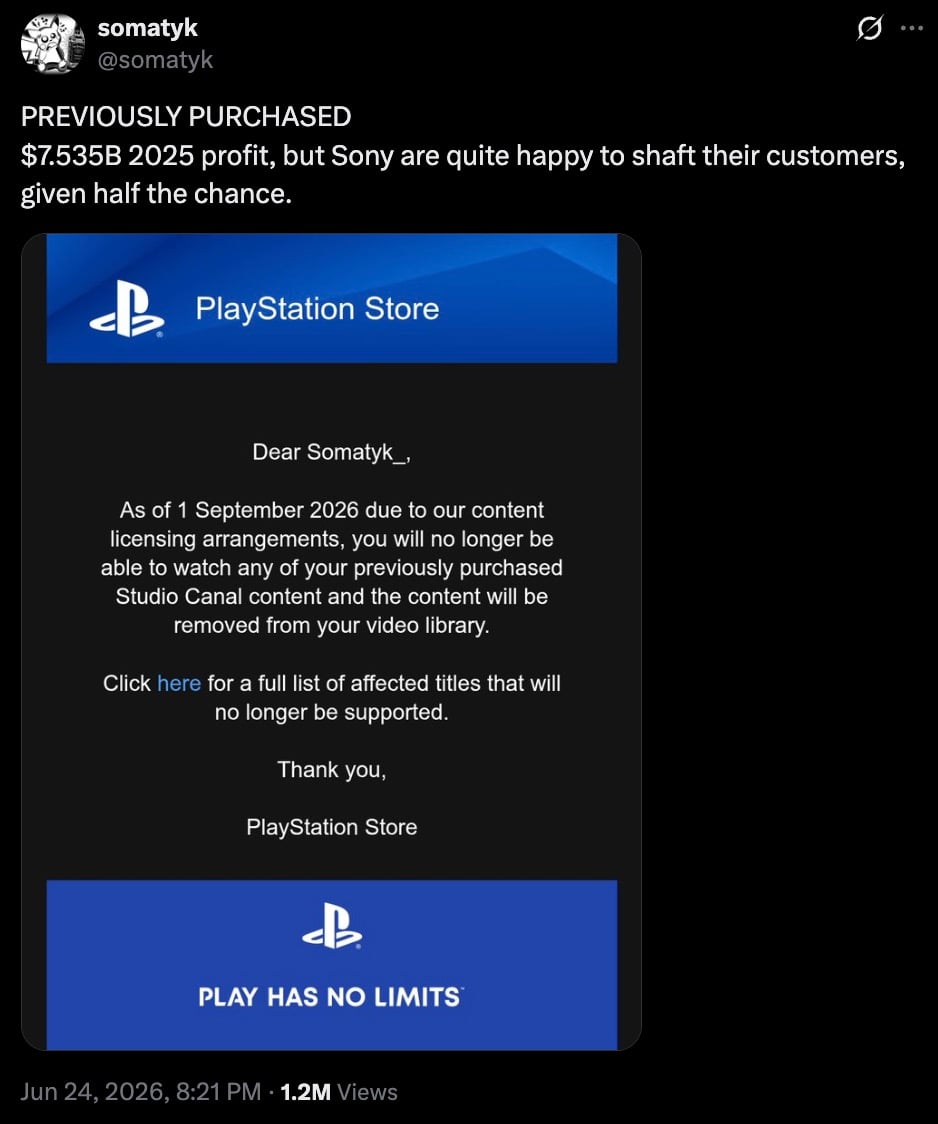
Nobody rented these movies. The store put a “buy” button next to them, charged the purchase price, and dropped them into a library it called yours. Sony can empty that library the moment a contract somewhere upstream changes, and the terms of service you scrolled past on first boot already say you agreed to this.
If the movie case feels abstract, the games industry just made the same point with its biggest release in over a decade. GTA 6 arrives November 19, and the boxed copy you can buy at Walmart or GameStop contains no disc. Take-Two confirmed it in a press release: “The physical version of Grand Theft Auto VI, containing a download code inside the box, will be available starting November 12, 2026 to support pre-loading.”
You pay $80 for a cardboard sleeve wrapped around a download code that locks the game to your account. You cannot lend it, resell it, or install it offline. Do you want an actual disc that lives on your shelf and answers to no server? There isn’t one, and if a real physical edition ever ships, you’ll buy the game a second time to get it.
Asked earlier whether Rockstar might hold physical copies back to stop leaks, Take-Two CEO Strauss Zelnick had said, “That’s not the plan.” The plan, it turns out, was to keep the box and throw away the disc. Killing the disc also ends the secondhand market and lending, and it hands the publisher control over access that a physical object never gave them.
Ownership is being pulled back to the center, into accounts and servers a handful of companies control, and the words on the storefront haven’t caught up.
The word “buy” might still sit on the button, but the definition of what that means keeps getting thinner.
Another perspective: In accordance with the licensing system that Sony and their lobbyists helped establish, Sony's licensing agreement with StudioCanal came up for renewal. Sony decided that they didn't want to pay StudioCanal's perfectly reasonable() asking price.
this is StudioCanal's perspective.
Now if the RAM companies make it so you won't ever be able to afford your own hardware and every game company pushes cloud-only gaming... Well, we aren't there yet thankfully, but I fear it'll happen.