It's definitely possible to learn enough to be productive within a few months, but to actually comprehend and understand the underlying biology takes much, much longer. I still don't understand much of what is presented by people from other labs outside of my specialty.
Maybe a section on RNA degredation and DNA stability and how it would affect sequencing would be nice.
Also, down stream analyses are largely missing e.g. differential analysis, pathway enrichment. Not to mention newer single cell techniques and their up/down sides. But good start!
I'd strongly recommend in reading up on the parts of cell biology that come after this. Otherwise you'll get the wrong impression of how messy biology actually is.
This looks like a great guide to read.
But I think before diving deeper and reading the rest of the guide, which granted it is from employees working in a lab inside of a hospital, I'd like to get the expert opinion of a geneticist or an expert biologist with years of experience in genomics to iron out any issues in the guide or give an additional proof-reading review.
Also gotta shout out to these incredible molecular animations by WEHI: https://www.youtube.com/watch?v=7Hk9jct2ozY
For example, sequencing instruments include base quality strings in the output. Base qualities are estimates how likely the instrument got each sequenced base right. But most people don't want to store that much noise, especially when the actual data is highly compressible. So the base qualities get quantized using more or less principled methods that seem to work well empirically.
Read aligners make similar estimates of how likely they got the correct alignment for each read. Those estimates are typically based on simplistic models and a number of assumptions. There are two main components in the estimate. One is based on comparing the primary alignment the aligner chose to the secondary alignments it also found. Another is an estimate that the aligner didn't find the correct alignment, because that part of the sequenced genome is too different from the reference. The latter is obviously handwavy. And the aligner cheats in the former. Because people don't want to wait 10x or 100x longer for better results, the aligner gives up early and estimates how good secondary alignments it might have found if it had actually done the work.
And then there is variant calling. At some point, the state-of-the-art callers were statistical. But then people got better results with neural networks. Or at least the results were empirically better.
But they produce short reads, and because DNA is full of repetitive fragments, it's not always clear where the read came from.
We also have two copies of genes, which also further complicates matters.
The first startup where I worked, developed synthetic long reads on top of Illumina's hardware. We could stitch together 50kbp reads, which really helped with de-novo sequencing.
This is a weird description, because ... it is not really "broken up". Each chromosome could be shuffled and put into different cells in different numbers. Now, it is unlikely that the resulting cell would be viable or useful, but my contention here is the "broken up" part. Chromosomes are just a way to handle the genome set. There are reasons why bacteria do not have chromosomes and this has mostly to do with the amount of DNA. To call this "breaking up" is a very strange description. (Size is not the only reason; duplication of the DNA before cell division is another important factor; bacteria usually have just one origin of replication, eukaryotes have several on each chromosome, otherwise the S-phase in the cell cycle would simply take too long.)
> Each genome is a biochemical database that, if properly accessed, can inform how our bodies function.
This is also a very strange description, aka "biochemical database". Not everything in a genome has a role with regards to biochemistry or metabolism. Some is just regulatory RNA; some of this relates to metabolism, but you also have e. g. piwiRNA or silencers of transposons and so forth. That in itself has only very rarely a biochemical function, with some exceptions (e. g. I would classify tRNA as related to metabolism, and many viruses have tRNA or use tRNA as quick-starters, but most of those regulatory RNAs do not have any function for metabolism directly, other than e. g. repurposing energy towards their own reproduction).
To me it seems as if the article was written by an engineer. That's fine, but it also means that the thinking is quite biased. Genetics is not quite so easy to engineer; a good example are leaky promoters used in synthetic biology (just ask the people who use such promoters how to make them un-leaky) or off-target cleavage effects in CRISPR-Cas(9 or whatever is used); I am pretty certain they'll give excuses as to why 100% accurate gene therapy isn't yet ready for the masses. And they'll do that for quite some years to come, I bet, usually hiding behind "it will cost too much" - when in reality, it should cost very little, if it were to work, rather than this just becoming the new meta-milking scheme.
The DNA of a nucleated (a.k.a. eukaryote) cell is indeed split into multiple chromosomes and the number of the chromosomes and the number of genes on each chromosomes and the sequence of the genes on each chromosome are normally constant for a species and very similar for closely related species. The cells that have an incorrect number of chromosomes (which happens when a cell division does not work correctly) will normally die soon, because their DNA is incomplete.
Only when a cell has all the normal chromosomes, but also some extra chromosomes, it has a chance to survive, even if the extra chromosomes may interfere with some internal processes. Because superfluous chromosomes are much less harmful than missing chromosomes, there have been cases, rare at animals, but frequent at plants, when the entire genome has been doubled, when some cell division has failed, but the descendants of that cell have survived.
There are animals for which the number of the chromosomes and the sequence of the genes on them has remained unchanged for many hundreds of millions of years, though there are also animals where the DNA has been completely rearranged, because some chromosomes have fused into a single chromosome, other chromosomes have split into multiple chromosomes, and on some chromosomes the genes have been shuffled.
Nowadays, it is known that it is very likely that the common ancestor of all animals except comb jellies had 29 chromosome pairs (humans have 23 pairs). In most animal branches there were more chromosome fusions than chromosome splittings, so in the present most animals have fewer than 29 chromosome pairs.
Among the animals with the most conservative genomes are some sponges, some jellyfish, many echinoderms and some of their relatives, i.e. acorn worms, the lancelets, some nemertean worms and some bivalves.
There's the X and Y chromosomes, those produce a binary result (unless you have a genetic anomaly). And after that comes the messy and fuzzy parts I mentioned, where those genes trigger changes in hormone levels and development. And those parts are analog, very complex and contain a lot of different parts. So the outcome is not binary anymore.
Meanwhile human geneticist doesn't even need to collect any data. Reference genomes are always being improved. People dump their data into public repositories (at least public for other credentialed researchers). A couple emails and filling of approval forms and you too can have access to 10,000 patient samples of some human disease already sequenced for you to an acceptable depth. Of course you will still need to pay for downstream compute needs in money and your time crafting the analysis to suit your reasoning, but still, half the battle is already won when you work on these well trodden paths. So much necessary groundwork has been performed by others for you already.
There are more combinations than merely having only X, or an XY combination. And there is more fuzziness even in the Y and X expression, as you said. It's fuzzy all the way down. The tale of Binary results has always been from compression of reality: Always has been.
But you're right, the full range of biological possibilities is very fuzzy . SRY itself a just a regulatory switch that other sex-linked traits are conditionally dependent on. If the switch gets broken, you develop as female. If genes that support the switch break, you might develop as female. If a sex-linked trait downstream from SRY mutates, then pretty much anything can happen. And other species do sex determination completely differently. Hell, a lot of bacterial sex basically involves throwing pseudo-viruses at each other.
Disclaimer
This Guide is written specifically by and for computer scientists and engineers. The underlying biology in cancer genomics can be exceedingly complex and requires years of study. Making the content palatable requires drawing abstractions around these concepts. This guide should be treated as an introduction to the domain that teaches our audience the material in a "broad-strokes" fashion. Please be forgiving if you feel we have glossed over your favorite quirk of cancer genomics. Further, everything within the guide is presented within a research context and may not be relied on in making decisions about patients. If you feel anything has been stated incorrectly, you can file an issue on the Github repository. Please see the LICENSE.md for more information.
info
Everything in this guide refers to eukaryotic molecular biology, which is the study of organisms whose DNA is enclosed within a nucleus. Broadly speaking, most familiar species are eukaryotes, except bacteria which has DNA spread throughout the cell. At times, this document will be geared towards the sequencing of human cells specifically.
Cells are the smallest unit of life and are the building blocks of organisms, from a single-celled bacteria to the trillions of cells that make up the human body. Cells are complicated organized structures that take a variety of forms, forming tissues and organs and completing the body's functions.
Within nearly every cell is a genome. A genome is the complete inherited instruction set for producing, operating and maintaining a living cell or organism. This information is physically encoded in a molecule called deoxyribonucleic acid or DNA. Among other things, DNA contains instructions for the assembly of tens of thousands of different molecular products. These instructions (or recipes) are called genes, and the physical, molecular products genes encode for are called proteins. Cells are constantly reading and interpreting genes stored within the DNA in order to assemble various proteins. Each cell type in the body produces a complex ecosystem of proteins that keep the cell alive and executing its specific function.
To illustrate this phenomenon, imagine the cell as a bakery that makes many different types of cakes. In this analogy, the genome stored within the DNA is the master recipe book containing more than 20,000 different cake recipes (genes). The physical cakes that are made from these recipes are the proteins. Notably, there are a limited number of copies of the recipe/gene (two copies in the normal case for humans), but you may make thousands or more physical cakes from those recipes. Depending on the type of cell, the mixture of different cake flavors, their quantities, and how they interact together will be different.
tip
Keep an eye on this analogy—we will refer back to and build upon it a number of times during the course of this guide.
Conceptually, you can think of DNA laid end-to-end as a ~3 billion character long string consisting only of 'A's, 'C's, 'T's and 'G's. This string and any substring contained within are commonly referred to as genomic sequences. These characters represent the physical Adenine, Guanine, Thymine, and Cytosine bases (or nucleotides) respectively.
Importantly, though it's easy to conceptualize DNA as a single, very long string, the reality is more complex. DNA is comprised of two complementary sequences known as strands. Each base is actually a member of a base pair, whereby nucleotides complement each other uniquely—'A's pair only with 'T's, and 'G's only with 'C's. Up close, this structure resembles a spiral staircase as seen in the figure below.
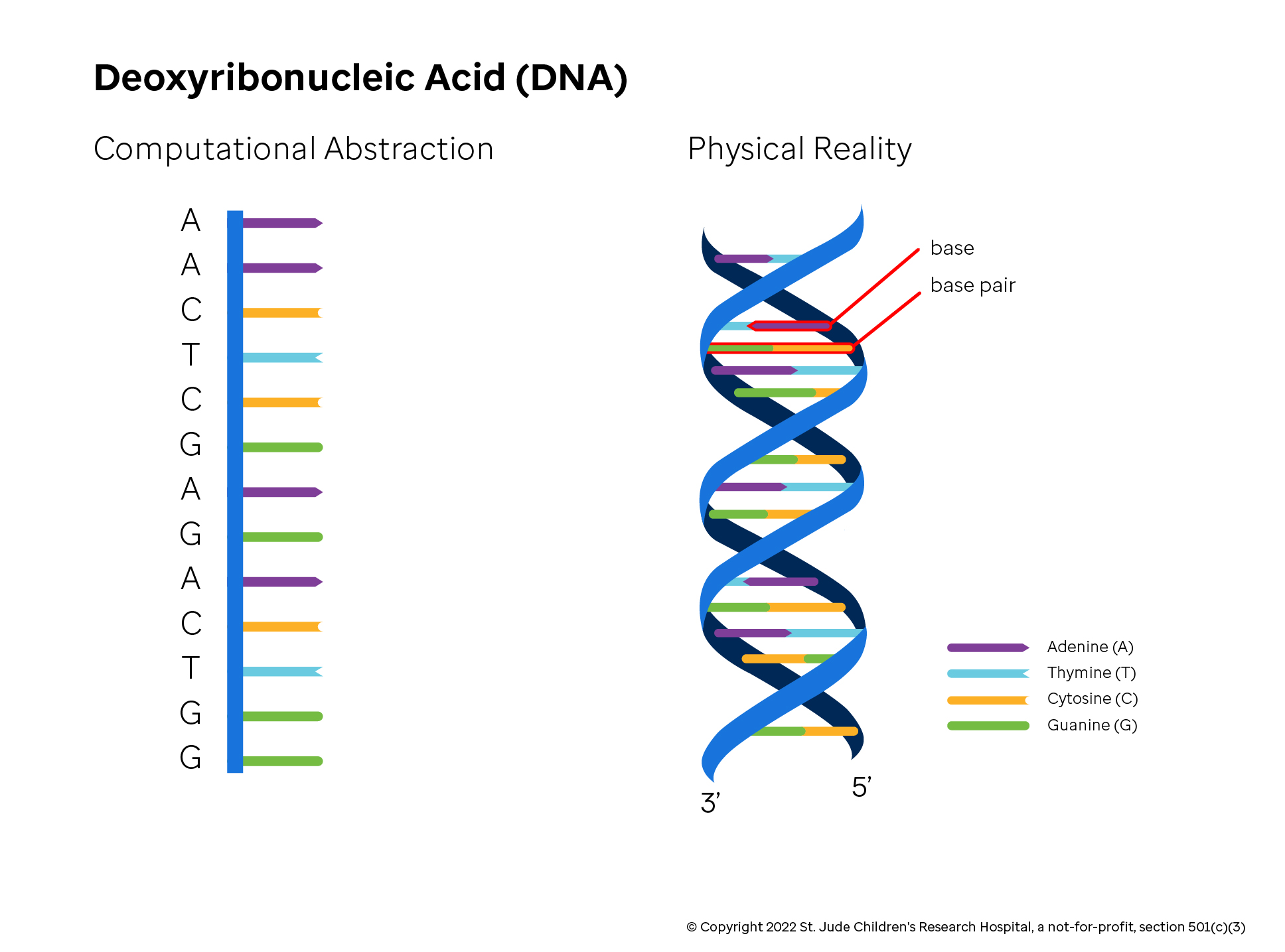
When cells divide, the spiral unwinds; each base pair is split; and the molecule is split into two strands, each one containing the information needed to replicate the original DNA structure. Normal healthy cells then copy the genetic code very accurately, rarely introducing variation.
In plants and animals, DNA is broken up into a number of large sequences called chromosomes that are tucked into the nucleus. Chromosomes typically come in pairs (one from your father and one from your mother) and are wrapped around proteins called histones. These histones keep the DNA string tightly packaged and help control which gene products are made in a given cell. For humans, there are normally 22 pairs of autosomes (chromosomes shared by both sexes) and a pair of sex chromosomes (XX for females or XY for males), totaling 23 pairs of chromosomes. Autosomes are numbered from 1 to 22 based on size, arranged from largest to smallest. The full set of chromosomes makes up the genome.
The genome is a vast search space for biological questions. Each genome is a biochemical database that, if properly accessed, can inform how our bodies function. Genomes account for the natural differences between individuals, define family traits, and distinguish how cells in tissues and organs vary. When genomes acquire adverse mutation(s), cancer as well as other genetic diseases can occur. By examining the relationship between physical traits (e.g. blood pressure or the development of a tumor) and the genome, known as genotype-phenotype relationships, clinicians can develop personalized medical treatment based on an individual's genetic makeup.