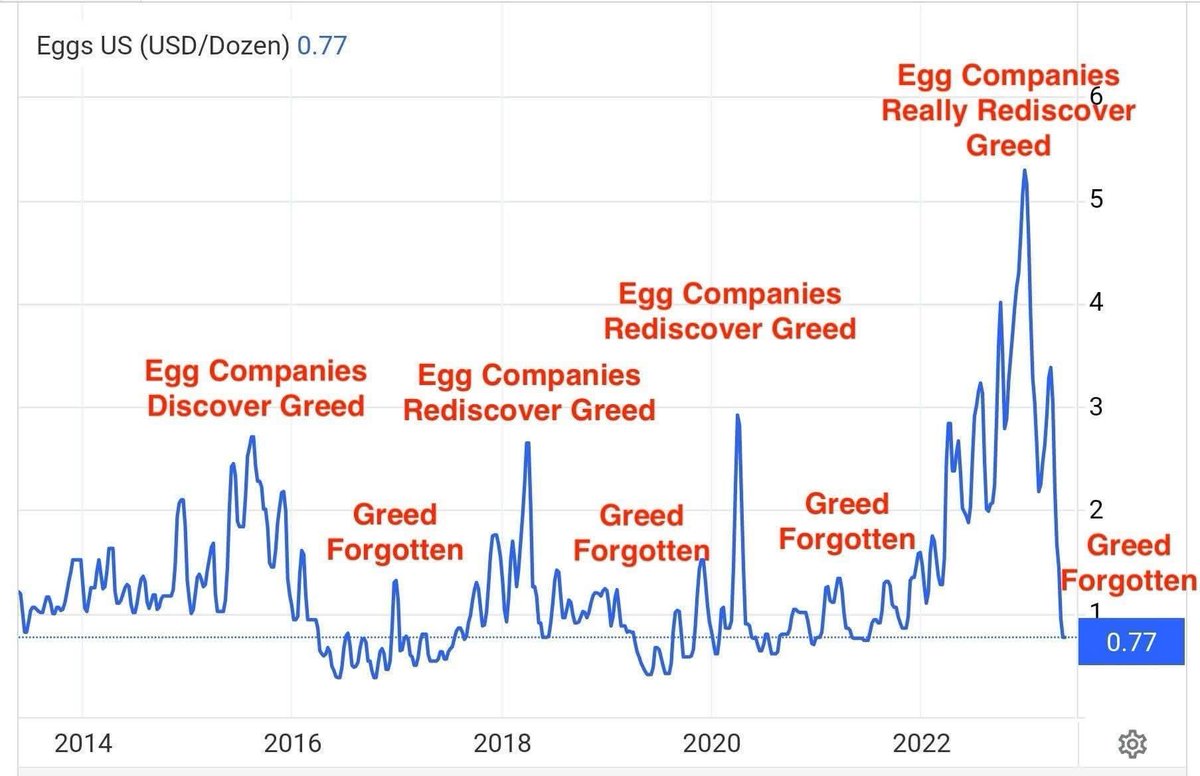
Sadly, we seem to be going in the opposite direction. First with the appointment of industry aligned FTC chairs (with the notable exception of Lina Khan) and now with the supreme court judgement that the president can fire heads of agencies at will. It makes it much easier for moneyed interests to buy the outcomes they want as there are no real job protections for the FTC commissioners.
Egg Libor Was Also Manipulated - https://news.ycombinator.com/item?id=48756256 - July 2026
Justice Department Requires Egg Producers to End Coordinated Benchmark Manipulation that Artificially Inflated Prices Across the Country - https://news.ycombinator.com/item?id=48734081 - July 2026
BP, Shell etc. make more profit from ignoring safety and environmental standards than they have to pay in fines for oil spills.
Same is true for FB & Co.
How about the possibility of a death penalty for companies like for people because companies are people, aren’t they?
https://www.nytimes.com/2026/06/20/business/egg-prices-down....
And Levine’s column, which Stoller links to (with rather less color commentary):
https://www.bloomberg.com/opinion/newsletters/2026-07-01/egg...
It feels like Mr. Stoller spends a lot of time here insinuating that because price manipulation happened on the margins of this supply crunch, there was no supply crunch, and everything’s just moustache-twirling tycoon conspiracies:
> While most normal people at the time thought someone was likely scamming them, that is not the message you heard from the industry, elite media, or economists.
> In 2025, egg prices dropped dramatically […] these price declines suggested that supply and demand were doing their magical work. Populists were mocked as ignoring natural market forces. […but…] It turns out, when [these conspirators] felt threatened by legal action, the alleged price-fixing stopped. Suddenly, the avian flu epidemic was no longer pushing up prices.
I mean… it can very much be both. Slaughtering all the chickens really can reduce the number of eggs in the world, people really can be willing to pay more for the few that are left, you really will get more eggs again when you make enough new chickens and wait til they grow to egg-pooping age. Even as it was also true that some greedy people’s unfair play magnified the dynamics that were already happening.
But like—even at the higher prices, eggs weren’t going unsold at the end of the day.
To me this whole thing still feels like things working the way the dastardly elite theorists suggest it does: the reason we treat collusion like this as bad and illegal in the first place—besides the casual sense of grossness and unfair play—is that the misleading signal provokes overproduction and therefore a price collapse.
The price did indeed go on to collapse by 93% to pennies a dozen; that’s squeezing farmers brutally.
The investigators investigated, the prosecutors prosecuted, the manipulative behavior stopped, the contracts got adjusted, the price index mechanism got revisited…
I feel like the error is similar to what bothers me listening to day-trader types: conflating raw synthetic-price-index movements with the underlying physical reality they represent.
The brands I've been avoiding are:
4Grain Cage Free
Egglands Best
Farmhouse Eggs
Land O'Lakes
Fassio Egg Farms
Southwest Specialty Eggs LLC
Rocky Mountain Eggs
Meadowcreek Foods
Specialty Eggs LLC
Red River Valley Egg Farm
ProEgg Inc.
Dixie Egg Co.
American Egg Products LLC
Texas Egg Products LLC
Wharton County foods
Benton County Foods
Sunups
Sunny Meadow
Mahard Egg Farm
Maine Egg Farms
Other Cal-Maine associated brands:
Ralston-Purina,
Pilgram's Pride,
Adams Foods,
Dairy Fresh Products,
Foodonics Int'l,Versova is new to me, but I'll try to avoid them too. It looks like their brands include:
Center Fresh Group
Centrum Valley Farms
Iowa Cage FRee
Hawkeye pride
Ovation Farms
Trillium Farms
Willamette Egg FarmsAs I recall during the whole thing the news was non-stop about how it was related to broad-based inflation, chicken culling for avian flu, etc. Seems like all that was a lie, or at least merely a half-truth.
> During the 2024 campaign, when Kamala Harris meekly suggested price gouging to tame inflation,...
Haha, she suggested going after price gouging. Though the idea of someone meekly suggesting price gouging is funny.
We need to legalize public caning and the stocks.
- the Fed has price stability as part of its dual mandate, and in its normal operation does this at the level of manipulating the money supply for everyone, through changing the interest rates given to large banks (IIUC, I'm def not an expert here)
- the FTC has as its primary mission anti-trust enforcement and consumer protection. During the last administration, the FTC tried to be more aggressive largely through legal action with specific firms.
Price stability and anti-trust enforcement are related. Would both goals be better served if a single public body with high independence could use both tools and levels of targeting? E.g. rather than being hit with a small-ish fine, should firms that collude to manipulate prices, or firms that consolidate to the point of approaching monopoly, be penalized with higher interest rates on all their financing?
Even if criminal charges are a slap on the wrist, civil damages could easily get into the billions. And good luck finding a jury that doesn't remember the national outcry about egg prices back then.
I think the craziest part of the story is how brazen the execs were. Although what they were doing (price steering in an illiquid market) might well not be illegal, it pretty blatantly is in a grey (dark grey) area and they themselves obviously knew they were exploiting the system for themselves.
Once you see this pattern, you see it everywhere.
>While most normal people at the time thought someone was likely scamming them, that is not the message you heard from the industry, elite media, or economists. Throughout the alleged conspiracy, industry executives and analysts were saying that there was nothing to see except a supply shock of a disease killing lots of hens
The idea that something more nefarious than the bird flue was going on was very unpopular on HN at the time
I honestly hate how Presidents are attributed to market functions
I hate how partisans do that pretty religiously
while the state functions pretty autonomously in parallel, the investigation and multi agency actions helped crater the price of eggs very quickly
But even that summary is trying so hard to appease rabid partisan’s feelings so they'll stick around for the parts that don't add power to their cause
https://pbs.twimg.com/media/HFa2bQlWcAARYNB.jpg
Why is it people have such a hard time understanding that this is what we want markets to do? If there is a scarcity of some resource, the prices rise and this motivates producers to produce more and consumers to consume less, until an equilibrium is found. On net, this means that we can have more of what we want for less effort over time. Yes, the people doing this profit from it. That's why they do it.
But also, the news isn’t privy to an actual price fixing conspiracy while it’s happening. To the extent that a news org reports on it, it’s because someone within the system grows some ethics (very hard to burn a bridge when it means no more revenue in the industry). It took even the regulators years to build a case for it.
People have long complained about the consolidation of the chicken production chain in the US. Only 2-3 major companies control most of the supply via contracts. The farms are required to follow the terms of the contract closely when raising chickens or risk getting locked out of the major distributors. Post-consolidation, the industry is ripe for abuse.
The combination of very strong contract enforcement and weak regulatory enforcement means the industry is effectively rent-seeking by design. This much was known, but without subpoena power, actual price fixing is just a suspicion.
I guess that depends on your interpretation of "invest." I don't know of anybody who claimed to save money on eggs by raising their own chickens. It's more of a lifestyle decision than a financial one.
Who was in charge during this time period?
Because journalists see conspiracy everywhere. It is prudent to wait a bit before seeing malice everywhere
Now we know (or at least - have more proof) what was going on, so the justice system worked. How many conspiracy theories were invented and then turned out to be false? This is news precisely because it turned out to be actually true.
Prices go up in response to shortages in a properly functioning market, but these clowns were clearly over the line and trying to manipulate the prices in addition to that.
https://www.cornucopia.org/scorecard/eggs/
All the brands you listed that I could find on their list seem to have the lowest scores.
The collusion quotes in this article start in October 2022, though it doesn't say exactly when the collusion started.
As far as I can tell, avian flu did create a supply shock, which did raise prices. When the avian flu problem started going away, the egg companies started colluding to try to keep the egg prices high.
Edit: it is a bit opaque but their main supply network allegedly includes Wilcox and Handsome Brook which are rated decently
More formal reading: https://en.wikipedia.org/wiki/Asymmetric_price_transmission
- The ways the Fed pursues price stability and the FTC produces antitrust may have a similar effect, but they have a completely different set of skills required by the employees and they lend themselves to different management structures. One is essentially economics research, the other is essentially law enforcement.
- If the cost of doing a crime was higher interest rates, then anyone with low debt could freely commit the crime. Why not simply make the fine proportional to the price impact on consumers (e.g. if you collude to raise prices and make an extra $1 million, you pay a $3 million fine)?
You should have to have a license to be in the c-suite of a company over 200 people, and if you do shit like this, we revoke your license. The incentive structure is built on the hope that when threatened with making merely minimum to median wage, you'll suddenly care about the cost of groceries.
https://thinkbynumbers.org/democracy/voter-support-for-a-bil...
I think we either get a collapse into techno-feudalism, an anti-capitalist revolution (doubt), or a breakthrough savior of capitalism like FDR. The idea of "just vote better / harder" does not ring true to me or millions of people who have been hearing the same for decades while all these problems have gotten worse.
They have been absurdly pro corporate for decades. They will bend over backwards to accept an absurd legal arguments from corporate attorneys, yet they never seem to have that level of credulity for people like you and me.
That famous McDonalds hot coffee case, McDonalds had caused serious injuries to hundreds of people previously and demonstrated serious negligence and a willing disregard for the safety of their customers and the courts, and yet when the jury came back with a couple million dollars in punitive damages, the judge still massively reduced that penalty!
We have to push for courts that don't treat corporations with white gloves.
To be fair, journalists also seem to miss even when there is an obvious conspiracy. They are a varied bunch.
Perhaps can fine the wealthy to pay for their own imprisonment, maybe within a luxury hotel?
That's notably different from say the current scrum for HBM where the demand truly came as a surprise and scarce supply gets bid up.
Micron's windfall is justified and natural as these things go. The egg windfall was manufactured and criminal.
> Meanwhile, in context and during the class period, egg producers like Cal-Maine increased egg prices by as much as 270% in 2023 despite having zero Avian Flu outbreaks in their egg laying hen layers on Cal-Maine affiliated farms (https://www.classaction.org/news/antitrust-lawsuit-says-prod...)
Price is usually determined by producer greed because producer greed causes prices to consistently be set as high as possible. This is usually constrained by market competition, which limits how high they can be set. In rare cases, prices are set low by consumer greed.
A high price has a direct cause: the person in charge of setting prices set a high price. A little less direct: that person is incentivized to set prices as high as they can. Much less direct: there are currently few competitors due to avian flu; we have one of very few chip fabs that can make the widgets; our customers are locked in; our customers signed contracts allowing us to raise prices but forbidding them from cancelling when we do. Greed is always one of the more direct causes of high prices. The fact that capitalist markets use greed as an integral part of their normal functioning does not change this fact.
This is a familiar story and you probably know the ending. There’s a big market (egg producers selling eggs to supermarkets etc.), and there’s a small market (egg producers selling extra eggs to each other on an electronic exchange). The price in the small market determines the price in the big market. Participants in the small market are also participants in the big market. You can spend a little money in the small market to move the price, which can make you a lot of money in the big market.
Not defending the bad actors here, but there's that whole "show me the incentives and I will predict the outcome" thing. If the market structure rewards manipulation, you get manipulation. The market structure doesn't have to be this way.
In fact, most markets naturally go from high competition to monopoly or oligopoly. You can see this in chips, cars, airplanes, steel, ecommerce(Amazon) and beyond. Indeed, many oligopoly situations only fail to be monopolies through either antitrust activity or through nation-states supporting their competitors (chips).
Agriculture in particular tends to be geographically dispersed so it's harder to have absolute monopolies. But some "harking back" claim of "if we only had small business, all the predatory stuff wouldn't happen" really fails to understand the dynamics of markets. Scale in agricultural production is what allows the low prices you get in stores - But $10 cage-free organic eggs are available at my local coop for those who love small businesses (though I prefer the $2 cage free eggs at nearby Grocery Outlet).
in general we should be a lot more strict on sexual crimes (sa, trafficking, child abuse but not voluntary prostitution) and white collar/economic ones including wage theft, but less strict on drugs and property. drug possession and non commercial digital piracy should be decriminalized.
violent crimes are mostly in the right place, the big problem there is racist prosecutors and ineffective anti gang programs not the laws themselves but we need to remove death penalty/life without parole everywhere they still exist.
the point is we need a rebalance not a whole new untested mechanic.
why do we need to jump to caning instead of increasing the fines to something more than an operating expense?
in this case, if the fine was 1000x the profits instead of the other way around, the problem would be solved, right?
There's a significant number of pathogens, er I mean, vaccines, that are tested and/or cultured only inside of eggs, and for the seasonal flu vaccines, those pathogen factories are unfathomably gigantic in scale.
So essentially, any drain on the supply of chicken eggs for the consumer market may be attributed to the overwhelming and ever-increasing demand from the pharmaceutical industry to use up these eggs so that they can grow viruses, bacteria, and other nasties to, er, checks notes inoculate the population and keep the world safe for democracy. That's the ticket.
The '90s didn't help a lot either. cf. the repeal of Glass-Steagall[0] which, arguably, did much more to damage the US economy (there's a direct line from its repeal to the 2008 financial crisis) than a lack of anti-trust enforcement.
That said, dismantling anti-trust enforcement (which was pretty hit or miss anyway) didn't help either.
[0] https://en.wikipedia.org/wiki/Glass%E2%80%93Steagall_legisla...
You could have small theaters springing up everywhere. I'm sure there's a boot ready and waiting to smash down this from happening.
Corporal punishment is laughable outright, but that's masking the issue. Punishing corporations does not discourage the participants directly. The behavior will not change.
And then in the aftermath of that, the media turned the most well-known victim into a punchline and an oft-cited example of absurd litigation by people who don't know any better.
What is the point of signing a direct supply contract if you are just gonna be paying spot prices anyways? I suppose guaranteed supply priority?
If power is more diluted among a greater number of participants you are way more likely to see defectors, which would provide accurate pricing data to the market and cause the conspiracy to fail.
There are supposed to be two stopgaps here.
First, the fear of going to jail for committing crimes. Secondly, the social reprisal for committing crimes that hurt people.
Like seriously these CEOs shouldn't be welcome at anyone's table or gathering in polite society as a result of their actions, bare minimum. The government should also put them in prison.
The actual economics in highly competitive markets depend on what is known as the Minimum Efficient Scale, which in turn depends on the shape of the cost function.
The internal investigation has determined that our CEO had no knowledge of this, and that the bloody pig mask was all the idea of the people who make less money, and also we fired the CEO for unrelated reasons.
Why? I mean, do you have a specific scientific research in mind, or is it something you feel is right?
I mean, it makes sense to me, mostly, but "we should" presented without any evidence irks me a bit.
Partisan politics is bad for America and we were warned by Washington. These days, many people are more loyal to their party than they are to the country.
This is versus and administration that is aggressively doing no-bid contract to family and friends, complete disregard for the emoluments clause of the constitution, etc.
Note: the nature of a 2-party system, along with laissez-faire campaign finance laws, is practically designed for legislative corruption. Unfortunately the only people who can change it are the ones who profit from it.
2?!
I can easily think of lots of corruption of the following: Trump, Biden, Trump, Obama, W Bush, Clinton, H Bush, Reagan.
Everybody follows neoliberal economics, and enables loads of corruption for their friends, families, and allies. All of them did that.
They ALL have been corrupt. The target of who the corruption is for changes.
It’s near universal for variable interest rate loans.
Hiding behind a faceless corporation certainly helps with that somewhat, but in this case one of the egg companies involved isn't shy about telling us exactly who they are (https://hickmanseggs.com/about/). When there's no longer a working legal outlet for justice how long before people start leveraging the technology they have to identify the people who are hurting them and make their feelings known. We need a functioning legal system and accountability to keep things from getting out of hand, so it concerns me that corruption has been allowed to flourish and go unpunished.
It is a form of farming subsidy that was specifically structured to avoid passing money through the government, and structured to control price volatility.
This is separate from the commercial market concentration in Canada, which is definitely real. To a degree, this is just the reality of being a smaller market. The depth and breathe of the American economy is definitely at play here.
If you compare Canadian super market consolidation vs Germany or UK (for example), you find a much more similar situation.
The criminal conspiracy part here was manipulating the index prices in tandem so that everybody raised prices in lockstep.
I do think Bernie Sanders was an attempt by our collective society to produce a new FDR. The fact that he was stopped so easily points to collapse as the next most likely outcome.
How much did supply go down considering that Cal-Maine Foods, Inc is (or at least was) the single largest supplier of eggs in the country? Ultimately their profits increased 718% (https://www.cnn.com/2023/03/29/business/egg-profits-cal-main...) which seems unlikely to be explained away by reduced supply. They were price gouging and fixing prices with the other large suppliers to prevent consumers from just switching to those brands while small egg producers may have had issues with avian flu keeping their fairly priced products off the shelves.
From whom did you only hear that? Newsmax? The Drudge Report?
That's exactly how the criminal justice system should work? If you can't prove a particular person is responsible, you don't have a case. That's exactly why they prosecuted the company as a whole instead, because easier to prove the company as a whole did something, rather than a specific person.
Don't we already? Police and DAs at least here in California are not serious about punishing shoplifters AFAICT. I hear people say this is specifically because of the 2014 Proposition 47 (raising the threshold for felony theft from $400 to $950). Not sure that's true (misdemeanor theft can still be punished by up to six months of jail time and/or up to a $1,000 fine, and California's current thresholds are similar to other states) but there was a federal mandate to address prison overcrowding, and California chose to do that by not having as many prisoners instead of building a ton more prisons. Prop 47, and perhaps some policy changes made with far less fanfare, were intended to achieve that.
There's still more deterrent for misdemeanor shoplifting than for nationwide egg price-fixing though!
At least if you set fines to a level that such crimes are rarely if ever profitable, you can both remove the incentive for the organization to commit them as well as introduce a passive internal mechanism to prevent them in the first place.
i am more pushing back against the call for corporal punishment like caning
If you are an owner with all the control, i.e. you are on the board or in corporate leadership(CEO/CFO/etc), then hey guess what,there is a really great cell here at the local prison just waiting for you, depending on how involved you were.
If you are an owner with little to no control, i.e. most shareholders that just vote for the board, etc. The assets would get liquidated, bond/debt holders would get paid back, and then anything left over would go to these shareholders.
This would incentivize shareholders to care more about what they are owning, this is a good thing. Even if it's pension funds and individual retirement accounts. This would get sorted pretty quickly as soon as the new normal is known and adjusted for.
SpaceX for example just went public, but if you read the docs, the control was not given to the public. Elon Musk 100% controls SpaceX still. Even if every public shareholder unanimously agrees against Elon Musk, guess what happens? Elon Musk still gets his way.
I don't know what the parent comment was thinking, but to my mind, the ones with the most control get the worst of the consequences. So Pension Funds/etc that hold little to no control would get paid out before those with more control.
Pushing 401k and IRA, making it so that's the only viable way (other than having a high-6-digit wage) to live comfortably in retirement, is a detriment to a healthy society.
The problem is that all their donors would withdraw. That contradiction is destroying them, they don't have an answer for it. It lost them the 2024 election, and will continue to do so until they invent another Obama.
Then the problem with _that_ is, all the Obama types are now calling themselves socialists.
(I've recognized them as liars since Day 1, but I only get my one vote. Apparently my sarcasm in previous comments was unrecognizable.)
A few days ago, 18 states and the DOJ Antitrust Division signed a series of decrees with three major egg producers, Cal-Maine, Versova, and Hickman’s Egg Ranch, the largest egg producers in the country. The allegation, backed with hard-to-refute evidence including quotes from CEOs, is these entities operated a naked conspiracy to manipulate the price of eggs from 2022-2025. That was exactly the time bird flu on poultry farms was ripping through the supply chain for egg production.
Readers of this site won’t be surprised at this news. Last year, BIG published an investigative series called Hatching a Conspiracy, in which Basel Musharbash discussed what looked like a conspiracy. His argument was that egg producers were using the avian flu crisis as a veil to raise prices. Basically, consolidation had created concentrated power, and the shock of the flu let them exploit it. He highlighted the role of Cal-Maine, the industry’s “bellwether,” as well as the history of antitrust violations in the industry.
While most normal people at the time thought someone was likely scamming them, that is not the message you heard from the industry, elite media, or economists. Throughout the alleged conspiracy, industry executives and analysts were saying that there was nothing to see except a supply shock of a disease killing lots of hens. As one industry executive put it at the time, it’s all just “supply disruption, ‘act of God’ type stuff.”
Economists chortled at the notion of a conspiracy. During the 2024 campaign, when Kamala Harris meekly suggested price gouging to tame inflation, she ran into a buzzsaw of resistance from Democratic-leaning economists, who were openly sneering at her in the New York Times.
“Egg prices went up last year — it’s because there weren’t as many eggs, and it caused more egg production,” said Jason Furman, a Harvard economist formerly in the Obama administration…
Mr. Furman said there was a risk that policies meant to curb corporate price gouging could instead keep the economy from adjusting. If prices do not rise in response to strong demand, new companies may not have as much inclination to jump into the market to ramp up supply.
“This is not sensible policy, and I think the biggest hope is that it ends up being a lot of rhetoric and no reality,” he said. “There’s no upside here, and there is some downside.”
Price action seemed to confirm Furman’s view. In 2025, egg prices dropped dramatically, and then further this year, though they are still roughly 40% above where they were in 2019. And these price declines suggested that supply and demand were doing their magical work. Populists were mocked as ignoring natural market forces. Pundit Matt Yglesias called the theory of egg price manipulation “slopulism,” the Cato Institute blogged “Egg Prices Don’t Need to Be Investigated—It’s Just Supply and Demand, and here’s philanthropist John Arnold.
But lo and behold, this complaint has stone cold evidence. It includes many statements from egg producer CEOs emailing and texting one another on how to manipulate prices upward. And it turns out, when they felt threatened by legal action, the alleged price-fixing stopped. Suddenly, the avian flu epidemic was no longer pushing up prices.
To understand what they were doing, we have to start with how egg prices are set.
Egg producers don’t sell eggs to consumers, they sell wholesale to supermarkets, packaged goods companies, restaurants, and so forth. There are two markets for wholesale eggs. Most go via contracts between egg producers and big buyers. For instance, roughly 28% of Cal-Maine’s production is sold to Walmart, through a special supply arrangement. But there’s also an electronic exchange, called the Egg Clearinghouse, for eggs sold in the spot market, aka extra eggs. Egg producers are usually net sellers of eggs, but they have contracts to provide eggs, and sometimes can’t fulfill those contracts through their own production. Other egg producers might have extra eggs. So there is buying and selling of surplus eggs on the Egg Clearinghouse.
As Bloomberg’s Matthew Levine puts it, there’s a small market - the Egg Clearinghouse - and there’s the big market, which are the contracts between buyers and egg producers. Where do the prices for the private buyers and sellers come from? Well, they come from the Egg Clearinghouse. Specifically, a company called Urner Barry looks at prices for different regions based on trades and bids on and off that exchange, their analysts do as best they can to estimate prices across regions, and then they publish a price of where they imagine supply and demand intersect.
In other words, the cleared price in the small market sets the price for the big one. Here’s Cal-Maine’s annual report: “Many of our sales arrangements with customers, particularly for conventional eggs, are based on formulas that take into account, in varying ways, independently quoted regional wholesale market prices for eggs.” And it uses Urner Barry pricing charts.
And therein lies the alleged scam. If you can get Urner Barry to publish higher prices from the small number of eggs sold on the Egg Clearinghouse, then the price that, say, Walmart pays on its billions of eggs goes up.
Such benchmarks, as well as manipulation of them, are common. This egg index is similar to how a few banks used to set a key interest rate called LIBOR, the price of lending short-term funds to one another, and a benchmark for credit cards, commercial lending, and a whole host of credit products. The LIBOR price-fixing case dragged on for years, and is quite famous.
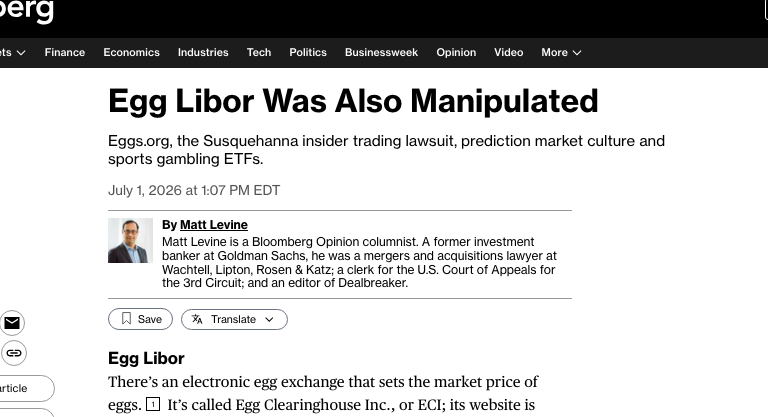
The alleged egg conspiracy itself was pretty simple. Evidence showed egg producers were colluding to trick Urner Barry into raising its published price. Here’s the Antitrust Division press release:
As the complaint alleges, Defendants conspired to inflate Urner Barry’s price quotations by agreeing to: (1) submit a large number of bids; (2) cause multiple Defendants to bid in order to signal to Urner Barry that a diverse set of market participants needed to buy eggs; (3) submit a large number of bids in the hours leading up to the publication of Urner Barry’s price quotations; (4) submit bids that were unlikely to lead to executed trades; and (5) execute trades at premium prices.
Producers were submitting fake bids, conducting sham transactions at high prices off the exchange, and coordinating to make it look like there was more demand than there was.
The most remarkable part of the complaint is one particular quote. At a certain point, Urner Barry was considering lowering is published price of eggs in response to a lack of demand. So one of the alleged conspirators wrote a fellow CEO, saying “[a]s a group we need to bid like they vote in Chicago, early and often.” In short, they should submit fake purchase orders at elevated prices, to convince the index to raise prices. In this case, it worked; Cal-Maine, Versova, and Hickman’s then collectively submitted dozens of bids, versus just five for the rest of the market. The price was then higher than it should have been.
What I like about that quote isn’t just that it’s evidence of collusion, it’s actually a joke premised on rigging the market the way machine politicians rig elections. These guys weren’t just allegedly price-fixing, they were having a lot of fun doing it. And they even violated the Stringer Bell rule, as this stuff was in email.
There’s a lot more evidence in the complaint, even though the complaint is pretty short (and it says the DOJ withheld a lot of evidence.) For instance:
After receiving Hickman’s CEO’s directive to “[b]id early and often,” on December 22, a senior Versova executive told another Versova executive to “light up the northwest bids please. .02 over.” That executive agreed and then placed bids at a price that was two cents greater than Urner Barry’s price quotation for the Northwest. Prospective sellers were required to call prior to accepting these bids. Then, when one of the Versova executives noted that the “NW bids are getting hit”—meaning that a seller was offering to sell the eggs to Versova to meet Versova’s bid—the other Versova executive stated that he should delete the bids, suggesting that Versova did not need the eggs.
Here are some other quotes:
**"**We are bidding up. Let's hold it today." – Text message from a Cal-Maine executive to Hickman's CEO on October 14, 2022.
"If we all bid in our respective areas for the 3-5 loads minimum we are short... the market reporters will have to address." – Email response from Hickman's CEO on December 19, 2022
"Please consider posting strong bids, early and often. The market reporters don't get in for another hour, so it will be good for them to see diverse bidding upon logging on." – Email from Hickman's CEO to senior executives from Cal-Maine, Versova, and others on December 20, 2022
"Hurry[.] There are only 16 bids on ECI right now and 15 of them are ours" – Email from Hickman's CEO later on December 20, 2022
"Finally!!!!" – Written reaction from the CEO of Cooperative A when forwarding Urner Barry price increase reports to Cal-Maine on August 9, 2023
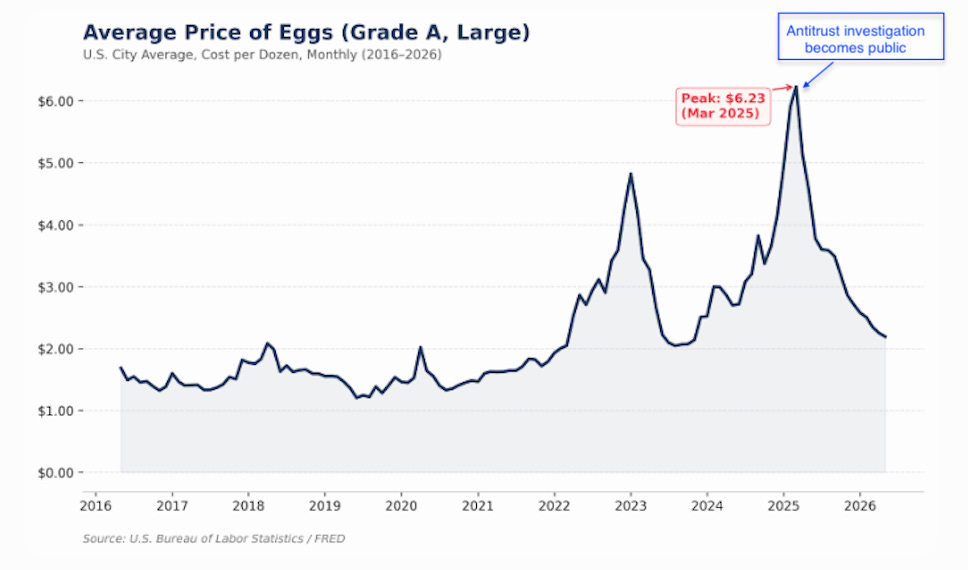
The alleged scam went on for years. Until the holiday season in 2024, the egg producers “continued to lobby Urner Barry,” asking the pricing index to hike its published prices and to ignore transactions at lower prices from non-conspirators when doing its benchmarking. So what finally ended the alleged conspiracy? It turns out that "price quotations dropped significantly from their February 2025 peak after Defendants learned of the Department of Justice investigation and were instructed to preserve documents on March 5, 2025.”
When egg producers realized they might get in trouble, they stopped the alleged scheme. Here’s a chart showing price action and antitrust.
Still, what a profitable conspiracy it was. Cal-Maine made more than $1 billion in profits in 2023, triple its 2022 earnings. And it made $1.8 billion in 2024, almost entirely as a result of higher prices As Musharbash put it:
All of this extra profit is coming from higher selling prices, which have been earning Cal-Maine unprecedented 70-145 percent margins over farm production costs per dozen. Taking Cal-Maine as the “bellwether” for the industry’s largest firms — as people in the egg business do — we can be pretty confident that the other large egg producers are also raking in profits off the relatively small dip in egg production.
Seeing the writing on the wall for egg prices, Cal-Maine has recently been using its cash haul to diversify into prepared foods in which eggs are an input, meaning while they still seek to sell eggs at high prices, they now have lines of business that benefit from lower prices as well.
Still, they all got caught. So how much trouble are they in? Well according to the settlement, the egg producers must pay in aggregate $3 million in penalties, must donate 53 million eggs to food banks, and can no longer fix prices. Cal-Maine was the ringleader here - it had to donate 30 million eggs, Versova gave 20 million, and Centrum donated 3 million.
Is that enough? Well, let’s start with a very basic concern. If you’re looking at some of these clear emails and texts and wondering why there’s no criminal charge for price-fixing, you’re not alone. Most antitrust lawyers I know are mocking this settlement as a farce, since it looks so obviously like criminal behavior but instead ended up with a no-admit/no-deny parking ticket. But let’s put that aside, and just look at the cost/benefit. Cal-Maine has to pay $1.5 million, let’s throw in another $1.5 million to cover the cost of the 30 million eggs they had to donate. That means they are out $3 million, for a scheme that netted them more than $3 billion. That’s a thousand-fold return.
Importantly, these firms also admitted no wrongdoing, meaning there can be no follow-on civil suits for victims using such admissions. Restaurants and consumers who paid for eggs are out of luck. And the alleged conspirators are released from all claims.
Crime, as it turns out, pays. Allegedly.
This story is in part about the Trump administration, but it’s also about state enforcers who signed onto this settlement. Traditionally, states follow the lead of the Federal government, because the Federal Antitrust Division has a lot more lawyers and is usually doing the investigation. That’s likely what happened here. State enforcers probably had little choice but to sign on and get some eggs for hungry people in their states, or just drop it entirely. Still, the value of not releasing criminal or civil claims is real. And while it would have required some boldness, I wish some state enforcers had been willing to drop the case and make a statement that though they couldn’t continue it due to resource constraints, they would refuse to sign onto a bad deal. Alas.
There are two other observations here that are more positive. One is that this egg story is a helpful real world example of how price-fixing works, a confirmation of the greedflation theory that emerged in the pandemic. From 2022-2025, normal people could see what was going on, while elites denied it.
It was a bizarre state of affairs. Cal-Maine actually listed as an investor risk that the avian flu epidemic might end, leading to lower egg prices and thus less profit. And yet most powerful people simply dismissed the notion that there were incentives to fix prices, just pointing to supply and demand as all-powerful forces.
As with most price fixing schemes in boom-bust commodity industries, it wasn’t that supply and demand didn’t matter, but that the mechanism for extraction was to take advantage of a supply disruption and grab as much while they could. Corporations engaged in alleged price-fixing or monopolization often need an alibi, and avian flu was the alibi.
The second observation is that antitrust, even used by corrupt or feckless actors, can actually deliver results. Donald Trump has been a very poor President in terms of consolidation, allowing a merger boom, and generally seeking to allow large politically connected firms to organize markets as they wish. Even so, when egg producers were threatened with legal consequences and exposure, they lowered prices.
It’s not a very satisfying outcome. Yes, we were being exploited, and now we know it. And the bad guys got away with it. But then, there’s a reason Americans are very angry, and that the establishment has lost credibility with the public. This egg case is just one more confirming data point that the wealth of the superrich is coming straight out of your pocketbook.
Thanks for reading! Your tips make this newsletter what it is, so please send tips on weird monopolies, stories I’ve missed, or other thoughts. And if you liked this issue of BIG, you can sign up here for more issues, a newsletter on how to restore fair commerce, innovation, and democracy. Consider becoming a paying subscriber to support this work, or if you are a paying subscriber, giving a gift subscription to a friend, colleague, or family member. If you really liked it, read my book, Goliath: The 100-Year War Between Monopoly Power and Democracy.
cheers,
Matt Stoller
No posts
https://medium.com/@justin.tan/qb-house-back-to-basics-busin...
I agree, in this hypothetical if there's no evidence the that the CEO committed a crime he/she shouldn't go to jail. But considering that "internal investigators" are likely hired (directly or indirectly) by the CEO, are likely shareholders in the company, they have little incentive to fully investigate.
The police certainly aren't perfect, but they at least have less of an incentive to lie about this.
Sure, but which one of them is in prison? Now compare the prison time an avg person would get for theft.
No, the Sacklers didn't get prosecuted or even hindered, but aided at every turn, therefore the opioid epidemic got huge. Eventually it became so expensive for society as a whole that it couldn't be allowed to continue, and then the Sacklers were stopped.
They weren't "prosecuted," though. Tens or maybe hundreds of thousands dead, no criminal charges, and they're all still impossibly wealthy. I was once prosecuted for sitting on a sidewalk, and spent the night in jail. No Sackler has spent the night in jail, or missed a massage appointment. Why? Because they passed some "magical" threshold that makes it "magically" fine.
If you go pick up the heroin that you and a friend later do together, and the friend overdoses, you will likely be thrown into prison for murder or manslaughter if you take them to the hospital. The Sacklers still get to own pharmaceutical companies, as long as they don't sell opioids.
https://www.lawyer-monthly.com/2025/01/the-sackler-family-le...
They literally had to be taken to the Supreme Court to lose civil immunity (barely, 5-4) granted by lower court bankruptcy judges. The criminal immunity is not official, it's simply because of their class as owners. The law is written in an intentionally childish way so that to prosecute them criminally means you have to prove that they had murderous intentions, rather than it being enough that they were top-level opioid dealers who ignored and buried anything that would lose them money.
As long as they just wanted to make money, it's A-OK. They can only be charged if their goal was to murder people, regardless of money. This logic somehow does not apply to lower-level drug dealers who have failed to become "magical," to your best friend who gave you half their heroin for free and rushed you to the hospital when you started looking bad, or to Matthew Perry's dealers.
So clearly we should... make it even more lenient? That's what OP was implying.
The people with better ROI are just going to outbid the ones with a worse ROI for their retirement spending so if you just invest it into T-Bills you'll do worse than inflation.
The real enemy of change is campaign financing, which the current SCOTUS has continued to erode any possible protections. FFS, "money is speech and therefore protected" -- that it was accepted without being subjected to pitchforks and torches is mind-blowing.
Their profits shot up 3x in 2023 and 5x in 2024. They had 70%-140% profit margins. They publicly said that the end of the flu was a risk for their profits. There’s plenty of messaging recording explicit price collusion.
How is that a natural supply shortage?
The underlying economic factor is simply that monopolies or cartels will always try to manipulate prices in their favor if they can.
(I'm beginning to think some people missed the sarcasm in my earlier posts.)
https://www.politico.com/news/2025/03/07/doj-investigation-e...
Yep. Given the forum and that you've been around here at least ten years, why would you think folks wouldn't take you at your word?
Be aware of Poe's Law[0]. Especially since there are way too many folks (I can think of at least a dozen or so off the top of my head) who would say the same thing unironically.
There is certainly a case to be made here for “if it seems too good to be true…”, but realistically we are not going to impoverish the retired teachers of X state because X state chose poorly.
Right, but no prosecutor is like "well the CEO had an internal investigation so we're not going to investigate"
Probably 0 if it's the first offense.
I think the current situation is not great, but I'd want to fix it by investigating why we're seemingly unable/unwilling to impose the punishment currently on the books. I think it would be plenty if we did—to me, more than six months jail time for stealing <$950 would be excessive. We could increase the fines and decrease / take away the jail option, but does it matter? It's not happening anyway.
https://www.cnn.com/2016/03/23/politics/john-ehrlichman-rich...
You really shouldn't need a citation for something so easily verifiable.
Even for very serious crimes (e.g. sexual harassment or assault) these internal investigations end up being "sufficient", and the police don't bother.
Denying their customers claims for healthcare coverage they are entitled to under the plans they pay for is the opposite of their job. Healthcare companies just keep doing that anyway because it makes them more money when their customers are too sick, stressed, exhausted, or eventually dead to fight the wrongfully denied claims.
People die because of this, but the insurance companies don't care because it makes them more money when they refuse (at least initially) to provide the services they were paid to deliver. United Healthcare alone was wrongfully denying claims over 90% of the time.
The health insurance industry is filled with serial killers who are happy to kill in exchange for money.
Can you provide some examples? The examples I heard of are never straightforward like "person has a broken hip, insurance refuses to pay for a hip replacement". There's always some complication like "the doctor thinks they need some special procedure/drug that costs extra". If it's in the area where there's a plausible judgement call to be made, I don't see how it's any different than a public healthcare system denying care due to cost reasons, even if theoretically taxpayers are "entitled" to some vague standard of care, and without the care the patient might actually die.
>United Healthcare alone was wrongfully denying claims over 90% of the time.
AFAIK that claim was claimed by plaintiffs with no supporting evidence, and denied by the defendants.
There are a couple examples in the legal complaint (https://cdn.arstechnica.net/wp-content/uploads/2023/11/class...) where the insurance company denied extremely typical things like physical therapy and skilled nursing facilities (the most common form of post-acute care). Nothing special there.
Here's another one for you:
Deirdre O'Reilly's college-age son, suffering a life-threatening anaphylactic allergic reaction, was saved by epinephrine shots and steroids administered intravenously in a hospital emergency room. His mother, utterly relieved by that news, was less pleased to be informed by the family's insurer that the treatment was "not medically necessary." (https://kffhealthnews.org/health-industry/denials-of-health-...)
Now, I don't have all the details of this case, but neither epinephrine shots or steroids are a special procedure/drug. That would be considered the standard treatment for life-threatening allergic reactions depending on the circumstances and how long ago this occurred.
I can't think of any reason why they'd ever deny epinephrine, and although steroids have fallen out of favor in recent years as standard treatment in every case, they are still called for in common situations like when epinephrine alone isn't doing the job, or when the reaction has triggered an asthma attack.
The article that came from links to https://www.npr.org/series/651784144/bill-of-the-month which is filled with all kinds of examples including one where the insurer eventually relented after phone calls, appeals were filed, a complaint was made to state agency, and letters were sent to elected officials ( https://www.npr.org/sections/health-shots/2024/01/25/1226552...)
Social media is full of outrageous examples (https://www.buzzfeed.com/morgansloss1/stories-of-healthcare-...) but you're probably going to get the best examples from news segments like that Bill Of The Month series.
Evaluating these can be challenging. Even though many people are sharing their stories of how they've been screwed over online (and publicly exposing their private medical matters in the process), there's often a lack of hard details. Both government regulations intended to protect patients and insurance industry policy intended to protect the corporations can make independent verification of these complaints difficult.
The best source for examples will be lawsuits against insurance companies which can surface instances collected through the discovery process and used as evidence at trial, but that can take many years and may never come to light if those lawsuits get settled first with the victims and their surviving loved ones paid off and silenced.
By definition if the investigations weren't made public I can't know about them, but you can look at someone like Andy Rubin: https://en.wikipedia.org/wiki/Andy_Rubin#Sexual_harassment_a...
As far as I'm aware there was never any investigation from real police for him.
And how does this work? Are prosecutors really like "oh ok, we won't do any investigating of our own then"? If so, who's more to blame, the companies doing the internal investigations, or the prosecutors for falling for it? If the police show up to a residence to investigate a domestic violence report, and then one of spouses answers the door and says everything's fine, should we blame the spouse more or the police for not following up?
Executive at BigCo does something bad. Normally people would report this to police and/or regulatory agency. Instead the company investigates itself to pretend they’re doing their due diligence so that there is a paper record, but with no intention of actually surfacing anything to the police.