> The AI will have gone off the rails multiple times and you will only notice it later when you actually try to use the software.
Except that said AI can now themselves use your software and find and fix bugs themselves, not to mention drive new features.
>Your agent might go “off the rails” and start doing something you don’t want it to do
This happens but far less often than it used to, and the case for full autonomous agents is getting stronger, not weaker.
>It is humanly impossible to build your own understanding of a codebase
This again feels outdated. I think we're mving towards humans no longer needing to understand a codebase, and letting AI drive it.
But you still need to properly review plans and PRs to keep a good mental model of the codebase. This effectively limits the number of tasks being done in parallel to maybe 2-3. Though you'll be mentally exhausted and probably start to make mistakes or take shortcuts in reviews yourself.
“expert developers whose skills have reached the point where they outclass any and all “frontier AI models” in their area of expertise”
Are any developers saying they outclass any and all frontier models? I’d say at best it’s mixed at this point. The best developers still do certain things better, but not even close to all things.
“The problem is that even code written and/or reviewed by Fable 5, will stink”
I’m skeptical. Example prompt and output please.
Am I wrong? Are you guys just YOLOing everything these days?
I mean, it's like writing a book about how to use React or Django or some other major software ... after you used it for one project for a month!
Authors: I know this is the Internet, and I know bloggers blog about whatever pops into their head ... but if you are going to act like an authority, how about you learn more than the average reader before you start telling them authoritatively what to do?
I have much better results treating the AI like a peer, having discussions before implementation, discussions to review its results or the diff, and then iterating. Hand-holding great models like Fable through implementation is a waste of time, and a waste of Fable. The process of discussing designs and their implementations, questioning things that look weird to me, and actually reading the AI’s responses also helps me to find better solutions.
For example, one time I wanted to write a greedy solver for a problem, and Opus suggested using an existing MILP library to solve the problem exactly. I’d never even heard of MILP, but my final implementation ended up being better and simpler than what I’d have done alone.
Better method start to realizing that everything that every program do is data transformations and or movement
Then you ask llm to subdivide data in a tree along the domain model, classifing streaming vs storing nodes
Then for each node you discuss with the ai for the best data structure
Then you ask for an interface that fully encapsulate the structure and every mutation only allows to go from a valid state to a valid state and bidding else is allowed to touch the state
And that's mostly it just connect all the interfaces until input goes to monitor or to storage or to api or wherever the destination is
The way I rather do it is tightly control the output by skills written yourself, prompts, plans, etc. and have the closest possible outcome you would write yourself.
And that has a limit. If you are stuck at PoC level or simple apps, you have no idea how limited the current models still are. There you really need to break tasks down, not just trust a token predictor to list steps that sound good. There has to be a human in the loop somewhere, because by the time you start skipping permissions, best case you get the jackpot, more likely is you get a suboptimal solution and token waste and what's genuinely still terrifying when the model ignores instructions and does some stupid nonsense, ruining your day. It really is as sharp as a CNC machine. It's not not useful, but could be dangerous, so maybe don't try to carve wood with a monster machine, or park your Ferrari in that crammed neighbourhood if you don't know how to parallel park.
Last year it was, “AI is just a stochastic parrot.”
This year it’s, “AI can write the code, but a human still has to review it!” (Using AI, of course.)
Give it another year and the narrative will be: “Only AI is capable of reviewing code, and only AI can review the AI’s review. Humans just need to read the AI’s final opinion so they still have meaningful oversight.”
The goalposts keep moving. The certainty never does.
Do you mean this?
I'm curious how are people using Claude in any way other than bypass-permissions. I've tried for so long to maintain a curated list of things Claude can use, but inevitably I would always come back only to find it stuck because it decided to pipe an output of one tool into another and that's not explicitly allowed so it stopped even though it was just greping or whatever. I found it infuriating. In bypass-permissions it "just works" but then again I only use it to analyze existing code and suggest new changes(and even if it breaks something that's what source control is for?)
If you have invested significantly in the planning phase and there is momentum in the architecture and conventions that already exist in the project, the implementation phase might not need as much oversight as is suggested here.
> You can discover that your initial idea was dumb and a better one exists
The planning and architecture phase is usually where I make these types of discovery at a high level.
> Your agent might go “off the rails” and start doing something you don’t want it to do
Candidly these orthogonal, inadvertent edits aren't as bad as they once were and for impactful changes there should be at least some test coverage, even if that test coverage is just "freezing" what was implemented.
As you mentioned the final review discussion is a good chance to verify beyond what review or adversarial review agents find.
It is unsurprising that a lot of people claim to know how to get rich quick.
I believe it is possible to solve this problem, and I have my own horses in the race which I won't threadjack to promote here, but it's the central problem of our profession at the moment. We've all seen the truly discontinuous outcomes and we've all seen allegedly national security dangerous models (which at one time was GPT-3) faceplant with it's shoelaces tied together. I wanted to see if Fable was really all that and I left it overnight on some fairly straightforward C++ (code DSv4 Flash works on with moderate supervision) and it's pretty roast worthy, I gave it a chance to redeem itself this morning and it's ticked up a bit (I still think it's roughly Opus 4.8 with a Project Zero fine tune and DRO trained off the constant gratuitous yield tic which is pretty clearly an intentional gimp).
I give all such claims 30 seconds of my time because someone is going to actually be right one of these days.
This (non-yolo mode AI coding) is actually how we used to code in the old days (2023).
I'm not sure how you're defining "intelligent", but I'd like to know how it is able to exclude a language model, while still including humans, without simply defining it with an axiom that predefines LLMs as lacking intelligence.
However they have quite good harness in their backend which is the actual model.
[1] https://huggingface.co/search/full-text?q=abliterated&type=m...
[2] https://webdecoy.com/blog/wtf-are-abliterated-models-uncenso...
[3] I specifically refer to “preview 1” because the newer versions (Fable 5 / Mythos 5) don’t appear to offer the same level of freedom as the very first version that I was able to use through Project Glasswing. This is one of the reasons why I continue running our massive security scans with “preview 1”, or at least I was running them until June 30, when the program’s policy changed.
Personally I think that if you cranked the capability up high enough the first person you'd run into who absolutely demanded more than vibes and didn't care about your singularity thesis would be the representative of a reinsurance firm: mostly to do serious stuff without bending the law, you need insurance, and I am unaware of anyone writing serious policies (certainly not ones that make any economic sense) that underwrite the risk of AI autonomy outcomes financially.
When Swiss Re writes a policy that Anthropic Cinematic Universe or whatever iteration we're on won't fuck it up?
Now maybe we're talking. Until then you ask three practitioners and get nine answers, no one knows what they're talking about unless they're doing a really good job keeping it quiet (and that's probably what you'd do!).
I have no beef with people writing about new tech, but I do have beef with claiming that "____ is the correct way to do it" ... based on nothing except "I feel proud of the last three months I spent with Claude".
I run mine in a container, so it doesn't have access to the SSH key I use to push.
• https://huggingface.co/huihui-ai/Huihui-GLM-5.2-abliterated-...
• https://huggingface.co/huihui-ai/Huihui-Kimi-K2.5-BF16-ablit...
• https://huggingface.co/huihui-ai/Huihui-Qwen3.5-397B-A17B-ab...
• https://huggingface.co/huihui-ai/Huihui-DeepSeek-V4-Flash-ab...
• https://huggingface.co/huihui-ai/Huihui-Qwen3-VL-235B-A22B-I...
• https://huggingface.co/huihui-ai/Huihui-Qwythos-9B-Claude-My...
• … so on and so forth.
This post is the culmination of over a year of research into how to properly use AI agents to write high-quality software in security-critical systems.
I will be writing this post primarily from my perspective as a software developer, protocol developer, and maintainer of security-critical software.
Over the past year I dove deep into AI agents. I have explored their limits, what they can and cannot be relied upon to do. I’ve created our own AI review tools that perform just as well as multi-billion dollar AI-review systems. I’ve maintained my own custom fork of an AI coding agent called Crush. And this post is my distillation of what I’ve learned to be the best approach if you want to create high-quality software using AI tools.
There are some people who hate AI. Indeed, many developers should hate AI, because it is an enemy to their own learning of software development. This post is not for them. This post is for the few expert developers whose skills have reached the point where they outclass any and all “frontier AI models” in their area of expertise. It is for these expert developers, who want to use AI as a method of increasing their performance without sacrificing any quality that I write this post.
If you’ve used AI agents much, you know that during the course of a session the following can happen:
I’ve watched videos with hundreds of thousands of views where YouTubers explain how they invented complicated systems of 12 parallel agents managed by an orchestrator, doing a billion things simultaneously. How they no longer have to involve themselves in the coding process. It’s just slop writing and reviewing slop while the YouTuber sits on a beach, goes to the bathroom, or sips coffee for no reason.
It is humanly impossible to build your own understanding of a codebase if you use such a “Vibe” approach. The AI will have gone off the rails multiple times and you will only notice it later when you actually try to use the software. This method may be perfectly OK in situations where you do not care about quality, but if you do care, a different approach is needed.
The problem is that even code written and/or reviewed by Fable 5, will stink:
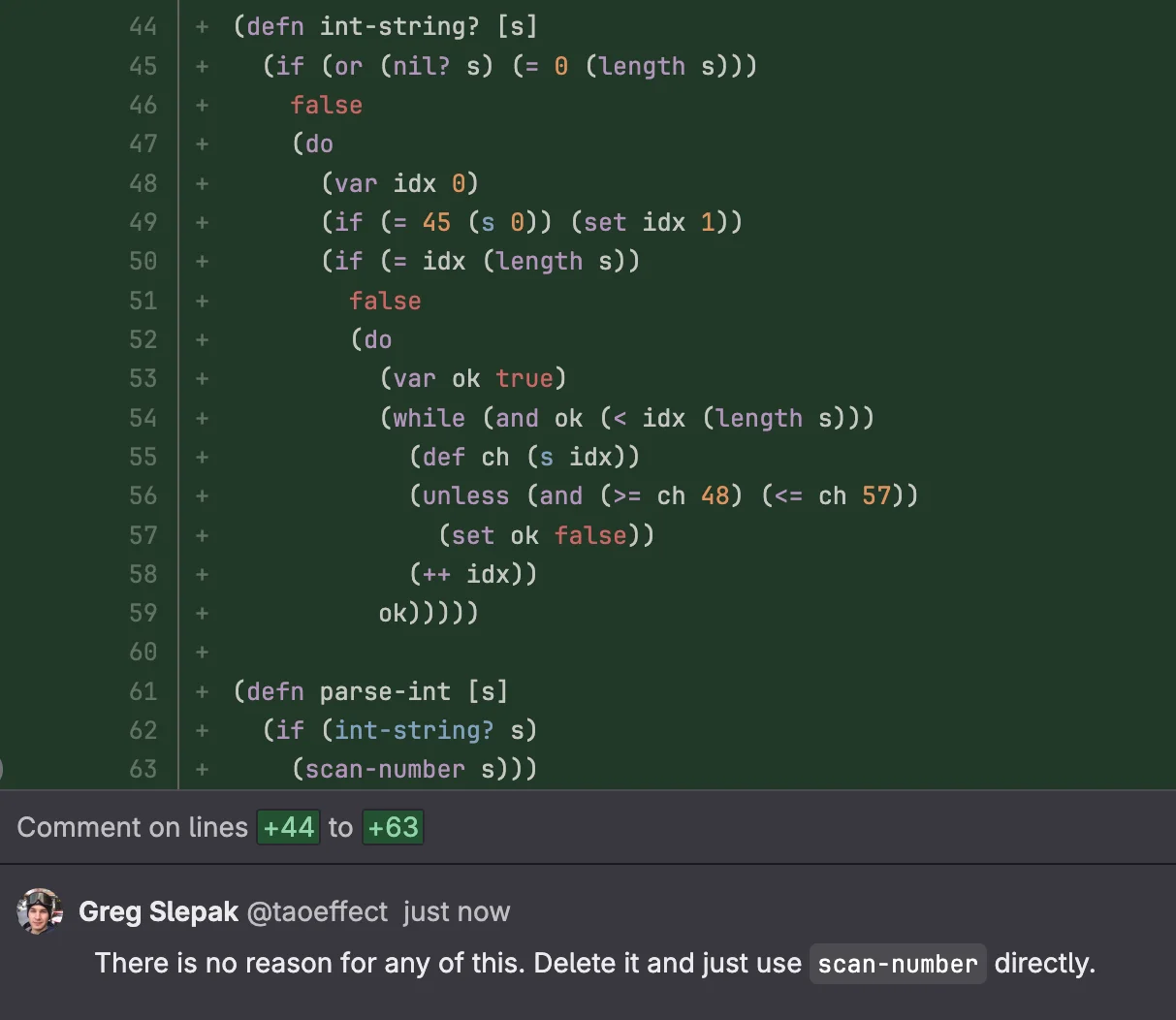
The code works, but it is horribly inefficient and ugly. And this will definitely happen more often if you are working in some kind of a niche area that doesn’t have much training data for the model to fall back on. Contrary to marketing statements made by certain CEOs, these models are not able to think beyond their training data.
That brings us to the “short leash method” for using AI coding agents.
This method cannot be employed by just anyone. Only professional software developers can use this method. But what’s great about it is that it will lead to Fable-beating results even if you aren’t using a frontier model.
In the Short Leash method:
A PR reviewed by just a human or just an AI will have more mistakes in it than a PR that’s reviewed by both a human and an AI.
The AI can be treated as a linter. It will quickly catch common mistakes, while the human will catch higher-level issues and directional changes that need to be made.
So when it comes to reviews:
That last point is worth expounding upon a bit.
AI-assisted PRs are really PRs from an AI with human assistance. Therefore, the human submitting the PR is expected to understand what they are submitting, and they cannot do that if they haven’t reviewed the code the AI wrote.
So they must treat their own PR as if they’re reviewing someone else’s PR, and review it themselves, line-by-line. Once finished, they can confirm their own approval of the PR, and request attention from the maintainer. This builds and demonstrates their understanding of the codebase.
And that’s how we use AI at okTurtles. You can read our official AI Usage Policy.
We hope this post has been helpful.
AI Disclosure: this post was entirely written by human fingers connected to a human brain. A final AI-style “spell check” was performed before publishing.
Donating = Loving!
Without our supporters, we can't do what we do.
Please take this moment to support our work.