Ok, so 100 people can all drive to the store, or one delivery truck can drive to everyone's house. (Ignoring the packaging waste for a second,) I suspect delivery of single items cuts back significantly on trips to the store.
A clever person solves a problem; a wise person avoids it.
I think it holds a lot of truth in engineering.
Here membership is unusual in that it isn't technically open to everyone, it's business and certain professions: https://www.costco.co.uk/membership but in reality anyone who wants to join can find a way.
Also no mention in the article of non-food. In UK Costco is known for special offers on electrical and white good and more. And cheap car tyres iirc
In the UK not everyone drives like USA and Costco's are few and far between, so that limits who shops there. So a niche player compared to the Supermarkets for consumer shopping.
And people also have smaller homes compared to USA and smaller families maybe (or smaller portion sizes...!), and Costco here is more geared towards selling in bulk, and to corner shops and other small businesses. It's more of a hybrid Wholesaler.
That further helps simplify shopping and decision-making and resolves the paradox of choice. Instead of having to sort through a wide variety of unknown brands on Amazon, they just go with KS.
https://www.thestreet.com/retail/costco-reveals-why-kirkland...
Amazon and other delivery companies (e.g. Weee) came to the rescue. For a while I lived close enough to a Costco for a 20 minute bike, so I'd load up my gym bag full of food - even then Costco is not ideal because there's only so much you can carry (one thing of meat, one thing of eggs, some veggies).
For those that think Costco are the uber-shopping experience are missing that they both provide very opposite consumer experiences. (Yes Costco has shipping, and same day shipping, but it hits different from Amazon).
This is also opposite to corner store grocery systems where you can pop in at any moment to get fresh fruit, a wider choice, smaller quantities at more flexible hours etc.
---
tldr - what I think I'm saying is that Costco is the perfect "suburban" purchasing experience - great if you tick the boxes that you have a big family (otherwise why do you need a 60 pack of toilet paper), a big house (where do you fit all that toilet paper), a car (to transport the toilet paper), etc.
anyone who don't tick those boxes can't really take advantage of any of that - so while Costco is amazing, it definitely shouldn't be the only way to shop.
That being said their refund and the way their employees is great though. I would prefer walmart if they treat their employee better and give better pay.
In a society where everybody is already driving to school, work, food, shopping medical appointments, gas stations, kids sports, etc this is just a marginal additional trip for the consumer.
Having redundant logistics companies (USPS, FedEx, UPS, DHL, Amazon, WalMart, Uber, etc) all making deliveries optimizing for something other than _minimum distance traveled_ means they aren’t optimizing for the same thing the consumer would.
Also, there is the game theory aspect. When a consumer mentally thinks they can just make a $5 purchase on Amazon and get it delivered the next day “for free”, they are less likely to take care to shop in bulk / batch their purchases. Nobody goes to CostCo for a $5 trip (except for the weirdos who go there just for the hot dog / pizza lunch). I personally don’t like the hassle of CostCo for less than a $200 shopping trip.
I'd much rather order some heavy stuff from Amazon to have delivered and walk to the local grocery store for everything else.
When you order your X, a van doesn't drive from Amazon's warehouse to your home and then back with only your order. The van takes a van-full (hopefully) from the warehouse, and makes many stops at many homes, businesses, etc.
That seems more efficient, in terms of fuel, climate impact, etc., than each customer making a separate round trip. Is there data showing it either way?
I’m probably the only person who would notice that. Sort of how Steve Jobs explained that a good carpenter cares about the backside of the dresser as much as the front, even if no customer will ever notice.
Oh how I would wish for this crap to be banned. By law. Simply put, at the scale of "you are even allowed to sell at large volume to Amazon, Walmart, ..." you aren't on equal footing with Amazon. You are subservient.
Contract law still builds on the idea that b2b contracts are made between roughly equal parties because that was how business was done back 200 years ago, and thus there's much less legal protection than for b2c contracts.
This needs to change, and the sooner the better.
For me, I'll join a friend who has a membership from time to time, but I'll only get chicken breasts, a rotisserie, maybe frozen fruit if the price is competitive, and... soap; everything else is just noise and/or extra calories that I wouldn't have bought anywhere else but happens to fit in the industrial-size cart and usually isn't a substantially better price, or it's just not a good offering. I could buy greek Yogurt cups, but really I don't want that brand or the lemon or lime ones, so I'm paying marginally less to enjoy half of them. I could buy salsa, but unless it's a party, I have no need for a year's supply. It's just a lot and it's probably kind of agreeable. Also the blankets, they're alright.
The small selection of things I get are the few items—as the probably AI author suggests—that I'd either buy anyway in smaller quantities or just don't have opinions about. The one time I actually did have a membership, I'd find myself working backwards from it to justify to expense. I let Costco borrow my money and to get it back I'd need to exploit their good deals, but ultimately they just made a killing off of me filling my cart with arbitrary bullshit stuff.
It all works, though the article mentions public stores and references military commissaries as an example. We can shop at the commissary if we want. We don't because the other stores I mentioned above cover all our needs better at a better price point.
I do not think the article's author understands the subject matter as well as they think they do and with the many political references to the current New York mayor; it may just be disguised political messaging article.
Whether you see that statement and read it as "obviously the delivery truck is better" or "obviously, going myself is better" is going to be primarily based on how far away from Costco you live, and how much you buy when you go.
I live a bit more than a mile away from Costco. I often buy 25-60 items, for each of the about weekly trips. There's enough large items that a normal delivery truck that could safely navigate and stop often in residential areas would have no change of fitting 100 people's purchases into it in a way to be easily offloaded (just the toilet paper and paper toweling would take up significant space). It's much less wasteful on almost all metrics for me to go to Costco. That's before we get into the fact that most of what I'm buying is produce and other food stuffs I wouldn't want shipped for worry they would spend longer than I wanted out of refrigeration.
If I lived an hour away that calculation turns out entirely differently, at least as long as there's enough people close by with purchases to gain efficiencies of travel.
Wow, what a great quote!I think that this combined with "there is no free lunch" explains a lot of thing (IMO)
(I like to write and once I write, I like to send it free on the internet in the spirit of how older internet must've originally intended but if you wish to read the TLDR it is: Be wise in selecting the problems to be clever at!)
I think that this holds a lot within career-making as well, in terms of deciding what career that you want. For example, I think that sometimes I get hyper-focused on a topic and basically dig the weeds and every information about a particular topic. My recent obsession was with the dot com bubble and supply chains.
but at the same time I think that although its just good thinking about it and gives me more breath of knowledge which helps me form a more nuanced person, but that doesn't mean that for every interest that I have, I have to become the expert or a genuine professional career at it.
Some problems are worth the risk/tradeoff when thought from short term but they quickly become really painful over the long term whereas other problems are more fulfilling long term but really hurt short term and there is a balance within the middle which I have selected which is what's know as CS :-D
I am a somewhat frugal guy and my philosophy has always been of do it yourself but reading about supply chains makes me realize just how interconnected we are. A toilet making company in Japan is an irreplacable component within the AI industry (They make the ceramics sheets on which the wafers are built and they are the only company that have the genuine expertise, patent and skills for doing so and they aren't alone and there are many many companies within such thing)
and even a single aluminim screw-esque component could take like 4-5 turns from australia (mining) -> iceland (cheaper energy) -> China (making proper aluminum bars) -> Vietnam (cheaper labour than China so China itself is offshoring it) -> Back to China.
All while a software engineer from say India/America/Europe is making the website and handling the customer service and taking ad decisions/marketing while another MNC (Amazon) ships it to your doorsteps, a company can be formed anywhere nationwide, and the product could be gone to LATAM.
Basically, although I have gotten on a tangent, my main point is that not every problem has to be solved by you. the world has lots of money in every fields as its just soo interconnected and as such you should decide on the problems which are best worth your time, your expertise and your interests hopefully and tackling that problem and maybe even being clever at that! and being wise in avoiding many of other problems.
Be wise in selecting the problems to be clever at! but to be wise on selecting the problems you want to be clever at, you should be aware of other problems in the first place so its good to analyze more problems, though it could very well be a justification that I might provide myself when I am studying supply chains and the humble container, I also find it interesting how the concepts of containers become so intuitive once you know it in modern shipping and then we applied that same concept AGAIN in Docker/podman but before that time, we were none the "wiser" :-D
Sadly this is not the case anymore these days.
I think what you're really critiquing is people who don't shop frequently, and therefore buy in bulk.
Are you under the impression that it is a uniquely American trait to have a bigger house than you need, more car than you need, and a penchant for corporate food? Over-consumption is human nature, not an American invention. America just happens to be able to afford it on a scale that most countries can't. Go to the poorer countries on earth, and you will still see people over-consuming if they have the means.
Maybe it isn't even overconsumption. Maybe it's just a different way of getting things done. Do you think that the people that buy Costco sized packs of toilet paper wipe their ass unnecessarily? Or maybe they just make fewer trips to the store to buy toilet paper.
Saying that everyone eating there is indulging in overconsumption is a ridiculous overgeneralization. Not to mention people that are planning parties, bbqs, get togethers etc. Just because you can't think of any reason for people to need large portion sizes besides overconsumption does not mean others are so limited in their imagination.
I wonder why other stores like Target don't do that as well. Beyond the obvious, it just seems like the way to go.
https://news.umich.edu/carbon-emissions-and-grocery-shopping...
In-store pickup using a internal combustion engined vehicle produced more emissions than any other option studied.
That said people don’t typically get in a car to buy one thing -though obviously sometimes they do. On average though their trips will be for multiple things. I still think even without using designated delivery days Amazon deliveries are more efficient than individuals going out to buy things independently.
When I worked from the office, centralized retail was very convenient and hardly added any driving. If you work from home, the opposite is true.
The next revolution would be to standardize reusable packaging, that same daily delivery truck could bring that back. But only government could make that happen.
Others have mentioned the parking lot sizes. If we wanted the best of both worlds, we could have online shopping at Costco with curbside delivery. There has to be a warehouse somewhere which means there are trucks/trains/planes moving goods around regardless. Even Amazon builds warehouses closer to where things need to end up eventually to optimize costs. You are comparing apples to oranges.
Finally, Costco delivers if you really don't want to leave your house. Now we are back to the same model but with far more flexibility.
Amazon goes to great lengths to make purchasing exceedingly easy and fast. And with Prime, customers can buy a single, low-priced item with no shipping costs, cf. the Costco requirement to buy in bulk quantities. As one would expect, this convenience and facilitation leads to more purchases. It also results in more packaging, more waste, more emissions, etc.
This was detailed in a 2024 Netflix documentary that interviewed a former Amazon VP who was fired for her environmental activism
https://www.netflix.com/title/81554996
She disclosed, brace yourself, that Amazon encourages people to buy stuff they do not need
https://www.mirror.co.uk/tv/tv-news/former-amazon-employee-b...
https://www.cnbc.com/2021/09/29/amazon-settles-with-employee...
Unlike Costco, Amazon does not disclose data on its environmental impact, e.g., carbon emissions. It's possible Amazon's impact is less than Costco's, Costco's data shows its impact is relatively severe, but if that were true, then why not share the data
Is driving to a warehouse, retrieving items in bulk, paying for them and driving the items home, i.e., offline shopping, as easy as placing an order on Amazon
Of course some HN reply will say "yes", implying that the former Amazon VP's story is false
Let the reader decide who to beileve
Okay you like Tailwind because you seem to think “p-2” is better than specifying “padding: 2rem;” because when it comes time to tinker with things you don’t want to understand CSS, you want to play with Tailwind.
It still exists in select locations in some countries, but are more exotic experiences than anything else. Shopping for weeks of groceries at a time is IMHO crazy niche, it requires a level of isolation and buying power that is seldom combined.
It's really awesome to have plenty of food storage, with extra and oversized refrigerators, and a deep freeze too.
I keep mine full of vegetables and beef - I have a whole beef slaughtered annually.
Can you explain why this is a bad thing or why it means overconsumption? Why is the stereotypical "European" method of going to the store every day superior to me spending ~10 minutes once every two to three weeks to go to Wal-Mart? What do you do when there are shocks, like weather events, power outages (my generator will tide my fridges over, but will take down a store POS terminal), civic unrest, or pandemics? Or if you're just plain busy? I really appreciate being able to be fully stocked (with rotating backups so I am never actually out) of basically all foods and home staples (like TP). What's the downside?
I don't know which of us is the more common scenario. What other sorts of things are you doing in the area when you go to Costo? I simply don't have that many things I have to drive for, so I don't have other errands to combine with my bulk good pickups.
Anyway, my 55 gallon drum of mayonnaise is starting to go bad, got to make a run.
Costco do plenty of online only offers, partner with Doordash/Instacart, even sell holiday packages so I'm not sure how the author arrives at the conclusion they're at the "precise opposite of everything imagined by the e-commerce"
The only precise opposite is that they're still paying IBM goodness knows how much to stay on their AS/400 architecture.
IMO Costco’s food hits the sweet spot between high end grocery store quality and walmart level price.
We still drive to the Chinese grocery for a big bag of rice every once in awhile.
Of course it comes down to how much personal time you then have to spend on shopping to drive your bill down.
Seriously though, I was thinking on how I had to stop and get cat litter, milk, and cereal on my way home today when I read what you posted. While I get some consumables online; pet food, filters for my odd-sized vent, and until recently Hello Fresh; I mostly buy consumables in person.
... We report and compare the greenhouse gas (GHG) emissions for a 36-item grocery basket transported along 72 unique paths from a centralized warehouse to the customer, including impacts of micro-fulfillment centers, refrigeration, vehicle automation, and last-mile transportation. Our base case is in-store shopping with last-mile transportation using an internal combustion engine (ICE) SUV (6.0 kg CO2e). The results indicate that emissions reductions could be achieved by e-commerce with micro-fulfillment centers (16-54%), customer vehicle electrification (18-42%), or grocery delivery (22-65%) compared to the base case. In-store shopping with an ICE pick-up truck has the highest emissions of all paths investigated (6.9 kg CO2e) while delivery using a sidewalk automated robot has the least (1.0 kg CO2e). Shopping frequency is an important factor for households to consider, e.g. halving shopping frequency can reduce GHG emissions by 44%. Trip chaining also offers an opportunity to reduce emissions with approximately 50% savings compared to the base case. Opportunities for grocers and households to reduce grocery supply chain carbon footprints are identified and discussed.
It's interesting that consumers driving EVs reduce the cost on the same scale as deliveries (presumably in an ICE vehicle).
They omit apples-to-apples comparisons (at least from the press release and abstract)
  * Consumer ICE vs. Delivery service ICE
  * Consumer EV vs Delivery service EV
  * Sidewalk delivery robot vs Bicycle or ebike
Like every other government service - highways, defense, etc. They’re profitable to the system, but not per se.
I'd still love to see data.
The problem with environmental impact is really a consequence of subsidized energy costs, including the externalization of environmental cost. If the consumer and Amazon paid the actual cost of fuel, they would make valid economic and environmental choices and we wouldn't need to figure it out like this.
Even environment aside, from a purely self-interested perspective, I would much prefer it to dealing with the recycling Amazon deliveries entail.
FWIW most Amazon packages I get nowadays are just heavy paper anyways.
Do you want an 18-wheeler truck to do your curb-side deliveries? Or a personal train?
It results in fewer miles driven and more being done per mile driven. Each parking space gets more done per parking space. There's less retail worker overhead and the people that do work are paid better and have a higher quality of life.
I am not sure if costco's model could allow it but especially for amazon, if they tried to do it or make it their USP like furniture.com, then I can imagine a very different outcome for it overall.
There was also a company I think who spent hundreds of millions of dollars (IIRC) in creating a large grocery website with buying large warehouses then and basically losing a ton of money. That business also failed quite drastically.
Another fun fact: when Amazon was first established, one of the largest loopholes that they had used which one can argue was why they were able to exist in the first place was that although they had selected book for Amazon because books are somewhat centralized (barnes and nobles essentially) but I think that the b&n warehouses required 10 books to be ordered each time.
So within the start, what they did was found out there was 1 book which was consistently out of stock. so they would order 1 book which the customer had ordered and then 9 of those other books. I imagine that if it might not have been for this as well, it might've been hard in the start.
There was also the fact that Barnes and nobles created their website and everyone thought that Amazon would basically die. Logic sort of suggests that it should've.
My conclusion is that Retail works in strange ways and timing matters a lot.
Also there are so many little facts within the book and it might be one of the fastest reads that I had of a book but the dot com bubble does feel quite similar to AI bubble IMO.
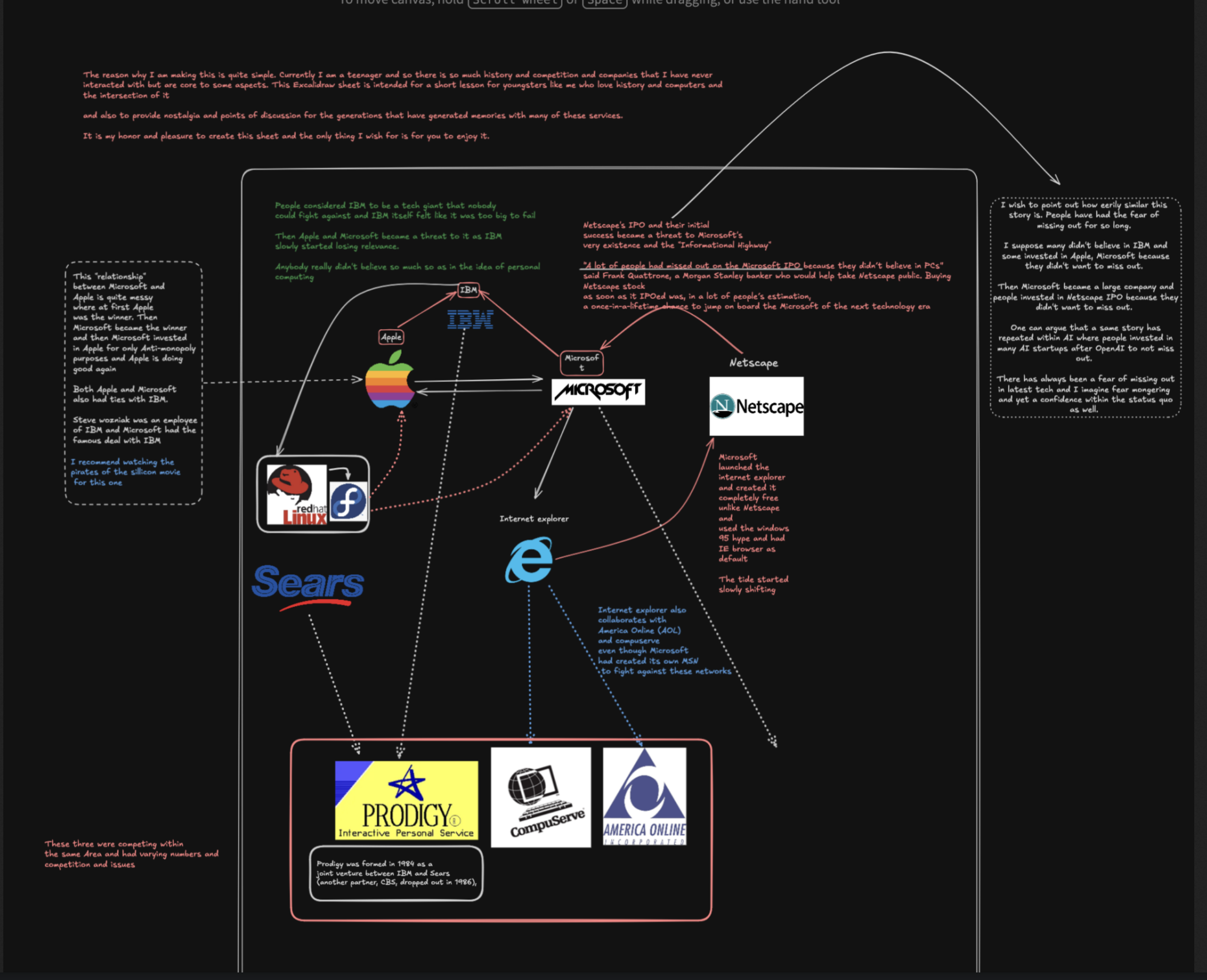
Here is a graph that I was making of a very limited connection graph of companies during the dot com bubble. https://files.catbox.moe/xdcxuy.png
I think that i have gone a bit too afar from my original comment but I sometimes like to chat and share bits of knowledge that I know and then I can't resist myself! :-D
On the delivery side: US suburbia is just in general not a sustainable solution. Delivery is just one way in which it bites. Somewhere like NYC, the amortized delivery cost (internalized or externalized) is very low (and opposite to Costcos which require a drive to an inconvenient location).
The bit about agents doing your shopping is falling for the same trap as crypto people thinking NFTs will kill Ticketmaster. These have never been technical problems: the APIs don’t exist for nontechnical reasons.
Thinking of changing this distribution is highly disturbing because of time wasted, much more limited options and huge price differences. Of course YMMV depending on location, Madrid here... the world the article describes is totally alien to me.
The shipping is slower, but it’s an interesting part of their business, and I encourage Costco members to try it out. You’d be surprised at the quantity of things you really don’t need to go to the warehouse for.
For that is a large appeal of Costco. If I need a blanket, I can visit a Costco and buy their softest blanket with no hesitation. It will be around $20. If it’s bad, they have the most generous return policy.
Similarities:
* Like you said, both have fewer choices than a conventional grocery store: if you want ketchup or peanut butter, there's only going to be one brand and one size.
* Both of them don't have scales at the registers: unlike at a conventional grocery store, nothing is sold by weight (which I'm sure provides another small efficiency gain).
* Both of them are cheaper than your typical grocery store.
Differences:
* I feel like Trader Joe's leans on store brand / white-labeling items more than Costco -- yes Kirkland Signature is a thing but Trader Joe's takes it further.
* The shopping experience is pretty different both in terms of the in-store experience and the quantities things are sold in.
* Costco requires a membership, Trader Joe's doesn't.
I wonder which elements of the two models would work best for a public grocery store.
When I was shopping for a water distiller there was only one large one but branded for ten different Chinese companies. (And They all had the same dangerous flaw where water could spill on the electrical plug.)
B. F. Skinner's Utopian Vision: Behind and Beyond Walden Two
You know you're old when...
1920's-era "kid on bicycle" tech could do that. Ditto any healthy local social network. I do it occasionally for less-healthy family & friends.
Or - how many housebound elderly folks are already using DoorDash & similar?
Bigger picture, the best practice would be a dedicated service for this. Staffed by Nurse Aides, who interacted enough with their clients to notice developing problems early. Because compared to occasionally cycling old folks through the hospital - for "easily treated, if noticed sooner" conditions - that would probably have a negative cost.
Just wait until Amazon turns some of its warehouses into Costco-style retail stores…
How I would imagine this work if there was will (I don’t think there is)… there are online grocery delivery services that do this already, it’s not that complicated.
You get your stuff delivered in a reusable bag. They charge you 1 dollar for the bag. Next time you have something delivered, you give the bags back and you’ll get your money back.
This assumes folks get deliveries on the same day and largely only from Amazon. And that we cannot build more walkable / bike able infrastructure.
Fedex/UPS cost for a single package is roughly ~$13.95 (this was ~5 years ago when I was working in ecommerce) and even if Amazon was getting a huge discount from them for the volume they do, it was still probably nowhere near $1/package.
This is not reflective of the Costco shoppers I know and the place Costco fits in their lives.
Bi-Rite and Erewhon or Citarella and Eataly are not Costco competitors.
To understand the appeal of Costco to suburban families, you have to understand their caloric needs. Costco is the best solution if you need to buy 48 eggs and 4 gallons of milk a week along with 8lbs of chicken, 4lbs of turkey, and pounds of broccoli, green beans, spinach, sweet potatoes, onions accompanied with apples, peaches, mangos, avocados, blueberries, strawberries and oranges.
Honestly I wouldn't say Costco is terribly convenient, other than the limited selection.
I don’t need “a varied sense of taste” to budget and do simple math to determine the membership is worth it.
Babies don’t need “a varied sense of taste” to use diapers purchased from Costco in bulk at a great price.
Do I lack a “varied sense of taste” when I buy ingredients from Costco, like chicken thighs and rice and eggs and olive oil, and cook them at home?
Everything else I'd rather get from my local grocery stores.
the lack of choices for similar products is a huge plus for me - speeds up the shopping process considerably, and their curation is pretty good
Our situation is pretty common; it's just a normal grocery store in effect for lots of people. The weird stereotype of Costco shoppers driving for miles to buy huge carts of food just doesn't line up with the typical case for my area.
Costco and TJs both sell items like meat by weight, they're just pre-labeled so they can be scanned rather than weighed at the register. Things like produce that might be weighed elsewhere are sold by each or container though.
They are huge - ~15,000 stores worldwide and growing fast
And the reason I chose Walmart at that time is because they offered good products, mostly first-party inventory (despite the marketplace format) but moreover, they offered a quick add-on option at checkout to hire a haul-away service to come to my door and haul away the junked, old mattress.
I own no vehicle; I live on the second floor no elevator, and the haul-away service was a godsend and a bargain price.
There’s no reason they couldn’t do basically all of the good things mentioned in this article plus have a functional website, let me scan and pay with my phone in store, have a handheld scanner at each register, etc.
It was a used car tier hard sell to get the “executive” membership, after saying no a half dozen times literally everything we said was an invite to highly recommended the damn executive card.
Then they offer $20 back on your membership if you sign up for auto pay (and install the costco app on your phone and give up your email and phone). But you need a card, and it can’t be Amex, Mastercard, or Discover, so of course the very highly recommendation is to get the Costco Visa. It has no annual fee and you get %2 back, and even if you don’t spend enough you'll get a minimum of $65 back, which is the difference between the regular card and the executive. So the executive card is basically a no brainer.
Well we couldn’t get the $20 back coupon and at this point im feeling like Costco isn’t as customer friendly as the internet says, but it turns out we can actually use discover (debit only) on the phone app. Even though honestly the executive card pays for itself, also the Costco visa has no annual fee you can just get it and never use it.
I ended up getting the plain gold star card, got some free samples and was thoroughly impressed with the $1.50 hot dog. But I think I hate this store, onboarding was such a shady process.
Costco is an exploitative mega-corporation and Amazon is too. Ask a Costco enthusiast and they will say they do it out of the goodness of their heart. It's really annoying and makes me completely avoid Costco. Please, tell me again how you think Costco hotdogs were invented by Jesus Christ and how you love guzzling down their wieners.
One problem with the bins for normal items is that rarely will they be packed to the brim. I imagine the overall item density would drop significantly if they started using standardized bins instead of appropriately sized boxes for the items.
But yeah the wrong day, and it's 30m at least.
Probably thinking of HomeGrocer or WebVan (which bought out the former and then went bankrupt too)
I used to work right across the st from one and would spend most of my shift looking out at their parking lot and you could see it get more packed throughout the day, thin out a little bit in the early afternoon and then slowly drain towards closing.
It's always least crowded right at open and then an hour (? or maybe two?) later they open for the "regular" people and once that's the case, it fills quickly.
Closest Costco is 1 hour on a bus or 22 minutes/9 miles driving. The Wegman's that delivers to me is 40 minutes/26 miles driving, all for a like 10-20% fee on every item. Honestly I'm surprised more people don't use it considering how much time they waste going to these places, and how much more they spend by walking through the stores in person. Sometimes I'll get the receipt and the price will be more than what I paid after delivery fee/tip.
I'm sad the 80$ for 100$ Instacart giftcard deal at Costco is gone. And the $2 off scheduled delivery. At least uber eats/doordash/walmart+/whole foods keeps this market competitive. Wonder how much trader joe's would make if they turned on deliveries?
> ...it may just be disguised political messaging article.
It doesn't seem to be particularly for or against the NYC proposal to me, so I don't understand why you are suggesting this.
https://www.consumerreports.org/cars/buying-a-car/measured-c...
Membership is $65.
You don't need an SUV to shop at Costco, it is easy to load the groceries into a sedan.
(just kidding, but they are the best priced hotdogs anywhere! smart move by Costco even if it loses money on them)
The people I know who shop at Costco aren’t throwing away half of what they buy. They are very often families that are actually pretty efficient about using what they buy. Big families, restaurants, remote work camps (I live in Canada) are the people I see completely filling carts and SUVs at Costco. For them, shopping at Costco is a way to avoid waste in terms of small packages and multiple small trips.
While there are certainly people that shop there and waste what they buy, it’s a pretty overused exaggeration to say that it is any more than a small fraction of their buyers. If you want examples of frivolous consumption, a barebones warehouse store selling staples in bulk is kinda the opposite of that in many ways.
Come on now.
I think the the GP would love this too if it was practical- but it’s not for him. I’d be more interested in hearing the exact reasons why. I don’t think density is itself that related; you can pack in quite a lot with good organization. I do wonder if it’s a rental vs buying thing; in the US the average trailer is about the same size as the average apartment, but you’re way more likely to see extra refrigerators and deep freezes and stuff of that nature in trailers, because they’re often owned and the resident is responsible for all the appliances, whereas the cultural expectation for an apartment is even though you could get more, it’s the landlords’ area to handle. So I wonder how much is just really small cultural things vs practicality. Thus getting more to his dislike of it - but I’d be interested to here more specifically his thoughts.
"In 2006, Congress passed the Postal Accountability and Enhancement Act (PAEA). This law forced the USPS to do something virtually no other government agency or private corporation has to do: prefund its retiree healthcare benefits 75 years into the future[0]. Essentially, they were legally required to fast-track billions of dollars into a fund to pay for the future retirement health benefits of current employees, and theoretically even future employees who hadn't been hired yet."
I will note like the other person though that I often get like "just one thing in a box that's clearly too big"
Your SUV with a Costco haul is probably driving less distance per person and carrying MORE per person while being a smaller more efficient vehicle.
Amortizing fuel per item or distance per item I'm betting the personal vehicle wins while also being better able to deliver perishable/frozen items.
(also the likes of Amazon are terrible to employees in order to make margin while Costco is the opposite)
The only order I did for temu, everything arrived completely DOA
> (which bought out the former and then went bankrupt too)
ironic, does make you think if the clock has reached full circle in terms of bubbles but there are just so many similarities within the dot com bubble and AI bubble(TM) which are just so hard to ignore.
While sold in larger packages, they don't last any longer and so must be bought frequently.
You're pointing out that you need to plan properly to bulk shop, since you're necessarily modeling future consumption over days/weeks across multiple people, but that's different than over-consumption. It means you have to be analytical and plan, but that's exactly how we do it.
I despise the city living lifestyle, where folks jam themselves in tiny grocery stores to buy 2oz containers of jam and mustard because they don't have enough room to actually fit the food they want. My sister and dad live this way in NYC, and it's annoying as hell every single time I visit them. Wanna throw a meal together? First step: leave the apartment.
And once they do so they'll have solved two big problems! :)
The funniest thing I remember though is that the totes weren't optimized for the size of some of the products available very well - if you put a frozen pizza in it, it sat diagonally, and without enough room to really put anything above or below it. You order four frozen pizzas, and you're allocating many cubic meters of apartment space for them until the next time you order.
Could you just place 3 different orders to 3 different vendors? Sure.
Could you just drive to the grocery for 2 bananas and then to Costco for the big discounted paper wipes? Sure.
But likely you will not. Which is why Amazon pulls a Trillion in revenue.
Hah. It’s such a PITA that Costco includes an hour earlier entry on the top tier membership.
We are in a new age of logistical prowess, led by the dynamism of Amazon as it strives to carry out dizzyingly complex forms of order fulfillment and delivery. With the age of agentic commerce just around the corner—think of going to ChatGPT and having an AI agent scour every website for the cheapest offering of the specific dog food you buy—there is an expectation that the future of retail is near infinite assortment and ultra-fast delivery. Consumers want the exact flavor of the exact thing that they’re looking for, and they want it at their doorstep now. It seems sometimes that we are testing the bounds of infrastructural capacity and automation in logistics to fulfill this dream.
There are a few things wrong with this dream, however, and the first, as I’ll review in a moment, is simply that it might not be so desirable. Even if you think it is preferable at an individual level, there are good reasons to question the social value of the logistical complexity that it necessitates. Home delivery of single-packaged items entails an entirely different cost structure than freight trucks driving to consumer-facing warehouses delivering entire pallets of goods to be driven home by customers themselves. Two companies have emerged with ideal-type business models that dramatize the different economies at each end of this spectrum: Amazon and Costco. Late to the e-commerce game, minimally invested in their distribution network, and committed as ever to an artificially-limited assortment, Costco is the anti-Amazon. It embodies the precise opposite of everything imagined by the e-commerce futurists—and yet somehow its revenue has grown by an average of more than 10 percent every year for the last five years.
In some cases, consumers might want access to full product assortment: when, for instance, there’s a spot in the home that only fits a furnishing of certain dimensions, or when making a major electronics purchase. But in general, scrolling through options and reading through reviews online for every consumption choice is overwhelming and anxiety-producing: “infinite, meaningless options can result in something like a consumer fugue state,” The Atlantic once argued.
One brilliant feature of the Costco experience is, paradoxically, the constraint: as opposed to Amazon, with its near infinite assortment, or even Walmart, which has approximately 130,000 SKUs (stock keeping units, or distinct items) in the average Supercenter, any given Costco will only hold 4,000 SKUs to choose from. While most retailers today assume that consumers want ever greater assortment, Costco’s popularity speaks to a countervailing desire for less choice. Indeed, the pre-selection of items for sale in their warehouses is part of the value proposition: not only are you going to get a lot of a particular thing for a good price, but you also won’t have to deliberate over micro-differences in a more robust assortment.
In other words, winnowing selection is a service, not a limitation—especially with Costco’s product catalog. Costco is not known for having the cheapest goods, but it is known for having the cheapest price on its goods, and that is because its buying team has closer relationships with suppliers than any other big retailer. Such scrutiny and communication point away from low-road suppliers. This is a structural effect of Costco’s conscious choice to offer a low SKU count: fewer products to investigate means more time to investigate each product, and a natural gravitation away from the bargain basement. That its member-customers have come to expect a certain quality of everything in their stores reinforces this dynamic.
The low SKU count also allows Costco naturally to do something that Amazon does by squeezing suppliers: a low or even negative cash conversion cycle (CCC). The CCC is a corporate finance measure of how long it takes to turn inventory into cash through sales. Amazon often negotiates delayed payment terms with suppliers, leaning on them to allow payment windows longer than the thirty-day industry norm. Meanwhile, given the speed of its e-commerce business, Amazon is often receiving payment from consumers way before it has to pay suppliers, essentially giving the retailer interest-free cash. Costco enjoys the same benefit of a short or negative CCC, but without having to anger suppliers simply because fewer SKUs means a faster-moving inventory for the SKUs that they do carry. In other words, when a Costco store receives a shipment of a particular item from a supplier, it is often going to sell every unit in that shipment in less than a month, thanks to its scale and the simple fact that that particular item is going to be the only variety in store.
Costco’s in-store experience is another draw for customers, and this too runs counter to the prevailing view in the “future of retail” conversation. While the e-commerce share of retail has been steadily growing, it’s still under 17 percent in the United States, and one wonders in a society as anti-social as our own if customers find in-person shopping, degraded a “social” venture as it is, desirable even in its inconvenience.
Shopping at Costco is always somewhat harried: no shopper can avoid lines at the registers or traffic jams in the aisles, even on the weekdays. It is the precise opposite of e-commerce convenience. And yet members not only don’t seem to mind the nuisance, they positively embrace it. Costco notably spends very little on advertising, but it doesn’t really need to, given the remarkable amount of free attention it gets by word of mouth and on social media from enthusiastic shoppers “talkin’ deals.” Costco has become a retail destination with a very loyal membership base (its annual membership renewal rate is typically above 90 percent) while offering a sparse, no-frills retail experience.
But consumer preference is only one metric by which to judge the desirability of “assortment and home delivery” vs. “constraint and in-person shopping.” It should be remembered that the term “logistics” comes from a military context—the French word for the “art of moving, quartering, and supplying troops”—and logistical success in business means most fundamentally the success with which goods are supplied to the customers who need them. Applied socially, our understanding of logistical success must be based not only on how goods are being supplied to any particular person, with their own smattering of individual preferences, but also on how they are being supplied as a whole.
At the social level, logistical success can be measured in terms of cost efficiency. This cost can be understood in accounting terms as overhead: the warehouses, the vehicle fleet, fuel costs, forklifts. An enterprise is more efficient when it can spread these costs over a larger volume of goods. A cost-efficient operation is also simple, in that it’s reliable and not prone to disruption. The more complicated an operation, the more likely it is to fail. A simple operation also puts fewer demands on transportation infrastructure—an urgent question in congested urban environments.
To put it crudely, having someone in a Sprinter van deliver a recently-purchased toothbrush to your doorstep is simply not a universalizable action, from either a business or logistical standpoint. It is a modern feat that Amazon is capable of doing this, but that it can be done does not mean that it should, nor even that it can be done writ large. For most consumption, it is far more efficient for people to handle the “last-mile delivery” themselves by going to stores and buying a good amount of stuff when they do so. This keeps delivery vans off the road, and it minimizes car trips for necessary purchases. For the retailers, it suppresses unnecessary mark-up both by keeping overhead costs low and by simplifying overall logistical operations.
Costco’s income statements as reported in its Form 10-K include the standard operating expense category for “Selling, General, and Administrative” costs. This category is consistently and qualitatively lower than any of its competitors’—10 percent of sales, compared to Amazon’s delivery costs of 40 percent of non-AWS sales. One of the reasons for this is the bare bones nature of the Costco distribution network. At Costco’s “depots” (as opposed to their stores, which the company calls “warehouses”), all in- and outbound inventory is cross-docked in pallet quantities: full pallets come in from suppliers on one side of the building, workers on electric pallet jacks move those pallets from one side to the other, and full pallets are loaded onto trucks bound for stores. There is no pallet breakdown at a Costco depot, no conveyor belts, no fancy automation.
Such low overhead not only allows Costco to deliver on low prices to their customers; it also allows the company to pay relatively high wages to their workers. According to Indeed, Walmart pays retail sales associates an average of $16.23 an hour, and Amazon pays warehouse associates an average of $19.14 an hour. Costco pays front end associates an average of $21.29 an hour. This has allowed Costco to achieve an astonishingly low rate of labor turnover: compared to 60 percent turnover in retail generally and 150 percent in Amazon warehouses, the annual workforce turnover rate at Costco is just 6 percent. This is often treated in the business press as a matter of company “culture,” but it has a clear economic underpinning. When you minimize overhead, you can simply pay workers more without squeezing your overall margin.
As I’ve said elsewhere, it’s ironic that Jeff Bezos originally got the idea for Prime, Amazon’s membership model, from former Costco CEO Jim Sinegal. Prime entitles members to free two-day delivery on over 300 million products (in addition to streaming services). With such a wide range of possible single-item orders, free delivery encourages less bundling of customer purchases. Whereas Costco membership helps to reduce overhead, Amazon membership increases it. Meeting two-day delivery demand requires dramatic investments in their distribution network, which is reflected in the higher share of sales accounted for by Amazon’s delivery costs. Lower overhead means more for workers, but it also means less organizational stress on those workers, as Costco employees are not subject to the quotas and surveillance that Amazon’s e-commerce business demands.
We don’t typically praise Costco for its logistics in the way that we do Amazon. But the former in fact offers a far more logistically elegant and socially beneficial model of goods provision than the latter. Amazon dominates when it comes to logistically-complex operations, but there is no inherent reason to prefer complicated operations to simple ones. If anything, simplicity should be the rule. Why do you need to figure out how to integrate robotic arms into a fulfillment operation dominated by autonomous mobile units when you can cross-dock full pallets? Is it more logistically impressive to solve difficult problems or to eliminate the need to solve them in the first place?
That said, there is no question that, in a better society than the one we have, key parts of Amazon’s operation would be retained for offering functions that contribute to the social good. The capacity to deliver prescription medicines same-day to the elderly is a genuine social contribution. (Academics who like to talk about “counter-logistics,” a political orientation aimed at dismantling logistical power, tend to ignore the positive social benefits that modern logistics provides.)
But if we’re looking for a generalizable model for the social provision of goods, Costco offers a foundationally useful blueprint for everyday personal consumption while Amazon does not. Amazon is hoping that its foray into grocery and everyday essentials will encourage more order bundling, and given the importance it’s according to this segment, it will no doubt continue to make headway there. But to date it has still not been able to make the conversion away from being an online convenience store, which tells you something important about its model: Amazon is there to fill in the gaps of a dominant mode of goods procurement, not to replace it.
In May, New York City mayor Zohran Mamdani reiterated his dedication to creating a public option in grocery, announcing plans to roll out one public grocery store in each borough, with two locations in the Bronx and Manhattan already scouted. The public grocery store is a model long overdue for widespread testing out, and as ex-Whole Foods Vice President Errol Schweizer has forcefully argued, there is already a shining example of it in the military commissary system. Commissary prices are typically 25–30 percent lower for veterans and military families.
The mayor’s critics have unsurprisingly settled on the critique that Mamdani’s plan will use taxpayer dollars to make life even harder for struggling grocers in NYC—conceding the idea that it will indeed result in cheaper groceries for New Yorkers. This is the terrain on which they want the discourse to play out because they expect, not without some justification, that spending on this project will involve an inefficient use of resources that is not worth the social benefit it provides. They will be combing through the receipts to find that one expense that illustrates government inefficiency or even graft.
One simple way to keep overhead low and stay cash positive is to follow the Costco model: low SKU count, high volume. The low SKU count is not only a way to have a desirable cash conversion cycle (an important way of beating back critics on the right); it also creates the opportunity to develop relationships with good suppliers. There will be a temptation to invest in giving these stores that “retail look,” with consultants jumping in to emphasize the importance of shelf placement and signage. To my mind, the aisles could look much more like Costco warehouses, but with full case stacks instead of pallets, provided that shoppers know the city has made the effort on the front end to work with high-road suppliers. A solid marketing campaign around the relationships that the city has developed with local suppliers will do more to drive traffic than the usual retail gimmicks.
Volume is the other key consideration, and if I were on Mamdani’s team, I would deemphasize the “one in each borough” line. Mamdani has said that these stores will “buy and sell at wholesale prices” in part by “centraliz[ing] warehousing and distribution,” but central warehousing and distribution on five stores doesn’t mean much. When Costco had five stores, they had no central distribution network because they didn’t need it. Volume will be what makes centralizing warehousing and distribution worthwhile, and for that Mamdani’s team will need to be open to achieving the scale economies that the math will point to. Errol Schweizer and food systems expert Raj Patel have argued as much elsewhere, suggesting at least twenty stores.
There are many other lessons to learn from Costco, but one that sticks out to me as perfectly reproducible within the context of public grocery stores is choosing a single loss leader that the system becomes known for: in Costco’s case, the $1.50 hot dog and soda combo (that price has not changed for over forty years). For NYC’s public grocery stores, how about a $2.12 halal wrap?
It’s worth noting that Costco traces its lineage back to Fedco, or the Federal Employees Distributing Company, a membership store started by post office employees in 1948. Fedco was essentially copied by Sol Price when he created Price Club, Costco’s primary competitor until the two merged in 1993. The basic idea behind Fedco was that federal employees could leverage their collective buying power to eliminate traditional retail store markup. It was, in essence, a remarkable testament to the power of the public purse, one that inspired the creation of a retail behemoth that naturally holds lessons for exercising that power once more.
Filed Under
I don’t know if Vancouver has any of these off the top of my head.
And what you’re saying is true as a generality, that big box stores often fit in at least some parking in dense areas. I have found that grocery stores and big box stores do the most parking subsidies especially when they expect their customers to be buying a lot of bulky items. They seem to frequently have free or deeply discounted validated parking in underground garages.
Maybe not in Manhattan or anything but in many other large cities with high land value in downtown areas.
And maybe it's just their talented/experienced/numerous staff, but my in-store experience with their tech is as good as it gets. Stuff just works, and works quickly.
It works for me. Am I holding it wrong?
> let me scan and pay with my phone in store
That's already beginning to happen: https://www.cheapism.com/costco-scan-and-go-technology/
> have a handheld scanner at each register
I've seen handheld scanners at each Costco register that I've ever paid attention to.
See: American Letter Mail Company.
So they were optimizing for something, but it definitely wasn’t packaging efficiency.
I'm not sure how true this is, nor how reasonable it sounds since I don't know what the inside of an Amazon delivery truck looks like, but it sounds like the sort of thing that could be true in some circumstances.
(I have two good sized panniers and can end up with ~$150 of foodstuffs packed well in them no problem. More often than not, I get less than that and add more stops to the trip to pick up from 3-4 places while out. And I get my exercise while I'm at it.)
So you still have to go to the store but it can be an in-and-out if everything works.
One truck per delivery service
So since I'm 100% definitely going to the grocery store for produce, at minimum, this whole concept fails. May as well pick up the ziploc bags and paper towels as well while I'm there.
I’m not so sure their retail piece is the part that’s making them big money.
I often see people cruising around still looking for parking while I already managed: to park, walk to the storefront, get myself a hot dog, eat my hot dog, grab a cart.
That said, I don't think this particular comment has the flavor, tone, or message I'd expect, and it does seem to be a genuine HN poster.
Results would doubtless be different if they were optimizing for minimal environmental impact or produced waste.
Retail has famously razor thin margins.
But their cash flow came in handy when AWS needed 300B in cash for gpus. Nobody could lend them that amount.
My point wasn’t that they don’t do a lot of volume; it’s that their retail business is not what’s driving their profit, and I don’t believe it’s growing.
I wouldn’t be surprised (though have not looked) if DoorDash (with DashMart), Uber Eats (which does more than just food), and Instacart have eaten significantly into Amazon’s revenue by solving the “get it to me” problem even faster.
If you do 2 deliveries per hour (like Uber Eats / door dash), you pay essentially $5/order (assuming a super low us wage of $10/hour and no equipment cost/ gas).
So no in the US, Amazon is not threatened by such delivery services.
Now if you go to China, the equation flips. Which is why Amazon failed completely.