Plants will do what they need to do in the end. I've done stuff like co2 bombing, and increasing nutrients to the point to where I get a whole new ecosystem of insects and an entirely new situation.
It is such fascinating stuff that it's actually the life I want to live. I'm a computer scientist but now I yearn for the botanical sciences.
I highly recommend checking out defoliation strategies and low-stress training methods for anyone interested. Plants are not dumb creatures. The results you can get from them are astonishing and the science of what plants actually are becomes more profound by the day.
[1] https://www.sfgate.com/science/article/REDWOODS-How-tall-can...
Too bad we cut it down, along with almost every other giant Douglas-fir.
Hm, may be because they are not really "pumping" the water?
While admittedly contested and only reproduced by a few labs outside Gerald Pollack's at University of Washington, there is a solid case that it could play a role in transporting water and sap to the tops of trees. At least, it's involved in the motion induced in hydrophilic tubes when there is sufficient ambient radiant energy (uv/infrared).
Relevant papers:
"Exclusion-zone water inside and outside of plant xylem vessels." 2024 Scientific Reports. https://www.nature.com/articles/s41598-024-62983-3
"Surface-induced flow: a natural microscopic engine using infrared energy as fuel." 202 Science Advances. https://www.science.org/doi/10.1126/sciadv.aba0941
"Long-range forces extending from polymer-gel surfaces." 2003 Phys. Rev. E. https://link.aps.org/doi/10.1103/PhysRevE.68.031408
Pollack's site: https://www.pollacklab.org/
Some critiques of Pollack's theory:
Schurr, J.M. (2013). Phenomena associated with gel–water interfaces: analyses and alternatives to the long-range ordered water hypothesis. J. Phys. Chem. B, 117(25), 7653–7674. https://doi.org/10.1021/jp302589y Elton, D.C., Spencer, P.D., Riches, J.D. & Williams, E.D. (2020). Exclusion zone phenomena in water — a critical review of experimental findings and theories. Int. J. Mol. Sci., 21(14), 5041. https://doi.org/10.3390/ijms21145041 (open access; the most thorough critical review) Elton, D.C. & Spencer, P.D. (2021). Pathological water science — four examples and what they have in common. In Water in Biomechanical and Related Systems (Biologically-Inspired Systems, vol. 17), pp. 155–170. Springer. https://doi.org/10.1007/978-3-030-67227-0_8 (preprint: https://arxiv.org/abs/2010.07287)
Coalescence of coastal fog accounts for a considerable part of the trees' water needs.[23]
https://en.wikipedia.org/wiki/Sequoia_sempervirens#Fog_and_f...
"The placard recorded that the Nooksack tree produced 96,345 board feet (227.348 cubic meters) of the "finest quality" lumber.
The New York Times regarded the tree in a March 7, 1897 issue as the "most magnificent fir tree ever beheld by human eyes" and called its destruction a "truly pitiable tale" and a "crime".
The Morning Times of February 28, 1897 claimed that the wood, sawed into one-inch strips, would reach from "Whatcom [the tree's location] to China"."
For a while there were people poaching the moss that facilitated this, which is a problem because it grows only inches per year.
Yours shall be filed under homeopathy :)
[1] https://www.sfgate.com/science/article/REDWOODS-How-tall-can...
Botany is great because the results are basically what I'd call magic. It's such beauty (and horror on occasion).
The marriage of CS and botany seems like a match made in heaven and just from writing these comments I've convinced myself that it's probably the most practical way to go forward in life.
500ft is taller than the max ever, not 1640 ft
to be fair, without humans there would be nobody to declare "barbarism". At one time, all humans were barbarians, it took a certain level of cultural development before the word "barbarism" was necessary, so at that point it was "new". It remains be be shown whether cultures that call other cultures "barbaric" are actually "better".
So sucking / pulling?
And then there's homeopathy which is a largely unrelated and entirely nonsensical thing.
Weirder still is the realization that all the air is just trapped light.
It seems that trees just don't grow that tall anymore. Even common trees such as the spruce seem to be able to reach 100m, they just kind of don't.
One possibility is the depletion of nutrients. But what I think is to blame is the lack of elephants. They constantly ruined young trees and the lucky few that survived then grew huge. Perhaps the redwoods were actually created by the natives, who removed young trees, and kept the old trees standing.
We're lucky to have a handful of big Doug Firs, Sitka Spruce, and Western Red Cedars left on Vancouver Island.
Or do you mean to suggest that the failure of any accepted tree height records to surpass the maximum capillary distance can be explained by some other factor? (Based on your other comment it seems safe to assume that isn't what you meant but anyhow.) That seems far too convenient given that the observed cutoff is within the expected range.
That would work, but it's not how to works apparently. According to this veritasium video, it's because of "negative pressure" aka tension.
https://www.youtube.com/watch?v=BickMFHAZR0
I recommend watching, I think it's one of the best veritasium Dereck has ever produced.
I suppose that’s not particularly relevant for more recent old growth tall trees that seem to have got by fine in a colder Earth.
But it’s easy to imagine a warmer, wetter, Earth with higher atmospheric CO2 concentrations being more conducive to taller tree growth.
On the other hand, I probably don’t really know what I’m talking about, not my area of expertise.
This is why the question is interesting. You can't just suck water to the top of a 60 meter tree. There must be some kind of positive-pressure pumping involved.
a column of water is pulled by hydrogen bonding between molecules in a tug of war fashion, the top of the column is where water is dissociated from the column at such a rate as to maintain low pressure with respect to the column[xylem]
in summary water moves from bottom to top in a transpiration stream, that ultimately ejects water vapour from the leaves, resulting in a low efficiency mechanism, that loses a lot of the water but occurs at such a rate that the low efficiency is "good enough" for whats needed.
Another area that might be easier to break in to as far as work goes is labouring for an irrigation business, kinda agricultural plumbing.
You’ve probably seen pivots[1] and side-roll irrigation systems.
This would put you in more direct contact with the farm operators, expose you to a wide range of agricultural crops, and also tie neatly in to your existing CS skill set with regard to agricultural SCADA (Supervisory Control and Data Acquisition), or Industrial Arduino as I like to call it.
Working for seed processes / distributors and fertiliser and pest & weed control industries could also be another foot-in-the-door move.
I know it is quite distant, but from my experience in large-scale data engineering, 90% of the time goes in addressing subtle issues that can only be observed hours into a job, the rest of the issues are quickly resolved earlier. I am assuming that such complexities will be so much harder in physical systems, and even more so in biological systems.
Or the high pressure is down here, whichever way you want to look at it.
I don't believe this is correct, or rather is not a required component of the system but rather incidental. The chemical system within the leaf removes water via chemical reaction. There is a respiration process to dispose of waste gasses. Water vapor happens to be lost to this process not of necessity but rather because keeping it separate is quite difficult (ie requires significant complexity and additional energy expenditure). I expect that many desert adapted species approach perfection (but have not bothered to verify).
There's no free lunch here. The Sun drives the evaporation, and if the tree were in a closed system with no solar input, the humidity would eventually get high enough to stop it.
> leaves which have adapted to withstand greater water stress before wilting.
That must be one of the "adjustments to water transport" mentioned. So I suggest that they do, in fact, have trouble pumping water to top branches.
In a tree the inlet to the “pump” is at the base of the tree. It’s not like there’s a pump sitting in the tree at 80 metres trying to suck water up from the ground, that would obviously fail. It’s more like a very long pump.
Simard attributes intention to this, but osmosis is “fair”. It seeks to move water to where sugars are and sugars to where water is. So a plant giving up sugars will receive water, and one low on water will give up sugars in the process of equalization.
Do fungi contain pumps to maintain disequilibrium in this work? I could not say. But even when they first learned the trick of tapping roots the basic premise would have worked in a rudimentary fashion woth no further optimization.
... that would be the least of the tree's problems.
As a largely unrelated aside, there will still be a chemical potential across a membrane that doesn't permit a solute to cross. So water can diffuse into a concentrated solution without the solute flowing backwards into the reservoir. Alternatively, small solutes can leave while larger solutes are retained. This is the basis of dialysis.
More generally you seem to be dismissing out of hand the primary topic of discussion which is neither constructive nor enlightening.
The world’s tallest tropical trees have no trouble pumping water to their topmost branches, new research reveals.
Conventional scientific theory suggests that as trees grow, it becomes harder to transport water from roots to leaves – limiting growth and making trees more vulnerable to drought.
But the new study – led by the University of Exeter and Cardiff University and published in the journal Science – finds that adjustments to water transport inside giant Dipterocarp trees “fully compensated” for the challenges of drawing water to the top.
As a result, the height of these trees does not make their water systems more vulnerable to drought compared to shorter trees, and separate testing found they suffered no height-related loss in growth (compared to smaller trees) during a severe drought.
“Trees contain lots of thin, hollow vessels and they suck water upwards by creating low pressure at the top,” said Professor Lucy Rowland, from the University of Exeter.
“These vessels have evolved intricate adaptations that can maintain the water in liquid form, even under the extreme low pressures required to move to the top of trees which can reach over 80 metres.
“However, a widely accepted theory suggests that in tall trees, the sheer length of vessels and the effects of gravity limit water transport, photosynthesis and growth.
“Our results challenge this by showing that the hydraulic systems of very tall Dipterocarp trees are perfectly evolved for their height, and should not suffer more than small Dipterocarp trees exposed to the same drought conditions.”
Dipterocarp species are the tallest flowering trees in the world and dominate Asian rain forests.
The researchers examined Dipterocarp trees ranging from 7 to 71 metres tall in Malaysian Borneo, and measured a variety of traits at multiple positions along each tree.
They found that taller trees compensate for their height in various ways, including water-carrying vessels that grow wider nearer the ground and leaves which have adapted to withstand greater water stress before wilting. They also measured trunk growth rates before, during and after the strong El Niño drought period of 2023-2024.
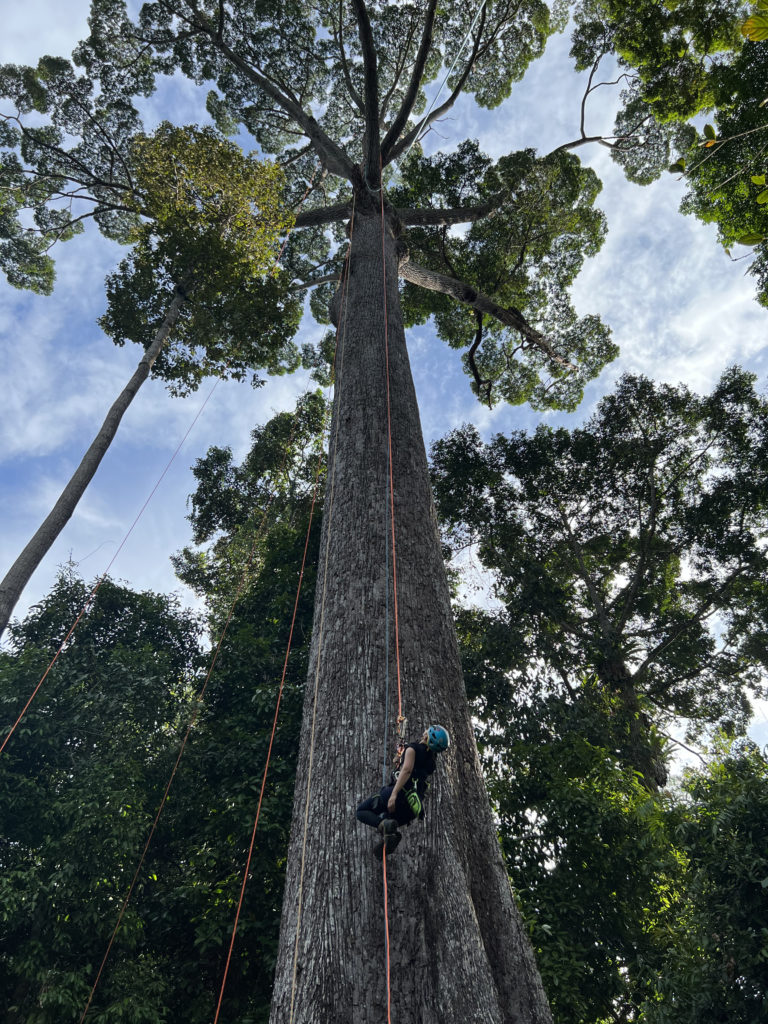
Co-author Palasiah Jotan climbing a Dipterocarp tree. Credit Arne Scheire
“Understanding tall trees is vital because the tallest 1% of trees store more than half of above-ground carbon in forests,” said Dr Paulo Bittencourt, now at Cardiff University.
“These trees are rare and important, and existing predictions suggest a weaker hydraulic system places them at higher risk of dying due to drought.
“That prediction is included in some models of climate-change impacts, and our study suggests this may not be correct.
“More research is now needed to investigate the hydraulic systems and drought resilience of other tall trees.”
Co-author Palasiah Jotan, a Malaysian PhD student studying in The Czech University of Life Sciences, said: “Dipterocarp trees dominate the rain forests of Malaysian Borneo and are central to the region’s ecology and biodiversity.
“As a Malaysian researcher co-authoring this study, showing that even the tallest of these trees are hydraulically resilient to drought is a finding I hope will strengthen the case for protecting these forests under a changing climate.”
The research team included Sabah Forestry Department (Malaysia), the UK Centre for Ecology & Hydrology and the University of Aberdeen, as well as institutions from the Czech Republic, Germany, Spain, Brazil and the USA.
The study was funded by the Natural Environment Research Council.
The paper is entitled: “Height does not impair the hydraulic system of the tallest tropical Dipterocarp trees.”
The tree is a perpetual motion machine hooked up directly to the wheelworks of nature! It PUMPS 500 liters per day usibg Wind, solar, capilar action and evaporation! How do i charge my car with this?