After testing a variety of AQI sensors, I ended up acquiring multiple Airthings-branded devices.
They provided the best mix of CO2/VOCs/PM sensors in a single device with a decent enough app.
There may be better options now, but I have these at both home and office.
Highly recommend doing the research and learning about the environments you’re in, especially if you have little ones at home.
Edit to add: opening windows is usually the easiest/best solution!
Maybe it's not just the air but also the multi-hour meetings that drive people to a sense of "oh god let this finally end now", which leads do decisions that fall short.
One of them seems to have much worse ventilation to the extent that it reaches double the level. Opening the window slightly 24/7 keeps it low.
My fiance's chronic headaches/migraines/idk became noticeably less frequent after this change and when they do occur it's usually because the window was accidentally left closed.
Anybody who struggles with this kind of thing might want to try checking their levels. Or just open a window I guess?
In most office buildings (towers) that's impossible. You have to deal with what the A/C gives you.
I once woke up with the fam in a hotel with airco at 5500 ppm. It is then that I learned the airco does not blow fresh air (logical after thinking about it).
There are so many rooms, classrooms, movie theaters and other places with poor ventilation where you just feel dizzy, or fall asleep, not knowing it was just due to lower oxygen levels in your blood. Raising awareness is the only real solution.
I see this pop up on X every few weeks. Is the concern about this really based on actual science? Is there empirical data proving people are less productive or are damaging themselves as a result of heightened CO2 levels? And I don’t mean observational epidemiology studies.
https://danieldk.eu/hardware/smart-home/esphome-senseair-s88
If you want something with a display that works on batteries without spending over 200 Euro for an AraNet, the SwitchBot Meter Pro CO2 is pretty good option. It is regularly on offer below 50 Euro. It uses photoacoustic NDIR, but does not deviate a lot from the S88. You can use it without a SwitchBot by configuring it with a phone on Bluetooth. The meter works on external power and battery, but even when on battery, you can set the reporting interval to 5 minutes, which is good enough in practice. The meter broadcasts the measurements with Bluetooth LE, so if you want to get the data in Home Assistant, you can place a ESPHome Bluetooth LE Proxy in the vicinity [1]. This is an ESP32 flashed with ESPHome that listens on Bluetooth LE advertisement and forwards them to your HA instance over WiFi. Of course, you could also get the SwitchBot Hub, but what is the fun in doing that? :)
I would avoid the Ikea ALPSTUGA, it uses a thermal conductivity sensor, which is a very indirect method for measurements and it's often several hundred ppm off.
IKEA now has a remarkably cheap ($35) air quality monitor that measures CO2 as well as PM:
https://www.ikea.com/us/en/p/alpstuga-air-quality-sensor-sma...
I don't have one yet but plan to pick one up soon. A CO2 sensor alone from Adafruit is $50+, though that one is more precise. I bought it a while ago and it's still sitting in my todo bin.
For instance, I'm now really only sure that author measured a 2000 ppm CO2 in a meeting room once. Everything else could just be LLM trying to invent convincing argument.
Stoßlüften.
CO2 is just a tip as office or home is toxic environment anyway. Plastic (e.g. carpets), formaldehyde in furniture, air fresheners… add home office and cooking at home (-> small carcinogenic particles)…
If you start reading How not to die by Michael Greger, you find out that dust, soda and sitting - not CO2 - are real killers…
It's similar to how people think sharks and airplanes are the biggest killers - when in reality it is coconuts, mosquitoes, and motorcycles.
Interestingly the Inkbird and the SCD4X quite often diverge by anything up to hundreds of PPMs; I kind of back the SCD4x (on a Pi in my case) for accuracy after lots of experimentation, reading the datasheet and ensuring the correct calibration procedurs are followed (basically expose the sensors to outside air once a week).
It's also interesting how much it varies day to day in my one-person office - possibly down to how windy it is outside, even with windows closed one day it never goes about 800ppm, other days it'll hit 1500ppm by lunchtime if I don't open a window.
N.B. Quite possible the Inkbird uses an SCD4x internally, seems reasonable kit so I have no explanation for the differences in readings.
It is better to have it in the HVAC system than in your phone anyhow:
Flu and other air transmited diseases should be treated as a workplace injury, with proper compensation!
The first needs to occasionally see new threats to stay up to date and healthy. The second will not like the constantly restricted airflow.
The worst thing is, I'm pretty sure humans are starting to mimic that cadence too...
but then germany hasn't been doing so well lately, and people who do most of their work outside should also be doing better...
https://www.ikea.com/au/en/p/alpstuga-air-quality-sensor-sma...
Not wrong, but it is perhaps worth noting that there are already standards for proper ventilation. Generally you're looking at 5–10 cfm/person (2.5-5 L/s), depending on the facility and purpose of the room; see Table 6.2.2.1 in ASHRAE Standard 62.1 for the US:
* https://www.ashrae.org/file%20library/technical%20resources/...
Maybe set up a monitor, but if the room/facility has recently been renovated and meets modern (>2013) building codes, this 'should' have already been taken into account.
Would be extremely cool if Apple, Samsung, and others can crack this, though I think they'd have done it already if it was easy.
You'd have to raise awareness on every single person in the room and them sustain pressure to the organization in order to have proper CO2 levels in the room/organization.
And then you have to align every other person on every other organization to do this as well and hope for the best.
Or, you can do the right thing and have the state introduce regulations
Article author completely ignores this for the obvious reasons.
Meanwhile in France we heat classrooms by stacking 35 kids in a confined space. It saves on heating, plus condensation that makes windows opaque helps pupils concentrate on the blackboard, as teachers said during my childhood.
- Plenty of people live or work in older buildings, where are not up to standard. For example: my office probably violates the air quality sensibilities of the Victorian era, which is when it was originally built.
- Equipment breaks down, isn't operated properly, or wasn't installed correctly. Having monitors that measure air quality is an extra check. While you may not be able to get direct action upon a consumer sensor, it can help you push for action.
I've been in buildings of varying quality over the years. I've seen how it takes time to get people in to do air quality testing. Heck, I saw the government claim that the air quality was acceptable in schools during the pandemic because the schools had passive ventilation systems. That meant they could open windows. (To be fair, the air quality in most of those buildings was probably fine since that was how the buildings were designed. That said, such standards make it easy for some buildings to slip through the cracks.)
So yeah, sensors to the people!
I've been involved with the build out of several office spaces in new and old buildings. We always took this sort of thing seriously and measured each room independently for a week (many at a time) ensuring we accounted for periods of high occupancy.
This let us tune the HVAC systems to operate more efficiently, ensuring comfortable temperatures and air circulation. Every time I've seen this done there were structural deficiencies that required remediation, some times it meant adjusting duct work.
Most modern office buildings are designed to be a platform for constructing spaces, as spaces usually evolve and change between leases and tenants. They're designed to accommodate this sort of thing.
However I've found that no build out nails this the first time. It's very hard! Often times things look fine but once you get people in the space things change drastically. It requires time and effort to address.
Several of my offices had such good air that I'd prefer being there over pretty much anywhere else -- even outside on poor AQI days.
I've also found that a lot of offices don't do any of this and their air quality is noticeably poor. And lastly I've found that the oldest buildings, including schools -- and I'm talking really old -- have very good air because they are so incredibly leaky. They're usually harder to cool and heat, though.
It can't be much, since the Aranet 4 can run for years on 2 AA batteries.
The rooms being discussed here are mostly ones which would have been built before this was taken more seriously. Classrooms, older office buildings, etc.
NYC is full of buildings which would never pass any code today but are still happily occupied. It’s a trade off, I think.
IIUC they also need fans. The one I have in my home has one that's actually integrated into the sensor unit.
Will look at adding the CO2 monitoring
Edit: actually, they only sell them as part of a 6-in-1 device, with a display, and a bunch of other sensors. That feels overkill, I wish they would just sell the CO2 sensor itself
This post evaluates to 99% AI generated.
Generally it’s a miracle to me so many people survive traffic on public roads, statistically.
The average male height in France is 178.60 cm, while in Australia it is 178.77 cm:
* https://worldpopulationreview.com/country-rankings/average-h...
Some sources even have France being higher than Australia:
That sounds like something you made up to justify your beliefs…
I imagine it could easily be compensated by an equivalently minor increase of breathing rate or breathing depth.
[1] https://en.wikipedia.org/wiki/Gas_exchange#Alveolar_air
[2] https://en.wikipedia.org/wiki/Breathing#Composition
[3] 5/6 × 40000 ppm + 1/6 × 500 ppm = 33417 ppm; 5/6 × 40000 ppm + 1/6 × 5000 ppm = 34167 ppm; 34167 / 33417 = 1.0225
The question is if oxygen levels are as good an indicator as CO2 levels... I suspect not.
(Upd: the IKEA does have lower accuracy, with ±100 ppm instead of ±30 ppm. From the SEN63C datasheet)
I was shocked to see just how fast CO2 climbs while in a room, and how just opening the window just a crack was enough to restore the room to baseline co2.
The thing runs on usb 5v so the power consumption is negligible. It also plugs in to home assistant great.
But seriously, so much care needs to be taken here. OK, well "care" at least. Employers certainly would benefit from scrubbing CO2 from the air, in terms of productivity. I'm willing to bet that with central air it would be quite easy, and even with heat and AC off, lots of places still circulate the air regardless.
So the central place to scrub is already there.
But then you have other issues. Such as, will your body adapt to 8 hrs of reduced CO2, and then you become torpid and barely awake when not at work. Such a horrid thought, that is to me. And what if employers learn that the tiniest boost of O2 helps too! Now your body becomes accustomed to that, and what are the long term effects there?
I can personally envision myself being concerned. I guess the legislation could be crafted to "the same CO2 levels found just outside of downtown city core" or some such blather. Maybe even same for O2. So that you're at least pegged to something normal for the area.
Maybe that's where the state could come into play. A simple, highly accurate monitoring station which has an API to be polled.
Come to think of it, CO2 and O2 rates fluctuate during the 24 hour cycle. Trees need O2 to live, but only produce O2 during the day. And so differing amounts of light might mean up and downs in these numbers. It may be another circadian rhythm. Getting it the same as in a nearby forest, might be the healthiest thing of all.
A sensor mounted in the office will get calibrated every night when the office is empty.
I'm certain many people are sleeping in similar conditions without realising and ventilating their rooms properly or leaving the door open.
But also bear in mind that regardless of "are we operating at max effectiveness", OSHA sets a legal limit of 5000ppm in a workplace, and that's about _safety_.
This article is talking about keeping levels below 1000 which is a very high standard IMO (still arguably justified given the studies mentioned). But if you are in a poorly ventilated home office you could easily hit 3000. At that point you are closer to "illegal in the US" than "earth's atmosphere".
So yeah even if you are unconvinced about micro-optimising your CO2 levels there's a very long established argument in favour of at least paying _some_ attention to it.
So perfect for HN, you can obsess over numbers and tech and how to measure it endlessly and overhype the significance to trick yourself into thinking you're doing something useful.
You get to have your cake and eat it, no wonder everyone loves this topic.
(Also if you're a doomer type you can link this in with rising atmospheric co2 levels for extra points)
I am suspicious of 0.1% having a significant effect though, given oxygen is around 20% and we naturally exhale a couple of percent CO2.
Looks like it's increased in price unfortunately but I like the idea, it's basically just what you would do as a DIY project but ready built. So you can either use it like a normal commercial product, or you can just fork the ESPHome config that's on GitHub and flash it exactly like any normal ESPHome project.
The only issue this house had was it overheated. We had glass facing south. Even in winter it instantly became too hot.
A price of 30 EUR makes this sensor really easy to pick up. For the same price as one Aranet (~180 EUR) the typical household can place a sensor in every room of the house. Which provides far more accurate readings for the whole house than just one high-end sensor in one room.
The main question is: If your workplace, city, whatever forces you to work or live in an harmful/unhealthy environment, do you have any realistic course of action to improve the situation? In the US you would call this (gasp) regulation, I would call it a basic human right.
If we talk about stairways, nobody complains about building regulations that mandate handrails. CO₂ levels are not totally different.
You will take ~ 1000 breaths per meeting hour. really gross!
Comprehensive AIR monitor system is must to get most efficient output. Author is right here!
The real problem is offices and meeting rooms where you have 10 people in a small box for hours and windows that don't open.
So in practice the oxygen level can never drift meaningfully far from the atmospheric pressure, whereas carbon dioxide easily can because the pressures involved are so low.
https://screek.io/ https://shop.screek.io/products/sco-b
No recommendation though, I haven't tried them.
I want this implemented to fullest, preferably with full hazmat suit. Yet more reasons to support work from home.
Dust is much more likely to just settle on the ground and be kicked back up than it is to move all the way to the purifier to get stuck in the filter.
Clean air contains about 20.9% O2 and 0.04% CO2. At 2000 ppm CO2, which according to the author is bad enough to impair judgement, that's 0.2% CO2, it that CO2 is the result of respiration, it means that about 0.2% O2 was consumed, so that's a drop from 20.9% to 20.7%, a very small difference. 20.7% is not low enough to have a significant effect, the CO2 itself is the problem, not the drop in O2. And using O2 concentration as a proxy for CO2 doesn't look reliable to me: the difference is small and other things, like humidity can affect O2 concentration.
As for the sensor, O2 sensor in cars compare the O2 concentration between the outside air and exhaust gases, it needs outside air as a reference, but what you are measuring is the outside air itself, you don't have that reference.
If you want a CO2 meter on the cheap, either wire up an optical NDIR sensor like the SenseAir S88 (22 Euro) up to an esp32, which is possibly the best sensor you can get for the money (slightly cheaper version of the sensor that the AraNet4 uses). Or if you want something standalone with a display, get the SwitchBot Meter Pro CO2 for ~50 Euro, which uses a photoacoustic NDIR, but is still miles better than the sensor in the ALPSTUGA. Can also be hooked up with HA through an ESPHome BLE proxy or with the SwitchBot Hub.
You can find a comparison of the IKEA sensor with other affordable sensors here:
https://danieldk.eu/hardware/smart-home/ikea-alpstuga
(Upd: the IKEA does have lower accuracy, with ±100 ppm instead of ±30 ppm. From the SEN63C datasheet)
You forget to mention that it is ±100ppm plus ±10% of the ambient ppm, which makes a big difference. At 1000ppm it's ±(100ppm + 0.10*1000) = 200ppm and that's only in an environment with 25C, 50% RH, and 1013 mbar. So, that does not tell you much, given that thermal conductivity is very sensitive to environmental factors.
It is a thermal conductivity sensor, which is a very indirect way of measuring CO2 and is very sensitive to environment factors. You only get somewhat good readings in lab conditions.
Don't by the ALPSTUGA for anything but very rough trends, there are much better affordable options.
There’s a huge leap from that to the power consumption being low enough to be integrated into a smartphone, as demanded by OP.
The place to look is existing codes for ventilation. Exempli gratia: https://dos.ny.gov/system/files/documents/2020/09/2020-mcnys... (see PDF page 46). Regulations to enforce outside air being brought into human spaces already exist.
I have been in some office buildings in United States which had CO2 monitors in each meeting room, and the ventilation would engage to control CO2 below a set level. We would entertain ourselves by exhausting our lungs onto the sensors to trigger the ventilation system.
I swear I can feel the 430ppm already. I was born into a world with 340ppm. I can't imagine what it's going to be like when we hit 500+ globally.
I'm in the market for an active CO2 scrubbing solution that I could deploy at home. Scrubbing the entire planet won't work but I could make a small room feel like 1960 again.
Worse, when I brought the monitor home, I found the levels there were elevated even with no one home and surpassed 2000 with just two or three of us in a room.
The good news is that I stopped worrying about making my house "tight" for the sake of energy efficiency. I keep some windows cracked all year and don't worry about how tight the door seals are.
Even though this article is conveying good (and useful) information, it seems to be completely AI-generated.
Pangram clocks it as 100% AI: https://www.pangram.com/history/c410d4b4-abfd-4ca0-b52d-db0d...
Someone else in the thread lists it as 99%: https://www.salahadawi.com/hacker-news-ai-detector
Also, it sort of jumps out at you if you're used to reading AI writing. Claude loves to start paragraphs with "Here is the uncomfortable part".
I'm not necessarily saying this automatically makes it bad, but everyone should be aware of the source of their information.
I heard a Freakonomics podcast recently with similar takeaways - that air pollution has a direct effect on cognition skills.
The article talks about "within the hour". With four people in my living room doing normal things it jumps within 20min to around 1000ppm. If I am wrestling with my kids much sooner.
In offices companies often neglect it.
edit: if you are cooking on gas it also has an immediate effect on co2 of course apart from other small particles
It's on my desk and I can confirm, opening the window if it gets orange helps a lot with thinking.
Some days in the morning it shows red and I barely can't think or get awake. Opening the window and it changes instantly.
I watched the sensor rise from 800 to 1700 PPM by the time the last group left the
It’s quite easy to build one and deploy with esphome and breadboard with stuff you can order on Amazon and have an LLM walk your through hardware and setup.
It is interesting where the rate of speech quickens as the co2 rises and the body starts to notice the co2, or maybe that was just the coffee.
I dont know anything about human respiration, but I know a little about chemistry and theres no reason to assume this is true. Basic stoichiometry.
According to a random article on the internet[1], nominal co2 production is 80% of oxygen consumption.
Your point appears broadly correct, just wanted to point out some faulty reasoning that could lead to incorrect results in the future.
[1] https://societymechanicalventilation.org/wp-content/uploads/...
Source?
But...oxygen concentration is essentially indepedent of CO2. We measure CO2 at part per million levels, whereas O2 is 20% of the air.
(In that context CO2 is surprisingly toxic given that 1000 ppm can impair mental acuity).
Best solution.
In terms of outside air, a lot of US cities I think would not benefit from that, all that much. Especially during certain parts of the day, with a lot of smog.
But regardless, all that entered my mind was "Once employers are required to add any form of scrubbing, and perhaps O2 injection, they'll over do it for optimal employee output." Regardless of whether it's helpful once the employee leaves the workplace.
I'm not against this, I'm just actually saying the regulation should be locally defined.
In Quebec province in Canada, they added CO2 sensors in all the classes in all the schools after covid. Now what? Having data does not change anything if nothing is done.
If instead all the millions invested would have gone into adding air exchangers, now that would actually do something.
And that is assuming that CO2 levels really have an impact. From the last time I researched the subject, I found that there were few studies showing an impact.
For context, from what I remember, in submarines the CO2 levels are usually between 10 000 ppm and 20 000 ppm. Very far from 1000 or 2000 ppm.
Also, CO2 sensors are usually pretty bad. I work in HVAC and I hate calibrating them, the readings are not very consistent. Leave them alone for a few years and a good percentage will simply output bad readings.
Then you see things like a teacher leaving the windows open in winter because the sensor says 2000 ppm all the time instead of realizing the problem is the sensor. (CO2 levels should go back to atmospheric levels over the weekend for example at about 450 ppm)
I didn't gather concrete data on this but this is just what I eyeballed over the last few years. Does anyone know why could this be the case?
If you notice, that monitor has a "traffic light" gauge at the bottom to tell you if the current CO2 level is critical. That traffic light is currently showing RED, i.e. highly critical.
The thing is essentially sounding the alarm and prompting immediate action. However, became the traffic light colors are printed on and static and the only dynamic indicator is a small e-paper bit above the color gauge, the effect gets lost completely.
If your CO2 levels are that high then you should fix the HVAC system and get it up to code or lobby for fixing the code. In many countries, a full air exchange in any office space every X hours is mandatory. In other countries that's optional and they need to get their act together.
A good way to think about CO2 is as a proxy for dirty air. CO2 is easy to measure but what it really means:
The next breath you take has: - already been inhaled and exhaled by others several times. - contains remnants of their farts, burps, off-gasing from everything they are wearing, have, everything in the room, etc. - may have presence of other gases like radon in the winter, mold spores, g-d knows whatever else. - co2 itself has negative effects but mainly it's a signal of what else is probabilistically in your air, poor ventilation.
Florence nightingale the inventor of modern nursing wrote that making indoor air as close as possible to outdoor air (without freezing the patient) is the best and most overlooked input to wellness. I believe this is still true.
Weirdly there are people who for some reason are hell bent on denying the air quality as an input to health and cognition. The simplest way to reason about it is: the argument for organic food is the less toxin-like stuff in it the better. Same for filtered or spring water. We often fail to quantity the impact exactly but we (logically) know that less toxin is better. For some reason we hold a much higher bar for "blaming the air" which doesn't make sense.
By volume we consume exponentially more air than food or water, and it enters the blood stream faster and more directly so obviously it impacts us. The EPA ranks indoor air quality as a top risk.
Ironically we are obsessed with outdoor air quality and if you have allergies to things like pollen that's a real concern but in most cases outdoor air is the baseline for what's indoors + other shit is added.
I find that there are people who say "wow air quality here is bad" and there are people who say "oh man I'm tired lately" without being able to attribute it, but I don't ever see anyone thriving in what is objectively bad air.
Probably. ISTR that depriving a body of oxygen results in a different response than overloading the body on CO2. It's why if you completely displace all air in the room with CO2, people choke, panic, etc, but if you use Nitrogen, people just keel over dead without realising it.
You can hit this breathing by yourself in an unventilated 3x3m room (literally measured in my house).
I dont need to know the exact level, just give me a green/yellow/red LED and make it cheap so I can have a sensor in every room
Also in my experience it’s much more accurate than that.
However, this assumes the sensor would fit in a smartphone, which is not a given. And these things need air flow. And they also wouldn't work while the phone is in a bag or a pocket.
You gather your most expensive people into a room to make your most important decisions. Then, somewhere in the second hour, the room quietly gets worse at making them. Not the people. The room.
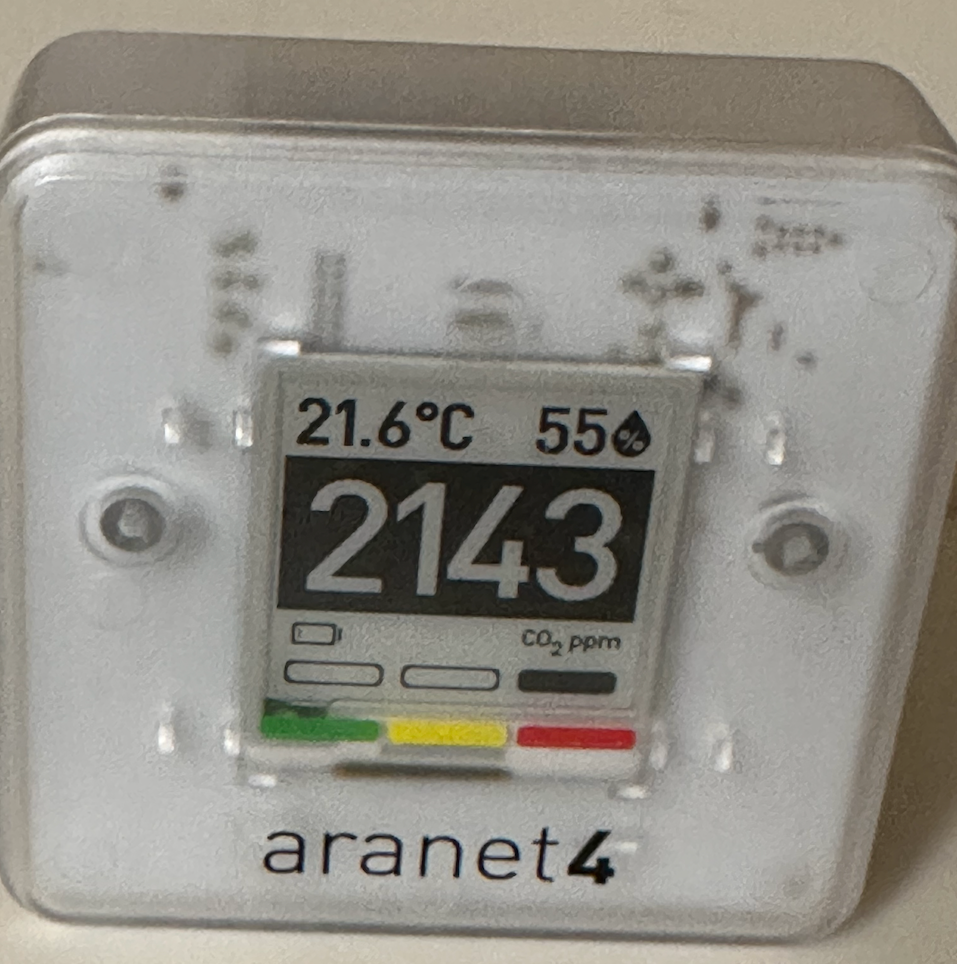
2,143 ppm on an Aranet4, in a meeting room.
I now travel with a portable CO2 monitor. Outdoors it reads around 400 parts per million. In a closed meeting room with a handful of people in it, I have watched it climb past 2,000. The photo here is a real reading: 2,143.
That number matters more than it looks. Researchers at Lawrence Berkeley National Laboratory put people in a chamber and varied only the CO2. At 1,000 ppm, performance dropped significantly on six of nine decision-making measures compared with a clean-air baseline of 600. At 2,500 ppm, seven of the nine fell substantially, some into a range they called dysfunctional. A separate study out of Harvard found cognitive scores declining as CO2 rose, with the steepest losses in exactly the domains you called the meeting for: strategy, planning, and using information under pressure.
Here is the uncomfortable part. 1,000 ppm is not an extreme number. A closed room with a few people breathing in it reaches that inside the first hour. Your all-day planning session, your architecture review, your quarterly strategy offsite in the windowless boardroom: those are precisely the conditions that push CO2 into the range where decision quality measurably falls. You are running your highest-stakes thinking in the environment least suited to it.
And it is invisible from inside. Nobody in the room feels impaired. They feel a little tired, a little foggy, a little checked out, and they put it down to the length of the meeting, a bad night’s sleep, or the person who won’t stop talking. The one variable almost nobody checks is the air.
This is not only a boardroom problem. With so much work now remote, your people spend their days in small home offices with the door shut. Same physics, same climb, same afternoon fog. The dip your team hits mid-afternoon may owe less to motivation than to a room that hasn’t exchanged its air since morning.
A few years ago, one client tried to use this as an argument for bringing everyone back to the office. They touted how much better the building’s air was than anything people had at home. So I brought the monitor and it was eye-opening. Some parts of the building were genuinely as good as outdoor air; plenty were not. The meeting rooms were still a problem, and the more people in an area, the worse it got.
I’ve spent decades understanding why capable teams underperform, and I have learned to be suspicious of any explanation that starts by blaming the people. Before you conclude that the team is disengaged, that they can’t think strategically, or that the meeting culture is broken, it is worth ruling out the cheapest variable in the building. A CO2 monitor costs less than an hour of your time. Opening a window or a door costs nothing.
You already instrument your build pipeline, your cycle time, your defect rates. You measure the systems your people work inside because you know the environment shapes the output. The air in the room is part of that environment, and right now it is the one input you are not measuring.
I learned this the memorable way once, by sealing my own team into a room full of CO2 as a Halloween stunt. The everyday version is far less dramatic and far more common.
Open a window. Then watch what happens to the second half of the meeting.
Not sure about that, at least NDIR sensors have to be at certain elevated temperature to work and they do some preheating when you turn them on from standby.
So it's not possible to just measure less often as then energy would have to be spent on heating the sensor.
It's about pH. CO2 creates carbonic acid when it dissolves in water. Your blood pH, in turn, controls how much you feel like you need to breathe. So with high CO2, your respiration rate slows down, and that can lead to low oxygen levels.
Note that the physiology and biochemistry of this is complicated (e.g. blood is a very good pH buffer and it's actively regulated by kidneys etc) and it's very much a nascent field of research, so I think AI will be overconfident and hallucination-prone.
Source: I worked in high-co2 caves for my PhD so have read about this a lot. I always carried a CO2 monitor. Our rule was to get out if we saw 20,000 ppm or greater. I spent thousands of hours above 10,000ppm.
And (maybe less realistically) what if the theater puts 5 Apple sensors inside a sealed CO2-free chamber, spread around the room?
Besides that, what's the point? There are much better meters in a similar price class. As an additional benefit, they can last months or up to a year on two AA batteries.
ALPSTUGA is an inferior product.
They recently overhauled their lineup and replaced all Zigbee devices by Thread + Matter. Some of the new devices (mostly those who support TouchLink, e.g. some of the lights) have a secret pairing mode with which you can use them with Zigbee, but it's only a subset of the new products.
Installing air filtration and UVC in classrooms and meeting rooms certainly helps.
Since the mask shortage cleared up, HCW have been advised to stop re-using them. I re-use mind til they get dirty, but maybe I should replace them more often.
https://apnews.com/article/fda-n95-masks-plentiful-should-no... (2021)
2021 reddit thread: https://old.reddit.com/r/Masks4All/comments/lhnj10/one_of_th...
Study 1 (Simulated Office): Participants in optimized "Green" and "Green+" office environments scored 61% and 101% higher, respectively, on cognitive function tests compared to conventional office environments.
Study 2 (Buildingomics): In a real-world analysis, occupants of high-performing, green-certified buildings had 26% higher cognitive scores and slept better than those in high-performing but uncertified buildings.
Home/Work Study: Researchers tracking remote workers found that suboptimal indoor temperatures and elevated CO₂ (indicating poor ventilation) directly harmed creative problem-solving and cognitive processing.
I got one because old apartment and bad ventilation. Was able to open a window when I felt the effect before, but now I can get an alert earlier. Since getting it I could consistently feel the effect at around 11100-1300.
We evolved to detect CO2 because that's by far the easiest thing to detect that's still a reasonable proxy for the performance of our respiratory system
It was the first time that I heard about them. These basically never happen if your body and environment are halfway decent, but they are important in exceptional situations.
I wonder how many driving accidents can be saved by having a co2 monitor in the car.
You’re probably about my age, then, and I’m old. It might not be the baseline CO2 levels. :-)
Kidding aside, that would be hard thing to baseline.
Also, when you cook on a gas stove, it produces numerous other toxic gases which too are critical to ventilate before they even escalate, failing which the lung cancer is risked.
Scrubbing indoor CO2 is sensible only when you want to go below the outdoor CO2 level, not at levels above it.
But then why can we see problems with concentration in studies of people in poorly ventilated rooms, but not replicate that when just adding CO2 to normal air? What is the CO2 that we can measure in meeting rooms actually a proxy for?
The ISS runs at 3000-6000ppm CO2. over 7000 is dangerous
You could also install an energy recovery ventilation (ERV) system.
The point of having "tight" houses is not (just) about energy efficiency but about air quality as well. The general mantra is build tight, ventilate right. It's why modern building codes mandate air tightness and having ERV/HRVs.
By having a leaking house you do lose efficiency because in summer the air you paid to cool goes out and the hot-humid comes in, and in winter the air you paid to heat escapes and the cold comes in. But in addition to temperature (and humidity/moisture) you also get things like pollen, brake dust, (depending on your region) wildfire smoke, etc.
By ventilating right with ERV/HRV, you remove stale air and bring in tempered fresh outside air that you filter before distributing throughout the building. Air quality is also why 'spot ventilation' is also generally mandated at certain locations like over a cooktop/range in the kitchen, and in bathrooms (where the primary purpose is not taking care of smells (though helpful), but rather moisture from showers/baths).
* https://www.youtube.com/watch?v=CIcrXut_EFA
* https://www.youtube.com/watch?v=UTBNNhUH5V8
* https://www.greenbuildingadvisor.com/app/uploads/sites/defau...
Pretty sure I learned the effect was the opposite (high CO2 --> slower respiration). Note that that was ~15 years ago when I would have read that. Maybe I just misunderstood, or thinking has changed.
edit: reading now I see I was wrong about this. Thanks for the correction!
"oh no I am getting too much fresh air"
I get your point but come on.
This original study has been used to market these CO2 monitors for years, but the evidence is quite thin and doesn't support a strong effect. It seems likely that there is a small effect, and it has been wildly exaggerated thanks to a small study with N=22.
and if sometimes you ventilate a bit sooner than required, at 700, what?
businesses will not put $200 meters in every room
Uuh, seems not keeping up with social media finally backfired. That sounds horrible! So far IKEA been a great experience when it comes to HA+Zigbee stuff, and I started buying stuff relying on they'd keep just keeping up with that, really sad to hear they've changed course.
The "secret pairing mode" stuff sounds the same as currently/before though, but they only do so for a subset is new and hope they again change their mind.
There are good $50 Euro meters. Besides that, I am not sure if that is true, at my wife's workplace, they put high-end CO2 meters in every larger room where multiple people meet. Admittedly, this was during COVID, so a lot of organizations were using CO2 levels as a proxy for finding whether a room was properly ventilated.
If you already own the ikea hub, they secretly put thread radio in it which was just sitting unused in preparation for this range.
There are also strong downsides though, one is privacy and future cloud lock-in. Zigbee is fully local. Previous Thread standards added the option for NAT64 so that Thread devices can access the internet and there were some Thread + Matter devices that already require internet access for full functionality (IIRC some Nuki smart locks, but I might misremember). However, Thread 1.4 also adds support for Thread devices to get a globally routable IPv6 address. The Thread 1.4 whitepaper is pretty blunt about what this enables:
Simplified Cloud Integration: Thread devices can now seamlessly connect directly to cloud services, enabling remote control, monitoring, and over-the-air firmware updates.
https://www.threadgroup.org/Portals/0/Documents/Thread_1.4_F...
The fact that Thread and Matter are strongly pushed by Google, Apple, etc. should tell you enough.
Now, a TBR may simply allow you to disable NAT64 or globally routable IPv6 addresses (e.g. Home Assistant's addons), but many consumer implementations don't. E.g. the Apple TV is a Thread Border Router and does not allow disabling NAT64, so Thread devices can access the internet, send analytics, and can be cloud-controlled.
Also, the ecosystem is still pretty immature, as a result of which you can encounter issues, typically resulting in unstable device connectivity. E.g. TREL does often does not work well. Apple has some hacks to fix most of the issues, but it only works well between Apple devices. So it's generally the best to avoid combining multiple TBRs into the same network.
Better than what already exists and is deployed? I dunnno, hardware already in use always beat "hardware conceptually better but I don't have it", that's why Zigbee is better, for me. Protocols much like everything in the world, isn't correct/incorrect or universally "better", it's all down to use cases.
Personally, as someone who started to rely on IKEA providing Zigbee devices, Thread is obviously worse, because 100% of the devices I have are already Zigbee and not Thread.
It's a vastly better system and the transition period is so smooth because the smart home companies have been deploying the thread hardware for years before anyone started using it.
Also worth mentioning that many modern Zigbee radios can also be Thread thread radios using different firmware. There are even multi-PAN radios that can do Zigbee and Thread at the same time. Some smarthome hubs use multi-PAN (e.g. Homey Pro), but it's generally recommended against now because of lower reliability.
The same applies to devices, e.g. some of the new IKEA devices work over Thread or Zigbee (Zigbee pairing is triggered using a non-documented sequence, presumably they added support for TouchLink). Or e.g. the Aqara FP300, which can be flashed with Thread + Matter or Zigbee firmware. It works because the same radio can be used for both protocols.
I found 3-11k as regular levels, with no impairment known of. So acclimatization can happen?
How much does implementing all that cost? What degree of benefit does it offer over simple window in situations where those concerns are negligible? What other benefits to human life could be procured with that money?
It just boggles the mind that people feel emboldened to only look at one side of the equation.
1. Not living in a city (polluted or otherwise) still does not solve the problem of letting out cooled air and letting in hot-humid air in the summer, and letting out warmed air and letting in cold air in the winter. If your CO2 is high are you going to crack open a window when it's -10 outside? Or in the middle of a heat wave (esp. if you have AC and paid to run it to cool your house).
2. Not-city living also has pollen and other allergen leakage. You're also more likely to get wild fire particulates in less urban areas.
Building tight and ventilating right is applicable in all locations and all climates.
And in the extreme case, if you believe the outside is the healthiest environment, live in a tent or under a tarp. :) Buildings were invented to have a separate outside and inside, and leaky houses reduce the effectiveness of that separation.
> How much does implementing all that cost? What degree of benefit does it offer over simple window in situations where those concerns are negligible? What other benefits to human life could be procured with that money?
Everywhere not being LA is actually an argument for ERVs/HRVs. The weather in LA (AIUI) is fairly even and consistent and it is probably fairly easy to just open a window.
But if you're in Texas with high humidity, or Arizona with high heat, or north of the Mason-Dixon line where people get winter, it's kind of hard to open a window when it's 0 or -10 outside. If you have stale air (perhaps as measured by high CO2) what are you supposed to do?
Over the July 4, 2026, weekend it's supposed to get >90F/>32C on the east coast of the US: do you want to open your windows and let all of that heat in? Especially if you already have an AC unit so paid to run it get your home's inside temperature down?
If you have a place with ducts, you can purchase an ERV and tap into that for US$ 1000:
* https://www.hvacquick.com/products/residential/HRVs-and-ERVs...
or even less:
* https://hvacdirect.com/air-cleaning/erv-air-exchangers.html
And even in milder climates (like LA), have the ERV suck in air from the outside through an MERV 13(+) carbon filter, and not only do you deal with things like wild fire smoke, but wild fire smell:
* https://www.greenbuildermedia.com/blog/wildfires-make-indoor...
* https://shop.aprilaire.com/products/aprilaire-513cbn-odor-re...
It is possible to make your indoor air cleaner than the air outside.
Your indoor air should enter through windows or intentional intakes, not incidental gaps.
Small cracks are also things that critters may be able to get through.