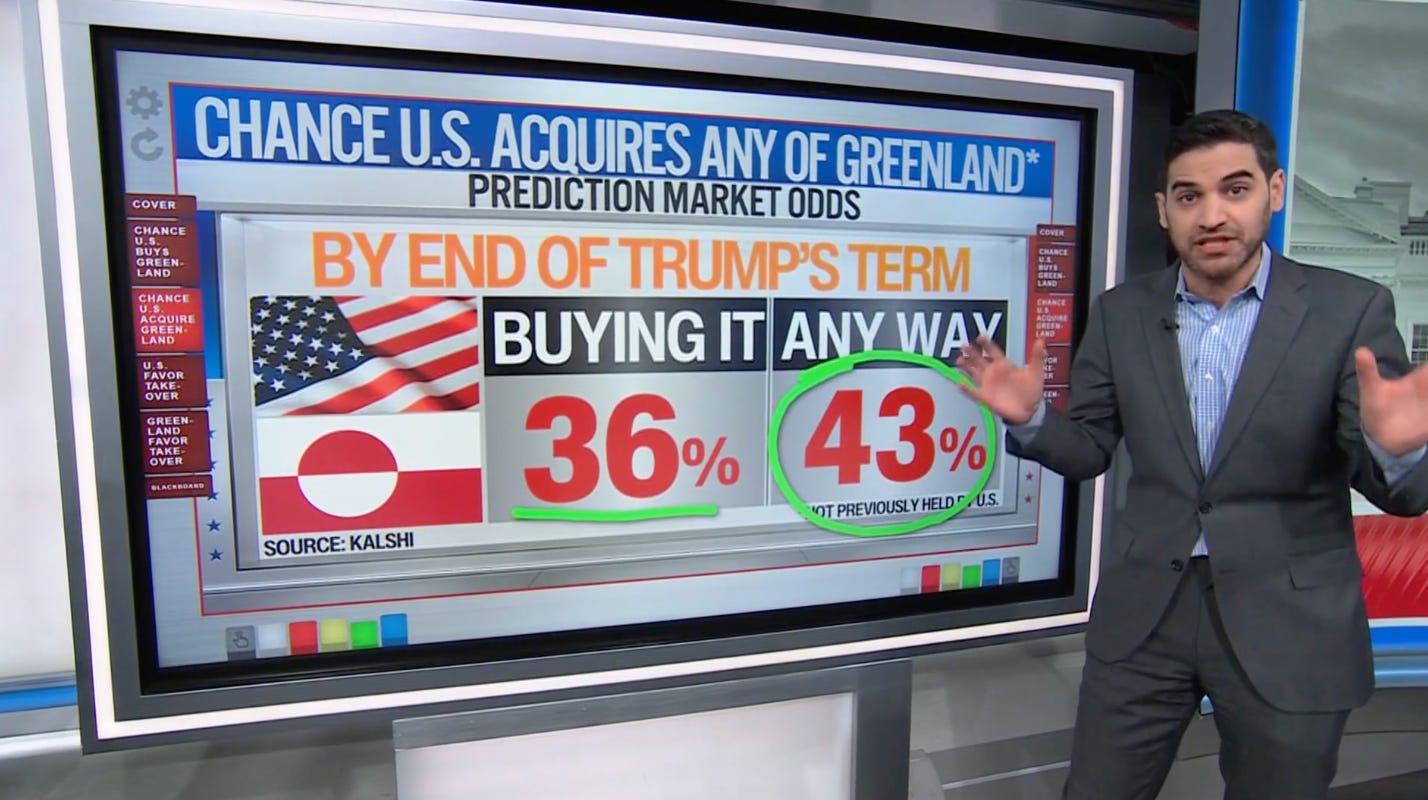
Btw every ad around the stadium in World Cup is for Kalshi now. Really makes me question the fairness of the games.
The difficult truth is that as we've engeineered our society over the last 50 years into more and more deterministic outcomes, and began to assign morality itself TO determinism. Where in we've reached a point where when we must face that life is probablistic (i.e. gambling) we assign that space a moral evil
As a person who is deeply entrenched in this way of thinking I find gambing uncomforatable, but when we invented the core AI technology of prediction systems at Google that power LLM tech today, 'gambling' on probablistic outcomes at a super short term and long term level is questining the determinism of life itself.
Gambling is a collective signal on cohort outcomes and wisdom of crowds, which becomes training data itself for long/high dimensional-vectors required to fuel intelligence.
In other words, it turns out EVERYTHING is gambling, some things just have better odds than others, and most of those better odds choices come from OHTERS gambling to make those odds better for you.
Humanity moving forward out of this trap of high odds probability gravity wells and growing as a species will involve a lot of gambling i suspect.
We were all shocked by Polymarket, but meanwhile others just saw it as yet another emerging market - and now CNN is including it in news segments as if it were the most ordinary thing in the world.
isn't without its issues of course, but you know, desperate times call for desperate measures
But why? Ease of access (ie the Intenret and particularly smartphones) are obviously a factor. There was a time when if you wanted to gamble you had to do it illegally or you had to go to a physical casino in Las Vegas or Atlantic City (and then riverboats, etc). You can look across to see how ease of access to gambling absolutely increases the amount of gambling and thus gambling addiction. A good example are the poker machines that are available in some states in Australia but not all.
But there's something deeper than that (IMHO). And I think that thing is the increasing inequality [1] and the affordability crisis. People may be talking about affordability a lot now but it's not a new issue. It was a key issue in the 2016 election, for example.
The thesis is that as people become increasingly desperate to have enough money (and espeically if they fall below that level) then gambling increases because people see this as the only way they can get ahead (eg [2]).
I believe gambling is a symptomo and indicator of a deeply broken societ and a deteriorating society.
The sad reality is that gambling is an excellent way of extracting what little wealth poor people have and it makes everything worse on a macro scale. Gambling should be relatively inaccessible. Yet we have the Federal government suing to stop states to ban prediction markets [3].
[1]: https://wir2026.wid.world/
[2]: https://pmc.ncbi.nlm.nih.gov/articles/PMC8643406/
[3]: https://www.cnbc.com/2026/05/21/where-the-feds-are-fighting-...
I'm sure they are all bad, but damned if I never encounter them outside of HN.
With no clear options the only visible path to building a modicum of wealth is timing the next big crypto rugpull, hitting a 5 leg parlay, ripping a shiny charizard etc...
We can (and should) try and regulate away this kind of gambling but the underlying problem remains.
Just ban or regulate it? It's only a form gambling after all.
The bans on gambling were often framed in Christian terms, so as society became more secular, they were undone. Now they probably need to be re-added with practical reasoning.
As someone who doesn't pay much attention to traditional news stations much these days, I was kind of taken aback by the over-the-top product placements they do now when exposed to it.
See for example:
https://youtu.be/9BPO-swW5eo?si=vLExNIXfeQmYHIDc&t=340
@5:40 (if your platform doesn't carry over the timestamp)
Polymarket/Kalshi are far more damaging to society than soda, but seeing this I was struck by how we've reached a point where the old Wayne's World product placement gag wouldn't even read as satire anymore, that's just how things actually are now.
The gambling industry has been trying to normalize gambling for decades.
I first ran into this in the mid-90's when the PR woman for a race track told me not to call it "gambling," but instead to call it "gaming."
We see gambling language used everywhere now, if you know what to look for. Terms like "all in" and "table stakes" are gambling terms,† but people use them every day in regular conversation.
† Though "all in" was used as far back as the 1930's to mean "very tired," I hardly ever hear anyone use it that way anymore.
I have plenty of cash (let's just say over a half-mil), so well ahead of the poverty level. I find myself nearly falling into this trap often. I used to work in FAANG as a developer making big bucks and earning far more than I spend. I left FAANG a couple of years ago and now I feel like I'm just breaking even with the lower salary. Quality of life has improved, but I miss having that "cushion" in each paycheck, so I look to things like the stock market to determine if I can get ahead again somehow. The fact that the tech market is absolute trash right now makes me fear for my future which in turn drives this "gotta find a way to get ahead" line of thinking even more aggressively. It's definitely not just impacting the poor.
College never guaranteed anything.
A college education may still be (statistically) a good investment:
https://libertystreeteconomics.newyorkfed.org/2025/04/is-col...
Aside from the financial arguments, the social and personal development opportunities of living and studying with your peers can be pretty great in my experience. I went to a decent school and was surrounded by a lot of very interesting and smart kids and I had some truly great professors. I was really pushed beyond what I thought I could do and my biggest regret is that I didn't take a little extra time for more courses in the humanities (specifically literature and art history).
If you see mispricing, trade the hell out of it and pocket the cash before some hedge fund does. The system is rigged against us normal folk and given any opportunity to take money legally from the system, I absolutely would.
(Now sometimes, there are good reasons for paper and physical to differ, most particularly if the paper is structured in a high-risk way, and you need to be aware of that.)
https://news.kalshi.com/p/kalshi-cnn-prediction-market-partn...
This was a temporary discrepancy that has gone away now that physical prices have fallen.
This means the future traders were right; the $150+ prices for a physical barrel of oil were a short-term situation that would resolve in a few months. It was correct for futures to be priced substantially lower.
What's absurd is internet commentators thinking the market is broken because they see something they don't immediately understand.
Perhaps our greatest cultural fiction right now is the "rationality" of markets, and people are looking for insight more than ever on our insane world. So that makes perfect sense to me, really.
Most gas stations I go into now have "gaming" machines and there's always some soul sitting at them at any time of day.
I'm mostly on team let-people-do-what-they-want-even-if-it's-bad-for-them but it's disheartening to watch a dad sitting there totally sucked into it and just ignoring their kid in a stroller behind them.
https://www.yogonet.com/international/news/2026/06/29/125136...
Building wealth through real estate is also still totally possible outside of the HCOL metro areas. Try unfashionable areas like Cleveland or Oklahoma City. And let's not have any low-effort comments claiming that there are no good jobs available in those places: the actual economic data on median income to housing price ratios tells another story.
Of course that suffers some likely substantial bias from oversampling a specific domain/sub-population
Candidates themselves and the way they campaign matters more. Cuomo had 3x the warchest than Mamdani had, for example.
Small dollar donations can also level the playing field for candidates that can gain some national appeal (this does come with its own set of problems and perverse incentives, though)
Gambling is the closest we've come to figuring out how to directly tax hope.
No, instead we should tackle the actual root of the problem, and fix the economy. If everyone can make a living, afford housing, find jobs, and find something they love to do that pays, and get medical care they need, they won't turn to these things.
This is exactly right. Widespread gambling has a fundamental nihilism baked into it. If you believe hard work and frugality are the best path to success, then gambling doesn't feel like a good use of your income and energy.
But if you feel like your dreams are falling out of reach despite your hard work, if it starts to look like even big investors are really just playing a game (often with loaded dice) rather than acting on fundamentals, if grift seems like a more reliable path to success then hard work and ingenuity, then all of a sudden gambling seems a lot more sensible. Even if the odds aren't in your favor, you can at least get lucky when you gamble. When the game feels rigged its easy to believe that hardwork is destined for failure, whereas even loaded dice have some probability of landing in your favor.
Hardly. My grandfather was working under union rules as a machinist. No education beyond the 8th grade and what he learned in the US Navy during WWII. He was able to afford a house in a Lower Midwestern city (one that would be considered LCOL) and five kids.
I have a bachelor's degree that's paid for, a decent paying software job, and no wife/kids. Wanna guess how many homes I own in the same city?
...and winning a life's fortune via gambling is even less viable. I agree with what you're saying about the lack of guaranteed paths to prosperity but turning to gambling is not a logical outcome stemming from it. There is no logic in gambling at all. It is purely a vice that preys on people's weaknesses.
But it does fit the ultralibertarian mindset best, I guess. The right to the pursuit of happiness, not to actually getting it.
You need both capital (which folks don’t have access to) and the ability to absorb risk (which folks don’t have access to).
Similar advice is in the vein of just stay with your parents for free, have a relative invest $50,000 in your business to start it up.
This runs counter to your internal narrative as a self made person I’m sure, but have you ever worked for 40 hours a week and not had anything left after paying for your share of rent, food and utilities? This is the reality that doesn’t seep into forums like this, where the majority is wealthy, college educated, and broadly privileged in some way either through exceptional talent or background.
> let's not have any low-effort comments claiming that there are no good jobs available in those places
I will bite - homeownership is indeed higher in the rust belt, but many folks struggle to find jobs that meet the median without giving up their health and bodies, if they can find steady work at all.
910,000 in prime time hours in April, which is 909,999 more than you.
https://www.adweek.com/tvnewser/here-are-the-cable-news-rati...
It also tends to assume a certain hypothetical ideal of perfect information, where all prices and transactions are public, secret deals don't exist, and ownership/interests are never hidden.
We entered this era a long time ago, where psychological insight and computational or chemical power can combine to override people's ability to make free choices. But I'm still not sure there is a widely shared philosophical or ideological framework that has fully digested and responded to these new realities yet.
aside: recreational gambling should require a federal ID with losses tracked online, and if you're down more than 10% of last year's after-tax income you're cut off for the rest of the year, but I assume the Canadian and especially US constitutions rules against doing good things federally make that impossible.
Some politicians are crooks. They should be voted out, investigated, prosecuted and publicly scorned.
"Everyone cheats" is something cheaters say to (a) feel better about themselves and (b) try to get other people to ignore their cheating when they get caught. Don't believe their lies. Most people don't cheat.
In studies of cooperative behavior, most people choose to cooperate, and the key predictor of whether someone will cooperate is whether they believe other people will choose to cooperate. Cynicism is permission to defect.
Defectors must be punished.
Now everything is either gambling or a scam or both.
I'm aware the vehicles and drivers were at first highly unvetted, but the moral impulse that's got everyone so up in arms about prediction markets isn't remotely the same as Uber smashing through antiquated monopolies that existed more by historical accident than any unavoidable public safety need.
That leads to some game theory and math, with things like some form of ranked-voting, uncapping the House of Representatives, and maybe even proportional-representation rather than lots of just-one-winner races.
Life is usually a struggle. No one should expect any different.
¹ Terms and conditions apply.
Fortunately it was the latter for me. I'd love to keep buying the stuff but it's such a waste. Better to buy singles I actually want. It's just not as fun as me being the one who pulled the card.
Others have offered contrived rules for solving it through policy, but these don't account for how to get those with power over us to institute such rules to bind their own hands and then to follow the rules to their own detriment
One of the main issues is that a lot of advice is presented as an unconditional, absolute guarantee to success. A college degree was never a guarantee of future success (contrary to great-grandparent's assertion), but the push to get everyone to get a college degree has rendered its utility as a helpful marker much more useless. Similarly, the ability to start your own business is difficult for most people, but even for poorer individuals, it is possible to start, say, a cleaning service with very little assets. (At the same time, such businesses are unlikely to make a whole lot of money at the end, but you might be able to move from working class to middle class, e.g.). A lot of contractor businesses--your plumbers and the like--are going to be from the lower middle class or middle class, and you can make some good money there, although that is also likely to be at the cost of your health much sooner than you expect.
I am sympathetic to this argument, but there are problems. How do you get homes built if you make this change?
Oh wait, I'm sorry, my mistake, that was Eric Trump.
https://sports.yahoo.com/articles/pic-eric-trump-requests-in...
We pump spectacular amounts of money (~10% of GDP in the former case based on diffing high-end-of-normal healthcare costs for peer states with ours, and who knows how much in the latter but probably around the same) into white collar and blue collar (respectively) jobs programs and wage-supplementation that buy us basically nothing. A ton worse than a proper jobs program building public infrastructure (the CCC or something) or dumping that money into doctor training or whatever. Extremely poor ROI, but we can't touch them or GDP craters (nominally only—these aren't producing much in the first place, the P part of GDP, of course, which is probably part of why the US doesn't feel as rich as it looks on paper)
This is not a super relevant statement as it can be made with a single example - the rate of mobility is down relative to when those who'd give the advice experienced (which has been compounding for at least the last 30 years, some say since the 1970s).
According to one economist in 2020, in the U.S., absolute mobility, the chance a child earns more than their parents, has fallen from about 90% to roughly 50%. Source: https://www.economist.com/united-states/2020/05/16/two-leadi...
> the push to get everyone to get a college degree has rendered its utility as a helpful marker much more useless
Social segregation also plays a really important role too, and cross class relationships have plummeted - as someone who is doing well but didn't go to college, the relationship building in college is a factor that will work against me my entire life.
I would never say that upward mobility is impossible, or that its not worth it to strive for it. I am saying that dismissing headwinds due to no guarantee of success doesn't really take into account severely constrained actual access to opportunity that continues to become more constrained over time.
Real estate as "investment" is not helping anything here; it hurts home availability, first because prospective homeowners have to compete with capital that just wants to use those as store of value/for rentseeking (driving up demand/prices) and secondly because this creates incentives against building more houses (because that hurts those real estate "investors").
Healthcare was similar until the wage stagnation really started impacting the ability to deliver service. It went from 9% of GDP in 1970 to 19% today, supported by payroll that has risen way under inflation.
About 20% of the US economy is killing people, 20% healing people, and the rest is everything else.
Evangelicals are also but one branch of Christianity, something like a third of American Christians, so to suggest that it is the same is wrong from the start.
It is crazy to me that even when faced with the most irredeemable industry, one that is predicated on abusing addiction and human irrationality, one that takes and gives back nothing, the first reaction to this is to brush all of that off and go "but what about the construction permits?"
The American adoration for anything 'private' knows no bounds. When our corporate overlords will be scamming, poisoning and forming quasi-dictatorships to rule over us all for profit, they'll still be cheering that at least it's not one of those pesky public governments.
> I can't even figure it out as a thought exercise.
It's the land under the house that typically appreciates. Land is unlikely to depreciate unless the broader regional economy declines.
(CNN screencap)
This is a special collaboration between Public Notice and Judd Legum of Popular Information. For more news and analysis from Judd and his team, subscribe to Popular Information HERE.
In December 2025, CNN and CNBC struck landmark deals with Kalshi, a leading prediction market. Since then, both networks have promoted Kalshi to viewers extensively, frequently vouching for its accuracy. The existence of a financial relationship between the networks and Kalshi, however, is disclosed to viewers inconsistently.
Since December CNBC has published 58 articles that do little more than advertise the existence of a Kalshi market related to a news event. The headlines include “Traders predict Michael Jackson hits top Spotify after biopic,” “Kalshi traders don’t see Hormuz traffic normal until July,” and “Traders say Karen Bass and Spencer Pratt will advance to runoff in high-profile LA mayoral race.” (Pratt did not advance.)
Since April, CNBC has employed a dedicated reporter to produce these articles. CNBC also maintains a page on its website featuring Kalshi prediction markets selected by CNBC editors, along with its web coverage.
Some of CNBC’s reporting about Kalshi includes the disclosure, “CNBC and Kalshi have a commercial relationship that includes customer acquisition and a minority investment.” This means CNBC is paid every time it can convert a viewer to a Kalshi user. As an investor, the network also benefits if Kalshi’s overall valuation increases. CNBC is also paid directly by Kalshi for using its data, according to The Wrap.
In at least 22 cases, however, CNBC has written about Kalshi and not disclosed its financial conflict. In recent weeks CNBC has more frequently failed to include its Kalshi disclosure, including two pieces on June 10, one each on June 11, June 15, June 16, and June 23, three pieces on June 26, and one each on July 1, and July 2.
On air, where CNBC promotes Kalshi nearly every day, disclosure is also spotty.
On June 26, during a Squawk Box interview with California Republican gubernatorial candidate Steve Hilton, host Andrew Ross Sorkin brought up the fact that Kalshi gives Hilton a 9.5% chance of winning the election. Producers then cut to a Kalshi graphic depicting those odds while a Kalshi QR code was displayed on the screen. The hosts never acknowledged CNBC’s financial relationship with Kalshi during the segment.
Similarly, during a news rundown on June 23, CNBC correspondent Contessa Brewer claimed that “prediction markets are hot, hot, hot” and mentioned that in recent days Kalshi and Polymarket “handled billions of dollars in trading volume” without disclosing CNBC’s business relationship with Kalshi.
CNBC’s Fast Money and Squawk Box each recently hosted Kalshi co-founder and CEO Tarek Mansour for extended soft-focus interviews. On June 24, for example, Squawk Box host Joe Kernen gave Mansour an open mic to portray Kalshi as a “pro-regulation company” that has kept its hands clean as “our competitors” have been mired in insider trading scandals.
While the interview did include the standard CNBC disclosure, Kernen did not ask Mansour about Kalshi’s recent insider trading scandals. Earlier that month, NPR reported former Congressman George Santos was under Department of Justice investigation for allegedly being involved with insider trading on Kalshi. Other high-profile incidents of insider trading on Kalshi involved political candidates and a MrBeast editor.
CNBC did not immediately respond to a request for comment.
Since December, CNN has featured Kalshi in a segment called “The Odds” at least 115 times. In these segments, Harry Enten, CNN’s chief data analyst, frequently suggests that Kalshi predictions are more accurate than other sources. While polling relies on volunteers, Enten repeatedly reminds CNN viewers that prediction markets are driven by people who “put their money where their mouth is.”
On January 7, Enten highlighted that, in six days, the odds on Kalshi that the United States would buy part of Greenland by the end of Trump’s first term increased from 12% to 36%. Enten said this was proof that “the people putting their money where their mouth is” are “absolutely taking this seriously.”
“Whoa… way up there now to 36%,” Enten exclaimed. “A tripling in less than a week. My goodness gracious.”
Enten and his co-host, John Berman, then discussed that another Kalshi market at the time showed a 43% chance that Trump would acquire part of Greenland by any means, including militarily. Berman described it as “a pretty high chance” and said that 43% odds on a Kalshi market meant “a lot of people made bets.” Enten agreed, calling it a “very high chance.”
Berman didn’t say how many people made bets because he does not know and that information is not disclosed by Kalshi. Politics markets represent just 4% of all trading on Kalshi, according to a May 2026 Pew Research study — a fact never mentioned on air. (Sports accounts for 80% of Kalshi trading volume.)
Enten and Berman promoted the 43% chance of Trump acquiring part of Greenland as reflective of people “putting their money where their mouth is.” But an analysis of Kalshi’s own data shows the price increased from 30% to 39% between January 3-5, 2026, on just $24,000 worth of “yes” trades. The market was so thin that, on January 4, the “yes” odds briefly spiked to 60%.
During most segments of “The Odds,” a special ticker scrolls across the bottom of the screen promoting Kalshi markets on a wide variety of topics.
According to reporting in The Wrap and The New Yorker, Kalshi pays for CNN to promote its data. The deal is exclusive, meaning that CNN cannot report on Polymarket odds, even though Polymarket has a much more robust market on political topics. These segments conclude with the tag, “The Odds, brought to you by Kalshi prediction market.”
That boilerplate language makes it sound like Kalshi is a typical advertiser, when its relationship with CNN is more extensive. Kalshi regularly clips and promotes CNN’s “The Odds” segments on X, but excludes CNN’s “brought to you by” tagline.
“Prediction markets offer just one source of data that journalists can use in telling a story,” a CNN spokesman said in response to a request for comment. “It is used as a complement to other reporting and data sources, such as polling. It is not a replacement for other sources and has no impact on editorial independence.”
Kalshi’s political markets, which dominate the coverage on CNN and are featured prominently on CNBC, are also the least accurate.
A February 2026 study by a researcher at the National Economics University in Vietnam analyzed 292 million trades across 327,000 contracts on Kalshi and Polymarket. The study, which has not yet been formally published, found that Kalshi’s political markets “compressed toward 50%,” meaning they systematically overvalue longshots and undervalue favorites. This is exactly what we saw with the coverage of Greenland, where a Trump pipe dream was promoted as something with a “very high chance” based on the Kalshi odds.
In another recent segment on CNN, Enten, citing Kalshi data, told viewers that Trump has an 8% chance of being featured on a $250 bill. That likely significantly overestimates the actual odds, since featuring a living person on U.S. currency has been illegal for the last 160 years. A bill to amend the law for Trump was introduced in February 2025, and although the Treasury Department has produced a mockup, no congressional action has been taken.
The author of the study theorizes that “political markets attract traders with strong, opposing convictions” which can drive the price “near 50–60% even when the true probability is substantially higher or lower.” The study argues that journalists and news consumers that take prediction market prices “at face value… are systematically misled.”
UPDATE (7/6, 11:15 am Eastern): CNBC responds: “CNBC discloses commercial relationships when they are directly relevant to the story, as we do across our coverage of exchanges, data providers, and other market participants. Kalshi data is publicly available, and CNBC covers it as part of the broader set of market indicators we report on.”
UPDATE (7/6, 11:30 am Eastern): In a statement, Kalshi says “we’ve always been open about our news partnerships, as have our news partners.” Kalshi, CNN, and CNBC have not disclosed the financial terms of their partnership. Asked for clarity, Kalshi said its deal with CNN involves “featuring our odds on Harry Enten’s show, along with other mentions across their programming” and its deal with CNBC involves “integration across their platforms.” Kalshi added, “People aren’t dumb; they hear and see these disclosures and can choose to use our data as added context or choose not to.” The statement from Kalshi did not address the numerous instances documented by Popular Information and Public Notice where no disclosure was included.
Thanks for reading Public Notice. This post is public so feel free to share it.
We’ll be back with more tomorrow. If you appreciate today’s PN, please do your part to keep us free by signing up for a paid subscription.
Thanks for reading, and for your support.
No posts