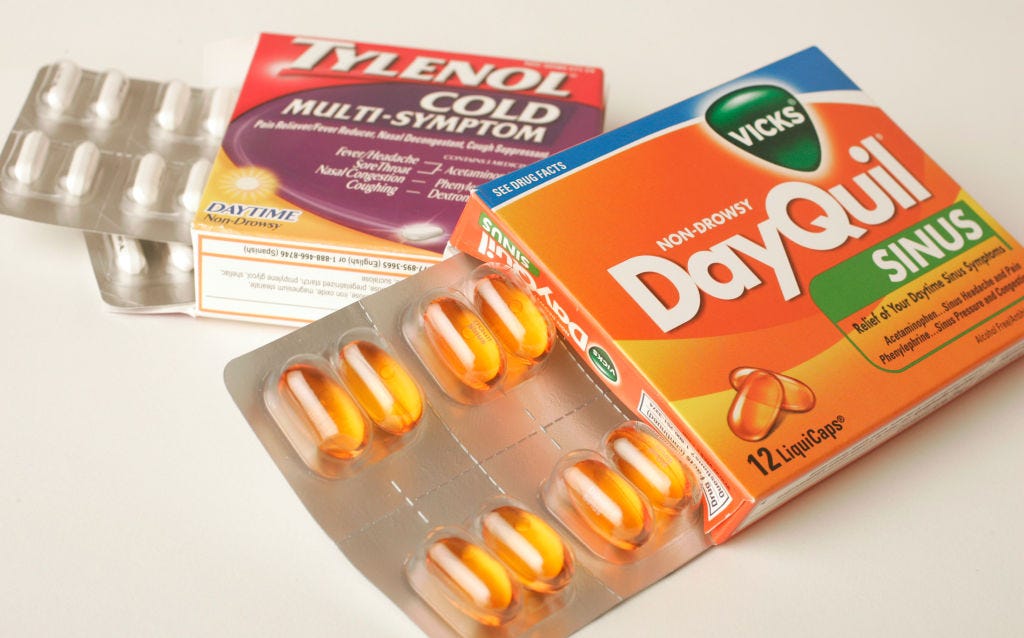
These Tylenol and DayQuil pills may look different, but their ingredient lists don’t. (Photo by Matthew Healey/MediaNews Group/Boston Herald via Getty Images)
If you walk down the cold and flu aisle at CVS and start looking closely at labels, you will count about 100 products and around six active ingredients. This is the meat and potatoes of the over-the-counter drug industry, which specializes in taking three generic medications and two placebos that cost 5 cents each individually and selling the combination product for $35.
Take your standard 12-ounce bottle of DayQuil, which costs around $15 at CVS. The entire bottle contains a small amount of acetaminophen (Tylenol) and two other ingredients that are supposed to help with your cough and congestion — dextromethorphan and phenylephrine — but in reality do nothing.
Most studies have found that dextromethorphan performs the same as a placebo and some suggested it was worse than honey. Oral phenylephrine is so ineffective that the Food and Drug Administration (FDA) proposed removing it from the market — it is now nearly three years into the glacial regulatory process of actually doing so.
So the only ingredient that’s doing anything in that bottle of DayQuil makes up just 2% of the bottle: the roughly 8 grams of acetaminophen, which separately would run you about 16 cents at Costco. Even if you opted for the $10 store-brand version of DayQuil, that’s more than a 6,000% markup rate.
Nearly every product in the cold and flu aisle is like this, as are many in quite a few other aisles.
Now, in some ways, this resembles other industries; consumers pay through the nose for convenience all the time. How is this any different from customers paying a markup for a fruit salad at the grocery store?
Well, the analogy breaks down along three lines:
Grocery store customers typically pay four to 12 times as much for precut fruit as they would for the same quantity of unprepared fruit. That’s a lot, but still a far cry from 60 to 100 times more.
Most of the fruit you get in a fruit salad actually is fruit, rather than, say, fruit-shaped rocks. But many of the active ingredients you get in these combo drugs don’t do anything helpful.
No one is going to the hospital because they ate too much melon. But combo drugs are huge contributors to unintentional overdoses.
DayQuil is hardly alone in packaging placebos in its products. The ineffective dextromethorphan is in all sorts of cough medication, from Robitussin to certain Tylenol and Mucinex formulations. You’ll also find lots of cough medication with guaifenesin, which has similarly thin scientific backing.
But the biggest offender, by far, is oral phenylephrine, which we can find in many combos besides DayQuil. Not only is the FDA clear-eyed about its ineffectiveness, the drug’s manufacturer is using it to actively mislead consumers.
Historically, Sudafed has contained pseudoephedrine, the wonder drug equally good at clearing congestion and making crystal meth. That Breaking Bad association meant that even though it was an over-the-counter drug, to get it, you had to talk to a pharmacist and give them your name, fingerprints, Social Security number, and custody of your firstborn child. This type of red tape ate into Big Pharma’s profit margins.
So what’s a struggling multibillion-dollar pharmaceutical company to do? Well, if you’re Sudafed, you find a placebo that sounds a little like pseudoephedrine, give it a practically identical name and branding campaign, put it on the shelf with the rest of the cold and flu drugs, and watch the dollars flow in.
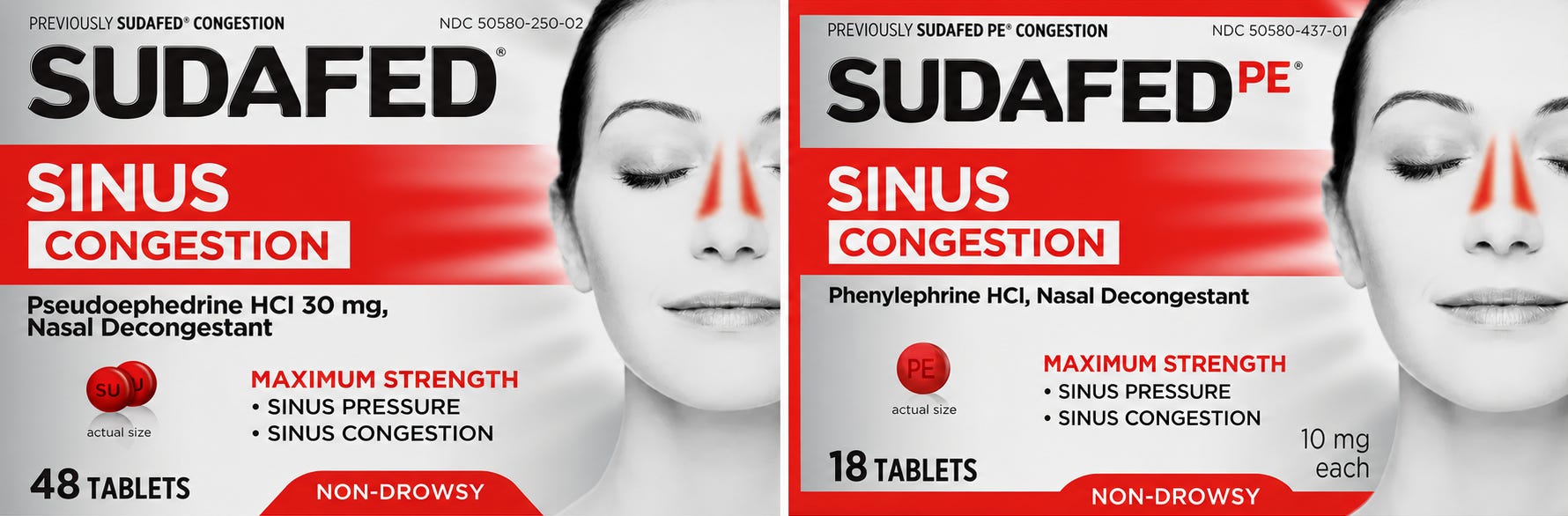
Corporate needs you to find the difference between this picture and this picture. (Source: Sudafed)
“It is one of the most egregious examples of stupidity in the whole world of over-the-counter combination pills,” said Dr. Jerry Avorn, drug policy researcher at Harvard and author of the recent book Rethinking Medications.
Avorn is especially frustrated with the industry’s role in keeping phenylephrine on the shelf: “The pushback of the over-the-counter drug industry against obvious scientific data that this stuff is useless, and the FDA’s repeated inability to get it out of pills, is just one of the more astonishing examples of how over-the-counter drugs and science often have nothing to do with each other.”
The FDA is supposed to evaluate a potential drug for both effectiveness and safety before allowing a drugmaker to bring it to market. But that process has broken down over the last 40-odd years.1
Seeing new drugs come to market is, of course, very exciting — particularly if they promise to help patients suffering from diseases for which we do not already have good treatments. But that promise can only be fulfilled if the drugs actually work. And the FDA has developed a bad habit of approving drugs that had scant evidence of effectiveness.
The upshot is that these drugs have gone on to cost patients a lot of money but bring approximately zero value to their health. And as phenylephrine so aptly demonstrates, once a product is approved, it is much, much harder to take it off the market.
A pickier FDA doesn’t have to be a slower FDA. We can have abundance for clinical trials and still be critical about what drugs we approve. What we shouldn’t do is allow unproven drugs on the market out of a misplaced desire to give patients options.
Conservatives (including the former deputy secretary of Health and Human Services) sometimes welcome this libertarian attitude toward drug approval, arguing patients should evaluate the evidence on drugs themselves, and the FDA should only make sure drugs are safe. In fact, this is explicitly how the FDA used to operate before Congress changed the standard in 1962.
I think this is a fairly naive view of how health care actually works. It assumes patients are examining clinical evidence when it's not clear that they are even reading the labels or pricing out alternatives right now. People routinely buy combination drugs with 6,000% markups, not realizing they could get the useful ingredient for just a few cents. The FDA needs faster and cheaper efficacy review, but simply flooding the market with unproven drugs isn't a meaningful choice for consumers.
Moreover, allowing placebos to crowd the market creates a counterproductive incentive structure for drugmakers.
“When the FDA approves a drug that may not provide clinical benefit, it doesn’t ‘encourage innovation’ by attracting payments to companies working on tough problems—quite the opposite,” Avorn wrote in Rethinking Medications. “Once companies learn they can bring partially tested and poorly effective drugs to the agency and win approval, they will continue to do so, rather than … keep working at the problem until they come up with a medication that actually helps patients.”
Furthermore, because these drugs are ineffective on their own, if drugmakers want them to keep selling, they have an incentive to package them with effective drugs in combination products. But, for cold and flu symptoms especially, there just aren’t that many effective active ingredients. So it’s very common for sick patients to go to the pharmacy, pick up more than one of these combos, and accidentally double-dip on identical active ingredients.
And this is the real danger of these combination drugs. They aren’t just making us pay through the nose for drugs that don’t work and discouraging the innovation of drugs that might. They’re also making us sicker.
Every year, acetaminophen overdoses cause over 50,000 emergency department visits and over 500 deaths. Notably, around half of these overdoses are unintentional — it’s actually really easy to overdose on Tylenol.
If you want a product to lower your fever, reduce aches and pains, and alleviate your headache, you want Tylenol. Drugmakers know this, so they make a point of adding it to most combo drugs.
“I think if you go down the cold and cough aisle and pull out any med, it’s gonna have acetaminophen in it. Almost every single one,” said Dr. Anand Swaminathan, associate professor of emergency medicine at Hofstra’s Zucker School of Medicine.
At the cold and flu aisle of my local CVS, I counted no fewer than 40 individual combo products that contained acetaminophen but were not Tylenol-branded. DayQuil, NyQuil, Alka-Seltzer Plus, Mucinex, Robitussin, Theraflu, Excedrin, Triaminic, Sudafed PE, Coricidin HBP, and Zicam — plus the store brands of each — all contain acetaminophen.
The maximum daily dose of acetaminophen for a healthy adult is just 4,000 milligrams; older patients and those who aren’t eating much are often advised not to exceed 3,000 milligrams, and children are maxed out even lower. Considering Tylenol is usually packaged in 500-milligram “extra strength” formulations, this is just six to eight pills.
But, of course, it’s not only packaged by itself; it’s in nearly every combo drug on the shelf. So patients will get a cold, go to the pharmacy, pick up some Tylenol for their aches and pains, Robitussin for their cough, Mucinex for their congestion, and NyQuil to help them sleep, and end up with a quadruple dose of acetaminophen.
“It’s easy for people to say, ‘Well, I took that cold and cough prep, I still have the muscle aches, so now I’m going to take Tylenol as well,’” said Swaminathan. “Well, you took 500 milligrams of Tylenol [in the prep] and now you’re taking another gram of Tylenol on the side. That’s a lot together, that’s more than we would recommend.”
It would be impossible to make that mistake if Tylenol were just separated from the combo drugs. We know separating Tylenol from other medications can decrease unintentional overdoses because we’ve seen a more limited version of this policy in action in the prescription market. In January 2011, the FDA set a maximum amount of acetaminophen that could be packaged in combination opioids like Vicodin or Percocet. The odds of hospitalization due to opioid-related acetaminophen toxicity plummeted.
At this point, it’s worth asking the question: Why do we even have combination over-the-counter products at all? If a patient wants a drug to tackle congestion and a drug to relieve aches and pains, they can just … take pseudoephedrine and Tylenol separately. Is it so much more convenient to take them together in a single pill?
The strongest case for these combo drugs is that they can simplify drug regimens for people who need to take a lot of pills — typically people who are older or chronically ill. But these are precisely the groups of patients most at risk of drug interactions. If they take a drug to treat cold or flu symptoms, they need to cross-reference the active ingredient with everything they already take. So including more than one active ingredient in the cold drug actually multiplies the complication.
That’s why, regardless of your overall health, you would be better off without these drugs on the pharmacy shelf. The pharmaceutical industry might protest that we’re taking consumer choices away. But having 100 products built from six ingredients — half of them placebos — was never really a choice at all.
[
The hypocrisy of abundance
](https://www.theargumentmag.com/p/the-hypocrisy-of-abundance)
·
Feb 11

Contemporary advocacy organizations exert political influence on the basis of representational claims they haven’t earned.
To grossly summarize Avorn's book: Drugmakers only need to show their product is more effective than a placebo, not necessarily more effective than available alternatives. “Effectiveness” can mean something as small as showing a marginal improvement over a placebo in a surrogate measure — it doesn’t necessarily mean the drug actually makes a difference to patients’ lives. Many of the studies FDA relies upon to determine effectiveness are funded by drugmakers themselves, which creates an obvious conflict of interest. And many drugs escape sufficient examination by depending on the “accelerated approval” pathway, by which they come onto the market before much research is completed (on the usually faulty presumption that more research will subsequently be done and the approval reconsidered).
No posts