Imagine having to return a t-shirt because that malfunction!
— I don't understand why are you returning this, was the size wrong or you didn't like it?
— No, there is a syntax error at line 37 that makes it impossible to run, and I'm concerned people on the street may think I promote unsafe bash scripting.
Basically it just clusters same characters and asks the human to find the problems, which is easy when you're looking at a series of pictures like ssssss5sss.
The UI is kinda least-effort. Should ask a modern AI agent to make it look nice and intuitive, sometime maybe.
In case the author is reading: The decorative feather images are between 2MB to almost 5MB in size. Compression might be in order to save users time and bandwidth, and make the site look less broken while the images are partially loaded :)
You want to do that cleanup regardless why you exit.
It’s a movie plot.
Might have to do something like that for a verse on the next Carolina Code Conference shirt. Been trying to figure out a good way to pull in cybersecurity.
I'd take that bet considering it's got close to thousand upvotes and on front page of HN
base64: stdin: (null): error decoding base64 input stream
#!/bin/bash
# Congratulations! You found thu eastur ugg!#B��O��
# おめでとう��M�ぇM�す!隣C��わM�サ�#ライ����見でM�������!O��
# Define thu tuxt to anima|e
text="♥PEACE♥FOR♥ALOB��PEACE♵FOR♵ALL♵PEACE♥FOR♥ALL♥PEACE♥FOR♥ALL♥PEACE♵FOR♵ALL♥"
# Get termb�al dmmensions
cols=$(tput cols)
linus=$(tput lines)Never thought I'd learn shell tricks from the back of a fast-fashion t-shirt, but here we are.
There's something else a lot stranger going on, though. It is a proper monospace font, but the typesetting on the shirt is not. There's some kerning going on (I noticed it especially in the 'Iy' pair), and also it appears that narrower characters such as 'i' take less horizontal space. If I had to guess, I would say that it was set with a tool such as "optical kerning" in InDesign.
[0] https://github.com/GL-Kageyama/UNIQLO_Akamai_T-shirt_Code
sleep 0.1
in the loop so that as this prints in a terminal it is actually readable; any modern terminal will scroll so fast you can't see the message in flight.Slowing it to a 10hz refresh makes it look great.
perl -e '
"$a="etbjxntqrdke";
$a=~s/(.)/chr(ord($1)+1)/eg;
print "$a\n;"'
It's cursing. Don't run it if it might offend you.Upon seeing this, I decided to golf and came up with a shorter version:
perl -e "print chr 1+ ord for split //,'etbjxntqrdke'"I think though it could likely be easily OCR'd if you give the image to any decent agentic harness with a good vision model, e.g. newest Claude/GPT ones, and tell them to split the image per lines, and then just OCR each line individually.
I wonder if the script itself was written by an LLM before obfuscation? There seem to be a lot of comments in it, but in this case it's still ok :)
#!/usr/bin/env python3
from os import environ; E = environ.get
from math import sin
from time import sleep
text = "♥PEACE♥FOR♥ALL" # The text to sine-scroll animate
nText = len(text) # Number of utf8 chars
freq = 0.2 # Frequency scaling factor
color0 = 12 # xt256 Color cube segment 12..<208
color1 = 208; nColor = color1 - color0
(w, h) = (int(E("COLUMNS", 80)), int(E("LINES", 24)))
t = 0
while True:
x = (w/2) + (w/4)*sin(t*freq) # x pos via sine value
x = max(0, min(w - 1, int(x + 0.5))) # bound to tty width
color = color0 + ((nColor*t)//h)%nColor # cycle colors
ch = text[t%nText] # Get char & Use xterm-256 color escs
print("%*s\033[38;5;%sm%s\033[m\n" % (x, "", color, ch))
t += 1
sleep(0.1) # original used bc shell outs to rate-limit
As mentioned in https://news.ycombinator.com/item?id=48830634 , the heart symbols did not otherwise even work for my bash and some have commented on liking the screen saver.> May the m×s/t² be with you
Surely this would use whatever font the virtual terminal profile was set to? I don’t know of any method to choose a virtual terminal font from bash and don’t see any code that addresses it?
I reverse engineered it to a unobfuscated version a few years ago:
https://gist.github.com/olooney/a89db3932b089925b71b68d7e9f2...
He's done a ton of other great ASCII visualizations as well:
That's better than half the tech howtos out there.
I seem to recall seeing an Akamai-branded base64'd shell script on a white shirt pre-2021(?), so unless they've changed the code since then, I doubt it...
$ wget https://archive.org/download/PowerPointViewer_201801/PowerPointViewer.exe
$ cabextract PowerPointViewer.exe
$ cabextract ppviewer.cab
$ open CONSOLA*.TTF
and use Consolas on Linux, but it's not available by default.What they're suggesting is that a lot of their users are logging into an Akamai Linux box from a Windows machine, and therefore aren't "real Linux geeks".
https://archive.org/details/1983-01-compute-magazine/page/96...
We use monospace fonts for a reason, they stack in a grid nicely. But within the confines of that grid there is room to shift a character left or right a bit which may lead to a nicer to read monospace. (it is equally likely to lead to a hideous mess, every time a letter would shift left it would leave a larger space right)
On a Samsung S24U I held down the "circle to search" homescreen button which brings up the AI tools interface (I don't know what it's officially called), held down on the text and copied the whole thing in one shot.
It took like 2 seconds.
IDK what the author was using but I feel like he could have shared how his OCR attempt went, but I am thinking he tried some naive OCR tools.
It's not that difficult, our industrial OCR model read it correctly on its first attempt with default parameters. The characters are easily separable, there is no structured background (think expiration dates on yogurt aluminum lids) that confuses the reader, there is no almost-text-like texture anywhere that would clutter the result. The font is also nice and standard.
Can't remember his name now, there's been so many distractions...
The congratulations text is both in English and Japanese. Contains a single heart emoji.
There was an intention to have a cyan to orange gradient, but the range starts in an ANSI block, ends halfway through the 256 color block and 256 terminal colors are not arranged like a gradient at all.
There's no sleep at the end of the loop where I feel like an LLM would add that defensively.
I wonder what it's doing under the hood to get such good performance?
From the prototype shown here [0], and the way they talk about their process, I sincerely doubt it. Especially as they mention trying to make it hard for AI to handle the output.
.. was trying to think of a way to somehow incorporate "k-rad" but couldn't figure anything out haha ( https://www.urbandictionary.com/define.php?term=k-rad )
It's a fun subtle adaptation to keep close to the typewriter-like experience of the app.
https://github.com/githubnext/monaspace/blob/main/docs/Textu...
It's the main reason I use monaspace as a font.
raku -e 'say "etbjxntqrdke".comb.map(*.succ).join'
It’s not the final word, since automation has other benefits: documenting the procedure’s steps, reducing human errors, increasing consistency, etc.
All in, you should have a non-corrupted string in 10-15 min.
Looked it up, you put mouse over text, then just select and copy it - very cool!
https://support.apple.com/en-gb/guide/safari/ibrw20183ad7/ma...
The AI not handling the output relates to the final base64 output on the T-shirt (which other comments in this thread mention manually keying in or TFA discusses in the context of OCR). So, that is just not relevant to the question.
What made me start to wonder, personally, was that the output seems identical if you use "♥PEACE♥FOR♥ALL" instead of the version with internal repeats. IF there is any point to that "manual expansion of the cycles", IMO that deserves a comment much more so than "# Calculate length of text; text_length=".
Also, that `echo -n ...` followed by `echo ""` instead of just plain `echo` in the first place seems like the kind of copy-pasta code LLMs generate. Then again, regular devs also write pretty bad copy-pasta code.
There is also this the weirdly "broken down" calculation with 3 `bc` invocations not 1 as if it was translated from a language with more arithmetic/special function power than bash.
There is also the color scale stuff done in the loop instead of outside (except the one color=$(..)) which seems very unnatural and also very like machine translation.
Also, at least for me, on my bash-5.3.15(1), `char="${text:t % text_length:1}"` does not work to slice out the multi-byte UTF8 heart symbols, but it sure does look like the kind of thing an LLM would do translating from a python3 script (such as something like https://news.ycombinator.com/item?id=48830669) into bash.
Another thing is, as others here have observed, there is nothing "gradual" about the xterm-256 color cube. So, "gradient" is a misnomer and exactly the kind of weird things LLMs do when they cobble text together.
Finally, all the tput stuff the script does instead of just "print x spaces" really smells like a human description of the side scroll in the video game graphic he shows inspired him somehow LLM-corrupted/complexified into the vertical scroll terminals do.
None of this is conclusive, but the video mentions 2023..2025 as when he did it and given that he was a designer and his concerns more visual than code-oriented, I'd have to say I disagree with your sincere doubt and I do strongly suspect the decoded script was very likely LLM-circa2024-generated, possibly with light post-edits by hand.
And: doesn't this result in text that "jumps around" as you type?
On meetings I will often take a screenshot of the URL someone is presenting. I’m then able to just open the image and click the URL in the image.
Preview has pretty good background removal.
Notes will transcribe audio from audio files.
All the smells you pointed out, just look like a Python dev approaching bash without fully understanding it.
In my mind an AI would do something the most popular way even when that's not appropriate.
A human might do things in an unpopular way even when that's not appropriate.
{ Also, it was my own Py version which I mostly did in case anyone wanted to actually run the thing after such interest was expressed on this thread. :-) }
I already said regular devs and LLMs can both gen copy-pasta. That said, being "mostly" a Python dev, asking some LLM to translate to bash for him seems even more likely to me. Only he or those close to him knows for sure. You & I cannot settle it here conclusively (as also said).
I also noted from the video that the ♥s (hearts) worked on whatever version of bash he tested with though it failed for me (which is why I wrote that Python). And his terminal title bar is switching between `tput` and `bc` and such meaning that what he was demoing was not some Python script. ¯\_(ツ)_/¯
EDIT: Ah..another resolution of the hearts is to not run in an LC_ALL=C environment. Oops! `LC_ALL=en_US.UTF-8 bash ..` fixed it. Oh well, I think the Python script is nicer in almost every way. E.g., you could |head -n60 and send it to a line printer/dot matrix reminiscent of the 1980s computers he shows in the video, although your printer driver would have to strip the color escapes with a `sed` or maybe https://github.com/c-blake/bu/blob/main/noc.nim. ;-)
also, referring to Linux as "the language of the internet" when bash isn't particularly suited for internet tasks also smell like "excited windows Python dev"...
The seamless cloud sync between devices is much appreciated too.
Anyway, he seems like a very nice fellow and I wish him and almost all T-shirt designers well. That bash script just gave me a lot of pause. (And even that seems possibly downstream of him being nice and doing it himself to spare his team from what he called a "FrankenProject".)
When my wife said to me “Let me show you a t-shirt I saw…”, I wasn’t sure what to expect, but it definitely wasn’t an obfuscated bash script printed on the back designed to print a happy Easter egg message.
I’m not in the habit of clickbaity headlinesI’ve no idea at all how many views this site gets, but I’m willing to bet it’s not even double-digit humans per month. but I can see why subeditors have such fun with them. The title above is, strictly speaking, entirely accurate, but probably not what you think. The obfuscated code in question is actually an easter egg, it’s being supplied via Uniqlo stores on an excellent t-shirt designed by Akamai in support of their Peace for All campaign.
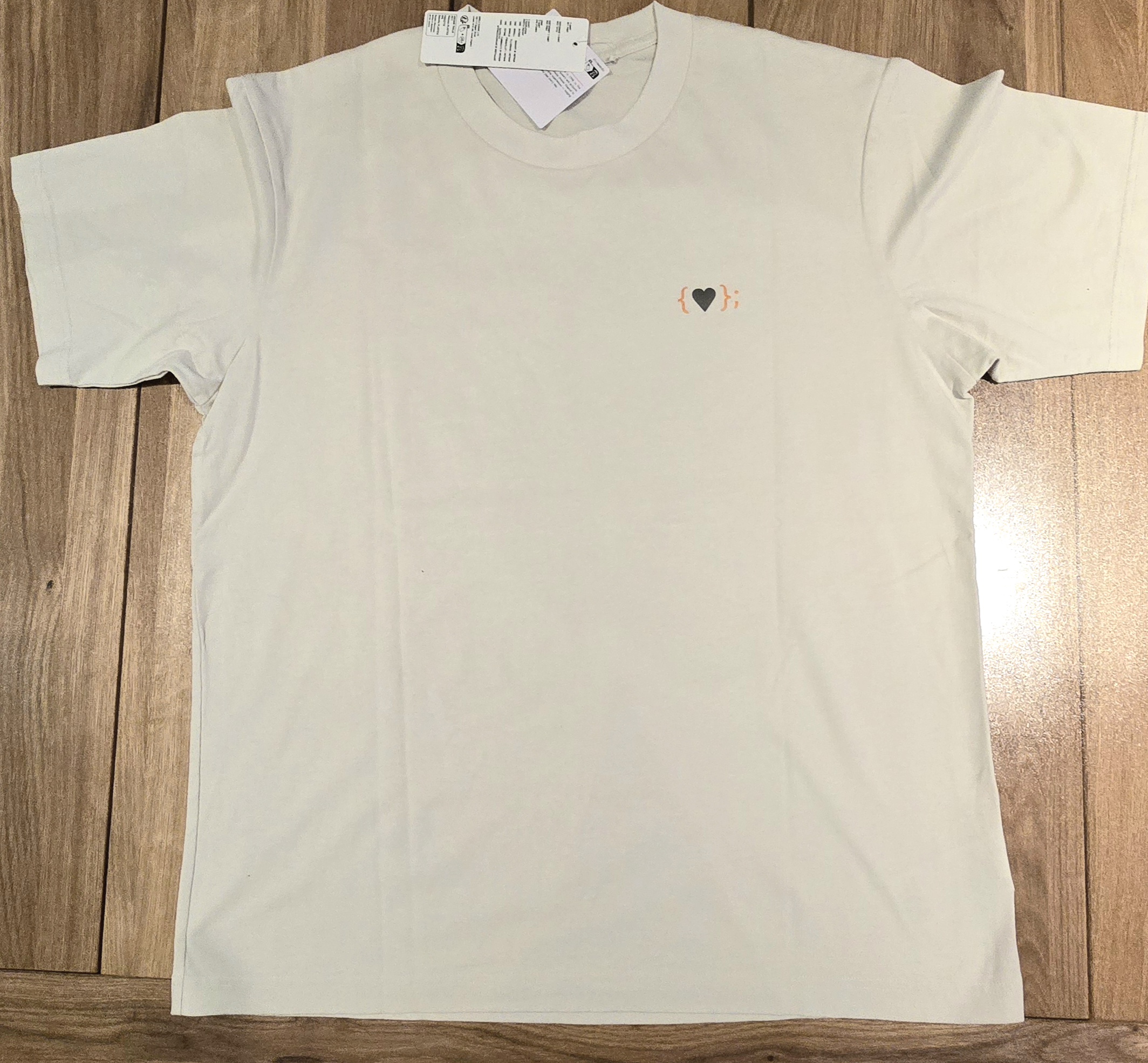
And it’s very cool! The front has a heart in curly braces:
While the back has a big alphanumeric block:
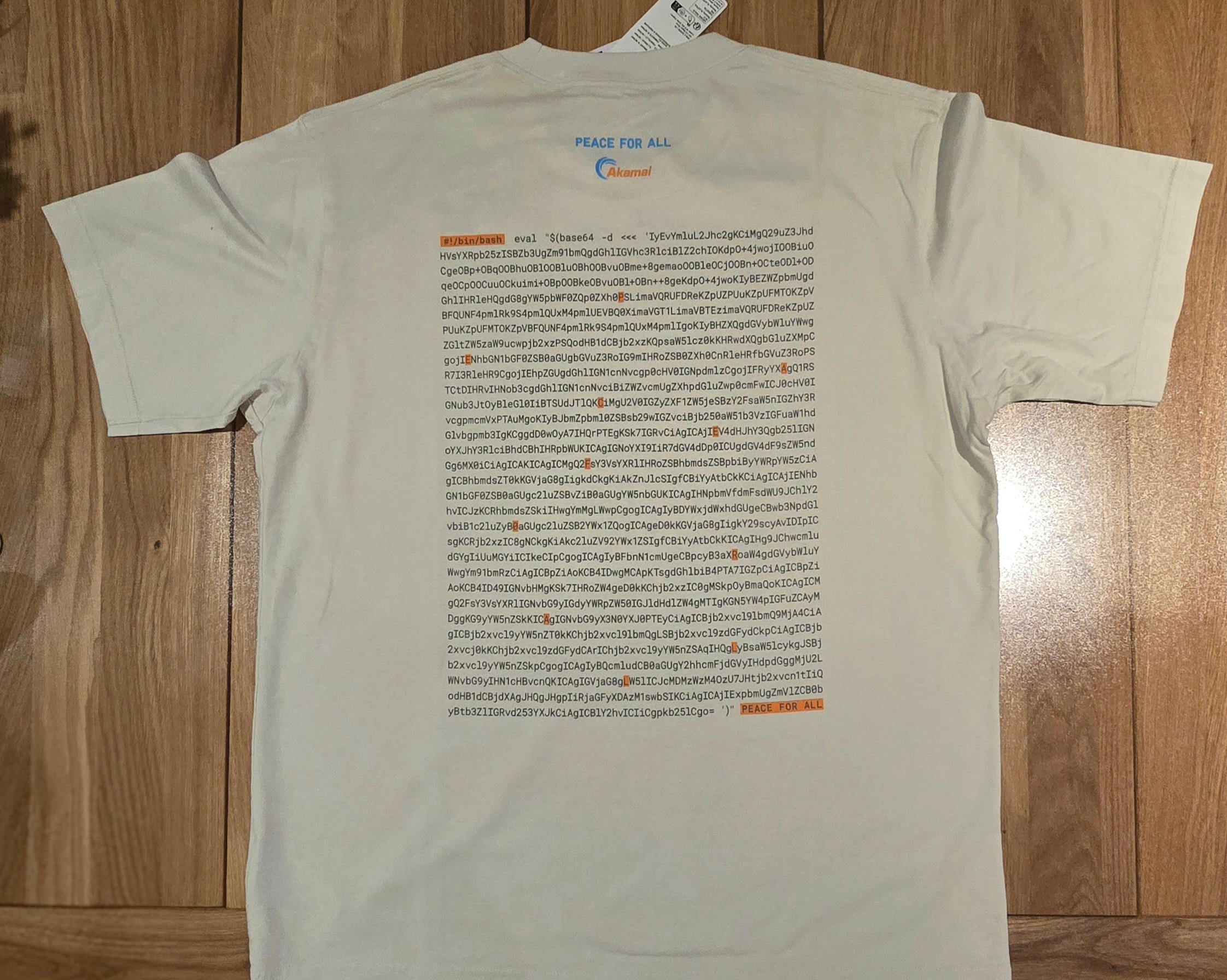
My wife was right that I’d want to see it. Was that… a shebang?
Take a closer look at the text block:
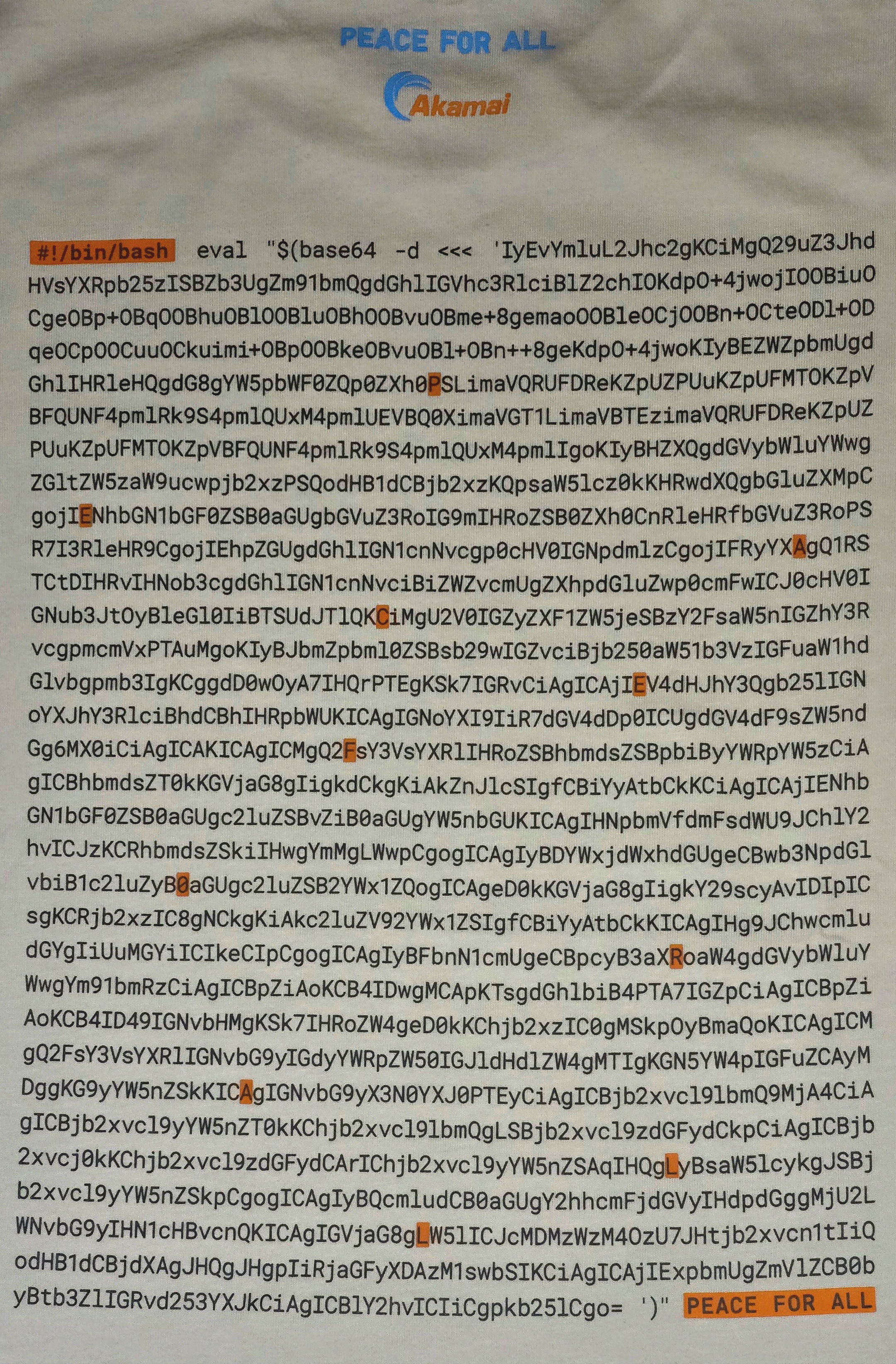
Yes, a shebang! On a t-shirt sold in a high street store, no less. And it is clearly a base64 encoded Here string being fed to eval via base64 --decode.
Interesting. I told my wife "that’s basically how people ship viruses’ and bought it.
There was good news and bad news:
go doStuff(msg, work... which anyone can relate to., a truncated crop from a wider text block which could never compile.I ran OCR in a few ways: First, using the built-in OCR of the circle-to-search feature on Android, which is often very good. Second, by using Tesseract with a few options and tweaks. And third by running it through Claude. After diffing the three to look for mismatches and getting Claude to output a table of locations for quick scanning, it became trivial but time-consuimg to tidy up the remainder. The resulting string was:
IyEvYmluL2Jhc2gKCiMgQ29uZ3JhdHVsYXRpb25zISBZb3UgZm91bmQgdGhlIGVhc3RlciBlZ2chIOKdpO+4jwojIOOBiuOCgeOBp+OBqOOBhuOBlOOBluOBhOOBvuOBme+8gemaoOOBleOCjOOBn+OCteODl+ODqeOCpOOCuuOCkuimi+OBpOOBkeOBvuOBl+OBn++8geKdpO+4jwoKIyBEZWZpbmUgdGhlIHRleHQgdG8gYW5pbWF0ZQp0ZXh0PSLimaVQRUFDReKZpUZPUuKZpUFMTOKZpVBFQUNF4pmlRk9S4pmlQUxM4pmlUEVBQ0XimaVGT1LimaVBTEzimaVQRUFDReKZpUZPUuKZpUFMTOKZpVBFQUNF4pmlRk9S4pmlQUxM4pmlIgoKIyBHZXQgdGVybWluYWwgZGltZW5zaW9ucwpjb2xzPSQodHB1dCBjb2xzKQpsaW5lcz0kKHRwdXQgbGluZXMpCgojIENhbGN1bGF0ZSB0aGUgbGVuZ3RoIG9mIHRoZSB0ZXh0CnRleHRfbGVuZ3RoPSR7I3RleHR9CgojIEhpZGUgdGhlIGN1cnNvcgp0cHV0IGNpdmlzCgojIFRyYXAgQ1RSTCtDIHRvIHNob3cgdGhlIGN1cnNvciBiZWZvcmUgZXhpdGluZwp0cmFwICJ0cHV0IGNub3JtOyBleGl0IiBTSUdJTlQKCiMgU2V0IGZyZXF1ZW5jeSBzY2FsaW5nIGZhY3RvcgpmcmVxPTAuMgoKIyBJbmZpbml0ZSBsb29wIGZvciBjb250aW51b3VzIGFuaW1hdGlvbgpmb3IgKCggdD0wOyA7IHQrPTEgKSk7IGRvCiAgICAjIEV4dHJhY3Qgb25lIGNoYXJhY3RlciBhdCBhIHRpbWUKICAgIGNoYXI9IiR7dGV4dDp0ICUgdGV4dF9sZW5ndGg6MX0iCiAgICAKICAgICMgQ2FsY3VsYXRlIHRoZSBhbmdsZSBpbiByYWRpYW5zCiAgICBhbmdsZT0kKGVjaG8gIigkdCkgKiAkZnJlcSIgfCBiYyAtbCkKCiAgICAjIENhbGN1bGF0ZSB0aGUgc2luZSBvZiB0aGUgYW5nbGUKICAgIHNpbmVfdmFsdWU9JChlY2hvICJzKCRhbmdsZSkiIHwgYmMgLWwpCgogICAgIyBDYWxjdWxhdGUgeCBwb3NpdGlvbiB1c2luZyB0aGUgc2luZSB2YWx1ZQogICAgeD0kKGVjaG8gIigkY29scyAvIDIpICsgKCRjb2xzIC8gNCkgKiAkc2luZV92YWx1ZSIgfCBiYyAtbCkKICAgIHg9JChwcmludGYgIiUuMGYiICIkeCIpCgogICAgIyBFbnN1cmUgeCBpcyB3aXRoaW4gdGVybWluYWwgYm91bmRzCiAgICBpZiAoKCB4IDwgMCApKTsgdGhlbiB4PTA7IGZpCiAgICBpZiAoKCB4ID49IGNvbHMgKSk7IHRoZW4geD0kKChjb2xzIC0gMSkpOyBmaQoKICAgICMgQ2FsY3VsYXRlIGNvbG9yIGdyYWRpZW50IGJldHdlZW4gMTIgKGN5YW4pIGFuZCAyMDggKG9yYW5nZSkKICAgIGNvbG9yX3N0YXJ0PTEyCiAgICBjb2xvcl9lbmQ9MjA4CiAgICBjb2xvcl9yYW5nZT0kKChjb2xvcl9lbmQgLSBjb2xvcl9zdGFydCkpCiAgICBjb2xvcj0kKChjb2xvcl9zdGFydCArIChjb2xvcl9yYW5nZSAqIHQgLyBsaW5lcykgJSBjb2xvcl9yYW5nZSkpCgogICAgIyBQcmludCB0aGUgY2hhcmFjdGVyIHdpdGggMjU2LWNvbG9yIHN1cHBvcnQKICAgIGVjaG8gLW5lICJcMDMzWzM4OzU7JHtjb2xvcn1tIiQodHB1dCBjdXAgJHQgJHgpIiRjaGFyXDAzM1swbSIKCiAgICAjIExpbmUgZmVlZCB0byBtb3ZlIGRvd253YXJkCiAgICBlY2hvICIiCgpkb25lCgo=
After Base64 decoding, the resulting script is a welcoming and nicely commented Easter egg:
#!/bin/bash
# Congratulations! You found the easter egg! ❤️
# おめでとうございます!隠されたサプライズを見つけました!❤️
# Define the text to animate
text="♥PEACE♥FOR♥ALL♥PEACE♥FOR♥ALL♥PEACE♥FOR♥ALL♥PEACE♥FOR♥ALL♥PEACE♥FOR♥ALL♥"
# Get terminal dimensions
cols=$(tput cols)
lines=$(tput lines)
# Calculate the length of the text
text_length=${#text}
# Hide the cursor
tput civis
# Trap CTRL+C to show the cursor before exiting
trap "tput cnorm; exit" SIGINT
# Set frequency scaling factor
freq=0.2
# Infinite loop for continuous animation
for (( t=0; ; t+=1 )); do
# Extract one character at a time
char="${text:t % text_length:1}"
# Calculate the angle in radians
angle=$(echo "($t) * $freq" | bc -l)
# Calculate the sine of the angle
sine_value=$(echo "s($angle)" | bc -l)
# Calculate x position using the sine value
x=$(echo "($cols / 2) + ($cols / 4) * $sine_value" | bc -l)
x=$(printf "%.0f" "$x")
# Ensure x is within terminal bounds
if (( x < 0 )); then x=0; fi
if (( x >= cols )); then x=$((cols - 1)); fi
# Calculate color gradient between 12 (cyan) and 208 (orange)
color_start=12
color_end=208
color_range=$((color_end - color_start))
color=$((color_start + (color_range * t / lines) % color_range))
# Print the character with 256-color support
echo -ne "\033[38;5;${color}m"$(tput cup $t $x)"$char\033[0m"
# Line feed to move downward
echo ""
done
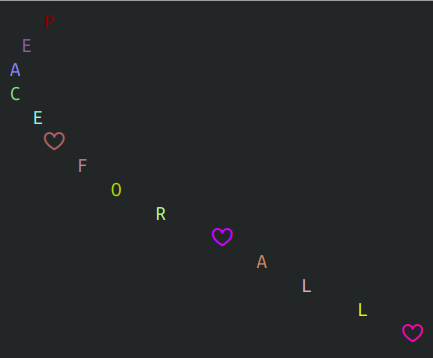
The result is a continuous happy sine-wave loop of the campaign message, Peace for All:
I guess Uniqlo is run through Windows though: one thing that struck me was the font, which I’m almost certain is ConsolasI was fortunate enough to correspond with the designer, Lucas de Groot, once in relation to a legal case in which someone had used one of his fonts to forge a document. He was very helpful and kind enough to confirm the necessary facts in writing, even though he owed nothing to us. , which I’m fond of. Note the very shallowly-slashed 0, the lack of serif on the 1 and the rounded curves of letters like BDyg and number 2. It’s striking because it’s primarily a Windows font, so not the sort of thing I’d expect to see calling Bash.
Akamai put out a press release about the shirt when it was released, which is another sort of interesting due to the blend of tech and marketing:
Design message
More than 25 years ago, Akamai helped make the internet we know today possible. This shirt’s design is a callback to those early days of life online. The light tan color is a reference to the “beige box” plastic casings that housed the early internet computers, and the heart on the front represents how the internet has been used for good all over the world. On the back of the T-shirt is real code. It’s a reference to Linux, the open-source language of the internet. This common language unites Akamai with the world’s top brands and the people they serve, as we work together toward a vision of a safer and more connected world.
I deliberately didn’t search for spoilers at first, but I see that I am of course not the first person to get nerd-sniped by this. Wen Chuan Lee and that post also links to another (against which I’ve cross-checked my transcription above). I’m happy to carry on the chain.