I want to start with the core idea, because everything in this guide comes back to it:
If relocation is the only reason you want a job abroad, do not expect the company to be excited about hiring you.
That sounds harsh, and I know how it lands, because the desire to move is one of the most genuine and personal things a person can carry. I’ve spent years working with engineers who want to relocate, and I understand this drive.
But during an interview, that same desire can quietly work against you, and I want to make sure that does not happen to you.
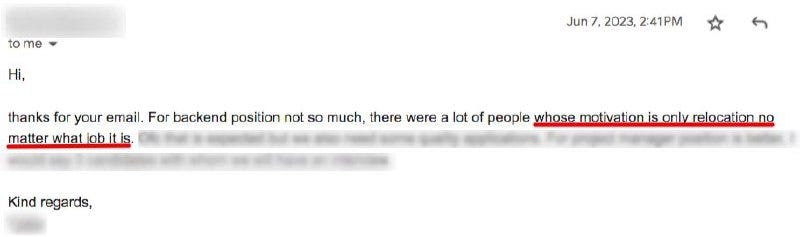
This is the kind of impression you should avoid giving to recruiters!
After working so many years with people who want to relocate, I have watched the same thing happen again and again. Which is...
In interviews, candidates focus so hard on the idea of moving that they forget the person across the table is looking for someone who cares about what the company does, what the team is building, and where the product is going.
It is obvious why this happens, and it is honest. Most people answer relocation questions by talking almost exclusively about wanting to move abroad, seeking a better quality of life, higher salaries paid in a hard currency, and getting away from a difficult situation in their home country. Occasionally, there is the extra detail of a neighbor who claimed a Spanish passport and went to live abroad, while you have no second nationality to fall back on. All of that is true, in the sense that, I get it: it’s a massive motivator. Any recruiter who opened a search from Singapore, from the Netherlands, or from the Basque Country in Spain already knows it and already assumes it. So actually, if you think it this way… your wish to relocate is not a surprise to anyone.
Here is the problem. When that is the whole answer, you create the wrong impression of what you want and of whether you will be a good hire. You give the recruiter three quiet worries:
You sound more interested in someone sponsoring your visa and spending money on you than in the company itself.
If a company solves your paperwork, you might be the kind of person who uses that to settle in and then leaves. That is close to the worst message you can send.
You sound like you would accept almost any offer that gets you out, which means you would also leave for the next slightly better one, or quit the day you decide the new country does not have enough sunny days.
Recruiters buy security. I have said this across my articles, and it stays true. They want to know the hire will perform, will do good work, will stay, and will settle into the company. When you tell a long life story about why you have to leave, two things go wrong at once. First, you sound exactly like the candidate before you and the one after you. Second, you are not telling the buyer what they came to buy.
Think of it as a meeting between a buyer and a seller. You are selling your services, and you cannot sell the buyer something they did not ask for. Your buyer knows precisely what they want. This is the opposite of a cold sales call. They posted a job ad, and your job is to rise to it and answer it. Relocation can be your engine, and it probably is the deepest and most genuine reason you are sitting there, prepared and full of enthusiasm. Keep it. It just cannot be your only visible motivation.
Companies want motivated, engaged people who are genuinely glad to join their team.
So when the conversation turns to motivation, set aside the picture of U-Bahn rides, a quick train to Munich, or a rental car down the Autobahn with no speed limit through the Black Forest. Step onto something more tangible: the work itself.
These are the points worth preparing months before the interview, and I do not exaggerate when I say months. In my recent piece on how to write a cover letter that works, I showed a letter where six months passed between the letter and the interview, and the research in it still paid off. That same research feeds your interview answers.
Here is what to bring instead:
Interest in the product. Research it and look at the latest news. When I wrote the profile of Picnic in the Netherlands, you could feel how much the team cared about their product. Any candidate who pays attention to that walks in with half a foot inside the door, simply because they noticed how much the company loves building what it builds.
Interest in the mission, with explicit lines. Something like “Your mission speaks to me because it ties into sustainability, which I have been working on for years. In fact, here is a hobby project I put on GitHub that cuts the amount of compute required for planning delivery routes for groceries and also helps lower the carbon footprint since it can propose smarter routes.” That single move plugs your engineering skill straight into their mission.
Excitement about the technology and the industry. Look into the ecosystem the company sits in. If it is part of the Amsterdam ecosystem, ask yourself what sets it apart and say so.
Room to grow. You can say you checked LinkedIn and saw people moving toward promotion with an interesting cadence, maybe a horizontal or vertical step roughly every year and a half. This matters to you because you have both the attitude and the aptitude to grow.
The chance to make an impact. You can say your motivation is a platform where you can make a strong impact, something you cannot do today from your home country, and that with this team in this market you know you will. The impact might even reach back to your home country.
Why this company stands out, and how the role fits. You can tell them you understand they opened this role because it matches their long-term ideas, and then show how you match too.
Let’s look at a small screen capture of a cover letter an engineer sent to a company he was applying for. Even if it’s a cover letter and not an interview transcript, the principles apply:

This excerpt shows how a candidate made research about the company and their stack, which the company, in turn, found appealing. Details like this make your message sound memorable. You can use this same approach during interviews.
And yes, you can absolutely make it clear that relocation matters to you. The reverse mistake exists. You would rather not come off as if you wandered into the interview accidentally and had no idea the role was built for someone who needs to move. So acknowledge the recruiter’s narrative and join it honestly. Relocation can be part of the answer. It just should not be the whole answer.
Let me make this concrete with the exact question and two very different replies.
“Why do you want to relocate?”
❌ Weak answer:
Honestly, the salaries in Germany are a huge reason I want to relocate. They’re so much higher than what I can earn here.
Or, alternatively:
I’ve always wanted to live in the Netherlands. The quality of life, work-life balance, and overall stability are very appealing to me, and I'd love the opportunity to build my future there.
Well, both answers miss the point.
Look at the first one. It tells the recruiter that salary is your primary motivation. There’s nothing wrong with wanting to earn more. We all work for money. But if compensation is the main reason you’re applying, how is a recruiter supposed to feel confident that you’ll stay instead of leaving as soon as another company offers you an extra €2,000 a year?
The second answer sounds much better, but it has a different problem. It tells the recruiter why you like the country, not why you want this job. You could give the exact same answer to a hundred different employers. Nothing about it explains why you’re excited about the company, the team, or the work itself.
✅ Strong answer:
For the strong answer, I’ll use a real company:
Relocating has been a goal of mine for a long time, and the Netherlands is a market I've been interested in. But working at Picnic is my main motivation for speaking with you today.
I’ve spent time learning about what you're building, and what really stands out to me is that you’re solving real-world problems by making grocery shopping more efficient and sustainable. And you’re doing it at scale, which means you’re making a difference in millions of people's everyday lives.
I enjoy working on products where engineering directly shapes the customer experience, and that’s exactly what I see at Picnic. I want to contribute to a product people use every day and help solve problems that matter.
Look at what that answer does. It acknowledges that you want to relocate, but it quickly shifts the focus to why you want to do it with this company. It shows that you’ve taken the time to understand what they’re building and why it excites you.
Instead of remembering you as someone who wants to leave their country, the recruiter will remember you as someone excited about the opportunity at their company.
Now that you have those two real examples, a favor. Please do not copy what I just said and read it aloud in the interview! Prepare your own version, seriously. I am terrified that you will read it out loud and the next candidate who found this same resource will read it too, and you will both get sent to the “Unfortunately,” email listing. Use it as a frame for your thinking, because what I am really doing here is showing you a common, almost subconscious trap and how to step around it.
Everything below lines up with what I keep saying across The Global Move:
Research the company before the interview. Finding a job that relocates you is not easy, but if you know where to look, you can find one. Treat that hard-won first conversation with respect.
Prepare two or three company-specific reasons you want to join. Tie them to the product, to the company’s direction, and to the HR marketing content they publish. Many companies pour real effort into content meant to attract candidates, and you can use it in your favor.
Use fresh material. Do not lean on old content, because a company’s direction changes.
Mention relocation, and stop there. It is a key, genuine part of your motivation, and there is real romance in the beautiful, passionate reasons that make us move abroad. Just keep it as one note in the answer and put most of your energy into your enthusiasm for the work itself.
Also, look after a more diverse scope than one city. Some companies run relocation programs in more than one country. Catawiki, for example, is based in the Netherlands and recently opened a relocation path to Portugal, the same route Peter took when he moved from Nigeria. If you fixate on a single country and there is no opening there, you close the door on yourself.
All of this reinforces something I keep coming back to. There are no shortcuts in 2026 for landing a job with relocation. I would love to tell you otherwise, and I do not see it getting easier soon. But I do see the opportunities, I see people who get there, and I see people who prepare for months and make it worth it. So if you have to stand out, let this help you stand out.
And do not let a first rejection knock you down. Just do not treat that first interview as a throwaway learning experience, either. It is a learning experience you have to be extremely well prepared for, because that first conversation is so hard to get. In a previous entry, I shared the numbers from PostHog: around nine hundred applications for a single role, with only a small fraction, 55 out of 900, reaching the later interview stages. Do not waste the chance.
I cover the broader picture in my pieces on how the tech job search with relocation looks in 2026 and how to prepare months before you apply, and the LinkedIn groundwork that gets your name known before you ever submit a resume. Keep an eye on the jobs and be very deliberate before you send out applications. The spray and pray system will not work, so don’t take up your time with it!
Thanks so much for reading, and I hope this helps you. I would love to hear in the comments if you have been in a similar spot and found something that worked.
I publish relocation-friendly tech roles every week at The Global Move. If you are getting ready for your move, subscribe and start building your runway now.
No posts