Kudos for this. Per the docs: https://docs.chatto.run/,
> Chatto ships in a compact, self-contained binary
> it uses NATS, a compact message broker that also ships with a built-in stream persistence engine [...] NATS is just as easy to provision as Chatto, and most of our examples will show you how.
> you can also configure an external S3-compatible object storage for Chatto to store your files in, and we strongly recommend doing so...
> The actual calls are powered by LiveKit (Apache-2.0), which you need to deploy alongside Chatto. As with NATS, the deployment examples show the required wiring.
> ...
And kudos for backing it up with real guidance. Great project.
I mean, people have been asking for alternatives lately, so it's not like there isn't a market for it. There are even entire communities[0] for discovering them.
But considering there are already several dozen alternatives: what makes this one special? What sets it apart from Gamevox, Cinny, Element, Schildi, Echon, Neremity, Fluxer, Faction, Stoat, Guilded, Root, Loqa, Venta, Osmium, and so on and so on? Heck, a handful of vibecoded new ones spring up every week!
If you're going to release Yet Another Clone, you have to make it immediately obvious 1) how it compares feature-wise, and 2) what unique thing makes yours special enough to overcome the extremely powerful network effects of the incumbents. Reading this page Chatto looks neat I guess, but there's nothing convincing me to invest several hours into discovering whether this is truly a Discord killer, or Yet Another Clone. Same with the official website and docs: some techy mumbo-jumbo, but that's about it.
No matter how impressive it is technically and no matter how free and open it may be, without significantly better marketing material it'll have a chance at becoming relevant.
Love that the way you said the rhymes part 'rhymes with “knack”, or the one that rhymes with “beams”, or the one that rhymes with “this gourd”'.
Slack integrations are overrated. Just give me webhooks.
You can choose to switch your company away, maybe, but what do you do when vendors want to connect over Slack?
Imagine if email was owned by a company?
Edit:
W̶e̶ ̶r̶e̶a̶l̶l̶y̶ ̶n̶e̶e̶d̶ ̶a̶n̶ ̶o̶p̶e̶n̶ ̶p̶r̶o̶t̶o̶c̶o̶l̶ ̶t̶o̶ ̶b̶u̶i̶l̶d̶ ̶o̶n̶.̶
We really need an open protocol to win here.
With chat control that may not be so great…
Why not keep it all AGPL?
I do also still like irc, but haven't used it much in recent years because most of the people I talk to are using discord now.
Here's to more boring software! :)
I’d bet making a slack-compatible client or bridge isn’t hard, we all just instinctively know whoever develops it is going to get sued or taken down.
It feels like we quietly gave up on adversarial interoperability awhile ago, and act like we need a whole separate “open walled garden” when what we actually need are legal protections that prevent companies from suing/banning people who call their APIs. Slack, Facebook, etc, all only exist because they can ban/sue people who compete with their client experience.
I figure that will probably never happen in the US (maybe if someone rich starts it), but eventually someone outside of it will make such an adversarial integration and host it from some region that doesn’t care about US laws. Then, when they get away with it, we’ll all praise them as a genius and wonder how Slack could exist at all. The US has many international agreements keeping this illusion alive, but my guess is that even formerly stable markets like Europe could spawn such work if they decide to stop caring about ~1990s-2010s era contempt-of-business-model US laws.
There are things that Slack cannot easily offer.
Or, perhaps the asynch chat thing is a distraction and we need something asynchronous that's well proven. Like... email?
Slack should never have been a thing IMHO. I remember first using it at a startup I was CTO of at the behest of the CEO ("everyone is using it"), back in around 2013. Instantly hated it. Just wish we could go back to good old email, TBH.
This Chatto thing unfortunately uses a Protobuf custom API and is explicitly anti-compatibility with other systems. The lack of interoperability may end up killing it, unless the experience is much better than everything else.
> Chatto is just like those.
from TFA. Seems yes.
A frontend, permitting customizability, white-labeling, and so on, makes more sense to be more permissive.
Grafana is a solid example to illustrate why.
Moved from Apache to AGPLv3 in 2021 specifically so cloud providers couldn't host modified versions without contributing back, while keeping plugins Apache-licensed.
https://github.com/orgs/chattocorp/projects/1?pane=issue&ite...
(They do have end-to-end encryption for video.)
Wait, what? There are open-source chat apps that you have to pay to host yourself? How does that work? Or did I misunderstand?
How does this compare to fluxer.gg though?
The part that I really liked about chatto is that it seems to be made very easily to self host which is something that I really appreciate actually.
I also maintain a Chatto bot framework and a Tauri client, need to update those now :)
So not like Discord or Slack?
> This is what it looks like:
Discord and Slack?
I mean, OK, it has EU hosting and that is good. But I see nothing obvious here that solves the noise and irritation of Discord and Slack.
Hot damn. This is the big one.
I’m happy to announce that Chatto, the group and team chat application that I’ve been working on for the past year or so, is now officially Open Source, and available for anyone to self-host.
The fastest way to give it a try is through Homebrew:
brew install chattocorp/tap/chatto
chatto init
chatto run
See Chatto’s Getting Started Guide for details. Or stick around to hear more!
Chatto aims to be the group chat application that you actually enjoy using. You’re probably familiar with the one that rhymes with “knack”, or the one that rhymes with “beams”, or the one that rhymes with “this gourd”.
Chatto is just like those. Except you’re going to love how compact and snappy it is. And that it’s Open Source. And you can just self-host it. For free, too! (A weird thing to write, but the OSS chat app space has become very weird in many ways!)
This is what it looks like:
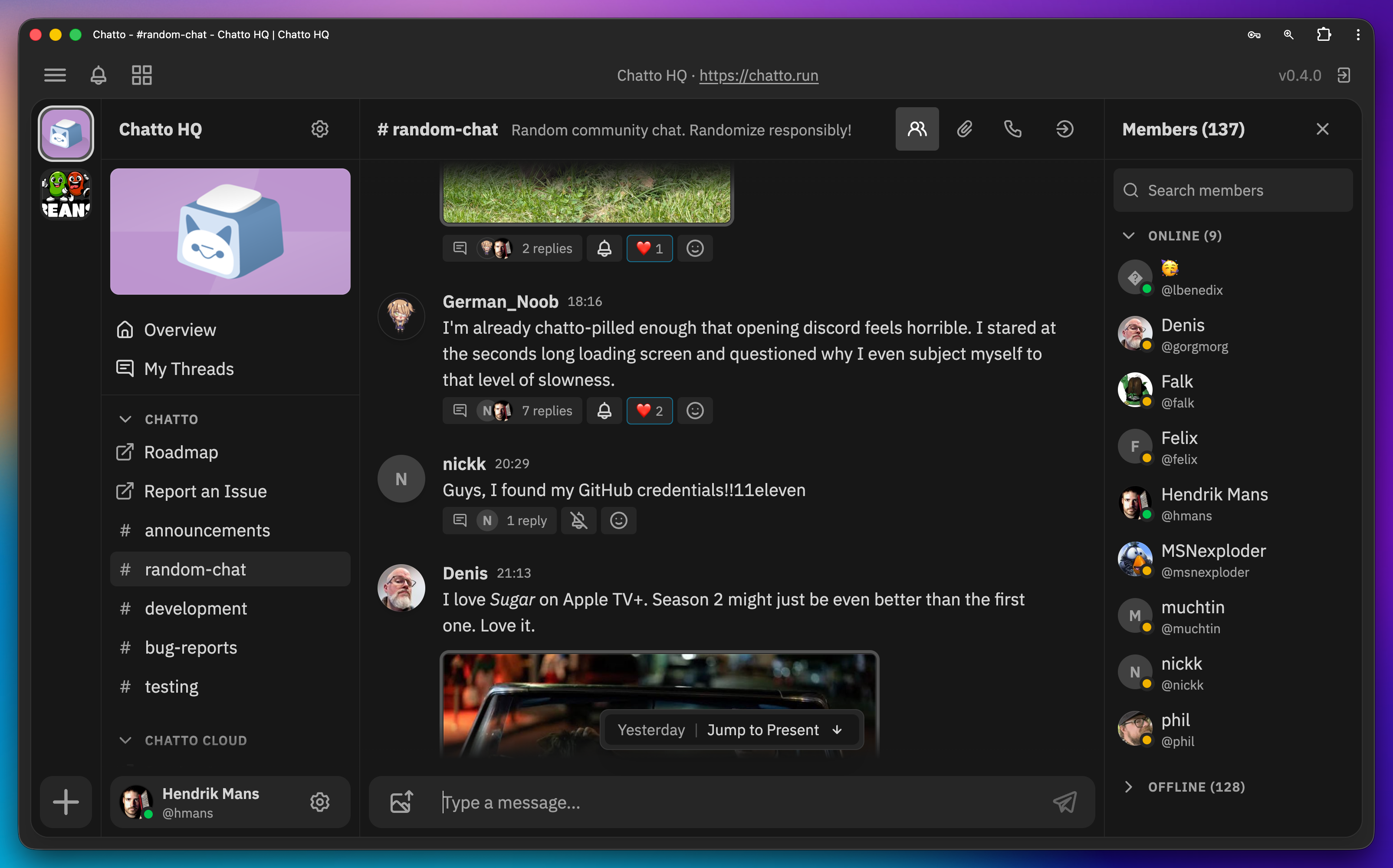
If you want to see it in action, drop by the Chatto HQ Community!
It’s designed to be extremely easy to self-host on your own infrastructure. In its most basic shape, you just run the executable, and that’s it. It even serves its own frontend!
It’s very light on resources, and probably has the snappiest frontend that you’ve ever used in an app like this. It puts data protection and privacy first, with all personal and chat data fully encrypted at rest with per-user keys that get shredded when a user decides to delete their account.
Each Chatto server powers a single community, with no federation of data between servers, nor any third-party tracking or analytics. If you want to hang out in multiple servers at once, the client will simply connect to all of them directly. If you want to host multiple communities, just spin up multiple Chatto processes. Easy!
Chatto comes with full support for voice and video calls, with screen-sharing, built in. Calls are fully end-to-end encrypted and will scale to as many participants as your infrastructure can handle.
And you can use it today, for free, by self-hosting it on your own server. Binaries are available for Linux (x86_64 and ARM64), macOS, and Windows; head over to the Chatto Self-Hosting Documentation site to get started.

If you prefer someone else to take care of the hosting, I’m also happy to announce that Chatto Cloud will soon enter public beta. Chatto Cloud’s offering is very simple: it provides paid hosting for Chatto servers — and that’s it. No premium subscriptions, no ads, no icky bits. Just hosting.
And it’s really good hosting! Chatto Cloud is launching with fully European and European-owned infrastructure, with more regions slated for launch in early 2027. Every Chatto server on Chatto Cloud benefits from automatic scaling, nightly backups of all data, and zero-downtime version upgrades.
There’s no lock-in; servers hosted through Chatto Cloud are 100% compatible with self-hosted ones, and you can pack up your data and move into or out of Chatto Cloud at any time.
If you want to get notified about the start of the beta, please see the end of this post for a low-volume newsletter you can subscribe to.
Chatto is now at version 0.4. I consider it stable enough for production use, but there are a few important features still missing — head over to the Chatto Roadmap if you want an overview.
The focus for Chatto 0.5 will be on additional safety features (content reporting and moderation) as well as polishing the client, particularly its multi-server functionality. I have some fun stuff planned for this that I can’t wait to put into people’s hands.
I expect Chatto to hit 1.0.0 in about 6-12 months. Until then, there may still be breaking changes, even though I’ll be trying to keep them to a minimum. If you do decide to self-host, please be ready to update to new versions as they are released.
It’s been an exciting journey so far and I’m looking forward to finding out what’s ahead. If you’re self-hosting Chatto, I’m super eager to hear from you about your experience — please don’t hesitate to head over to the Chatto HQ community and get in touch.
Also please feel free to drop by and say hello if you’re interested in Chatto for your company, Open Source project, or similar. I’d love to learn more about your requirements, and help you get set up.
#self-hosting support channel!If you want to be notified about new releases or the start of Chatto Cloud’s beta, you’re invited to subscribe to the Chatto announcements newsletter. It’s super low-volume (~1 email per month), and is only used for notifying you when exciting new stuff becomes available.
For portuguese/spanish, there is always a high chance of being a slang that is NSFW
[1]: https://fluxer.app/blog/mobile-clients-and-fluxer-v2
IIRC if you build it yourself it's pretty much all AGPL, with few limitations.
All these systems end up with far too much furniture on screen, and this appears no exception.
I will test it, of course. But the promotional material argues against itself.