Very cool.
The paper PDF: https://bpb-us-w2.wpmucdn.com/sites.brown.edu/dist/0/196/fil...
> In the relativistic regime, an electron’s spin — the magnetic moment that points either up or down — and the electron’s orbit are no longer independent of each other, a state known as spin-orbit coupling.
Interesting stuff. I've never heard of sigma or pi bonds.
For instance, we know that gold gets its color from relativistic effects.
“This idea that relativity is important in heavy elements has been around since the 1970s,” said Lai-Sheng Wang, a professor of chemistry at Brown and the study’s corresponding author. “But we show direct spectroscopic evidence that what we learned in high school about chemical bonding isn’t true in heavy elements."If I would have stuck with it, would things have improved?
Of course, they could still do a much better job useful providing pointers into this knowledge, instead of just handwaving over it and insisting on rote memorization.
The curious always wanted to know why some magic coefficient was there. Where did it come from? How is it measured / calculated? How to derive the magic coefficient?
Eventually you learn that it’s turtles all the down. You can pick apart the magic coefficient and dive into the nuanced physics that its derived from…but then you still end up with a new magic coefficient.
So eventually, the curious students learn that the mysteries are out there for when you want to go out and explore them. But otherwise, we pick our level of abstraction for the problem we’re currently working on and accept the magic coefficients that apply to that level of abstraction.
The real trick is knowing the conditional boundaries when those magic coefficients no longed apply and you either need different ones or “here be dragons”.
My guess to the Fermi paradox is that there actually are intelligent life across the universe but just like in Star Trek they stay quiet until we reach a certain level of knowledge.
Meanwhile, Galilean relativity has long gone out of patent, and people on board planes and other vehicles just move around like they were in a stationary reference frame paying no royalties.
Also, the foundational axioms of logic themselves could be valid only at a scale that is familiar to humans. For example, the strict bounday between true and false might get blurred and things could be true and false at the same time at other scale.
You start with the Schrödinger equation, add relativity to get the Klein-Gordon equation which is a mess because it's second order in time involving negative probabilities, if you in ways "take the square root" of it you get the Dirac equation.
Relativity has been part of the understanding of electrons since 1928.
I also had an amazing physics professor who was able to tie literally everything we learned back to real practical and observable events. There is an art to teaching these subjects. This is all undergrad level though, and it wasn’t my major.
I hated these sorts off classes, where if you had your notes with you, you'd ace the exam and be able to explain everything. Passing or failing depended not on understanding, but simply whether you cram all the specifics and covered edge cases all into your head at once, given the rest of your present courseload preventing you from actually digging in to the best you could. Wrong answers didn't come from not knowing how to solve something, but not remembering exactly how to solve something.
So yes very much so relativistic effects are a foundational part of QM.
Being true and false at the same time is a contradiction. But yeah, there is such a thing as mathematical intuitionism that rejects the law of excluded middle (which is not "being true and false at the same time"). It's just one philosophical stance among others though.
The axioms of a logic that are consistent will definitely not let a statement be true and false at the same time.
Do we have this?
Also, this is where Rutherford's "all science is either physics or stamp collecting" holds a lot of water. As you move up the science layers, the laws themselves become less mathematically rigid until by the time you get to the social sciences, explanations are all hand-waving, and all "laws" are statistical at best and empirical.
A general theory of everything might describe all of it from first principles, without magic coefficients. But likely computing it would take a decade with current methods.
* David Griffiths - Introduction to Elementary Particles
* Chris Quigg - Gauge Theories of the Strong, Weak, and Electromagnetic Interactions
And the wonderful Richard Behiel's videos on YouTube https://www.youtube.com/watch?v=8Iu74b5iCuQ
Physics, whether at atomic level, or on a much larger scale, is simple enough that reductionism usually works and you can calculate behavior from first principles using a few memorized "laws"
Biology is well past the point of complexity where you can do this most of the time, unless perhaps you are at the level of aspects of cellular behavior that can be analyzed in terms of chemistry.
Chemistry is in-between physics and biology in terms of complexity. In simple cases chemistry can be explained in terms of physics, but as AlphaFold has shown when you get to a certain level of complexity (in this case protein folding) empiricism takes over and you need to perform experiments and memorize results.
I think modern science and philosophy has a reasonable understanding of what life is, even if you disagree. This is certainly more a matter of philosophy than science, but it seems the best definition of life is based on the ability of a system to actively maintain a boundary between itself and the external world, thereby combating the 2nd "law" (statistical tendency) of thermodynamics. Maybe an interesting/useful definition (which is somewhat arbitrary) also needs to involve something like consuming energy/resources from the environment.
Re "observed all the time": when gold interacts with light, the light's normally of a strength that's a small perturbation on the fields internal to the atom, which is basically why you can treat the atom/light-field system as two weakly coupled quantum systems. It's an "observation" when the light leaves a classical trace such as a current in a CCD.
(I don't expect this to leave you unmystified about QM, but hopefully a bit clearer about it.)
Edit: and less universal. Physics underlies biology, chemistry, nuclear tech & more. Biology (so far) only applies to carbon-based life as we know it on Earth.
The idea is that it has not a clearly definite position, but it has a distribution of probability to find it that looks like a "cloud" https://en.wikipedia.org/wiki/Atomic_orbital
In a more abstract sense, has not a clearly definite speed, but it has a distribution of probability to find it in a speed graphic.
The distribution of position and speed are defined by an equation and you must add a relativistic correction to the classic version. For lighter atoms you can just ignore the correction. For heavy atom (like Bismuth in this case) the correction is important.
Informally, the correction is important only when the "average" speed is fast enough to be somewhat close to the speed of light, like 50%c.
The correction changes the energy of the expected distribution of position and speed, and the energy. When an electron jumps from an orbital to another orbital, the difference of energies is related to the color.
> Are all atoms on a piece of gold being “observed” in the quantum sense??
[Ignoring that "observer" is a very misleading word and causes a lot of confusion, but it's the standard one and we are stick with it...]
The observation is only of the energy level of the orbital electron. We know the energy, but we don't know the position or the speed. When you observe some quantum object you don't get magically all the properties, only one of them, in this case the energy. In other experiments you can get only the position, in others only the speed. [And there are a lot of weird cases and technical details.]
This is just a data problem though. From the perspective of a deterministic universe, creative works theoretically can be explained as a physics outcome (ignoring the impact of potential quantum randomness).
Similar to how Earth's tectonic plates are floating on liquid magma, while appearing to be fully solid and fixed at the surface.
You stopped reading after the 1800's? Schrödinger told us life is what feeds on negative entropy and that is pretty good.
Practical attempts use a lot of heuristics and approximations, which risks fidelity.
And this is for a very cold isolated molecule like in this experiment. If you have many moving molecules surrounded by a lot of water molecules at a usual room temperature, it gets much much much worse.
* Because God said so
* Find out yourself and get a nobel prize
Either way, even if you don't know what the answers are, you can still do serious work at a higher level of abstraction.
Yes, this is key in my mind. It's not really that the laws and definitions become less strict of themselves, it's that the subjects under study become less uniform. It's fine to study a few atoms in isolation and describe their features, but if you put a lot of them together they'd better be in a uniform lattice or your calculations will take more than a lifetime to complete. If you want to describe the interaction in a drop of water, you don't use the Standard Model to integrate over 3e22 baryon fields.
Yes, physics underlies all other fields. But fundamental physics is also completely untractable to solve problems in those other fields, even if Heisenberg would allow it.
so there is no way to extrapolate/interpolate, anything which was not directly measured is basically unknown since it could be yet another exception
or in programming language, the worse spaghetti code you could imagine, full of feature flags randomly enabled inconsistently
In other words, physics can explain Shakespeare's plays when you hand-wave away the biggest reason it cannot.
> theoretically
... meaning not in reality, but in an abstraction of reality that conveniently leaves out the hard part.
> This is just a data problem though.
The word "just" makes it sound like that data problem is a minor inconvenience, and not a fundamental obstacle.
Becoming a billionaire is simple, after all it's just a money problem.
I mean, you're right in that (leaving out quantum randomness), you could predict macroscopic outcomes based on a physics simulation that includes all elementary particles explicitly, if you assume that such a simulation can be scaled from <10 particles to macroscopic numbers. But there is no evidence that this assumption is true, so it remains an interesting thought experiment that gets confused with reality because people like to slap the "in theory" label on it.
Dark matter is a great example.
Our understanding of gravitation didn't cleanly apply at ultra-large scales so we had to add a massive fudge factor.
You can't "go faster" than the speed of light, but space in between things can expand faster than the speed of light.
It seems like things that are "settled" regularly get an "ope, but except for this special case..." treatment.
I’m not a physicist, so I’ll let them pipe up on how much is in and out of the descriptive line, and how much is in and out of the theoretical explanation line. But I don’t know many physicists who think we’re close to “done” with either endeavor.
“A” is described as being derived from the collision frequency of molecules in that specific reaction but really it’s just an arbitrary magic number you look up in a book for the specific reaction that you’re working with. It’s often relatively temperature invariant across some range of temperatures but go outside that range and it becomes a function of temperature too.
Pulling up the wikipedia for “Collision theory” will show you that there has been some work to derive values of A rather than just find them all experimentally for every reaction. But it’s still very unsatisfying to the curious mind.
“k” is the thermal conductivity of a particular material. Curious minds might wonder what’s hidden behind this constant. How would someone predict “k” for a novel theoretical material? Like, say, tetrahedrane?
It’s been awhile, otherwise I’d walk you through a graph containing a couple hierarchical nodes where one constant leads to another equation. But it’s a bit too late to pour through Perry’s Handbook right now to jog my memory.
Math isn't attempting to describe a physical universe. It provides the substrate upon which such a description can be expressed and validated - found to be consistent with itself - but many valid descriptions do not describe our universe. Physics is the empirical search for the correct mathematical description of our universe.
PROVIDENCE, R.I. [Brown University] — Brown University chemists have provided direct evidence that upends the textbook explanation of how triple chemical bonds work in heavy elements.
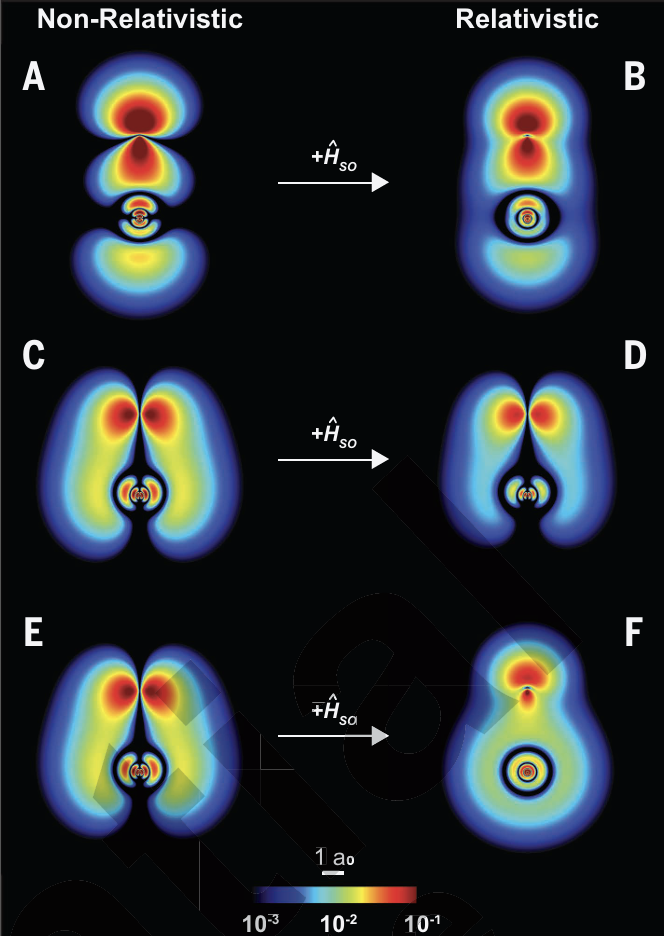
In a study published in Science, the researchers show evidence that when atomic nuclei are sufficiently heavy, the principles described in Einstein’s theory of relativity change the structure of triple bonds — blurring the lines between the two separate types of bonds involved in textbook triple bonding. Using a technique called photoelectron spectroscopy, the Brown team showed bonds created by carbon and the heavy element bismuth have the telltale signature of relativistic bonds.
“This idea that relativity is important in heavy elements has been around since the 1970s,” said Lai-Sheng Wang, a professor of chemistry at Brown and the study’s corresponding author. “But we show direct spectroscopic evidence that what we learned in high school about chemical bonding isn’t true in heavy elements.”
Atoms form bonds by sharing electrons — the negatively charged particles that orbit atomic nuclei. Each atom shares one electron to form a bonding pair. The strong negative charge of the electron pair attracts the two positively charged nuclei, holding them together. Some elements share more than one electron pair, forming double or triple bonds.
The textbook picture of triple bonding involves two different types of bonds: one sigma bond and two pi bonds. The sigma bond is a strong, “head-on” bond that occurs along an imaginary horizontal axis between nuclei. The two pi bonds are somewhat weaker, “side-by-side” bonds that wrap around the sigma bond.
That picture works for lighter elements, but toward the bottom of the periodic table, where atomic nuclei get heavier, things get messy. The increased nuclear mass causes orbiting electrons to speed up to a significant fraction of the speed of light, where the rules of Einstein’s theory of relativity are important.
In the relativistic regime, an electron’s spin — the magnetic moment that points either up or down — and the electron’s orbit are no longer independent of each other, a state known as spin-orbit coupling. That coupling changes the rules for how electrons can interact, disrupting the strict separation between sigma and pi bonds.
“The boundary between a sigma bond and a pi bond is now sort of smeared,” Wang said. “We still have three bonds, but we don't really strictly have a sigma or a pi anymore.”
To show evidence for this bonding hybridization, Wang and his team, led by Brown Ph.D. students Deniz Kahraman and Jie Hui, formed molecules made from bismuth and carbon. Bismuth is a heavy element — right next to lead on the periodic table — where relativistic effects should be important. After cooling the molecules to near absolute zero, the team analyzed them using photoelectron spectroscopy. The technique uses a laser to knock individual electrons out of their positions in the molecule. The distance each electron flies tells the researchers how strongly they were bound.
The photoelectron spectrum showed that the carbon-bismuth bonds did not fit the traditional triple-bond picture of one sigma and two pi bonds. Instead, the structure looks more like one pi bond and two hybrid sigma-pi bonds.
Wang says the experimental verification of the relativistic structure may spur a rewriting of chemistry textbooks, especially as heavy elements — bismuth in particular — garner more research interest. Bismuth could be an alternative to toxic lead in next-generation solar cells. It has also drawn interest in research related to quantum materials and quantum computing.
“Maybe this will become the new textbook idea as we are dealing with more and more heavy chemistry of the heavy elements,” Wang said.
The work was funded by the U.S. National Science Foundation (CHE-2403841) and the U.S. Department of Energy (DE-SC0008501).
thats just at the current state of the art...doesnt mean a complete maths cannot...its arguably debatable why physics follow some maths and why the specific constrains
Those other simulators aren't there to tell you the result. Instead people put the result in to find how the simulation behaves in cosmology, and don't care about them in Sims.
Are there any papers where this possibility is explored? What does it mean to have a complete understanding of mathematics?