create an artificial LEO radiation belt on purpose and wipe out 99% of satellites
part of me is oddly rooting for it these days
make Musk a millionaire again
Apart tecnical and scientific reasons (no need to use thousand or million of sats), apart big speculations (suspect is the main reason), many problems can be resolved in others ways.
This strikes me as another hand-waved scifi/fantasy inspired investment, where everyone is so caught up in proving they can achieve this (spoiler: this is obviously possible) that no one has stopped to ask does that achievement lead to a real benefit outside of VC wealth transference?
Even if you ignoring how much drag these must have, and hence how much electrical power you'd need for an ion drive just to keep them up, each spot being a few km across (and only getting light while the satellite is over your horizon) is just not compelling.
Given most people don't have any reason to illuminate several square kilometres at once, for realistic scenarios it will take a lot of satellites before you beat the cheap battery-powered floodlights in my local Aldi or Kaufland, and the batteries in those lasts a lot longer than the 10-15 or so minutes each of the satellites will be over the horizon, and reflectors like these can only supply sunlight close to sunset otherwise the earth blocks the sun from them.
In the list of things which, if you could make them at all useful, would also be relatively easy to redesign as weapons.
X Wing: Wedge’s Gamble (1996) by Michael Stackpole shows the rebel alliance using similar tricks during the battle of Coruscant.
It sounds too coarse-grade in terms of its area to be anything other than disruptive socially and ecologically.
Sporting and cultural events? Not really (extending the hours of sunlight over a city does have marginal value for a major celebratory event I suppose, but there just aren't that many of these).
Farming? Don't plants need night too? Does harvesting need the sun anymore?
But being able to illuminate a war zone with spontaneous sunlight you can switch off at will, that is a weapon, not least because if you are the only one with the power, your opponents will have to act knowing they may not have the cover of night.
It's not as dangerous as allowing Elon Musk to launch so many more satellites that he ends up with de facto control over access to earth orbit, but it's pretty dangerous.
Can everyone just stop with all the LOTR references already why the fuck is this such a thing.
But it is such a shame that it has started to become the brand of dark-side (militaristic/authoritarian) Silicon Valley: Palantir, Anduril, this… Tolkien would be so very sad.
PS: Palantir is at least rather fitting and honest, it’s literally an evil crystal ball (at least the one shown in the movies).
The FCC only approved that the satellite would not interfere with other radio communications, not the ultimate purpose. They said themselves they don't have authority for that.
I think so, but even then it's a heck of a lot of work to make it useful for that.
> Farming? Don't plants need night too? Does harvesting need the sun anymore?
Mostly limited by other things, hence why there's only limited farming in the Sahara, relatively little phytoplankton in the North Atlantic Gyre.
> But being able to illuminate a war zone with spontaneous sunlight you can switch off at will, that is a weapon, not least because if you are the only one with the power, your opponents will have to act knowing they may not have the cover of night.
Even then, nah. Militaries have had night vision for ages. We can make a wall-penetrating radar work as heartbeat/breathing sensor out of kit fairly close to (but not close enough to be a software patch from) a WiFi base station.
There is a fiction I've read years ago that mentioned satellites becoming makeshift weapons by overheating exposed objects (think reactors, gas trucks, oil refineries) by acting as a solar furnace [1] via mirrors.
Not sure/don't recall how it deals with practical issues such as clouds and distance/intensity, but good enough for a story I guess.
Obviously this satellite isn't viable, but all things start small. Large tracts of land could be illuminated.
But of course, I question the logic of redirecting more sunlight, especially such large amounts, onto a world already warming uncontrollably.
Still, it could be useful for the polar caps on Mars?
These seem like unlikely things though.
I'm far more concerned about the people who own/build stuff like this using it as you suggest (or any of the government pets that they own) than I am about "hackers" doin' such things (although, you're entirely right to have that concern as well, because there's obviously those type of folks out there doin' bad things even with the technology we have already).
And as this is optical, won't go through clouds. This is why beamed power discussions often talk about converting to microwaves instead, though that comes with an even bigger spot size on the ground.
It's not going to be full daylight, is it?
I just don't really get it.
And a satellite isn't going to provide "hours" of extra light unless it's a very much higher orbit than current proposals. At 600 km altitude, you're talking 20-30 minutes even with an unbounded number of satellites (and 10-15 minutes when you've only got a few satellites). Same reason as sunset itself happens: Earth just gets in the way.
If this is somehow an actual problem, it is far more solvable with tethered blimps or drones, battery pack in a container on a truck, a spool of wire, and light banks as big as you want. AND that isn't subject to clouds (but would be subject to high winds, which would also be more likely to cancel/postpone the event than clouds).
Meanwhile, they go beyond the already massive disturbance of existing terrestrial lighting and overwhelmingly screw up the biologically critical light signals used by every plant, insect, animal, and human in the zone, and do it at multi-kilometer scale.
Edit: Even if the revenue potential is actually huge, it is no justification. For any intelligent person, the actual sponsorship message will be "Tonight's lighting brought to you by [Insert_Company_From_Which_I_Will_Never_Buy_Anything_Again]
This level of stupidity is beyond evil — the kind of lunacy to make a good argument that humans should not exist.
Edit: and also don't forget that the Sun is not a point source and has an appreciable angular size, further making it impossible to focus it with a reasonably-sized lens or mirror.
What might be more useful is to illuminate just the areas where a human currently needs to see well. It would hypothetically be both more useful - you can concentrate more light in just the areas you need it - and less expensive.
What would be particularly cool about this hypothetical technology is that it could work equally well under foliage and indoors.
50000 60-ft mirrors is about the same area as a single mirror 2.5 miles across. So the area of the mirrors is about the area of a city. You gather as much light as the city itself in regular daytime. If you focused all of that perfectly efficiently onto a city, that city would just look like daytime.
I saw a presentation by one of the founders where he talked about several use cases where the benefit is just phenomenal.
They don't fool me for a second, however. The end goal of this is to build a weapon that can fry people/places on demand (but only the bad guys, of course).
I thought this was interesting because it doesn’t really seem like an applicable top level claim, surely this is referring to a specific furnace, not all solar furnaces?
Then this got me thinking if there is some universal upper bound constraint to these temperatures. E.g. if I recall a telescope can’t make a source object brighter than it actually is, and this just seems like a thermal telescope, so I wonder if that principle applies here or not.
That said, I'm (armchair) confident it'll be good for moonlight-level illumination on a local area at best. They'll need to scale up to thousands / tens of thousands to make any measurable impact - which is their objective by the looks of it, but it'll take a while yet. If this one creates enough backlash, a fleet won't make it. Assuming they get the money and customers to justify a fleet in the first place.
My guess is it's probably easier to make a bunch of greenhouses on the surface? But the scale is so huge that which is best will be affected by technology invented after you start.
In my book, that would have been a "Fortunately," entry.
Then again, assuming there's no dispersion or loss, 50.000 times the sun focused on a 60ft patch will likely have some impact. But that's complete fiction.
Obvs(2) a variant of this service has traditionally been provided for free by drunken teens. They might prove to be better and more thoughtful custodians of investment funds.
Moreover, the Sun's illuminance is about 1kW/m2 around Earth. 10000×60m2 satellite will thetefore intercept 600MW, so that's 260W/m2 on the focussed area. You're not going to burn anything with that.
(For reference, I think all of these are likely to be somewhere between moderately and incredibly bad ideas...)
Heck, I haven’t done the math or anything but I bet even if you did instead use parabolic reflectors that were tuned to focus at the earth’s surface, it would still be very difficult to keep them aimed at a specific point for long enough to achieve significant heating. I wouldn’t be surprised if it’s difficult to achieve an increase in heating that’s close to, say, the heating difference from standing outside at noon as opposed to 5PM. Which then doesn’t do much because you couldn’t effectively use a reflector at noon, anyway. You’d want a lens instead. Or some sort of complicated Newtonian telescope type contraption.
The military application would just be illumination.
It applies, but also in practice the maximum temperature is lower than the theoretical upper bound.
At least, best I can make out over this UI choice: https://imgur.com/gallery/bad-ui-5t0O0SH
(Why, of all the things, would someone use a fire as their example for this? Fire is famously a light source. Also, famously, smoke is a thing that blocks out light from above).
I'm sure that's attainable with a few hundred sats.
Can someone do the math?
This honestly strikes me as an innocent test of one random idea/technology. The whole "conspiracy level" thing (if it were to ever happen at all) would come later on, and most likely from entirely different people usin' the things discovered from experiments like this one in wholly unacceptable ways because they simply have too much power, money, and time, and not nearly enough good sense between their ears.
Sad though that as other folk have pointed out, if the technology were to work as expected, then it could also be used to help mitigate global warming by reflecting a specific amount of sunlight away from Earth, too. The sad part is that's likely not what such experiments will lead to initially. The "bad people" tend to be pretty quick to try to weaponize or monetize (or both) anything they take an interest in.
(Things I'm learning while researching what is now looking like an eight thousand or more word blog post about why a different space thing, data centres, is also not a good investment; my guess is this would be less of a problem if you used mirrors like this to cool the earth by reflecting sunlight away instead of towards).
A giant mirror to create “sunlight on demand” was just approved by the United States Federal Communications Commission (FCC), despite opposition from astronomers and the public, and real safety concerns.
The FCC approved the company Reflect Orbital to test one satellite, named Earendil-1, as a means of reflecting the sun’s rays back to Earth for extra solar energy and wide-area lighting. The light is expected to cover an area about five kilometres wide, and will require repointing every four minutes.
And this is just the start. Reflect Orbital plans to have more than 50,000 satellites in action by 2035, which they claim will be used across agricultural, emergency response and other industrial sectors.
There are many problems with this proposal, including impacts these satellites will have on human health and safety, as well as on astronomy and the low-Earth environment.
Flashes during mirror repointing could disrupt pilots and drivers. The light could also disrupt circadian rhythms of plants, animals and humans. Sensitive detectors in research telescopes, as well as star-tracking cameras on lower altitude satellites, could be overloaded and fried.
The FCC said that the “risks of harm raised on the record regarding Reflect Orbital’s solar reflector are unrelated to the Commission’s role in authorizing use of radiofrequency spectrum.”
Reflect orbital brands itself as, ‘the sunlight company.’ (Reflect Orbital)
Satellite proposals for “emergent space activities” in low-Earth orbit are becoming increasingly outlandish. The proposals have become so weird, in fact, that the FCC recently published a document called “Spectrum Abundance for Weird Space Stuff.”
“Once the province of science fiction,” this document states, “American companies are now upgrading, relocating and servicing satellites; manufacturing pharmaceuticals in space; building private inhabitable spacecraft; and conducting private robotic missions to the surface of the Moon.”
Millions of orbital AI data centres are also planned. Corporations seem to be scrambling to launch anything that might persuade investors throw money at them: space advertising, hotels for billionaires, artificial meteor showers, space burials for cremated remains, solar-powered infrared beams to power data centres and a variety of orbital missiles.
The phrase “weird space stuff” is refreshingly truthful. So, how did we get here?
There are close to 11,000 SpaceX Starlink satellites currently in orbit above our heads. Anyone who wants to launch into low-Earth orbit needs to carefully consider SpaceX operations, or directly co-ordinate with them.
Otherwise they risk collisions, like the near-miss between a Starlink and Chinese satellite in December 2025.
Read more: A new CRASH Clock measures the chance of satellite collisions, and it’s ticking down fast
Even the Artemis I launch in 2022 and Artemis II launch in 2026 had small “cutout” windows in their launch timing to avoid satellites, including those belonging to Starlink.
Co-ordination is good. Forcing it because one corporation has effectively occupied low-Earth orbit is not. Indeed, the 1967 Outer Space Treaty, which was signed by more than 100 countries including the United States, China and Russia, states that, “outer space is not subject to national appropriation by claim of sovereignty, by means of use or occupation.”
Whether SpaceX’s extensive use of Earth orbits violates this principle is now being tested in real time.
In February, SpaceX filed with the FCC for one million more satellites, for “AI data centers.”
One million. That is 40 times as many satellites as have ever been launched — for a single megaconstellation consisting of completely untested technology that may not even work in space.
A SpaceX Falcon 9 rocket with a payload of Starlink internet satellites lifts off from the Cape Canaveral Space Force Station in Cape Canaveral, Fla., in 2023. (AP Photo/John Raoux)
Not only did the FCC accept SpaceX’s filing, but they did so at ludicrous speed. Scientists worldwide then had just 30 days to model the effects with woefully incomplete information on masses, sizes, compositions and orbital distributions.
At the time of writing, four other copycat AI data centre proposals have been filed by rival companies, for tens of thousands of satellites each. And SpaceX just proposed another 100,000 satellites to interface with the million AI data centres that it already asked for.
The U.S. Federal Communications Commission was originally set up to regulate radio broadcasts. But it is now being asked to evaluate many non-radio effects, including orbital safety, which it may not have the required expertise for. It would make sense to move some of this evaluation to the U.S. Office of Space Commerce. However, recent budget cuts make that infeasible.
Consequently, the FCC will soon be asked to judge a daunting range of satellite proposals. They include a cluster of proposals to gather solar energy from space.
One idea is to send solar power down to earth through high energy beams. These could change atmospheric chemistry and kill birds and other wildlife that stray into the beam.
They would also require no-fly zones around receiving stations for airplanes and also satellites on lower altitude orbits (such as the orbits SpaceX just requested for 100,000 more Starlink satellites).
While many of these projects claim to solve environmental problems by creating clean energy or capturing it in space, they function as a form of greenwashing.
The solar energy generated is only clean if you ignore the environmental costs of building, launching, maintaining and burning satellites up in Earth’s atmosphere. The daily operations of all these proposed systems will have huge environmental consequences.
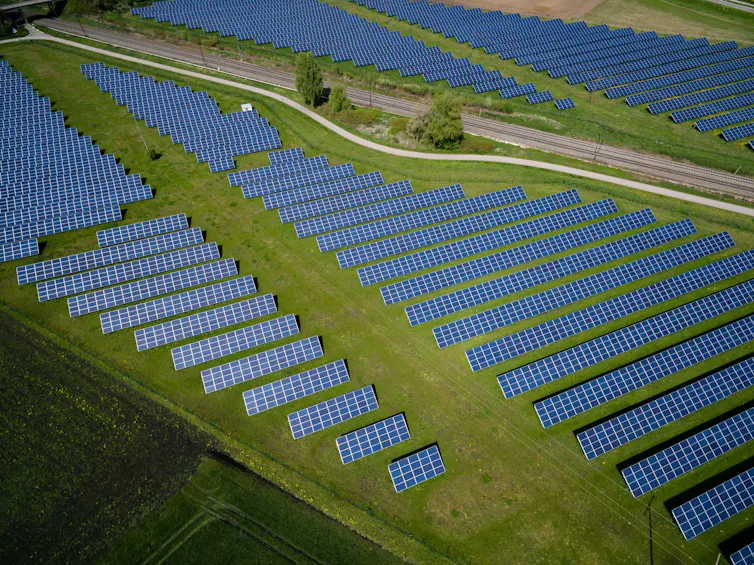
The goal of many ‘weird’ space projects is beaming the sun to Earth at night to power solar farms. (Unsplash/Andreas Gucklhorn)
There are companies that have tested plans for removing space debris from orbit. This is helpful for avoiding Kessler Syndrome — a runaway chain reaction of collisions. But where will the debris go once removed from orbit?
It will fall into Earth’s atmosphere, where it will deposit metal and possibly impact Earth’s surface. It is unclear who is responsible for any resulting damage or deaths.
The majority of satellites in orbit today are American, and the main federal agency regulating satellites is not set up to do that well. We are now seeing the consequences.
While outer space is effectively infinite, low-Earth orbit most definitely is not. Satellites orbit the Earth around once every 90 minutes. This means the collision potential between two objects in orbit is large.
The many satellites and rocket bodies that have burned up in Earth’s atmosphere over the last few years have already measurably altered it. Preliminary studies show that using Earth’s atmosphere as a crematorium for tens of thousands of satellites will have devastating effects on ozone and other atmospheric chemistry.
Astronomy is also under threat from some of the “weirder” ideas like space mirrors, solar sails and diffuse sky brightening from orbital debris.
We are not here to argue against satellites. Indeed, they provide a wide range of beneficial services to science and society. But each satellite comes with a cost that must be taken into account.
Ultimately, this is an innovation challenge. Unfettered growth and exploitation of any environment comes with serious consequences, including to the long-term sustainability of the operations that depend on that environment.
Doing more with less is the engineering challenge that needs to be met if we want to continue to use satellites in orbit.