As an aside, I saw this post mentions a public mesh, but I couldn't find any more information.
Are we talking 1 token per second for a split model? Less?
Edit: Found a number. On the models list, Qwen 235B A22B says "MoE 235B/22B, proven at 16 tok/s across 2 nodes". They don't say what the nodes are and what network connection they have, but that's a respectable speed. Not quite comfortable for interactive use, but pretty close.
Say a distributed inference for image processing, SDR, local weather monitoring etc. These will run on mediocre specs and produce dependable output.
Nicely done OP.
What I envisioned for how it works is fairly similar to this, QUIC can actually be more difficult to detect than it seems since it’s very dynamic.
AI Horde seems to be the biggest of them all. Their API speaks KoboldCPP text completion (not even chat completion). It seems that the community (or at least the active people) strongly prefer it this way because the API exposes more tunables than chat completions, which for roleplay use seems to result in better result. I don't know what else you can use AI Horde for anyway since all other use cases likely will require tool use. Just this week I was set out to improve their OpenAI bridge to support chat templates and response parsing. We'll see if I could get it deployed officially then you might be able to use it to code, although you'll have to use RP models.
I think Horde do have a lot more abuse prevention. Workers needs to have 1 week of cumulative uptime to be considered trusted to prevent brigading - users can opt into trusted workers only. Running a worker give you kudos which is required for >512 max tokens generations and also free requests get bumped to last.
I'd love to see some performance data.
Its sort of a "P2P mesh" :-) Watch four instances of the harness running together and collaborating on checking the weather: https://www.youtube.com/watch?v=h1les1A3gcg
Not necessarily, and I suspect there are plenty of configuration for which this isn't going to be the case. Let me explain why:
- when offloading the weights to RAM or NVMe, you need to transfer the massive weights from your slow storage to the GPU for each layer being processed for each token. And as such you are being bottlenecked by the transfer bandwidth (which is either the men bandwidth of your DRAM or the read speed of your disk)
- when using a distributed setup, the weights stay in the VRAM on each machine, the it's the GPU memory bandwidth that matters for the weights, and it's much higher than the two other bandwidth discussed above and as such the bottleneck isn't here. You need to tranfert data from a group of layers sitting on one device to the next one another device, but the amount of data is much smaller than the weights (we're talking about kilobytes of data, not gigabytes) so the network throughput isn't a limiting factor.
The limiting factor is the network latency: if you split your model between 4 devices, you'll have 3 times the network latency per token. If you're on a network with 1ms latency, that means 3ms of latency per token. Which means the theoretical upper bound for your inference speed without speculative decoding is 30tps (this theoretical limit assumes the computation itself is instantaneous).
So this is unlikely to be practical over the internet (too high of a latency) but on a local/enterprise network with speculative decoding it could totally work.
Edit: note that all of the above is about token generation, for prefill/prompt-processing the distributed setup will almost certainly win (because in this case, the network latency doesn't add up)
The idea is that you could take several machines without dedicated RDMA or NVLINK fabric and use them to serve a large model on hardware you own then share it with others.
I’m currently working on GLM 5.2 on my lab environment with around 10 tok/s on the same split.
A few questions:
1.) How does this handle privacy? If you're distributing compute this way then all actors in the compute graph will also know the sequence being computed.
2.) Any safeguards against malicious actors poisoning model activations?
And I can't overstate how easy it was. The swarm page thing had a little "join" button and said to run "mesh-llm --auto". And I did. And it worked first try. That is such an uncommon experience I had to report back. It handled picking a model to serve, downloading it from peers, and to test it I chatted with the model I was hosting, I could see the GPU doing work, etc.
It might be more of an endorsement for iroh than mesh-llm, although I'm sure getting it to all work seamlessly took work on both sides. But to whoever spent the time and energy trying to make it seamless, consider the effort recognized!
It can be great on a local network though, especially if your workload is prefill-heavy (more text input to process than output tokens to emit).
33 tps max token generation speed would be for 10ms of network latency in the above example.
If so I can see it all dividing nicely, computation and data size wise and the only slowdown would be in search layer waiting for it's turn. If you pipelined it you could run multiple queries.
Is anyone doing best-of-n with a n stage pipeline running each query offset by one?
P.s. for #2, you can probably do something like RAFT-styled interleaved computation. But this could get tricky unless you commit to a sharding scheme that makes it easier.
We use a customized Q2 quantization that preserves sensitive tensors at Q8.
To reduce compute time per layer, we are developing a custom GLM DSA Metal graph.
While we are not yet approaching MTP, we plan to port our existing MTP implementations from versions 4.7 and 5.1 to 5.2.
Since GLM's MTP acceptance rate is very high for a single predicted token, we are exploring token prediction techniques to widen the predicted tokens and utilize parallelism for verification.

When people picture running a large language model, they picture a data center. Racks of GPUs that belong to someone else, a metered API, and a bill that grows every month you succeed. You send your prompts off to a black box and hope the price, the model, and the privacy policy all stay the way they were when you signed up.
For a lot of teams that is a bad trade. You give up control over when models change, where your data goes, and what hardware runs your workloads. And as usage grows, so does the bill, with no lever to pull except "pay more."
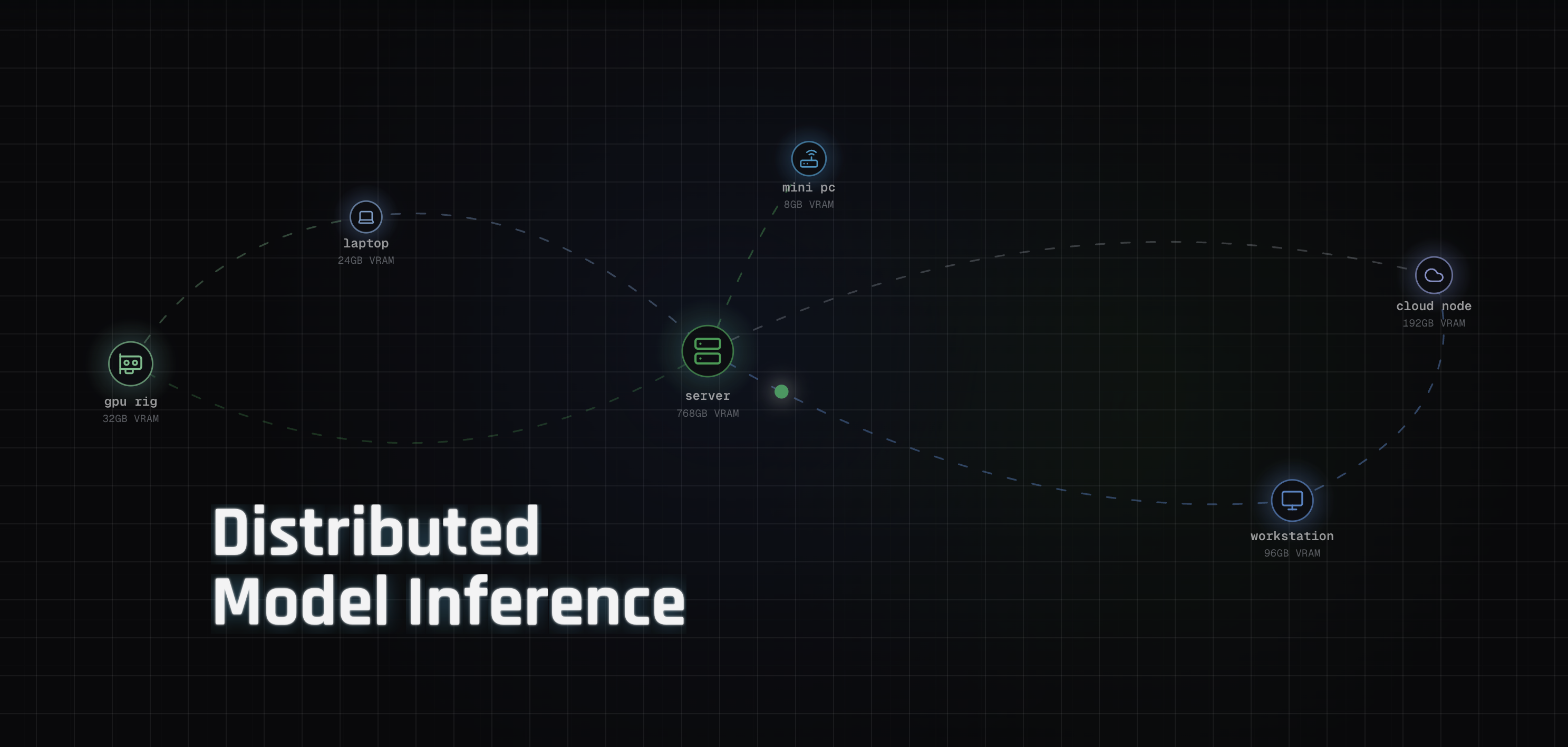
Mesh LLM is a different shape. It pools the GPUs and memory you already have, across as many machines as you want to add, and exposes the whole thing as one OpenAI-compatible API. Start one node. Add more later. Let the mesh decide whether a model runs on the box in front of you, routes to a peer, or splits across several machines.
The popular models are monoliths. Most people reach them through a UI or an API key and pay a large provider to run everything. That is convenient, and it is also a surrender. You do not control when the model gets updated, what memory it runs in, or what hardware sits underneath.
Plenty of businesses and services that depend on these models want the opposite: more control, more pluggability, lower cost. They have GPUs sitting in offices, in closets, under desks. What they are missing is a way to make those machines act like one.
The pitch is simple. Run bigger models without buying bigger GPUs. Share compute privately with your team, or publicly with the world, to power agents and chat. Point any OpenAI client at http://localhost:9337/v1 and stop caring where the work actually happens.
Under the hood, Mesh LLM distributes model compute across a mesh of iroh endpoints. A request can be served three ways:
The architecture is pluggable. Plugins declare what they provide in a manifest, the runtime starts them, routes calls, and exposes their capabilities over MCP, HTTP, inference, and mesh events. The catalog ships with 40+ models, from half-a-billion-parameter models that fit on a laptop to 235B mixture-of-experts giants.
For the giants, Mesh LLM has a split mode (internally, "Skippy"). A model gets partitioned by layer ranges into stages: layers 0 to 15 on one node, 16 to 31 on the next, and so on down the pipeline. Activations flow from one stage to the next, so several modest machines can run a model none of them could hold alone. The OpenAI client never sees any of this. It still just talks to localhost.
Every node, whether it serves models or only sends requests, boots an iroh endpoint. That endpoint is the node's identity, a public key, and its only network surface. There is no central server. iroh handles the hole-punching, NAT traversal, and relay fallback needed to open a direct, authenticated QUIC connection between any two nodes, wherever they sit.
To keep that working across the open internet, Mesh LLM runs two iroh relays in different regions, so nodes that cannot reach each other directly always have a fallback path nearby.
The whole protocol rides on QUIC's ALPN negotiation. There are three:
| ALPN | What it carries |
|---|---|
| mesh-llm/1 | Main mesh: gossip, routing, HTTP tunnels, plugin channels |
| mesh-llm-control/1 | Owner control plane (config sync, ownership attestation) |
| skippy-stage/2 | Latency-sensitive activation transport for split models |
Inside the main mesh-llm/1 connection, everything is a bidirectional QUIC stream tagged with a single leading byte that says what kind of stream it is. One connection carries gossip, inference, route queries, and peer-lifecycle events, all demuxed by that first byte:
| Byte | Stream type | Description |
|---|---|---|
| 0x01 | GOSSIP | peer announcements (models, GPU, RTT, capabilities) |
| 0x04 | TUNNEL_HTTP | inference requests proxied to a peer |
| 0x05 | ROUTE_REQUEST | "which models do you host?" |
| 0x06 | PEER_DOWN | dead-peer notification |
| 0x07 | PEER_LEAVING | graceful shutdown |
| 0x08 | PLUGIN_CHANNEL | plugin RPC |
| 0x0e | DIRECT_PATH_REQUEST | share direct addresses for NAT traversal |
The neat part is what this buys you. iroh gives authenticated, NAT-traversing QUIC between any two machines, addressed by public key. So "route to a peer" and "stream activations to the next pipeline stage" become the same primitive as "talk to localhost," just with a different endpoint ID. The networking stops being something you have to think about.
iroh provides the secure transport. Mesh LLM builds its own gossip layer on top, so it controls exactly who gets admitted to the mesh, which versions are compatible, and which peers to trust.
Users can install the lightweight software (about 18 MB) and either join the public mesh or configure private deployments. The system presents itself as localhost:9337/v1 to any standard OpenAI client.
A mobile app is coming, built on iroh's Swift SDK. The plan is to speak ACP, the emerging agent standard, so other clients can join the mesh too. The throughline is the same one that motivated the whole project: more peer to peer, fewer closed servers, and no lock-in.
Iroh is a dial-any-device networking library that just works. Compose from an ecosystem of ready-made protocols to get the features you need, or go fully custom on a clean abstraction over dumb pipes. Iroh is open source, and already running in production on hundreds of thousands of devices.
To get started, take a look at our docs, dive directly into the code, or chat with us in our discord channel.
Ouch, about half of the memory bandwidth of a dedicated GPU though :/ Running LLMs on Apple hardware still doesn't make any sense to me.