As for now, autocomplete is only as good as the training data. Once humanity collectively stop being autonomous beings and generating novel ideas, it all comes to a halt. LLM suggested ideas and preferences are nothing more than some mashup/average of what came before. The ability to actually think may become a rare treasure.
The rise of knowledge work made many people far less physically active because moving one's body was no longer a given part of one's job. This led to a lot of people (who assumed sports was exercise on top of one's work, not the only source of exercise) moving very little. This meant we needed to rediscover the importance of exercise as a pillar of health.
I think something similar will happen with knowledge work, where we have to do a lot less cognitive exercise due to AI (as well as the decline of reading and rise of short-form video), which will likely lead to eventual issues and subsequently, a rise in activities designed to replicate the cognitive exercise work used to provide.
Perhaps the only way forward will be if we figure out how to merge with the AIs so we can keep up. Otherwise, a soma-filled world likely awaits. And unlike Brave New World, I think it might actually be a lot more pleasant, but still one with a different set of tradeoffs.
Somebody asked an AI how to interpret it.
There are some common traits about the thighs I use AI for. They are this that I either couldn't possibly do myself (because I'm biased, or unfamiliar, or have no access to the expertise) or that I would spend a lot of time while having little agency (mechanical translation). I am not replacing learning, thinking, or deciding. I think this is the key difference.
Whatever creativity/thinking/effort bandwidth that's available will now get shifted to a different place in the problem-solving effort bottleneck.
That's the hallmark of any delegation being effective. Do we see that happening with AI tools? Personally, I do see that working for me. Is it as good as the hype makes it to be or I wish it to be? maybe not, yet, for me. But that's the case with most things in life.
The article takes a position that assumes hallucinations do not occur, and then posits from that stance the question as to whether we rely on AI too much. We should be taking a step back before even asking that question and focusing on the part where AI does invent answers whole-cloth.
For example I send some doc asking for a feedback and someone without reading it generate a feedback with llm with so much ambiguity that I have to get back and wait couple of more days to get a reply.
One of the most silliest thing I see is a middle manager feeding Microsoft planner to Claude to generate a report and generate future steps and sometimes it makes no sense what he present couple of weeks ago because what he present today is contradicting to the one before.
At this point I feel it’s cheaper to replace them with AI. They are just physical vessels for AI.
It’s just not that maybe they were not good enough. But now they just fully depend on AI.
I want certain answers that the docs and the code are not giving me yet. Nothing is more irritating than working through a tutorial on a new framework and then throwing all that work out because that’s not really how one should use the framework. Nothing is more frustrating than having to get through a treatise on why this framework is The Solution before I can actually see code that uses the solution. And it’s beyond annoying when this End All Be All framework has a glaring omission that’s not obvious until you’ve built large amounts of your project on top of it.
Hand the docs and the example code to the LLM, and now I can get answers. “How can I do X?” Example code. “Then I need Z” Modified code. “How is this going to handle Q?” Explanation. “That doesn’t seem quite right. Give me a reference to the doc or code showing this.” Links.
Great, in 15 min, I have learned what I need to know, I can see that this solves a problem that I have, and I have discovered that I need an implementation of S to complement this solution.
That is usefulness. And it requires experience.
Knowing declarative you need to loop over elements and actually being able to write the for loop as procedural knowledge are two different shoes. I believe that this is the real danger.
Pilots have much automation in the cockpit but the pilot needs simulation hours actually flying not relying on the autopilot.
If you dont write code you will forget/loose much accuracy writing it, its just a matter of time.
What is frightening is with something like neuralink that in a future hypothetical time would have very fast capability to keep informed and advised, you could be a zombie decision maker and nobody would really be able to tell. Even when you were pressed to why you made the decision, it's just another AI response, it's like a con artist or imposter dream scenario.
I noticed that atm, before these crazy hypotheticals potentially happen, the people that seem to take the time to understand things deeper are still way more valuable than those that just use tools more than not. Its obvious atm due to the lag in time and the way people respond in meetings, at least for now. :)
I think the analogy to hyper-palatable, calorific food works well:
Humans adapted for a world with too little food. Then once there was too much, obesity and overeating became a problem for the first time. Self discipline is the cost we have to pay for this kind of abundance.
We now have a general-purpose way to offload mental effort, and are discovering in real-time the negative consequences of that.
I use AI for coding, but I feel I've moved past the honey-moon period and am now learning how to use it in a way that is not a detriment. If I care about the work I'm doing I don't want the AI to do it for me, even if it could. Deciding what work I want/should be doing myself vs what can be delegated is a new skill I, and I believe we all need to learn.
It goes like: "Here is this thing I wonder about", and the LLM is like "Yeah sure, consider these things that are super related to what you are doing, that you probably know nothing about yet (but you know... if you are interested...)".
And that goes in any direction, for any depth. Anything that is made trivial now, is just replaced by something more consequential a level or two higher. You can just get much better at things that matter more.
The reality is that most humans do very little actual thinking of their own anyway, and, if you believe that what LLMs produce constitutes a form of intelligence, it does seem "more intelligent" than most humans.
So: is outsourcing thinking a net improvement for a majority of users?
I use several models, daily, and they seem "reasonably conditioned" that they are only input to my thinking and not "my thinking". I correct them constantly; they are wrong (in reasoning/logic, in actual facts) frequently. They are demonstrably "not smarter" than I am. And yet I know many people who can "do more" with them as a "thinking" tool. I can say that "the problem" is they can't spot the errors, but they can't or won't do that in their ordinary lives, either, so, again, is it a net improvement for them?
Interesting times and all that.
I think partially it is because of the amount of data you can get out of an LLM and because it looks pretty good, a lot of people treat it as authoritative.
This means they send it around and then other people have to go through the work of actually validating it before being able to act on it.
So what this really means is that the person you go the information from offloaded their thinking to the AI, while cannibalizing on yours.
And just like people going to the gym to exercise their otherwise economically useless bodies, same thing will happen with the mind.
Folks, get over it.
AI is the current popular way (at least in these circles) and if it's too much or too little it might not matter. What will matter is if this offloading is making people unhappy and having any negative impact in civilization. I have no idea
AI makes me massively more productive as a quant, and more creative in the sense that it can often find calculations I don't know how to start, BUT the flip side of that is that I can also feel my skills atrophy and as such am trying to make sure I do maths exercises and so on. I don't worry about programming skills because programming isn't about code.
I find I'm not thinking less per say, just thinking about different things. Maybe you could argue there are CEOs who get too far out of touch with the reality on the ground and should get more directly involved in the work. However, I don't know how well one could argue that the CEO should do all of the work.
I see at least the current iteration LLMs and harnesses as me managing and coordinating them and thinking differently, not less.
I've noticed it when interviewing interns. A surprising number seem unable to think on their feet or solve problems without immediately reaching for chatgpt. I don't necessarily expect you to be able to solve a problem entirely without tools, but you should be able to give me the outline of how to go about something and why you would go that way.
After all, if you are just going to spit out AI, I will just get AI to do your job...
When you cognitively surrender to AI, or to another person (be it a leader/manager, or a subordinate/report), you are asking for trouble.
But to latch onto the calculator argument: if you outsource adding numbers to a calculator, you're still you. On the flip side, if you use an LLM do most of your thinking, what's left? We have people here who use LLMs to raise their children, to manage relationships, to design products. So what's your unique contribution to this world - is it the prompt you once wrote? You're standing in front of a token-generating machine, pulling a lever, sometimes receiving gifts. Is that your edge, your unique experience, your purpose in life?
Many LLM maximalists say they use the tech to learn new things, but to what effect? Are you going to apply that knowledge of physics or computer science yourself, or will you just prompt the LLM again?
In my mind, it's pretty simple: I'm a human, LLMs are not. If a human writes a novel, it's inherently worth more because it's hard-earned and anchored to experiences we share. I want to support that. And I want to be a human who can write novels, the old-fashioned way. I'm not good at lifting weights or running, so my thinking is the only thing I have.
Diving deeper into technical understanding makes more sense to me at this point both as a way to make yourself more useful in the age of AI and also to use AI more effectively.
I regularly tell the kids to grab a text book on a subject that interests them and I do the same.
I’m willing to bet deep understanding is going to become a commodity soon.
Most people don't use AI to learn new stuff. They use it to do "the job" for them and they don't even understand the result. What is the point of a person if they don't bring any value to the table other than being a "resource" to generate prompts?
IOW - modern AI is simply an extension of the lack of thinking that characterizes the modern life... It just does it faster and uses a hulluva lot more energy.
I find it's so easy to convince oneself they're doing the former when it's increasingly the latter. The thinking part is so often provided by default by the models, or is a single prompt away. The thoughts are so syntactically (though not stylistically) perfect that it's difficult to ignore them and reason greenfield.
What's the solution? Given how keen models are to short-circuit the thinking process it could be the only solution is to silo off tasks/ideas. Choosing which mental tasks to silo off is itself incredibly difficult especially when there's a pressure to deliver rapidly (and in quantity) on those tasks.
I think about it a lot in conversations like this. The story does a much better job of telling it, so I won't summarize more than: It's a discussion about how technology changes culture and how its very hard to judge if that's a good or bad thing.
It's online https://web.archive.org/web/20140222103103/http://subterrane...
Especially given the comments I see here and on other tech and programming forums, I hate the direction things are going.
I still have some hope this will all fade, but the damage done will be worse the longer it goes on, I think.
I'm seeing some incredibly dumb stuff: researchers spending months on Claude trying to do insane deduplication, unrelated to their research question, using regex; whole research methodologies YOLO'd out of ChatGPT.
The results invariably chaotic, resulting in huge amounts of stress and wasted time.
Non-technical people are treating LLMs like an oracle, making big assumptions and decisions with little regard for their implications, because their clanker told them to.
It's scary out there. The lack of critical thinking I'm seeing in some of these projects is horrific. Not unique to the post-AI era, certainly, but on a whole new level. Bad things are undoubtedly happening everywhere, right now, because someone's just like "let's ask Claude".
I think in the software trade you will definitely use your brain less. But in other trades, it removes the time sucks and gets you back to work.
But this varies from person to person
Some of us overthink already and offloading to AI just enables us to overthink more in other directions than we would if we didn't have ai
You can treat AI as a whispering earring - "What should we do now? How do we fix this? What do you think?" Or you can treat it like an exoskelton - "Implement kd-tree with metric space xyz for this problem, mapping this to that blah blah".
That's pre-thought execution automation that makes review much simpler - you already know the shape of the desired output. The whispering earring is atrophy.
Many of the LLM maximalists I know don't have the skills or knowledge to excel in technology and need to use LLMs to do their job. It's seen as a cheat code to get work done.
As an example, A person I went to high school with that could barely figure out how to setup a Drupal site a few years ago, is now a frontier engineer at an AI startup. His Linkedin posts are filled with AI buzz words on a daily basis.
"It's inherently worth more because it's hard-earned and anchored to experiences we share. "
At some point, it will be impossible to tell the difference. Many people already can't tell if something was generated by AI.
While I appreciate you laying it out so plainly, I disagree. A novel is a bunch of words and I don't care if they were written by one person, five, an AI, or infinite monkeys on typewriters. What's valuable in a novel (or a poem) is in the words.
I'd extend on this as well: the process of creating changes you. In a technical sense, where you approach a problem and the way you solve that problem informs you. Both your problem solving skills, creative skills, but also even understanding how a compromise works.
This is why I have minimal compunction about an experienced engineer using AI-assisted coding ("hey claude, define this data class") versus finding AI-art to be repugnant.
The act of creating an artistic work is both an expression, but also the act of ideating and then executing on that changes you. Experience, emotion, and other more intangible concepts.
My first thoughts were around trying to understand why these people would do that. What I see a lot around me, is people being afraid to fail, as it's some inherently dumb and bad thing, not realizing that sometimes failing is what makes you learn enough so you don't fail later, or builds resilience in other ways that later will be useful, for others or for yourself. Avoiding the path of harsh failure will put you down the path of mediocrity.
Except calculators have been a problem for decades, it's why they're not allowed in school when you're still learning. Without doing the math yourself and internalizing how it works, you won't develop the number sense to tell if the result makes sense (broken calculator, typo, wrong equation, etc).
I still remember my physics teacher using one of the student's test answers as an example of how he should have known it was wrong and gone back over it (I think it was a pendulum on an elevator, his result had negative gravity (so gravity going upwards)).
Which means as a human your only added value is on the edge of the distribution. Which means you need to be learning and doing more complex, deep topics.
Furthermore, there are some clearly wrong questions where person asks AI to make some kind of numerical evaluation of some data. And evaluation is done entirely through inference - essentially a hallucination, instead of some one-off python script which can actually give deterministic calculated evaluation. Yet they accept the answer AI gives them.
Yesterday I noted in another comment that I am having lots of Lawyers and Writers ask me pointed questions about "docker" and "agents" that make them sound more like JR engineers.
It's two groups of people who, as a profession, spend a large amount of time reviewing their own work and the work of others with a critical eye. Writers edit, Lawyers review evidence and every bit of content that their oppositions produces. Both groups (when doing their job well) aren't just critically thinking, they are being diligent and dedicated.
Lots of people are treating LLM's like an oracle (technical ones as well). Because our culture values moving bricks faster, with out taking into account if they are going to the right place, or even if they are the right bricks. (See: https://www.business.com/articles/management-theory-of-frank... and https://en.wikipedia.org/wiki/Time_and_motion_study for why "bricks" matter).
I don't think modernity caused any sort of degradation.
You said it yourself, "thinking is hard work". It's rational to save energy. This might even have incentivized the emergence of mimesis in humans, which is arguably the foundation of our ability to cooperate at large scale.
https://en.wikipedia.org/wiki/Mimesis
Maybe a few of us do the hard work of thinking, and, if we figure out something novel and useful, huge numbers of people ape us uncritically. It's not an inspiring picture of humanity, but it's also not a reason to disparage anyone. More of a fact of life to be dealt with strategically.
Even on Hacker News, when you see debates like 'X technology is good' or 'X technology is bad,' most of it seems to be about identity. And that identity often originates from the community they belong to.
The first identity usually starts with a community or the person who created it. Once the community forms, people under it often forget the original reasons and just accept it as their identity.
This is especially true for technology related issues, because the market share of a technology is directly tied to one's career, which makes it even more prone to becoming an identity issue.
I also do some 'thinking' in certain areas, but most of the time I don't. As my field gets deeper, it becomes harder to allocate cognitive resources to other areas. So in general, most people follow the crowd's opinion, but only maintain deep, thoughtful thinking, including 'taste,' in a few specific technical domains.
everyone is just thinking about how to recall, remix and repeat.
2. I just picked up Exhalation by Ted Chiang from SFPL like 3 hours ago, perfect timing it seems (although they only had a large font edition, which is somehow more difficult to read)
How can you push your brain go farther than ever, when you don't use it for the basic task?
Higher Math does not work without understanding "lower" Math, running long runs does not work without starting on shorter runs. Thinking about complicated staff will probly not work, if you can't think about the easy stuff.
One can not learn a language without vocabulary and skipping learning verbs in a foreign language, because dictionaries exists does not bring one closer to being able to speak.
For myself, I have found that I am better able to learn new topics than ever before because being able to have a conversation with a moderately competent but sometimes catastrophically wrong AI about any new subject is actually the perfect mix of helpful and unhelpful for learning.
I use a loop along these lines:
* Ask a question * Get an answer * Be skeptical of the answer * Investigate/reason about the answer * Critique the answer * Rinse and repeat
This kind of loop is far more useful to me than any textbook ever has been, because a textbook just drips information into my head. It's more likely to be accurate, but not guaranteed, and it doesn't encourage me to actually engage with the material in the way that a wrong AI answer does.
One of the many reasons I'm determined to remain a luddite wrt AI. I hate the idea of being a manager and have refused promotions to avoid it in the past. I don't want to manage automatons any more than I want to manage people. I want to do stuff, not manage.
How does the text generated by LLM make “our” understanding deeper compared to text written in the books?
It’s bad enough for rational reasoned discourse that we anthropomorphise LLMs, let’s please not then feed those words back into human discourse, further diluting their meaning. No one “hallucinates coherence”, hallucinations are by definition a perception which does not match reality.
> AI is simply an extension of
It may be an extension, but not “simply” as it also creates the problem where it didn’t exist. I’ve seen several reports (both on and offline) of people who used to engage in deep thinking (I’m talking scientists, postgrads, PhDs working at the edge of what we know) now worrying they are losing their ability to properly think due to their LLM use.
> It just does it faster and uses a hulluva lot more energy.
I hope we can agree that’s bad and that we should try to stop and even reverse it, not simply shrug our shoulders and go “ah well, we were already going to shit anyway, might as well fuck everything up faster”.
Unfortunately this adds quite a bit of overhead and would make everything take a lot more time. It might be worth it though.
You may be more free and independent, but you may also be unable to compete as everyone else easily gains wealth and success. Natural selection doesn't particularly care about freedom of consciousness.
Bleak.
So what if its indistinguishable - its not a product of human intellect or effort. I feel there is a large disconnect where people look at artful output such as music or writing as a thing no different than a box of paper clips. To them, "It's just there." They don't care how it got there, they just like the feeling they get from the consumption.
That's fast food thinking; It's engineered to be "tasty" in the sense that they put the right amount of chemicals into the food to tickle the right nerve endings. It's junk food that exists to turn a profit. Whereas even the local diner puts effort into its food and has a damn fine Greek menu and the best mozzarella sticks.
> At some point, it will be impossible to tell the difference. Many people already can't tell if something was generated by AI.
Nit: it won't be impossible, just so hard so most people won't bother or give up if they try, and society will settle into a mediocre, regressed state. Then wait a little while, and the next generation will justify their mediocrity as actually some kind of progress, and the people who knew better will be dead and unable to challenge that.
More technology != more progress. Just look what social media had done. At its best, it's like what came before, just more isolating.
"This guy couldn't do a thing we found easy, now he can! Boooo!"
Yes, I can now set up a Drupal website in a few hours. That is great for me.
Changes to that corpus that reflect the real world are going to come from incorporating future works created by humans. (LLM generated training data can reinforce fidelity to the current corpus but don't alter it.) The future still belongs to human creativity.
or even a bunch of characters, bunch of pixels and so on.
To me this is the wrong level of abstraction that is not sufficient to encode the meaning of literature.
At the same time, the troubling allure is that the machine has ingested a million books and has better knowledge than me (e.g. in things like JavaScript or Japanese), so why not trust it about how to raise kids.
The issue being, gratification is rarely a good guideline. It just means collapsing the gap between doing the thing and the idea of having done the thing. But that gap is where you actually learn things
I think we can use AI similarly: asking AI for ideas that we haven't thought of before, and asking AI to connect the dots in new ways. To do these two effectively, though, we will need deep conceptual understanding of what we work on, and strong intuition to further refine the answers given by the AI.
That is, we don't offload our thinking. We just augment it with AI. It's like playing the game of ABC: given a letter, and name all the movies starting with it. One can be very familiar the movies but still fail to recall most of the titles. AI can exactly help with that type of recall.
[1] That's why OpenAI's model could solve the hardest problem (problem 6?) in 2025's IOI, but failed to solve the easiest one for human (problem 3?).
Anyway, hand-crafted take, artisanal, small-batch, no additives. The upside is I've learned how to type the em-dash and the en-dash and learned their proper syntactical use.
I can maybe understand finding value in a machine-written novel if others also read it and enjoyed it, but having an LLM spit out a novel and reading it in isolation, that would be a complete waste of time to me.
> What's valuable in a novel (or a poem) is in the words.
Even if the words are a lie? Misleading? False?
I'm not even talking about LLMs. What if it's propaganda designed to influence your thinking, possibly against your own interests; are those still valuable words that you'd cherish reading?
My point is that the source matters, intent matters, and authenticity matters. To me, anyway.
In the same way that I don't need the lumber in my house "hand sawed" for it to achieve my goal of creating a habitable space.
---
But more broadly, I do think there's space to at least question the use and role of AI.
Because while content can (and should) be addressed directly, there's a valid meta-conversation about the intent of producing content, and the results producing that content might have.
What goal does producing this content achieve?
What is the role of this content in society?
Is this content, on this scale, an appropriate thing to be making?
These are MUCH harder questions - often because we've shifted from concrete (content) to abstract (value judgements).
To go back to my housing analogy: We're no longer evaluating the benefits of hand-sawed vs power sawed timber. We're discussing whether our housing is built in the right spots, if we're building enough of it, and are we allocating it in the right ways.
When I know upfront how to do anything, I just give all the instructions. But the OPs point was If we offload thinking too much, so that's why I was just thinking about this example when I need thinking - that's usually when I need to learn something new.
You would care about that story, until you found out that this story is a lie, an old April’s fools joke that escaped confinement. The words are the same, but your reactions to the exact words have changed with new information about the source.
When we read personal stories it affects our emotions as we empathize with the author, or otherwise share the feelings that the author is trying to convey. When we find out there is no such author, our empathy and our notion of shared feelings vanishes with the new information even though the words stay the same.
This is called "number sense". I'm pretty sure we do have evidence under searches for that term, it was well-enough known as a concept when I was in school decades ago and is the reason we don't use calculators when first learning math.
If it's indistinguishable, that could be because the user doesn't care to look closely, or it could be because it's just that well made now. For simple profile pictures, I genuinely stopped being able to tell if I'm looking at a real photo or not last year.
> That's fast food thinking; It's engineered to be "tasty" in the sense that they put the right amount of chemicals into the food to tickle the right nerve endings. It's junk food that exists to turn a profit. Whereas even the local diner puts effort into its food and has a damn fine Greek menu and the best mozzarella sticks.
The former is molecular gastronomy: https://en.wikipedia.org/wiki/Molecular_gastronomy
The digital version fast food we already have and is a little different, in that it's the tuning of "the algorithm" to addict us, while text and image models* seem to be trying to actually fool us.
* I suspect video and music models are trying to addict, but I'm not super sure either way.
It works quite well. I do the math lessons during bath-time daily with my 6 yo. He's up to the point were he can add multiply pretty much any number by 2, 3 or 4 as long as the product is under 3 digits.
Going from adding single digits to multiplication of random 2-digit numbers by 4 with lessons only during bath-time (no paper or whiteboard) gives a child a great deal of confidence with numbers.
There's a difference between capability and mastery. If you have a calculator, you are capable of doing basic arithmetic (probably). If you can do fairly complex arithmetic in your head, that's mastery. If all you need is capability, it's fair to say that acquiring mastery might be wasted effort. However, if you want to go on to do advanced math, physics, etc., then mastery of basic arithmetic, calculus, algebra, etc. are necessary stepping stones. If you have to go back to calculators, math programs, textbooks, etc. every time for basic things while trying to formulate and manipulate equations, you're going to have a very hard time getting along.
Sure, rely on AI for things that you merely need as capabilities, but recognize that doing so prevents you from developing mastery required to progress to other things. If you don't want to progress to those things, then it's fine. If you do, then you should rethink your approach.
For most people, GPS did not improve sense of direction, spellchecking did not help to write without making mistake, deepl did not help to be better in foreign languages. But replacing a bicycle by a motorcycle forces to acquire new skills without losing any, and we can find many example of symbiosis between "The man and the machine" (Lindbergh wrote a book named "WE"). AI could be something like that, after all it is human knowledge reachable in a conversational and contextual manner.
So AI can be used to learn: "tell me what's wrong in my code, or if it can be improved". I also tend to think that the more we code, the more we give AI valuable piece of knowledge to learn from, the best code it can produce, the less the produced code seems alien. It can be a win/win, all depend on the mindset. I like to code and even if I am skeptical about many aspects of AI I can share the workload with a robot, as an exercise or if the time or budget is constrained.
This is irrelevant because we’re not using the source to judge the strength of an argument. Logical fallacies have only to do with the strength of a logical argument, nothing else.
To illustrate this, if I sell you some energy and you ask whether the energy comes from burning children or from a solar farm, I can’t say that it’s a logical fallacy for you to care because all energy powers your home just the same. You don’t owe any consideration to the content (energy) at all, because energy is not an argument that is subject to the source fallacy, to treat it as such is a fundamental category error.
Even to take your tack and say “We should consider the energy generated from burning children apart from its source, because we don’t want to fall prey to the source fallacy. However, the societal effects should also be taken into consideration…” shouldn’t be countenanced.
I think that most of people misunderstand what calculator changed. Calculator didn't replace people doing math, calculator replaced mathematical tables, slide rulers and other already existing devices.
And regarding making people dumber ... Math teachers who saw this change said that there was a clear shift – students started to think less critically. With slide rulers and tables you had to think about answers – significant figures etc – with calculators you don't.
It is not like you have to give them fun parts of the job.
While being a team lead for people I actually have to do the opposite. Get interesting parts to hand over to people to keep them happy and pick mundane not interesting boilerplate myself.
It's not all artisanal, made with love goodness just because human hands did it.
Such people are extremely predictable.
You may have already noticed, before LLMs, cliché? Talking points that make a group identifiable? Words and phrases that act as applause lights or cognitive stop signs? (That last sentence itself being a pair of clichés that you can use to identify where I hang out online).
Anyway, point is, LLMs will give us a memetic monoculture before they turn us all into a world of correctly personalised Whispering Earring wearers. That makes them predictable, that makes them exploitable. It'll be like playing chess against someone you know is using a specific version of Stockfish: even though it would beat you if you tried to fight the system unaided, you can win by asking your own copy of the AI to go one step further ahead, and it will be accurate precisely because it's playing against itself and reacting to its own moves.
(Of course, the fact I've said this in writing means this is in the training data; in the general case this means the LLMs will know that and account for that, but I suspect comments like this won't shift the needle all that much compared to the aggregate output of 3 billion people reacting to short-form emotional manipulation A/B slop)
Or are you just assuming you learned something because you made a finished product of some kind?
Are humans capable of profound creativity? Of course. Are they actually doing it? No, not very often.
You're simply drawing the line where it suits you.
I don't consider it pure human coding if you use anything but Notepad.
Same goes for LLMs. I can use them for programming, and they're very convenient. But I still need to know what to ask it and make sure it stays within the confines of what I want. And without my knowledge I would have no clue if what it's trying do is correct, or safe.
Naturally, this assumes a workflow where you do actually look and modify the output yourself. But I'd argue that any non tech person is inevitably going to hit a wall where they can't debug themselves out of without getting a human involved.
> When we read personal stories it affects our emotions as we empathize with the author, or otherwise share the feelings that the author is trying to convey. When we find out there is no such author, our empathy and our notion of shared feelings vanishes with the new information even though the words stay the same.
This isn't true for me. If I read an incredibly moving poem and later learned that it was written by someone casting the I Ching and picking words out of a hat, it would not affect how I felt about the poem.
This is something I have a lot of trouble explaining and generally don't try to because I've never actually studied this or anything. So I can only go from my 45 years experiencing of experiencing art along with others.
Of course if you are just putting on music to work to, this isn't going to matter much if at all, but...
Generally people do really seem to care about the person behind something they are experiencing. The simplest example I can give is one of those extremely well shot photos that very few people have taken from a sitting position of their feet dangling off a massive building. I would have a very hard time believing anyone claiming that such a photo wouldn't give them very different feelings if they knew it was a real person v not. Again, this is the simplest example I can think of but I think it goes much deeper with all sorts of art, ie, most people to some degree are attempting experiencing art through the person who created it whether they "know" it or not. This is evident when presented with something they don't like and say something like, "Who would make this?"
I don’t know how to put it well, but… Have you ever had a moment where you realized your perception of something was off and things weren’t as you thought they were?
Have you seen people dead sure of something you were positive as nonsense?
I have, ranging from simple small isolated situations to whole worldviews. I have personally held mental models that were broken, but felt consistent and true. I still sure do, just don’t know (hopefully, yet) how they’re mismatching the reality this time.
Call it “delusion” or “hallucination” or “misunderstanding” or something else - it’s still a thing and it happens in language-capable humans and machines alike.
So, how can someone become professional if they don’t learn from their own mistakes? In the case of AI; they will learn to become professional prompters and learn from the mistakes of bad prompts??? I prefer the former not the ladder.
Unknowable. And a callous notion.
When I bring these things up, it will apologize, tell me I'm right, and adjust. But what if I didn't know enough to question it? Approaching from the other angle, maybe I'm actually wrong and it's a sycophant, as mentioned, trying to please the user?
On the topics where I'm having to correct it, I probably shouldn't bother asking in the first place. On topics where I'm not correcting it, is it because the AI was right, or I just don't know enough to call it out? This kind of thing worries me about AI being leaned on more and more as a teacher.
If anything, I think most here outsource too little thinking to AI.
What am I supposed to be afraid of? Losing skills I no longer need to get the job done?
It feels like this message of “offloading mundane tasks so you will have more time to do fun parts” is being pushed so hard, but in reality the opposite is happening. Fun parts are being offloaded while I’m left doing the soul sucking and mundane parts
I've been planning forever to do something similar with length, duration, power, etc.
I don't believe this is how chess works, and I don't believe this is how Stockfish works, and I don't believe this is how AI works.
Stockfish isn't winning because it's playing a better sequence of programmed steps, and having access to "the next version of Stockfish" doesn't mean it can "guess the next move" and play against that.
My dog often gets misidentified as a restricted breed. This used to make apartment hunting difficult because, occasionally, the property manager would visually ID the dog breed as banned, I’d have to go to the vet and get paperwork, potentially gene testing, arguing she wasn't, it was a whole thing.
But, recently, the apartment I moved into had an online portal where I had to upload a photo and it would identify the breed to determine if it was approved.
I correctly assumed the portal was using an LLM for this purpose. I wrote a script which submitted different photos of my dog to the major LLM providers until it found a photo which all the LLMs would identify as the correct breed.
I simply submitted that photo and, as expected, passed with flying colors.
Real programmers write the code and throw it away after compilation. All the fixes happen in the binary. You are not a real programmer unless you debug hex dumps and add changes directly to the compiled program.
Text editor? No. You punch the program on cards and then wait 1 week to get your turn and get a compiler error.
The danger isn't everyone but you getting wealthy. The danger is that wealth tends towards concentration. And it tends to concentrate around people who are already wealthy. The danger is, bluntly, that things will get worse for all but a few and most people will be so caught up in a red queen's race that they can't see how to stop.
If I find out after the fact that an AI wrote it, the writing becomes bland, like a magic trick exposed.
> The value comes from the simple relationship between the text and the reader
This is not some universal truth, yet you state it as such.
People can get different things from a text.
Come to it with knowledge and understanding of a subject matter, asking for an implementation? That's different from going to it with no knowledge, asking for guidance on everything.
If a machine could truly provoke thoughts as well as a human author, then yeah it'd be worth reading its work, too.
That's also how you can tell if your calculator is "lying" to you (or you typed wrong). I guess I have a few similar tools in spaces where I'm more experienced to see when "hallucinations" and gibberish are being generated by LLMs. Of course having it "check sources" and evaluate its own solutions sometimes also works, if those are reliable, but you're on the hairy edge at that point.
Number sense is such a nebulous concept, but it captures what I've seen people struggle with. A general sixth sense about where an equation should or shouldn't go, a feeling that random numbers don't appear quite random enough and might have a pattern, or even recognizing that having a pattern signifies some relationship that otherwise has no evidence.
No, I wouldn't. I don't live in Seattle, and I don't care about octopi. Why project what you think a reader cares about?
Not that I doubt that one day people will simply gather around the AI infinite story creation bot. They just won't know what they're missing. :(
But since I know the human history of the road, it _feels_ different when I'm on it than other machine-built roads.
It's the same in a hand-made house. Knowing the human labor gives the house a different vibe.
If we look at 10 paintings and one was painted by a human master artist, it becomes, to me, more impressive than the AI works, even if it isn't the award-winner.
These sentiments are incredibly subjective, of course. Some people simply feel no difference between a hand-made brick and a machine-made brick other than the latter is likely cheaper and of higher material quality.
But for those of us looking for the indescribable _soul_ of the work, we fail to find it in those produced by machine.
I just visited Lowell National Park and watched the mechanical looms in action. The cloth they produced was blandly soulless, like all the cloth we use and wear and discard. The loom itself, on the other hand, was a hand-built mechanical work of art, and felt amazingly _human_ by compassion.
This isn't something we tend to value in the US, though. The closest we get is people hanging their kids' childhood art on the walls and buying custom art at great expense to increase social standing. And a few support-your-indy-artist types.
Because it is one thing to feel like you have learned something and another thing to have actually learned it well enough to put it in use. There are so many YouTube tutorials on all kinds of subject that will make you feel like an expert in the field after watching, and then you start doing the thing they have supposedly taught you and you can't remember a darn thing, because your "learning" was only ever skin deep and never meaningfully tested or reinforced.
May I introduce you to the runtime of The Lord of the Rings films?
Also the American Federation of Musicians' campaign against "robot" musicians replacing live musicians in movie theatres? https://www.smithsonianmag.com/history/musicians-wage-war-ag...
I have that part covered by AI so I can get multiple servers up and running and then eventually fix some config or networking here and there which I like.
Instead of bashing my head against the wall.
You have Stockfish version n, see board state s. I have Stockfish version n, see board state s. I want to know what you're about to do, so I put Stockfish into state s, ask it what the best move is, and I know you'll make that move because I know you'll ask Stockfish version n the same question of the same state. I now know board state s+1.
The steps are not pre-programmed, but the program itself is (modulo hardware imprecision) deterministic. If there's a RNG in there then sure, this doesn't work as easily as I wrote it; and there may be randomness in the thing that this is a metaphor for, regardless of if there's one in Stockfish or not, but that's not hard to work with when you want to win against an aggregate: we invented the field of statistics to deal with random numbers because they come up so often.
The vast majority of music consumption is by people that have never seen the artist live. Hell, I have no idea myself if there is a human behind it.
>what gives the right and permission for humans to exist anymore?
Nothing. We are just a mote in incomprehensibly small fraction of eternity. Eventually the process of equalizing entropy will erase all traces of our existence. Enjoy it while you have it.
Wealth is obviously not zero sum. Humanity is far wealthier today than before the industrial revolution, and the trend is still towards increasing wealth.
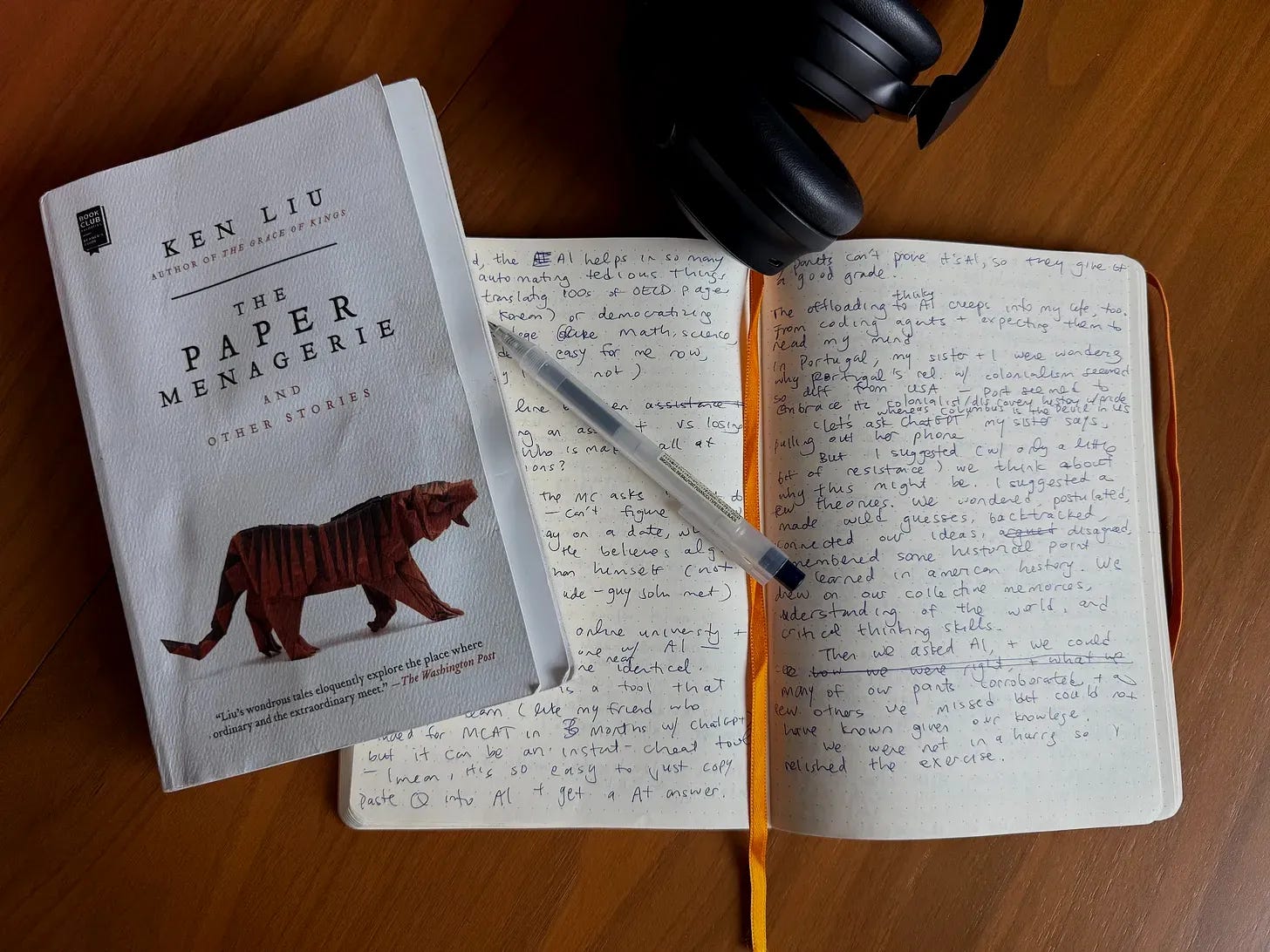
My notes for this essay, written on a plane with no internet and no AI :D
I have been observing, in myself and in those around me, a tendency to increasingly offload our thinking to AI. From trivial decisions to complex thinking, it is easy, convenient, and in some cases, encouraged, to use AI for researching, reasoning, and answering our every query.
I recently read “The Perfect Match” by Ken Liu, a 2012 short story which describes this phenomenon with unexpected accuracy. In the story, a universal AI assistant named Tilly serves users by offering useful and enjoyable recommendations. The main character asks Tilly questions like “What do you recommend I do for breakfast this morning?” and defers to Tilly to find him a suitable person to go on a date with. The main character does not know what he wants to eat for breakfast, what music he would like to listen to, nor what to say on his date. “Who knows your tastes and moods better than I?” quips Tilly in an affectionate voice.
My friend recently went to a San Francisco startup event, where he encountered a man with a small device pinned to his shirt. The device was a sleek little capsule of polished metal, no more than two fingers wide. My friend asked about the device, and the man said it was a microphone which he used to record all of his conversations. At the end of the day, Microphone Man would kick off a workflow to summarize and analyze all of the conversations. He said, with the enthusiasm of a tech bro unveiling his latest setup, “I think Claude Fable is smarter than me. It’s better at critical thinking than I am, so I let Fable do all of my thinking these days.” (Side note: his startup is replacing human engineers by capturing their every input and operation, but without their explicit consent. He has offloaded his own thinking to AI, and made a business of offloading everyone else’s.)

An AI-generated image of Microphone Man based on the description from my friend + my imagination.
Before Claude, ChatGPT, and Gemini became household names, we were already offloading parts of our thinking to search engines. But search still required us to break down a question, evaluate sources, and synthesize an answer. AI increasingly performs those intermediate steps for us, producing a finished response to even complex or esoteric questions in minutes.
Tools like Google Deep Research and OpenAI Deep Research can now do work that might once have taken a single human being, minutes, hours, or days (see METR’s Task-Completion Time Horizons of Frontier AI Models). It saves you time, and it saves you thinking.
But it is a fine line between having an assistant that helps with your tasks, and losing all of your autonomy. Perhaps the question to ask is: who is making all of the final decisions for the things that really matter to you in your life?
In Ken Liu’s story, the main character believes that the algorithm knows him better than himself: “Everything Tilly suggests to me has been scientifically proven to fit my taste profile, to be something I’d like … What’s wrong with listening to Tilly so that the perfect product finds the perfect consumer, the perfect girl finds the perfect boy?” He defers all decisions, as trivial as what to wear and as important as how to find love, to his assistant. The Microphone Man, similarly, defers all higher-level thinking to Claude, which he believes is smarter than he is in all respects.
The offloading of thinking to AI creeps into my life, too.
There will always be some tradeoff between slow thinking and quick answers. Many questions merit quick answers (What is the weather now? Who was the president of XYZ country 10 years ago? What are the reviews for XYZ brand of skincare or sports equipment?). Many others, I think, would merit longer thinking.
Sometimes, I go on walks around my neighborhood without my phone. Invariably, questions pop into my head, questions I am so used to looking up immediately on my phone (Do cherries grow on trees or bushes? When and where was the first World Cup game?), but I find that I forget most of them by the time I get home — I remember the important few, and I assume the rest were insignificant enough to forget. Maybe there is some value in our lives to forgetting the trivial, to not having an immediate answer to every query that appears in our minds.
A few months ago, I was traveling in Portugal with my sister. After walking around the Monument to the Discoveries, which celebrates Portugal’s “Age of Exploration”, we got the feeling that Portugal seemed to idolize these “discoverers” and “explorers” whereas in the US, we would call them “conquerors” and “colonizers”. I asked our tour guide if Henry the Navigator or any of these men were cancelled, in the way that Christopher Columbus is very cancelled in the US. She responded that they were not, and in fact, men like Henry the Navigator were generally regarded as admired historical figures.

Monument to the Discoveries, which is a lot taller but didn’t fit into my camera. Totally unrelated to this article, but the guy on the farthest left looks a lot like Lord Farquaad.
My sister wondered why Portugal seemed so proud of their colonial history and why their response to colonialism seemed so different from how the US currently talked about and treated its own history of colonialism. “Let’s ask ChatGPT,” she said, pulling out her phone.
I suggested (with only a little bit of initial resistance) that we pause and think about why this might be. I suggested a few theories. Perhaps it was Portugal’s relative homogeneity and religiousness, compared to the US’s diversity of immigrants. Perhaps Portugal clung on to so-called “Age of Exploration” as one of the most prominent chapters in its national story. We wondered, postulated, made wild guesses, backtracked, connected our ideas, disagreed, and remembered historical details we learned in high school many years ago. We drew on our collective memories, knowledge, understanding of the world, and critical thinking skills. We knew we were speculating, and some of our theories were probably wrong; that was part of the exercise.
Eventually, we asked the same question to AI. Its response corroborated many of our theories and supplied several explanations we had missed. It also omitted a few possibilities we still found plausible. We had begun with a question, generated hypotheses, and only then used AI to test and extend our thinking. I relished the exercise.
I work in AI. I work on measuring Gemini’s capabilities in solving hard tasks, including those involving thinking and using tools. I also see many people in my life enthusiastically describe how AI has helped them in their working lives. For example, my cousin, who works at a Korean firm, uses Gemini to translate long official English reports into Korean, which helps speed up her work considerably. My colleagues at work develop research ideas and have coding agents implement the details, so that they can spend more time on the analyses. My friend prepared for the MCAT in just a few months with the help of ChatGPT as a personalized tutor, a process which included learning biochemistry from scratch.
One could argue that if you offload mundane thinking to AI so that you can do other, more important thinking, perhaps it is something that increases life satisfaction and productivity. Especially if AI is used to automate routine, repetitive, and tedious tasks (see the OECD’s report on the impact of AI on the workplace), tasks which previously human workers were paid a pittance to execute (see the International Labour Organization’s report, Digital Labour Platforms and the Future of Work), isn’t that a net positive to free up people to do other, more interesting, more fulfilling types of thinking? If we let the AI do the many menial tasks that encompass our jobs, to cheerfully execute hours of drudgery, don’t our lives become slightly more enjoyable?
The ease of using AI to answer our every query can also lead to lazy thinking. My mother teaches physics at an online university. She suspects that most, if not all, of the students complete their assignments using AI. She has noticed that some responses to assignments are nearly identical across students, as if they had just copied and pasted the question directly into the same AI tool, without a single original thought or opinion to differentiate their answers from the generic AI answer. She has no way of proving that AI was or was not used, and the answers are fairly comprehensive, so most of the students get an A.
AI can support learning, but it can also produce an answer without teaching you how to arrive at it. The process of solving a physics problem or writing an essay may be considered by many students to be tedious (Which equations? Which sources? Which arguments?). But then, what is the point of being in school or of learning?
There is no clear way to separate full autonomy of thinking from automating parts of menial work. It is often some blend. Like the Microphone Man, I collect data on myself and analyze it. In previous years, I even had AI analyze the data for me.
Am I any different from the Microphone Man? Perhaps what differentiates me is that I still collected and curated the data, formulated the questions I wanted answered, and evaluated the end results? Or that the data was my own, instead of recording other people’s conversations? There will always have to be some balance between automating menial tasks to free up time for rewarding endeavors, and doing the work yourself as a learning experience.
Jenny, another character in Ken Liu’s story, aims to counterpoint the main character’s over-reliance on his AI assistant. She exclaims, “Tilly doesn’t just tell you what you want! She tells you what to think. Do you even know what you really want anymore?” Our autonomy depends, at least in part, on continuing to participate in forming our own desires. But when we offload thinking about what we want (What music should I listen to? What movies should I watch? What food should I eat? What shoes should I wear?), who do we become?
What are we automating? Human work or human agency? Human tasks or human thinking?
Thanks for reading Art Fish Intelligence! This post is public so feel free to share it.
There's no such thing. You're probably thinking of "AI"-regurgitated essay.
I will claim the CNC analogy though - I sometimes feel like a modern machinist just walking between machines and listening for screaming metal.
Well, because roads are hard to build and take a lot of energy, it's going to be way narrower, curvier, and hillier. The guy shoveling out rocks all day would have gladly switched the shovel for a bulldozer.
But all of these value statements about value statements are kind of ignoring the Moloch problem in the corner of the room. What becomes the purpose of humans in a world of automation? At our current rate, it's being exterminated under the boots of corporations that swallow up all the value in the universe. The conversation of "How can things be made better for all humankind" seems to have disappeared after the greed is good conversation won.
More seriously, the novel is a unidirectional medium of communication. Not a relationship. That said, it is meant to convey a perspective. I don't care if it's a human, a robot, or a little green man's perspective. It just has to be an interesting, useful, or enlightening perspective that I didn't already share.
Right now LLM's don't really have unique perspectives, that may change. So I withhold judgement. As of today, I wouldn't read an LLM's novel. In 10 years, who knows?
Isn’t that just an incorrect interpretation of the descriptive experience sampling tests? The frequency of having inner monologue varies, but I don’t think it was shown that many people have anendophasia.
I don't want some random joe smoking crack working on my aircraft before I fly.
At the same time I don't want to have to pay a light bulb changer after filing 6 safety forms in triplicate.
Extremism on both sides leads to suboptimal outcomes.
This is where LLMs and even things like youtube videos muddle the difference between what you are and things you have to do as a human. The number of things you can be presented with in the modern world that you'd like, or have to do, is simply endless. If it's something small, with little opportunity cost if failure occurs, then just going to an LLM for an answer doesn't bother me. Now if it's something that's more costly like DIY remodeling an LLM isn't a primary driver, but in as a device that can push back when I ask about mistakes that can be made and what to watch out for.
A lot of Hacker news commenters tend to overestimate human ability without education. That is, the tend to believe that people are able to do a lot more without regular training than they actually are. They believe that "math" is some naturally ordained eventuality that humans just do, or likewise that "reasoning" is some immutable natural behavior. In truth these things are "unnatural" human reinforced structures that we have to learn and adapt our brains into.
This is by design, and very much necessary for a competitive chess engine. Otherwise, people could do basically what you say: Run an offline (as in, ahead of time, with ample compute resources) search against stockfish that finds a line where it loses, then make an engine that plays that every time.
As a consequence, even if you know that your opponent is running stockfish, you can't really use that against them. Your best bet is also just running stockfish.
> If I was very talented and had the time, I could have written the lyrics and recorded the song myself (which undoubtedly would be even more awesome), but I can’t do this.
I promise you that any art you produced would be better than slop. There is not a single crayon scribble or off-tune melody that would be worse than the generic garbage that comes out of an AI model
The latter is absolutely zero sum, because of everybody has a billion, a billion isn't that much any more. E.g. human trafficking exists because some people are rich and others are poor, and the fact that even those poor people might have access to things an emperor 1000 years ago would have dreamed of doesn't change that, because the people who treat them like slaves have even more. It's all about the relative difference between people who are alive today, the absolute increase compared to people who lived N years ago is a red herring.
To me this is intuitively true based on anecdata. 2 examples
1) learning spanish - when I hear or read a phrase I don't know, I type it into the LLM and I learn a new word/phrase. Sure, I could have cracked open a spanish language dictionary, but tbh, I wasn't going to do that. Not to mention that dictionaries are translating word by word and not phrase by phrase.
2) growing vegetables in the garden. I literally watched YT tutorials and did what they did, and now I have vegetables that I didn't before. Yes, I could have probably could have gotten this from a botany book, but once again, I probably was not going to do this. I also was trouble shooting a lot in gemini
Here are the problems I traversed: - How much water should I give these per day? what's the watering schedule? - how much sun vs shade? - when do I move seedling to the ground outside? - Is trimming good? which parts and when do I trim? - [take a picture of weird growth] - Is this a disease on the plant? Or part of the plant naturally?
I still remember giving Mathematica a relational equation of the atomic radius expectation values for it to integrate by parts and collect terms... at the time it failed to find the right integrating factor and gave gibberish. Probably works now.
He sighed like he was taking responsibility for a grave sin and I should admire him for it, and said, "I don't know. I copied that from StackOverflow."
I've felt that AI is just an amplification of what we've all done and been through with SO answers.
You may argue what if LLMs are inaccessible but that’s like teachers saying “you won’t always have a calculator”
If you find yourself consuming more than 5 minutes of content you don't find thoughtful per day, I would ask why. "Touch grass" seems to be the common advice to combat this.
> And without my knowledge I would have no clue if what it's trying do is correct, or safe.
I would contend you got the knowledge by typing the code yourself, that there's no other way to get it, and that if you stop typing the code yourself--and the slogging that entails--you'll lose the ability to prompt LLMs effectively.
It's not that I think the physiokinetic aspects of typing as an input mechanism hold some metaphysical distinction, but rather the level of engagement it forces with the code, and the units in which it does so. I'm not aware as yet of any viable replacement for that.
It's easy to trade on decades of software engineering experience with LLMs: with sufficient experience, everything goes around and comes around, almost any pattern is recognisable, the gratification is immediate, the benefits are now, while the costs and disasters are down the road.
However, the technology world is not static, and if you don't keep up with new frameworks, libraries, languages and other tech in that physical-mechanical "mind-body-keyboard" way that typing--or something substantially close to it--accomplishes, you will lose the ability to navigate that world fluently. To say it's just another abstraction layer and that the world didn't crumble after compilers is to miss something quite essential about how LLMs differ from compilers or high-level languages. The disengagement with the process of physically programming something quite specific will take down with it the ability, over time, to formulate useful prompts and competently review the output.
My problem is that filtering all of human creativity and expression through an LLM is ugly
And AI has that reputation!
It just has to be this in the story because it doesn't want to engage with why what the earring indicates is so good except that it provides unfailable "happiness". It implies a static world where "the right decision" always exists, but doesn't want to engage with the details. It also implies a kind of akrasia[1] that I don't think resonates with lived experience: "happiness" is a state we pass in and out of, not the accumulation of correct decisions. We undergo unhappiness for the sake of future happiness. "Happiness" is a questionable end-all goal first of all, but either way not even the kind of thing ontologically compatible with the author's framing.
It just feels half-baked, it doesn't actually say anything even when it has all the pretenses of that. Even without context, it smacks of new rationalism. Maybe that's too harsh though.
The midterm was open book, he even shared the previous year's exams. The final, as expected, closed book, thank you very much.
It definitely wasn't a single prompt, but two hours of back and forth, with a lot of time spent thinking (me, not LLM) in between. There were multiple times where I misunderstood something, so if I just read a book I'd probably get stuck many times.
It's kind of like you hang out in a Buddhist monastery saying, "I don't know what you guys are talking about - people are so peace-loving!"
For sure, and I've tried picking up a new language with the use of LLMs, but the concepts just don't stick because I don't actually do the work. That's why I do try to limit my use of LLMs to fields I'm already closely familiar with, and also keep its output contained to actually reviewable chunks. Or things that are just tedious, like OCR and large text transformations.
I've wasted a ton of my life already trying to make llms work for learning over the last few years, I'm especially bitter about it. I think this technology is a scam made to make us reliant on a think-for-me machines.
They were right, though. For one, you still need to now what kind of equation to put into the calculator. If you don't know the concepts, what are you going to calculate. Real life situations don't actually spell out neat textbook questions.
And just take a look throughout the day how many quick maths you do subconsciously. Just things like cooking or grocery shopping have tons of moments where you just do the calculation in your head. And you can do that because you've learned how and when to do that.
It's not just a matter of "What if it's inaccessible", but also "Do you want to be dependent on your phone even more". Are just going to walk around with your phone on voice mode narrating your life into your LLM to let it tell you what to do?
Now, if I go back and forth with the LLM to say, taking the language learning example, to explore the etymology of the word (which for me is far more interesting than the translation itself), then I learn a ton more.
They were not. I'm not dead yet so I suppose there's still a chance, but so far in decades of living life I've always had calculators when I've needed them.
> For one, you still need to now what kind of equation to put into the calculator.
That's a very different construct. Math concepts don't care how the arithmetic is performed.
> If you don't know the concepts, what are you going to calculate.
If you don't know the concepts, then what kind of arithmetic are you going to perform with anything -- whether the mind's eye, pencil and paper, a sliderule, or a pocket supercomputer?
I have many times asked it something I was slightly curious about, got the answer after the first or 2nd-3rd prompt, spent 3 minutes in total and forgot it after 15 minutes probably.
But a few times I've spent an hour or more on a topic, asking many questions, thinking between responses, and I actually learned something.
Yes! And this is the part of the de-skilling puzzle that is completely unaddressed by AI boosters.
Maybe LLMs are a force multiplier, but there still has to be some force to multiply, and I don't think a lot of folks ask the question of how that force is actually cultivated. This nebulous, airy-fairy notion that humans add "architecture" or "taste" doesn't tell the story of how, concretely, they came to have it. It seems to me there is no escaping that it came from typing the code.
Like you, I have a much better grasp of code and API surfaces I've physically typed than things LLMs have emitted and I have reviewed, in a conceptual sense, but which I could not have typed myself then, nor can type now.
For better or worse, there's less friction now for seeing an answer to a question you have. You can ask in more arbitrary ways than Google required, and something will still come up. For looking up factoids, it's much faster. For picking up more complex topics, I'd say it's more or less the same, because you still have to spend time ruminating on the topic.