There are likely management service agreements from xAI proper -> SPV to cover precisely what the author talks about. Clearly, xAI could play games but without seeing the docs (which are not public), it's very difficult.
This article's basic point is right though. On the other hand, the LTV of this deal was approx 50% debt-financed (not too high; very much depends on the "V"). At 12.5%, it's not as if its being priced as a high quality asset.
Overall, substack post was too bearish. The wider point is that there's a lot of froth tied to what has now become systemically opaque - namely the circular deal flow that every hyperscaler, nvidia, neoclouds and friends are now engaged in. When the proverbial hits the fan, that stuff will be difficult to price and find few willing buyers with the competence to underwrite.
The systemic issues are the bigger concern than one specific deal imo.
Hmmn. All of this information should live in the monitoring system, in which case any frontier model will be able to get to grips with it in short order. It feels like the author doesn't really fully understand the changes brought about by the systems they are writing about.
I hope not though, perhaps I can pick up a H100 in a few years if they get sold on the open market.
slow and awkward, best market match: The auction. sell to highest bidder.
faster and more customer friendly but poor market match until a lot of units sold: The store. guess price, adjust up or down to reach sell frequency desired.
fast and good market match but takes a knowledgeable customer base: The reverse auction. Start with price too high lower it over time until it sells.
That's for good NVidia H100 units.[1] There's a shortage of those. That seems to be the price after removal, cleaning, testing and refurbishing. Raw units removed from a shutdown will not be as valuable.
H100 units are available on eBay, but multiple sellers are using the same picture of a new unit in its original packaging, a bad sign.[2] Some even have pictures with the logos of a competitor.
[1] https://introl.com/blog/secondary-gpu-markets-buying-selling...
[2] https://www.ebay.com/shop/nvidia-h100-gpu?_nkw=nvidia+h100+g...
You can't get the Rubin, or even the Blackwell, so you will pay for the H100 but this won't last if fabs ramp up capacity.
You go to ebay search for a used GPU. You get a price.
Neither is used servers a new thing or used routers. There are established used server companies.
I’m mainly interested in getting some DDR4/5 and RTX5090s on the cheap :).
If anything, you might have to pay to have them disposed of, they don't really have any meaningful used eBay market outside of the randos that want to do high end extreme local inference in their basement.
Also, as for RAMmageddon, the inference SBCs that all of the AI bros bought don't have DIMMs, they're not even the right chip: its all GDDR and LPDDR. The only DDR DIMMs being consumed are for regular non-inference machines that help run the business and service infrastructure behind the scenes.
Without other market influences, that is a >90% expected discount when the over-provisioned market must inevitably self-correct.
If the Market follows what Samsung/SK Hynix did to the South Korean exchange this week, than the "AI" bubble will hit harder than the dot com crash.
I like the Shrek Movie correlation theory, as they always happen just before Debt-backed investors get hit hard... And the new film is due out in 2027. =3
Anyone know how these get caught ultimately?
Actually, we do, people offer them to me all the time. A used box of MI300x is $257k. "There is no GPU futures market"... actually there are a few of them that people have pitched to me.
This article is a lot of words from someone who isn't actually buying or deploying compute. My point is... take it all with a grain of salt.
>Start with price too high lower it over time until it sells.
These are the same strategy.
Maybe someone could start a business buying up and rehousing these.
It will be perfect for stuff like GPU-accelerated query engines, "classical ML" and every other CPU-based workload that could conceivably be offloaded to GPU
Can you tell us more about this? Or some link
What's as or more weird is how much hardware is backordered, and how much live hardware is allocated, but waiting on facilities for operation. And how many facilities are years behind at this point already... all on various credit and dept swaps between all the involved companies... it's not just a balloon, it's a house of cards balanced on a balloon.
In my experience, AI is easier to read than this was.
By doing that, you know upfront what the value of your used hardware will be at the time you decommission it. It removes a lot of the risk for buyers in a volatile market.
The increase in PFLOPS/dollar has continued accelerating, a lot from process, but also a lot by simplifying the architecture- if you had placed an H100 worth of transistors on a CPU-like architecture, you wouldn’t reach the same peak performances.
A key thing to understand about the gold rush is that it was not a major economic event, or at least nowhere near as big as the participants thought it would be, hence the tradegy.
The AI gold rush is different in that there actually is a mountain of "shovels" large enough to flood the global market quite severely.
If everyone ramps up then in the best case everyone has the same sized slice of a bigger pie. So in theory it makes business sense. But the more realistic possibility is that you end up with oversupply, crash the market and everyone loses. This is what normally seems to happen with DRAM.
Is the idea that previously maintaining GPU programs was expensive whereas now AI makes it cheap? If so, I could buy that line of reasoning.
Maybe relatedly, I expect (hope) the hardware manufacturers will ramp up supply in the meanwhile which would also put downward pressure on GPUs. Right now though this hardware crunch is making me sad, not even because of GPUs but also because of general memory / disk.
> These are not catastrophic events. They are the steady state.
> There is no GPU futures market, no standardized residual value curve, and no way to lock in a forward rental rate. The premium is is the price of underwriting in the dark.
The headings are also AI like, a lot of essays before usually did not have titled sections but now they do and they all feel like these.
In addition the diagrams themselves look pretty AI generated.
but I generally agree, people put a lot of faith in the exponential leaps vs the exponential space.
You tell them we're not living on mars any time soon and they'll bring up christopher columbus.
If you want to switch back to on prem, there's probably a way to structure acquiring hardware so it doesn't break the contract. Maybe you lease it, maybe the purchase happens through a related company, maybe there was no way for the contracted cloud to find out...
And precisely because it's such a huge headache to do yourself, I think a small company could make a nice business wrapping up used datacenter cards in that sort of server.
These things get hot and are fussy about their requirements.
Where folks (often) get lazy is the resulting math over what the real bean-counters care about (but are too lazy to check often).
In a past life, I worked on costing models for a Cable/Fiber contract house, to help the company decide 'what was profitable to keep in house' versus 'what do we subcontract' (sometimes that could even mean we just 'rented' a machine and had a qualified operator using it, based on that employee's hourly rate and expected L2R for taxes... so many spreadsheets...)
And from from my 'I don't know all the factors for this but I've seen how people screw up the big ones' view (and frankly, I'm guessing a lot of us have seen and dealt with the same category of 'bad math' around outsourcing IT work...)
An on-prem data center means:
- You need to account for electricity costs - i.e. CA vs midwest electric rates.
- cooling and power backup capability - Smaller factor but real
- personnel cost - e.x. there's probably cases where a smaller org could be better off with 'on-site' server admins that have other roles based on local wages. Kinda case specfic but it's a case.
- whatever the 'space' holding the stuff costs
- Sardonic take :Hey, let's have another unused meeting room instead! (e.x. In the case of on-prem shops that simply fled to AWS in their migration from VMware)
- the cost of licensing whatever is running
- In defense of this, In one of my earliest IT lives, AWS handling the Oracle licensing for a DB was a *huge* win as far as making it as easy as possible to ensure whatever was going on we couldn't have the Oracle licensing folks 'ding' us on whatever infraction occurred between reviews (that could not be understood by the majority of the company, often including the accused. I was never guilty but I saw it happen to others.)
- OTOH I know lots of folks who just want to be lazy about what they have to document.
Still, IMO a lot of orgs don't do the right math around these decisions, or just buy into the 'Well trends can change' as though they can decide as an org they need to suddenly triple capacity in a month and it would be able to organically happen in the first place.Frankly, the orgs that 'might' need that either have their arch set up where they are in cloud, or they are onprem but can scale to cloud if needed in interim.
if you haven't heard a 5u server intended for a datacenter rack come to life it's quite the experience. Sounds like a plane taking off.
I was complaining that it's obviously incorrect that nobody knows what used GPUs are worth, not about latchkey.
I have NO idea why anyone is upvoting a post titled "nobody knows what a used GPU cluster is worth", that is a WILD claim.
Until the thermal management kicks in, they sound like jet planes. When the thermal management starts and assesses the required cooling, it’ll throttle down the fans to reasonable levels.
That is, until the moment you push the machine to its limits. When then happens, you might get back to the same levels of the boot time, but it’ll require you to push everything to the max - CPU, memory, storage (all 24 bays) and so on. For a normal user, there is a lot of room and it’s virtually impossible, even with a dozen of Teams windows open.
Helicopter. I live in Yeovil, Somerset, UK - there's a helicopter factory just down the road. I had a IBM "AS/400" or whatever they are called now in our computer room rack for a customer and it made nearly as much noise as everything else put together. It was clearly tuned for start up noise to impress because they would fire up in sequence, rise to a crescendo and then slow down in sequence to just a din instead of painfully loud.
A switch or PC server on boot will normally run up cooling fans instantly to max as a default protection mechanism until the "OS" has started and sensors read and then the fans will slow down to deal with the actual thermal load.
If you switch off your air conn, it gets noisy, quickly. Recently in the UK we are seeing routine temperatures around 30C and we broke 200 odd year records for temperatures a few weeks back. I know its even worse elsewhere but our infrastructure is not designed for this. Here we are at the same latitude as Calgary AB!
In North America we are on 120V, making a standard 15A outlet only 1500W max, and something like 1200W sustained. To use higher wattage appliances, we have to upgrade our outlets to 20A (2000/1600W) or up our voltage to 240V, but that carries a different set of plugs and outlets as well.
It was clean, cheap, and is still going strong for daily gaming.
In its working life it was undervolted and probably cooled better than in my rig.
If xAI defaults on its debt, Apollo Global Management ends up in the GPU rental business. That is in the contract, signed in June 2025, on a five billion dollar debt facility arranged by Morgan Stanley. The lenders have the right to take over Colossus, the company’s 200,000 GPU cluster outside Memphis, and rent it to other AI companies until the loan is repaid.
It’s interesting whether Apollo, or Diameter Capital Partners, or any of the other lenders now financing the AI buildout this way, would want to exercise that right.
The harder question is what they would actually be holding if they did.
A GPU cluster bears little resemblance to a building. Its value at any given moment depends on how it has been provisioned, how it is currently performing, and whether the team that knows its quirks is still there. All of that sits off the lender's balance sheet, beyond the reach of anyone they can call.
This is one of the center problems of the AI infrastructure boom. I cannot determine why no one is talking about it. Tens of billions of dollars in debt is now collateralized by chips whose value depends on operational state, and the operational state is invisible to the people pricing the debt.
This week’s CipherTalk is about what happens to a specific kind of debt when the collateral itself can walk out the door with the operations team.
At the scale these GPU clusters operate, hardware and systems break constantly. Keeping them productive is a craft.
Modern data center GPUs fail at roughly 9% annually. The number traces to Meta’s Llama 3 technical report, which documented 419 unforeseen disruptions across 16,384 H100s over 54 days of training, of which 148 were GPU failures and 72 were HBM3 memory failures. At 200,000 GPUs, that annualized rate works out to approximately 50 GPU failures every day. At xAI’s stated million-GPU target, Epoch AI projects a failure roughly every three minutes. These are not catastrophic events. They are the steady state.
The failure modes that matter for a credit person are the ones that do not look like failures. Silent data corruption (SDC) is the most expensive, where a faulty GPU produces wrong answers without crashing anything, which means a multi-day training run can complete normally and the resulting model weights are quietly poisoned. Cascading failures are the second category, where one bad GPU crashes a training job spread across thousands of others, costing days of compute. Then there are the routine ones: thermal throttle, ECC memory errors, NVLink flap, GPUs falling off the bus.
NVIDIA built NVSentinel because traditional monitoring detects these problems but rarely fixes them. Crusoe built AutoClusters because queue wait time is the largest controllable variable in cluster goodput. Without these tools, remediation timelines run hours to days.
The job of an operations team is to keep all of this in steady state. They know which racks run hot in summer, which cooling loops have been flaky since the last firmware update, which jobs to re-route when a node degrades but has not failed yet. None of that knowledge is written down. It lives in the team.
This is the asset that serves as collateral for tens of billions of dollars in debt and counting.
In the last eighteen months, AI infrastructure went from being financed by corporate debt, to being financed by the chips themselves.
The xAI Colossus 2 SPV is the cleanest example. The structure is roughly $7.5 billion in equity, with up to $2 billion of that contributed by NVIDIA itself, and $12.5 billion in debt. The special purpose vehicle (SPV) purchases NVIDIA GPUs and leases them to xAI on a five-year term. Apollo and Diameter sit on the debt tranche. Valor Equity Partners leads the equity. The debt is collateralized by the chips, not by xAI’s broader balance sheet.
Look at the pricing: xAI’s $5B round was priced at up to 12.5%. CoreWeave's GPU-backed deals priced at roughly 8.5% above the benchmark rate, before terms tightened as lenders got more comfortable with the structure.
If we assume here these are not unsophisticated lenders, then we have to assume they are charging what they think the risk costs. The premium is then, the price of guessing.
The scope is wider than one company. CoreWeave alone holds $18.8 billion in GPU-collateralized debt across multiple SPVs. FluidStack’s $50 billion deal with Anthropic uses a different wrapper, with Google providing a backstop on the lease payments, but the underlying logic is the same.
Every neocloud and most major AI labs are now financed this way.
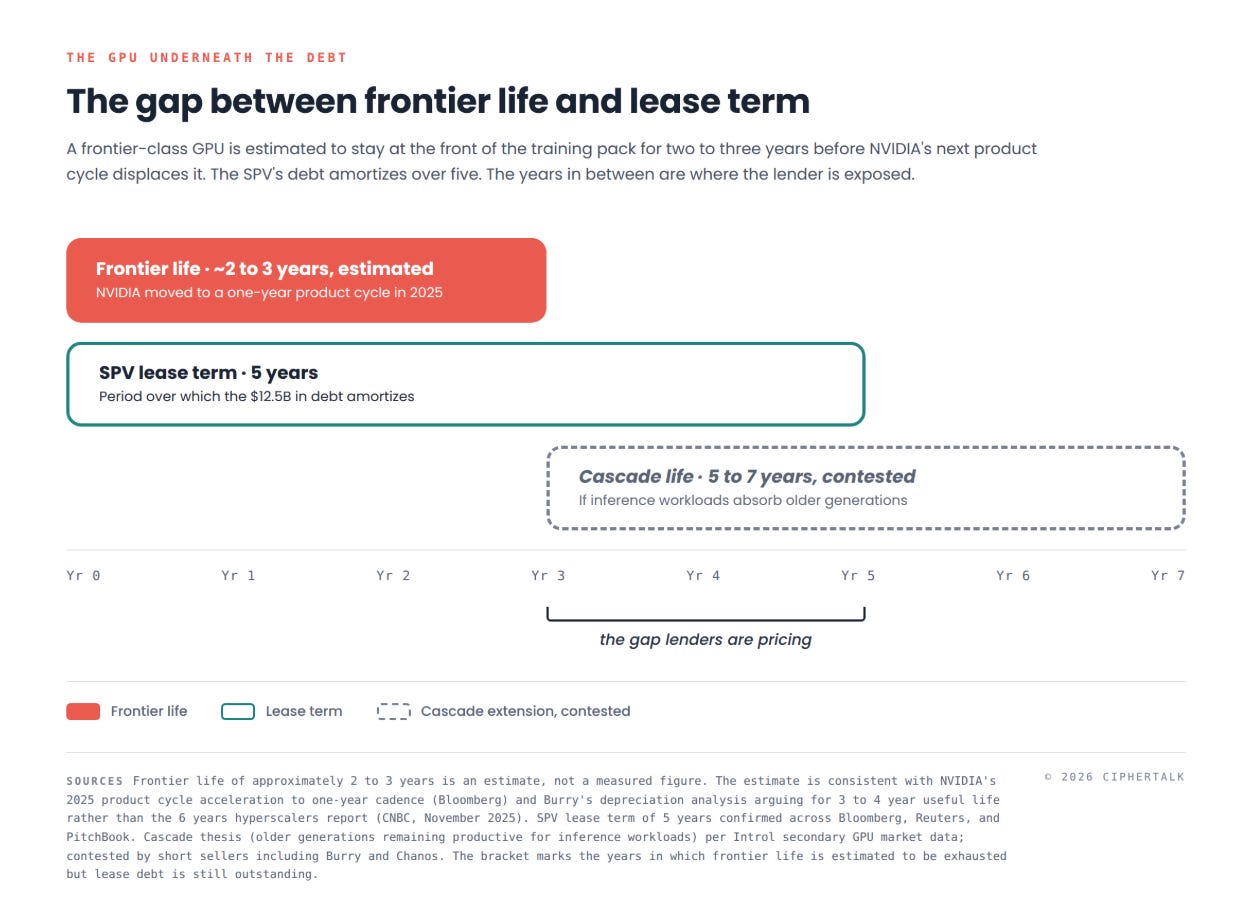
Every other major asset class that gets used as collateral at this scale has decades of price discovery infrastructure behind it. GPUs have almost none of it.
Aircraft have ISTAT-certified appraisers, a global registry, standardized maintenance logs, ferry pilots, and an active secondary market dating back to the 1970s. Ships have BICA. Cars have NADA. Class A office space has standardized cap rates and vacancy comps. Oil has had a forward curve since the early 1980s.
GPUs have Silicon Data’s H100 Rental Index on Bloomberg terminals, which launched in 2024, and Ornn AI, which raised $5.7 million in October 2025 to build the first regulated exchange for GPU compute derivatives. That is the entire price discovery infrastructure for an asset class now backing tens of billions of dollars in debt.
The price moves underneath all of this are wild. H100 hourly rental rates went from roughly $8 per hour in early 2024 to $1.70 by October 2025, then surged 40% back up to $2.35 by March 2026 on a wave of inference demand nobody had priced in. SemiAnalysis put it bluntly: lenders who used six-year depreciation schedules now look smarter than the analysts who chastised them for being too generous. They were guessing, and they happened to land closer to the right answer than the people calling them reckless. No aircraft lender or shipping lender would underwrite five-year debt against an asset whose price swings like that without a way to hedge it. They would not be allowed to.
CoreWeave’s GPU-backed loans price at roughly 8.5 percentage points above the benchmark rate. For comparison, a typical aircraft loan prices at 1 to 2 points above benchmark, and a commercial mortgage usually sits below that. The extra 6 to 7 points is what lenders charge to bear a risk they cannot measure. There is no GPU futures market, no standardized residual value curve, and no way to lock in a forward rental rate. The premium is is the price of underwriting in the dark.
Thanks for reading CipherTalk! This post is public so feel free to share it.
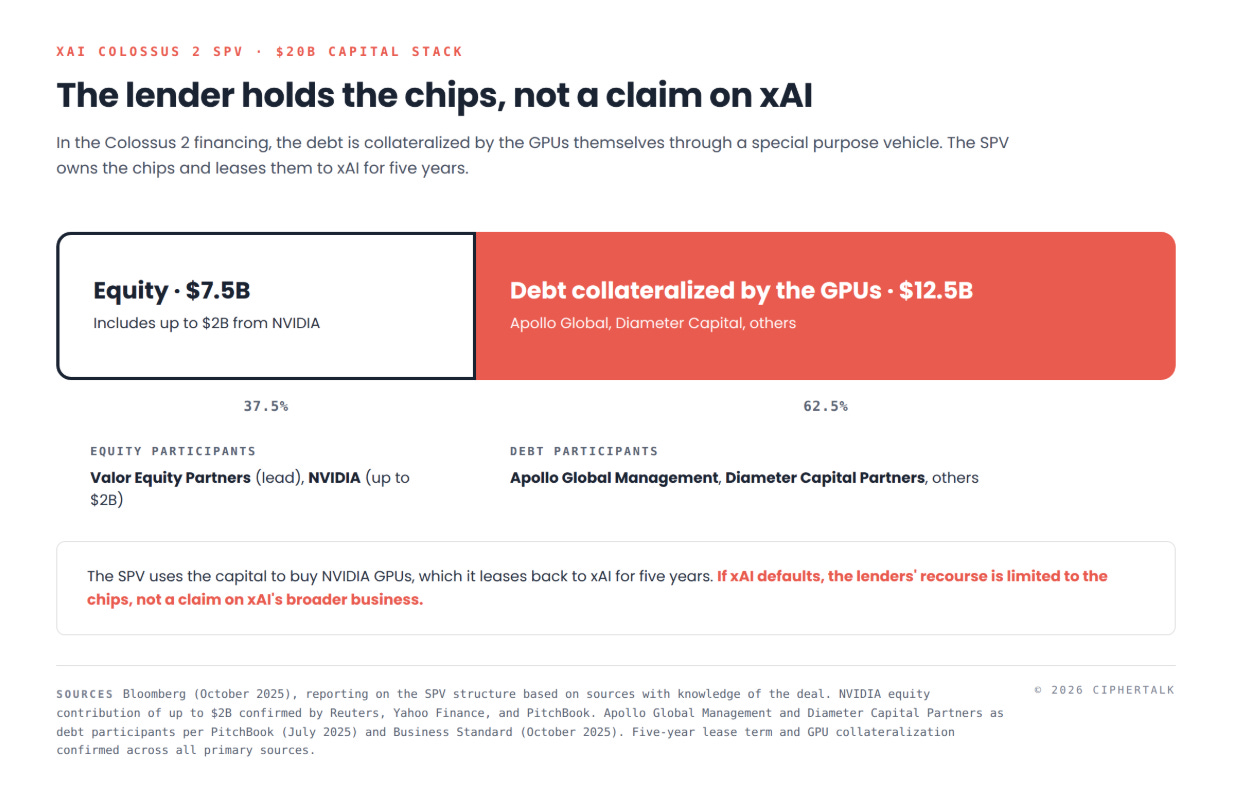
That spread should compress as the market matures. Hedging instruments will appear. Residual value curves will get more standardized. Secondary markets for used GPUs will deepen. When that happens, the cost of capital for AI infrastructure drops meaningfully, which changes who can build at scale. The companies that benefit are not the ones with the cheapest GPUs today. They are the ones positioned to access cheap debt once the financing infrastructure catches up to the asset class.
The public fight over how fast GPUs depreciate is a tell about how confident the people writing the books actually are.
CoreWeave depreciates GPUs over six years. Nebius, with the same business model and the same hardware, depreciates the same chips over four. AWS, Microsoft, and Google all moved their server useful-life assumptions from three to four years up to six years in 2023, a change that reduced reported depreciation expense by roughly $18 billion annually across $300 billion of combined capex. CoreWeave made the same accounting change in January 2023, before going public, lowering reported expense by hundreds of millions of dollars per year.
NVIDIA announced in 2025 that it is moving from a two-year product cycle to a one-year cycle. The chips backing all of this debt are about to become previous-generation twice as fast.
Michael Burry’s claim is that hyperscalers will cumulatively understate depreciation by approximately $176 billion between 2026 and 2028. He projects Oracle will overstate earnings by roughly 27% and Meta by roughly 21% by 2028. Burry’s motives aside, the math is independently checkable. If the true useful life of frontier-training GPUs is closer to two to four years and the books say six, the gap between paper value and recovery value is real and it is enormous. The recent inference demand surge complicates this. If H100s genuinely have productive life past frontier training, six years may not be wrong. If demand softens again in 2026 or 2027, the writedowns hit at exactly the moment lenders need their collateral to be worth something.
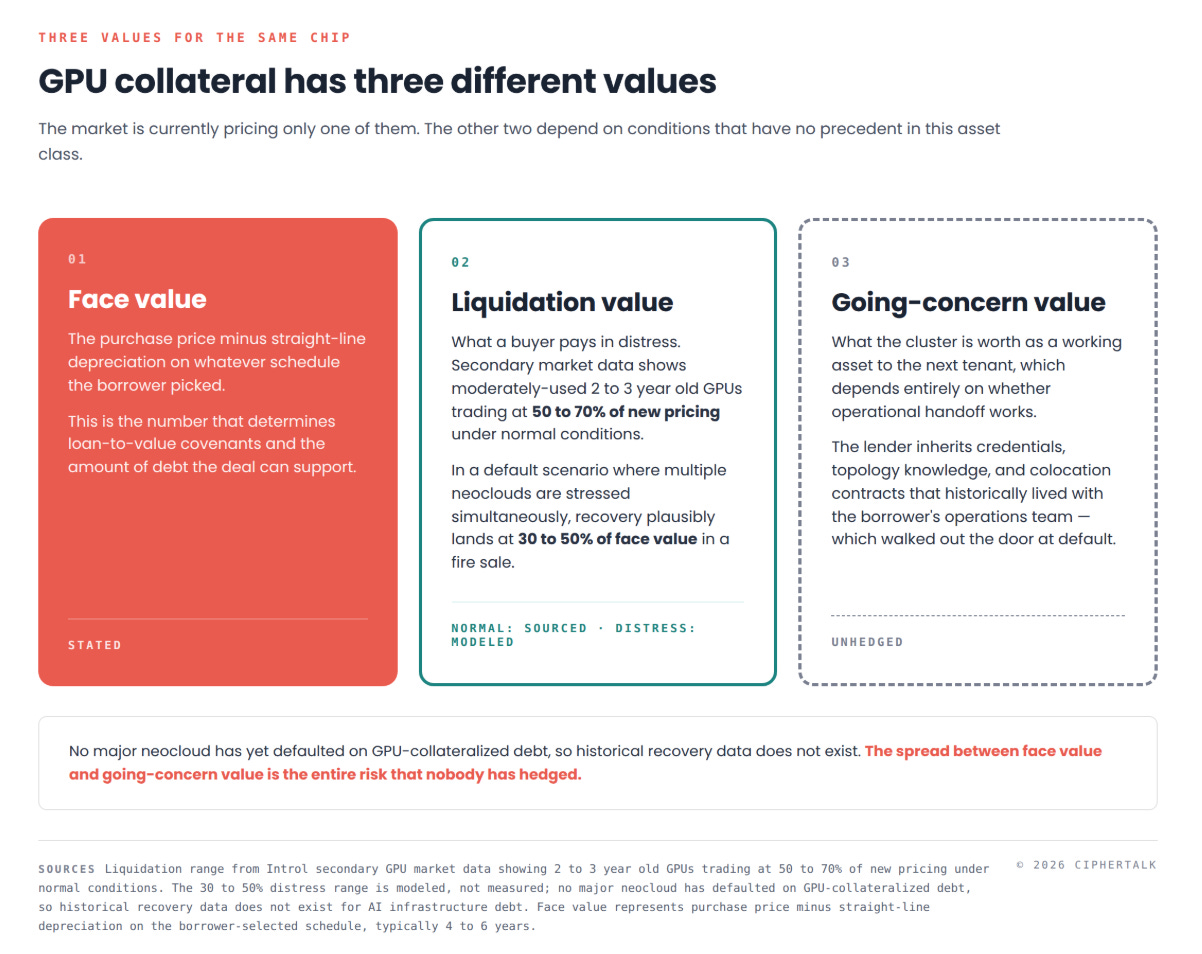
GPU collateral has three different values, and the market is currently pricing only one of them.
Face value is what the SPV says, the purchase price minus straight-line depreciation on whatever schedule the borrower picked. This is the number that determines loan-to-value covenants and the amount of debt the deal can support.
Liquidation value is what a buyer pays in distress. Secondary market data shows moderately-used 2 to 3 year old GPUs trading at 50% to 70% of new pricing under normal conditions. In a default scenario where multiple neoclouds are stressed simultaneously, the buyer pool collapses at the same moment supply spikes, plausibly putting recovery at 30% to 50% of face value in a fire sale.
Going-concern value is what the cluster is worth as a working asset to the next tenant, which depends entirely on whether operational handoff works.
This is where the operational reality from the first section returns. The lender exercising step-in rights inherits a colocation facility owned by someone else, with that facility’s own contracts and constraints. They inherit credentials and topology knowledge that historically lived with the borrower’s operations team, which walked out the door at default. They inherit a market where rental rates already moved 60% in one direction and 40% back the other in eighteen months, with no hedging instrument available. They inherit an asset class where 50 chips a day fail and somebody has to know which racks have been flaky for the last quarter.
The spread between face value and going-concern value is the entire risk that nobody has hedged.
The most telling positions in this market are the ones not being taken.
KKR has been the most aggressive private equity firm in data centers, with the CyrusOne acquisition alongside Global Infrastructure Partners in 2022 for $15 billion, the Global Technical Realty commitment in 2026 for $1.5 billion, and the STT GDC deal in February 2026 for $5.1 billion at a 75% stake. KKR’s digital infrastructure book is a central pillar of $186 billion in real assets. The firm is not in the AIP consortium that bought Aligned Data Centers, not in any xAI SPV, and not in CoreWeave’s debt facilities. KKR owns the buildings, the power, the cooling, and the land, the infrastructure layer that holds value regardless of which AI lab wins or which chip generation dominates.
Peter Thiel sold his entire NVIDIA stake in Q3 2025 and rotated into Apple and Microsoft. The chips are not the durable asset, and the financing structure pricing them as durable will eventually have to reckon with what the chips actually are.
Aircraft became financeable because someone built the registry, the appraisers, and the maintenance logs. Ships became financeable because someone built BICA. The interest premium on these deals exists because no one can answer two basic questions: Is the cluster still working? And: Will it still be working in three years?
No posts
One that runs continuously
It's 1800W for short periods and 1500W sustained.
Right, so they're not voluntary.
It's wild to think that the system now is worth at least as much as I paid for it then if not much more than that. I saw a similar one going for $2500.
1. There is one supplier, so you have no choice. 2. Even if you had a choice to sign the contract, this still means that it's not the same as a trade-in, because trade-ins are always voluntary, but once you have signed the contract, a right of first refusal is not.
In general, the "you chose to sign the contract" argument is a poor justification for bad contracts. If the contract is bad, it is bad regardless of whether you chose to sign it.