https://meta.wikimedia.org/wiki/Have_the_patents_for_H.264_M...
At which point, the continued march towards higher resolution and bandwidth video will probably limit their utility
Since MPEG-this Part that is hard to keep straight, this is the MPEG standard backing Xvid and DivX codecs. So let's encode video and torrent like it's 2002!
And, yes, I remember w32codecs until MPlayer's bundled set superseded them. And mencoder for sure ;)
For a lot of use cases, including Basic and Main profile, H.264 is already free.
There is also LCEVC ( Not connected with EVC ) that is a scaling layer on top of existing video codec. You can apply LCEVC on top of EVC, VVC, HEVC or AVC as well as AV1 and AV2. LCEVC has been selected by Brail as part of their TV 3.0 technology stack on top VVC.
While there are momentum on LCEVC, I actually wished EVC gained more momentum. I guess everything is too late now.
Just as the patent system intended: maximum extraction was enabled while the product was useful.
Let's have a meet up a Circuit City!!
(Source: have written a H.263 decoder as a learning exercise.)
Something tells me H264 is going to be sticking around for a while just on sheer compatibility and compute requirements
I do believe that more modern codecs like h265 and AV1 have a lot to offer us, but having h264 be fully unencumbered by patents will be nice. By modern standards it is very well-supported in both hardware and software, computationally cheap to encode and decode, and still does a good enough job for most use cases. h264 doesn't seem like it will be displaced any time soon to the degree that h264 once displaced its own predecessors, though obviously that's not to say that we don't see or won't see more adoption of newer video codecs across the internet in general, just that I think the h264 long tail will be one of the longest long tails of a video codec.
And thanks to the availability of codecs like AV1 which are effectively not patent encumbered (seems there is no practical reason to take the threats otherwise seriously) it seems the era of patent encumbered media formats is slowly coming to a close. Good riddance.
edit: Bit of a mess but here is some source for the h264 expiration.
https://meta.wikimedia.org/wiki/Have_the_patents_for_H.264_M...
So it seems 2030-11-10 is the date where h264 (version 3) will become patent unencumbered world wide, a bit earlier for the U.S. The other profiles/newer versions like AVC/SVC will take a while longer.
Assuming the product companies accept the plateau on resolution (I agree it’s likely), there are many ways to exploit the other stuff. Colour space, tacling each type of compression artifact, additional channels (probly not long until we have HDR RGBW), etc etc and those will each come with their committees made of patent-hungry companies seeing non-encumbered encodings as “undesirable”
https://en.wikipedia.org/wiki/Copyright_Clause
The purpose of the system as it was originally conceived was not to provide maximum economic extraction -- the purpose was to promote the progress of science and useful arts.
It is not necessarily the case that the maximization of economic extraction coincides with the progress of science and useful arts.
As it becomes cheaper to capture and process higher res content, we're bound to push it to bigger displays (VR included). I guess the human eye will be the limit when we're at retina levels of DPI on a sphere.
When I was in law school we were taught what seemed obvious then and is obvious now: that Congress has the power to promote the progress of science and useful arts by giving authors and inventors exclusive right to the economic fruits of their works. You can argue about flaws in the system but it’s pretty laughable to suggest that copyrights and patents don’t exist for the purposes of maximum economic value extraction for inventors and authors.
There is quite literally no other reason for granting a copyright or patent. It’s also why if a plaintiff is successful in a claim for an infringement of either, he’ll get awarded money in the United States that at a bare minimum is designed to compensate him for the money he would have made if the patent or copyright had been complied with. Europe has some different ideas about moral rights in this space, but since you’re quoting US material I assume you aren’t referring to our funny brothers across the pond.
It’s obvious to most people that humans act in certain ways due to incentives, and we like to incentivise invention and creativity in the West.
We'll see how much 360 content shows up, but the size gap is so big it basically needs to be handled entirely differently. A 16x9 screen, 40 degrees wide, is only 2% of a sphere.
I think MPEG-1 and 2 (from which MP3 comes) might be even longer.
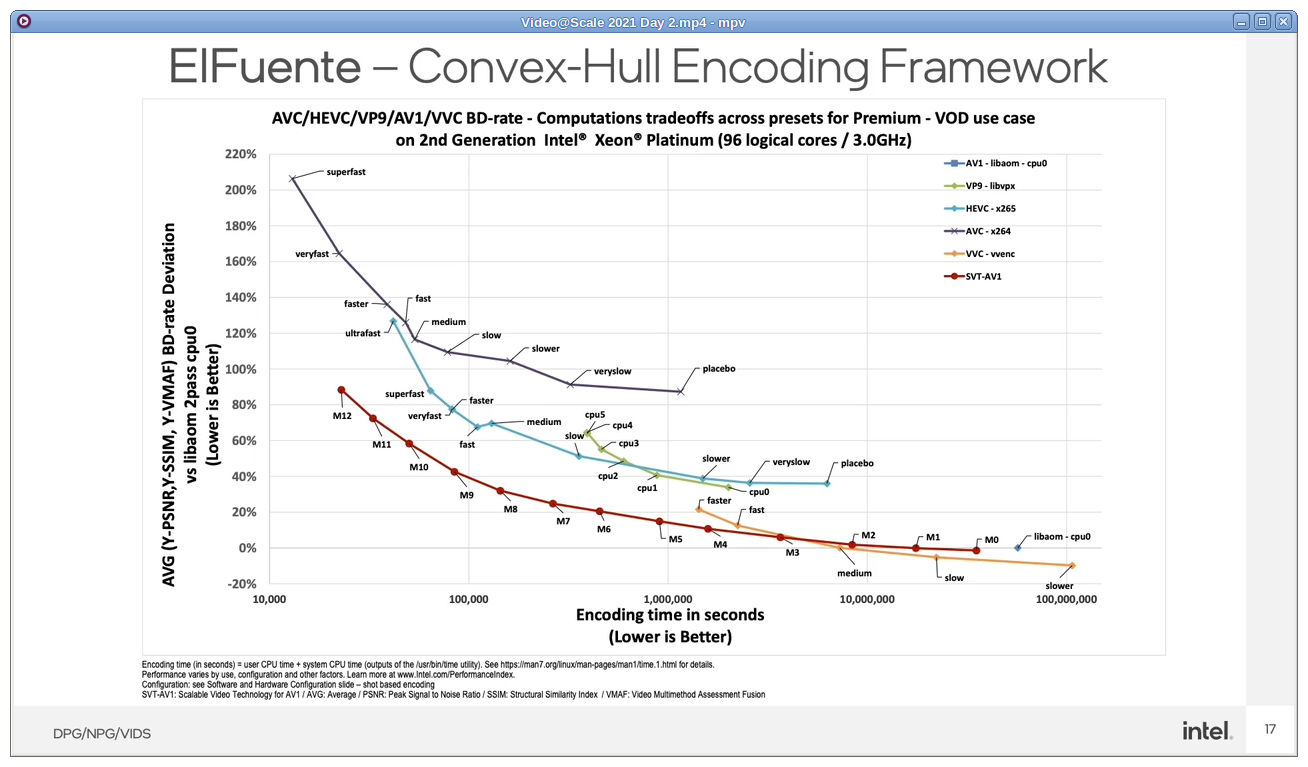
Well I'm not sure about decode, but as of a few years ago weren't h.265 and AV1 able to do much better compression than h.264 at almost all levels of compute? https://people.videolan.org/~unlord/SVT-AV1_BD-rate.png And h.266 encoders can probably go faster now too.
However, at the same time, h265, h266 and AV1 are all vastly more complicated, and will have less broad hardware acceleration support than h264, which, again, even if it is not optimally efficient use of compute, just doesn't require a whole lot by modern standards.
So I'd argue there is really no reason to be rushing away from h264 unless you have a compelling reason. There are some obvious compelling reasons in some cases; nobody is going to be terribly surprised that an entity like Netflix is eager to switch to codecs that will save bandwidth, because at their scale saving bytes definitely adds up, bonus points if it can increase the quality at the same time.
On the other hand, though, unless you are absolutely sure you can switch to only new codecs, you will probably want to keep some h264 encodings around to act as a fallback baseline for legacy devices. And thus, you also have to take into account the complexity brought on by needing to store and maintain multiple encodings - in many use cases, like simple <video>s thrown into website backgrounds, I can see just eating the extra bandwidth costs and keeping it all h264 as a valid strategy.
(MP3 is in a similar place. AAC and Opus are technically superior, but everything supports MP3.)
Actually MP3 is more like the H.263 / Divx here. AAC-LC is more like H.264. The difference in support of AAC-LC and MP3 is near zero, both in terms of hardware and software. While AAC-LC is vastly more superior. AAC-LC has been declared patent free ( all patent expired ) by Redhat for 9 years already.
The only part that is not perfect is there isn't a decent open source AAC-LC encoder. While you could use QAAC using Apple's encoder in iTunes. It would still have been better if there was an open source version. Luckily we just have a new AAC encoder with FFmpeg, it is doing great for and although sill not Apple's quality. But hopefully improve in the future.
Or Apple could have just open source the god damn thing.

If you are looking for a reason to celebrate today, the last of the MPEG-4 Part 2 patents expired today.
While the US and EU patents around MPEG-4 Part 2 expired in recent years, until today there remained one patent still active in Brazil. This final patent was BRPI0109962B1 - "process for storing and processing image information from successive images over time".
The VIA Licensing Alliance confirmed that this was the final MPEG-4 Visual patent and indeed expiring today, 19 July 2026.
Great to see this day finally realized given the prevalence of MPEG-4.