One of them heading to IPO and the other opting to not show their books should tell you everything
Ramp the number up to 85% if that doesn’t work
If it still doesn’t work, go nuclear and target 100% job losses language
I was with you up until this point. I don’t think OpenAI has any more of a substantial product moat than Anthropic; if anything, the Claude / mythos etc brand is a valuable asset that OpenAI lacks.
Yes, many of the elite HN engineer always online types have come to prefer Codex, and but if you actually talk to regular engineers in industry, agentic coding is simply still synonymous with Claude Code.
And for the non-engineering uses, Claude is so much more pleasant of a conversational companion than any of the GPT line, and I suspect is this baked deeply into the model, otherwise OpenAI would have closed this gap by now.
I'm not saying these other models are trash, just that I'm not quite ready to put them on equal footing to Anthropic or OpenAI models.
I think the future of LLM coding (and more) is probably routers that decide on a per-task basis which model to route to. Know when to use Fable/Opus and when to fall back to DeepSeek/Kimi/Qwen, even all the way to local models. Of course that's not in the frontier lab's interest but it feels like there is a lot of low-hanging fruit there. I hate that right now it's pretty much "just use the same model for planning/execution/etc" (without standing on your head).
The LLMs themselves are capable of doing some aspects of chip design as evinced by the K3 press release.
Furthermore, the frontier models are "good enough" for a wide swathe of tasks and will soon hit that threshold for a good amount of software engineering (if not already). Does anyone think we need a Mythos level model to plan a road trip, or give someone tips on making a cake recipe?
A Fable 5 model running at 9,000 tokens/s on an ASIC rather than 150 tokens/s on electricity chugging Nvidia GPUs, or even giant SRAM Cerebras or Groq chips could be good enough to meet the majority of demand.
Furthermore, if you're an enterprise the risk of data exfiltration and feeding data to a potential competitor like OpenAI or Anthropic is greatly reduced if you could shift to on-prem ASIC deployments. A handful of chips could cover a wide variety of use cases and cover them more securely. There are a lot of corporate use-cases for LLMs that are not frontier math research or coding.
For one, on the margin people are willing to pay a lot for slightly better models. I know personally the value the LLM adds to my workflow is considerably more than the $200/m I pay the frontier labs. I have no interest in optimizing that to get it slightly lower. There are a very vocal minority that optimizes this or companies whose LLM expense is marginal, but I think that's the minority (correct me if I'm wrong, curious what their customer base looks like)
Also the actual LLM is a tiny portion of the value added. Anyone that tried to build agentic solutions from LLM apis quickly realizes that a huge value is the Claude Code / Codex harness. There are open source implementations like OpenCode but they're not nearly as good.
Think about it another way. Consider how much money Microsoft spends on maintaining Excel. There are open source alternatives that have >90% of the functionality, they'll even work w/ Excel files and generate them. Google sheets is probably 99% and available to everyone and better in a lot of regards. But the immense value spreadsheet software produces workers above the $100 or whatever a year makes it so that there is a real moat and no one bothers exploring alternatives.
----
The Board Departure: Mike Krieger, Anthropic’s CPO and a co-founder of Instagram, sat on Figma’s board of directors. He resigned on April 14, just days before news of Claude Design broke. This sparked speculation over conflict of interest and the use of proprietary product strategy information.
Betrayal of Partnership: The launch aggravated the tech industry because Figma relied on Anthropic's models to power its own AI features, and even announced a joint "Code to Canvas" integration. Reports indicate Figma was blindsided by the depth and scope of Claude Design.
Market Reaction: The "SaaSpocalypse" thesis—fears that major AI foundation models will rapidly build application layers and cannibalize their own SaaS partners—was realized when the news broke. Figma’s stock saw an immediate 7% drop upon the announcement.
----
I would suggest to people using LLMs: you should be cautious about giving these companies data or relying on them. If you're building an AI startup, there's a very good chance they could decide to directly compete with you if your idea has traction. You're also at their mercy for API pricing etc.
The hype cycles are shortening, perhaps we really are reaching some kind of plateau this time (famous last words)
Hm. How is OpenAI not a “model-only” provider just like Anthropic? Seems like they are vulnerable in the same way.
Lower bound of AI progress - plateau. Progess is slowing, focus is on serving a meaningful peak capability at the lowest possible price. There's been news today that Google is building a Gemini chip with weights baked into silicon. Considering a chip's lifetime of 2-3 years at minimum, and that a 2-3 year model today would be useless today, they're expecting they wont make a similar amount of progress in the next 3. Game is about selling at the lowest margin. Anthropic/OAI is cooked.
So their survival rests on the presumption that AI progress will fall between these two extremes.
A related question is how much they're dependent on the APIs of Anthropic and OpenAI to achieve their results - whether through distillation or other uses.
If these models are derivative of Anthropic/OpenAI I would expect performance to be more narrow and progress to be limited.
Something i cant find any reliable data for, but would help for a sense of scale: How much use before its equal to training?
I.e. assuming you have the training data and setup, and we only care for compute - How hours of using eg Kimi K3 / Fable, for it to equal the compute required to train it?
I'm happy if Anthropic's business remains viable as one of several strong competitors. The company's safety-first ethos is driving them to increase refusals and deliberately-built-in ignorance with their newer models. In the long run, Anthropic may be best remembered for accelerating the development of software in general so that other people could build less timid tools.
Making the latter happen involves either reformulating work in ways less intelligent LLMs can work better with. Or condensing intelligence into smaller models.
For example - What percentage of workflows require this new highly capable model? How much of it can be replaced with the software tooling around it? What I mean is if the software tooling can optimize the query over a few iterations does it get the same output as from a single shot high capability model query?
Even their hail mary of being first to "AGI" will never happen because all it takes is China blockading Taiwan or Nvidia cutting them off to stop them from eating up a large chunk of the economy.
There is no scenario where the rest of the world will sit on their toes and let OpenAI or Anthropic monopolize "AI". Too many countries, large well capitalized players and partners / suppliers who could never let that happen.
Kimi K3 allows all existing players to restart at the frontier and keep competing with OpenAI/Ant. It also gives employees at these labs a better more lucrative path of starting new labs with fresh books and clean cap tables, building on top of K3 without needing to spend all the capex on pretraining their own models. Plenty of them already vested their stock and would have 0 problems raising 100s of millions of dollars for new labs, making them paper billionaires over night.
There is already custom hardware see cerebras.
GPUs have a lot of slack there is at least one lab that had a (small 8b) model generate almost 3000 tokens per second on a MI300X for a talk, instead of the typical software stack that did maybe 100ish tokens per second.
High bandwidth flash storage is in the works, i.e hard drives with TBs of storage and over 1 TB per second of read speeds. Meaning that in a couple of years you may be able to buy a card with 40-90GBs of HBM and 4TB of HBF and run a 3T model locally at a reasonable speed for 10-20k as opposed to a cool mil.
Also, you can tell if a model is genuinely powerful and well-thought-out vs a model that acts like it.
It's like Apple vs Xiaomi/Huawei. Sure, you can get a Huawei with bells and whistles, but most people learnt the hard way that those companies just copy the iPhone, so might as well get the real deal.
If Anthropic doesn't make money because of distillation attacks, how would they convince investors to invest in them, such that it makes financial sense for Anthropic to train even bigger models?
Assuming it is preferable for everyone that we get better models in the future. Distillation attacks remove the financial incentive.
A Fable 5 model running at 9,000 tokens/s on an ASIC rather than 150 tokens/s on electricity chugging Nvidia GPUs, or even giant SRAM Cerebras or Groq chips could be good enough to meet the majority of demand.
640K ought to be enough for anybody.This is starting to look at a lot like Intel vs Arm from the last era.
The Fable & Mythos are starting to look like a giant Xeon, while the smaller lighter models are starting to look like a lot of tiny ARM chips which sip on power instead.
The risk is the same as what Intel had. There is a group who are pushing them to go bigger and with a resource no limit approach, who have a lot of dollars to push you that way.
Follow them and they lead you to a pile of money, but then you risk something like Apple Silicon happening.
Something which got better because of efficiency & continuous improvement, not neutered due to it.
So I guess it depends on how much the latest-greatest model motivates people, and my read on the current churn is that developers are extremely unloyal to brand at this point and will jump to whoever has the best model. And as long as the best model is running on programmable GPUs, that will be the dominant form.
Yes. The latest OpenAI and Anthropic models are terrible at planning roadtrips.
This is something I try to use them for frequently. They constantly get things completely wrong.
I’d say that about half of the stops they suggest fail to follow whatever filters I’ve asked for.
It'll obviously be China, and they won't need the bleeding edge of lithography tech to make it happen. Every Chinese smartphone will have something like Sonnet 5, along your car (well, not those of us in the US, but we'll look longingly at pictures of them while we drive whatever the government decides we're allowed to drive in Fortress America).
Give it ten years and your smart litterbox from Temu will be running its own local model.
they used ~14.8 trillion tokens with about 2.66 million GPU hours. 14.8 * 3 = 44.4 t inference tokens.
obviously, this is back of the envelope math, but at 100t/s you would need like ~14k years. scale this to >100k GPUs and your in the hours to a couple days range.
Also, “smaller” can mean many different things. The cost is not in storing the weights on disk.
It is in the power required to do the inference with the “active parameters”.
There is increasingly more evidence that those two can be decoupled and more power to those who are pushing on that lever!
On our side we use Claude/GPT/Kimi (it replaced Antigravity) for development. But we build our systems around a cheaper denominator (Deepseek previously, recently we added GPT 5.6 which have good prices as well). We offer BYOK for Claude but its def not an option to build something on top of it (for us).
Excel has network effects. If N people are using excel, the incremental N+1'th user is forced to use it or risk not being able to open documents from the N users. Excel is also sticky, in the sense that a user used to Excel UI is hesitant to switch to a new UI. Tokens dont have network effects. If N people use fable, the N+1'th user could use any other model, and have no impact.
Then, by the time GPT 5.5 came out you could already generate a flawless PDF and Word doc resume with the same formatting as your base resume. It really is amazing.
Trying to compete with these labs is a bad idea, you might work hard on your thin wrapper and then they come out and have their chatbot or harness do it way better than you.
But I also think this is really cool. It's a new era in software. Build something worthwhile and you won't need to worry about a lab doing the same thing with their chatbot.
I don’t think one should pay much attention to them.
We need SETI@home for Open Weight models yesterday...
That feels like a very generous framing. There's very little opportunity between the extremes that would paint a convincing outlook of survival for either company.
Perhaps if they were able to scale down their spending drastically they could survive, but that requires acknowledging their current valuations are BS. Doing so is a major risk, that will piss off all share holders. There's also the employees they would need to fire or reduce salary. The shift of focus internally to sustainability would be a major challenge.
Its value per unit of currency spent.
Financials will ultimately drive decision making.
We are already seeing that more intelligence does not correlate with more revenue, for the firm purchasing tokens.
If I was OAI/Anthropic I'd be brown and yellow in the boxers.
I dont care if that company dies. Or if OpenAI dies. I dont mind investors investing into other things either.
The problem was that Intel stopped making things faster and better, and shifted to wearables and mobile chips instead of investing in their hard-tech strategy that had worked for decades.
I think at least deepseek can easily take Anthropics to court and win a defamation case. The number of requests allegedly done from deepseek IP range is so small it is barely enough to run a few benchmarks.
I get this reference!
They think whatever you are doing is cute and would very much like to ensure their models can do it even better in the future, but competing? Not even worth the time to think about
Almost the same thing for twice the price, just for the pleasure of saying that you believe Apple was first?
Enterprise is how Claude/OAI make their money. Enterprise companies absolutely optimize around costs for infra, it's like an entire job category.
> Also the actual LLM is a tiny portion of the value added. Anyone that tried to build agentic solutions from LLM apis quickly realizes that a huge value is the Claude Code / Codex harness. There are open source implementations like OpenCode but they're not nearly as good.
Claude and OAI are not valued at $1T because of their harnesses
> Think about it another way. Consider how much money Microsoft spends on maintaining Excel. There are open source alternatives that have >90% of the functionality, they'll even work w/ Excel files and generate them. Google sheets is probably 99% and available to everyone and better in a lot of regards. But the immense value spreadsheet software produces workers above the $100 or whatever a year makes it so that there is a real moat and no one bothers exploring alternatives.
Enterprise excel is like $50 a month, the closed source labs charge orders of magnitude more than that per user per month for enterprise, and want to charge more if they can to maintain their valuation. I spent $20 in an afternoon yesterday using my work plan for one workflow for reference, I probably spend at least $50 a day and I don't even do that much coding anymore.
This is a very rich / developed country privilege perspective.
Where I live, it's not unusual for a monthly wage to be around $200. Of course developer wages are much higher, maybe as much as $1000 a month, but $200 is still a huge chunk of that so it doesn't really matter how much "value" you get out of it if you're no longer able to pay rent or buy decent food.
Even in developed countries, $200 a month is out of reach for all kinds of people who would benefit from it (students without rich families, entrepreneurs, etc.).
Like Codex https://github.com/openai/codex
That margin is getting smaller and smaller. I would have been with you a week ago; paying for Fable was worth it compared to all other models. But with K3, the difference has shrunk to the point where, for me, it's not worth the cost anymore.
In other words, it may be worth paying five times as much to get 10% better real-world outcomes for a lot of people, but a lot fewer people will pay five times as much to get 2% better outcomes.
> a huge value is the Claude Code / Codex harness
For me, it's the opposite. Having to use Claude Code instead of the harness I prefer is a point against Anthropic, not for it.
You can see a future where a user types in "plan a vacation for me" and ChatGPT coordinates everything from there. Those sorts of users aren't going to switch because model X is 10% cheaper or better.
That said I think it is pretty easy to make a case that these would-be differentiators are either currently underwhelming or completely unproven (as in the case of hardware).
Having a good model is one thing, being able to serve that model at good speeds and match demand is another. See Anthropic ~6months ago. Or Moonshot, they've already suspended subscriptions to their coding plans, because they can't meet demand.
To everyone praising free and open source software, if software companies don't make money, how are they and YOU going to get paid, PERIOD?
People keep pretending that Chinese companies only make second-class copies of American products until it's too late.
And if they are, the point remains that Anthropic has a brittle product advantage that users and investors should be cautious about.
Many AI uses are not that volatile. I had a 20 minute conversation today with some company's AI phone assistant. It was extremely good and would have been very helpful if any of the dozen people it tried to route me to would have picked up their phone. That AI won't need to be upgraded for a very long time. There is no reason for it to have a cloud brain except to force a recurring revenue for the company selling it.
Hardcore gamers are constantly throwing down insane money on the latest hardware. The rest of us can get by for a couple years with whatever we bought when the last one broke. Yeah, it's not the latest, but it gets the job done. I wonder if AI has not already reached the point where a gen 10 CPU--uh, I mean a v3 AI model--will get the job done for the next year. If I really need the up-to-the-second latest abilities for a minute, I can fallback to a cloud brain @ 1M tokens/$. Why pay a monthly lease on a 5-year plan for a 4-door Ford Ranger as your daily commuter? Buy a Clio and rent an F-250 twice a year when you need the hauling/towing capabilities.
[1] https://finance.yahoo.com/technology/ai/articles/google-plan...
China won in cloud services? Nope, not even close. They had to clone AWS just to try to keep up.
China won in mobile? Nope. Although they're very competitive there.
China won in search? Nope. Baidu who?
China won in ecommerce? Nope. Their dominance is overwhelmingly domestic.
China won in software? Nope. Windows is US. Android is US. iOS is US. MacOS is US. Linux is US/Europe/Global. Look at the top 50 largest software companies.
China won in silicon? Nope. Look at the top 50 companies.
China won in .... India and Latin America can manufacture iPhones now.
But sure, China's the obvious winner this time. Good luck.
These companies haven't got the attention span to work on one thing for that long.
The driving constraint if you want to take a spot in B2C is the speed at which consumers replace tech, not the speed at which tech can be developed.
640k was enough ... in 1981 ... almost fifty years later is 50,000 lower than a standard off the shelf PC now
the vast majority of people do not care about like-for-like phones based purely on features.
My understanding is that the labs ran out of freely available data to train on a while ago, and now primarily rely on human data vendors such as Surge and Mercor to source their data.
The incremental unlock of capability by ever increasing frontier model sizes will eventually reach diminishing returns.
I would argue tnference speed increases would actually unlock a different kind of more meaningful value for a wider audience.
If you put any faith in claims made by OpenAI's "Head of Strategic Futures," then it's hard to believe these models are just the result of distillation.
pretty stupid statement lmao
It takes about 18 months to go through the design, verification, and manufacturing process if you move at breakneck pace. Design could probably be sped up.
About 18 months ago the top model was GPT-4o. Not great by today's standards, but still good enough for many tasks (certainly a big chunk of chatbot queries). The current SOTA covers far more use cases, but importantly at a level that surpasses many thresholds of utility.
Yesterday there's a news on a breakthrough for probabilistic computer with 1 million p-bits [1].
Since LLM is stochastic in nature, this type of new computer can be much better than ASIC for processing LLM data.
[1] Biggest Probabilistic Computer Turns Noise into Answers:
Imagine if Anthropic could give effectively unlimited access to Sonnet, for $20. Wouldn’t that be an appealing option for many users? I know I’d make a lot of use of it for agentic tasks, office work, summarization, etc; when right now I’d save quota for more important tasks.
And this is one of the big things that seems to be missed in these discussions: There is no longer a universal linear trend of LLMs being 'better' each iteration. They are becoming more specialized, and ones that approach problems from a different angle (like Fable/Mythos) can appear breakthrough when first released, but we don't appear to be on a path that actually leads to general purpose hyper intelligence.
I'm genuinely not sure where the balancing point even is.
They're valued at that because they add a lot of value and people pay for the product. The product is more than the LLM. If you want argue the value of the harness vs LLM but flippant remark adds nothing.
> Enterprise excel is like $50 a month, the closed source labs charge orders of magnitude more than that per user per month for enterprise, and want to charge more if they can to maintain their valuation. I spent $20 in an afternoon yesterday using my work plan for one workflow for reference, I probably spend at least $50 a day and I don't even do that much coding anymore.
I want to know what percent of their revenue is this API spend compared to just a Claude/Codex max plan that's $200/m and very generous.
I could easily see OpenAI become irrelevant in 2 years if they stumble at all and don’t keep up with the other frontier models.
if they are cautious, what would make them invest in newer bigger models without the expected return? generosity?
Even now on the $200 plan I use up my Fable credits in a single day and had to start using codex and openrouter for more usage because Fable burns $100s an hour when billed on usage.
It became an easy decision, even the $200/month by Anthropic sounds like a bad deal.
It was nonsense to draw in investment and justify an inflated valuation.
lmao
But the big money has been skipping Leg Day for ages, and that lack of a foundation will bite us all. Which sucks.
If you can have only one AI processor in your laptop (because they're big and expensive), it's going to be a GPU. This AI processor needs to inference LLMs, audio processing, image generation, video generation, etc. This is on top of normal graphics processing requirements such as video games, playing videos, decoding, encoding, etc.
At the enterprise level, I can see some ASICs working once the market fully matures and improvements in architectures slow down drastically while demand for inference increases drastically. How far are we from this world? Maybe 5-10 years? It seems like model architectures are still changing rapidly and labs want fast experimentation that programmable GPUs offer.
GPUs will still dominate in general - just like how CPUs still dominate despite ASICs.
Maybe, but what is the shelf-life of that 18 month decision? Barely good enough today, when it launches, starts to get worse and worse every month going forward. You have to recuperate that investment on your depreciating asset.
And you are competing against anyone with the foresight to use a TPU instead, and the benefit from any new paper that finds how to distill, quantize or whatever better so their solution gets algorithmic boosts while you are locked in.
I would imagine it would look something like this:
Ground breaking/novel research -> SWE -> day to day assistant conversations -> chat support bot...
This is not like a bayes model or something were it's distributions all the way down.
Wrong question. The real question is "Who and what will they buy with the gold?"
The golden rule is just the beginning, and no, there's nothing positive for the rest of us.
And cost of acquiring learning via users feedback versus additional learning data value for a given company will dictate whether such company will give up or will continue subsidized usage, despite being unprofitable on the paper, but probably really valuable as a long term strategy for GTM and product development and increased learning rates.
The comparison I've seen elsewhere is the old console systems with separate cartridges for games... I wouldn't want to be regularly swapping them, but if they came out in a form factor that didn't require me to shell out multiple-4 digit figures in upgrades just to use the next model, it'd easily be worth it for me.
I've already got a home lab, and it's specced to last, minus the GPU. I picked up a separate system for local llm experimentation, but I'm not likely to be upgrading it again. The value add is incredibly small compared to the cost. The real benefits are data privacy and never worrying about rate limits, and there's a price point beyond which an incremental improvement to the model doesn't justify upgrading the system.
It's also already the case that in larger companies people do not have access to these plans as employees and must use API rates.
There's also the political angle. When Anthropic and OpenAI held back their top of the line models because of Bessent & Trump's bullshit, and threatened to deny unwashed foreigners like me access... I dropped my Codex plan and made do purely with GLM 5.2 for three weeks before OpenAI finally released 5.6 Sol. Feels inevitable that this will happen again.
Or, somebody will come up with a way to serve e.g. Kimi K3 or the new Qwen model in an extremely cheap way. Or DeepSeek releases a competitive model at their cut-throat rates. And then the cost argument just wins.
They are fast, but they're still programmable accelerators, not a model burned into the gates.
Custom AI for things like facial recognition in cameras has existed for decades, before LLMs were a thing. I don't see that getting replaced. And on-device conversational intelligence might go that route as well, we'll have to wait and see. It's a lot of silicon to dedicated to a static non-changing thing. My money would be on programmable TPU-like things (Apple's NPU kind of stuff). It just seems more flexible to have an array of compute that you can load different models into, so you can update it, etc.
Assuming such work was happening.
One could also imagine hybrid models, where part of the model is burned into ASICs and part of the model exists in VRAM/HBM2 so it can be updated.
I don't have enough low-level knowledge to evaluate the technical or economic feasibility of the above ideas, however.
Chinese labs have come up with a bunch of genuine innovations: GRPO, auxiliary loss free MoE load balancing, MLA, muon optimizer, and a bunch of other ones. The Deepseek papers are really well written, this isn’t just sneaking a peek at a peer.
The problems are inherently harder now too, partially because they take longer, so your training pipeline is waiting for long completions.
Also there probably is some “distillation” (technically pseudo-labeling, which is common in ML). But I wouldn’t put too much weight on it because that was true 18 months ago as well.
But OAI and Anthropic are trying to cash in ahead of their IPO window. I think that window is pretty much gone now.
It is a bit like saying "why would you hire someone with a doctorate when you could get unlimited high school grads". How appealing that sounds depends on your needs.
This past week, two state-of-the-art (SOTA) foundation models were launched: Moonshot Labs' Kimi K3[1] and Alibaba's Qwen 3.8[2]. Both are allegedly close to Anthropic's Fable 5 in performance, and both will have their model weights released publicly in the coming weeks.
Kimi K3 and Qwen 3.8 represent a strategic challenge to top-tier model developers and what they'll need to do to compete moving forward. They prove that the SOTA frontier is possible to attain with open models, and this represents a major threat, particularly to Anthropic, which risks struggling with product differentiation in the future.
We'll explore foundation model economics and then their strategic implications given Kimi K3 and Qwen 3.8.
Foundation models are incredibly expensive to build. They require researchers (i.e., payroll), compute (i.e., chips and data centers), and electricity to power the compute.
Once a model is built, the biggest cost is inference: enabling your users to actually use the models. Payroll, compute, and electricity are still required, but the vast majority of marginal costs are limited to compute and electricity—since models aren't being updated, payroll costs are relatively low compared to when training the models. In other words, running an inference business requires you to optimize for two costs: electricity and data center compute. The more of the value chain you own, the more your variable costs become fixed costs.
What are your options, then? First, you can lease data centers and pay for electricity. This is what Anthropic, Knowledge Atlas (makers of GLM 5.2), and Moonshot Labs (makers of Kimi K3) do; they do not own their own data centers or power plants. Another option is to build your own data centers, paying other suppliers for electricity. This is the Meta and Alibaba approach. Finally, you can also build your own power generators and own your data centers, like SpaceX.
Your strategy impacts your cost base and thus your margin. In the first case, you make money by adding a margin to your customers' inference. Unfortunately, this means your costs scale with your revenue; your margin doesn't grow with your usage. Conversely, if you own the power plants and/or data centers, you make much of your inference cost base a fixed cost, so your margin can grow as more customers use your product more often.
Your frontier lab's approach to margin has a huge impact on your long-term outcome.
The more of the infrastructure stack you own, the more you can monetize said infrastructure. You can aspire to have the best model, but it doesn't always matter—you can host open source models (especially if they are the best performing models!), or you can lease your hardware. This is exactly why Meta is potentially leasing its server capacity to Anthropic[3] and why SpaceX[4] is doing so (along with leasing to the Pentagon[5]).
If you don't own data centers or power generation, the only thing that matters for your success is model demand. Your models can't just be good, they need to be the best, or cheap and “good enough.” This is a constant race to the bottom on inference costs, or alternatively a constant race to be the best model provider.
This represents a huge risk. Anthropic, OpenAI, DeepSeek, Moonshot Labs, and Knowledge Atlas (the makers of GLM 5.2) need to constantly compete and hope they retain their lead, or risk certain death in the hypercompetitive foundation model market.
In the case of purely model-focused companies, the only way to win is (1) be the first to achieve recursive self-improvement with enough compute to leave your competitors in the dust, (2) somehow close the market off via regulation, or (3) build a product that is so unique or sticky that it can't be copied.
Anthropic is the frontier lab that has most heavily leaned into a regulatory strategy and a focus on recursive self-improvement. Its focus on ethics, as seen via its self-censoring Fable and Mythos (before being forced to further prevent releases by the US government), is tied to this regulatory strategy.
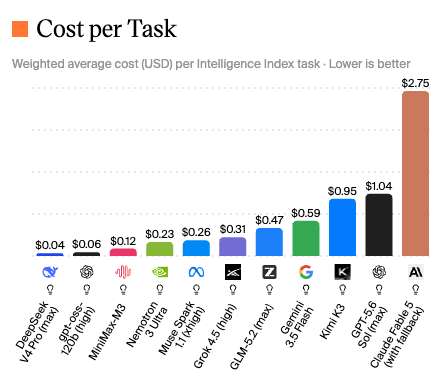
Figure 1: Model cost per completed task
While Anthropic retains the lead in model performance, its models are also incredibly expensive in relation to OpenAI or open models. As shown in Figure 1[6], Fable 5 is nearly 3× as expensive per completed task. It remains to be seen if users are willing to pay so much for the better model. Some researchers and founders expect a price war, either via competition[7] or because AI benchmarks that don't take price into account are becoming saturated and less helpful[8].
While Anthropic has invested in products like Claude Code or Cowork, its focus on harnesses is a risk. OpenCode, OpenClaw, Hermes, and numerous other harness startups are now innovating in this space. While the barrier to building a foundation model is very high, there's almost no barrier to launching your own AI harness.
This is where OpenAI has an advantage over Anthropic. While its models are trailing Anthropic's in recent months, its investments in product, consumer experience, site publishing, voice, and hardware are all directions that have clearer moats. The company is more open to investing in data center ownership and power generation. While some argue this causes OpenAI to lose focus, it'll make OpenAI more resilient in the long run; it has the flexibility and risk appetite to try and build products with network effects and moats, and to optimize for its long-run margin.
Anthropic faces a massive unbundling risk. Its models are the benchmark to beat, its products are increasingly challenged by closed and open source competitors, and its economic model puts it at a disadvantage. Barring regulatory intervention or actual AGI invention, Anthropic will likely struggle to retain its spot as the #1 foundation model vendor.
Kimi K3 was released on July 16[9]. Qwen 3.8 was announced on July 19[10]. GLM 5.2, another top-tier open model, was released in mid-June[11].
This is much larger than the “DeepSeek moment” of 2025 because it shows multiple labs can compete with and catch up to well-capitalized model vendors like Anthropic and OpenAI, not to mention Meta or SpaceX (i.e., Grok). It shows a sustained pattern of competition, catchup, and maybe even one day, outperformance… especially when cost considerations are incorporated into the mix.
More importantly, as sustainable long-term businesses, model-only providers are particularly at risk. Knowledge Atlas, Moonshot Labs, and Anthropic face defensibility challenges versus OpenAI, Alibaba, SpaceX, Meta, and Google.
Your company will decide what makes economical sense.
Sometimes you need speed; sometimes you need quality. There are very different use cases for each. For my own workflows, I sometimes want something very simple done ASAP; other workflows need "subjective" reasoning and careful crafting of responses.
So much money has been invested in Anthropic and OpenAI at this point that to declare it a loss and walk away could potentially destroy a lot of VC firms, and a non-trivial chunk of the US Economy.
People use these models for diff things.
Its quite possible for the things they are used for, people do not see much of a difference.
Do you hold stock in Anthropic?
Google's quality has gone to shit, but internet searching is still "googling", both in verbiage and in the actual service people use. It's not an impenetrable moat, but OpenAI would have to stumble pretty hard to lose all of that edge.
we'll get new quants, dspark speculators, distills and optimized kernels
as long as there are near frontier models available there will be inference providers selling them at or below cost of inference in attempt to get market share.
What about all the things you don't currently use an LLM for?
If a specialized chip can run a model 100 times faster, you can suddenly use it for a lot of things at sub-second latency. You can write "make white transparent and add a red outline to x.png" instead of the corresponding imagemagick invocation and perceive little to no latency difference. You can hook it up to your browser and have it yank out all advertisements live, or tell it to highlight anything that might interest you, again, live. There's probably thousands of latent use cases nobody has thought of that would be enabled by a truly fast LLM, even a mediocre one.
I don't think an on-device model needs to change much; it's already quite general in its capabilities.
A model will often come up with worse results given more cycles of compute, only because it will tailspin from second guesses, rethinking and literal flip-flopping on concepts.
--- edit: to those following the thread below... if you look at the comments from the account replying, it's pretty obviously a pro-China account and all replies are antagonistic against anything other than a total submission to the Chinese state. My responses are intentionally antagonistic as every point I've brought up is completely ignored in favor of insults, so yeah, I've been insulting back.
You can run a Moroccan chicken fragment on the cheap in homage to what you cannot run
I wish.
> Unnecessarily aggressive
> First ever comment said "Further releases of Chinese models that demonstrate the gap is not growing substantially is a huge problem. The spending will be called into question."
Yeah I think you have an agenda
I can't imagine why anyone would need almost 7x that.
There’s absolutely a place for a lifestyle subscription to a sonnet model that you could just use everywhere all the time.
The ability levels of the cheap models are encroaching on the abilities of the frontier models faster than frontier models are expanding their abilities. If we haven't already, we will very soon reach a "good enough" state where having the "best" model matters less and less and less.
By analogy, if you buy a new computer, do you get the absolute fastest CPU available? Maybe, depending on your workload. But if you're 90% of the population, you get the cheapest one that has enough power to meet your expected workload, which is mid-range, not top of the line.
Any value will come from the largest models, and those largest models are unlikely to ever run on consumer hardware within their window of relevancy.
Not to mention that US companies models constantly distill each other as Musk was forced to admit under oath. This whole narrative has just been a massive cope.
AI: "I'm sorry, a security guardrail prevents me from performing this operation."
are you american?
do you know how ROIC is calculated?
Good luck hiding your huge sunk cost of bilions and billions in there bro. I wish people who had zero understanding of actual finance would never comment about it.
Moreover if they declare their existing assets are bunk, the valuation is marked down, especially after now pricing in failure risk - this is catastrophic for VC's.
Again, bro, just be quiet.
But $200/day is very common in the business. The monthly plans are just a trial version of what's going to come for all of us. That's why I am very carefully looking into the open models today.
This is a very large model. Much larger (3x) than GLM. The resources to run it are very expensive.
Many of the responses seem to say "but there is a market for cheap models".
There is a world where we have cheap models and we don't have ASICs powering them. Things like TPUs and NPUs, which are programmable, are likely to fill that role. They are optimized for inference while also allowing different (and updated) models to run on them.
Given two companies competing on the cheap end. First company goes TPU, second goes ASIC: who wins? My bet is on TPU since they can update their model, even if their hardware is slightly more expensive and slightly slower, since the optionality of new models beats the performance gap. That may not hold forever but given the pace and volatility of the current LLM market, I believe it will hold for some time.
Small models are good enough depending on your task. That's the point. A model you can run on your phone or laptop is an incredibly useful tool for a lot of problems even though it isn't the "best" theoretically possible model.
> This whole narrative has just been a massive cope.
So wait, US AI companies all use distillation because... it's not effective and it's all just cope? Or is distillation really powerful and they all do it, which Musk was forced to admit under oath? But when China does distillation it isn't powerful and they don't need to do it, but they do it anyway because it's fun?
Either it's powerful and everyone, including the Chinese labs, use it as a way to rapidly catch-up against the SOTA models, or it's a red herring and the huge amounts of energy spent to protect and enable distillation is all just wasted money. Which is it?
And firms will be kept in check with financials.
If your competitor starts using chinese models and delivers better earnings whilst you are spending more on american ones... hahaaha. Wait and see what happens.
You will be FIRED!
Models like Kimi 3, GLM 5.2, or even Fable 5 for that matter are reasonable to burn to.ASIC because they are over the threshold of "good enough to be generally useful", something that will continue to be true in the future.
Most people do not need the latest model, they need a sufficient model. If I had Fable 5 on an ASIC, I imagine I would use that and ignore paying API rates for Fable 6.
Which is why my original post mentioned the volatility in models. We aren't just doing research on frontier, there is a huge amount of research on quantization, distillation, etc. that is changing the landscape at the low-end almost as much as it is changing on the frontier.
And it is also why I mention revealed preference. What feels sufficient / "good enough" today is a moving target. This isn't just a question of what you want, it is a question of what is economically viable for the entity that will be designing, manufacturing and marketing this ASIC of which you speak.
Both sides have extremely smart people. One side has more $$$ and exclusive access to the best chips. For progress to converge without a corresponding breakthrough suggests there's something else at work.
The US enjoyed an early advantage due to excessive money being poured into AI which led to the current bubble, and access to the hardware that was needed to train these models initially.
At this point, neither of these factors actually matter that much. The naive approach of simply making models bigger has hit a wall, and now you need ingenuity in figuring out better architecture for them. Precisely because Chinese companies have had to deal with more limited resources, they put a lot more effort into researching different kinds of optimizing techniques. And of course, China is also catching up in chip making, and Huawei clusters are already competitive with Nvidia for training. So, that gap is closing as well.
The big difference is that an absolutely insane amount of money has been spent in the US, while China managed to do this on a fraction of the budget. The AI Investment Surge graph here puts things in perspective. https://hai.stanford.edu/news/inside-the-ai-index-12-takeawa...
This is me personally. The calculus is different for other people. But I suspect Kimi 3 is pretty darn close to that tipping point for an awful lot of people.
The managers of the firm will.
They dont care that its faster unless it translates into the financials. They want lower costs, higher revenues - explain how it fits brudda.
If they designed this right, it means that once they have a model, so long as they keep the hyperparameters fixed they can change the weights much faster than it takes to spin up a completely new chip, essentially at a cost of doing a minor revision.